|
National Aeronautics and Space Administration
Infrared Astronomical Satellite IRAS Catalogs and Atlases Volume 4: The Point Source Catalog Declination Range 0 Degrees
National Aeronautics and Spa. 1988. Hardcover. UsedGood. Hardcover; Volume 4 only; NASA RP-1190; prepared under the auspices of the Joint IRAS Science Working Group; fading scuffing and shelf wear to exter ior; former owner's stamping on front endpaper; in good condition with clea n text firm binding. No dust jacket. . National Aeronautics and Spa hardcover
Bookseller reference : 97290
|
|
|
National Aeronautics and Space Administration
Infrared Astronomical Satellite IRAS Catalogs and Atlases Volume 3: The Point Source Catalog Declination Range 30 Degrees
National Aeronautics and Spa. 1988. Hardcover. UsedGood. Hardcover; Volume 3 only; NASA RP-1190; prepared under the auspices of the Joint IRAS Science Working Group; fading scuffing and shelf wear to exter ior; former owner's stamping on front endpaper; in good condition with clea n text firm binding. No dust jacket. . National Aeronautics and Spa hardcover
Bookseller reference : 97289
|
|
|
National Aeronautics and Space Administration
Infrared Astronomical Satellite IRAS Catalogs and Atlases Volume 6: The Point Source Catalog Declination Range -50 Degrees
National Aeronautics and Spa. 1988. Hardcover. UsedGood. Hardcover; Volume 6 only; NASA RP-1190; prepared under the auspices of the Joint IRAS Science Working Group; fading scuffing and shelf wear to exter ior; former owner's stamping on front endpaper; in good condition with clea n text firm binding. No dust jacket. . National Aeronautics and Spa hardcover
Bookseller reference : 97292
|
|
|
National Aeronautics and Space Administration
Infrared Astronomical Satellite IRAS Catalogs and Atlases Volume 2: The Point Source Catalog Declination Range 90 Degrees
National Aeronautics and Spa. 1988. Hardcover. UsedGood. Hardcover; Volume 2 only; NASA RP-1190; prepared under the auspices of the Joint IRAS Science Working Group; fading scuffing and shelf wear to exter ior; former owner's stamping on front endpaper; discolored spot to side pag e edge; in good condition with clean text firm binding. No dust jacket. . National Aeronautics and Spa hardcover
Bookseller reference : 97288
|
|
|
National Aeronautics and Space Administration
Infrared Astronomical Satellite IRAS Catalogs and Atlases Volume 5: The Point Source Catalog Declination Range -30 Degrees
National Aeronautics and Spa. 1988. Hardcover. UsedGood. Hardcover; Volume 5 only; NASA RP-1190; prepared under the auspices of the Joint IRAS Science Working Group; fading scuffing and shelf wear to exter ior; former owner's stamping on front endpaper; in good condition with clea n text firm binding. No dust jacket. . National Aeronautics and Spa hardcover
Bookseller reference : 97291
|
|
|
National Archives and Records Administration
Inland route Cheboygan to Conway SuDoc C 55.418/7:14886/997
Unknown Binding. Very Good. 3 great Michigan navigational chart books."1997 NOAA 14886 CHART. Inland Route- Cheboygan to Conway"; "Lake Charlevoix" & "Inland Route and Straits of Mackinac" unknown
Bookseller reference : H2-WASK-CIA4
|
|
|
National Aeronautics and Administration
Integrated In-Space Transportation Plan
like new. unknown
Bookseller reference : 23129277 ISBN : 1505568781 9781505568783
|
|
|
National Aeronautics and Administration
Integrated In-Space Transportation Plan
new. unknown
Bookseller reference : 23129277-n ISBN : 1505568781 9781505568783
|
|
|
National Aeronautics and Administration
Integrated In-Space Transportation Plan
Paperback / softback. New. paperback
Bookseller reference : A9781505568783 ISBN : 1505568781 9781505568783
|
|
|
National Aeronautics and Administration
Integrated In-Space Transportation Plan
Paperback / softback. New. paperback
Bookseller reference : B9781505568783 ISBN : 1505568781 9781505568783
|
|
|
National Aeronautics and Space Administration
International Space Station Benefits for Humanity 3rd Edition: NP-2018-06-013-JSC
Paperback. NEW/NEW. <br/> <br/> paperback
Bookseller reference : Pazz28161 ISBN : 9798326249925 9798326249
|
|
|
National Aeronautics and Administration
International VLBI Service for Geodesy and Astrometry 2010 General Meeting Proceedings: "VLBI2010: From Vision to Reality"
like new. unknown
Bookseller reference : 22246022 ISBN : 1503248917 9781503248915
|
|
|
National Aeronautics and Administration
International VLBI Service for Geodesy and Astrometry 2010 General Meeting Proceedings: "VLBI2010: From Vision to Reality"
new. unknown
Bookseller reference : 22246022-n ISBN : 1503248917 9781503248915
|
|
|
National Aeronautics and Administration
International VLBI Service for Geodesy and Astrometry 2010 General Meeting Proceedings: "VLBI2010: From Vision to Reality"
Paperback / softback. New. paperback
Bookseller reference : A9781503248915 ISBN : 1503248917 9781503248915
|
|
|
National Aeronautics and Space Administration
International Space Station Assembly NASA Graphic; LG-1999-09-522-HQ
Washington DC: National Aeronautics and Space Administration 1999. Presumed First Edition First printing. Presumed one of multiple originals produced. Single sheet printed on both sides. Very good. The format is approximately 8 inches by 10 inches. This is a single sheet with printing/imagery on both sides in a plastic sleeve. On the front side is a large color drawing of the International Space Station being assembled. Components from the United States Russia Japan Europe Canada Italy and Brazil are color coded. Items are captioned/tagged. The other side is in a three-column format with a small illustrations of the assembled International Space Station in the third column. The text discusses elements of the assembly process and that 'Further assembly will see the ISS completed as a premier research facility in space." The ISS was originally intended to be a laboratory observatory and factory while providing transportation maintenance and a low Earth orbit staging base for possible future missions to the Moon Mars and asteroids. However not all of the uses envisioned in the initial memorandum of understanding between NASA and Roscosmos have been realized. In the 2010 United States National Space Policy the ISS was given additional roles of serving commercial diplomatic and educational purposes. The International Space Station ISS is a large space station assembled and maintained in low Earth orbit by a collaboration of five space agencies and their contractors: NASA United States Roscosmos Russia JAXA Japan ESA Europe and CSA Canada. The ISS is the largest space station ever built. Its primary purpose is to perform microgravity and space environment experiments. Operationally the station is divided into two sections: the Russian Orbital Segment ROS assembled by Roscosmos and the US Orbital Segment USOS assembled by NASA JAXA ESA and CSA. A striking feature of the ISS is the Integrated Truss Structure which connects the large solar panels and radiators to the pressurized modules. The pressurized modules are specialized for research habitation storage spacecraft control and airlock functions. Visiting spacecraft dock at the station via its eight docking and berthing ports. The ISS maintains an orbit with an average altitude of 250 miles and circles the Earth in roughly 93 minutes completing 15.5 orbits per day. The ISS program combines two prior plans to construct crewed Earth-orbiting stations: Space Station Freedom planned by the United States and the Mir-2 station planned by the Soviet Union. The first ISS module was launched in 1998. Major modules have been launched by Proton and Soyuz rockets and by the Space Shuttle launch system. The first long-term residents Expedition 1 arrived on November 2 2000. Since then the station has been continuously occupied the longest continuous human presence in space. As of March 2024 279 individuals from 22 countries have visited the space station. The ISS is expected to have additional modules the Axiom Orbital Segment for example and will be in service until the end of 2030 after which it will be de-orbited by a dedicated NASA spacecraft. National Aeronautics and Space Administration unknown
Bookseller reference : 86156
|
|
|
National Astronautics and Space Administration
International Space Station NASA photograph; LG-2003-07-559-HQ
Washington DC: National Astronautics and Space Administration 2003. Presumed First Edition First printing. One of multiple originals issued. Single sheet printed on both sides. Very good. The format is approximately 8 inches by 10 inches. This is a single sheet with printing/imagery on both sides in a plastic sleeve. On the front side is a large color photograph of the International Space Station above the Earth wish sun gleaming off two of its solar panels. The other side is in a two column format with text on Why Have an International Space Station and Key NASA Web Sites. The graphic of the International Space Station has a number of specific features labeled. The ISS was originally intended to be a laboratory observatory and factory while providing transportation maintenance and a low Earth orbit staging base for possible future missions to the Moon Mars and asteroids. However not all of the uses envisioned in the initial memorandum of understanding between NASA and Roscosmos have been realized. In the 2010 United States National Space Policy the ISS was given additional roles of serving commercial diplomatic and educational purposes. The International Space Station ISS is a large space station assembled and maintained in low Earth orbit by a collaboration of five space agencies and their contractors: NASA United States Roscosmos Russia JAXA Japan ESA Europe and CSA Canada. The ISS is the largest space station ever built. Its primary purpose is to perform microgravity and space environment experiments. Operationally the station is divided into two sections: the Russian Orbital Segment ROS assembled by Roscosmos and the US Orbital Segment USOS assembled by NASA JAXA ESA and CSA. A striking feature of the ISS is the Integrated Truss Structure which connects the large solar panels and radiators to the pressurized modules. The pressurized modules are specialized for research habitation storage spacecraft control and airlock functions. Visiting spacecraft dock at the station via its eight docking and berthing ports. The ISS maintains an orbit with an average altitude of 250 miles and circles the Earth in roughly 93 minutes completing 15.5 orbits per day. The ISS program combines two prior plans to construct crewed Earth-orbiting stations: Space Station Freedom planned by the United States and the Mir-2 station planned by the Soviet Union. The first ISS module was launched in 1998. Major modules have been launched by Proton and Soyuz rockets and by the Space Shuttle launch system. The first long-term residents Expedition 1 arrived on November 2 2000. Since then the station has been continuously occupied the longest continuous human presence in space. As of March 2024 279 individuals from 22 countries have visited the space station. The ISS is expected to have additional modules the Axiom Orbital Segment for example and will be in service until the end of 2030 after which it will be de-orbited by a dedicated NASA spacecraft. National Astronautics and Space Administration unknown
Bookseller reference : 86157
|
|
|
National Aeronautics and Space Administration
International Space Station; Assembling A World-Class Orbiting Laboratory
Washington DC: National Aeronautics and Space Administration c2000. Presumed First Edition First printing. Pamphlet. Very good. Unpaginated 8 pages. Illustrations 8 pages. This is a NASA Fact Sheet. Each NASA center creates and updates Fact Sheets covering its mission facilities and projects. The ISS was originally intended to be a laboratory observatory and factory while providing transportation maintenance and a low Earth orbit staging base for possible future missions to the Moon Mars and asteroids. However not all of the uses envisioned in the initial memorandum of understanding between NASA and Roscosmos have been realized. In the 2010 United States National Space Policy the ISS was given additional roles of serving commercial diplomatic and educational purposes. This Fact Sheet was produced after Phase I was completed and presumably Phase 2 was on-going. The International Space Station ISS is the largest modular space station in low Earth orbit. The project involves five space agencies: the United States' NASA Russia's Roscosmos Japan's JAXA Europe's ESA and Canada's CSA. The ownership and use of the space station is established by intergovernmental treaties and agreements. The station serves as a microgravity and space environment research laboratory in which scientific research is conducted in astrobiology astronomy meteorology physics and other fields. The ISS is suited for testing the spacecraft systems and equipment required for possible future long-duration missions to the Moon and Mars. The ISS program evolved from the Space Station Freedom a 1984 American proposal conceived by Ronald Reagan to construct a permanently crewed Earth-orbiting station and the contemporaneous Soviet/Russian Mir-2 proposal from 1976 with similar aims. The ISS is the ninth space station to be inhabited by crews following the Soviet and later Russian Salyut Almaz and Mir stations and the American Skylab. It is the largest artificial object in the Solar System and the largest satellite in low Earth orbit regularly visible to the naked eye from Earth's surface. It maintains an orbit with an average altitude of 250 miles by means of reboost maneuvers using the engines of the Zvezda Service Module or visiting spacecraft. The ISS circles the Earth in roughly 93 minutes completing 15.5 orbits per day. The station is divided into two sections: the Russian Orbital Segment ROS is operated by Russia while the United States Orbital Segment USOS is run by the United States as well as other countries. The Russian segment includes six habitable modules. The US segment includes seven habitable modules whose support services are distributed 76.6% for NASA 12.8% for JAXA 8.3% for ESA and 2.3% for CSA. The length along the major axis of the pressurized sections is 218 ft and the total habitable volume of these sections is 13696 cu ft. National Aeronautics and Space Administration unknown
Bookseller reference : 86123
|
|
|
National Aeronautics and Administration
International VLBI Service for Geodesy and Astrometry 2010 General Meeting Proceedings: "VLBI2010: From Vision to Reality"
Paperback / softback. New. paperback
Bookseller reference : B9781503248915 ISBN : 1503248917 9781503248915
|
|
|
NATIONAL AERONAUTICS AND SPACE ADMINISTRATION HAMPTON VA LANGLEY RESEARCH CENTER
International Aerospace and Ground Conference on Lightning and Static Electricity: Technical Papers Held in Orlando Florida on 26-28 June 1984. Supplement
PN. New. 1984. Soft Cover. Date is original print. This is a reprint edition. . PN paperback
Bookseller reference : 773265
|
|
|
NATIONAL AERONAUTICS AND SPACE ADMINISTRATION WASHINGTON DC
International Space Station Research Plan Assembly Sequence Rev. F
PN. New. 2000. Soft Cover. Date is original print. This is a reprint edition . PN paperback
Bookseller reference : 1326582
|
|
|
National Aeronautics and Space Administration
International Programs
Washington DC: NASA 1973. Reprint Edition. good. 26 wraps xerox copy stapled in upper left corner illus. pencil erasure on index. This is intended to be a fact sheet for media editors. It includes the following statement--"Editors: This fact sheet contains information on NASA's international activities. It is suggested that it be retained in your files. " Cover is the Sortie Lab. Shown in the payload bay of the Space Shuttle Orbiter is a model of the Spacelab European designate of Sortie lab. NASA paperback
Bookseller reference : 41152
|
|
|
National Aeronautics and Administration
Interplanetary Mission Design Handbook Volume 1 Part 4: Earth to Saturn Ballistic Mission Opportunities 1985-2005
new. unknown
Bookseller reference : 22226667-n ISBN : 1503059766 9781503059764
|
|
|
National Aeronautics and Administration
Interplanetary Mission Design Handbook Volume 1 Part 4: Earth to Saturn Ballistic Mission Opportunities 1985-2005
like new. unknown
Bookseller reference : 22226667 ISBN : 1503059766 9781503059764
|
|
|
National Aeronautics and Administration
Interplanetary Mission Design Handbook Volume 1 Part 1: Earth to Venus Ballistic Mission Opportunities 1991-2005
new. unknown
Bookseller reference : 22226657-n ISBN : 1503059448 9781503059443
|
|
|
National Aeronautics and Administration
Interplanetary Mission Design Handbook Volume 1 Part 1: Earth to Venus Ballistic Mission Opportunities 1991-2005
like new. unknown
Bookseller reference : 22226657 ISBN : 1503059448 9781503059443
|
|
|
National Aeronautics and Administration
Interplanetary Mission Design Handbook: Earth-to-Mars Mission Opportunities and Mars-to-Earth Return Opportunities 2009-2024
Paperback / softback. New. paperback
Bookseller reference : A9781503059344 ISBN : 1503059340 9781503059344
|
|
|
National Aeronautics and Administration
Interplanetary Mission Design Handbook Volume 1 Part 4: Earth to Saturn Ballistic Mission Opportunities 1985-2005
Paperback / softback. New. paperback
Bookseller reference : A9781503059764 ISBN : 1503059766 9781503059764
|
|
|
National Aeronautics and Administration
Interplanetary Mission Design Handbook Volume 1 Part 1: Earth to Venus Ballistic Mission Opportunities 1991-2005
Paperback / softback. New. paperback
Bookseller reference : A9781503059443 ISBN : 1503059448 9781503059443
|
|
|
National Aeronautics and Administration
Interplanetary Mission Design Handbook Volume 1 Part 5: Mars-to-Earth Ballistic Mission Opportunities 1992-2007
Paperback / softback. New. paperback
Bookseller reference : B9781503059917 ISBN : 150305991x 9781503059917
|
|
|
National Aeronautics and Administration
Interplanetary Mission Design Handbook Volume 1 Part 1: Earth to Venus Ballistic Mission Opportunities 1991-2005
Paperback / softback. New. paperback
Bookseller reference : B9781503059443 ISBN : 1503059448 9781503059443
|
|
|
National Aeronautics and Administration
Interplanetary Mission Design Handbook: Earth-to-Mars Mission Opportunities and Mars-to-Earth Return Opportunities 2009-2024
Paperback / softback. New. paperback
Bookseller reference : B9781503059344 ISBN : 1503059340 9781503059344
|
|
|
National Aeronautics and Administration
Interplanetary Mission Design Handbook Volume 1 Part 2: Earth to Mars Ballistic Mission Opportunities 1990-2005
Paperback / softback. New. paperback
Bookseller reference : B9781503059641 ISBN : 1503059642 9781503059641
|
|
|
National Aeronautics and Administration
Interplanetary Mission Design Handbook: Earth-to-Mars Mission Opportunities 2026 to 2045
Paperback / softback. New. paperback
Bookseller reference : B9781503060012 ISBN : 1503060012 9781503060012
|
|
|
National Aeronautics and Space Administration (NASA) Space Program
Inventions of NASA: Patents from the Space Program
Paperback. NEW/NEW. <br/> <br/> paperback
Bookseller reference : Pazz145094 ISBN : 0990606198 9780990606192
|
|
|
National Aeronautics and Space Administration Jet Propulsion Laboratory
Jet Propulsion Laboratory
Pasadena CA: California Institute of Technology Jet Propulsion Laboratory 1982. Tailored compilation unknown number of these specific sets assembled. Folder with multiple inserts. Good. Scarce compilation of publications and 14 photographs. Folder is worn/torn and approximately 9 inches by 12 inches with impressive color space photographs on front and back. Inside there are two/pockets with text and inserts in each side. On the left side there is a pamphlet JPL Closeup approximately 8.5 inches by 8.5 inches. 16 pages plus covers. Illustrated. Dated 5/80. The second item is entitles Voyager at Saturn: 1981. It is approximately 8.5 inches by 11 inches. It has an illustration on the front cover. It is dated on the back as produced in 1981. It is 16 pages plus covers with illustrations some in color. On the right side is Voyager 1 Encounters Saturn JPL 400-100 dated 12/80. It is approximately 8.5 inches by 11 inches. It has 40 pages plus covers and is illustrated some in color. There are 6 8.5 inches by 11 inch color photographs with substantial text on the back of each. The Voyager Jupiter photographs are designated Voyager 1-47 P-21182 March 3 1979 Voyager 1-143 P-21457 March 3 1979 Voyager 1-149 P-21631 undated; Voyager 1-S-13 P-23058 November 6 1980 Voyager 1-S-54 P-23178 November 15 1980 and Voyager 1-S-82 P=23400 undated. There are 8 approximately 8 inch by 10 inch photographs 2 in black and white and six color. The Voyager Jupiter images are P-23876C August 13 1981 P-23912C/BW August 21 1981 P-23913C August 21 1981 P-23887C/BW August 24 1981 P-23922C August 24 1981 P-23927C August 25 1981 P-23932BW August 25 1981 and P-23933BW August 25 1981. Each image back has text taped to it. Folder with multiple inserts The Jet Propulsion Laboratory is a research development and flight center owned by the National Aeronautics and Space Administration and operated by the California Institute of Technology. JPL's primary responsibility is the investigation of the solar system with automated scientific spacecraft. The Laboratory's activities however are not limited to space exploration. The basic research and development in support of space exploration involves a broad spectrum of scientific and engineering disciplines; the resulting technological and managerial capabilities are finding increasing application to medical and environmental problems on earth especially in the area of solar energy research. To provide spacecraft tracking and communications for deep-space missions JPL designed developed and manages the Deep Space Network DSN with stations in California Spain and Australia. The twin Voyager 1 and 2 spacecraft are exploring where nothing from Earth has flown before. Continuing on their more-than-40-year journey since their 1977 launches they each are much farther away from Earth and the sun than Pluto. In August 2012 Voyager 1 made the historic entry into interstellar space the region between stars filled with material ejected by the death of nearby stars millions of years ago. Voyager 2 entered interstellar space on November 5 2018 and scientists hope to learn more about this region. Both spacecraft are still sending scientific information about their surroundings through the Deep Space Network or DSN. The primary mission was the exploration of Jupiter and Saturn. After making a string of discoveries there — such as active volcanoes on Jupiter's moon Io and intricacies of Saturn's rings — the mission was extended. California Institute of Technology, Jet Propulsion Laboratory unknown
Bookseller reference : 81051
|
|
|
National Aeronautics and Space Administration, Kennedy Space Center
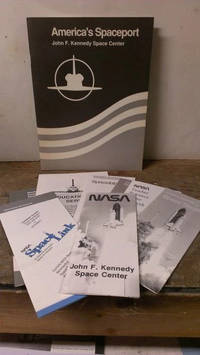
John F. Kennedy Space Center: America's Spaceport
NASA Cape Canaveral FL 1970T. paperback. Very Good. in x in x in. 1991 Edition With Assorted Pamphlets. Could pass as new but is not No obvious damage to the cover or dust jacket Pages are clean without writing or markings of any kind. May have name or inscription inside cover Email with questions STOCK PHOTOS MAY VARY FROM THE ACTUAL ITEM. ACTUAL PHOTOS AVAIL. UPON REQUEST. NASA, Cape Canaveral, FL paperback
Bookseller reference : 4ZF000000KBE
|
|
|
National Aeronautics & Space Administration
JOHN F. KENNEDY SPACE CENTER. Souvenir folder
National Aeronautics & Space Administration 1968. Pamphlet. Used - Good. Printed folder 11.5 x 9" 2 pockets 7 booklets & leaflets: Public Welcome Saturn V America's Spaceport Launch Complex Facilities Fact Sheets for July & November 1966 March 1968 NASA Facts 33 Vol. IV No. 5 Saturn V. Illustrated. Rubbed toned G. National Aeronautics & Space Administration unknown
Bookseller reference : 44455
|
|
|
National Aeronautics and Space Administration Kennedy Space Center
John F. Kennedy Space Center: America's Spaceport
Cape Canaveral FL: NASA 1970. good. 24 wraps illus. map figure covers somewhat worn and soiled pencil erasure to top corner page 1. A guide for visitors to the Kennedy Space Center. Topics covered include mission launch vehicles manned space flight Project Mercury Project Gemini Project Apollo satellites and space probes Launch Complex 39 theKennedy Space Center Industrial Area Cape Kennedy facilities the human element private industry and facts and figures. Kurt H. Debus was Director of the John F. Kennedy Space Center when this guide was published. NASA paperback
Bookseller reference : 36247
|
|
|
National Aeronautics and Space Administration (NASA) and Jet Propulsion Laboratory, California Institute of Technology
JPL Fact Sheet: Voyager 2 At Uranus
Pasadena CA: NASA and JPL 1985. Book. Fine. Soft cover. 1st Edition. 4to - over 9¾" - 12" tall. An upper-left stapled publication in newsletter format dated April 14 1985 measuring 8-1/2" by 11" and containing seven sheets printed on one side front cover and six pages of text. NASA and JPL Paperback
Bookseller reference : 005714
|
|
|
National Aeronautics and Space Administration
JSC Safety and Health Handbook: JPR No.: 1700.1K
Independently published 2018. Paperback. New. 418 pages. 11.00x8.50x0.95 inches. Independently published paperback
Bookseller reference : 2-1730998895 ISBN : 1730998895 9781730998898
|
|
|
National Aeronautics and Space Administration
JSC Safety and Health Handbook: JPR No.: 1700.1K
Independently published 2018. Paperback. New. 301 pages. 11.00x8.50x0.68 inches. Independently published paperback
Bookseller reference : 2-1730970745 ISBN : 1730970745 9781730970740
|
|
|
National Aeronautics and Space Administration
Juno Launch; Press Kit August 2011
Washington DC: National Aeronautics and Space Administration 2011. Xerox-style reproduction. Presumed to be one of only a few copies made for media representatives. Stapled at upper left corner. Very good. 25 1 pages. Illustrations. Contents include Media Services Information; Quick Facts; Jupiter at a Glance; Why Juno; Mission Overview; Mission Phases; Spacecraft; Science Overview; Missions to Jupiter; and Program/Project Management. Juno is a NASA space probe orbiting the planet Jupiter. It was built by Lockheed Martin and is operated by NASA's Jet Propulsion Laboratory. The spacecraft was launched from Cape Canaveral Air Force Station on August 5 2011 UTC as part of the New Frontiers program. Juno entered a polar orbit of Jupiter on July 5 2016 UTC to begin a scientific investigation of the planet. After completing its mission Juno will be intentionally deorbited into Jupiter's atmosphere. Juno's mission is to measure Jupiter's composition gravitational field magnetic field and polar magnetosphere. It will also search for clues about how the planet formed including whether it has a rocky core the amount of water present within the deep atmosphere mass distribution and its deep winds which can reach speeds up to 390 mph. Juno is the second spacecraft to orbit Jupiter after the nuclear powered Galileo orbiter which orbited from 1995 to 2003. Juno is powered by solar panels commonly used by satellites orbiting Earth and working in the inner Solar System whereas radioisotope thermoelectric generators are commonly used for missions to the outer Solar System and beyond. For Juno however the three largest solar panel wings ever deployed on a planetary probe play an integral role in stabilizing the spacecraft as well as generating power. During the science mission infrared and microwave instruments will measure the thermal radiation emanating from deep within Jupiter's atmosphere. These observations will complement previous studies of its composition by assessing the abundance and distribution of water and therefore oxygen. This data will provide insight into Jupiter's origins. Juno will also investigate the convection that drives natural circulation patterns in Jupiter's atmosphere. Other instruments aboard Juno will gather data about its gravitational field and polar magnetosphere. The Juno mission was planned to conclude in February 2018 after completing 37 orbits of Jupiter but now has been commissioned through 2025 to do a further 42 additional orbits of Jupiter as well as close flybys of Ganymede Europa and Io. The probe was then intended to be deorbited and burnt up in Jupiter's outer atmosphere to avoid any possibility of impact and biological contamination of one of its moons. The Juno spacecraft's suite of science instruments will: Determine the ratio of oxygen to hydrogen effectively measuring the abundance of water in Jupiter which will help distinguish among prevailing theories linking Jupiter's formation to the Solar System; Obtain a better estimate of Jupiter's core mass which will also help distinguish among prevailing theories linking Jupiter's formation to the Solar System; Precisely map Jupiter's gravitational field to assess the distribution of mass in Jupiter's interior including properties of its structure and dynamics; Precisely map Jupiter's magnetic field to assess the origin and structure of the field and the depth at which the planet's magnetic field is created. This experiment will also help scientists understand the fundamental physics of dynamo theory; Map the variation in atmospheric composition temperature structure cloud opacity and dynamics to pressures far greater than 100 bar 10 MPa; 1500 psi at all latitudes; Characterize and explore the three-dimensional structure of Jupiter's polar magnetosphere and auroras; and Measure the orbital frame-dragging known also as Lense-Thirring precession caused by the angular momentum of Jupiter and possibly a new test of general relativity effects connected with the Jovian rotation. National Aeronautics and Space Administration unknown
Bookseller reference : 86129
|
|
|
National Aeronautics and Space Administration
KC-135 and Other Microgravity Simulations
paperback. Good. Access codes and supplements are not guaranteed with used items. May be an ex-library book. paperback
Bookseller reference : 1502416034.G ISBN : 1502416034 9781502416032
|
|
|
National Aeronautics and Space Administration Kennedy Space Center
Kennedy Space Center Annual Report FY2002; Forty Years Pioneering The Future
Kennedy Space Center FL: National Aeronautics and Space Administration Kennedy Space Center 2003. Presumed First Edition First printing. Wraps. Very good. The format is approximately 8.5 inches by 11 inches. 61 3 pages plus covers. Illustrated covers. Illustrations most in color. Contents include Center Director's Message; NASA Vision and Mission; KSC Goals and Principles; The President's Management Agenca; Significant Events; Expendable Launch Vehicle Program; Space Shuttle Program; Shuttle Upgrades; International Space Station and Shuttle Payload Processing; Payload Carriers Program; Spaceport and Range Technologies; Future Vehicles; Safety and Health First; Environmental Stewardship; Partnerships; Outreach to the World; Education; KSC Business Report; Economic Impact; Workforce Diversity; Procurement Report; and Financial Statement. The John F. Kennedy Space Center KSC originally known as the NASA Launch Operations Center located on Merritt Island Florida is one of the National Aeronautics and Space Administration's NASA ten field centers. Since December 1968 KSC has been NASA's primary launch center of human spaceflight. Launch operations for the Apollo Skylab and Space Shuttle programs were carried out from Kennedy Space Center Launch Complex 39 and managed by KSC. Located on the east coast of Florida KSC is adjacent to Cape Canaveral Space Force Station CCSFS. The management of the two entities work very closely together share resources and operate facilities on each other's property. Though the first Apollo flights and all Project Mercury and Project Gemini flights took off from the then-Cape Canaveral Air Force Station the launches were managed by KSC and its previous organization the Launch Operations Directorate. Starting with the fourth Gemini mission the NASA launch control center in Florida Mercury Control Center later the Launch Control Center began handing off control of the vehicle to the Mission Control Center in Houston shortly after liftoff; in prior missions it held control throughout the entire mission. Additionally the center manages launch of robotic and commercial crew missions and researches food production and in-situ resource utilization for off-Earth exploration. Since 2010 the center has worked to become a multi-user spaceport through industry partnerships even adding a new launch pad LC-39C in 2015. There are about 700 facilities and buildings grouped throughout the center's 144000 acres. Among the unique facilities at KSC are the 525-foot tall Vehicle Assembly Building for stacking NASA's largest rockets the Launch Control Center which conducts space launches at KSC the Operations and Checkout Building which houses the astronauts dormitories and suit-up area a Space Station factory and a 3-mile long Shuttle Landing Facility. There is also a Visitor Complex on site that is open to the public. National Aeronautics and Space Administration, Kennedy Space Center paperback
Bookseller reference : 86119
|
|
|
National Aeronautics and Space Administration
KENNEDY SPACE CENTER STORY
NASA. Collectible - Good. Kennedy Space Center FL: National Aeronautics and Space Administration 1972. Sm 4to paperback. 286pp. B/W photos throughout. Good book. Typical shelfwear moderate toning and creasing to spine. Tom Crouch's name inked to table of contents. From the library of American aeronautics author historian and curator Tom D. Crouch. space flight space flight aeronautics astronaut apollo Inquire if you need further information. NASA paperback
Bookseller reference : MA04B-01220
|
|
|
National Aeronautics and Space Administration John F. Kennedy Space Center
Kennedy Space Center Featuring Visitors Center Hall of History & Guided Bus Tours: Official Souvenir Book
Orlando FL: Kennedy Space Center 1981. Revised Edition. very good. Quarto 32 wraps profusely illus. in color chart slight wear to cover edges. Kennedy Space Center paperback
Bookseller reference : 11161
|
|
|
National Aeronautics and Space Administration
Kennedy Space Center Souvenir Booklet Featuring the Visitors Information Center and the Guided Tour Map
Orlando FL: NASA c. 1973. fair to good. 24 wraps profusely illus. in color map chronology covers somewhat creased spine worn. NASA paperback
Bookseller reference : 6735
|
|
|
National Aeronautics and Space Administration
Kepler: NASA's First Mission Capable of Finding Earth-Size Planets; Press Kit February 2009
Washington DC: National Aeronautics and Space Administration 2009. Presumed First Edition First printing. Comb binding. Very good. 31 3 pages including covers. Contents include Media Services Information; Quick Facts; NASA's Search for Habitable Planets; Scientific Goals and Objectives; Mission Overview; Spacecraft; Instrument - Photometer; Selecting the Kepler Star Field; Education and Public Outreach; Other Exoplanet Activities; Science Team; and Project Management. The Kepler space telescope is a disused space telescope launched by NASA in 2009 to discover Earth-sized planets orbiting other stars. Named after astronomer Johannes Kepler the spacecraft was launched into an Earth-trailing heliocentric orbit. The principal investigator was William J. Borucki. After nine and a half years of operation the telescope's reaction control system fuel was depleted and NASA announced its retirement on October 30 2018.<br /> Designed to survey a portion of Earth's region of the Milky Way to discover Earth-size exoplanets in or near habitable zones and estimate how many of the billions of stars in the Milky Way have such planets Kepler's sole scientific instrument is a photometer that continually monitored the brightness of approximately 150000 main sequence stars in a fixed field of view. These data were transmitted to Earth then analyzed to detect periodic dimming caused by exoplanets that cross in front of their host star. Only planets whose orbits are seen edge-on from Earth could be detected. Kepler observed 530506 stars and detected 2778 confirmed planets as of June 16 2023. By January 2015 Kepler and its follow-up observations had found 1013 confirmed exoplanets in about 440 star systems along with a further 3199 unconfirmed planet candidates. Four planets have been confirmed through Kepler's K2 mission. In November 2013 astronomers estimated based on Kepler space mission data that there could be as many as 40 billion rocky Earth-size exoplanets orbiting in the habitable zones of Sun-like stars and red dwarfs within the Milky Way. It is estimated that 11 billion of these planets may be orbiting Sun-like stars. The nearest such planet may be 3.7 parsecs 12 ly away according to the scientists. On January 6 2015 NASA announced the 1000th confirmed exoplanet discovered by the Kepler space telescope. Four of the newly confirmed exoplanets were found to orbit within habitable zones of their related stars: three of the four Kepler-438b Kepler-442b and Kepler-452b are almost Earth-size and likely rocky; the fourth Kepler-440b is a super-Earth. On May 10 2016 NASA verified 1284 new exoplanets found by Kepler the single largest finding of planets to date. Kepler data has also helped scientists observe and understand supernovae; measurements were collected every half-hour so the light curves were especially useful for studying these types of astronomical events. National Aeronautics and Space Administration unknown
Bookseller reference : 86131
|
|
|
NATIONAL AERONAUTICS AND SPACE ADMINISTRATION COCOA BEACH FL JOHN F KENNEDY SPACE CENTER
KSC and Space-Related Area Attractions
PN. New. 1997. Soft Cover. Date is original print. This is a reprint edition . PN paperback
Bookseller reference : 296188
|
|
|
National Astronautics and Space Administration Kennedy Space Center
Landing the Space Shuttle Orbiter; NASA Facts FS-2005-08-028-KSC
Kennedy Space Center FL: National Astronautics and Space Administration Kennedy Space Center 2005. Presumed First Edition may be a reprint since illustrations are in black and white. Staplebound. Very good. The format is approximately 8.5 inches by 11 inches. 8 pages. Illustrations. Maps. Kennedy is the primary end-of-mission landing site for the shuttle orbiter. An alternate site is Edwards Air Force Base EAFB in California. The Space Shuttle Program began with landings at EAFB because the site offered more stable and predictable weather conditions and a diverse choice of concrete and spacious dry lake bed runways. But landing the orbiter at KSC's Shuttle Landing Facility is preferred because it saves about five days of processing time for its next mission. A KSC landing also eliminates exposing the orbiter a national resource to the uncertainties and potential dangers of a cross-country ferry trip atop one of NASA's two modified Boeing 747 Shuttle Carrier Aircraft. Unlike launches for which a "go" for lift off can be given within minutes of changing weather conditions during the launch window a change in the landing site must be chosen up to 90 minutes prior to landing. From 1981 through February 2003 there were 113 Shuttle missions: 61 landed at Kennedy 49 at EAFB and one at the Northrup Strip in New Mexico. The Space Shuttle Challenger on Mission STS 51-L in 1986 was destroyed in an accident shortly after liftoff . The Shuttle Columbia was destroyed over Texas in 2003 as it was making its landing approach. An array of visual aids as well as sophisticated guidance equipment at the Shuttle Landing Facility help guide the orbiter to a safe landing. The Tactical Air Navigation TACAN system on the ground provides range and bearing measurements to the orbiter when the vehicle is at an altitude of up to 145000 feet. The Microwave Scanning Beam Landing System MSBLS provides more precise guidance signals on slant range azimuth and elevation when the orbiter gets closer — up to 18000 to 20000 feet. Both TACAN and MSBLS are automatic systems that update the orbiter's onboard navigation systems. The MSBLS also provides an autoland capability that can electronically acquire and guide the orbiter to a completely "hands off " landing. So far shuttle mission commanders have taken control of the orbiter for all final approach and landing maneuvers during subsonic flight usually about 22 miles from the touchdown point. The initial landing approach at a glide slope of 20 degrees is more than six times steeper than the 3-degree slope of a typical commercial jet airliner as it approaches landing. Two series of lights help pilots determine the correct approach. The Precision Approach Path Indicator PAPI lights are an electronic visual system that shows pilots if they are on the correct outer glide slope. PAPI lights are used at airports all over the world but these have been modified for the unique configuration of the orbiter. A set of PAPI lights are at 7500 feet and another at 6500 feet to delineate an outer glide slope of between 18 and 20 degrees. The Ball-Bar Light System is a visual reference to provide inner glide slope information. The bar lights are 24 red lamps in horizontal sets of four each. They are 2200 feet from the runway threshold and 300 feet from the first nominal touchdown point. Five hundred feet closer to the runway threshold are three white lights — the ball — at a higher elevation. If the orbiter is above the glide slope of 1.5 degrees the white PAPI lights will appear to be below the bar of red lights. If the vehicle is below the glide slope white lights will appear to be above the red lights. If the red and white lights are superimposed the orbiter is on the correct glide slope. Lighted distance markers show the crew the distance remaining to the end of the runway during landing and rollout. Just before touchdown a flare or a pull-up maneuver brings the orbiter into its final landing configuration. Touchdown nominally is 2500 to 2700 feet beyond the runway threshold. For night lights the SLF has 16 powerful xenon lights each of which produces up to 1 billion candlepower 1 billion candela. Flatbed trailers hold eight lights in two groups of four at each end of the runway. To avoid blinding the crew workers only turn on the lights at the end of the runway that will be behind the orbiter at landing. National Astronautics and Space Administration, Kennedy Space Center unknown
Bookseller reference : 86095
|
|

 Receive by email
 Download as PDF document
 RSS feed
 Permanent link


