|
Marx, Karl
Kapital Karla Marksa. In Russian /Karl Marx's Capital
"Short description: In Russian. Marx, Karl. Karl Marx's Capital. Rostov; Krasnodar: Burevestnik, 1924. You are welcome to reach out to us for a detailed description of the copies currently available. Delivery of this book may take longer than usual including extended processing and pre-shipping time, no expedited shipping is available. Please advise us if you have a set date or a deadline to receive your order.SKU9116810"
Referenz des Buchhändlers : 9116810

|
|
|
Marx, Karl
Kapital und Politik
Verlag Zweitausendeins Frankfurt am Main 2008. 1354 S. kartonierter Einband. unknown
Referenz des Buchhändlers : 2e7863 ISBN : 3861508699 9783861508694

|
|
|
Marx, Karl
Kapital und Politik
Zweitausendeins Frankfurt am Main 2008 1354 Seiten kartoniert. - neuwertig/original verlagsfrisch verschweißt - unknown
Referenz des Buchhändlers : 8681a ISBN : 3861508699 9783861508694

|
|
|
Marx, Karl
Kapital. In Russian /Capital
Short description: In Russian. Marx Karl. Capital. Moscow: Publishing House of the Central Committee of the All-Union Communist Party b 1934. The image is provided for reference only. It may reflect condition of one of the available copies or only help in identifying the edition. Please feel free to contact us for a detailed description of the copies available. SKU8986851 unknown
Referenz des Buchhändlers : 8986851
|
|
|
Marx, Karl
Kapital. In Russian /Capital
Short description: In Russian. Marx Karl. Capital. Moscow: State Publishing House of Political Litas 1952. The image is provided for reference only. It may reflect condition of one of the available copies or only help in identifying the edition. Please feel free to contact us for a detailed description of the copies available. SKU5836321 unknown
Referenz des Buchhändlers : 5836321

|
|
|
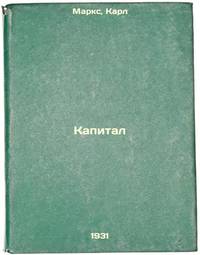
Marx, Karl
Kapital. In Russian /Capital
Short description: In Russian. Marx Karl. Capital. Moscow; Leningrad: Ogiz - State Economic and Social Publishing House 1931. The image is provided for reference only. It may reflect condition of one of the available copies or only help in identifying the edition. Please feel free to contact us for a detailed description of the copies available. SKU9306739 unknown
Referenz des Buchhändlers : 9306739
|
|
|
Marx, Karl
Kapital. In Russian /Capital
Short description: In Russian. Marx, Karl. Capital. Moscow: Publishing House of the Central Committee of the All-Union Communist Party (b), 1934. You are welcome to reach out to us for a detailed description of the copies currently available. Delivery of this book may take longer than usual including extended processing and pre-shipping time, no expedited shipping is available. Please advise us if you have a set date or a deadline to receive your order.SKU8986851
Referenz des Buchhändlers : 8986851

|
|
|
Marx, Karl
Kapital. In Russian /Capital
Short description: In Russian. Marx, Karl. Capital. Moscow: State Publishing House of Political Litas, 1952. You are welcome to reach out to us for a detailed description of the copies currently available. Delivery of this book may take longer than usual including extended processing and pre-shipping time, no expedited shipping is available. Please advise us if you have a set date or a deadline to receive your order.SKU5836321
Referenz des Buchhändlers : 5836321

|
|
|
Marx, Karl
Kapital. In Russian /Capital
"Short description: In Russian. Marx, Karl. Capital. Moscow; Leningrad: Ogiz - State Economic and Social Publishing House, 1931. You are welcome to reach out to us for a detailed description of the copies currently available. Delivery of this book may take longer than usual including extended processing and pre-shipping time, no expedited shipping is available. Please advise us if you have a set date or a deadline to receive your order.SKU9306739"
Referenz des Buchhändlers : 9306739

|
|
|
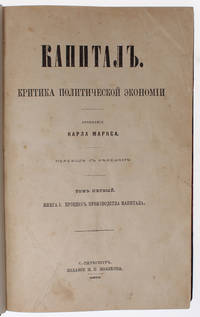
MARX, KARL.
Kapital. Kritika politicheskoj ekonomii. Perevod c nmetskago. Tom pervoej. Kniga I. Protschess proizvodstva Kapitala. Russian = The Capital. Critique of the Political Economy. Translated from German. Volume One. Book I all. - FIRST TRANSLATION INTO ANY LANGUAGE OF "THE BIBLE OF MARXISM"
S.-Peterburg N.I. Poliakov 1872. Large 8vo. In a nice recent half calf binding with gilt lettering to spine and five raised bands. First few leaves with light soling and a closed tear and a few marginal repairs to title-page. pp. 11-18 with repairs to upper outer corner. Closed tears to last leaf otherwise a fine copy. XIII 3 678 pp. wanting the half-title. <br/><br/><em>First Russian edition first issue with the issue-pointers being the first translation into any language of Marx' immensely influential main work probably the greatest revolutionary work of the nineteenth century.Marx' groundbreaking "Das Kapital" originally appeared in German in 1867 and only the first part of the work appeared in Marx' lifetime. The very first foreign translation of the work was that into Russian which considering Russian censorship at the time would seem a very unlikely event. But as it happened "Das Kapital" actually came to enjoy greater renown in Russia than in any other country; for many varying reasons it won a warm reception in many political quarters in Russia and it enjoyed a totally unexpected rapid and widespread success. The first Russian translation of "Das Kapital" came to have a profound influence the economic development of of Russia. It was frequently quoted in the most important economic and political discussions on how to industrialize Russia and the essential points of the work were seen by many as the essential questions for an industrializing Russia. " "Das Kapital" arrived in Russia just at the moment that the Russian economy was recovering from the slump that followed Emancipation and was beginning to assume capitalist characteristics. Industrialization raised in the minds of the intelligentsia the question of their country's economic destiny. And it was precisely this concern that drew Mikhailovsky and many of the "intelligenty" to "Das Kapital"." Resis p. 232.The story of how the first printing of the first translation of "Das Kapital" came about is quite unexpected. As the "triumph of Marxism in backward Russia is commonly regarded as a historical anomaly" Resis p. 221 so is the triumph of the first Russian edition of "Das Kapital". The main credit for the coming to be of the translation of "Das Kapital" must be given to Nicolai Danielson later a highly important economist in his own right. The idea came from a circle of revolutionary youths in St. Petersburg including N.F. Danielson G.A. Lopatin M.F. Negreskul and N.N. Liubavin all four of whom participated in the project. Danielson had read the work shortly after its publication and it had made such an impact on him that he decided to make it available to the Russian reading public. He persuaded N.I. Poliakov to run the risk of publishing it. "Poliakov the publisher specialized in publishing authors Russian and foreign considered dangerous by the authorities. Poliakov also frequently subsidized revolutionaries by commissioning them to do translations for his publishing house. Diffusion of advanced ideas rather than profit was no doubt his primary motive in publishing the book." Resis p. 222. Owing to Danielson's initiative Poliakov engaged first Bakunin and then Lopatin to do the translation. Danielson himself finished the translation and saw the work through press. It was undeniably his leadership that brought Marx to the Russian reading public. In fact with the first Russian edition of "Das Kapital" Danielson was responsible for the first public success of the revolutionizing work. "Few scholars today would deny that "Das Kapital" has had an enormous effect on history in the past hundred years. Nonetheless when the book was published in Hamburg on September 5 1867 it made scarcely a stir except among German revolutionaries. Marx complained that his work was greeted by "a conspiracy of silence" on the part of "a pack of liberals and vulgar economists." However desperately he contrived to provoke established economists to take up "Das Kapital"'s challenge to their work his efforts came to nought. But in October 1868 Marx received good news from an unexpected source. From Nikolai Frantsevich Danielson a young economist employed by the St. Petersburg Mutual Credit Society came a letter informing Marx that N. P. Poliakov a publisher of that city desired to publish a Russian translation of the first volume of "Das Kapital"; moreover he also wanted to publish the forthcoming second volume. Danielson the publisher's representative requested that Marx send him the proofs of volume 2 as they came off the press so that Poliakov could publish both volumes simultaneously. Marx replied immediately. The publication of a Russian edition of volume 1 he wrote should not be held up because the completion of volume 2 might be delayed by some six months in fact it did not appear in Marx' life-time and was only published ab. 17 years later in 1885; and in any case volume 1 represented an independent whole. Danielson proceeded at once to set the project in motion. Nearly four years passed however before a Russian translation appeared. Indeed a year passed before the translation was even begun and four translators tried their hand at it before Danielson was able to send the manuscript to the printers in late December 1871." Resis pp. 221-22. This explains how the book came to be translated but how did this main work of revolutionary thought escape the rigid Russian censors "By an odd quirk of history the first foreign translation of "Das Kapital" to appear was the Russian which Petersburgers found in their bookshops early in April 1872. Giving his imprimatur the censor one Skuratov had written "few people in Russia will read it and still fewer will understand it." He was wrong: the edition of three thousand sold out quickly; and in 1880 Marx was writing to his friend F.A. Sorge that "our success is still greater in Russia where "Kapital" is read and appreciated more than anywhere else." PMM 359 p.218. Astonishingly Within six weeks of the publication date nine hundred copies of the edition of three thousand had already been sold."Under the new laws on the press "Das Kapital" could have been proscribed on any number of grounds. The Temporary Rules held for example that censorship must not permit publication of works that "expound the harmful doctrines of socialism or communism" or works that "rouse enmity and hatred of one class for another." The Board of Censors of Foreign Publications was specifically instructed to prohibit importation of works contrary to the tenets of the Orthodox Church or works that led to atheism materialism or disrespect for Scriptures. Nor did the recent fate of the works of Marx and Engels at the hands of the censors offer much hope that "Das Kapital" would pass censorship. As recently as August 11 the censors of foreign works had decided to ban importation of Engels' "Die Lage der arbeitenden Klassen in England" and according to Lopatin the censors reprimanded Poliakov for daring to run announcements on book jackets of the forthcoming publication of "Das Kapital". By 1872 the censors had prohibited the importation and circulation of all works by Marx and Engels except one - "Das Kapital". The book as we shall see had already won some recognition in Russia shortly after its publication in Germany. Not until 1871 however did the censors render a judgment on the book when the Central Committee of Censors of Foreign Publications on the recommendation of its reader permitted importation and circulation of the book both in the original language and in translation. The official reader had described the book as "a difficult inaccessible strictly scientific work" implying that it could scarcely pose a danger to the state. . The length and complexity of the book prompted the office to divide the task of scrutinizing it between two readers D. Skuratov who read the first half of the book and A. De-Roberti who read the last half. Skuratov dutifully listed objectionable socialist and antireligious passages taking special note of Marx's harsh attack on the land reforms General Kiselev had instituted in the Danubian Principalities. But in his report Skuratov dismissed these attacks as harmless since they were imbedded in a "colossal mass of abstruse somewhat obscure politico-economic argumentation." Indeed he regarded the work as its own best antidote to sedition. "It can be confidently stated" he wrote "that in Russia few will read it and even fewer will understand it." Second he said the book could do little harm. Since the book attacked a system rather than individual persons Skuratov implied that the book would not incite acts threatening the safety of the royal family and government officials. Third he believed that the argument of the book did not apply to Russia. Marx attacked the unbridled competition practiced in the British factory system and such attacks Skuratov asserted could find no target in Russia because the tsarist regime did not pursue a policy of laissez faire. Indeed at that very moment Skuratov stated a special commission had drafted a plan that "as zealously protects the workers' well-being from abuses on the part of the employers as it protects the employers' interests against lack of discipline and nonfulfillment of obligations on the part of the workers." Repeating most of Skuratov's views De-Roberti also noted that the book contained a good account of the impact of the factory system and the system of unpaid labor time that prevailed in the West. In spite of the obvious socialist tendency of the book he concluded a court case could scarcely be made against it because the censors of foreign works had already agreed to permit importation and circulation of the German edition. With the last barrier removed on March 27 1872 the Russian translation of "Das Kapital" went on sale in the Russian Empire. The publisher translators and advocates of the book had persevered in the project for nearly four years until they were finally able to bring the book to the Russian reading public." Resis pp. 220-22. The Russian authorities quickly realized however that Skuratov's statement could not have been more wrong and the planned second edition of the Russian translation was forbidden; thus it came to be published in New York in 1890. That second edition is nearly identical to the first which can be distinguished by the misplaced comma opposite "p. 73" in the table of contents replaced by a full stop in the 2nd ed. and the "e" at the end of l. 40 on p. 65 replaced by a "c" in the 2nd ed. A third edition translated from the fourth German edition appeared in 1898. Volumes 2 and 3 of "Das Kapital" appeared in Russian translation also by Danielson in 1885 and 1896.See: Albert Resis Das Kapital Comes to Russia in: Slavic Review Vol. 29 No. 2 Jun. 1970 pp. 219-237. </em> hardcover
Referenz des Buchhändlers : 60281
|
|
|
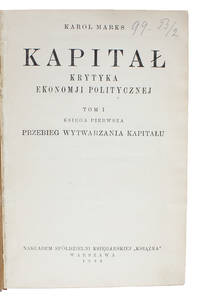
MARX, KARL.
Kapital. Krytyka ekonomji politycznej. Tom I. Ksiega pierwsza. Przebieg wytwarzani kapitalu.
Warszawa Warsaw Nakladem Spóldzielni Ksiegarskiej "Ksiazka" 1933 1926 printed on title-page Large8vo. In contemporary full blind-stamped cloth. Wear to extremities. Hindges a bit weak. 4 XXXVII 1 5-905 5 pp. <br/><br/><em>Rare second Polish translation of Marx's Das Kapital. This edition is a new translation by the collective of Henryk Lauer Ludwik Selen Mieczyslaw Kwiatkowski Jerzy Heryng. The planned second volume was never published.OCLC list no copies outside Poland. </em> hardcover
Referenz des Buchhändlers : 57816
|
|
|
MARX, KARL.
Kapital. Kritika Politicke Ekonomije. 2 vols. - THE FIRST SERBO-CROATIAN TRANSLATION OF 'DAS KAPITAL'
Beograd Zaklada Tiskare Narodnih Novia 1933 & 1934. Large 8vo. 2 volumes both in publisher's original embossed blue cloth. Leather title-label to both spine. Extremities with wear and hindges weak. Occassional brownspotting throughout. Last leaf advertisement missing outer top corner. 837 3; 549 2 pp. <br/><br/><em>The first Serbo-Croatian translation of Marx' landmark work constituting what is arguably the greatest revolutionary work of the nineteenth century.Translator Mosa Pijade 1890-1957 is thought to have had a major influence on Marxist ideology as exposed during the old regime in the Kingdom of Yugoslavia. In 1925 he was sentenced to 20 years in prison because of his 'revolutionary activities' after World War I. He was discharged after 14 years in 1939 and imprisoned again in 1941 in the camp Bileca."In prison he met Rodoljub Colakovic 1900-1983 a member of Crevena Pravda a group accused of killing interior minister Milorad Draskovic in 1921. Together they translated volume one of "Das Kapital" in Serbo-Croatian and published it under the pseudonyms Milovan Porobic and R. Bosanac. The second volume was translated by Mosa Pijade alone." karlmarx. lu /Kapitalserb.htm </em> hardcover
Referenz des Buchhändlers : 55558

|
|
|
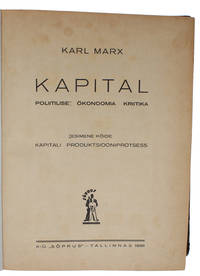
MARX, KARL.
Kapital. Poliitilise Ökonoomia Kriitika i.e. German "Das Kapital". - FIRST ESTONIAN TRANSLATION OF MARX'S 'DAS KAPITAL'
Tallinn Kirjastusühing "Soprus" 1936 4to. In contemporary half calf with gilt lettering to spine. Extremities with light wear and corners bumped. Housed in a nice full black cloth clamshell box with black leather title-label to spine with lettering in silver. Otherwise fine and clean. 8 9-43 3 640 pp. <br/><br/><em>The rare first complete Estonian translation of Karl Marx's 'Das Kapital'. The comparatively late translation was due to the fact that German was Estonia’s official language and the language of grammar school and higher education prior to 1918/1920. It was replaced by Russian starting in the 1890s. Translator Nigol Andresen 1899-1985 worked as a teatcher at various Estonian High Schools from 1918 to 1932. In 1932 he was dismissed for political reasons because of his membership in the Estonian Social Democratic Labor Part. In the same year he was elected to the Estonian Parliament to which he formally belonged until 1937. In 1934 Andresen was expelled because of his contacts with the Communist Party from the Social Democratic Labor Party. He was then union secretary and became after the Sovietization in 1940 a proponent of the new communist system. In a short period under the Vares Cabinet he functioned as foreign minister.At the outbreak of the German-Soviet War in 1941 he went to the Soviet Union and lived in Moscow. After returning to Estonia he was from 1946 to 1949 Member of the Supreme Soviet of the Estonian Soviet Socialist Republic. However at the infamous eighth plenum of the Estonian Communist Party of March 1950 he fell out of favor and was imprisoned. Only in 1955 he was released from custody. </em> hardcover
Referenz des Buchhändlers : 59261
|
|
|
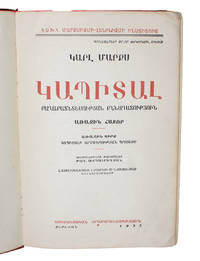
MARX, KARL.
Kapital: k'aghak'atntesut'yan k'nnadatut'yun Armenian i.e. "Das Kapital". 4. vols. - FIRST ARMENIAN TRANSLATION OF 'DAS KAPITAL'
Erevan Kusakts'akan Hratarakch'ut'yun 1933 - 1949. Royal8vo. 4 volumes all in the original red in four different nuances full cloth with embossed title to front boards and spine. Light soiling to extremities on all four volumes expecially volume 1 with heavy soiling. Hindges a bit weak. All volumes internally fine and clean. XL745 3 pp.; XXVII 492 4 pp.; XXVI 452 pp.; 4 452 pp. <br/><br/><em>The rare first Armenian translation of Karl Marx's Das Kapital. "Fifty years after the death of Karl Marx the Communist Party of Armenia published in 1933 the first Armenian translation of book one of 'Das Kapital'. After a long fight against the Ottoman Empire Armenia had become part of the Transcaucasian Socialist Federative Soviet Republic in 1922. The famous Armenian historian and linguist Tadeos Ayrapetovich Avdalbegyan 1885-1937 made the translation according to the tenth and last German edition 1922 by the Meissner publishing house. Book two followed in 1936 but book three was only published after World War II in 1947 and 1949. The changing name of the editor reflects the history of soviet Armenia over the years." Karl Marx Memorial Library Luxembourg - http://karlmarx.lu </em> hardcover
Referenz des Buchhändlers : 54792
|
|
|
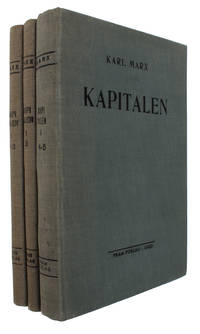
MARX, KARL.
Kapitalen i.e. Norwegian: "Das Kapital". - FIRST NORWEGIAN TRANSLATION OF MARX'S 'DAS KAPITAL'
Oslo Fram Forlag 1930 - 1931. 5 parts all. 8vo. 5 part in publisher's original 3 full cloth bindings with title and author in black lettering to front boards and spines. Spines lightly miscoloured otherwise fine and clean. 166 pp.;144 pp.; 237 pp. <br/><br/><em>The uncommon first Norwegian translation of Marx’s ‘Das Kapital’ – only volume 1 was ever translated. The translation was commissioned by ‘Mot Dag’ a Norwegian political group active from the 1920s to the early 1930s and was first affiliated with the Labour Party. After World War II many of its former members were leaders in Norwegian politics and cultural activities. “Although always small in numbers and often regarded with suspicion by Labour and trade union leaders the Mot Dag organization was nevertheless an important factor in providing the Norwegian workers’ movement with a cultural policy and attracting artists writers and intellectuals to the socialist cause. Well-known and respected authors and artists figured prominently in the organisation’s ranks as members and as contributors to the journal of the same name. Mot Dag was also instrumental in establishing cultural and educational enterprises for Norwegian workers within the workers’ movement most famously the Arbeidernes leksikon The Workers’ Encyclopaedia a gigantic and unique collective effort by specialists and writers who worked without remuneration. It set up a successful publishing house where Falk published his Norwegian translation of the first volume of Marx’s Das Kapital Capital an undertaking that actually turned out to be profitable. In many ways Mot Dag had a position in Norway comparable to that of The Partisan Review in the United States as an organisation that as Hugh Wilford puts it had a “dual commitment to anti-Stalinist Marxism and cultural Modernismâ€â€ Sørenssen Olav Dalgard – Politics Film Theatre and the Avant-Garde in Norway in the Interwar Years </em> hardcover
Referenz des Buchhändlers : 60005
|
|
|
MARX, Karl.
Kapitalen.
Copenhagen: N. Cohens Bogtrykkeri 1885 & 1887. Capital in Danish First edition in Danish of Das Kapital. Marx's seminal work first appeared in German in 1867 and the first translation of the work was that into Russian 1872. The first English translation appeared after the Danish in 1887. "The history of the twentieth century is Marx's legacy. Stalin Mao Che Castro - the icons and monsters of the modern age have all presented themselves as his heirs. Whether he would recognise them as such is quite another matter. Nevertheless within one hundred years of his death half the world's population was ruled by governments that professed Marxism to be their guiding faith. His ideas have transformed the study of economics history geography sociology and literature. Not since Jesus Christ has an obscure pauper inspired such global devotion - or been so calamitously misinterpreted" Francis Wheen in his introduction to Karl Marx 1999. 2 vols in 1 quarto. Modern red buckram spine lettered in gilt top edge sprinkled black. Without the half-titles "Socialistisk Bibliotek Vol. IV-V". Previous ownership inscription in blue ink to front free endpaper with the quotation "The expropriators are expropriated. p. 462 I" inscribed underneath in red ink; library stamp to vol. 2 p. 1. Spine slightly faded ends a little bruised and rubbed contents evenly browned with some chipping to page edges as usual due to paper quality front and rear gutters and several page edges neatly reinforced using Japanese tissue overall a very good clean copy of a fragile publication. See Printing and the Mind of Man 359 first edition. hardcover
Referenz des Buchhändlers : 122813

|
|
|
MARX, KARL.
Kapitalen. 2 Dele. Første Bind. Kapitalens Produktionsproces. Oversat efter Originalens tredje Oplag. 2. Kapitalens Cirkulationsproces.Udgivet efter Forfatterens Død af Friedrich Engels. i.e. Danish "Das Kapital". - FIRST DANISH TRANSLATION OF "THE CAPITAL"
København Copenhagen 1885-87. 4to. In contemporary half cloth with gilt lettering to spine. Even browning as usual due to the paper quality. An envelope pasted on to front free end-paper containing Danish articles on Marx. Previous owner's name to title-pages. A fine and clean copy with both half-titles present "Socialistisk Bibliotek" Vol. IV-V. Vol 1: 2 473 1; Vol 2: VII; 1; 4 363 1 pp. <br/><br/><em>First edition of the first Danish translation of "Das Kapital". The translation is remarkable in several respects - the Danish Social-democratic party was one of the first labour organizations in the world to publish the two volumes of "The Capital" the translation of the first volume preceded both the English and the Italian and the translation of the second volume is the second in the world to appear only preceded by the Russian from 1885 - furthermore these two translations were the only two to appear of volume two until after Engels' death in 1895. After having been in a serious crisis at the end of the 1870'ies the labour movement in Denmark turned things around in the 1880'ies primarily with the aid of Marx. Marx' theories and his connection between theoretical and practical politics became the foundation for the Social Democrats. In 1884 the Danish Social Democratic Party got its two first members of parliament elected and many workers wished to become politically active. Also in Denmark the class struggle had properly begun.As Marx was the foundation for the beginning success of the Social Democrats the Party decided that it would translate and publish all the most important works by Marx - of course most importantly "The Capital". This translation was to become "a new and powerful weapon for the Danish Labour Party in the agitation for the socialist principles". The translation of "The Capital" was made by the linguist and journalist Hans Vilhelm Lund 1840-1893 who worked at the paper Social-Demokraten in the 1880'ies and 90'ies. The translation is famed for being extremely true to the original and virtually flawless. In order to reach as wide a relevant audience as possible the price was kept as low as it could be. It still constituted a full day's wages for a skilled worker namely 2 kroner - still about 1/7 of the German edition. In spite of all the efforts to distribute the translation it did not become a bestseller and in 1911 the remainders were issued with a new title-page in 1911. PMM 359 - first edition. </em> hardcover
Referenz des Buchhändlers : 55207

|
|
|
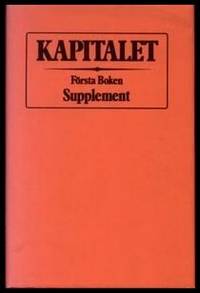
Marx, Karl
Kapitalet
Original Hardcover. Publisher: Arkiv förlag/A-Z förlag Utg. 1985 Original Hardcover 114 p. This book is brand new. Original title: Das Kapital Language: Svenska We have this book in our store house - please allow for a couple of extra days for delivery. hardcover
Referenz des Buchhändlers : BIB-470841 ISBN : 9186070037 9789186070038
|
|
|
Marx, Karl ; Harvey, David
Kapitalet
Original Hardcover. Publisher: Arkiv förlag/A-Z förlag Utg. 2018 Original Hardcover 488 p. This book is brand new. Original title: Das Kapital. Zweiter Band Translator: Bohman Ivan; Gundenäs Henrik Language: Svenska We have this book in our store house - please allow for a couple of extra days for delivery. hardcover
Referenz des Buchhändlers : BIB-281591863 ISBN : 9179243029 9789179243029

|
|
|
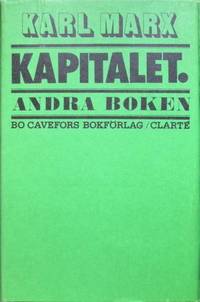
MARX, KARL
Kapitalet Kritik av den politiska ekonomin. Bok 2 Kapitalets cirkulationsprocess
Lund1971.Förlagsband med skyddsomslag.Bo Cavefors förl. översättning: Ivan Bohman 488 s. Gulnad inlagaGott skick.9150400533Boken publicerad i samarbete med Tidskriften ClartéISBN 9150400533 unknown
Referenz des Buchhändlers : 997471 ISBN : 9150400533 9789150400533
|
|
|
MARX, KARL.
Kapitalet. Kritik av den politiska ekonomin. I svensk oversättning av Rickard Sandler. 3 vols. - FIRST SWEDISH EDITION OF MARX' "CAPITAL"
Stockholm Tidens Förlag 1930-31. 8vo. Three volumes all in the original publisher's uniform half calf bindings with gilt lettering to spines. Extremities especially capitals with a bit of wear. Internally very fine and clean. XXII 2 740; XXIII 1 479 1; XXV1 836 2 pp. <br/><br/><em>Scarce first edition of the first Swedish translation of "Das Kapital" which had an immense impact upon Swedish thought and politics. The translation is made by the Swedish politician and previous social democratic prime minister and later foreign minister Rickard Johannes Sandler 1884 - 1964. He was a leading intellectual of the contemporary social democracy.A second severely criticized translation of the work into Swedish appeared 1969-73. </em> unknown
Referenz des Buchhändlers : 59980
|
|
|
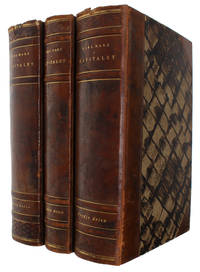
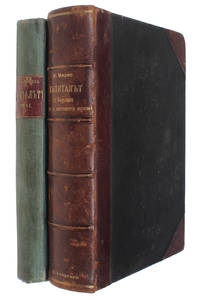
MARX, KARL.
Kapitalut. Kritika na politicheskata ekonomiia. i.e. Bulgarian "Das Kapital". Translated by Dimitar Blagoev Kapitalut. Translated by Georgi Bakalov Karlu Marksu i Negovoto Vreme i.e. Bulgarian: "Karl Marx and his Time". - THE FIRST BULGARIAN TRANSLATIONS OF MARX'S 'DAS KAPITAL'
Blagoev-translation: Sofia presumably 1910 but august 1909 stated on last leaf of preface & Ba Blagoev-translation: 8vo. In a contemporary full cloth binding with red leather title-label with gilt lettering to spine. Spine with wear and light soiling to extremities. Hindges a bit weak First 10 leaves with stain in margin otherwise a good copy. 6 XXXI 1 675 1 pp.Bakalov-translation: 8vo. In contemporary half calf with five raised bands and gilt lettering to spine. Wear to extremities and hindges a bit weak Repair to inner margin of title-page. Internally fine and clean. XXX 2 598 2 pp. frontiespiece of Marx. Withbound is "Karl Marx and His Time": 1-180 pp. <br/><br/><em>A most interesting set consisting of the two first Bulgarian translations of Marx' 'Das Kapital'. Quite extraordinary in the history of translations of 'Das Kapital' two Bulgarian translation appeared presumably simultaneously and both translations seems to have been actively used though the 20ies and 30ies and they were reprinted simultaneously in 1930-31 both edited by Todor Pavlov. To our best knowledge Bulgarian is the only language which have had two complete translation published at the same time.The Bakalov-translation is certainly published in 1910. The Blagoew-translation printed in Sofia has often been referred to as being printed in 1909 and has occasionally been referred to as the first translation of the two solely because his foreword was proceeded by "August 1909". That the book was actually printed in 1909 has however recently been disputed. Both translators were well aware of each other and perhaps Blagoew simply wrote "August 1909" to gain primacy in being the first to have a complete translation published: "I was not able to prove this but this is either a typo unlikely or was Blagoev's way to acquire primacy over the other translation from 1910 that of Georgi Bakalov" Panayotov Capital without Value: The Soviet-Bulgarian Synthesis. Translator Dimitar Blagoev the founder and leader of the Bulgarian Worker's Social Democratic Party became or Narrow Socialists or Tesniaki became the the first Marxist propangandist in Bulgaria. About the present translation Blagoev said: "The translation was made from Russian but we can rightly say that it came from Russian as well as from Russian German and French. We all had four Russian issuesbut the basis for this was the last Russian translation which was edited by G. P. Struwe as it came closest to the original. In all this however we had to compare almost line by line with the original of the last fourth German edition of Friedrich Engels and the French translation which was specially reviewed by Marx himself."Blagoev was also a prominent proponent of ideas for the establishment of a Balkan Federation leading the Narrow Socialists into the Communist International in 1919 where the party changed its name to the Bulgarian Communist Party. However during this period Blagoev and the party as a whole did not completely adopt Bolshevik's positions on the basic questions. This determined the party's policies during the Vladaya Soldiers' Rebellion of 1918 and the military coup of 9 June 1923 when the party adopted a position of neutrality. He was also an opponent of the failed September Uprising and thought that there were no ripe conditions for a revolution in Bulgaria yet.A partial translation by Blagoev only 122 pp was published in 1905 and is of the utmost scarcity. Georgi Bakalov published his translation from the German in his hometown Stara Zagora. The publisher was The Liberal Club which was a printshop rather than a proper publisher. He was also a member of Bulgarian Social Democratic Party as of 1891 and likely much similar to many of the early Bulgarian socialists was active in education and socalled 'uchitelsko delo' teachers' affairs. In 1891-93 he studied in Geneva and quickly befriended Plekhanov whom he translated in the 1890s.OCLC only list no copies of either translation. We know however that a copy of both translations are held in the SS. Cyril and Methodius National Library Bulgaria. </em> hardcover
Referenz des Buchhändlers : 57297
|
|
|
MARX, KARL.
Kapitalut. Kritika na politicheskata ikonomiya. i.e. Bulgarian "Das Kapital". Translated and introduction by Dimitar Blagoev Rech za svobodata na turgoviyata i.e. Bulgarian: "A speech on free trade". - FIRST PARTIAL BULGARIAN TRANSLATION OF MARX'S 'DAS KAPITAL'
Kapitalut: Balchik Izdanie na Krist'o Ivanov 1905. Speech On the Question of Free Trade: Sofia 8vo. In contemporary red half calf. Extremities with wear. Previous owner's name in contemporary hand to upper part of both title-pages. Light browning throughout and a few occassional underlignings in text mainly in "A speech on free trade". Kapitalut: XXXVIII 122 pp. Rech za.: 27 1. <br/><br/><em>The exceedingly rare first partial Bulgarian translation of Marx's 'Das Kapital' heft. 1. Translator Dimitar Glagoev who eventually in 1909-10 made the first complete translation was the founder and leader of the Bulgarian Worker's Social Democratic Party became or Narrow Socialists or Tesniaki became the the first Marxist propangandist in Bulgaria. The present publication is presumably printed in very low number and are of the utmost scarcity; OCLC locate no institutional holdings We know of one copy in the SS. Cyril and Methodius National Library Bulgaria and no copy has been up for auction the past 50 years.Extradited in 1885 by the Russian government Blagoev returned to Bulgaria settled in Sofia and began to propagate socialist ideas. In July 1891 on the initiative of Blagoev the social democratic circles of Tarnovo Gabrovo Sliven Stara Zagora Kazanluk and other cities united to form the Bulgarian Social Democratic Party BSDP. The Marxist nucleus of the BSDP was opposed by a group who were essentially opposed to making the social democratic movement into a party. In 1893 this group led by Yanko Sakazov founded a reformist organization the Bulgarian Social Democratic Union. In 1894 Blagoev's supporters agreed to unite with the Unionists in the interests of working class unity and took the name Bulgarian Social Democratic Workers Party. Blagoev founder and became the leader of its left wing which split from the BSDWP in 1903 to found the Bulgarian Social Democratic Workers' Party Narrow Socialists. Under his guidance the foundations of the class trade-union movement was laid in 1904. Blagoev was also a prominent proponent of ideas for the establishment of a Balkan Federation leading the Narrow Socialists into the Communist International in 1919 where the party changed its name to the Bulgarian Communist Party. However during this period Blagoev and the party as a whole did not completely adopt Bolshevik's positions on the basic questions. This determined the party's policies during the Vladaya Soldiers' Rebellion of 1918 and the military coup of 9 June 1923 when the party adopted a position of neutrality. He was also an opponent of the failed September Uprising and thought that there were no ripe conditions for a revolution in Bulgaria yet.From 1897 to 1923 Blagoev directed the publication of the party's theoretical organ the journal "Novo Vreme" which published more than 500 of his articles. The first complete Bulgarian translation were published in 1909/1910. </em> unknown
Referenz des Buchhändlers : 58543

|
|
|
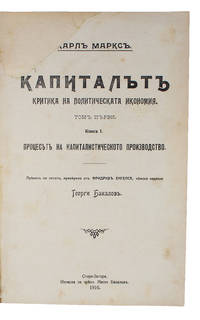
MARX, KARL.
Kapitalut. Kritika na politicheskata ekonomiia. i.e. Bulgarian "Das Kapital". Translated by Georgi Bakalov. - FIRST FULL BULGARIAN TRANSLATION OF MARX'S 'DAS KAPITAL'
Stara Sagora 1910. 8vo. Contemporary half cloth with gilt lettering to spine. Spine with wear. Upper inner corner of title-page with repair missing the 'K' in 'Karl'. Two last leaves with marginal repairs not affecting text. Light occassional brownspots throughtout. XXX 2 598 2 pp. frontiespiece of Marx. <br/><br/><em>The very rare full Bulgarian translation by Georgi Bakalov from 1910 published simultaneously with Dimitar Blagoev's translation. Quite extraordinary two different Bulgarian translations both complete were made at the same time.Interestingly both translations seems to have been actively used though the 20ies and 30ies and both translations were reprinted simultaneously in 1930-31 both edited by Todor Pavlov. To our best knowledge Bulgarian is the only language which have had two complete translation published at the same time. Georgi Bakalov published his translation from the German in his hometown Stara Zagora. The publisher was The Liberal Club which was a printshop rather than a proper publisher. He was also a member of Bulgarian Social Democratic Party as of 1891 and likely much similar to many of the early Bulgarian socialists was active in education and socalled 'uchitelsko delo' teachers' affairs. In 1891-93 he studied in Geneva and quickly befriended Plekhanov whom he translated in the 1890s.OCLC only list no copies </em> hardcover
Referenz des Buchhändlers : 56711
|
|
|
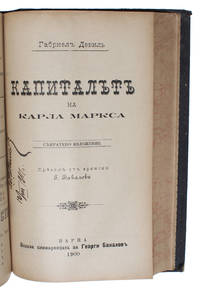
MARX, KARL (+) GABRIEL DEVILLE (+) [TRANSLATOR:] CHRISTIAN RAKOVSKY (+) ED. BERNSTEIN (+) GEORGI PLEKHANOV
Kapitalutu. i.e. Bulgarian "Das Kapital" Bound with: Predpostavkit na sotsializma i zadachitu na sotsialnata demokratsiya i.e. Bulgarian: "The Preconditions of Socialism and the Tasks of Social Democracy" Marksovata Istoricheska Teoria i.e. - FIRST BULGARIAN EDITION OF THE MOST IMPORTANT ABRIDGED VERSION OF "THE CAPITAL"
Varna 1900. 8vo. In contemporary half calf with four raised bands to spine. Extremities with wear. Frontboard missing parts of cloth. Two bands on spine missing some of the leather. Verso of front free end paper with notes in contemporary hand and previous owner's name to title-page of all three works. A few occassional marginal lignings in pencil otherwise internally good and clean. Predpostavkit na sotsializma i zadachitu.: XII 257 1 XIV pp. Marksovata Istoricheska Teoria: 86 2 pp. Kapitalutu: IV 5-284 pp. <br/><br/><em>The exceedingly scarce first Bulgarian edition of the most important abridged version of Marx's Capital ever to have appeared published five years before the first partial translation and whole 9 years before the first full Bulgarian translation. Translator Christian Rakovsky later became head of Soviet Ukraine and leader of the left opposition in the Soviet Union after 1928 was one of Trotsky's few intimate friends."The epitome here translated was published in Paris in 1883 by Gabriel Deville possibly the most brilliant writer among the French Marxians. It is the most successful attempt yet made to popularize Marx's scientific economics. It is by no means free from difficulties for the subject is essentially a complex and difficult subject but there are no difficulties that reasonable attention and patience will not enable the average reader to overcome. There is no attempt at originality. The very words in most cases are Marx's own words and Capital is followed so closely that the first twenty-five chapters correspond in subject and treatment with the first twenty-five chapters of Capital. Chapter XXVI corresponds in the main with Chapter XXVI of Capital but also contains portions of chapter XXX. The last three chapters-XXVII XXVIII and XXIX-correspond to the last three chapters-XXXI XXXII and XXXIII-of Capital." ROBERT RIVES LA MONTE Intruductory Note to the 1899 English translation.Translator Christian Rakovsky dominated the socialist movement in the Balkans during the two decades before the first world war and was probably the most influential character in spread of socialism in Europe. Trotsky wrote of him: " Ch.G. Rakovsky is internationally one of the best known figures in the European Socialist movement" and G.D.H. Cole wrote in The Second International "No other Socialist spans the Balkans in the same way as Rakovsky nor is there any of comparable importance."In 1913 Rakovsky was an organizer and leader of the Rumanian Socialist Party which later joined the Communist International. The party was showing considerable growth. Rakovsky edited a daily paper which he financed as well."He received his initial education at Kotel. At the age of fourteen in a period when as he says in his Autobiography in this volume "even the youngest students were passionately interested in politics" he was excluded from all Bulgarian schools after organizing a school riot which it took a company of soldiers to suppress. After a year in his father's house "reading indiscriminately everything that came to hand" he was readmitted to school only to be expelled again after a year this time for good. The occasion this time was his collaboration with his friend and mentor E. Dabev one of the veterans of the Bulgarian revolutionary movement. Dabev 1864-1946 edited the first marxist weekly in Bulgaria in 1886. He published in it Marx's Wage Labour and Capital. In 1890 already a marxist Rakovsky aided Dabev in preparing the publication of Engels's Development of Scientific Socialism in particular in adapting Vera Zasulich's introduction to Bulgarian conditions. In this final year in school Rakovsky also produced with a friend a clandestine newspaper called Zerkalo "Mirror" which his Autobiography describes as having "something of everything: Rousseau's educational ideas the struggle between rich and poor the misdeeds of teachers etc. ." He was now seventeen years old. That same year he left Bulgaria to study medicine in Geneva."In Geneva in 1892 Rakovsky began to edit and publish the Bulgarian journal Social Democrat which not only in its title but also in its contents resembled the Russian journal. Jointly with his companion Savva Balabanov and with the active collaboration of Plekhanov Rakovsky continued the journal for two years. Social Democrat grouped around itself in Bulgaria the supporters of the Bulgarian Social Democratic Union. This group opposed itself to the Bulgarian Social Democratic Party founded in 1891 by Dimitar Blagoev who led the left wing of the movement and later in 1919 the Bulgarian Communist Party and made the full translation of Das Kapital in 1909. Fagan Biographical Introduction to Christian Rakovsky.OCLC list no copies. </em> hardcover
Referenz des Buchhändlers : 57116
|
|
|
Marx, Karl and Frederick Engels
Karl Mark Frederick Engels Collected V4
hardcover. Good. Access codes and supplements are not guaranteed with used items. May be an ex-library book. hardcover
Referenz des Buchhändlers : 0853152942.G ISBN : 0853152942 9780853152941
|
|
|
Marx, Karl
Karl Marx
De Gruyter 1991-01-01. 1st. hardcover. New. 6x2x10. De Gruyter hardcover
Referenz des Buchhändlers : 1739871 ISBN : 3050033975 9783050033976

|
|
|
Marx, Karl,
Karl Marx
new. unknown
Referenz des Buchhändlers : 70184-n ISBN : 0198782659 9780198782650
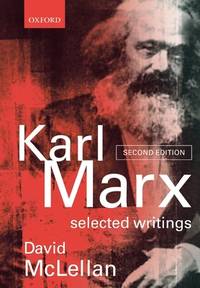
|
|
|
Marx, Karl,
Karl Marx
like new. unknown
Referenz des Buchhändlers : 70184 ISBN : 0198782659 9780198782650
|
|
|
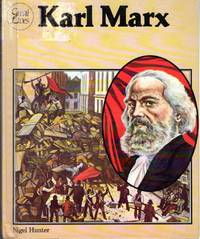
Marx, Karl) Hunter, Nigel
Karl Marx
NY: Bookwright Press 1987. Hardcover. Very Good/No Jacket as Issued. 8vo. Chris Higham. glossy pictorial c w/black titles; owner' initials on title page; 32 clean unmarked pages <br/> <br/> Bookwright Press hardcover
Referenz des Buchhändlers : 124940 ISBN : 0531181332 9780531181331
|
|
|
Marx, Karl und Franz Borkenau
Karl Marx
Fischer-Bücherei Frankfurt a.M 1971. paperback. gebraucht gut Auflage von 1973! . 1821 x 1059 x 140 Fischer-Bücherei Frankfurt a.M, paperback
Referenz des Buchhändlers : 44374 ISBN : 3436001236 9783436001230
|
|
|
Marx, Karl.- Blumenberg, Werner
Karl Marx
Thaning & Appels Forlag 1963. Illustreret Heftet Thaning & Appels Forlag, 1963 unknown
Referenz des Buchhändlers : 9025
|
|
|
Marx, Karl und Franz Borkenau:
Karl Marx
Fischer-Bücherei Frankfurt a.M 1971. Taschenbuch Gut 222 Seiten / 145 gr / ISBN 3436001236 Fischer-Bücherei Frankfurt a.M, unknown
Referenz des Buchhändlers : 114180 ISBN : 3436001236 9783436001230
|
|
|
Marx, Karl
Karl Marx / Friedrich Engels: Das kommunistische Manifest. Vollständige Neuausgabe
new. unknown
Referenz des Buchhändlers : 50379466-n ISBN : 3753800120 9783753800127

|
|
|
Marx, Karl
Karl Marx / Friedrich Engels: Das kommunistische Manifest. Vollständige Neuausgabe
like new. unknown
Referenz des Buchhändlers : 50379466 ISBN : 3753800120 9783753800127
|
|
|
Marx, Karl, Bender, Frederic L
Karl Marx - Essential Writings
Harper & Row Limited. Used - Good. Former library book; may include library markings. Used book that is in clean average condition without any missing pages. Harper & Row Limited unknown
Referenz des Buchhändlers : 16027104-6 ISBN : 0061315583 9780061315589

|
|
|
Marx, Karl; McLellan, David (editor)
Karl Marx Selected Writings
1977. Soft Cover. Good. Publisher: Oxford University Press 1977 Good Soft Cover HIGHLIGHTING fore-edge has soil mark cover wear. paperback
Referenz des Buchhändlers : 006968 ISBN : 0198760388 9780198760382
|
|
|
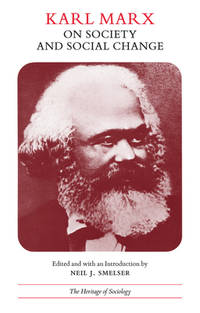
Marx, Karl
Karl Marx on Society and Social Change: With Selections by Friedrich Engels Heritage of Sociology Series
University of Chicago Press. paperback. Good. Buy with confidence. Excellent Customer Service & Return policy. University of Chicago Press paperback
Referenz des Buchhändlers : ANAIS-0226509184 ISBN : 0226509184 9780226509181
|
|
|
Marx, Karl
Karl Marx 1818 – 1883. Extracts from reminiscences of Marx by Wilhelm Liebknecht an Paul Lafargue. Four Letters of Engels on the Death of Marx. Engels speech at the Graveside of Marx.
Lawrence & Wishat London o.J. 1111. Obr. 30s. in gutem Zustand SAP442 SC Lawrence & Wishat, London o.J., unknown
Referenz des Buchhändlers : 65678
|
|
|
Marx, Karl & Friedrich Egels
Karl Marx und Friedrich Engels – die Begründer des wissenschaftlichen Sozialismus. Die Bedeutung des Manifests der Kommunistischen Partei.
Dietz Berlin 1953 1953. Obr. 72s. in gutem Zustand SAP463 HC Dietz, Berlin 1953, unknown
Referenz des Buchhändlers : 65692
|
|
|
Marx, Karl
Karl Marx Frederick Engels: Collected Works 1857-61: 28
NEW. unknown
Referenz des Buchhändlers : BIB-NOV-14-2025-128516 ISBN : 071780528x 9780717805280
|
|
|
Marx, Karl
Karl Marx Frederick Engels: Collected Works 37
NEW. unknown
Referenz des Buchhändlers : BIB-NOV-15-2025-14196 ISBN : 0717805379 9780717805372

|
|
|
Marx, Karl
Karl Marx / Friedrich Engels: The Communist Manifesto English Edition
hardcover. Good. Access codes and supplements are not guaranteed with used items. May be an ex-library book. hardcover
Referenz des Buchhändlers : 3753801976.G ISBN : 3753801976 9783753801971

|
|
|
Marx, Karl
Karl Marx / Friedrich Engels: The Communist Manifesto English Edition
paperback. Good. Access codes and supplements are not guaranteed with used items. May be an ex-library book. paperback
Referenz des Buchhändlers : 3753801968.G ISBN : 3753801968 9783753801964

|
|
|
Marx, Karl (Mitwirkender), Sperl, Richard (Mitwirkender), Wisotzki, Gunter (Mitwirkender)
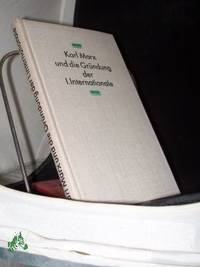
Karl Marx und die Gründung der 1. Internationale : Dokumente u. Materialien / Im Auftr. d. Instituts f. Marxismus-Leninismus beim ZK d. SED hrsg. u. eingel. von Richard Sperl u. Günter Wisotzki
Berlin : Dietz. Hardcover. Gut. Umfang/Format: XXI 162 Seiten : mit Abb. 1 Titelbild 8 Anmerkungen: Status nach VGG: vergriffen Einbandart und Originalverkaufspreis: : DM-Ost 5.80 Sachgebiet: Politik Wehrwesen 14a Geschichte Kulturgeschichte Volkskunde Im Auftrag des Instituts für Marxismus-Leninismus beim ZK der SEI herausgegeben und eingeleitet von Richard Sperl und Günter Wisotzki Die vorliegende Ausgabe erscheint aus Wag der hundertjährigen Wiederkehr der Gründung der Internationalen Arbeiterassoziation am 28. September 1964. Sie umfaßt Dokumente und Materialien die unmittelbar mit der Gründung der L Internationale im Zusammenhang stehen und die den Marxschen Anteil an der Herausbildung dieser ersten internationalen proletarischen Massenorganisation belegen. Von den 33 Dokumenten ist der größte Teil dem deutschen Leser unbekannt und wird erstmalig oder zum ersten Mal wieder abgedruckt. Alle Texte wurden nach den Fotokopien der Originale überprüft die soweit vorhanden vom Institut für Marxismus-Leninismus beim ZK der KPdSU in Moskau zur Verfügung gestellt wurden. Bei jeder Arbeit ist die für den Abdruck bzw. für die Übersetzung herangezogene Quelle vermerkt. Die Inauguraladresse die Provisorischen Statuten die Resolutionsentwürfe über die Aufnahmebedingungen für Arbeiterorganisationen und die Adresse an Abraham Lincoln siehe vorl. Band S. 42-58 73/74 88-90 sind bereits in Karl Marx/Friedrich Engels: Werke Bd. 16 S. 5-20 abgedruckt. gutes Exemplar altersgemäß gebräunt Gesamtzustand gut Berlin : Dietz hardcover
Referenz des Buchhändlers : B00069232
|
|
|
Marx, Karl herausgegeben von Hans- Joachim Lieber, Peter Furth, Benedikt Kautsky
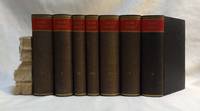
Karl Marx Ausgabe Werke - Schriften. 2 Durchgesehene Auflage
Darmstadt Germany: Wissenschaftliche Buchgesellschaft 1971. First of the second revised edit. Hardcover. Good. Darmstadt: Wissenschaftliche Buchgesellschaft 1971. First of the second revised edition. In German. 6 Bande in 7 complete. Spines evenly sunned else very good. Stacheln gleichmaclig gebraunt sonst sehr gut. CONTENTS: 1. Fruhe Schriften; 2. Fruhe Schriften; 3.1. Politische Schriften; 3.2. Politische Schriften; 4. Okonomische Schriften Das Kapital; 5. Ãkonomische Schriften Das Kapital; 6. Ãkonomische Schriften Das Kapital. Due to the size/weight of this book extra charges will apply for international shipping. Not available for priority/expedited shipping. Wissenschaftliche Buchgesellschaft hardcover
Referenz des Buchhändlers : 328957
|
|
|
MARX, KARL & ENGELS, FREDERICK
Karl Marx and Frederick Engels: Selected Works in Two Volumes 2 Vol Set
Foreign Languages Publishing 1955. COMPLETE 2 VOL SET super octavo blue buckram boards gilt lettering to spines & front boards blind stamp portrait of authors to front boards frontispieces to vol 1 only vol 1- 679pp vol 2- 531pp VG- moderate rubbing & creasing to spine & extrems light bruising & rubbing to board corners light to moderate chafing & soiling to boards light to moderate tanning & foxing/soiling to page edges & eps minor cracking to rear gutter of vol 1 moderate to heavy cracking to rear gutter of vol 2- boards a little shaky Foreign Languages Publishing 1955 hardcover
Referenz des Buchhändlers : 350223
|
|
|
Marx, Karl
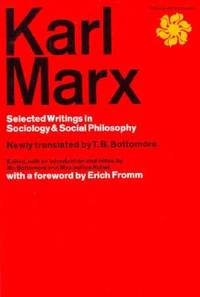
Karl Marx Selected Writings in Sociology and Social Philosophy
McGraw-Hill Education. Used - Very Good. Used book that is in excellent condition. May show signs of wear or have minor defects. McGraw-Hill Education unknown
Referenz des Buchhändlers : 4020581-6 ISBN : 0070406723 9780070406728
|
|
|
Marx, Karl, and Smelser, Neil (Editor)
Karl Marx on Society and Social Change: With Selections by Friedrich Engels
University of Chicago Press 1975. Trade paperback. Very good. University of Chicago 1973 206 pages trade paperback no underlining or owner's mark light wear University of Chicago Press paperback
Referenz des Buchhändlers : Alibris.0003005 ISBN : 0226509184 9780226509181
|
|
|
Marx, Karl
Karl Marx / Friedrich Engels: Das kommunistische Manifest. Vollständige Neuausgabe
paperback. Good. Access codes and supplements are not guaranteed with used items. May be an ex-library book. paperback
Referenz des Buchhändlers : 3753800120.G ISBN : 3753800120 9783753800127
|
|

 Per e-mail erhalten
 Als pdf-Dokument herunterladen
 RSS feed
 Permanenter link


