Professional bookseller's independent website

‎Marx karl‎

Main

????? : 23,139 (463 ?)

??? ??? 1 [2] 3 4 5 6 7 ... 72 137 202 267 332 397 462 ... 463 ??? ????

‎LE POPULAIRE-N°6932-MARDI 4 JUIN 1946‎

‎4 PAGES FORMAT 43 CM X 60 CM-P1: LE PROBLEME GOUVERNEMENTAL EST POSE-LA CONSTITUANTE SE REUNIRA LE MARDI 11 JUIN-L'HEURE DE LA JUSTICE SONNERA, PAR LEON BLUM-SERVITUDE DE LA BANLIEUE POUR QUE LA VIE DES TRAVAILLEURS PRENNE UN SENS, PAR JULIEN BLANC-ANTOINE MARCHI AGENT DE LA CAGOULE ET DE VICHY A ARME LES TUEURS DE MARX DORMOY-P2 P3: LES DERNIERS RESULTATS-HOMMAGE A ROBERT DESNOS-P4: A LYON MARIUS BERLIET ET SES FILS DEVANT LA COUR DE JUSTICE-PAULETTE GODDARD EXPLORE PARIS, PHOTO SUR VELO‎

‎COUVERTURE SOUPLE ETAT TRES BON‎

书商的参考编号 : ABE-16328261003

Livre Rare Book

Librairie Grégoire
Rennes France Francia França France
[Books from Librairie Grégoire]

€18.00 购买

‎LES ETUDES PHILOSOPHIQUES-JUILLET-SEPTEMBRE 1976-PHILOSOPHIE ALLEMANDE‎

‎MARTIN HEIDEGGER IN MEMORIAM PAR P. AUBENQUE-LA SITUATION DE HOLDERLIN AU SEUIL DE L'IDEALISME ALLEMAND PAR J.F. COURTINE-LA CRITIQUE DE LA RELIGION CHEZ MARX PAR N. LOBKOWICZ-APRES ARISTOTE ET ADAM SMITH, QUE DIT HEGEL DE L'AGIR? PAR S. MERCIER JOSA-SCHELLING: DU SYSTEME A LA CRITIQUE PAR J. RIVELAYGUE-IN 8 BROCHE-(14C)‎

‎PRESSES UNIVERSITAIRES DE FRANCE (PUF) COUVERTURE SOUPLE ETAT BON‎

书商的参考编号 : ABE-3450489721

Livre Rare Book

Librairie Grégoire
Rennes France Francia França France
[Books from Librairie Grégoire]

€18.00 购买

‎LES NOUVELLES LITTERAIRES-N°2025-23 JUIN 1966‎

‎14 PAGES-EN UNE: "LA FIN DES MANDARINS OU VA L'ENSEIGNEMENT DE LA PHILOSOPHIE?/SUITE EN P10/SARTRE/PLATON/NIETZSCHE/MARX-ADIEU A BEN/DESSIN-"UN GRAND SAVANT NOUS A QUITTES" PAUL WINTREBERT/PAR JACQUES MOREAU/PHOTO-LES ROSES ROUGES DE JUIN/PAR GERMAINE BEAUMONT-L'ANGLETERRE AUX CHEVEUX LONGS/1P/PHOTO-"HOKUSAI ET LES AUTRES" PAR JEAN A.KEIM/1P/4 ILLUSTRATIONS-"VICTOR HUGO PAR LA CARICATURE" A LA MAISON DU POETE/LA CIBLE ETAIT TROP BELLE!/3 DESSINS-‎

‎COUVERTURE SOUPLE ETAT TRES BON‎

书商的参考编号 : ABE-7903288530

Livre Rare Book

Librairie Grégoire
Rennes France Francia França France
[Books from Librairie Grégoire]

€18.00 购买

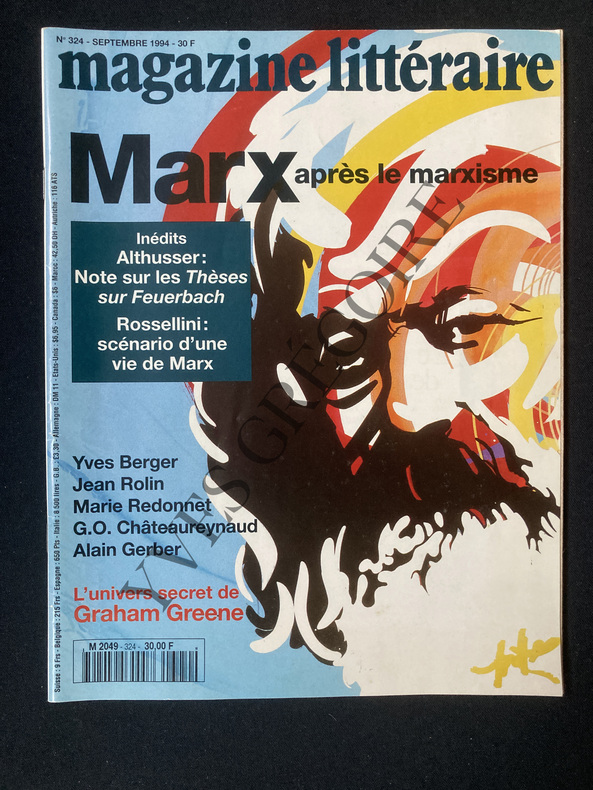
‎MAGAZINE LITTERAIRE-N°324-SEPTEMBRE 1994-MARX‎

‎124 PAGES-21 CM X 27 CM-EN COUVERTURE MARX PAR MORETTI-PREVERT, PAR VALERIE MARIN LA MESLEE, OMONVILLE LA PETITE, PHOTO-THEATRE PAR GILLES COSTAZ, PHOTO ISABELLE CANDELIER ET JEAN-PAUL ROUSSILLON DANS "LINGE SALE"-DOSSIER KARL MARX, 50 PAGES-LES INEDITS DU MAGAZINE LITTERAIRE: NOTE SUR LES THESES SUR FEUERBACH, 6P PAR LOUIS ALTHUSSER-LA CREATION D'UN MONDE, YVES BERGER, PHOTO-JEAN ROLIN: LE PUR ET L'IMPUR-SANTAMARIA, L'ENFER DE JUAN CARLOS ONETTI, DESSIN DE PANCHO-AU SECOURS VOLTAIRE!, 3P PAR MICHEL DELON-L'UNIVERS SECRET DE GRAHAM GREENE, 10P PAR ROBERT Mc CRUM-(17CA)‎

‎COUVERTURE SOUPLE ETAT COMME NEUF‎

书商的参考编号 : ABE-18818670788

Livre Rare Book

Librairie Grégoire
Rennes France Francia França France
[Books from Librairie Grégoire]

€16.00 购买

‎MARX, ENGELS ET LA REVOLUTION DE 1848‎

‎Paris François Maspero 1980 in 8 (22x13,5) 1 volume broché, couverture à rabats illustrée, 458 pages [3]. Collection ''. Textes à l'appui '. Bel exemplaire‎

‎Très bon Broché‎

书商的参考编号 : 054186

Livre Rare Book

Librairie Rouchaléou
Saint André de Sangonis France Francia França France
[Books from Librairie Rouchaléou]

€25.00 购买

‎MARX, scienziato e rivoluzionario.‎

‎(Milano), Edizioni Lotta Comunista, (1983), in-8, br. edit., pp. 127.‎

‎MATCH-N°38-23 MARS 1939‎

‎FORMAT 26 CM X 35 CM-56 PAGES-TCHECOSLOVAQUIE: LE REVE DE MASARYK A DURE 20 ANS; RETOUR HISTORIQUE DU TRAITE DE VERSAILLES A L'OCCUPATION ALLEMANDE, 11P-MARGUERITE LEBRUN CHEZ SA COUTURIERE A LA MAISON WORTH, 2P-LES SECRETS DE MONTE CARLO, 11P-LA GUERRE DU "CHIFFRE" PAR PAUL ALLARD, PARTIE 2, 1P-REPORTAGE SUR LES PARACHUTISTES DU CENTRE D'AVIGNON PUJAUT, 7P-DEUX DECHIRURES SANS MANQUE DE 2 CM ET 3 CM EN MARGE INFERIEURE DE UNE-‎

‎COUVERTURE SOUPLE ETAT TRES BON‎

书商的参考编号 : ABE-1711378458941

Livre Rare Book

Librairie Grégoire
Rennes France Francia França France
[Books from Librairie Grégoire]

€16.00 购买

‎MIDDLE ENGLISH PROSE COMPLAINT OF OUR LADY AND GOSPEL OF NICODEMUS. Ed. from Cambridge, Magdalene College, MS Pepys 2498. Hrsg. v. C. William Marx u. Jeanne F. Drennan.‎

‎Hdlbg., Winter, 1987. 232 S. OKt. - Englischer Text. - Gutes Ex.‎

书商的参考编号 : 192358DB

‎MONDE-N°184-SAMEDI 12 DECEMBRE 1931‎

‎16 PAGES-LE SENS DES RECENTES ELECTIONS ALLEMANDES PARIS BERLIN MOSCOU, CARICATURE HITLER-"AU SECOURS" PAR MARC BERNARD UN APPRENTI ET SA MERE-NOTRE DEBAT SUR LA LITTERATURE PROLETARIENNE COMMENT ON TENTA DE LE FAUSSER COMMENT IL FUT PRECISE-LA MUSIQUE: VINCENT D'INDY-SCENES DE LA VIE FUTURE, PAR BORIS PILNIAK-LA REVOLUTION ET LES GENS DE LETTRES EUX ET NOUS, PAR MAXIME GORKI, PAR LEON WERTH-A PROPOS D'UN CENTENAIRE HEGEL ET MARX A LA RECHERCHE DE LA DIALECTIQUE-LA SEMAINE POLITIQUE: LE HITLERISME ET SES RELATIONS INTERNATIONALES-LA SEMAINE ECONOMIQUE: HITLER ET LE CAPITALISME-(PJ1)‎

‎COUVERTURE SOUPLE ETAT ASSEZ BON‎

书商的参考编号 : ABE-1743639824673

Livre Rare Book

Librairie Grégoire
Rennes France Francia França France
[Books from Librairie Grégoire]

€40.00 购买

‎Narthex - Heft für radikales Denken. Vol. 4‎

‎Halkyonische Assoziation für radikale Philosophie, 2018. Broschiert A4 98‎

‎Gut leicht abgegriffen‎

书商的参考编号 : 010491

Antiquariat.de

Antiquariat BM
DE - Flensburg
[Books from Antiquariat BM]

€5.00 购买

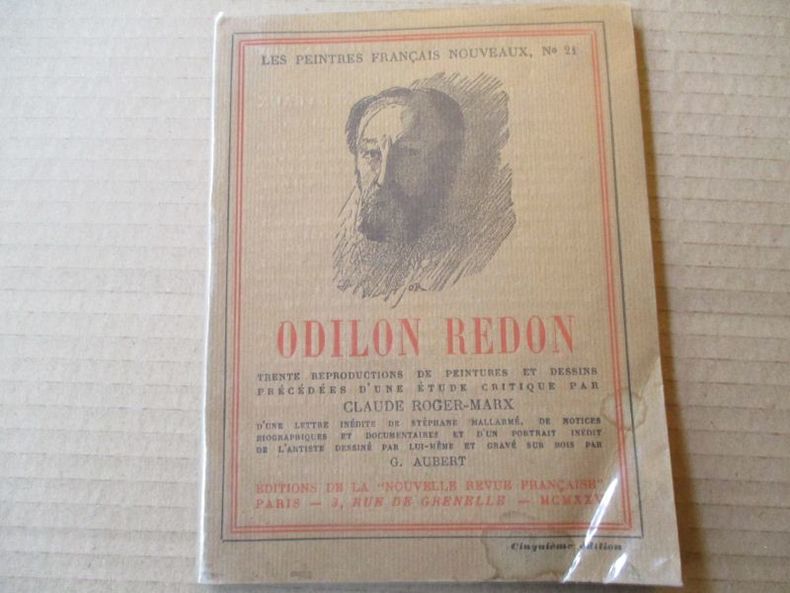
‎Odilon Redon‎

‎1925 édition de la nouvelle revue française Paris 1925 - In12 broché 63 pages nombreuses illustrations dans le texte‎

‎trente reproductions de peintures et dessins précédées d'une étude critique par claude Roger-Marx d'une lettre inédite de Stéphane Mallarmé, de notices biographiques et documentaires et d'un portrait inédit de l'artiste dessiné par lui-même et gravé sur bois par G.Aubert‎

书商的参考编号 : 5239

Livre Rare Book

Le Monde à l'Envers
Montargis France Francia França France
[Books from Le Monde à l'Envers]

€15.00 购买

‎PARIS MATCH-N°1103-27 JUIN 1970‎

‎112 PAGES FORMAT 26,5 CM X 34 CM-HUSSEIN DE JORDANIE EN COUVERTURE-LA REVOLTE DES PROFS-HEATH NOUVEAU "PREMIER"-LE TRIOMPHE DE MEXICO,COUPE DU MONDE DE FOOTBALL,6P-UN ADMIRATEUR DE MARQUE POUR LE GOBELINS DE PICASSO: MALRAUX,2P-LA PRINCESSE ANNE,3P-HUSSEIN LES FEDAYIN ET MAO,PAR RAYMOND CARTIER-LE PENTAGONE-ELSA ET ARAGON LA POESIE LES A UNIS POUR TOUJOURS-LE NOUVEAU NUMERO DE RAQUEL LA FEMME AUSSI DESCEND DU SINGE,2P-MANOLETE,3P PAR OLIVIER MERLIN,6 PHOTOS-LA ROLLS DE LA MOTO,HONDA 750,4P-LES MARX BROTHERS,2P PAR ALEXANDRE ASTRUC,PHOTO-EXPOSITIONS,ISCAN ET SES BOITES A MALICE,PHOTO-‎

‎COUVERTURE SOUPLE ETAT BON‎

书商的参考编号 : ABE-11625750893

Livre Rare Book

Librairie Grégoire
Rennes France Francia França France
[Books from Librairie Grégoire]

€12.00 购买

‎Picasso - Hieronimus Bosch - La Renaissance janvier 1939‎

‎Paris Les Editions nationales - La Renaissance 1939 In-4 Broché, couverture illustrée‎

‎N°6, janvier 1939. Vingt unième année. Sommaire : Les Solitudes de Picasso - Les Papiers collés de Picasso - Le singe de Dieu : Hieronimus Bosch - Gimond et l'atticisme français - Un Nouveau monument de Perret : le Musée des travaux publics - Chronique littéraire - Chroniques du mois : Planson, Braque, Matisse, Marquet, Lbasque; Les Arts graphiques : Luc-Albert Moreau et les" Poètes Maudits". Echos & chroniques. Textes en français et en anglais de Jean Cassou, J. Paul-Guillaume, Marcel Brion, Waldemar George, B. Champigneulle, Claude Roger Marx. Nombreuses photographies et reproductions, dont trois en couleurs, l'une en couverture. 60 pp. Très bon 0‎

书商的参考编号 : 016054

Livre Rare Book

Librairie-Galerie Emmanuel Hutin
Paris France Francia França France
[Books from Librairie-Galerie Emmanuel Hutin]

€30.00 购买

‎Po mestam shisni i dejatel'nosti Karla Marksa.‎

‎Moskau, (Isobrasitel'noe Iskussto, 1970). Marx-Gedenkstätten. 4°. OLwdbd. mit OUmschl. 40 nn. Bll. mit 39 Zeichnungen und Aquarellen von F.Longuet.‎

‎Erste Ausgabe. - Die Lebensstätten von Karl Marx in reizvollen Aquarellen mit viersprachiger Bildlegende. - Bibliotheksexemplar in Folie mit Ausleihkarte. - Selten.‎

书商的参考编号 : 5222

‎Politik und sozialistische Gesellschaftskritik. Erich Fromm: Gesamtausgabe; Bd. 5.‎

‎DTV, 1981. VII, 480 S.; 8°. Originalleinen mit Schutzumschlag.‎

‎Gutes Ex. - INHALT : POLITIK -- Fragen zum deutschen Charakter (1943a) -- Was soll mit Deutschland geschehen? (1943c) -- Marschiert Deutschland bereits wieder? (1966 -- Den Vorrang hat der Mensch! Ein sozialistisches Manifest und Programm -- (1960b) -- Es geht um den Menschen! Eine Untersuchung der Tatsachen und Illusionen in -- der Außenpolitik (1961a) -- Vorwort -- Allgemeine Voraussetzungen -- Veränderung durch vorausschauendes Handeln und Veränderung durch Katastrophen -- Historische Ursprünge der gegenwärtigen Krise und Aussichten für die Zukunft -- Gesundes und pathologisches Denken in der Politik -- Grundlagen des Sowjetsystems -- Die Revolution - eine fehlgeschlagene Hoffnung -- Stalins Umwandlung der kommunistischen Revolution in eine Manager-Revolution -- Das System Chruschtschows -- Das Ende des Terrors -- Die sozio-ökonomische Struktur -- Erziehung und Moral -- Ist Weltherrschaft das Ziel der Sowjetunion? -- Ist die Sowjetunion sozialistisch? -- Ist die Sowjetunion revolutionär-imperialistisch? -- Die Sowjetunion als revolutionäre Macht und die Rolle der Komintern -- Die Sowjetunion als imperialistische Macht -- Bedeutung und Funktion der kommunistischen Ideologie -- Das Problem China -- Das Problem Deutschland -- Gedanken zum Frieden -- Friede durch Abschreckung - Aufrüstung und Allianzen -- Die amerikanisch-russische Allianz gegen China und die Kolonialvölker -- Vorschläge für den Frieden -- Weltweite kontrollierte Abrüstung -- Amerikanisch-russische Beziehungen auf der Basis des Status quo -- Schlußfolgerungen -- Nachwort vom Februar 1963 -- Kommunismus und Koexistenz Das Wesen der totalitären Bedrohung heute Eine Analyse der Erklärung der 81 Kommunistischen Parteien (1961 -- Gründe für eine einseitige Abrüstung (1960c) -- Erich Fromm und Michael Maccoby: -- Die Frage der Zivilverteidigung (1962b) -- Zur Theorie und Strategie des Friedens (1970h) -- Anmerkungen zur Entspannungspolitik (1975a) -- GESELLSCHAFTSKRITIK UND ZUKUNFT DER GESELLSCHAFT -- Der gegenwärtige Zustand des Menschen (1955c) -- Vorwort zu Edward Bellamy "Looking Backward" (1960f) -- Nachwort zu George Orwell "1984" (1961c) -- Propheten und Priester (1967 b) -- Psychologische Aspekte zur Frage eines garantierten Einkommens für alle -- (1966c) -- Die psychologischen und geistigen Probleme des Überflusses (1970j) -- Die Zwiespältigkeit des Fortschritts Zum 10 Geburtstag von Albert -- Schweitzer (1975c) -- MARX UND DIE MARX-INTERPRETATION -- Das Menschenbild bei Marx (1961) -- Vorwort -- Die Verfälschung des Marxschen Denkens -- Marx' historischer Materialismus -- Das Problem von Bewußtsein, Gesellschaftsstruktur und Gebrauch von Gewalt -- Die Natur des Menschen -- Der Begriff der menschlichen Natur -- Die Tätigkeit des Menschen -- Die Entfremdung -- Der Marxsche Sozialismus -- Die Kontinuität des Marxschen Denkens -- Marx als Mensch -- Vorwort zu Karl Marx "Selected Writings" (1964d) -- Die Anwendung der humanistischen Psychoanalyse auf die marxistische Theorie (1965c) -- Probleme der Marx-Interpretation (1965d) -- Marx'Beitrag zum Wissen vom Menschen (1968h) -- ANHANG. ISBN 342101955X‎

书商的参考编号 : 1053963

Antiquariat.de

Fundus-Online GbR
DE - Berlin
[Books from Fundus-Online GbR]

€18.00 购买

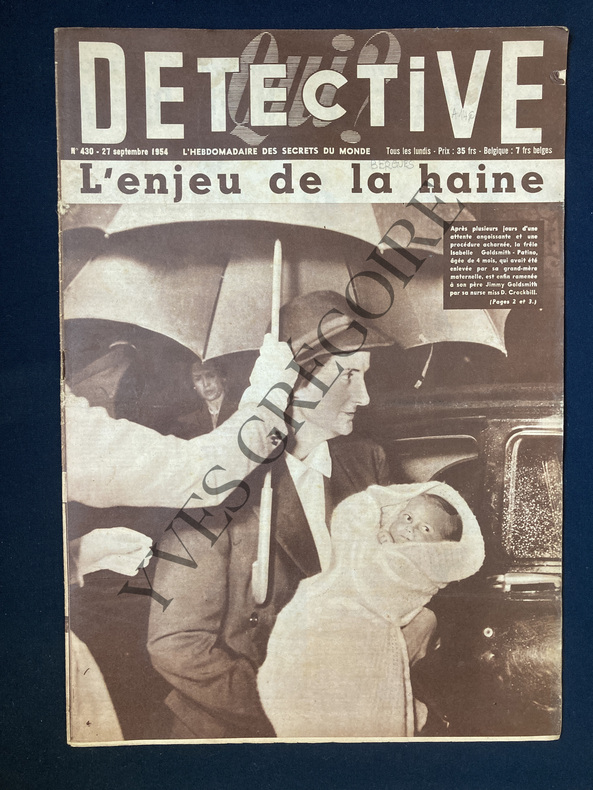
‎QUI? DETECTIVE-N°430-27 SEPTEMBRE 1954‎

‎EN COUVERTURE ISABELLE GOLDSMITH ET SA NURSE/"L'ENJEU DE LA HAINE"-PARIS/PETITE FILLE DU MILLIARDAIRE PATINO, ROI DE L'ETAIN, ISABELLE ENJEU DE LA HAINE/2P/PHOTOS-BERGHES/DUNKERQUE/L'ASSASSIN OUBLIE UN MILLION/1P/4 PHOTOS-LONDRES/CALAIS/JE REUSSIRAI OU JE SOMBRERAI! FURENT LES DERNIERES PAROLES DE L'INDOMPTABLE TED MAY-BIEN QUE NEE A SALE LEILA EST TOUT SUCRE/PHOTO-DRAME TENDRE A SAINT ETIENNE/CATHERINE VOULAIT MOURIR.LE "POUSSIN" L'A SAUVE-POLICIERS BELGES ET FRANCAIS METTENT EN ECHEC LE GANG DES MASQUES-MARSEILLE/UN COFFRE FORT ET HUIT MILLIONS DE LA VILLE S'ENVOLENT MAIS LES VOLEURS NE VONT PAS LOIN-CHARTRES/DANS LES GRANDS PRES L'HERBE ETAIT ROUGE-ARGENT SUR SAULDRE/LAMOTTE BEUVRON/SUICIDE, NON! AFFIRMENT LES REPORTEURS DE DETECTIVE/LE MORT FUT SON PROPRE MEURTRIER-SAINT JULIEN DE VALGALGUES (GARD)/CHOUALA LE MONSTRE AVAIT DIT LA VERITE!-EN 4: UN CENTIMETRE CONSACRE LA RESURRECTION DE VICTOR SILLON/1P/5 PHOTOS‎

‎COUVERTURE SOUPLE ETAT TRES BON‎

书商的参考编号 : ABE-2668129876

Livre Rare Book

Librairie Grégoire
Rennes France Francia França France
[Books from Librairie Grégoire]

€15.00 购买

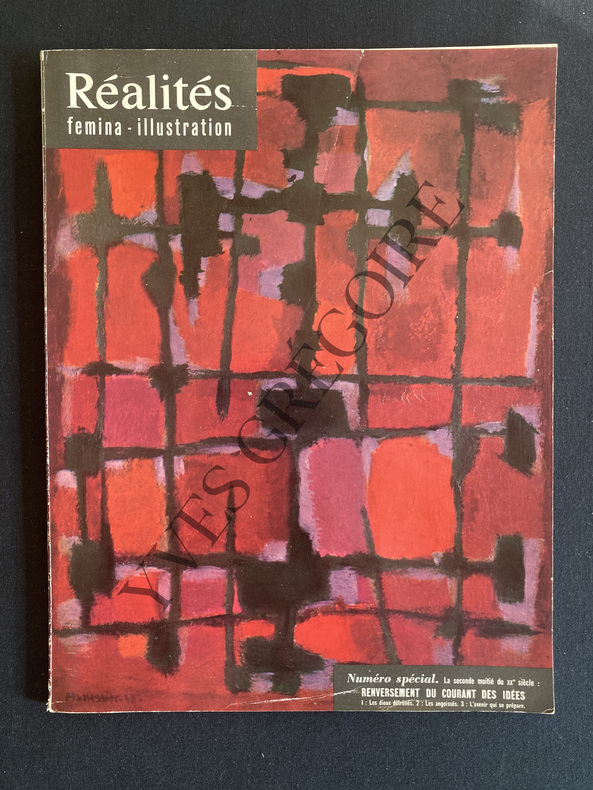
‎REALITES-N°137-JUIN 1957-NUMERO SPECIAL-LA SECONDE MOITIE DU XXe SIECLE: RENVERSEMENT DU COURANT DES IDEES‎

‎116 PAGES-24,2 CM X 31,7 CM-EN COUVERTURE OEUVRE D'ALFRED MANESSIER-RENVERSEMENT DU COURANT DES IDEES, LA FIN DU PESSIMISME, PAR DENIS DE ROUGEMENT, LES DIEUX DETRONES, MARX DEPASSE, FREUD DEPASSE, OU EN SONT NOS MANDARINS, PAR CLAUDE BRULE, LES ANGOISSES, COLIN WILSON OU LE MAL DU SIECLE, NICOLAS DE STAEL OU L'ARTISTE VISITE PAR LA MORT, OPPENHEIMER OU LE CAS DE CONSCIENCE DU SAVANT, L'AVENIR QUI SE PREPARE, LES JEUNES SCIENTIFIQUES VIENNENT EN AIDE AUX MANAGERS, LES ELITES S'ENFLAMMENT POUR LA RECHERCHE SPIRITUELLE, L'OCCIDENT S'EVEILLE AU SENS DE SES RESPONSABILITES PLANETAIRES‎

‎COUVERTURE SOUPLE ETAT TRES BON‎

书商的参考编号 : ABE-1551720251131

Livre Rare Book

Librairie Grégoire
Rennes France Francia França France
[Books from Librairie Grégoire]

€15.00 购买

‎robho n°5-6. Quelques aspects de l'art bourgeois‎

‎Paris Les Carnets de l'Octéor. Direction Julien Blaine et Jean Clay. 1971 In-2 agrafé, couverture illustrée‎

‎Dernier numéro de cette revue mise en page par Carlos Cruz-Diez. Au Sommaire : La Poésie du livre hors du spectacle hors de l'objet - Yves Alain Bois (sculptures corporelles avec papier ill. photo), F.E. Walther. Dossier Argentine : les fils de Marx et Mondrian., Mommartz, Medalla, Aubertin. Guerre au MOMA : Takis, raid sur Malevich (Troche, Hendricks, A.W.C.), Quelques aspects de l'art bourgeois: la non-intervention, Buren contre le CNAC, Espaces Collectifs : Soto, Colombo, Cruz-Diez. Van Tongerloo, De la révolution théâtrale au théâtre révolutionnaire: Grand Magic Circus ... Pinoncelli (Festival AG Bordeaux et action contre Malraux à l'ouverture du musée Chagall à Nice) groupe Le Crapul, Baudrillard "Du scoutisme au napalm", Jiro Yoshihara : Sur l'art Gutai - Très bon 0‎

书商的参考编号 : 015895

Livre Rare Book

Librairie-Galerie Emmanuel Hutin
Paris France Francia França France
[Books from Librairie-Galerie Emmanuel Hutin]

€100.00 购买

‎SPECTATEUR-N°102-13 MAI 1947‎

‎8 PAGES FORMAT 43X55-EN UNE PHOTO DE PIERRE JOURDAN DANS "LES MARIS DE LEONTINE" 16,5X20-DES MOTS! DES MOTS! DES MOTS!,PAR ANDRE ROUBAUD-HOMMAGE A PAUL DUKAS,CINQUANTENAIRE DE L'APPRENTI SORCIER,PAR ADOLPHE BOSCHOT,SUITE P6-BALANCHINE A L'OPERA-LE CONSERVATOIRE D'ART DRAMATIQUE VA AVOIR UN AN D'EXISTENCE,PAR YVON NOVY-SUZANNE VALADON,PAR CLAUDE ROGER MARX,1 PHOTO-"UNE NUIT A CASABLANCA" PAR LES MARX BROTHERS,CRITIQUE PAR BERNARD GAVOTY‎

‎COUVERTURE SOUPLE ETAT BON‎

书商的参考编号 : ABE-10017830393

Livre Rare Book

Librairie Grégoire
Rennes France Francia França France
[Books from Librairie Grégoire]

€18.00 购买

‎The Marx Brothers Poster Book.‎

‎Zachary Kwinter, London, 1991. Fol. , 37 x 27,5 cm, kartoniert / Paperback‎

‎Einband mit minimalen Gebrauchspuren, insgesamt sehr schönes Exemplar / Cover with minimal traces of use, very good condition.‎

书商的参考编号 : 34783

‎Thesen des Zentralkomitees‎

‎Bln., Dietz, 1983. der SED zum Karl-Marx-Jahr 1983. (2. Aufl.). OBrosch. 47 SS.‎

‎Bibliotheksexemplar mit Ausleihkarte.‎

书商的参考编号 : 5171

‎TRESORS DE LA BIBLIOPHILIE, LES. AVANT-PROPOS DE ROGER MARX. - COMMENT J'AI FAIT MES LIVRES - PAR HENRI MATISSE. GENEVE. EDITO-SERVICE. SANS DATE.‎

‎PETIT IN-8 (21,5 X 14 CENTIMETRES ENVIRON) DE XXV PAGES + 91 PLANCHES HORS TEXTE, RELIURE DE L'EDITEUR A LA BRADEL SKIVERTEX A L'IMITATION DU VEAU MARBRE, DOS ET PLATS ENCADRES D'UN DOUBLE FILET DORE, TITRE DORE.‎

‎BEL EXEMPLAIRE.‎

书商的参考编号 : 353

Livre Rare Book

Librairie du Château de Capens
Capens France Francia França France
[Books from Librairie du Château de Capens]

€10.00 购买

‎Ärzte um Karl Marx. Hrsg. v. H. Dressler.‎

‎Berlin, 1970. 148 S. OBr. Umschlag lichtrandig.‎

书商的参考编号 : 604807

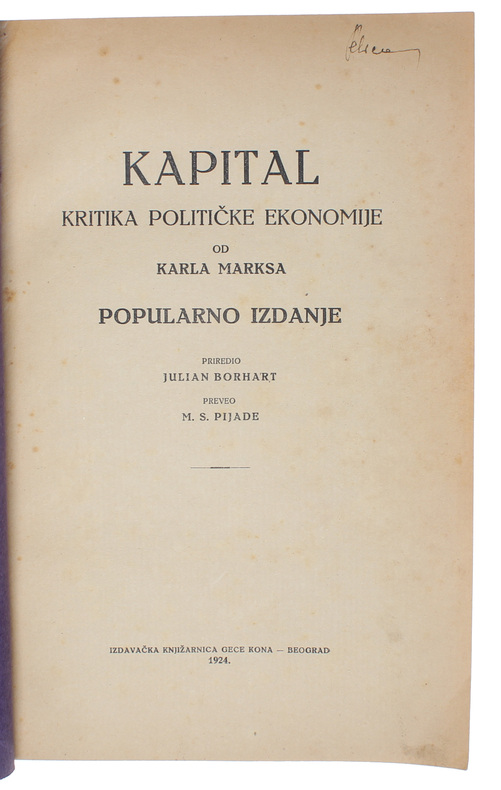
‎"[MARX, KARL], KARLA MARKSA‎

‎Kapital. Kritika Politicke Ekonomije. - [FIRST SERBIAN TRANSLATION OF MARX'S ""DAS KAPITAL""]‎

‎Beograd, Izdavacka Knjizarnica Gece Kona, 1924. 8vo. In the original printed wrappers. Spine renewed, preserving most of the original spine. Ink stain to front wrapper. Previous ower's name to top of title-page. First leaves with a few underlignings, otherwise internally fine and clean. 198, (4) pp.‎

‎Rare first Serbian translation of Marx's Das Kapital. Translator Mosa Pijade, a Serbian Sephardic Jew, were sentenced 20 years of prison in 1925 because of 'revolutionary activities', partly because of making the present translation. In prison he meet Josip Broz-Tito and Pijade became Tito s right hand, one of the leaders of Tito s Partisans during WWII and after the war the President of the Yugoslavian Parliament.During WWII Pijade became one of the leaders of Tito s partisans and after the war the President of the Yugoslavian Parliament between 1954 and 1955. In 1948, Pijade convinced Tito to allow the Yugoslav Jews to immigrate to Israel. The book was issued by Geca Kon (Géza Kohn), a Jewish publisher, born in Hungary, who owned the biggest publishing house in Yugoslavia, operating from 1901 until the occupation by Germany in 1941. After the Germans marched into Belgrade, Kon was arrested and shot. Most of his family, who were also active in the business, were taken to a concentration camp in Vojvodina and shot in the same year. OCLC only list three copies: University of Pittsburgh, Philosophical Faculty" Ljubljana and Zagreb City Library‎

书商的参考编号 : 56992

Livre Rare Book

Herman H. J. Lynge & Son
Copenhagen Denmark Dinamarca Dinamarca Danemark
[Books from Herman H. J. Lynge & Son]

€3,357.50 购买

‎"[MARX, KARL].‎

‎The Civil War in France. Address of the General Council of the International Working-Men's Association. - [MARX' SEMINAL DEFENSE OF THE PARIS COMMUNE]‎

‎High Holborn, for the Council by Edward Truelove, 1871. Small 8vo. Near contemporary quarter cloth with silver lettering to front board. Binding with signs of use, but overall good. One closed marginal tear and title-page with a few brownspots, otherwise very nice and clean. 35 pp.‎

‎Exceedingly rare first edition (with the names of Lucraft and Odger still present under ""The General Council"") of one of Marx' most important works, his seminal defense of the Paris Commune and exposition of the struggle of the Communards, written for all proletarians of the world. While living in London, Marx had joined the International Working Men's Association in 1864 - ""a society founded largely by members of Britain's growing trade unions and designed to foster international working class solidarity and mutual assistance. Marx accepted the International's invitation to represent Germany and became the most active member of its governing General Council, which met every Tuesday evening, first at 18 Greek Street in Soho and later in Holborn. In this role, Marx had his first sustained contact with the British working class and wrote some of his most memorable works, notably ""The Civil War in France"". A polemical response to the destruction of the Paris Commune by the French government in 1871, it brought Marx notoriety in London as 'the red terror doctor', a reputation that helped ensure the rejection of his application for British citizenship several years later. Despite his considerable influence within the International, it was never ideologically homogenous... (homas C. Jones: ""Karl Marx' London"").The work was highly controversial, but extremely influential. Even though most of the Council members of the International sanctioned the Address, it caused a rift internally, and some of the English members of the General Council were enraged to be seen to endorse it. Thus, for the second printing of the work, the names of Lucraft and Odger, who had now withdrawn from the Council, were removed from the list of members of ""The General Council"" at the end of the pamphlet. ""[Marx] defended the Commune in a bitterly eloquent pamphlet, ""The Civil War in France"", whose immediate effect was further to identify the International with the Commune, by then in such wide disrepute that some of the English members of the General Council refused to endorse it."" (Saul K. Padover, preface to Vol. II of the Karl Marx Library, pp. XLVII-XLVIII).""Written by Karl Marx as an address to the General Council of the International, with the aim of distributing to workers of all countries a clear understanding of the character and world-wide significance of the heroic struggle of the Communards and their historical experience to learn from. The book was widely circulated by 1872 it was translated into several languages and published throughout Europe and the United States."" (The Karl Marx Archive)Marx concluded ""The Civil War in France"" with these impassioned words, which were to resound with workers all over the world: ""Working men's Paris, with its Commune, will be forever celebrated as the glorious harbinger of a new society. Its martyrs are enshrined in the great heart of the working class. Its exterminators history has already nailed to that eternal pillory from which all the prayers of their priests will not avail to redeem them.""The address, which was delivered on May 30, 1871, two days after the defeat of the Paris Commune, was to have an astounding effect on working men all over the world and on the organization of power of the proletarians. It appeared in three editions in 1871, was almost immediately translated into numerous languages and is now considered one of the most important works that Marx ever wrote. "" ""The Civil War in France"", one of Marx's most important works, was written as an address by the General Council of the International to all Association members in Europe and the United States.From the earliest days of the Paris Commune Marx made a point of collecting and studying all available information about its activities. He made clippings from all available French, English and German newspapers of the time. Newspapers from Paris reached London with great difficulty. Marx had at his disposal only individual issues of Paris newspapers that supported the Commune. He had to use English and French bourgeois newspapers published in London, including ones of Bonapartist leanings, but succeeded in giving an objective picture of the developments in Paris. ...Marx also drew valuable information from the letters of active participants and prominent figures of the Paris Commune, such as Leo Frankel, Eugene Varlin, Auguste Serraillier, Yelisaveta Tornanovskaya, as well as from the letters of Paul Lafargue, Pyotr Lavrov and others.Originally he intended to write an address to the workers of Paris, as he declared at the meeting of the General Council on March 28, 1871. His motion was unanimously approved. The further developments in Paris led him, however, to the conclusion that an appeal should be addressed to proletarians of the world. At the General Council meeting on April 18, Marx suggested to issue ""an address to the International generally about the general tendency of the struggle."" Marx was entrusted with drafting the address. He started his work after April 18 and continued throughout May. Originally he wrote the First and Second drafts of ""The Civil War in France"" as preparatory variants for the work, and then set about making up the final text of the address.He did most of the work on the First and Second drafts and the final version roughly between May 6 and 30. On May 30, 1871, two days after the last barricade had fallen in Paris, the General Council unanimously approved the text of ""The Civil War in France"", which Marx had read out.""The Civil War in France"" was first published in London on about June 13, 1871 in English, as a pamphlet of 35 pages in 1,000 copies. Since the first edition quickly sold out, the second English edition of 2,000 copies was published at a lower price, for sale to workers. In this edition [i.e., MECW], Marx corrected some of the misprints occurring in the first edition, and the section ""Notes"" was supplemented with another document. Changes were made in the list of General Council members who signed the Address: the names of Lucraft and Odger were deleted, as they had expressed disagreement with the Address in the bourgeois press and had withdrawn from the General Council, and the names of the new members of the General Council were added. In August 1871, the third English edition of ""The Civil War in France"" came out, in which Marx eliminated the inaccuracies of the previous editions.In 1871-72, ""The Civil War"" in France was translated into French, German, Russian, Italian, Spanish, Dutch, Flemish, Serbo-Croat, Danish and Polish, and published in the periodical press and as separate pamphlets in various European countries and the USA. It was repeatedly published in subsequent years....In 1891, when preparing a jubilee German edition of ""The Civil War in France"" to mark the 20th anniversary of the Paris Commune, Engels once again edited the text of his translation. He also wrote an introduction to this edition, emphasising the historical significance of the experience of the Paris Commune, and its theoretical generalisation by Marx in ""The Civil War in France"", and also giving additional information on the activities of the Communards from among the Blanquists and Proudhonists. Engels included in this edition the First and Second addresses of the General Council of the International Working Men's Association on the Franco-Prussian war, which were published in subsequent editions in different languages also together with ""The Civil War France"". (Notes on the Publication of ""The Civil War in France"" from MECW Volume 22). Only very few copies of the book from 1871 on OCLC are not explicitly stated to be 2nd or 3rd editions, and we have not been able to find a single copy for sale at auctions within the last 50 years.‎

书商的参考编号 : 58474

Livre Rare Book

Herman H. J. Lynge & Son
Copenhagen Denmark Dinamarca Dinamarca Danemark
[Books from Herman H. J. Lynge & Son]

€83,937.49 购买

‎"ENGELS, FRIEDRICH & KARL MARX.‎

‎Die heilige Familie oder Kritik der kritischen Kritik. Gegen Bruno Bauer & Consorten. - [THE COLLABORATION THAT WOULD CHANGE THE WORLD]‎

‎Frankfurt a. M., 1845. 8vo. Contemporary black half calf. Professionally rebacked. Title-page somewhat dusty and re-hinged. VIII, 335, (1) pp.‎

‎Incredibly scarce first edition of one the most significant political publications of the 19th century, the first joint work of Marx and Engels, leading to a life-long association that would change the world. ""The Holy Family"" is one of the most fundamental works in the history of communism and contains the first formulations of a number of fundamental theses of dialectical and historical materialism. For instance, it is here that the idea of mass/the people as the actual maker of the history of mankind is put forth for the first time and here that Marx shows that communism is the logical conclusion of materialistic philosophy.The work became incredibly influential and caused great uproar. Lenin claimed that it was this work that laid the foundations for scientific revolutionary materialist socialism.At the end of August, 1844, Engels passed through Paris,on his way to Manchester. It was here that he met Marx (then for the second time).Marx suggested that the two of them should write a critique of Young Hegelian trend of thought then very popular in academic circles. They decided to co-author the foreword and divided up the other sections between them. Engels had already finished his chapters before leaving Paris after 10 days. Marx had the larger share of work, which he completed by the end of November 1844.The general title, ""The Holy Family"", was added at the suggestion of the publisher Lowenthal, being a sarcastic reference to the Bauer brothers and their supporters."" ""The Holy Family, or Critique of Critical Critique. Against Bruno Bauer and Co."" is the first joint work of Karl Marx and Frederick Engels. At the end of August 1844 Marx and Engels met in Paris and their meeting was the beginning of' their joint creative work in all fields of theoretical and practical revolutionary activity. By this time Marx and Engels had completed the transition from idealism to materialism and from revolutionary democratism to communism. The polemic The Holy Family was written in Paris in autumn 1844. It reflects the progress in the formation of Marx and Engels's revolutionary materialistic world outlook.In ""The Holy Family"" Marx and Engels give a devastating criticism of the subjectivist views of the Young Hegelians from the position of militant materialists. They, also criticize Hegel's own idealistic philosophy: giving credit for the rational element in his dialectics, they criticize the mystic side of it.The Holy Family formulates a number of fundamental theses of dialectical and historical materialism. In it Marx already approaches the basic idea of historical materialism - the decisive role of the mode of production in the development of society. Refuting the idealistic views of history which had dominated up to that time, Marx and Engels prove that of themselves progressive ideas can lead society only beyond the ideas of the old system and that ""in order to carry out ideas men are needed who dispose of a certain practical force."" (See p. 160 of the present edition.) The proposition put forward in the book that the mass, the people, is the real maker of the history of mankind is of paramount importance. Marx and Engels show that the wider and the more profound a change taking place in society is the more numerous Me mass effecting that change will Re Lenin especially stressed the importance of this thought and described it as one of the most profound and most important theses of historical materialism.The Holy Family contains the almost mature view of the historic role of the proletariat as the class which, by virtue of its position in capitalism, ""can and must free itself"" and at the same time abolish all the inhuman conditions of life of bourgeois society, for ""not in vain does"" the proletariat ""go through the stern but steeling school of labour. The question is not what this or that proletarian, or even the whole of the proletariat at the moment considers as its aim. The question is what the proletariat is, and what, consequent on that being, it will be compelled to do."" (pp. 52-53.)A section of great importance is ""Critical Battle against French Materialism"" in which Marx, briefly outlining the development of materialism in West-European philosophy, shows that communism is the logical conclusion of materialistic philosophy.The Holy Family was written largely under the influence of the materialistic views of Ludwig Feuerbach, who was, responsible to a great extent for Marx's and Engels's transition from idealism to materialism"" the work also contains elements of the criticism of Feuerbach's metaphysical and contemplative materialism given by Marx in spring 1845 in his Theses on Feuerbach. Engels later defined the place of The Holy Family in the history of Marxism when he wrote: ""The cult of abstract man, which formed the kernel of Feuerbach's new religion, had to be replaced by the science of real men and of their historical development. This further development of Feuerbach's standpoint beyond Feuerbach was inaugurated by Marx in 1845 in The Holy Family."" (F. Engels, Ludwig Feuerbach and the End of Classical German Philosophy.)The Holy Family formulates some of the basic principles of Marxist political economy. In contrast to the Utopian Socialists Marx bases the objective inevitability of the victory of communism on the fact that private property in its economic motion drives itself towards its downfall.The Holy Family dates from a period when the process of the formation of Marxism was not yet completed. This is reflected in the terminology used by Marx and Engels. Marxist scientific terminology was gradually elaborated and defined by Marx and Engels as the formation and development of their teaching progressed."" (Introduction to the work by Foreign Languages Publishers)""The book made something of a splash in the newspapers. One paper noted, that it expressed socialist views since it criticised the ""inadequacy of any half-measures directed at eliminating the social ailments of our time."" The conservative press immediately recognized the radical elements inherent in its many arguments. One paper wrote that, in The Holy Family, ""every line preaches revolt... against the state, the church, the family, legality, religion and property."" It also noted that ""prominence is given to the most radical and the most open communism, and this is all the more dangerous as Mr. Marx cannot be denied either extremely broad knowledge or the ability to make use of the polemical arsenal of Hegel's logic, what is customarily called 'iron logic.'Lenin would later claim this work laid the foundations for what would develop into a scientific revolutionary materialist socialism."" (Marx Archive).‎

书商的参考编号 : 58581

Livre Rare Book

Herman H. J. Lynge & Son
Copenhagen Denmark Dinamarca Dinamarca Danemark
[Books from Herman H. J. Lynge & Son]

€37,604.00 购买

‎"Karl Marx, Kurt H. Guddat (Editor), Lloyd Easton (Editor)#11;.".‎

‎Writings of the Young Marx on Philosophy & Society .‎

‎Anchor 1967. Paperback. Good. Used but usable! Edge wear & corner bends on cover underlining in text. ABOUT THE BOOK Writings of the Young Marx on Philosophy and Society Anchor paperback‎

书商的参考编号 : 07566 ???????? : 038507171X 9780385071710

Biblio.com

Cuyahoga Valley Book Company
United States Estados Unidos Estados Unidos États-Unis
[Books from Cuyahoga Valley Book Company]

€5.07 购买

‎"Marx, Arthur"‎

‎Red Skelton: An Unauthorized Biography‎

‎New York: "E.P. Dutton & Co. Inc." 1979. "First Edition First Printing". Hardcover. Near Fine/Near Fine. "White Cloth and Black Board Covers; edges of white covers are lightly soiled; White Endpapers; book interior is clean and tight; illustrated; 8vo; 326 pages; indexed; dustjacket is protected by a mylar wrapper and because it is white it shows light soiling; top edge of rear panel has a tiny chip and a diagonal corner crease " <br/><br/>1.30#; P3; "E.P. Dutton & Co., Inc." hardcover‎

书商的参考编号 : 980000167 ???????? : 052518953x 9780525189534

Biblio.com

Charing Cross Road Booksellers
United States Estados Unidos Estados Unidos États-Unis
[Books from Charing Cross Road Booksellers]

€16.03 购买

‎"MARX, CARLO. [KARL].‎

‎Il Capitale. Critica dell'economia politica. - [FIRST ITALIAN TRANSLATION OF MARX' ""DAS KAPITAL""]‎

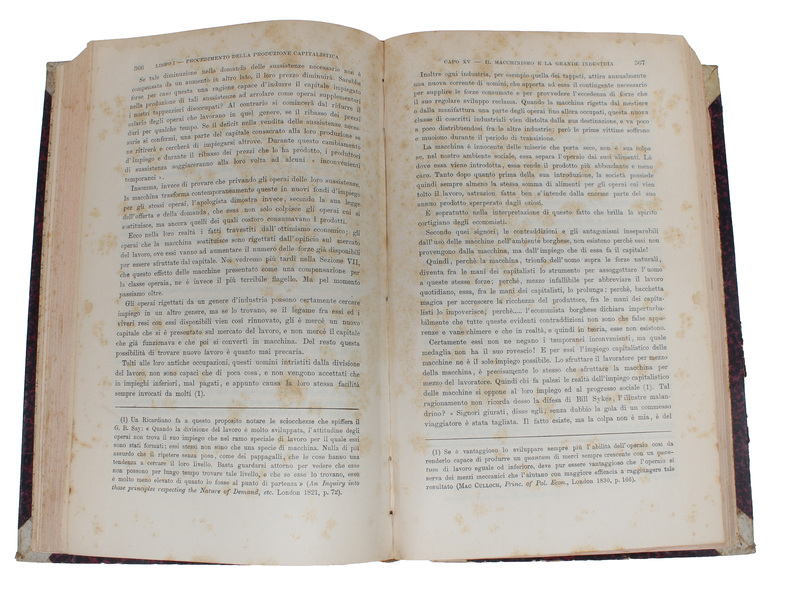
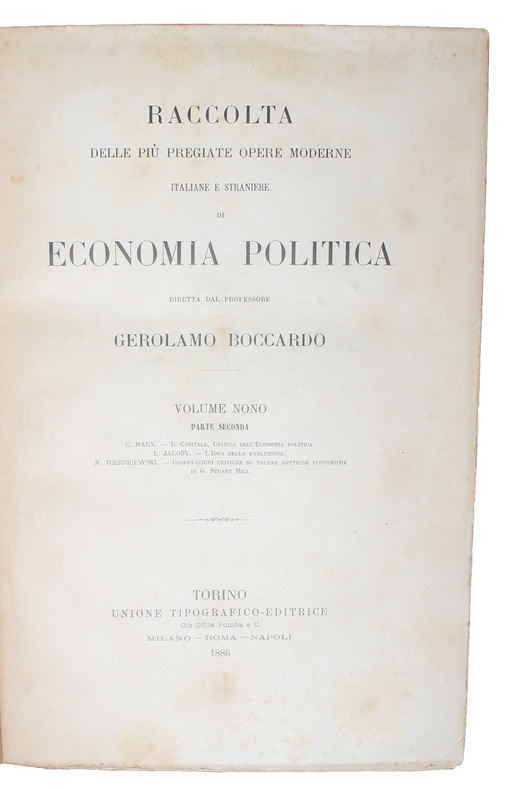
‎Torino, Unione Tipografico-Editrice, 1886. Royal8vo. Bound in a contemporary half vellum binding with red and green title label to spine with gilt lettering and ornamentation to spine, forming six compartments. In ""Biblioteca dell'Economista"", Third Series, volume 9. wear to extremities and light brownspotting throughout, especially to first and least leaves. e copy. Il Capitale: 685 pp. [Entire volume: (4), 903, (1) pp.].‎

‎First full Italian translation of Marx' landmark work, constituting what is arguably the greatest revolutionary work of the nineteenth century. The work proved immensely influential in both communist and fascist circles. Antonio Gramsci, founding member and one-time leader of the Communist Party of Italy (PCI), based much of his theoretical and practical work on the present translation of Marx' work and Ezra Pound read this Italian translation (which is among the most heavily marked annotated volumes in his personal library) and was horrified by the accounts of the exploitation of labor given by Marx which eventually grew into his sympathy for fascism and Mussolini's socialist roots. (Rainey, Textual Studies in the Cantos).The translation was done in nine installments beginning in 1882 but was not published until 1886. The translation, however, remained relatively unknown: ""It was difficult in Italy during that period [late 19th century] to obtain Marx's works. With the exception of Cafiero's hard to find summary and some other summarizing pamphlets published by another Southern scholar, Pasquale Martiguetti of Benevent, those Italians who sought to consult Marx were forced (unless they could read the original German) to have recourse to the French translation of the first volume of 'Capital', published in 1875. True, in 1886 Boccardo had published in Biblioteca dell'Economista, an Italian translation of 'Capital', but this was inaccessible to those of modest means."" (Piccone, Italian Marxism).The first edition of the work originally appeared in German in 1867, and only the first part of the work appeared in Marx' lifetime.Bert Andréas 154Einaudi (not numbered, between no. 3769 and 3770)Mattioli 2287 (a reprint from 1916).‎

书商的参考编号 : 55015

Livre Rare Book

Herman H. J. Lynge & Son
Copenhagen Denmark Dinamarca Dinamarca Danemark
[Books from Herman H. J. Lynge & Son]

€4,029.00 购买

‎"MARX, CARLO. [KARL].‎

‎Il Capitale. Critica dell'economia politica. - [FIRST COMPLETE ITALIAN TRANSLATION OF MARX' ""DAS KAPITAL""]‎

‎Torino, Unione Tipografico-Editrice, 1886. Royal8vo. Bound uncut and largely unopened with the original printed wrappers in a very nice recent red half calf binding with marbled paper covered boards. Half-title and title-page browned. Published as ""Biblioteca dell'Economista"", Third Series, volume 9. An unusually fine copy. Il Capitale: 685 pp. [Entire volume: (4), 903, (1) pp.].‎

‎First full Italian translation of Marx' landmark work, constituting what is arguably the greatest revolutionary work of the nineteenth century. The work proved immensely influential in both communist and fascist circles. Antonio Gramsci, founding member and one-time leader of the Communist Party of Italy (PCI), based much of his theoretical and practical work on the present translation of Marx' work and Ezra Pound read this Italian translation (which is among the most heavily marked annotated volumes in his personal library) and was horrified by the accounts of the exploitation of labor given by Marx which eventually grew into his sympathy for fascism and Mussolini's socialist roots. (Rainey, Textual Studies in the Cantos).The translation was done in nine installments beginning in 1882 but was not published until 1886. The translation, however, remained relatively unknown: ""It was difficult in Italy during that period [late 19th century] to obtain Marx's works. With the exception of Cafiero's hard to find summary and some other summarizing pamphlets published by another Southern scholar, Pasquale Martiguetti of Benevent, those Italians who sought to consult Marx were forced (unless they could read the original German) to have recourse to the French translation of the first volume of 'Capital', published in 1875. True, in 1886 Boccardo had published in Biblioteca dell'Economista, an Italian translation of 'Capital', but this was inaccessible to those of modest means."" (Piccone, Italian Marxism).The first edition of the work originally appeared in German in 1867, and only the first part of the work appeared in Marx' lifetime.Bert Andréas 154Einaudi (not numbered, between no. 3769 and 3770)Mattioli 2287 (a reprint from 1916).‎

书商的参考编号 : 55866

Livre Rare Book

Herman H. J. Lynge & Son
Copenhagen Denmark Dinamarca Dinamarca Danemark
[Books from Herman H. J. Lynge & Son]

€6,715.00 购买

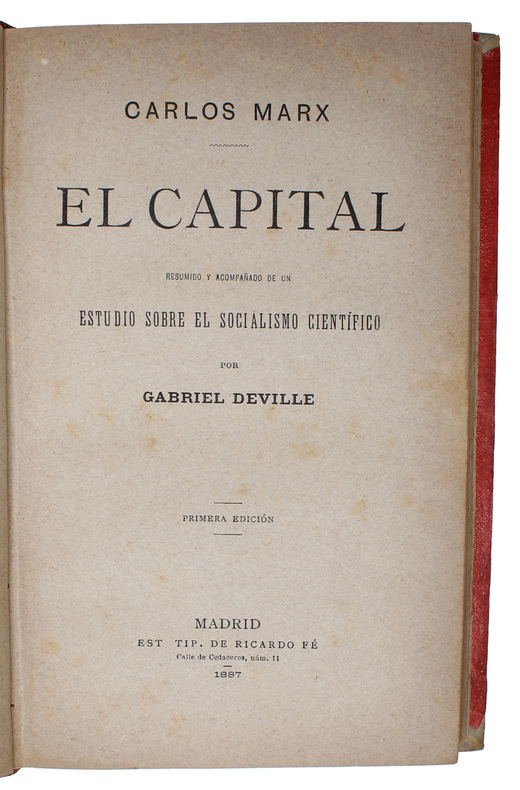
‎"MARX, CARLOS (+) FREDERICO ENGELS (+) JULIO GUESDE.‎

‎El Capital. Resumido y acompanado de un estudio sobre el socialismo científico por Gabriel Deville. Primera edición [Marx / Deville] (+) Socialismo Utopico y Socialismo Cientifico [Engels] (+) La Ley de Los Salarios y Sus Consecuencias [Guesde]. - [FIRST SPANISH EDITION OF THE MOST IMPORTANT ABRIDGED VERSION OF ""THE CAPITAL""]‎

‎Madrid, Ricardo Fé, 1887. 8vo. Contemporary brown half calf with gilt lettering and ornamentation to spine and red paper covered boards. Most leaves evenly browned (due to the quality of the paper) and some brownspotting to last few leaves. Overall a very good copy indeed of this otherwise fragile book. [Socialismo Utopico... :] pp. (1)-91, (1) + frontispiece of Engels" [La Ley de Los Salarios... :] pp. (1)-44 + frontiespiece of Guesde" [El Capital:] pp. (I)-LVI, 263 pp.‎

‎The exceedingly scarce first Spanish edition of the most important abridged version of Marx's Capital ever to have appeared, published in the same year as what is generally accepted as the first Spanish edition of ""Das Kapital"" (Zafrilla's abridged version - defectively translated from Roy's French version - which was published in newspaper installments 1886-87).This Spanish translation was made from the French of Gabriel Deville (1854 -1940), the great French socialist theoretician, politician and diplomat, who did more than almost anyone else to raise awareness of Karl Marx's theories of the weaknesses of capitalism - most effectively through the present work, which came to have a profound influence upon the spreading of Marxist thought throughout the Spanish speaking part of the world. ""The epitome, here translated, was published in Paris, in 1883, by Gabriel Deville, possibly the most brilliant writer among the French Marxians. It is the most successful attempt yet made to popularize Marx's scientific economics. It is by no means free from difficulties, for the subject is essentially a complex and difficult subject, but there are no difficulties that reasonable attention and patience will not enable the average reader to overcome. There is no attempt at originality. The very words in most cases are Marx's own words, and Capital is followed so closely that the first twenty-five chapters correspond in subject and treatment with the first twenty-five chapters of Capital. Chapter XXVI corresponds in the main with Chapter XXVI of Capital, but also contains portions of chapter XXX. The last three chapters-XXVII, XXVIII, and XXIX-correspond to the last three chapters-XXXI, XXXII, and XXXIII-of Capital."" (ROBERT RIVES LA MONTE, Intruductory Note to the 1899 English translation).The Spanish translator of the work is Antonio Atienza, a typographer and translator at the press of Ricardo Fé, who in 1886 volunteered his work at the newly founded ""El Socialista"", the Spanish flagship publication of Marxist socialism. It was also in 1886 that Atienza translated the present work, with the publication following in 1887. This translation happened almost simultaneously with the ""translation"" by Zafrilla, which appeared in weekly installments in the rival newspaper ""La Républica"", and the two first versions of ""Das Kapital"" to appear in Spanish tell the story of more than just the desire to spread Marx's ideas in Spain. Both versions were part of an ongoing struggle between political parties vying for the loyalty of Spain's workers (see more below). THE WORK IS OF THE UTMOST SCARCITY, WITH MERELY THREE COPIES LISTED ON OCLC (two in Bristish Library and one in Bibliothèque Nationale) and none at auction over the last 40 years at least.Backgrund for the publication:Among the numerous nascent political organizations that sprouted in the last half of 19th century Spain, many of them as a result to the tumultuous years after the so-called ""Glorious Revolution"" of 1868, was the Partido Socialista Obrero Español (PSOE). The party was founded by Pablo Iglesias in 1879, and it was the second socialist party in Europe, preceded only by the Sozialdemokratische Partei Deutschlands (SPD). Notably, of the original twenty-five founding members sixteen were typographers. March of 1886 was a turning point for the PSOE, as they began to publish a weekly newspaper, ""El Socialista"", in order to reach a wider audience throughout Spain and thus advance the Marxist socialist agenda, of which the paper became the flagship. (To this day, it is the official paper of the PSOE, the present ruling party in Spain, although it was suppressed during the years of Franco's dictatorial regime and published sporadically in exile, in France, or clandestinely in Spain. It was again published regularly since 1978. The PSOE gave up Marxism in 1979 in favor of Democratic Socialism.)In 1886 the translator of the present work, Antonio Atienza, was a typographer and translator at the press of Ricardo Fé. At the same time, he volunteered his work at the newly founded El Socialista, as the PSOE funds were quite limited-he wouldn't have a paid position in the paper until 1913. He translated articles by Engels, Guesde, and Buechner, among others.""Das Kapital"" had been published twenty years earlier. That it took so long to reach Spain in book form reveals, among other things, that up to that moment most of Marx's thoughts had filtered through to the workers' unions and parties by way of the writings of his followers as they were interpreted and explained by the intellectuals in charge of these organizations. It is also evident that the complexity of the book wouldn't be of much use to the average worker, factory and otherwise. Enter Deville's abridged version, which was more accessible in that some of the most basic ideas of Marx were digested and re-explained. The point was not to publish a book that could only be only be understood by economists and philosophers, but one that could be given to the workers. A rival party leftist party, considered by the PSOE as bourgeois, was the Partido Republicano Federal. One of its members, Pablo Correa y Zafrilla, undertook the task of translating the first volume of Das ""Kapital"". Quite usual for Spain at the time, the translation was published in weekly instalments to subscribers of their newspaper, ""La República"", starting in 1886 and ending in 1887. The paper then sold the cloth binding to its subscribers and offered to collect the installments to have the book bound for its customers. According to the ad in ""La República"" (22/1/1886), the translation is purportedly from the German original, but it has been clearly demonstrated that it is a defective translation from the French translation of Roy (Ribas). It seems very plausible that when the PSOE found out that someone else in Spain was beginning to publish a translation of the first volume of ""Das Kapital"", El Socialista decided to publish Deville's translation. In fact, the publication of El Capital by ""La República"" was briefly mentioned once in ""El Socialista"", and not in flattering terms (7/10/1887). That a Marxist newspaper disparaged against the first Spanish publication of ""Das Kapital"" reveals, among other things, that they were not terribly excited about some other party's publication producing a defective rendering of their guiding principles. On the other hand, that ""La República"" had decided to publish the book was probably brought about by the foundation of ""El Socialista"", as they saw that the PSOE now had the means to spread their ideas throughout the country. It is in no small way possible that the haste to publish the book brought about the many defects in the translation from the French of Roy as Correa hurried to finish it.José Mesa y Leompart, a typographer, translator, and Marxist ideologue and activist, had experienced the upheavals of the Commune of Paris during his exile after the 1868 revolution. He developed a friendship with Marx's son in law, Paul Lafargue, and his wife, Laura Marx-who themselves had been in exile in Spain during 1871-72-, as well as with Engels, with whom he shared much correspondence, and many other figures of the Marxist movement. He also met both Marx and Engels during their exile in London. His friendship with Pablo Iglesias was a major driving force behind the formation of the PSOE, and he collaborated with El Socialista both as a writer and as a financial supporter. Mesa writes to Engels in April of 1887 lamenting that some Spanish thinkers were using Marx's theories and the policies of the German Socialist Party to deny the concept of class struggle, despite the fact that ""we have […] proven to them that you and Marx have always said the opposite, and having quoted to them the very clear statements of the German Socialist Party"" [but] they remain unmovable, and at some point they even wanted to publish the abridged Capital by Deville, without the preface, and with notes interpreting the meaning in their own way-which we have impeded-(the Resumen [abridgement] of Deville will soon be published, faithfully translated into Spanish.""Therefore, as early as April of 1887 the present translation was already in progress, and in fact, according to Mesa, soon to be published, so it was apparently very advanced. It is then quite possible that Antonio Atienza was commissioned to translate the Deville's abridgement a few months earlier, and not unlikely as far as 1886, when ""La República"" was still publishing installments of the Correa translation. The PSOE is obviously trying to obscure and minimize Correa's translation by publishing the Deville book, as the task of translating ""Das Kapital"" from the original would be lengthy and costly, and it would have come out too late to ascertain their political hold on Marx's ideas. This translation of Deville, then, sees the light is in the very midst of the bickering between leftist parties, and is in fact a product of the confrontations between leftist ideologies. It was finally published about nine months after Mesa's letter to Engels. The first announcement in ""El Socialista"" appears in their November 11th, 1887 issue. The price is four pesetas, or about the cost of an entire year's subscription to the paper, although subscribers could purchase it at half price. Still, given that many subscribers were workers of scarce means, less than three hundred copies were sent out to the main Spanish cities, and that the total edition was probably about a thousand copies at most.The scarcity of this book can be underlined if one considers the virulent war that was waged against all socialist and Marxist literature during and after the Spanish Civil War by the dictatorial regime of Francisco Franco. Book purges and burnings were considerable throughout Spain since the onset of the war, in 1936. It is not that books were burnt sporadically and occasionally, but rather they were destroyed in a systematic and terrifyingly efficient manner. As early as September of 1936 official orders were given to all civil governors, mayors, school inspectors in the nationalist areas to purge all ""harmful"" books, such as pornography and books of a communist or Marxist content. Teachers, librarians, and private citizens, often purged their own libraries, public or personal, of such works in order to comply with the official orders. Countless people were summarily executed for owning certain books that revealed their political tendencies. Obviously, owning actual edition of a book by Marx was reason enough to be deemed guilty and likely executed. As the war advanced, many other such official orders were issued, and unfathomable numbers of books were burnt. To this is added that many libraries were burnt down during the bombardments that took place throughout the country, and that all the libraries of the leftist parties were systematically destroyed. The end of the war, in 1939, only made it official throughout the entire country that communist and socialist literature was banned. So even the few copies that might have survived the fires and the purges were surely disposed of by their owners. It is no small wonder that this particular copy did manage to survive.Withbound in the present volume is the first Spanish translation of Engels' ""Socialism: Utopian and Scientific"" and Jules Guesde's work on the Law of Wages. See:Ribas, Pedro. ""La primera traducción castellana de El capital, 1886 - 1887"", in Cuadernos Hispanoamericanos, Madrid, junio de 1985, pp. 201-210.Castillo, Santiago. ""Marxismo y socialismo en el siglo XIX español"", in, Movimiento sociales y estado en la España contemporánea, Manuel Ortiz et al (coord.), Universidad de Castila-La Mancha, 2001Boza Puerta, Mariano, and Sánchez Herrador, Miguel Ángel. ""El martirio de los libros: una aproximación a la destrucción bibliográfica durante la Guerra Civil."" In Boletín de la Asociación Andaluza de Bibliotecarios. Año nº 22, Nº 86-87, 2007, págs. 79-96Tur, Francesc. https://serhistorico.net/2018/04/04/el-bibliocausto-en-la-espana-de-franco-1936-1939/‎

书商的参考编号 : 58427

Livre Rare Book

Herman H. J. Lynge & Son
Copenhagen Denmark Dinamarca Dinamarca Danemark
[Books from Herman H. J. Lynge & Son]

€13,430.00 购买

‎"MARX, CARLOS [KARL] (+) GABRIELLE DEVILLE (+) [Translator:] ALBANO DE MORAES.‎

‎O Capital. (i.e. Portuguese: ""Das Kapital""). - [FIRST PORTUGUESE EDITION OF THE MOST IMPORTANT ABRIDGED VERSION OF ""THE CAPITAL""]‎

‎Lisboa, De Francisco Luiz Goncalves, 1912. 8vo. In the original red printed cloth-binding with black and white lettering. Spine with loss of the white lettering. Paper-label pasted on to lower inner margin of front board. Very light wear to extremities, Internally very fine and clean. 240 pp.‎

‎The exceedingly scarce first Portuguese edition of the most important abridged version of Marx's Capital ever to have appeared, published fifty-six years before the first full Portuguese (but published in Brazil) translation and whole sixy-two years before the first full translation published in Portugal. Curiously, two translations of the present work were made 1912 but the present translation seems to have priority (see Bastien, ""Readings and Translations of Karl Marx in Portugal""). After the 1933 rise of Salazar's dictatorial Estado Novo regime, suppression of the relatively newly founded Communist party grew. Members were arrested, tortured, and executed and many were sent to the Tarrafal concentration camp in the Cape Verde Islands. Communist literature suffered an equally repressive fate, hence the rarity of the present work. Marxism and especially Marxist writing caught on comparatively late in Portugal: ""As for the Socialist Party - supposed to be the main expression of Marxism -, it revealed itself unable to stimulate effective theoretical and doctrinal efforts. Its existence was an example of ambiguity and inconsequence. Its political programme went on mixing Marxian elements, associationist tradition and positivist thinking. Its strategy balanced continuously between an alliance with republican politicians and the maintenance of political autonomy. Its tatics balanced between electoral abstencionism and an involvement in election processes, that never led it to a relevant position in parliament. Even its international relations showed a lasting ambiguity: it had been created according to the instructions of the Marxist majority at the Hague Congress, when most of its members tended to support political abstencionism. When the formation of the Second lnternacional was taking place in Paris in 1889 Portuguese socialists tried to join the Marxist congress, after being present at the possibilist congress. In 1920 they decided to join the Third lnternacional (what was not accomplished), at the same time that an internal reformist turn was taking place."" (Bastien, ""Readings and Translations of Karl Marx in Portugal""). ""The epitome, here translated, was published in Paris, in 1883, by Gabriel Deville, possibly the most brilliant writer among the French Marxians. It is the most successful attempt yet made to popularize Marx's scientific economics. It is by no means free from difficulties, for the subject is essentially a complex and difficult subject, but there are no difficulties that reasonable attention and patience will not enable the average reader to overcome. There is no attempt at originality. The very words in most cases are Marx's own words, and Capital is followed so closely that the first twenty-five chapters correspond in subject and treatment with the first twenty-five chapters of Capital. Chapter XXVI corresponds in the main with Chapter XXVI of Capital, but also contains portions of chapter XXX. The last three chapters-XXVII, XXVIII, and XXIX-correspond to the last three chapters-XXXI, XXXII, and XXXIII-of Capital."" (ROBERT RIVES LA MONTE, Intruductory Note to the 1899 English translation). Capital de Marx also had a Portuguese edition at this time, or better, two different editions, both in 1912, but only in translation of the survey of Book I published in France by Gabriel Deville in 1883 (Marx, 1912a and Marx, 1912b). This version omitted material dealt with in at least four chapters of the original text and was not particularly appreciated by Engels. It was a simplified text, aimed at supporting the training of socialist militants and that made it possible for them to have access, indirect, to the work of Marx. The other summaries and anthologies of Capital, which, with a purpose similar to that of Deville, circulated in Europe during this period or ignored in Portugal, as was the case with Carlo Cafiero, or were only occasionally mentioned, as was the case with Paul Lafargue and Karl Kautsky, in its French versions. OCLC list two copies, both in the US.‎

书商的参考编号 : 62679

Livre Rare Book

Herman H. J. Lynge & Son
Copenhagen Denmark Dinamarca Dinamarca Danemark
[Books from Herman H. J. Lynge & Son]

€3,357.50 购买

‎"MARX, CARLOS [KARL] (+) GABRIELLE DEVILLE (+) [Translator:] ALBANO DE MORAES.‎

‎O Capital. (i.e. Portuguese: ""Das Kapital""). - [FIRST PORTUGUESE EDITION OF THE MOST IMPORTANT ABRIDGED VERSION OF ""THE CAPITAL""]‎

‎Lisboa, De Francisco Luiz Goncalves, 1912. 8vo. Uncut in the original printed wrappers. Wrappers brownpostted and with a few minor nicks and tear. Upper part of spine with loss of paper. Internally fine and clean. A fine and well preserved copy of an otherwise fragile book. 240 pp.‎

‎The scarce first Portuguese edition of the most important abridged version of Marx's Capital ever to have appeared, published fifty-six years before the first full Portuguese (but published in Brazil) translation and whole sixy-two years before the first full translation published in Portugal. Curiously, two translations of the present work were made 1912 but the present translation seems to have priority (see Bastien, ""Readings and Translations of Karl Marx in Portugal""). After the 1933 rise of Salazar's dictatorial Estado Novo regime, suppression of the relatively newly founded Communist party grew. Members were arrested, tortured, and executed and many were sent to the Tarrafal concentration camp in the Cape Verde Islands. Communist literature suffered an equally repressive fate, hence the rarity of the present work. Marxism and especially Marxist writing caught on comparatively late in Portugal: ""As for the Socialist Party - supposed to be the main expression of Marxism -, it revealed itself unable to stimulate effective theoretical and doctrinal efforts. Its existence was an example of ambiguity and inconsequence. Its political programme went on mixing Marxian elements, associationist tradition and positivist thinking. Its strategy balanced continuously between an alliance with republican politicians and the maintenance of political autonomy. Its tatics balanced between electoral abstencionism and an involvement in election processes, that never led it to a relevant position in parliament. Even its international relations showed a lasting ambiguity: it had been created according to the instructions of the Marxist majority at the Hague Congress, when most of its members tended to support political abstencionism. When the formation of the Second lnternacional was taking place in Paris in 1889 Portuguese socialists tried to join the Marxist congress, after being present at the possibilist congress. In 1920 they decided to join the Third lnternacional (what was not accomplished), at the same time that an internal reformist turn was taking place."" (Bastien, ""Readings and Translations of Karl Marx in Portugal""). ""The epitome, here translated, was published in Paris, in 1883, by Gabriel Deville, possibly the most brilliant writer among the French Marxians. It is the most successful attempt yet made to popularize Marx's scientific economics. It is by no means free from difficulties, for the subject is essentially a complex and difficult subject, but there are no difficulties that reasonable attention and patience will not enable the average reader to overcome. There is no attempt at originality. The very words in most cases are Marx's own words, and Capital is followed so closely that the first twenty-five chapters correspond in subject and treatment with the first twenty-five chapters of Capital. Chapter XXVI corresponds in the main with Chapter XXVI of Capital, but also contains portions of chapter XXX. The last three chapters-XXVII, XXVIII, and XXIX-correspond to the last three chapters-XXXI, XXXII, and XXXIII-of Capital."" (ROBERT RIVES LA MONTE, Intruductory Note to the 1899 English translation). Capital de Marx also had a Portuguese edition at this time, or better, two different editions, both in 1912, but only in translation of the survey of Book I published in France by Gabriel Deville in 1883 (Marx, 1912a and Marx, 1912b). This version omitted material dealt with in at least four chapters of the original text and was not particularly appreciated by Engels. It was a simplified text, aimed at supporting the training of socialist militants and that made it possible for them to have access, indirect, to the work of Marx. The other summaries and anthologies of Capital, which, with a purpose similar to that of Deville, circulated in Europe during this period or ignored in Portugal, as was the case with Carlo Cafiero, or were only occasionally mentioned, as was the case with Paul Lafargue and Karl Kautsky, in its French versions. OCLC list two copies, both in the US.‎

书商的参考编号 : 63248

Livre Rare Book

Herman H. J. Lynge & Son
Copenhagen Denmark Dinamarca Dinamarca Danemark
[Books from Herman H. J. Lynge & Son]

€3,760.40 购买

‎"MARX, K. (+). F. ENGELS.‎

‎Komunistički manifest [i.e. Croatian: ""Das Kommunistische Manifest""] - [RARE FIRST CROATIAN TRANSLATION OF THE COMMUNIST MANIFESTO]‎

‎Preveo M. Pijade (Belgrad), Biblioteka Marksizma-Lenjinizma, 1945. 8vo (195 x 145 mm). In the original printed wrappers. A few small nicks to wrappers and a few occassional light markings in margin. Otherwise a fine and clean copy. 64, (3) pp.‎

‎First Croatian translation of the Communist Manifesto, translated by Moša Pijade (1890 – 1957), a Yugoslav communist, politician and Tito’s close friends. Pijade also translated the introductions to previous translations to other languages, to help the reader to understand the importance of the work. Pijade, artist, art critic and author, was born in Belgrade and of Sephardic Jewish parentage. He joined the Communist party in the 1920s, in which he was active as a writer for various newspapers and magazines. After having translated ‘Das Kapital’ in 1924, Pijade was arrested and sentenced to 20 years in prison because of his ‘revolutionary activities’, a sentence, for which he served 14 years. In the prison Moša Pijade befriended Josip Bros-Tito, who was also imprisoned for his illegal communist activities, and the two men became good friends. During WWII, Pijade became one of the leaders of Tito’s partisans and after the war the President of the Yugoslavian Parliament between 1954 and 1955. In 1948, Pijade convinced Tito to allow the Yugoslav Jews to immigrate to Israel.‎

书商的参考编号 : 59904

Livre Rare Book

Herman H. J. Lynge & Son
Copenhagen Denmark Dinamarca Dinamarca Danemark
[Books from Herman H. J. Lynge & Son]

€3,021.75 购买

‎"MARX, KAREL [KARL].‎

‎Kapitál. Kritika Politické Ekonomie. [i.e. Czech ""Das Kapital""]. [Translated by Theodor Smeral]. - [FIRST CZECH TRANSLATION OF DAS KAPITAL]‎

‎Praze, 1913. Royal8vo. In contemporary full cloth with gilt lettering to spine. Ex-libris pasted on to front free end-paper. A few occassional underlignings in text. XXIII, (1), 619, (5) pp.‎

‎First Czech translation of Das Kapital. Extracts had been published in 1896 but the present translation consitute the first complete and by far the most influential.‎

书商的参考编号 : 57764

Livre Rare Book

Herman H. J. Lynge & Son
Copenhagen Denmark Dinamarca Dinamarca Danemark
[Books from Herman H. J. Lynge & Son]

€1,611.60 购买

‎"MARX, KARL (+) FRIEDRICH ENGELS‎

‎Kommúnistaávarpið [i.e. Icelandic: ""The Communist Manifesto""] - [FIRST ICELANDIC TRANSLATION OF THE COMMUNIST MANIFESTO]‎

‎Akureyri, Jafnaðarmannafélagið [i.e. Icelandic: ""the Socialist association""], 1924. 12mo. (105 x 167 mm). Original printed red wrappers, slightly sunned. Stapled block. No staining or spotting of any kind. Apart from the sunfading, mainly to back wrapper, in near mint condition. 75, (1) pp. + 1 f. (contents).‎

‎First edition of the scarce first Icelandic translation of The Communist Manifesto. Translated by Stefán Pjetursson (1898-1987) and Einar Olgeirsson (1902-1993), who were at the time studying in Berlin. Together with Brynjólfur Bjarnason (1898-1989), they were among the main leaders of Icelandic communists in the second and third decades of the 20th century. After returning to Iceland, Pjetursson worked as a journalist, and later as editor and archivist. In 1930, Pjetursson went to Moscow, where he was placed in the Inernational Lenin School, but he was expelled by the Comintern leadership, on the grounds that he was doing a poor job of retraining. He had been in contact with the Danish embassy and received a forged passport, which allowed him to return to Iceland throuh Finland. Upon his return to Akureyri, Olgeirsson worked as a teacher, writer, editor and later as a politician and member of Parliament. He was one of the co-founders of the Communist Party of Iceland in 1930 but was nearly expelled in the early 1930s for working closely with other political forces: he played the main role in the merger of the Communist Party of Iceland and another splinter group from the Social Democratic Party into the Socialist Party – of which he was chairman (1938–1968) – later merged into the People's Alliance.‎

书商的参考编号 : 63244

Livre Rare Book

Herman H. J. Lynge & Son
Copenhagen Denmark Dinamarca Dinamarca Danemark
[Books from Herman H. J. Lynge & Son]

€2,014.50 购买

‎"MARX, KARL (+) FRIEDRICH ENGELS (+) D. B. RIAZANOV (+) HAYIM HOLMSHTOK (+) M. LEVITAN.‎

‎Komunistisher Manifest [i.e. ""Communist Manifesto]. - [COMMUNIST MANIFESTO IN YIDDISH]‎

‎Moskve [Moscow], Tsentraler Farlag Far Di Felker Fun F. S. S. R., 1924. 16mo. With the original front wrapper (lacking spine and back wrapper). With previous owner's name to front wrapper (Henoch Gelernt). Front wrapper and last leaf with a few nicks, otherwise fine and clean. 181, (3) pp.‎

‎Rare first Soviet Yiddish translation of Marx and Engel's Communist Manifesto. From the library of Jewish activist Henoch Gelernt.‎

书商的参考编号 : 53496

Livre Rare Book

Herman H. J. Lynge & Son
Copenhagen Denmark Dinamarca Dinamarca Danemark
[Books from Herman H. J. Lynge & Son]

€1,343.00 购买

‎"MARX, KARL (+) FRIEDRICH ENGELS.‎

‎Komunisticni manifest. [i.e. ""The Communist Manifesto""]. - [EXCEEDINGLY RARE UNDERGROUND SLOVENIAN TRANSLATION OF THE COMMUNIST MANIFESTO]‎

‎[Slovene Littoral, Printed for Agitprop, Presumably 1944]. Small4to. In the original stapled printed grey wrappers. Previous owner's name in light pencil to front wrapper and title-page. A few brown spots to title-page, otherwise a very fine and clean copy. 52 pp.‎

‎Exceedingly rare Slovenian translation of the Communist Manifesto. This virtually unknown edition is not to be found in any bibliography nor on OCLC. The present edition of the Manifesto was printed and distributed by Agitprop, the Communist Party institution that controlled education, publishing, libraries and mass media from the end of World War II until 1952. Presumably the present publication was among the first publications made by Agitprop. Until the end of World War II Agitprop was essentially an underground movement whose goal was to pave the way for communism after the war. After the resistance in Slovenia started in summer 1941, Italian violence against the Slovene civilian population escalated and to counter the Communist-led insurgence, the Italians sponsored local anti-guerrilla units, formed mostly by the local conservative Catholic Slovene population that resented the revolutionary violence of the partisans. After the Italian armistice of September 1943, the Germans took over both the Province of Ljubljana and the Slovenian Littoral. They united the Slovene anti-Communist counter-insurgence into the Slovene Home Guard and appointed a puppet regime in the Province of Ljubljana. The anti-Nazi resistance however expanded, creating its own administrative structures as the basis for Slovene statehood within a new, federal and socialist Yugoslavia.In 1945, Yugoslavia was liberated by the underground resistance and soon became a socialist federation known as the People's Federal Republic of Yugoslavia. Slovenia joined the federation as a constituent republic, led by its own pro-Communist leadership and Agitprop became the official mass media institution.Not in OCLC‎

书商的参考编号 : 54613

Livre Rare Book

Herman H. J. Lynge & Son
Copenhagen Denmark Dinamarca Dinamarca Danemark
[Books from Herman H. J. Lynge & Son]

€1,343.00 购买

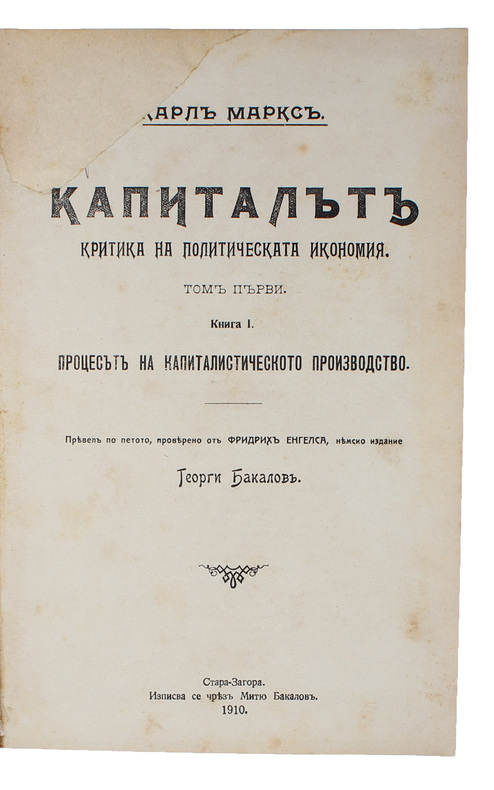
‎"MARX, KARL (+) GABRIEL DEVILLE (+) [TRANSLATOR:] CHRISTIAN RAKOVSKY (+) ED. BERNSTEIN (+) GEORGI PLEKHANOV‎

‎Kapitalutu. [i.e. Bulgarian ""Das Kapital""] [Bound with]: Predpostavkit na sotsializma i zadachitu na sotsialnata demokratsiya [i.e. Bulgarian: ""The Preconditions of Socialism and the Tasks of Social Democracy""] (+) Marksovata Istoricheska Teoria [i.e... - [FIRST BULGARIAN EDITION OF THE MOST IMPORTANT ABRIDGED VERSION OF ""THE CAPITAL""]‎

‎Varna, 1900. 8vo. In contemporary half calf with four raised bands to spine. Extremities with wear. Frontboard missing parts of cloth. Two bands on spine missing some of the leather. Verso of front free end paper with notes in contemporary hand and previous owner's name to title-page of all three works. A few occassional marginal lignings in pencil, otherwise internally good and clean. [Predpostavkit na sotsializma i zadachitu...:] XII, 257, (1), XIV pp. [Marksovata Istoricheska Teoria:] 86, (2) pp. [Kapitalutu:] IV, (5)-284 pp.‎

‎The exceedingly scarce first Bulgarian edition of the most important abridged version of Marx's Capital ever to have appeared, published five years before the first partial translation and whole 9 years before the first full Bulgarian translation. Translator Christian Rakovsky later became head of Soviet Ukraine and leader of the left opposition in the Soviet Union after 1928 was one of Trotsky's few intimate friends.""The epitome, here translated, was published in Paris, in 1883, by Gabriel Deville, possibly the most brilliant writer among the French Marxians. It is the most successful attempt yet made to popularize Marx's scientific economics. It is by no means free from difficulties, for the subject is essentially a complex and difficult subject, but there are no difficulties that reasonable attention and patience will not enable the average reader to overcome. There is no attempt at originality. The very words in most cases are Marx's own words, and Capital is followed so closely that the first twenty-five chapters correspond in subject and treatment with the first twenty-five chapters of Capital. Chapter XXVI corresponds in the main with Chapter XXVI of Capital, but also contains portions of chapter XXX. The last three chapters-XXVII, XXVIII, and XXIX-correspond to the last three chapters-XXXI, XXXII, and XXXIII-of Capital."" (ROBERT RIVES LA MONTE, Intruductory Note to the 1899 English translation).Translator Christian Rakovsky dominated the socialist movement in the Balkans during the two decades before the first world war and was probably the most influential character in spread of socialism in Europe. Trotsky wrote of him: "" Ch.G. Rakovsky is, internationally, one of the best known figures in the European Socialist movement"" and G.D.H. Cole wrote in The Second International ""No other Socialist spans the Balkans in the same way as Rakovsky, nor is there any of comparable importance.""In 1913 Rakovsky was an organizer and leader of the Rumanian Socialist Party, which later joined the Communist International. The party was showing considerable growth. Rakovsky edited a daily paper, which he financed as well.""He received his initial education at Kotel. At the age of fourteen in a period when (as he says in his Autobiography in this volume) ""even the youngest students were passionately interested in politics"", he was excluded from all Bulgarian schools after organizing a school riot which it took a company of soldiers to suppress. After a year in his father's house, ""reading indiscriminately everything that came to hand"", he was readmitted to school, only to be expelled again after a year, this time for good. The occasion this time was his collaboration with his friend and mentor, E. Dabev, one of the veterans of the Bulgarian revolutionary movement. Dabev (1864-1946) edited the first marxist weekly in Bulgaria in 1886. He published in it Marx's Wage Labour and Capital. In 1890, already a marxist, Rakovsky aided Dabev in preparing the publication of Engels's Development of Scientific Socialism, in particular in adapting Vera Zasulich's introduction to Bulgarian conditions. In this final year in school Rakovsky also produced with a friend a clandestine newspaper called Zerkalo (""Mirror""), which his Autobiography describes as having ""something of everything: Rousseau's educational ideas, the struggle between rich and poor, the misdeeds of teachers, etc. ..."" He was now seventeen years old. That same year he left Bulgaria to study medicine in Geneva.""In Geneva in 1892 Rakovsky began to edit and publish the Bulgarian journal Social Democrat which, not only in its title but also in its contents, resembled the Russian journal. Jointly with his companion Savva Balabanov, and with the active collaboration of Plekhanov, Rakovsky continued the journal for two years. Social Democrat grouped around itself in Bulgaria the supporters of the Bulgarian Social Democratic Union. This group opposed itself to the Bulgarian Social Democratic Party founded in 1891 by Dimitar Blagoev who led the left wing of the movement and later, in 1919, the Bulgarian Communist Party and made the full translation of Das Kapital in 1909. (Fagan, Biographical Introduction to Christian Rakovsky).OCLC list no copies.‎

书商的参考编号 : 57116

Livre Rare Book

Herman H. J. Lynge & Son
Copenhagen Denmark Dinamarca Dinamarca Danemark
[Books from Herman H. J. Lynge & Son]

€6,715.00 购买

‎"MARX, KARL (+) HAYDAR RIFAT (translator).‎

‎Sermaye. [i.e. Turkish: ""Das Kapital""]. - [FIRST TURKISH EDITION OF THE MOST IMPORTANT ABRIDGED VERSION OF ""THE CAPITAL""]‎

‎Istanbul, Sirketi Mürettibye Matbaasi, 1933. 8vo. In a recent full black leather binding with four raised bands and gilt lettering to spine and front board. Blindtooled frames to front and back board. A fine and clean copy. (7), (1), (5)-305, (1), [errata-leaf] pp.‎

‎Rare first Turkish book-length appearance of Marx’s landmark ‘Das Kapital’, being a translation of the most important abridged version of Marx's Capital ever to have appeared, Haydar Rifat’s (Yorulmaz) 1933 translation Sermaye, which was based on an abridged French version (1897) of the original by Gabriel Deville. Exerting great effort for the formation of the leftist thought and discourse in the late Ottoman and early Republican periods, Haydar Rifat was a prominent translator acting as a culture entrepreneur in the cultivation of leftist ideas. In his preface to Sermaye, Rifat notes that only passing remarks are made on Marx’s works in the faculties of law and political sciences and accounts for his attempt to further introduce Marx and his ideology to the academia and the public as follows: Das Kapital, Karl Marx’s masterpiece, has been translated into all major languages, and numerous commentaries and interpretations on this work have been published by experts in modern countries. The translations, commentaries and interpretations of this work are so abundant that they quantitatively surpass the commentaries on all Holy Books"" indeed, the works produced by various experts with different approaches under the title “Marxist Library” can fill up buildings. (Front the present work). ""The epitome, here translated, was published in Paris, in 1883, by Gabriel Deville, possibly the most brilliant writer among the French Marxians. It is the most successful attempt yet made to popularize Marx's scientific economics. It is by no means free from difficulties, for the subject is essentially a complex and difficult subject, but there are no difficulties that reasonable attention and patience will not enable the average reader to overcome. There is no attempt at originality. The very words in most cases are Marx's own words, and Capital is followed so closely that the first twenty-five chapters correspond in subject and treatment with the first twenty-five chapters of Capital. Chapter XXVI corresponds in the main with Chapter XXVI of Capital, but also contains portions of chapter XXX. The last three chapters-XXVII, XXVIII, and XXIX-correspond to the last three chapters-XXXI, XXXII, and XXXIII-of Capital."" (ROBERT RIVES LA MONTE, Intruductory Note to the 1899 English translation). “He also refers to how he has had to deal with the challenges arising from the translation of certain terms and/or the absence of any expert on the field whom he could consult: While doing this short translation, I have encountered many difficulties. It is necessary to find equivalents for new terms, or rather the terms, which are new for us. The trouble arose not just from finding Turkish equivalents in line with the new course our language has taken, it also concerns the difficulty in finding any equivalent. Some of these words and terms were used for the first time, while I have replaced some others with alternative words and terms though they have been in use for the past five or ten years. I almost never go out. On those rare occasions when I leave home and go out, I can find almost nobody whom I can consult and discuss my translation. (Rifat 1933, 7)” Rifat concludes his lengthy preface with a humble, almost apologetic note stating that he would be more than willing to correct any mistakes in his translation that could potentially cause his readers difficulty and that he had consulted a whole list of experts, mainly economists, about the equivalents of certain terms and the general content of the translation. The preface actually ends with a list of the names of the experts to whom Rifat had sent a copy of his translation” (Konca, The Turkish Retranslations of Marx’s Das Kapital as a Site of Intellectual and Ideological Struggle) Rifat’s translation immediately triggered a series of articles and critiques in various journals and papers upon its publication.‎

书商的参考编号 : 59547

Livre Rare Book

Herman H. J. Lynge & Son
Copenhagen Denmark Dinamarca Dinamarca Danemark
[Books from Herman H. J. Lynge & Son]

€3,357.50 购买

‎"MARX, KARL (+) HAYDAR RIFAT (translator).‎

‎Sermaye. [i.e. Turkish: ""Das Kapital""]. - [FIRST TURKISH EDITION OF THE MOST IMPORTANT ABRIDGED VERSION OF ""THE CAPITAL""]‎

‎Istanbul, Sirketi Mürettibye Matbaasi, 1933. 8vo. In contemporary full black cloth binding with gilt lettering to spine. Blindtooled frames to front and back board. Previous owner's name ""Hüsnû Hizlan"" in gilt lettering to front board. A fine and clean copy. (7), (1), (5)-305, (1), [errata-leaf] pp.‎

‎Rare first Turkish book-length appearance of Marx’s landmark ‘Das Kapital’, being a translation of the most important abridged version of Marx's Capital ever to have appeared, Haydar Rifat’s (Yorulmaz) 1933 translation Sermaye, which was based on an abridged French version (1897) of the original by Gabriel Deville. Exerting great effort for the formation of the leftist thought and discourse in the late Ottoman and early Republican periods, Haydar Rifat was a prominent translator acting as a culture entrepreneur in the cultivation of leftist ideas. In his preface to Sermaye, Rifat notes that only passing remarks are made on Marx’s works in the faculties of law and political sciences and accounts for his attempt to further introduce Marx and his ideology to the academia and the public as follows: Das Kapital, Karl Marx’s masterpiece, has been translated into all major languages, and numerous commentaries and interpretations on this work have been published by experts in modern countries. The translations, commentaries and interpretations of this work are so abundant that they quantitatively surpass the commentaries on all Holy Books"" indeed, the works produced by various experts with different approaches under the title “Marxist Library” can fill up buildings. (Front the present work). ""The epitome, here translated, was published in Paris, in 1883, by Gabriel Deville, possibly the most brilliant writer among the French Marxians. It is the most successful attempt yet made to popularize Marx's scientific economics. It is by no means free from difficulties, for the subject is essentially a complex and difficult subject, but there are no difficulties that reasonable attention and patience will not enable the average reader to overcome. There is no attempt at originality. The very words in most cases are Marx's own words, and Capital is followed so closely that the first twenty-five chapters correspond in subject and treatment with the first twenty-five chapters of Capital. Chapter XXVI corresponds in the main with Chapter XXVI of Capital, but also contains portions of chapter XXX. The last three chapters-XXVII, XXVIII, and XXIX-correspond to the last three chapters-XXXI, XXXII, and XXXIII-of Capital."" (ROBERT RIVES LA MONTE, Intruductory Note to the 1899 English translation). “He also refers to how he has had to deal with the challenges arising from the translation of certain terms and/or the absence of any expert on the field whom he could consult: While doing this short translation, I have encountered many difficulties. It is necessary to find equivalents for new terms, or rather the terms, which are new for us. The trouble arose not just from finding Turkish equivalents in line with the new course our language has taken, it also concerns the difficulty in finding any equivalent. Some of these words and terms were used for the first time, while I have replaced some others with alternative words and terms though they have been in use for the past five or ten years. I almost never go out. On those rare occasions when I leave home and go out, I can find almost nobody whom I can consult and discuss my translation. (Rifat 1933, 7)” Rifat concludes his lengthy preface with a humble, almost apologetic note stating that he would be more than willing to correct any mistakes in his translation that could potentially cause his readers difficulty and that he had consulted a whole list of experts, mainly economists, about the equivalents of certain terms and the general content of the translation. The preface actually ends with a list of the names of the experts to whom Rifat had sent a copy of his translation” (Konca, The Turkish Retranslations of Marx’s Das Kapital as a Site of Intellectual and Ideological Struggle) Rifat’s translation immediately triggered a series of articles and critiques in various journals and papers upon its publication.‎

书商的参考编号 : 59614

Livre Rare Book

Herman H. J. Lynge & Son
Copenhagen Denmark Dinamarca Dinamarca Danemark
[Books from Herman H. J. Lynge & Son]

€3,357.50 购买

‎"MARX, KARL (FRIEDRICH ENGELS edt.).‎

‎Das Kapital. Kritik der politischen Oekonomie. Zweiter Band. Buch II: Der Cirkulationsprocess des Kapitals. Herausgeben von Friedrich Engels. - [""THE FORGOTTEN BOOK OF CAPITAL""]‎

‎Hamburg: Otto Meissner, 1885. 8vo. Very nice contemporary black half calf with gilt spine. A bit of wear to extremitoes. Inner front hinge a little weak. Title-page a littel dusty, but otherwise very nice and clean. Book-plate (Arnold Heertje) to inside of front board. XXVII, (1), 526 pp. + 1 f. With pp. 515-16 in the first state (""Consumtionsfonds"" with a C) and with the imprint-leaf at the end.‎

‎Scarce first edition of the second volume of ""The Capital"", edited from Marx's manuscripts by Friedrich Engels and with a 20 pages long preface by Engels. The second volume constitutes a work in its own right and is also known under the subtitle ""The Process of Circulation of Capital "". Although this work has often been to as referred to as ""the forgotten book"" of Capital or ""the unknown volume"", it was in fact also extremely influential and highly important - it is here that Marx introduces his ""Schemes of Reproduction"", here that he founds his particular macroeconomics, and here that he so famously distinguishes two ""departments"" of production: those producing means of production and those producing means of consumption - ""This very division, as well as the analysis of the relations between these departments, is one of the enduring achievements of Marx's work."" (Christopher J. Arthur and Geert Reuten : The Circulation of Capital. Essays on Volume Two of Marx's Capital. P. 7).The work is divided into three parts: The Metamorphoses of Capital and Their Circuits, The Turnover of Capital, The Reproduction and Circulation of the Aggregate Social Capital, and it is here that we find the main ideas behind the marketplace - how value and surplus-value are realized. Here, as opposed to volume 1 of ""The Capital"", the focus is on the money-owner and -lender, the wholesale-merchant, the trader and the entrepreneur, i.e. the ""functioning capitalist"", rather than worker and the industrialist. ""[i]t was here, in the final part of this book [i.e. vol. II of Das Kapital], that Marx introduced his ""Schemes of Reproduction"", which influenced both Marxian and orthodox economics in the first decades of the twentieth century."" (Arthur & Reuten p. 1).The first volume of ""Das Kapital"" was the only one to appear within Marx' life-time. It appeared 1867, followed by this second volume 18 years later, which Engels prepared from notes left by Karl Marx.‎

书商的参考编号 : 57044

Livre Rare Book

Herman H. J. Lynge & Son
Copenhagen Denmark Dinamarca Dinamarca Danemark
[Books from Herman H. J. Lynge & Son]

€4,029.00 购买

‎"MARX, KARL [Translated by:] P. RUMYANTSEV [Edited by:] A.MANUILOV.‎

‎Kritika nekotorykh polozhenii politicheskoi ekonomii. (i.e.: ""Zur Kritik der Politischen Oekonomie"", i.e.: ""A Contribution to the Critique of Political Economy""). - [FIRST RUSSIAN TRANSLATION OF THE BLUEPRINT FOR ""DAS KAPITAL"" ]‎

‎Moscow, Izdanie Vladimira Bonch-Bruevicha, 1896. 8vo. In a later modest black half calf binding with marbled boards. Traces of stamp to verso of front and back board. Title-page slightly rubbed. Occassional underlignings in text and margins. Pp. 145-146 reinforced in margin. Otherwise a fine copy. XII, (4), (1)-160 pp.‎

‎Exceedingly rare first Russian translation of this groundbreaking work, in which Marx first presents his revolutionizing theories of capitalism. For years, the present work was largely overshadowed by ‘Das Kapital’, and despite being published 8 years earlier (The original being published in 1859, ‘Das Kapital’ in 1867), the present work was not translated, until ‘Das Kapital’ had made Marx a household name in socialist and revolutionary circles, making the present translation comparatively early (the first English translation being from 1904).The Russian censorship cut Marx’ preface in this first translation - the full text did not appear until the revolutionary decade of 1905-1917. This Manuilov/Rumiantsev-translation remained the canonic-translation throughout the Soviet rule. The translation was made by Bolshevik revolutionary Petr Rumiantsev (1870-1924), who left the party in 1907 and emigrated in 1918, but the success of the present translation is primarily due to editor Manuilov. Editor Alexander Appolonovich Manuilov (1861-1929) was a Russian economist and politician, famous not only as one of the founding members of the Constitutional Democratic party (known as the Kadets), but also as the Russian translator of the present work. ""Manuilov graduated from the law department of the University of Novorossiia (Odessa, 1883). He began scholarly and pedagogical work in political economy in 1888. In 1901 he became head of a subdepartment at Moscow University, becoming assistant rector in 1905 and serving as rector from 1908 to 1911. He was dismissed by the tsarist government for attacking the ""extremes"" of Stolypin's agrarian legislation. In the 1890's he was a liberal Narodnik (Populist), later becoming a Constitutional Democrat (Cadet) and a member of the Central Committee of the Cadet Party. Manuilov's draft on agrarian reform (1905) was the basis for the Cadets' agrarian program. V. I. Lenin sharply criticized Manuilov, calling him one of ""the bourgeois liberal friends of the muzhik who desire the 'extension of peasant land ownership' but do not wish to offend the landlords"" (Poln. sobr. soch., 5th ed., vol. 11, p. 126, note).""At the beginning of his scholarly career Manuilov accepted the labor theory of value. In 1896 he translated K. Marx' work A Contribution to the Criticism of Political Economy (Zur Kritik der Politischen Oekonomie). During the years of reaction he espoused subjectivist and psychological views in political economy. In 1917 he was minister of education of the Provisional Government. After the October Revolution in 1917 he emigrated but soon returned and cooperated with Soviet power. He participated in the orthographic reform (1918). In 1924 he became a member of the board of Gosbank (State Bank). He taught in higher educational institutions. Changing to Marxist positions and relying on Lenin's works, he criticized the revisionists and neo-Narodniks on the agrarian question."" (Encycl. Britt.). For many years, the exclusive focus on ""Das Kapital"" meant that the ""Kritik"" was overlooked. Since the beginning of the 1960's, however, scholars have become increasingly aware of its importance as the blueprint for the social and economic theory Marx shall go on to develop (see for example Raymond Aron, ""Le Marxisme de Marx"", 1962). It is here that Marx outlines the research programme to which he shall devote the rest of his working life. He himself described ""Das Kapital"" as a continuation of his ""Zur Kritik der politischen Oekonomie"" (see e.g. PMM 359), in which his primary concern is an examination of capital and in which he provides the theoretical foundation for his political conclusions later presented in ""Das Kapital"". ""I examine the system of bourgeois economy in the following order: capital, landed property, wage-labour" the State, foreign trade, world market. The economic conditions of existence of the three great classes into which modern bourgeois society is divided are analysed under the first three headings the interconnection of the other three headings is self-evident. The first part of the first book, dealing with Capital, comprises the following chapters: 1. The commodity, 2. Money or simple circulation" 3. Capital in general. The present part consists of the first two chapters."" (Preface to the present work, in the translation (by S.W. Ryazanskaya) of the Progress Publishers-edition, Moscow, 1977). Apart from the obvious importance of the work as the foundational precursor to what is probably the greatest revolutionary work of the nineteenth century, the ""Kritik"" is of the utmost importance in the history of political and economic thought, as it is here, in the preface, that Marx outlines his classic formulation of historical materialism. This preface contains the first connected account of what constitutes one of Marx's most important and influential theories, namely the economic interpretation of history - the idea that economic factors condition the politics and ideologies that are possible in a society. ""The first work which I undertook to dispel the doubts assailing me was a critical re-examination of the Hegelian philosophy of law"" the introduction to this work being published in the Deutsch-Franzosische Jahrbucher issued in Paris in 1844. My inquiry led me to the conclusion that neither legal relations nor political forms could be comprehended whether by themselves or on the basis of a so-called general development of the human mind, but that on the contrary they originate in the material conditions of life, the totality of which Hegel, following the example of English and French thinkers of the eighteenth century, embraces within the term ""civil society"""" that the anatomy of this civil society, however, has to be sought in political economy. The study of this, which I began in Paris, I continued in Brussels, where I moved owing to an expulsion order issued by M. Guizot. The general conclusion at which I arrived and which, once reached, became the guiding principle of my studies can be summarised as follows. In the social production of their existence, men inevitably enter into definite relations, which are independent of their will, namely relations of production appropriate to a given stage in the development of their material forces of production. The totality of these relations of production constitutes the economic structure of society, the real foundation, on which arises a legal and political superstructure and to which correspond definite forms of social consciousness. The mode of production of material life conditions the general process of social, political and intellectual life. It is not the consciousness of men that determines their existence, but their social existence that determines their consciousness. At a certain stage of development, the material productive forces of society come into conflict with the existing relations of production or - this merely expresses the same thing in legal terms - with the property relations within the framework of which they have operated hitherto. From forms of development of the productive forces these relations turn into their fetters. Then begins an era of social revolution. The changes in the economic foundation lead sooner or later to the transformation of the whole immense superstructure."" (Preface to the present work, in the translation (by S.W. Ryazanskaya) of the Progress Publishers-edition, Moscow, 1977). OCLC lists merely three copies, all in the US (Havard, Wisconsin, and Hoover Institute on War).‎

书商的参考编号 : 59587

Livre Rare Book

Herman H. J. Lynge & Son
Copenhagen Denmark Dinamarca Dinamarca Danemark
[Books from Herman H. J. Lynge & Son]

€6,043.50 购买

‎"MARX, KARL.‎

‎Capital. I. - The Serfdom of Work. II. - The Lordship of Wealth. [In ""To-Day: A Monthly Gathering of Bold Thoughts. Vol. I. May - September, 1883]. - [THE FIRST BRITISH TRANSLATION OF ANY PART OF ""DAS KAPITAL""]‎

‎London, The Modern Press, 1883. Royal8vo. Entire volume present, in the original olive green full cloth binding with gilt lettering to spine. Front board with black line-borders, black vignette, gilt lettering and gilt ornamentation depicting the sun. Spine with small mark and professional repairs to head and tail of spine. Light occassional brownspots to first leaves, otherwise a fine and clean copy. (Capital:) Pp. 57-68" 145-150. (Entire volume:) IV, 600 pp. Housed in a cloth clamshell box with gilt lettering to spine.‎

‎The exceedingly rare first British translation of any part of ‘Das Kapital’ and the first English translation of any part of the work to be published in Britain. When Karl Marx was finalizing the first volume of “Das Kapital”, he was already planning an English translation British socialism was dominated by trade unionism and Marx wanted to propagate his ideas among the British working class. It would take 16 years, however, before the present translation was published and a full 20 years before the first full translation of the first volume of Das Kapital was published. The present work is of the utmost scarcity and we have not beeen able to find a single auction record of it. Marx' research for ‘Das Kapital’ was in large part carried out in the reading room of the British Library, and the British working class during the industrial revolution in the late 18th century and early 19th century was highly important to Marx' class analysis. Consequently, Marx was eager to have an English translation published and for years, Marx and Engels tried to find an English translator and an editor for “Das Kapital”. While several unauthorized translations were planned and even begun, nothing came of it in Marx’s lifetime. The present book is the first volume of a journal, edited by Ernest Belfort Bax & James Leigh Joynes, which specialized in the publication of free-thinking and radical works. It was published from 1883 to 1889, and To-Day's guiding principle was to 'shake itself free from all fetters, save those of truth and taste'. Its political stance is indeed bold and not entirely unfitting for a first translation of ‘Das Kapital’: 'the equal rights of every human being to health, wealth, wisdom and happiness shall be our watchword'. Two sections of ´Das Kapital´, namely: I. The Serfdom of Work" II. The Lordship of Wealth. According to the heading, the second installment is being translated from the French edition of 1872, but a footnote states: “this chapter is translated from the second and third sections of chapter X of the original"". The first complete English book edition appeared in 1887, under the title Capital: A Critical Analysis of Capitalist Production. It was translated by Samuel Moore and Edward Aveling (the partner of Karl Marx's daughter Eleanor), overseen by Engels.‎

书商的参考编号 : 60072

Livre Rare Book

Herman H. J. Lynge & Son
Copenhagen Denmark Dinamarca Dinamarca Danemark
[Books from Herman H. J. Lynge & Son]

€20,816.50 购买

‎"MARX, KARL.‎

‎Das Kapital. Kritik der politischen Oekonomie. Erster Band. Buch I: Der Produktionsprocess des Kapitals. - [THE NEW RELIGION - PMM 359]‎

‎Hamburg, Otto Meisner, 1867. 8vo. Nice contemporary black half calf with gilt spine. Minor wear to hinges and capitals, which have tiny, barely noticeable professional restorations. Inner hinges re-enforced. Contemporary owner's names (Emil Kirchner and Karl Kirchner (1887)) to front free end-paper. Contemporary book-plate to inside of front board (Ernst Ferdinand Kirchner). A very nice copy with just the slightest of occasional brownspotting. Housed in a very nice custom-made black full morocco box with gilt llettering to spine. XII, 784 pp.‎

‎Scarce first edition of Marx' immensely influential main work, arguably the greatest revolutionary work of the nineteenth century. With its attack on capitalists and capitalist mode of production, this cornerstone of 19th century thought came to determine the trajectory of economics and politics of the Western world. Marx' groundbreaking ""Das Kapital"" originally appeared in German in 1867, and only the first part of the work appeared in Marx' lifetime. PMM 358.‎

书商的参考编号 : 56311

Livre Rare Book

Herman H. J. Lynge & Son
Copenhagen Denmark Dinamarca Dinamarca Danemark
[Books from Herman H. J. Lynge & Son]

€154,445.00 购买

‎"MARX, KARL.‎

‎Der 18the Brumaire des Louis Napoleon [in: Die Revolution, eine Zeitschrift in zwanglosen Heften. Herausgegeben von J. Weydemeyer. Erstes Heft]. - [THE MOST IMPORTANT PROPOSITIONS IN THE MARXIST TEACHING ON THE STATE]‎

‎New-York, 1852. Bound in a later (ab. 1900) red full cloth binding with silver lettering to front board. A bit of wear to capitals, corners, and extremities. Front free end-paper with small repairs and strengthening. A couple of closed tears to blank outer margin of title-page (no loss and not affecting printing)Inner blank margins of the first few leaves strengthened (far from affecting text). Occasionally a few marginal notes. and underlinings. A near contemporary notice in Russian about the work has been inserted between the title-page and the preface. All in all a good copy with no major flaws. IV, (4), 62 pp.‎

‎The exceedingly scarce first edition of one of the absolutely most important writings by Marx - his seminal essay on the French coup of 1851, which not only constitutes our principal source for the understanding of Marx' theory of the Capitalist state (together with ""The Civil War in France""), but which is also the work in which Marx formulates for the first time his view of the role of the individual in history.""This work (i.e. ""The Eighteenth Brumaire""), written on the basis of a concrete analysis of the revolutionary events in France from 1848 to 1851, is one of the most important Marxist writings. In it Marx gives a further elaboration of all the basic tenets of historical materialism - the theory of the class struggle and proletarian revolution, the state and the dictatorship of the proletariat. Of extremely great importance is the conclusion which Marx arrived at on the question of the attitude of the proletariat to the bourgeois state. He says, - ""All revolutions perfected this machine instead of smashing it."". Lenin described it as one of the most important propositions in the Marxist teaching on the state. In The Eighteenth Brumaire of Louis Bonaparte Marx continued his analysis of the question of the peasantry, as a potential ally of the working class in the imminent revolution, outlined the role of the political parties in the life of society and exposed for what they were the essential features of Bonapartism."" (note 1 in the Preface to the Third German Edition (Engels, 1885) ).""The Eighteenth Brumaire of Louis Napoleon"" was written between December 1851 and March 1852 and originally published - as it is here - in 1852 in ""Die Revolution"", a German monthly magazine established by Joseph Weydemeyer and published in New York. In this cornerstone of modern political thought, Marx discusses the French coup of 1851 in which Louis-Napoléon Bonaparte assumed dictatorial powers and does so by treating actual historical events from the viewpoint of his materialist conception of history.Marx states that his purpose with the work is to ""demonstrate how the class struggle in France created circumstances and relationships that made it possible for a grotesque mediocrity to play a hero's part"" (preface to the second edition, 1869), and he famously formulates his view of the role of the individual in history (""Men make their own history, but they do not make it as they please"" they do not make it under self-selected circumstances, but under circumstances existing already, given and transmitted from the past"").If one wants to understand Marx' views on the capitalist state, ""The 18th Brumaire"" is absolutely essential, as it is to the understanding of the nature, the rise, and the meaning of fascism. Among Marxist scholars, there's wide consensus about regarding Louis Bonaparte's coup and rise to power as a forerunner of the fascism that is to emerge the 20th century. In the words of Engels: ""The fact that a new edition of ""The Eighteenth Brumaire"" has become necessary, thirty-three years after its first appearance, proves that even today this little book has lost none of its value. It was in truth a work of genius. Immediately after the event that struck the whole political world like a thunderbolt from the blue, that was condemned by some with loud cries of moral indignation and accepted by others as salvation from the revolution and as punishment for its errors, but was only wondered at by all and understood by none-immediately after this event Marx came out with a concise, epigrammatic exposition that laid bare the whole course of French history since the February days in its inner interconnection, reduced the miracle of December 2 to a natural, necessary result of this interconnection and in so doing did not even need to treat the hero of the coup d'état otherwise than with the contempt he so well deserved. And the picture was drawn with such a master hand that every fresh disclosure since made has only provided fresh proofs of how faithfully it reflected reality. This eminent understanding of the living history of the day, this clear-sighted appreciation of events at the moment of happening, is indeed without parallel. ...In addition, however, there was still another circumstance. It was precisely Marx who had first discovered the great law of motion of history, the law according to which all historical struggles, whether they proceed in the political, religious, philosophical or some other ideological domain, are in fact only the more or less clear expression of struggles of social classes, and that the existence and thereby the collisions, too, between these classes are in turn conditioned by the degree of development of their economic position, by the mode of their production and of their exchange determined by it. This law, which has the same significance for history as the law of the transformation of energy has for natural science - this law gave him here, too, the key to an understanding of the history of the Second French Republic. He put his law to the test on these historical events, and even after thirty-three years we must still say that it has stood the test brilliantly."" (Preface to the Third German Edition (Engels, 1885)).The work is incredibly scarce. OCLC lists no more than two copies in libraries world-wide: One in the USA: University of Wisconsin, one in France: Bibliothèque Nationale. We have not been able to locate a single copy at auction over the last 60 years.‎

书商的参考编号 : 58600

Livre Rare Book

Herman H. J. Lynge & Son
Copenhagen Denmark Dinamarca Dinamarca Danemark
[Books from Herman H. J. Lynge & Son]

€100,724.99 购买

‎"MARX, KARL.‎

‎Haq-qâpîtâl: bîqqôret hak-kalkala ham-medînît, [ha-Kapital: bikoret ha-kalkalah ha-medinit], [hakapital], [i.e. Hebrew ""Das Kapital""]. 2 vols. - [FIRST HEBREW TRANSLATION OF 'DAS KAPITAL']‎

‎Yerûsalayim [Jerusalem], Sifriyyat Pôalîm, 1947 & 1954. Large8vo. Two volumes both in publisher's original printed cloth with the original dust-jackets. 763 pp."" 516 pp.Vol. 1: A bit of misolocured to spine and front board. Front dust-jacket detached from the spine and back-part. Spine lacking a third of the paper. Very fragile.Vol. 2: Upper and lower part of spine miscoloured. Dust-jacket missing upper and lower part of spine. Both volumes internally very fine and clean.‎

‎The very rare first complete Hebrew translation of Marx's Das Kapital. In the 1890ies numerous attempts at a Hebrew translation were made but not until Zevi Wislavsky's 1947-translation the Hebrew speaking world were able to read the full volume 1 of 'Das Kapital'.Marx, himself being of Jewish descent, was a proponent of antisemic idea and he argued that the modern commercialized world is the triumph of Judaism, a pseudo-religion whose god is money. Even in Das Kapital, he lets his anti-Semitism flourish: ""The capitalist knows that all merchandise, no matter how ruinous it may seem or how bad it might smell, is by faith and in truth money, internally circumcised Jews"". ""He denigrated the Polish Jewish refugees in Germany as ""the filthiest of all races"" and in the Neue Rheinische Zeitung, edited by himself, he accused the Jews of Poland of setting churches ablaze, burning villages and beating down defenseless Poles, when these were in fact the very things Polish Jews suffered at the hands of Christians."" (Schvindlerman, Karl Marx, the Jews and capitalism)OCLC only locates two copies.‎

书商的参考编号 : 56712

Livre Rare Book

Herman H. J. Lynge & Son
Copenhagen Denmark Dinamarca Dinamarca Danemark
[Books from Herman H. J. Lynge & Son]

€3,760.40 购买

‎"MARX, KARL.‎

‎Herr Vogt. - [MARX' STRUGGLE AGAINST DEFAMATION ]‎

‎London, 1860. 8vo. Bound partly uncut with the original wrappers in a nice recent half calf pastiche binding with four rasied bands and gilt lettering to spine. Front wrapper with marginal repairs and back wrappers with repairs with minor loss of text. Light brownspotting to first and last leaves. A fine copy. VI, (2), (1)-191, (1, -errata) pp.‎

‎The rare first edition of Marx' landmark defense against defamation, a seminal work in his struggle for a new human society. Written in the midst of his writing of ""The Capital"", ""Herr Vogt"" constitutes the work that took precedence over this most important critique of political economy and the work that gives us one of the most profound insights into the mind of the great Marx. ""Herr Vogt"" is furthermore the work that we have to thank for the influence that ""The Capital"" and Marxist socialism did come to have upon our society. ""In 1857, Karl Marx resumed work on his critique of political economy, a process that culminated in the publication of ""Capital"" a decade later. He wrote a rough draft (the ""Grundrisse"") in 1857 and 1858, parts of which he then reworked into the ""Contribution to the Critique of Political Economy"", which was published in June 1859. Then, in 1861 through 1863, he wrote a revised draft of the whole of ""Capital"", which was followed by a more polished draft written during 1864 and 1865. Finally, he revised the first volume yet again, during 1866 and 1867. It appeared in September, 1867.The careful reader will have noticed a rather lengthy gap in this chronology. From the second half of 1859 through 1860, Marx was not working on his critique of political economy. What was he doing instead? What was so important, so much more of an urgent priority than his theoretical work?The answer is that Marx was fighting back against Carl Vogt's defamatory attack. He fought back in order to defend his reputation and that of his ""party."" ... "" Herr Vogt"", the book Marx wrote in order to set the record straight."" (Klimann, Marx' Struggle Against Defamation).Vogt was a prominent radical German politician and materialist philosopher who had immigrated to Switzerland, where he served in parliament and was also a professor of geology. His position on the 1859 war over Italian unification had a pro-French tilt, which resulted in the publication of a newspaper article and an anonymous pamphlet that alleged (correctly) that Vogt was being paid by the French government. Vogt believed Marx to be the source of the allegation and the author of the pamphlet.Vogt fought back by attacking Marx. He published a short book that described Marx as the leader of a band of blackmailers who demanded payment in return for keeping quiet about their victims' revolutionary histories. The book also contained a number of false and harmful allegations against Marx, and Vogt did everything in his power to destroy Marx' reputation. Not only did he attack Marx personally, he also falsified facts and made up untrue allegations to libel the Communist League, portraying its members as conspirators in secret contact with the police and accusing Marx of personal motives.There is no doubt that this work of slander put both Marx' own future as well as that of the Communist League at stake. ""Ferdinand Lassalle warned Marx that Vogt's book ""will do great harm to yourself and to the whole party, for it relies in a deceptive way upon half-truths,"" and said that ""something must be done"" in response (quoted in Rubel 1980, p. 53). Frederick Engels also urged Marx to respond quickly, and he provided a good deal of assistance when Marx wrote ""Herr Vogt""....Carl Vogt and the circumstances that gave rise to his defamatory attack against Marx and his ""party"" are dead and gone. But ""Herr Vogt"" and Marx's battle against defamation remain living exemplars of how one responds in a genuinely Marx-ian way-i.e., the way of Marx. Do not separate theory from practice, or philosophy from organization. Do not retreat to the ivory tower or suffer attacks in silence"" set the record straight. Use the bourgeois courts if necessary. Enlist the assistance of others."" (Klimann).""Marx's Herr Vogt, almost entirely unknown in the English-speaking world. It is nevertheless one of the most brilliant of his writings. Engels considered it better than the Eighteenth Brumaire"" Lassalle spoke of it as ""a masterpiece in every respect"""" Ryazanov thought that ""in all literature there is no equal to this book"""" Mehring rightly wrote of its ""being highly instructive even today""."" (Karl Marx on Herr Vogt - from The New International, Vol. X No. 8, August 1944, pp. 257-260. Transcribed & marked up by Einde O'Callaghan for ETOL).‎

书商的参考编号 : 56420

Livre Rare Book

Herman H. J. Lynge & Son
Copenhagen Denmark Dinamarca Dinamarca Danemark
[Books from Herman H. J. Lynge & Son]

€13,430.00 购买

‎"MARX, KARL.‎

‎Kapitaal en Arbeid. Bewerkt door F. Domela Nieuwenhuis. - [THE RARE FIRST DUTCH TRANSLATION]‎

‎The Hague, Liebers & Co, (1881). 8vo. Uncut in the original printed wrappers. Spine missing some of the paper and upper part of front wrapper and lower part of back wrappers detached. Wrappers brownspotted and previous owner's name in pencil to upper margin of front wrapper. Pp. 37-40 missing some of the paper in upper margin - far from affecting text, otherwise internally fine and clean. VII, 82 pp.‎

‎The rare first Dutch translation of Marx’s “Lohnarbeit und Kapital” (i.e. ""Wage Labour and Capital"") here in the exceedingly rare printed wrappers, presumably being the only known copy in wrappers. This seminal work by Karl Marx, which, due to its aim to be a popular exposition of his central theories of capitalism and the economic relationships between workers and capitalists, became one of the most generally influential and widely read of Marx' works. It is widely considered the precursor to Das Kapital. ""Wage Labour and Capital"" was originally written as a series of newspaper articles in 1847 and was first published, however only fragmentarily, in the form of five articles in April 1849 in the ""Neue Rheinische Zeitung"". Because of the political conditions, the printing of the series had to be ended, and thus only these five articles appeared, as there was no sign of the rest of it between the papers of Marx that were found after his death. The work did not appear again until 1881. In 1891, Engels published a re-worked version of the article, which took into account Marx' later developments in his economic theory (for instance Engels inserted the distinction between ""labour"" and ""labour-power"", which Marx did not make in the original version), and during the 1890'ies the work appeared in numerous languages and in an enormous amount of editions. Marx' seminal theories that are made easily accessible in this important publication include his Labour Theory of Value, his Theory of Concentration of Capital, his Theory of Alienation etc., which were all later developed in the ""Capital"", three fundamental theories that have influenced all later economical-political thought. Ferdinand Domela Nieuwenhuis (1846-1919), a Dutch socialist. ""Originally a Lutheran pastor (1870-1879), he left the church, founded the socialist weekly Recht voor Allen (1879). He played a leading part in developing the Social-Democratic movement in the Netherlands" was elected to parliament for a term (1881-1891)" disappointed in legislating social reform, he turned to anarchism (1890s). He authored a number of propaganda brochures."" (Draper: The Marx-Engels Glossary, p. 154.)‎

书商的参考编号 : 60211

Livre Rare Book

Herman H. J. Lynge & Son
Copenhagen Denmark Dinamarca Dinamarca Danemark
[Books from Herman H. J. Lynge & Son]

€18,130.50 购买

‎"MARX, KARL.‎

‎Kapital. Kritika politicheskoj ekonomii. Perevod c nmetskago. Tom pervoej. Kniga I. Protschess proizvodstva Kapitala. (Russian, = The Capital. Critique of the Political Economy. Translated from German. Volume One. Book I [all].). - [FIRST TRANSLATION INTO ANY LANGUAGE OF ""THE BIBLE OF MARXISM""]‎

‎S.-Peterburg, N.I. Poliakov, 1872. Large 8vo. In a nice recent half calf binding with gilt lettering to spine and five raised bands. First few leaves with light soling and a closed tear and a few marginal repairs to title-page. pp. 11-18 with repairs to upper outer corner. Closed tears to last leaf, otherwise a fine copy. XIII, (3), 678 pp. (wanting the half-title).‎

‎First Russian edition (first issue, with the issue-pointers), being the first translation into any language, of Marx' immensely influential main work, probably the greatest revolutionary work of the nineteenth century.Marx' groundbreaking ""Das Kapital"" originally appeared in German in 1867, and only the first part of the work appeared in Marx' lifetime. The very first foreign translation of the work was that into Russian, which, considering Russian censorship at the time, would seem a very unlikely event. But as it happened, ""Das Kapital"" actually came to enjoy greater renown in Russia than in any other country"" for many varying reasons, it won a warm reception in many political quarters in Russia, and it enjoyed a totally unexpected rapid and widespread success. The first Russian translation of ""Das Kapital"" came to have a profound influence the economic development of of Russia. It was frequently quoted in the most important economic and political discussions on how to industrialize Russia and the essential points of the work were seen by many as the essential questions for an industrializing Russia. "" ""Das Kapital"" arrived in Russia just at the moment that the Russian economy was recovering from the slump that followed Emancipation and was beginning to assume capitalist characteristics. Industrialization raised in the minds of the intelligentsia the question of their country's economic destiny. And it was precisely this concern that drew Mikhailovsky and many of the ""intelligenty"" to ""Das Kapital""."" (Resis, p. 232).The story of how the first printing of the first translation of ""Das Kapital"" came about, is quite unexpected. As the ""triumph of Marxism in backward Russia is commonly regarded as a historical anomaly"" (Resis, p. 221), so is the triumph of the first Russian edition of ""Das Kapital"". The main credit for the coming to be of the translation of ""Das Kapital"" must be given to Nicolai Danielson, later a highly important economist in his own right. The idea came from a circle of revolutionary youths in St. Petersburg, including N.F. Danielson, G.A. Lopatin, M.F. Negreskul, and N.N. Liubavin, all four of whom participated in the project. Danielson had read the work shortly after its publication and it had made such an impact on him that he decided to make it available to the Russian reading public. He persuaded N.I. Poliakov to run the risk of publishing it. ""Poliakov, the publisher, specialized in publishing authors, Russian and foreign, considered dangerous by the authorities. Poliakov also frequently subsidized revolutionaries by commissioning them to do translations for his publishing house. Diffusion of advanced ideas rather than profit was no doubt his primary motive in publishing the book."" (Resis, p. 222). Owing to Danielson's initiative, Poliakov engaged first Bakunin, and then Lopatin to do the translation. Danielson himself finished the translation and saw the work through press. It was undeniably his leadership that brought Marx to the Russian reading public. In fact, with the first Russian edition of ""Das Kapital"", Danielson was responsible for the first public success of the revolutionizing work. ""Few scholars today would deny that ""Das Kapital"" has had an enormous effect on history in the past hundred years. Nonetheless, when the book was published in Hamburg on September 5, 1867, it made scarcely a stir, except among German revolutionaries. Marx complained that his work was greeted by ""a conspiracy of silence"" on the part of ""a pack of liberals and vulgar economists."" However desperately he contrived to provoke established economists to take up ""Das Kapital""'s challenge to their work, his efforts came to nought. But in October 1868 Marx received good news from an unexpected source. From Nikolai Frantsevich Danielson, a young economist employed by the St. Petersburg Mutual Credit Society, came a letter informing Marx that N. P. Poliakov, a publisher of that city, desired to publish a Russian translation of the first volume of ""Das Kapital""" moreover, he also wanted to publish the forthcoming second volume. Danielson, the publisher's representative, requested that Marx send him the proofs of volume 2 as they came off the press so that Poliakov could publish both volumes simultaneously. Marx replied immediately. The publication of a Russian edition of volume 1, he wrote, should not be held up, because the completion of volume 2 might be delayed by some six months [in fact, it did not appear in Marx' life-time and was only published ab. 17 years later, in 1885]" and in any case volume 1 represented an independent whole. Danielson proceeded at once to set the project in motion. Nearly four years passed, however, before a Russian translation appeared. Indeed, a year passed before the translation was even begun, and four translators tried their hand at it before Danielson was able to send the manuscript to the printers in late December 1871."" (Resis, pp. 221-22). This explains how the book came to be translated, but how did this main work of revolutionary thought escape the rigid Russian censors? ""By an odd quirk of history the first foreign translation of ""Das Kapital"" to appear was the Russian, which Petersburgers found in their bookshops early in April 1872. Giving his imprimatur, the censor, one Skuratov, had written ""few people in Russia will read it, and still fewer will understand it."" He was wrong: the edition of three thousand sold out quickly"" and in 1880 Marx was writing to his friend F.A. Sorge that ""our success is still greater in Russia, where ""Kapital"" is read and appreciated more than anywhere else."" (PMM 359, p.218). Astonishingly, Within six weeks of the publication date, nine hundred copies of the edition of three thousand had already been sold.""Under the new laws on the press, ""Das Kapital"" could have been proscribed on any number of grounds. The Temporary Rules held, for example, that censorship must not permit publication of works that ""expound the harmful doctrines of socialism or communism"" or works that ""rouse enmity and hatred of one class for another."" The Board of Censors of Foreign Publications was specifically instructed to prohibit importation of works contrary to the tenets of the Orthodox Church or works that led to atheism, materialism, or disrespect for Scriptures. Nor did the recent fate of the works of Marx and Engels at the hands of the censors offer much hope that ""Das Kapital"" would pass censorship. As recently as August 11, the censors of foreign works had decided to ban importation of Engels' ""Die Lage der arbeitenden Klassen in England"", and, according to Lopatin, the censors reprimanded Poliakov for daring to run announcements on book jackets of the forthcoming publication of ""Das Kapital"". By 1872 the censors had prohibited the importation and circulation of all works by Marx and Engels except one - ""Das Kapital"". The book, as we shall see, had already won some recognition in Russia shortly after its publication in Germany. Not until 1871, however, did the censors render a judgment on the book, when the Central Committee of Censors of Foreign Publications, on the recommendation of its reader, permitted importation and circulation of the book both in the original language and in translation. The official reader had described the book as ""a difficult, inaccessible, strictly scientific work,"" implying that it could scarcely pose a danger to the state. [...] The length and complexity of the book prompted the office to divide the task of scrutinizing it between two readers, D. Skuratov, who read the first half of the book, and A. De-Roberti, who read the last half. Skuratov dutifully listed objectionable socialist and antireligious passages, taking special note of Marx's harsh attack on the land reforms General Kiselev had instituted in the Danubian Principalities. But in his report Skuratov dismissed these attacks as harmless, since they were imbedded in a ""colossal mass of abstruse, somewhat obscure politico-economic argumentation."" Indeed, he regarded the work as its own best antidote to sedition. ""It can be confidently stated,"" he wrote, ""that in Russia few will read it and even fewer will understand it."" Second, he said, the book could do little harm. Since the book attacked a system rather than individual persons, Skuratov implied that the book would not incite acts threatening the safety of the royal family and government officials. Third, he believed that the argument of the book did not apply to Russia. Marx attacked the unbridled competition practiced in the British factory system, and such attacks, Skuratov asserted, could find no target in Russia because the tsarist regime did not pursue a policy of laissez faire. Indeed, at that very moment, Skuratov stated, a special commission had drafted a plan that ""as zealously protects the workers' well-being from abuses on the part of the employers as it protects the employers' interests against lack of discipline and nonfulfillment of obligations on the part of the workers."" Repeating most of Skuratov's views, De-Roberti also noted that the book contained a good account of the impact of the factory system and the system of unpaid labor time that prevailed in the West. In spite of the obvious socialist tendency of the book, he concluded, a court case could scarcely be made against it, because the censors of foreign works had already agreed to permit importation and circulation of the German edition. With the last barrier removed, on March 27, 1872, the Russian translation of ""Das Kapital"" went on sale in the Russian Empire. The publisher, translators, and advocates of the book had persevered in the project for nearly four years until they were finally able to bring the book to the Russian reading public."" (Resis, pp. 220-22). The Russian authorities quickly realized, however, that Skuratov's statement could not have been more wrong, and the planned second edition of the Russian translation was forbidden"" thus it came to be published in New York, in 1890. That second edition is nearly identical to the first, which can be distinguished by the misplaced comma opposite ""p. 73"" in the table of contents (replaced by a full stop in the 2nd ed.) and the ""e"" at the end of l. 40 on p. 65 (replaced by a ""c"" in the 2nd ed.). A third edition, translated from the fourth German edition, appeared in 1898. Volumes 2 and 3 of ""Das Kapital"" appeared in Russian translation, also by Danielson, in 1885 and 1896.See: Albert Resis, Das Kapital Comes to Russia, in: Slavic Review, Vol. 29, No. 2 (Jun., 1970), pp. 219-237.‎

书商的参考编号 : 60281

Livre Rare Book

Herman H. J. Lynge & Son
Copenhagen Denmark Dinamarca Dinamarca Danemark
[Books from Herman H. J. Lynge & Son]

€13,430.00 购买

????? : 23,139 (463 ?)

??? ??? 1 [2] 3 4 5 6 7 ... 72 137 202 267 332 397 462 ... 463 ??? ????