Professional bookseller's independent website

‎Tea‎

Main

Parent topics

‎Gastronomy‎
Number of results : 506,697 (10134 Page(s))

First page Previous page 1 ... 18 19 20 [21] 22 23 24 ... 1468 2912 4356 5800 7244 8688 10132 ... 10134 Next page Last page

‎"AEPINUS (ÆPINUS), FRANZ ULRICH THEODOSICUS. - ANALYSIS OF THE MICROMETER.‎

‎Sur les inconvéniens qu'on a lieu de Craindre dans l'usage du Micrometre, surtout par Rapport aux Instrumens qu'on adapte au quart de Cercle.‎

‎(Berlin, Haude et Spener, 1758). 4to. No wrappers as issued in ""Mémoires de l'Academie Royale des Sciences et Belles-Lettres"" Tome 12 (1756), pp. 365-386 a. 2 folded engraved plates.‎

‎First apperance of the paper in which Aepinus gives a mathematical analysis of a micrometer adapted to a quadrant circle, his only publication related to satronomy.‎

Bookseller reference : 49127

Livre Rare Book

Herman H. J. Lynge & Son
Copenhagen Denmark Dinamarca Dinamarca Danemark
[Books from Herman H. J. Lynge & Son]

€134.30 Buy

‎"AIRY, B.G. (GEORGE BIDELL). - THE FIGURE OF THE EARTH.‎

‎On the Figure of the Earth. Read June 15, 1826.‎

‎(London, W. Nicol, 1826). 4to. No wrappers as extracted from ""Philosophical Transactions"" 1826 - Part II. Pp. 548-579. Clean and fine.‎

‎Airy's classic paper on the figure of the earth.‎

Bookseller reference : 46375

Livre Rare Book

Herman H. J. Lynge & Son
Copenhagen Denmark Dinamarca Dinamarca Danemark
[Books from Herman H. J. Lynge & Son]

€67.15 Buy

‎"AIRY, B.G. (GEORGE BIDELL). - WEIGHTING THE EARTH.‎

‎Account of Pendulum Experiments undertaken in the Harton Colliery, for the purpose of determining the Mean Density of the Earth. Received December 26, 1855, - Read January 24 and 31, 1856. (+) Supplement to the ""Account of Pendulum Experiments...."" "" ...‎

‎(London, Taylor and Francis, 1856). 4to. No wrappers as extracted from ""Philosophical Transactions"" 1856 - Vol. 146 - Part I. Pp. 297-342 a. pp. 343-355. Clean and fine.‎

‎First printing of the paper in which Airy describes his remarkable experiments aiming at finding the density of the earth. His approach to the problem was to determine the differences of gravity at the top as well at the bottom of a suitable deep mine.""One of the most remarkable of Airy's researches was his determination of the mean density of the Earth. In 1826, the idea occurred to him of attacking this problem by means of pendulum experiments at the top and bottom of a deep mine. His first attempt, made in the same year, at the Dolcoath mine in Cornwall, failed in consequence of an accident to one of the pendulums. A second attempt in 1828 was defeated by a flooding of the mine, and many years elapsed before another opportunity presented itself. The experiments eventually took place at the Harton pit near South Shields in 1854. Their immediate result was to show that gravity at the bottom of the mine exceeded that at the top by 1/19286 of its amount, the depth being 383 m (1,256 ft) From this he was led to the final value of Earth's specific density of 6.566.[This value, although considerably in excess of that previously found by different methods, was held by Airy, from the care and completeness with which the observations were carried out and discussed, to be ""entitled to compete with the others on, at least, equal terms."" (The currently accepted value for Earth's density is 5.5153 g/cm.). (Wikipedia).‎

Bookseller reference : 46373

Livre Rare Book

Herman H. J. Lynge & Son
Copenhagen Denmark Dinamarca Dinamarca Danemark
[Books from Herman H. J. Lynge & Son]

€161.16 Buy

‎"Amey, James M.; Experience, Toni L. Amey of The I‎

‎Lost Idora Park Images of America‎

‎new. unknown‎

Bookseller reference : 35848835-n ISBN : 1467103934 9781467103930

Biblio.com

GreatBookPrices
United States Estados Unidos Estados Unidos États-Unis
[Books from GreatBookPrices]

€14.26 Buy

‎"Amey, James M.; Experience, Toni L. Amey of The I‎

‎Lost Idora Park Images of America‎

‎like new. unknown‎

Bookseller reference : 35848835 ISBN : 1467103934 9781467103930

Biblio.com

GreatBookPrices
United States Estados Unidos Estados Unidos États-Unis
[Books from GreatBookPrices]

€16.55 Buy

‎"AMICI, JEAN-BAPTISTE. - INVENTION OF THE ACROMATIC MICROSCOPE.‎

‎Sur les Microscopes catadioptriques. (Traduit de l'italien).‎

‎Paris, Crochard, 1821. No wrappers. In: ""Annales de Chimie et de Physique, Par MM. Gay-Lussac et Arago."", tome 17, Cahier 4. With titlepage to tome 17. Pp. 337-414 a. 1 engraved folded plate. (Entire issue offered). Amici's paper: pp. 412-434 a. 1 folded engraved plate. Clean and fine, printed on good paper.‎

‎First French edition of Amici's famous paper ""Dei microscopii catadiottrici"" first published in Italian in 1818, in which he describes his invention of a new type of catadioptric microscope, the first with successfull achromatic lenses. The invention had a great impact on biology - Amici himself was able to see the streeming movements of protoplasm in the Alga Chara and in examining the hairs on the stigma of Purslane he saw a tube given off by the pollen grain, and the granular content os prerform streaming movementys like those in Chara, an importent feature in plant fertilization.‎

Bookseller reference : 48349

Livre Rare Book

Herman H. J. Lynge & Son
Copenhagen Denmark Dinamarca Dinamarca Danemark
[Books from Herman H. J. Lynge & Son]

€268.60 Buy

‎"AMONTONS, (GUILLAUME). - IMPROVING THE BAROMETER.‎

‎De la Hauteur du Mercure dans les Barometres. (+) Suite des Remarques sur la hauteur du mercure....(+) Suite des remarques...(+) Suite des Remarques...(4 Parts).‎

‎(Paris, Jean Boudot, 1706). 4to. Without wrappers. Extracted from ""Mémoires de l'Academie des Sciences. Année 1705"". Pp. 229-232, 232-234, 234-236 a. 267-272.‎

‎First apperance of one of Amontons last papers on the barometer. He develops, after having noted that barometers are affected by heat as well as by the weight of the atmosphere, his mercury barometer.‎

Bookseller reference : 45174

Livre Rare Book

Herman H. J. Lynge & Son
Copenhagen Denmark Dinamarca Dinamarca Danemark
[Books from Herman H. J. Lynge & Son]

€201.45 Buy

‎"AMONTONS, (GUILLAUME). - ESTABLISHING THE LAW OF PROPORTIONALITY AND THE BASIC CONCEPT OF FRICTION.‎

‎De la Resistance cause'e dans les Machines, tant par les frottemens des parties qui les composent, que par la roideur des Cordes qu'on y employe, & la maniere de calculer l'un & l'autre.‎

‎(Paris, Jean Boudot, 1702). 4to. Without wrappers. Extracted from ""Mémoires de l'Academie des Sciences. Année 1699"". Pp. 206-227 a. 5 large engraved plates (tables). Textillustrations. Last leaf with a small paperloss in inner margin‎

‎First appearance of a milestone paper on the friction loss of energy in machines, hereby establishing the basic concepts of friction.""In the same year (1699) Amontons produced the first known study on the question of losses caused by friction in machines. He then established the las of proportionality between friction an the mutual pressure of the bodies in contact."" (DSB I, p. 138).‎

Bookseller reference : 44387

Livre Rare Book

Herman H. J. Lynge & Son
Copenhagen Denmark Dinamarca Dinamarca Danemark
[Books from Herman H. J. Lynge & Son]

€671.50 Buy

‎"AMONTONS, (GUILLAUME). - THE INVENTION OF THE AIR PRESSURE THERMOMETER.‎

‎Discours sur quelques proprietez de l'air, & le moyen d'en connoître la temperature dans tous les climats de la terre.‎

‎(Paris, Jean Boudot, 1704). 4to. Without wrappers. Extracted from ""Mémoires de l'Academie des Sciences. Année 1702"". Pp. 155-174 a. textillustrations.‎

‎First appearance of this paper in which Amontons describes his invention, construction and function of his air thermomer. He thus improves on Gallileo's design by using air pressure instead of volume. The paper is the earliest study in this field, and Amontions concludes ""that unequal masses of air under equal weights invcrease equally the force of their spring for equal degrees of heat"" Fifteen years later Gay-lussac performed the same experiments with better technique and results - the Gay-Lussac laws.The paper ""contains Amontons' account of the first thermometer with which temperature was measured by the pressure of air.""(Magie ""A Source book in Physics"", pp. 128 ff.).""His first scientific production was a Hygrometer in 1687....The other was an air thermometer independent of the atmospheric pressure. Air occupied the top of one of the branches of a U-shaped tube, and by its dilation it pushed down one of the mercury columns so that the other end ofthe branch formed a barometric chamber.""(DSB I, p. 138 a).Parkinson ""Breakthroughs"", 1702 M).‎

Bookseller reference : 44385

Livre Rare Book

Herman H. J. Lynge & Son
Copenhagen Denmark Dinamarca Dinamarca Danemark
[Books from Herman H. J. Lynge & Son]

€872.95 Buy

‎"AMONTONS, (GUILLAUME). - THE INVENTION OF THE THERMIC MOTOR.‎

‎Moyen de substituer Commodement L'Action du Feu, a la Force des Hommes et des Chevaux pour mouvoir les Machines.‎

‎(Paris, Jean Boudot, 1702). 4to. Without wrappers. Extracted from ""Mémoires de l'Academie des Sciences. Année 1699"". Pp. 112-126 and 1 engraved plate. (showing the ""Moulin a Feu"" Textillustrations.‎

‎First apperance of this classic paper in which Amontons decribes his invention of a thermic motor.""As early as 1699 Amontons proposed a thermic motor: a machine using hot air and external combustion with direct rotation. The experiments carried on in connection with this machine led him to note that ordinary air going from the temperature of ice to that of boiling water increases in volume by about one third.""(DSB I, p. 139).Together with L'HOPITAL ""Methode Facil pour trouver un Solide Rond qui étant mû dans un Fluide en repos paralellement..."" 1699/1702. Pp. 107-112‎

Bookseller reference : 44388

Livre Rare Book

Herman H. J. Lynge & Son
Copenhagen Denmark Dinamarca Dinamarca Danemark
[Books from Herman H. J. Lynge & Son]

€470.05 Buy

‎"AMPÈRE, ANDRÉ-MARIE. - THE CARDINAL FORMULAS OF ELECTRO-DYNAMICS.‎

‎Mémoire sur une nouvelle Expérience électrodynamique, sur son application à la formule qui représente l'action mutuelle de deux élemend de conducteurs voltaïques, et sur de nouvelles conséquences déduites de cette formule. (Lu à l'Academie royale de...‎

‎(Paris, Crochard, 1825). Extracted from ""Annales de Chimie et de Physique, Par MM. Gay-Lussac et Arago."", tome 29 a. 30. Ampère's papers: pp. 381-404 a. 1 folded engraved plate (tome 29) + Suite pp. 29-41 (tome 30) + ""Lettre à Gerhardi"": pp. 373-381 (tome 29). With both halftitlepages to vol. 29 a. 30. Scattered brownspots.‎

‎First appearance of this famous memoir, in which Ampère presented his collected results on electrodynamics to the French Academy, creating the foundation of 19th century developments in electricity and magnetism. In the words of James Clark Maxwell, ""We can scarcely believe that Ampère really discovered the law of action by means of the experiments which he describes. We are led to suspect, what, indeed, he tells us himself, that he discovered the law by some process which he has not shown us, and that when he had afterwards built up a pefect demonstration he removed all traces of the scaffolding by which he raised it.""The offered memoir was published BEFORE the famous ""Theorie mathématique des phénomènes électro-dynamiques uniquement déduite de L'expérience"", which did not appear until 1827. That 1827-Memoire incorporates, together with a new presentation of Ampère's results from 1820, 1822, 1823, the offered memoir (1825). (Horblit: 100 - Dibner: 62).""From 1814 until 1820 Ampére did not perform the kind of research that would have made it into the annals of the histrory of science, but on September 11, 1820 when he heard Francois Arago speak about Oersted's work, he got fresh inspiration and started the work that made him famous. Arago related how Oersted had found that a steady electric current influences the orientation of a compass needle. After a weak Ampère had determined experimentally that that two straight, parallel, and current-carrying, wires execute a force on each other. The magnitude of the force is inversely proportional to the distance between the wires and proportional to the strenghts of the current..... During the following years he continued his researches, both experimentally and theoretically. he built an instrument for measuring electricity that later was developed into the galvanometer. Finally in 1825 he presented his collected results to the Academy IN ONE OF THE MOST CELEBRATED MEMOIRS IN THE HISTORY OF NATURAL PHILOSOPHY (The paper offered)."" (Citizen's Compendium, p. 2). - Norman No 47.‎

Bookseller reference : 47420

Livre Rare Book

Herman H. J. Lynge & Son
Copenhagen Denmark Dinamarca Dinamarca Danemark
[Books from Herman H. J. Lynge & Son]

€1,275.85 Buy

‎"AMPÈRE, ANDRÉ-MARIE. - ""ONE OF THE MOST CELEBRATED MEMOIRS IN THE HISTORY OF NATURAL PHILOSOPHY""‎

‎Mémoire sur une nouvelle Expérience électrodynamique, sur son application à la formule qui représente l'action mutuelle de deux élemend de conducteurs voltaïques, et sur de nouvelles conséquences déduites de cette formule. (Lu à l'Academie royale de...‎

‎Paris, Crochard, 1825. 8vo. Bound in 2 uniform later hcloth. Gilt lettering to spines. In: ""Annales de Chimie et de Physique, Par MM. Gay-Lussac et Arago."", tome 29 a. 30. - 448 pp. and 3 folded engraved plates + 448 pp. and 2 folded engraved plates. (The entire volumes offered). Ampère's papers: pp. 381-404 (tome 29) + Suite pp. 29-41 (tome 30) + ""Lettre à Gerhardi"": pp. 373-381 (tome 29). Some scattered brownspots.‎

‎First appearance of this famous memoir, in which Ampère presented his collected results on electrodynamics to the French Academy, creating the foundation of 19th century developments in electricity and magnetism. In the words of James Clark Maxwell, ""We can scarcely believe that Ampère really discovered the law of action by means of the experiments which he describes. We are led to suspect, what, indeed, he tells us himself, that he discovered the law by some process which he has not shown us, and that when he had afterwards built up a pefect demonstration he removed all traces of the scaffolding by which he raised it.""The offered memoir was published BEFORE the famous ""Theorie mathématique des phénomènes électro-dynamiques uniquement déduite de L'expérience"", which did not appear until 1827. That 1827-Memoire incorporates, together with a new presentation of Ampère's results from 1820, 1822, 1823, the offered memoir (1825). (Horblit: 100 - Dibner: 62).""From 1814 until 1820 Ampére did not perform the kind of research that would have made it into the annals of the histrory of science, but on September 11, 1820 when he heard Francois Arago speak about Oersted's work, he got fresh inspiration and started the work that made him famous. Arago related how Oersted had found that a steady electric current influences the orientation of a compass needle. After a weak Ampère had determined experimentally that that two straight, parallel, and current-carrying, wires execute a force on each other. The magnitude of the force is inversely proportional to the distance between the wires and proportional to the strenghts of the current..... During the following years he continued his researches, both experimentally and theoretically. he built an instrument for measuring electricity that later was developed into the galvanometer. Finally in 1825 he presented his collected results to the Academy IN ONE OF THE MOST CELEBRATED MEMOIRS IN THE HISTORY OF NATURAL PHILOSOPHY (The paper offered)."" (Citizen's Compendium, p. 2). - Norman No 47.The volumes contain many other notable papers by: Wöhler, Fresnel, Marcet, Berzelius, Felix Savart, De la Rive, Braconnet, Boussingault, Magnus, Poncelet, Vaugelin, Poisson, Gay-Lussac, Faraday, Laplace etc.‎

Bookseller reference : 48082

Livre Rare Book

Herman H. J. Lynge & Son
Copenhagen Denmark Dinamarca Dinamarca Danemark
[Books from Herman H. J. Lynge & Son]

€2,954.60 Buy

‎"AMPÈRE, ANDRÉ-MARIE. - DEMONSTRATING THE BOYLE-MARIOTTE LAW OR AMPÈRES GAS LAW.‎

‎Démonstration de la relation découverte par Mariotte, entre les volumes des gaz et les pressions qu'ils supportent à une même température. Lu a l'Institut, le 24 janvier 1814.‎

‎Paris, Crochard, 1815. Contemp. hcalf. Spine gilt. Slightly rubbed. A few scratches to binding. Wear to top of spine. Small stamps on verso of titlepage.In: ""Annales de Chimie, ou Recueil de Mémoires concernant la Chemie"" Tome 94. 336 pp. a. 1 plate (the plate in facs., not belonging to Ampere's paper). Ampere's paper: pp. Some scattered brownspots.‎

‎First appearance of Amperes second paper on molecular physics.""The noumenal aspect of chemistry fascinated Ampère. Although his derivation of Avogadro’s law came three years after Avogadro had enunciated it, the law is known today in France as the Avogadro-Ampère law. This was Ampère’s first excursion into molecular physics, and was followed almost immediately by a second. In 1815 he published a paper demonstrating the relation between Mariotte’s (Boyle’s) law and volumes and pressures of gases at the same temperature. The paper is of some interest as a pioneer effort, along with Laplac’s great papers on capillarity, in the application of Mathematical analysis to the molecular realm.""(DSB).The volume contains 3 importent papers by Jean-Baptiste Biot on polarisation of light and Berzelius ""Experiences pour déterminer les proportions définies, dans lequelles les élémens de la nature organique sont combinés"" + ""Suite..."" 1-2, pp. 5-33, pp. 170-190 a. pp. 296-232‎

Bookseller reference : 45113

Livre Rare Book

Herman H. J. Lynge & Son
Copenhagen Denmark Dinamarca Dinamarca Danemark
[Books from Herman H. J. Lynge & Son]

€268.60 Buy

‎"AMPÈRE, ANDRÉ-MARIE. - INCORPORATED IN THE ""PRINCIPIA"" OF ELECTRODYNAMICS.‎

‎Extrait d'un Mémoire sur les Phénomènes électro-dynamiques. (Communique à l'Academie royale des Sciences le 22 dévcembre 1823). + Suite de l'Extrait, fait par M. Ampère, de son Mémoire sur les Phénomènes électro-dynamiques.‎

‎Paris, Crochard, 1824. 8vo. Without wrappers. In 'Annales de Chimie et de Physique', Series 2 - Volume 26, issue 2 and 3. With titlepage to vol. 26. Pp. 113-224 a. pp. 225-336, 1 folded engraved plate (entire issues offered). Ampere's papers: pp. 134-162 a. pp. 246-258.‎

‎First appearance of one of Ampere's importent contributions to electrodynamic. This memoir was later incorporated in his great memoir of 1827 ""Mémoire sur la théorie mathématique des phénomenes electro-dynamiques...."", published 1827, the ""Principia"" of electrodynamics.‎

Bookseller reference : 44786

Livre Rare Book

Herman H. J. Lynge & Son
Copenhagen Denmark Dinamarca Dinamarca Danemark
[Books from Herman H. J. Lynge & Son]

€1,007.25 Buy

‎"AMPÈRE, ANDRÉ-MARIE. - INCORPORATED IN THE ""PRINCIPIA"" OF ELECTRODYNAMICS AND THE INVENTION OF THE SOLENOID.‎

‎Extrait d'un Mémoire sur les Phénomènes électro-dynamiques. (Communique à l'Academie royale des Sciences le 22 dévcembre 1823). + Suite de l'Extrait, fait par M. Ampère, de son Mémoire sur les Phénomènes électro-dynamiques. + Description d'un Appa...‎

‎Paris, Crochard, 1824. 8vo. Contemp. hcloth with gilt lettering to spine. In 'Annales de Chimie et de Physique', Series 2 - Volume 26. 448 pp. a. 5 large folded engraved plates. (Entire volume offered). Ampere's papers: pp. 134-162, 246-258 a. 390-411. A bit of browning to halftitle and verso of last plate. A few scattered brownspots.‎

‎The first paper is the first appearance of one of Ampere's importent contributions to electrodynamic. This memoir was later incorporated in his great memoir of 1827 ""Mémoire sur la théorie mathématique des phénomenes electro-dynamiques...."", published 1827, the ""Principia"" of electrodynamics.The second paper is the first appearence of the paper in which Ampere describes his invention of the SOLENOID, the electro-magnetic device he used in his early electrodynamical experiments.""A solenoid is a coil wound into a tightly packed helix. In physics, the term solenoid refers to a long, thin loop of wire, often wrapped around a metallic core, which produces a magnetic field when an electric current is passed through it. Solenoids are important because they can create controlled magnetic fields and can be used as electromagnets. The term solenoid refers specifically to a magnet designed to produce a uniform magnetic field in a volume of space (where some experiment might be carried out).""The volume contains further importent papers by Poisson ""Sur la Chaleur rayonnante"", pp. 225-246 + Note.. pp. 442-44, Gay-Lussac, Savart, Pelletier et Caventou, Becquerel etc.‎

Bookseller reference : 48831

Livre Rare Book

Herman H. J. Lynge & Son
Copenhagen Denmark Dinamarca Dinamarca Danemark
[Books from Herman H. J. Lynge & Son]

€1,275.85 Buy

‎"AMPÈRE, ANDRÉ-MARIE. - THE CLASSIFICATORY SYSTEM OF AMPERE.‎

‎Essai D'une Classification naturelle pour les Corps simples. (+) Suire De l'Essai i d'une Classification naturelle pour les Corps simples. (+) Suire D'une Classification naturelle pour les Corps simples. Suite du II. (+) Suite...Suite du II. (...‎

‎(Paris, Crochard, 1816) No wrappers as extracted fron 'Annales de Chimie et de Physique', Volume 1 and 2 (2e Series). Pp. 295-308 a. pp. 373-394 (Vol. 1), pp. 5-32 a. pp. 105-125 (Vol. 2). With both halftitles to vols. 1 a. 2. Htitles shaved in inner margins, no loss of letters. All 4 papers having some scattered brownspots.‎

‎First appearance of Ampere's notable memoir (issued in 4 parts) in which he tries to set up a classification system for the elementary entities in chemistry tieing the elements together in a natural classification, a dim foreshadowing of the periodic table.""Here (in the paper offered) he drew attention to the similarities between Lavoisier's and his fellowers classification of elements in terms of their reactions with oxygen and Linnaeus' classification of plants in terms of their sexual organs. Bernard de Jussieu had successfully challenged Linnaeus with a natural system that took the whole plant into account and sought affinities between all parts of the plant, not just the flowers, as the basic classification. Ampère now wished to do the same thing for chemistry. By discovering a natural classification, i.e., one that tied the elements together by real and rather than artificial relations, Ampère hoped to prove a new insight into chemical reactions. His classificatory scheme, therefore, was not merely an ordering ofthe elements but, like the later periodic table of Dimitri Mendeleev, a true instrument of chemical research. Ampères system was as artificial as Lavoisier's...Thepapermay be noted, however, as an early attempt to find relationships between elements that would bring some order into the constantly growing number of elementary bodies.""(DSB I, p. 143).‎

Bookseller reference : 43465

Livre Rare Book

Herman H. J. Lynge & Son
Copenhagen Denmark Dinamarca Dinamarca Danemark
[Books from Herman H. J. Lynge & Son]

€268.60 Buy

‎"AMPÈRE, ANDRÉ-MARIE. - THE INVENTION OF THE SOLENOID.‎

‎Description d'un Apparail électro-dynamique.‎

‎(Paris, Crochard, 1824). 8vo. Without wrappers. In 'Annales de Chimie et de Physique', Series 2 - Volume 26, Cahier 4. Pp. 337-448 (entire issue offered). With htitle to volume 26. Amperes' paper: pp. 390-411 and 2 folded engraved plates.‎

‎First appearence of the paper in which Ampere describes his invention of the SOLENOID, the electro-magnetic device he used in his early electrodynamical experiments.""A solenoid is a coil wound into a tightly packed helix. In physics, the term solenoid refers to a long, thin loop of wire, often wrapped around a metallic core, which produces a magnetic field when an electric current is passed through it. Solenoids are important because they can create controlled magnetic fields and can be used as electromagnets. The term solenoid refers specifically to a magnet designed to produce a uniform magnetic field in a volume of space (where some experiment might be carried out).""Poggendorff I, p. 29. - Ronalds, p. 10.‎

Bookseller reference : 45511

Livre Rare Book

Herman H. J. Lynge & Son
Copenhagen Denmark Dinamarca Dinamarca Danemark
[Books from Herman H. J. Lynge & Son]

€470.05 Buy

‎"AMPÈRE, ANDRÉ-MARIE. - THE NEW ELECTRIC MOTOR AND AMPÉRE'S ""FORCE LAW""‎

‎Expériences relatives à de nouveaux phénomenes électro-dynamique. (+) Mémoire sur la Détermination de la formule qui représente l'action mutuelle de deux portions infiniment petites de conducteurs voltaiques.‎

‎(Paris, Crochard, 1822). No wrappers. In: ""Annales de Chimie et de Physique, Par MM. Gay-Lussac et Arago."", Tome 20 (Premier Cahier) Pp. (5-) 112 a. 1 engraved plate. (Entire issue offered). Ampère's paper: pp. 60-74 a. 1 engraved folded plate depicting apparatus. Some brownspots to the plate.‎

‎First apperance of this importent paper in which Ampère his creation of a new kind of electric motor where he succeeded in spinning a cylindrical magnet around its axis by connecting it to a battery generating a steady current.With the invention of the battery (Allessandro Volta, 1800), the generation of a magnetic field from electric current (Hans Christian Oersted, 1820) the foundation for building electric motors was laid.Togetner with this paper comes the importent paper in which Ampère introduced his ""LAW OF FORCE"", the force which exists between two current elements. - Extract from the same volume of ""Annalen"", pp. 398-421. The text refers to the plate attached to the first paper offered here.‎

Bookseller reference : 48224

Livre Rare Book

Herman H. J. Lynge & Son
Copenhagen Denmark Dinamarca Dinamarca Danemark
[Books from Herman H. J. Lynge & Son]

€517.05 Buy

‎"ANDREWS, THOMAS. - THE ""CRITICAL TEMPERATURE"" OF GASES.‎

‎The Bakerian Lecture. - On the Continuity of the Gaseous and Liquid States of Matter. Received June 14, - Read June 17, 1869.‎

‎(London, Taylor and Francis, 1870). 4to. No wrappers as extracted from ""Philosophical Transactions"" 1869 - Vol. 159 - Part II. Pp. 575-590 and 1 plate. Clean and fine.‎

‎First apperance of the paper in which Thomas Andrews announces his discovery of the ""CRITICAL POINT"", which states that for every gas there was a temperature above which pressure alone could not liquefy it.""This was a crucial discovery for it pointed the way toward the liquefaction of the permanent gases by demonstrating the necessity of dropping the temperature below the critical point before exerting pressure. This new view led within half a century to the work of Dewar and Kammerlingh-Onnes and the liquefaction of all known gases.""(Asimov).Magie: A Source Book in Physics, pp. 187-192. - Parkinson, Breakthroughs: 1869 C.‎

Bookseller reference : 42299

Livre Rare Book

Herman H. J. Lynge & Son
Copenhagen Denmark Dinamarca Dinamarca Danemark
[Books from Herman H. J. Lynge & Son]

€470.05 Buy

‎"ANDREWS, THOMAS. - THE ""CRITICAL TEMPERATURE"" OF GASES.‎

‎The Bakerian Lecture. - On the Continuity of the Gaseous and Liquid States of Matter. Received June 14, - Read June 17, 1869.‎

‎(London, Taylor and Francis, 1870). 4to. No wrappers as extracted from ""Philosophical Transactions"" 1869 - Vol. 159 - Part II. Pp. 575-590 and 1 plate. Clean and fine.‎

‎First apperance of the paper in which Thomas Andrews announces his discovery of the ""CRITICAL POINT"", which states that for every gas there was a temperature above which pressure alone could not liquefy it.""This was a crucial discovery for it pointed the way toward the liquefaction of the permanent gases by demonstrating the necessity of dropping the temperature below the critical point before exerting pressure. This new view led within half a century to the work of Dewar and Kammerlingh-Onnes and the liquefaction of all known gases.""(Asimov).Magie: A Source Book in Physics, pp. 187-192. - Parkinson, Breakthroughs: 1869 C.‎

Bookseller reference : 46366

Livre Rare Book

Herman H. J. Lynge & Son
Copenhagen Denmark Dinamarca Dinamarca Danemark
[Books from Herman H. J. Lynge & Son]

€470.05 Buy

‎"ANDREWS, THOMAS. - THE NATURE OF OZONE‎

‎On the Constitution and Properties of Ozone. Received May 16, - Read June 21, 1855.‎

‎(London, Taylor and Francis, 1856). 4to. No wrappers as extracted from ""Philosophical Transactions"" 1856 - Vol. 146 - Part I. Pp. 1-13 a. 1 lithographed plates.‎

‎First printing of Andrew's paper in which he shows, that ozone is oxygen in allotropic form.Andrews subsequently turned his attention to the problem of the constitution of ozone. This had been investigated by a number of chemists, including Schöonbein, its discoverer. Its nature was still unknown, however, and it was by no means certain that the ozone obtained from different sources was one and the same substance" it was thought by some to contain hydrogen. Andrews says his researches extended over four or five years, and he finally reached the conclusion that all the supposed varieties of ozone were identical and that it was in fact oxygen in an altered or allotropic condition.‎

Bookseller reference : 46372

Livre Rare Book

Herman H. J. Lynge & Son
Copenhagen Denmark Dinamarca Dinamarca Danemark
[Books from Herman H. J. Lynge & Son]

€100.72 Buy

‎"Anne" The Still Room Maid (compiled by).:‎

‎The Bolton Castle Wensleydale Book Of Recipes Past and Present‎

‎<p>Dewsbury no date Black and white frontispiece probably by Fred Lawson 1p preface 10p recipes. Stapled paper covers little scuffed and creased. Staples rusty. Pages foxed and little fingered. 14x21cms.</p> Dewsbury, no date‎

Bookseller reference : 2867

Biblio.com

Jane & John Kinnaird
United Kingdom Reino Unido Reino Unido Royaume-Uni
[Books from Jane & John Kinnaird]

€11.42 Buy

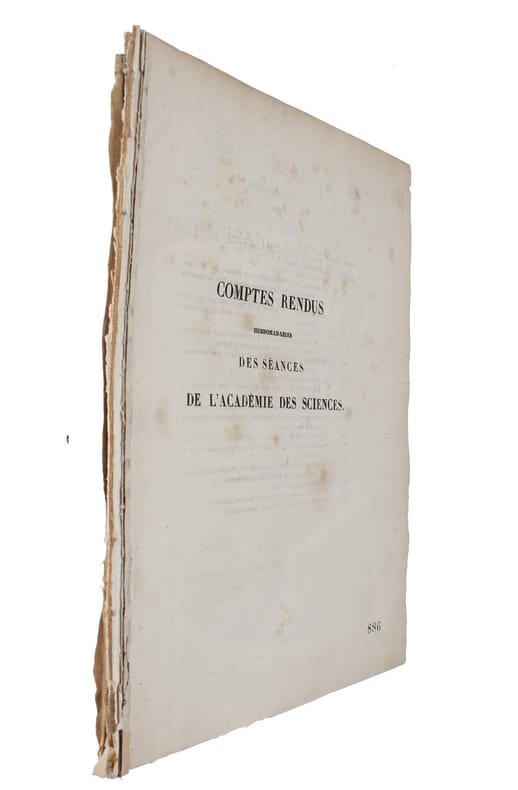
‎"ARAGO, FRANCOIS - LOUIS DAGUERRE. - THE DAGUERREOTYPE.‎

‎Le Daguerréotype. (Seance du Lundi 19 Aout 1839). (+ Daguerre:) Des procédés photogéniques comme moyens de gravure - Lettre de M. Daguerre à M. Arago. (Séance du Lundi 20 Septembre 1839).‎

‎(Paris, Bachelier), 1839. 4to. No wrappers. In: ""Comptes Rendus Hebdomadaires des Séances de L'Academie des Sciences"", Tome IX, No. 8 a. 14. Pp. (249-) 282 a. pp. (417-) 436. Arago's rapport: Pp. 250-267 - Daguerre's letter: pp. 423-429. Both issues clean and fine.‎

‎First printing of the first official and complete report of the invention of the ""daguerreotype"", the photographic process invented by Louis Daguerre. The presentation by Arago preceeded Daguerre's own publication ""Historique de description des procédés du daguerreotype et du diorama"", (1839). Together with Daguerre's letter to Arago in which he relates the process of heliography and describes his contract with Niépce to exploit the heliogrphis process. The Heliogravure was invented by Niépce‎

Bookseller reference : 49477

Livre Rare Book

Herman H. J. Lynge & Son
Copenhagen Denmark Dinamarca Dinamarca Danemark
[Books from Herman H. J. Lynge & Son]

€1,141.55 Buy

‎"ARAGO, FRANCOIS - LOUIS DAGUERRE. - FIRST ANNOUNCEMENT OF THE PRODUCTION OF DAGUERROTYPES.‎

‎Fixation des images qui se forment au foyer d'une chambre obscure. (Seance du Lundi 7 Janvier 1839).‎

‎Paris, Bachelier, 1839. 4to. No wrappers. In: ""Comptes Rendus Hebdomadaires des Séances de L'Academie des Sciences"", Tome VIII No. 1. Pp. 1-36. (Entire issue offered with htitles and titlepages to volume 8). Arago's paper: Pp. 4-7. Light toning to halftitle. Stamps to title-page (one punched in lower margin). Fine and clan.‎

‎First printing of the first announcement and description of the production of Daguerreotypes made by Arago to the French Academy on January 7, 1839. The first complete report was printed on August 19, 1839. The presentation by Arago preceeded Daguerre's own publication ""Historique de description des procédés du daguerreotype et du diorama"", (1839).""Arago, himself a chemist and a member of the Chamber of Deputies, made a brief pronouncement on Daguerre's proces in the Chamber on 7 January 1839 (the paper offered). and in the following August printed the full text of his report thereon made to a joint sesion of the Chambers of Deputies and the Academy of Sciences.""(PMM: 318 (Note to).‎

Bookseller reference : 49478

Livre Rare Book

Herman H. J. Lynge & Son
Copenhagen Denmark Dinamarca Dinamarca Danemark
[Books from Herman H. J. Lynge & Son]

€1,343.00 Buy

‎"ARAGO, FRANCOIS - LOUIS DAGUERRE. - THE INVENTION OF THE DAGUERREOTYPE.‎

‎Fixation des images qui se forment au foyer d'une chambre obscure. (Seance du Lundi 7 Janvier 1839). (+) Le Daguerréotype. (Seance du Lundi 19 Aout 1839).‎

‎Paris, Bachelier, 1839. 4to. No wrappers. In: ""Comptes Rendus Hebdomadaires des Séances de L'Academie des Sciences"", Tome VIII (No.1)+ IX, (No. 8) Entire issues offered with htitles and titlepages to both volumes. Pp. 1-36 + Pp. 249-282 and 1 lithographed plate. The papers: pp. 4-7 and pp. 250-267. A faint stamp to top of titlepages. A few brownspots to titlepages.‎

‎First Edition of the official and complete report of the invention of the ""daguerreotype"", the photographic process invented by Louis Daguerre. Together with the preliminary report of the invention (OF JANUARY 7). The presentation by Arago preceeded Daguerre's own publication ""Historique de description des procédés du daguerreotype et du diorama"", (1839). ""When the attempt to exploit the process of daguerreotype was unsuccessfull, Daguerre and Nièpce decided to offer their method to the government. Daguerre approached Francois Jean Arago, to whom he imparted, under the seal of secrecy his processes and those of Nicéphore Niépce. It was fortunate that Arago possessed such a great insight into the invention, which he received enthusiastically. He reported the invention of the daguerretype to the Academy of Sciences on January 7, 1839. The secrecy, however, was not observed very carefully, for the ""Gazette de France"" published a note abouit it on January 6, 1839, although without printing any details.""(Eder ""History of Photography"").‎

Bookseller reference : 46845

Livre Rare Book

Herman H. J. Lynge & Son
Copenhagen Denmark Dinamarca Dinamarca Danemark
[Books from Herman H. J. Lynge & Son]

€2,484.55 Buy

‎"ARLOING, SATURNIN. - THE SERUM DIAGNOSIS OF TUBERCULOSIS.‎

‎Sur l'obtention de cultures et d'émulsions homogénes du bacille de la tuberculose humaine en milieu liquide et ""sur une variété mobile de ce bacille"".‎

‎(Paris, Gauthier-Villars), 1898. 4to. No wrappers. In: ""Comptes Rendus Hebdomadaires des Séances de L'Academie des Sciences"", Tome 126, No 19. Pp. (1299-) 1382. (Entire issue offered). Arloing's paper: pp. 1319-1321.‎

‎First appearance of this importent paper in which Arloing describes his ""Sero-agglutination for the diagnosis of presence of tubercle bacillus."" (Garrison & Morton No. 2334).It is well known that the ordinary cultures of the bacillus of Koch can not be used for agglutination. Arloing, however, in 1898, obtained a fluid homogeneous culture of the tubercle bacillus and demonstrated its specific agglutinability by the serum of tuberculous human beings or animals, thus rendering possible the serum diagnosis of tuberculosis. (Courmont in ""Arch Intern Med."" 1909).‎

Bookseller reference : 47217

Livre Rare Book

Herman H. J. Lynge & Son
Copenhagen Denmark Dinamarca Dinamarca Danemark
[Books from Herman H. J. Lynge & Son]

€134.30 Buy

‎"ARNOLD, GOTTFRID. - THE HERETICS OF THE CHURCH.‎

‎Unparteyische Kirchen= und Ketzer= Historie. Vom Anfang des Neuen Testaments Biss auf das Jahr Christi 1688. (1.-2. Theil).‎

‎Franckfurt am Mayn, Thomas Fritsch, 1700. Folio. Bound in one contemp. full calf. Spine worn. lacks leather at upper compartment and wear to lower compartment. Corners bumped and worn. (20),411:695,(36) pp. Woodcut on titlepage. A few scattered brownspots. A faint dampstain to lower margins on a few leaves. Oth3rwise internally fine.‎

‎Scarce second edition of Arnold's influential ""Impartial History of the Church and of Heresy"".""In this major revision of church history, Arnold directed his sharpest criticism against those who wrote deeply biased apologetic ""orthodox"" histories instead of trying to understand where substantial religious differences actually came from. In his view,""heresy making"" was usually the defensive reaction of those in authority, rather than a true indictment of unconventional thinkers. He thought that the worst calamity in Church history was its establishment as the accepted and orthodox faith by the Roman Emperor Constantine in the fourth century. Arnold evinced a remarkable sympathy for a huge variety of ""heretics."" This ""impartial history"" exercised a wide influence on the German Enlightenment and won approval from such thinkers as Johann Wolfgang Goethe in addition to Leo Tolstoy.""‎

Bookseller reference : 49419

Livre Rare Book

Herman H. J. Lynge & Son
Copenhagen Denmark Dinamarca Dinamarca Danemark
[Books from Herman H. J. Lynge & Son]

€738.65 Buy

‎"ATLAS - THE FRENCH PILOT- MOUNT, WILLIAM & THOMAS PAGE.‎

‎The Sea-Coasts of France, from Calais to Bayone. Described in Fifteen Large Charts. Surveyed and Printed by the order of the French King. From the Original, done at Paris, and the Remarks Explained in English, and Published for the Use of His Majesty'...‎

‎London, Printed for William Mount and Thomas Page on Tower Hall, no date (c. 1715). Folio. 53X35 cm. Cont. hcalf with marbled boards. Rebacked and recornered in old style with raised bands. Engraved typographical titlepage with a large engraved vignette showing the English King's Coat of Arms. With all 15 double-page engraved sea-charts (numbered (1)-(15) in lower right corners). Neat repairs to inner margins of free endpapers and titlepage. Some browning to charts. Chart 5 (45x75,5 cm) having the right margin shaved reaching the printed frame.‎

‎Second edition of this scarce ""Atlas Maritime"". According to Shirley it was first published by Richard Mount and Thomas Page in 1701 and re-issued with undated title (as this) in ab. 1715, but with the charts unchanged and a new engraved titlepage. A third issue came out in 1737 with a dated title. The fine charts are copied from Pieter Mortier's famous ""Neptune Francois"" (1693-1702) and reduzed in size.""The charts in this early Mount & Page atlas ""The Sea-Coasts of France"" are re-engravings, reduzed in size, from the charts in the French Neptune of 1693. The charts may also be found in the 1702 edition of Mount and Page's Atlas Maritimus Novus..."" (Rodney Shirley). - Not in Phillips. - Shirley Vol. II: M.M&P - 12 b.‎

Bookseller reference : 34417

Livre Rare Book

Herman H. J. Lynge & Son
Copenhagen Denmark Dinamarca Dinamarca Danemark
[Books from Herman H. J. Lynge & Son]

€4,029.00 Buy

‎"Auteur de ""The Dominnie's Legacy""²"‎

‎The black watch. Volume 1‎

‎Richard BENTLEY, Londres. 1834. In-12. Relié demi-cuir. Etat d'usage, Couv. convenable, Dos satisfaisant, Rousseurs. 318 pages. Pièce de titre avec titre doré arrachée. Dos orné de palettes dorées. Texte n anglais.. . . . Classification Dewey : 0-GENERALITES‎

‎Classification Dewey : 0-GENERALITES‎

Bookseller reference : ROD0024927

Livre Rare Book

Le-livre.fr / Le Village du Livre
Sablons France Francia França France
[Books from Le-livre.fr / Le Village du Livre]

€19.80 Buy

‎"AVOGADRO, (AMEDEO). - EXPANDING THE LAW OF PETIT & DULONG.‎

‎Nouvelles Recherches sur la Chaleur spécifique des Corps solides et liquides.‎

‎Paris, Crochard, 1834. No wrappers. In: ""Annales de Chimie et de Physique, Par MM. Gay-Lussac et Arago."", tome 57, Cahier Oct. Pp. 113-224 a. 1 folded engraved plate. (The entire issue offered with halftitle to tome 57). Avogadro's paper: pp. 113-148. Browning to halftitle. Smoe scattered brownspots.‎

‎First printing of this paper in which Avogadro analyzed the connection between specific heats and atomic weights of chemical compounds and liquids after Dulong and Petit has announced their discovery of a relationship between heats and atomic weights of substances (the Law of Petit & Dulong). Avogadro tries to expands their law onto compounds as well.‎

Bookseller reference : 47415

Livre Rare Book

Herman H. J. Lynge & Son
Copenhagen Denmark Dinamarca Dinamarca Danemark
[Books from Herman H. J. Lynge & Son]

€335.75 Buy

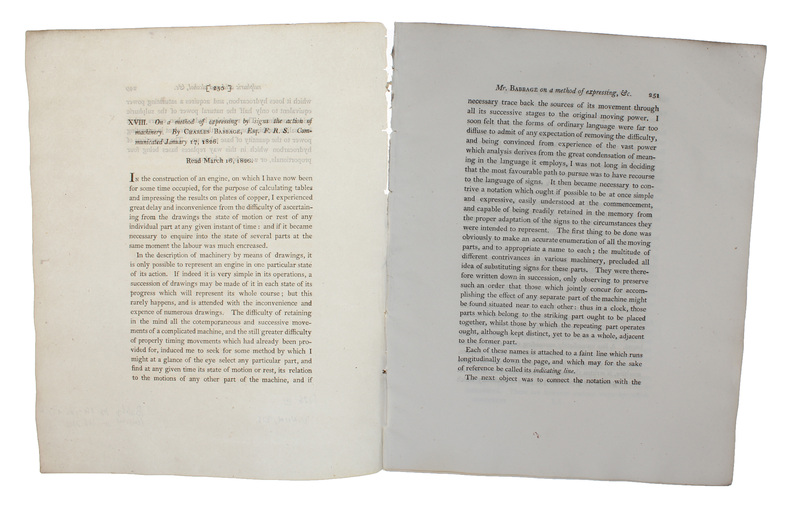
‎"BABBAGE, CHARLES. - THE LANGUAGE OF THE COMPUTER INVENTED.‎

‎On a Method of expressing by signs the action of machinery. Read March 16, 1826.‎

‎(London, W.Nicol, 1826). 4to. No wrappers as extracted from ""Philosophical Transactions"" 1826 - Part III. Pp. 250-265 and 4 engraved plates. Some faint dampstains to plates. One plate with a small tear, no loss. the same plate some creasing at upper part, verso of plate somewhat soiled. Page 261 with some marginal brownspots and some soiling. The other leaves clean and fine.‎

‎First appearance of a main paper in the history of Computing Science in which Babbage set forth some of the basic principles that guide modern computers.""Babbage's first publication of his system of mechanical notation that enabled him to describe the logic and operation of his machiness on paper as they would be fabricated in metal. Babbage later stated that: ""Without the aid of this language I could not have invented the Analytical Engine"" nor do I belive that any machinery of equal complexity can ever be contrived without the assistance of that or of some other equivalent language. The Difference Engine No.2...is entirely described by its aid."" .Babbage considered his mechanical notation system to be one of his finest inventions, and thought it should be widely implemented. It was a source of frustartion to him, that no other machine designerr adopted it (probably because no ther engineer during Babbage's time attermpted to build machines as logically and mechanically complex as Babbage's. More than one hundred years later, in the 1930s, when development in logic were applied to switching systems in the earliest efforts to devwelop electromechanical calculators. Ckaude Shannon demonstrated that Boolean algebra could be applied to the same types of problems for which Babbage had designed his mechanical notation system.""(Hook & Norman No. 37).Together with Babbage's paper comes a paper by J.F.W. Herschel ""On the parallax of the fixed stars"", pp. 266-280.‎

Bookseller reference : 43113

Livre Rare Book

Herman H. J. Lynge & Son
Copenhagen Denmark Dinamarca Dinamarca Danemark
[Books from Herman H. J. Lynge & Son]

€1,141.55 Buy

‎"BABBAGE, CHARLES. - THE DIFFERENCE MACHINE OF SCHEUTZ, MATHEMATICALLY DESCRIBED.‎

‎Note sur la machine suédoise de MM. Schutz (!) pour calculer les Tables mathématiques par la méthode des différences, et en imprimer les résultats sur des planches stéréotypes.‎

‎(Paris, Mallet-Bachelier), 1855. 4to. No wrappers. In: ""Comptes Rendus Hebdomadaires des Séances de L'Academie des Sciences"", Tome 41, No 15. Pp. (537-) 563. (Entire issue offered). Babbage's paper: pp. 557-560. Some faint, mostly marginal brownspots.‎

‎First printing of this importent paper being babbage's report on the Scheutz differnce calculator, explaining its functions by way of his own notations.""Babbage's report on the differnce engine built by the Swedish printer Georg Scheuts (1785-1873) and his son Edvard (1821-81), based on Babbage's own designs.... In 1854 the Scheutzes took their engine no. 2 to England in the hopes of marketing it. There they were introduced to Babbage, who received them with great friendliness and showed a lively interest in their work. Babbage devoted two whole days to investigating Scheutz' engine for which he had much praise, especially for the way they had succeeded in building it with the funds at their disposals.... As part of his effort to promote the Scheutz Engine, Babbage gave a talk on it before the Academie des Sciences, illustrated with drawings by his son henry, in which Babbage's system of mechanical notation was used to describe the machines construction and functions. This talk was published (the paper offered) without illustrations in the Academie 'Comptes rendus'. ((Hook & Norman ""Origins of Cyberspace"", No. 73).‎

Bookseller reference : 48992

Livre Rare Book

Herman H. J. Lynge & Son
Copenhagen Denmark Dinamarca Dinamarca Danemark
[Books from Herman H. J. Lynge & Son]

€470.05 Buy

‎"BABINET, J. (JACQUES) - BABINET'S PRINCIPLE - EXTENDING THE FINDINGS OF FRAUNHOFER.‎

‎Sur les couleurs des réseaux,‎

‎(Paris, Crochard, 1829). 8vo. Without wrappers. In 'Annales de Chimie et de Physique', Series 2 , tome 40, Cahier 2. With halftitle to vol. 40. Pp. 113-224 a. 3 folded plates. (Entire issue offered). Babinet's paper: pp. 166-176 a. 1 plate.‎

‎First appearance of the paper in which Babinet expounds his importent law, stating the formula that holds between diffraction and diffraction pattern in optics. The principle plays an important role in antenna design and Babinet’s principle is particularly interesting to consider in this case where the metasurfaces and their complements can be regarded as variations on a folded dipole antenna array and patch antenna array, respectively. Babinet was together with Fresnel one of the pioneers in the development of the new optics, the wave-theory of light.""An early proponent of the wave theory of light which had recently been perfected by Fresnel and Young, Babinet devoted much of his research to extending its applications. His first published paper on optics. ""Sur les couleurs des réseaux,"" dealt with Fraunhofer’s discovery that white light viewed through a wire grating produces a series of continuous spectra. Babinet derived the formula that relates the deviation of rays of a given color to the ratio of their wavelength divided by the sum of the diameter of the wires plus the distance between any two wires. He also showed that diffraction experiments could yield an improved measure of wavelengths and presented a table of new values.Babinet realized that the grating was only one of a number of means of producing diffraction effects, so he extended his theoretical work to include other systems. The result was a concept known today as Babinet’s principle: ""If parallel rays fall normally on a diffraction system formed from a large number of openings... the diffraction phenomena will remain identically the same if the transparent parts become opaque, and reciprocally.""(DSB).‎

Bookseller reference : 45030

Livre Rare Book

Herman H. J. Lynge & Son
Copenhagen Denmark Dinamarca Dinamarca Danemark
[Books from Herman H. J. Lynge & Son]

€268.60 Buy

‎"BALARD, ANTOINE JÉROME. - THE DISCOVERY OF THE ELEMENT BROMINE‎

‎Mémoire sur une Substance particulière contenue dans l'eau de la mer (le brôme).‎

‎(Paris, Crochard, 1826). Without wrappers. In: ""Annales de Chimie et de Physique, par Gay-Lussac et Arago"", tome 32, Sec. Series, Cahier 4. Pp. 337-443 a. 1 fodled engraved plate. (The entire issue offerd). Balard's paper: pp. 337-84.‎

‎First printing of Balard's famous memoire in which he records his discovery of the new element Bromine (le brôme). While he was studying the flora of a salt marsh, he notized a deposit of sodium saulfate which had crystallized out in a pan containing mother liquer from common salts. ""In an attempt to find a use for the waste liquers he performed a number of experiments, and notized that when certain reagents were added, the mother liquer bacame brown. His investigation of this phenomenon,...ked to the remarkable discovery....(Weeks p. 264).""The discovery of a new chemical element by a young and obscure provincial pharmacist caused a sensation in Paris. Balard's achievemnt was recognized by the Academie des Sciences and he was awarded a medal by the Royal Society of London.""(DSB I, p. 416).""The discovery of bromine is a very importent acquisition to chemistry, and gives M. Balrad honorable rank inthe career of the sciences. We are of the opinion that this young chemist is every way worthy of the encouragement of the Academy, and we have the honour to propose that his memoir shall be printed in the ""Recueil des Savants Étrangers"" (The report from the French Academy, signed by Vaugelin, Thenard, and Gay-Lussac).‎

Bookseller reference : 43853

Livre Rare Book

Herman H. J. Lynge & Son
Copenhagen Denmark Dinamarca Dinamarca Danemark
[Books from Herman H. J. Lynge & Son]

€268.60 Buy

‎"BALARD, ANTOINE JÉROME. - THE DISCOVERY OF THE ELEMENT BROMINE‎

‎Mémoire sur une Substance particulière contenue dans l'eau de la mer (le brôme).‎

‎Paris, Crochard, 1826. Contemp. hcloth. Gilt lettering on spine. In: ""Annales de Chimie et de Physique, par Gay-Lussac et Arago"", tome 32. 448 pp., 3 folded engraved plates. Balard's paper: pp. 337-84. Entire volume offered with original memoirs by Savart, Berzelius, Humboldt, Arago, Poisson, Liebig, Dumas et al.‎

‎First printing of Balard's famous memoire in which he records his discovery of the new element Bromine (le brôme). While he was studying the flora of a salt marsh, he notized a deposit of sodium saulfate which had crystallized out in a pan containing mother liquer from common salts. ""In an attempt to find a use for the waste liquers he performed a number of experiments, and notized that when certain reagents were added, the mother liquer bacame brown. His investigation of this phenomenon,...ked to the remarkable discovery....(Weeks p. 264). ""The discovery of a new chemical element by a young and obscure provincial pharmacist caused a sensation in Paris. Balard's achievemnt was recognized by the Academie des Sciences and he was awarded a medal by the Royal Society of London.""(DSB I, p. 416). ""The discovery of bromine is a very importent acquisition to chemistry, and gives M. Balrad honorable rank inthe career of the sciences. We are of the opinion that this young chemist is every way worthy of the encouragement of the Academy, and we have the honour to propose that his memoir shall be printed in the ""Recueil des Savants Étrangers"" (The report from the French Academy, signed by Vaugelin, Thenard, and Gay-Lussac).‎

Bookseller reference : 59047

Livre Rare Book

Herman H. J. Lynge & Son
Copenhagen Denmark Dinamarca Dinamarca Danemark
[Books from Herman H. J. Lynge & Son]

€335.75 Buy

‎"BALLE, NICOLAI EDINGER.‎

‎Bibliu-Lestrar á Sunnu- og Helgi-døgum innihaldandi Nýja Testamentisins bækur og nockur stycki úr Gamla Testamentinu. Thetta allt safnad i útleggingu og vida útskirt... Fyrsti Partur som tekur frá Adventu til Føstu-inngángs, med Formála... Ove Høegh G...‎

‎Leirárgørdum vid Leirá, Islands allmenna Uppfrædingar Stiptun, 1799. Samtidigt islandsk hellæderbind af fåreskind med blindtrykte rammer på permer og blindtrykt stempel i midtfeltet. Ryg lidt slidt, øvre kapitæl slidt, en lille skindstykker bortrevet ved ryggens fod. (I-III)IV-XX,412 pp. Første og sidste sider med brugsspor i kanter, ellers indvendig ganske velbevaret.‎

‎"BARKER, ROBERT. - THE OBSERVATORY AT BENARES.‎

‎An Account of the Bramin's Observatory at Benares. In a Letter to John Pringle. Read May 29, 1777.‎

‎(London, W. Bowyer and J. Nichols, 1777). 4to. Extracted from ""Philosophical Transactions"", Year 1777. Vol. 67 - Part II. Pp. 598-607 and 3 large folded engraved plate. One of these the well known view of the Banaras Jantar Mantar by Archibald Campbell, measuring 23x43 cm. Wide-margined, clean and fine.‎

‎The paper describes one of the five famous observatories built by Maharaja Sawai Jai Singh II of Jaipur, consisting of stone instruments used for determining solar time precisely, based on Muslim design principles.‎

Bookseller reference : 46844

Livre Rare Book

Herman H. J. Lynge & Son
Copenhagen Denmark Dinamarca Dinamarca Danemark
[Books from Herman H. J. Lynge & Son]

€268.60 Buy

‎"BARLOW, PETER. - THE ""BARLOW LENS""‎

‎An Account of the Construction of a Fluid Lens Refracting Telescope of eight inches aperture, and eight feet and three quarters in lenght, made for the Royal Society by george Dolland. Read November 22, 1832.‎

‎(London, Richard Taylor, 1833).‎

‎First printing of the paper in which he describes the 8 inch-telescope with the fluid lens - the so-called second Barlow-lens - required by the Royal Society for testing.""Barlow’s next major contribution makes his name still well known by amateur astronomers today. He invented the Barlow lens, a telescope lens consisting of a colourless liquid between two pieces of glass. The ""Barlow lens"", a modification of this telescope lens, is a negative achromatic combination of flint glass and crown glass. It is a negative lens used to extend the effective focal length of a telescope objective.""""His optical experiments began about 1827. There were several experiments to correct a single lens for chromatic aberration with concave lenses. These correctors were first placed near the first lens, but some opticians moved the concave lens further down the tube. This arrangement was described 1828 by Rogers in a paper to the Astronomical Society. By this a 3 inch concave flint lens was sufficient to correct a 9 inch crown glass. Smaller lenses near the focus would do the colour correction, but have to have steeper curves which would introduce spherical aberration.""‎

Bookseller reference : 44051

Livre Rare Book

Herman H. J. Lynge & Son
Copenhagen Denmark Dinamarca Dinamarca Danemark
[Books from Herman H. J. Lynge & Son]

€134.30 Buy

‎"BARLOW, PETER. - THE FIRST ""BARLOW LENS""‎

‎An account of a Series of experiments made with the view to the construction of an achromatic telescope with a fluid concave lens, instead of the usual lens of flint glass. In a letter adressed to Davies Gilbert.... Read January 17, 1828.‎

‎(London, Richard Taylor, 1828). 4to. No wrappers as extracted from ""Philosophical Transactions"" 1828 - Part I. Pp. 105-112.‎

‎First appearance of the paper in which Barlow described his invention of the so-called first ""Barlow-Lens"".He constructed his first achromatic telescope lens by enclosing liquid carbon disulfide between two pieces of glass. The Barlow- lens has come into general use for increasing the eyepiece power of any optical instrument.‎

Bookseller reference : 46089

Livre Rare Book

Herman H. J. Lynge & Son
Copenhagen Denmark Dinamarca Dinamarca Danemark
[Books from Herman H. J. Lynge & Son]

€134.30 Buy

‎"BARON, (THÉODORE). - THE COMPOSITION OF BORAX.‎

‎Examen Chymique d'un Sel apporté de Perse, sous le Nom de Borech, avec des réflexions sur une Dissertation latine concernant la même matière, dédiée à la Société Royale de Londres.‎

‎(Paris, Imprimerie Royale, 1755). 4to. Extract from ""Mémoires de Mathematique et de Physique, Présentés à l'Academie des Sciences par divers Savans"", Tome II. Pp. 412-434.‎

‎First printing of one of the 2 papers in which baron finally settled the composition of Borax. He showed that Borax is formed by the combination of soda with the substance (boric acid) previously called se sédatif.‎

Bookseller reference : 45935

Livre Rare Book

Herman H. J. Lynge & Son
Copenhagen Denmark Dinamarca Dinamarca Danemark
[Books from Herman H. J. Lynge & Son]

€67.15 Buy

‎"BASEDOW, JOHANN BERNHARD. - MATHEMATICS IN THE EDUCATIONAL REFORM.‎

‎Bewiesene Grundsätze der reinen Mathematik. 2 Bde. (1. Bd. Zahlenkunst und Algebra, zur elementarischen Bibliothek. 2. bd. Geometrie und Etwas von dem Unendlichen).‎

‎Leipzig, Siegfried Lebrecht Crusius, 1774. Bound in 2 very fine contemp. full calf, raised bands, richly gilt spines. Title-and tomelabels in leather on spines with gilt lettering., gilt border on all covers. Blindtooled decorations on covers in Cambridge-style, ""mirror-binding"". Edges gilt. Stamp on foot of titlepages. (22),312"(16),296 pp. and 11 folded engraved plates. Light browning to some quires and to top of titles, otherwise fine.‎

‎Scarce first edition of the famous German educators mathematical textbook, - his suggestion to how mathematics should be taught in his educational reform. Basedow’s views were based on the writings of men such as John Amos Comenius, John Locke, and Jean-Jacques Rousseau. His practical teaching methods were more expansive in their implications for education than those of any of his immediate predecessors in the field, and by the early 19th century they had become a fundamental force in Germany’s public school systems.Basedow blev i 1753 ansat af J.H.E. Bernstorff ved Sorø Akademi som professor i moral og de skønne videnskaber. Her kom han bl.a. i forbindelse med den danske oplysningsforfatter og Sorø-professor Jens Schielderup Sneedorff, hvis værker han oversatte til tysk. Sneedorff blev selv inspirereret af Basedows pædagogiske idéer.‎

Bookseller reference : 45029

Livre Rare Book

Herman H. J. Lynge & Son
Copenhagen Denmark Dinamarca Dinamarca Danemark
[Books from Herman H. J. Lynge & Son]

€1,007.25 Buy

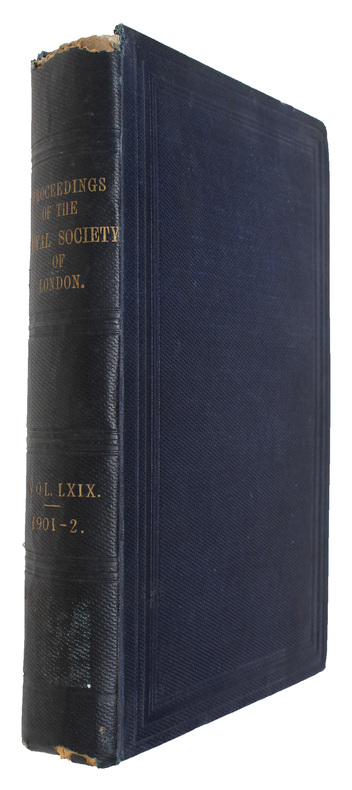
‎"BAYLISS, W.M. (WILLIAM MADDOCK) & ERNEST H. STARLING. - FOUNDING THE SCIENCE OF ENDOCRINOLOGY.‎

‎On the Causation of the so-called 'Peripheral Secretion' of the Pancreas (Preliminary Communication). Received January 22, - Read January 23, 1902.‎

‎London, Harrison and Sons, 1902. 8vo. Contemp. full cloth. Top of spine worn down. Lower spine end with a small crack. A collation remark on title-page. A bookmark on inside frontcover, stating that the volume was bound 10/9/02 for City of Manchester. Municipal Technical School. ""Proceedings of the Royal Society"", Vol. 69. VII,501 pp. a. 6 plates. Bayliss & Starling's announcement: pp. 352-353. Internally clean.‎

‎This is the first printing, annoucing a milestone discovery which introduced a quite new field in physiology and medicine, the discovery of the FIRST HORMONE, which the discoverers named ""Secretin"". A few years later Sterling coined the word 'hormone' from the Greek 'hormon', meaning to exite or set into motion. Until know it was though that the control of the glands, here the pancreas, was controlled by the nerves (Pavlow and others), but Bayliss and Sterling showed that they have found that the intestine was signalling the pancreas by some COMPLETELY NEW MECHANISM involving a new kind of body or substance functioning as a chemical messenger. ""If nerves are the sprinters of biology, Bayliss & Starling had discovered the marathon runners. In doing so, they also founded the science of hormones, called endocrinology"" (Alan Lightman ""The Discoveries"", p. 34 ff). The announcement, as offered here, was later the same year followed by their larger paper ""The Mechanism of Pancreatic Secretion"" which they published in ""Journal of Physiology (1902)"".""With the discovery of hormones, Bayliss & Starling had found the internal command and control centers - and in this, their discovery was much larger than a new communication system. The mechanism of response and control was chemical: atoms and molecules. Now, with hormones, there was a mechanism for a living thing to regulate itself. Furthermore with hormones, an organism could not only be studied but also controlled from the outside... Never had the living body come closer to a machine, a self-regulating machine governed not only by physics but also chemistry. An not only a machine, but a machine that we human could willfully control. At the start of the new century, we still have not come to terms with the implications of this idea.""(Alan Lightman).Parkinson ""Breakthroughs"", 1902 B.‎

Bookseller reference : 49356

Livre Rare Book

Herman H. J. Lynge & Son
Copenhagen Denmark Dinamarca Dinamarca Danemark
[Books from Herman H. J. Lynge & Son]

€1,678.75 Buy

‎"BAYLISS, W.M. (WILLIAM MADDOCK) & ERNEST H. STARLING. - THE CHEMICAL MESSINGER.‎

‎The Chemical Regulation of the Secretory process. (Croonian Lecture).‎

‎London, Harrison and Sons, 1904. 8vo. Later full buckram. Spine with gilt lettering. In: ""Proceedings of the Royal Society"", Vol. 73. VIII,548 pp. a. 11 plates. (Entire volume offered). Bayliss & Starling's paper: pp. 310-322. A stamp to edges, otherwise clean.‎

‎First printing of this paper in which they developed the theory of hormonal control of the internal secretion, a milestone discovery by Bayliss and Starling in 1902, which introduced a quite new field in physiology and medicine, the discovery of the FIRST HORMONE, which the they named ""Secretin"". They here tries to find out how this new body could be decribed chemically, and one of the conclusions were ""It is not precipitated by tannic acid, thus excluding bodies of alkaloid nature as well as di-amido compounds. This evidence, slight thought it is, points to secretin being a body of relatively small molecular weight and not a colloid. It may be compared to the active principle of the suprarenal glands, adrenalin, which has been obtained in a crystallic form and the cemical constitution of which has been approximately determined...""(p. 314-15).Garrison & Morton: 1121.‎

Bookseller reference : 49361

Livre Rare Book

Herman H. J. Lynge & Son
Copenhagen Denmark Dinamarca Dinamarca Danemark
[Books from Herman H. J. Lynge & Son]

€268.60 Buy

‎"BECQUEREL, ANTOINE HENRI.- THE DOCTORIAL DISSERTATION.‎

‎Recherches sur les Variations des Spectres D'Absorption dans les Christaux. (+) Surles Variations des Spectres D'Absorption des Composé du Didyme.‎

‎Paris, G. Masson, 1888. Bound with the original printed wrappers to all 4 issues (8 wrappers) in contemp. hcalf. Wear to top of spine. Light wear along edges. Two small stamps on verso of titlepage. In ""Annales de Chimie et de Physique"", 6. Series - Tome XIV. 576 pp. The entire volume offered. Becquerel's papers pp. 170-257 a. pp.257-279.‎

‎First printing of Henri Becquerel's doctorial thesis. Becquerel is known for his discovery of radioactivity, for which he received the Nobel Prize for physics jointly with the Curies in 1903, and for other contributions to that field which he made during the half-dozen years when he was most active in it.After studying infrared spectra ""He then studied the absorption of light in crystals (1886-88), particularly its dependence of the plane of polarization of the incident light and the direction of its propagation through crystal (the papers offered). With these researches Becquerel obtained his doctorate from the Faculty of Sciences of Paris (1888) and election to the Academy of Sciences (1889).""(DSB I, p.558).The volume has other notable papers by Chappuis et Riviere, E. Edlund, M. Berthelot (3 papers).‎

Bookseller reference : 43641

Livre Rare Book

Herman H. J. Lynge & Son
Copenhagen Denmark Dinamarca Dinamarca Danemark
[Books from Herman H. J. Lynge & Son]

€268.60 Buy

‎"BECQUEREL, EDMOND (ALEXANDRE-EDMUND). - BECQUEREL'S ""CONTINUING RAYS"" OR THE ""BECQUEREL PHENOMENA""‎

‎Mémoire sur le rayonnement chimique qui accompagne la lumiere solaire et la lumiere électrique. (3e Mémoire.- Extrait par l'auteur).‎

‎(Paris, Bachelier), 1840. 4to. No wrappers. In: ""Comptes Rendus Hebdomadaires des Séances de L'Academie des Sciences"", Tome XI (No.18). Pp. (667-) 716. (Entire issue offered). Becquerel's paper:pp. 702-703. Some marginal brownspots, margins slightly soiled, light browning an creasing.‎

‎First printing of an importent paper in the history of photochemistry as he here discovered some effects of coloured rays of the solar spectrum.""Edmund Becquerel seems to be the first person to observe, in 1840 (in the paper offered), that the latent daguerreotype image which had been underexposed could be intensified if re-exposed to the yellow and red rays of the spectrum and then developed with mercury... Explaining this phenomenon, Becquerel called the yellow-red continuing rays (""rayon continuateurs"") in contrast to the primary rays, which exicited or produced the light image and which he called exiciting rays (""rayons excitateurs"").... They are dependent on the wave lenght of the light.""(Eder ""History of Photography"", pp. 265 ff.)""Becquerel was an early experimenter in photography. In 1840 he discovered that the silver halides, natively insensitive to red and yellow light, became sensitive to that part of the spectrum in proportion to their exposure to blue, violet and ultraviolet light, allowing Daguerreotypes and other photographic materials to be developed by bathing in strong red or yellow light rather than by chemical treatment. In practice this technique was rarely used."" (Wikipedia).‎

Bookseller reference : 47213

Livre Rare Book

Herman H. J. Lynge & Son
Copenhagen Denmark Dinamarca Dinamarca Danemark
[Books from Herman H. J. Lynge & Son]

€201.45 Buy

‎"BECQUEREL, EDMOND. - INVENTION OF THE PHOSPHOROSCOPE.‎

‎Recherches sur divers Effets Lumineux qui résultent de l'Action de la Lumiere sur les Corps.(Ce Travail comprend les deux Mémoires présentés à l'Academie des Sciences le 16 novembre 1857 et le 24 Mai 1858). (Premiere-deuxieme Mémoire).‎

‎(Paris, Victor Masson et Fils, 1859). Without wrappers. In: ""Annales de Chimie et de Physique"", 3e Series - Tome 55, Cahier Janvier 1861. Pp. 5-128 a. 2 large folded engraved plates (emission-lines and the phosporoscope). The entire issue offered.‎

‎First appearance of Becquerel's first two pioneering studies on lluminiscent phenomena. ""It was in these studies that Becquerel first described the phosphoroscope, an instrument of his own invention consisting of a box sealed with two disks mounted on the same axis and pierced with holes arranged in such a way that light could not at any one time pass through the entire apparatus. By rapidly revolving these perforated disks, an observer could continously view substances in the dark only fractions of a second after they had been exposed to brilliant light"" and by regulating the speed of the revolution of the disks, one could measure the lenght of time that substances continued to glow after the exposure to light. Using this device, Becquerel was able to identify many new phosphorescent substances and to show that the phenomenon G.C. Stokes had named fluorescence in 1852 was in reality only phosphorescence of an extremely short duration....In this manner substances could be analyzed without physical or chemical alteration.""(DSB I, p. 556).Becquerel dis his most importent work in optics on the phenomena of luminescence. In the middle years of the nineteenth century, he virtually monopollized the significant discoveries made inthis field.(DSB).‎

Bookseller reference : 44136

Livre Rare Book

Herman H. J. Lynge & Son
Copenhagen Denmark Dinamarca Dinamarca Danemark
[Books from Herman H. J. Lynge & Son]

€335.75 Buy

‎"BECQUEREL, EDMOND. - THE BEGINNING OF SOLAR-CELL-ENERGY.‎

‎Sur les effets électriques qui se produisent sous l'influence solaire.‎

‎(Paris, Bachelier), 1839. 4to. No wrappers. In: ""Comptes Rendus Hebdomadaires des Séances de L'Academie des Sciences"", Tome IX (No.22). Entire issue offered. Becquerel's paper: pp. 711-713.‎

‎First printing of this important paper, which together with Becquerel's paper ""Mémoire sur les effets èlectriques produits sous l'influence des rayons solaires"" and ""Recherches sur les effets de la radiation chimique de la lumière solaire, au moyen des courants électriques"", published the same year, marks the beginning of Solar-Cell-Energy, the first step in a long path to solar panels, and a technology of immense importence for humanity. In 1923 Albert Einstein received the Nobel Prize for his theories explaining the photoelectric effect (his 1905-paper).The ""photovoltaic effect"" is the basic physical process through which a solar cell converts sunlight into electricity. In 1839, nineteen-year-old Edmund Becquerel, a French experimental physicist, discovered the photovoltaic effect while experimenting with an electrolytic cell made up of two metal electrodes. Becquerel found that certain materials would produce small amounts of electric current when exposed to light.‎

Bookseller reference : 49104

Livre Rare Book

Herman H. J. Lynge & Son
Copenhagen Denmark Dinamarca Dinamarca Danemark
[Books from Herman H. J. Lynge & Son]

€335.75 Buy

‎"BECQUEREL, HENRI - THE FIRST EVIDENCE OF A RADIOACTIVE TRANSFORMATION.‎

‎Sur la radioactivité de l'uranium.‎

‎(Paris, Gauthier-Villars), 1901. 4to. No wrappers. In: ""Comptes Rendus Hebdomadaires des Séances de L'Academie des Sciences"", Tome 133, No 24.. Pp. (969-) 1044. (Entire issue offered). Becquerel's paper: pp. 977-980.‎

‎First appearance of this historical paper in which Becquerel relates THE FIRST EVIDENCE OF A RADIOACTIVE TRANSFORMATION. ""Nothing that Becquerel subsequently accomplished (after his discovery of radioactivity in 1896) was as important as this discovery, by which he opened the way to nuclear physics. Nevertheless, there were two other occasions on which he stood directly on the path of history: when he identified electrons in the radiations of radium (1899 - 1900) and when he published the first evidence of a radioactive transformation (1901). (The paper offered).""(DSB).""To prove his supposition that the uranium would recover its activity, Becquerel set aside some of the inactive uranium solution and its radioactive barium sulfate precipitate for a period of 18 months. Late in 1901, he found that the uranium had completely regained its activity, whereas the barium sulfate precipitate had become completely inactive. Becquerel wrote: ""The loss of activity ... shows that the barium has not removed the essentially active and permanent part of the uranium. This fact constitutes, then, a strong presumption in favor of the existence of an activity peculiar to uranium, although it is not proved that the metal be not intimately united with another very active product.""‎

Bookseller reference : 47430

Livre Rare Book

Herman H. J. Lynge & Son
Copenhagen Denmark Dinamarca Dinamarca Danemark
[Books from Herman H. J. Lynge & Son]

€470.05 Buy

‎"BECQUEREL, HENRI. - ESTABLISHING THE CONNEXTION BETWEEN ROTATORY POWERS AND MAGNETISM.‎

‎Recherches expérimentales sur la polarisation rotatoire magnétique.‎

‎Paris, G. Masson, 1877. 8vo. Contemp. hcalf, raised bands, gilt spine. Light wear along edges. Small stamps on verso of titlepage. In: ""Annales de Chimie et de Physique"", 5e Series,Tome 12. - 576 pp. a. 1 folded plate. (The entire volume offered). Becquerel's paper: pp. 5-87.‎

‎First edition of Henri Becquerel's importent study of the magnetic substances in which he sets forth his discovery that ""the magnetic rotation of the bodies is connected with their refractive index and with another function that varies with their specific magnetism"". For the first time it was showed that there is a connexion between the rotatory power and the magnetic properties of matter.The volume contains other importent papers, more than 10 papers by , MARCELLIN BERTHELOT, mainly on Thermo-Chemistry.‎

Bookseller reference : 47427

Livre Rare Book

Herman H. J. Lynge & Son
Copenhagen Denmark Dinamarca Dinamarca Danemark
[Books from Herman H. J. Lynge & Son]

€335.75 Buy

‎"BECQUEREL, HENRI. - THE DISCOVERY OF RADIO-ACTIVITY - THE BEGINNING OF THE NUCLEAR AGE‎

‎Sur les radiations émises par phosphorescence. (+) Sur les radiations invisibles émises par les corps phosphorescents. (+) Sur quelques propriétés nouvelles des radiations invisibles émises par divers corps phosphorescents. (+) Sur les radiation...‎

‎Paris, Gauthier-Villars, 1896. 4to. Near contemp. full cloth. Spine gilt and with gilt lettering. Bookmark, ""The Chemists Club"" in gold on lower part of spine. Light wear along edges. In: ""Comptes Rendus Hebdomadaires des Séances de L'Academie des Sciences"", Tome 122 (Entire volume offered).1633 pp. The papers: 420-421, pp. 501-502, pp. 559-564, pp. 689-694, pp. 762-767 and pp. 1086-1088.‎

‎First appearance of the six landmark papers in which Becquerel documents his discovery of Radio-activity, PROMPTING THE NUCLEAR AGE.Becquerel was an expert in fluorescence and phosphorescence, continuing the work of his father and grandfather. Follwing the discovery of X-rays by Röntgen, Bexquerel investigated fluorescent materials to see if they also emitted X-rays. He exposed a fluorescent uranium salt, pechblende, to light and then placed it on a wrapped photographic plate.He found that a faint image was left on the plate, which he believed was due to the pichblende emitting the light it had absorbed as a more penetrating radiation.. However, by chace, he left a sample that had not been exposed to light on top of a photographic plate in a drawer. he noticed that the photographic plate also had a a faint image of the pechblende. After several chemical tests he concluded that these ""Becquerel rays"" were a property of atoms. He had, by chace, discovered radio-activity and prompted thee beginning of the nuclear age. He shared the Nobel Prize for Physics in 1903 with Marie and Pierre Curie. The ""Becquerel Rays"" were later discovered to be a composite of three forms of emanation, distinguished by Rutherford as alpha, beta and gamma rays.Dibner: 163 (the later Mémoire from 1903) - PMM: 393 (1903- Mémoire) - Garrison & Morton: 2001 (only the first paper). - Magie ""A Sourve Book in Physics"" p. 610 ff. - Norman:157.‎

Bookseller reference : 46854

Livre Rare Book

Herman H. J. Lynge & Son
Copenhagen Denmark Dinamarca Dinamarca Danemark
[Books from Herman H. J. Lynge & Son]

€1,141.55 Buy

Number of results : 506,697 (10134 Page(s))

First page Previous page 1 ... 18 19 20 [21] 22 23 24 ... 1468 2912 4356 5800 7244 8688 10132 ... 10134 Next page Last page