Site indépendant de libraires professionnels

‎Thé‎

Main

Thèmes parents

‎Gastronomie‎
Nombre de résultats : 506,698 (10134 Page(s))

Première page Page précédente 1 ... 16 17 18 [19] 20 21 22 ... 1466 2910 4354 5798 7242 8686 10130 ... 10134 Page suivante Dernière page

‎"LAGRANGE, (LA GRANGE), JOSEPH LOUIS. - A BREAKTHROUGH IN ""THE THEORY OF EQUATIONS"".‎

‎Sur la Résolution des Équations Numériques. (On the Solution of numerical Equations).‎

‎(Berlin, Haude et Spener, 1769). 4to. Without wrappers as issued in ""Mémoires de l'Academie Royale des Sciences et Belles-Lettres"", Année 1767, Tome XXXIII, pp. 311-352.‎

‎First edition of a monumental paper in the theory of equations by ""one of the greatest mathematicians of all times"" (Cajori). In this memoir, which deals with the solutiuon of numerical equations, Lagrange examines the roots of algebraic equations and provides methods of separating the real and imaginary roots and of approximating the real roots with continued fractions.Parkinson ""Breakthroughs"" 1767 P.‎

Référence libraire : 46556

Livre Rare Book

Herman H. J. Lynge & Son
Copenhagen Denmark Dinamarca Dinamarca Danemark
[Livres de Herman H. J. Lynge & Son]

€604.35 Acheter

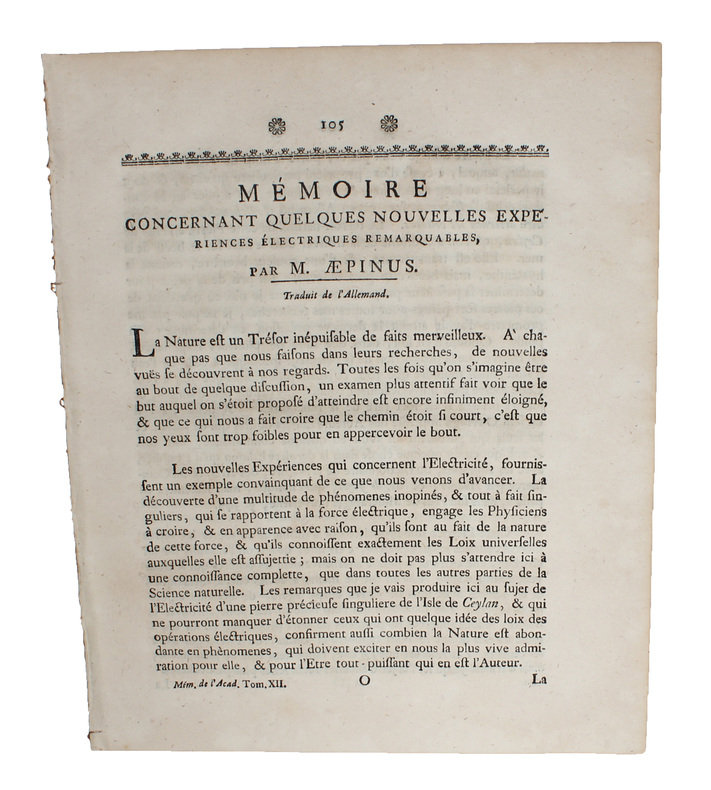
‎"ÆPINUS (AEPINUS), FRANZ ULRICH THEODOSICUS. - THE ANALOGY BETWEEN ELECTRICITY AND MAGNETISM.‎

‎Mémoire concernant quelques nouvelles Experiences électriques remarquables.‎

‎Berlin, Haude et Spener, 1758. 4to. No wrappers, as issued in ""Mémoires de l'Academie Royale des Sciences et Belles-Lettres"", 1756, tome XII. Pp. 105-121. With titlepage to the volume, printed in red/blac and with engraved titlevignette. Also having the parttitlepage. Titlepage with 2 small wormtracts.‎

‎First appearance of a milestone paper in the history of electricity as Aepinus here found that a heated tourmaline attracted and repelled light bodies. He decided, that the effect was electrical and that its ends was carrying charges of opposite sign, much as soft iron is magnetized by a lodestone. This paper is a forerunner of his ""Tentamen Theoriae electricitatis et magnetismi"", - published 1759, and one of the most original and important books in the history of electricity. It is the first reasoned, fruitful exposition of electrical phenomena based on action-at-a-distance.""Aepinus’ first reseraches on the thermoelectric properties of this stone (Tourmalin) which was then of extreme rarity, were fundamental. He recognized the electrical nature of the attractive power of a warmed tourmaline and attempted not altogether successfully, to reduce its apparent capriciousness to rule. He was particularly struck by the formal similarity between the tourmaline and the magnet in regard to polarity which inspired him to reconsider the possibility, then occasionally discussed, that electricity and magnetism were basically analogous. This thought became the This thought became the theme for his masterwork, Tentamen theoriae electricitatis et magnetismi (1759).""(DSB).""Aepinus is known in the history of electricity for his attempt to develop the one fluid theory of Franklin. His theory was for a while generally adopted, but was gradually displaced by the two fluid theory, in consequence chiefly of the necessity of ascribing to uncharged matter repulsions of the same force as those which were ascribed to electrical charges. His theory exhibits interesting similarities to the present theory of the constitution of matter""(Magie ""A Source Book in Physics"", pp.406-8).Ronalds p. 4.‎

Référence libraire : 46557

Livre Rare Book

Herman H. J. Lynge & Son
Copenhagen Denmark Dinamarca Dinamarca Danemark
[Livres de Herman H. J. Lynge & Son]

€1,275.85 Acheter

‎BENEDICTE (KALL, BENEDICTE ARNESEN).‎

‎Smaaskizzer fra en Islandsreise i Sommeren 1867. + Ny Række.‎

‎Kjøbenhavn, Høst, 1869-71. Indbundet i et samtidigt halvlæderbind med forgyldt titel på ryd. Kapitæler med en smule slitage. Først bog en smule brunplettet, ellers et pænt eksemplar. Sansynligvis med dedikation fra forfatteren på foden af titelbladet.‎

‎Fiske I, p. 21 a.‎

Référence libraire : 46564

Livre Rare Book

Herman H. J. Lynge & Son
Copenhagen Denmark Dinamarca Dinamarca Danemark
[Livres de Herman H. J. Lynge & Son]

€73.86 Acheter

‎"RÉAUMUR, (RENÉ-ANTOINE FERCHAULT DE). - THE RÉAUMUR TEMPERATURE SCALE.‎

‎Regles pour construire des Thermometres dont les Degres soient comparables, et qui donnent des idées d'un Chaud ou d'un Froid qui puissant être rapportés à desmsures connües.‎

‎Paris, L'Imprimerie Royale, 1732. 4to. Without wrappers. Extracted from ""Mémoires de l'Academie des Sciences. Année 1730"". Pp. 452-507 a. 1 folded engraved plate. With titlepage to Année 1730/1732. Titlepage with small tears to margins. Clean and fine.‎

‎First appearance of this importent paper in which Reaumur reveled how he constructed his invention of the thermometer scale, the scale which bears his name. The construction of the thermometer was based on alchohol, and the scaling bases on 0 degree for the freezing point of water and 80 degree for the boiling point of water.""The one serious drawback to Réaumur’s thermometer was that different strengths of alcohol have different coefficients of dilation, so that while one type of alcohol might expand one degree after the application of a certain amount of heat, another might expand two degrees under the same conditions. It was vital that all thermometers scaled according to his system have the same grade of alcohol. Réaumur suggested that the alcohol used in his thermometers be of a type that would dilate 80 degrees - that is, 8 parts in 100 - between the temperature of ice and the temperature at which the alcohol began to boil in an open thermometer tube. Owing to an unfortunate confusion of language in his article on the thermometer, however, nearly everyone believed that 80° on his scale was the temperature of boiling water"" and as a result, when so-called Reaumer thermometers began to be made by the artisans of Paris, they were nearly all scaled linearly with respect to two fiducial points, 0° for ice and 80° for boiling water."" (DSB).Parkinson ""Breakthroughs"" 1730 P.‎

Référence libraire : 46579

Livre Rare Book

Herman H. J. Lynge & Son
Copenhagen Denmark Dinamarca Dinamarca Danemark
[Livres de Herman H. J. Lynge & Son]

€1,141.55 Acheter

‎"CLAIRAUT, (ALEXIS-CLAUDE) - STATING THE PRINCIPLE OF RELATIVE MOTION.‎

‎Sur quelques Principes qui donnent la Solution d'un grand nombre de Problèmes de Dynamique.‎

‎Paris, L'Imprimerie Royale, 1745. 4to. Without wrappers. Extracted from ""Mémoires de l'Academie des Sciences. Année 1742"". Titlepage to Année 1742/1745. - 52 pp. (pp. 1-52) and 5 folded engraved plates. Clean and fine.‎

‎First appearance of this importent paper on the relative movement and the dynamics of a body in motion. It is Clairaut's main contribution to mechanics.The principle of ""Galilean invariace"" ""was stated most clearly by Cairaut in a paper published in 1745 (the paper offered)"" in effect, it is the modern principle of relative motion, according to which a body seen from a non-inertial frame experiences an ""apparent force"" per unit mass equal to the negative ofthe acceleration of that frame relative to inertial frame.""(Truesdell ""Essays in the History of Mechanics"", p. 131)‎

Référence libraire : 46580

Livre Rare Book

Herman H. J. Lynge & Son
Copenhagen Denmark Dinamarca Dinamarca Danemark
[Livres de Herman H. J. Lynge & Son]

€604.35 Acheter

‎"CAMUS, CHARLES ÈTIENNE LOUIS. - THE GEAR OF TIMEKEEPERS.‎

‎Sur la Figure des Dents des Roues, et des Aisles des Pignons, pour rendre les Horloges plus parfaites.‎

‎(Paris, L'Imprimerie Royale, 1735). 4to. Without wrappers. Extracted from ""Mémoires de l'Academie des Sciences. Année 1733"". Pp. 117-140 and 4 folded engraved plates. Fine and clean.‎

‎By this paper Camus was the first to work out the mathematical theory of gearteeth into a systematical and general theory of the mechanism.‎

Référence libraire : 46584

Livre Rare Book

Herman H. J. Lynge & Son
Copenhagen Denmark Dinamarca Dinamarca Danemark
[Livres de Herman H. J. Lynge & Son]

€335.75 Acheter

‎"DUFAY (DU FAY), CHARLES FRANCOIS DE CISTERNAY. - THE DISCOVERY OF POSITIVE AND NEGATIVE CHARGE OF ELECTRICITY.‎

‎Premier- (Quatrième) Mémoire sur L'Électricitè. (1. Histoire de L'Électricité. 2. Quels sont les Corps qui sont susceptibles d'Électricité. 3. Des Corps qui sont le plus vivement attirés par les matiéres électriques, & de ceux qui sont les plus p...‎

‎(Paris, L'Imprimerie Royale, 1735). 4to. Without wrappers. Extracted from ""Mémoires de l'Academie des Sciences. Année 1733"". Pp. 23-39, pp. 73-84, pp. 233-254 a. 1 engraved plate, pp. 457-476. With titlepage to the volume (1733/1735). Margins of titlepage with a few brownspots.‎

‎First appearance of these milestone papers in the histroy of electricity in which Dufay explains his discovery of two kinds of electricity and the relation between them, attraction and repulsion, shocks and sparking, and the full recognition of electrostatic repulsion. He formulates the two-fluid theory of electricity. He further showed that ""not all bodies can become electrified themselves"" (by friction) and went on to show, ""that they can all acquire a considerable (electrical) virtue when the tube (of rubbed) glass), wood, metals or liquids are brought near them,"", provided only that they are insulated by beiing stood on ""a support of glass or of sealing-wax"".Dufay ""TRANSFORMED A COLLECTION OF MISCELLANEOUS WEEDS INTO THE FIRST GARDEN OF EUROPE"" (Heilbron)""Dufay's substantive discoveries - ACR, the two electricities, shocks and sparking - are but one aspect, and perhaps not the most significant, of his achievement. His insistence on the impiortence of the subject, on the universal character of electricity, on the necessity of organizing, digesting and regulariizing known facts before grasping new ones, all helped to introduce order and professionel standards into the study of electricity at precisely the moment when the accumulation of data began to require them. He foundthe subject a record of often capricious, disconnected phenomena, the domain of the polymaths, textbook writers, and prfesional lecturers, and left a body of knowledge that invited and rewarded prolonged scrutinity from serious physicists."" (Heilbron ""Electricity in the 17 & 18 Centuries"", p. 260).Parkinson ""Breakthroughs"", 1734 P - Ronalds Library, p. 145. - Not in Wheeler Gift Cat.‎

Référence libraire : 46590

Livre Rare Book

Herman H. J. Lynge & Son
Copenhagen Denmark Dinamarca Dinamarca Danemark
[Livres de Herman H. J. Lynge & Son]

€1,678.75 Acheter

‎"EULER, LEONHARD. - THE RETROGRADE MOVEMENTS OF THE PLANETS.‎

‎Mémoire sur la plus grande Équation des Planetes. (Memoir on the Maximum Value of an Equation of the Planets).‎

‎(Berlin, Haude et Spener, 1748). 4to. No wrappers as issued in ""Memoires de l'Academie Royale des Sciences et Belles Lettres"". tome II, 1746. Pp. 225-248.‎

‎First apperance of Euler's mathematical treatment of the retrograde motions of the planets. He discusses the fact that planets observed from the earth exhibit a very irregular motion. In general, they move from west to east along the ecliptic. At times however, the motion slows to a stop and the planet even appears to reverse direction and move from east to west. We call this retrograde motion. After some time the planet stops again and resumes its west to east journey. However, if we observe the planet from the stand point of an observer on the sun, this retrograde motion will not occur, and only a west to east path of the planet is seen. These facts Euler treats mathematically.‎

Référence libraire : 46593

Livre Rare Book

Herman H. J. Lynge & Son
Copenhagen Denmark Dinamarca Dinamarca Danemark
[Livres de Herman H. J. Lynge & Son]

€201.45 Acheter

‎"BERNOULLI, (JOHANN I) - THE TAUTOCRONE CURVE IN A MEDIA.‎

‎Méthode pour trouver les Tautochrones, dans des Milieux résistants, comme le Quarré des Vitesses.‎

‎(Paris, L'Imprimerie Royale, 1732). 4to. Without wrappers. Extracted from ""Mémoires de l'Academie des Sciences. Année 1730"". Pp. 78-101.‎

‎First printing of Johann Bernoulli's importent paper in which he for the first time (Euler did it at the same time) solved the problem of finding the tautochrone in a medium that resists a body's motion directly as the square of the body's speed.After Huygens first discovered that the cylcoid was a tautochronous curve in vacuo according to the hypothesis of uniform gravity" Newton and Hermann have also given tautochrones following the hypothesis of non-uniform gravity acting, and pulling towards some fixed point as centre. Moreover, they have considered the motion to arise in a vacuum, with no resistance. Truly pertaining to resisting media, Newton has also shown that the cycloid is a tautochrone in a medium for which the resistance is proportional tothe speed moreover, as far as any other kinds resisting media are concerned, there has been no progress made either in roducing the curves themselves or in demonstrating possible tautochronism in them [The 3rd edition of the Principia that Euler refers to finally in 35 alters this view to include the type of resistance offered here. It may be of interest to the reader to observe that Johan. Bernoulli published a paper in the Memoire de l'Acad. Roy. des Sciences in 1730, also present in his Opera Omnia, T. III, p.173, with the title (in tra. from French): Method for Finding Tautochrones in Media Resisting as the Square of the Speed in which Euler does not get a mention.].‎

Référence libraire : 46599

Livre Rare Book

Herman H. J. Lynge & Son
Copenhagen Denmark Dinamarca Dinamarca Danemark
[Livres de Herman H. J. Lynge & Son]

€268.60 Acheter

‎"D'ALEMBERT, JEAN LE ROND. - D'ALEMBERT'S THEOREM - THE FUNDAMENTAL THEOREM OF ALGEBRA.‎

‎Recherches sur le Calcul Intégral. Premier - (Seconde) Partie. (+) Suite des Recherches sur le Calcul Intégral. (= Troisieme Partie). (+) Additons aux Recherches sur le Calcul Integral. (+) Errata pour les Mémoires, imprimés dans les Volumes de 1746, ...‎

‎Berlin, Haude et Spener, 1848-52. 4to. No wrappers as extracted from ""Mémoires de l'Academie Royale des Sciences et Belles-Lettres"", tome II (1846), tome IV, tome VI a. tome VI. Pp. 182-224, pp. 249-291, pp. (361-) 378, pp. 413-416 and 1 folded engraved plate.‎

‎First apperance of d'Alembert's 3 importent papers on the Calculus of Integration, a branch of mathematical science which is greatly indepted to him. He here gives the proof of THE FUNDAMENTAL THEOREM OF ALGEBRA, called d'Alembert's theorem, and later corrected by Gauss (1799).The theorem is based on these three assumptions:Every polynomial with real coefficients which is of odd order has a real root. (This is a corollary of the intermediate value theorem. Every second order polynomial with complex coefficients has two complex roots. For every polynomial p with real coefficients, there exists a field E in which the polynomial may be factored into linear terms.Also with an importent paper by Leonhard Euler ""Mémoire sur l'Effet de la Propagation successive de la Lumiere dans l'Apparition tant des Planetes que des Cometes"" (Memoir on the effect of the successive propogation of light in the appeareance of both comets and planets). Pp. 141-181 and 2 folded engraved plates. - The paper is founded on Euler's theory of light as waves and not as particles. It is from the same year as his fundamental work on light as waves: ""Nova Theoria"" - Enestroem E 104.‎

Référence libraire : 46603

Livre Rare Book

Herman H. J. Lynge & Son
Copenhagen Denmark Dinamarca Dinamarca Danemark
[Livres de Herman H. J. Lynge & Son]

€1,007.25 Acheter

‎[THE ECONOMIST]‎

‎The Economist, Weekly Commercial Times, Bankers' Gazette, and Railway Monitor: A Political Literary, and General Newspaper.‎

‎London, The Economist Office, 1883. Small folio. Bound in comtemporary half cloth with paper label pasted on to spine. Entire volume 41, July-December, 1883 of The Economist. Front hinge weak, internally very fine and clean. VII, 1548 pp.‎

Référence libraire : 46708

Livre Rare Book

Herman H. J. Lynge & Son
Copenhagen Denmark Dinamarca Dinamarca Danemark
[Livres de Herman H. J. Lynge & Son]

€241.74 Acheter

‎"CLAIRAUT, (ALEXIS CLAUDE de). - THE FIRST DIRECT CONFIRMATION OF THE COPERNICAN THEORY.‎

‎De L'Abberation apparente des Etoiles, causée par le mouvement progressif de la Lumière.‎

‎(Paris, L'Imprimerie Royale, 1740). 4to. Without wrappers. Extracted from ""Mémoires de l'Academie des Sciences. Année 1737"". Pp. 205-227 a. 2 folded engraved plates.‎

‎First appearance of this extremely importent paper in which Clairaut directly confirms the rotation and the orbital movement of the Earth around the Sun, and giving an indirect proof of the axiom, that the velocity of light does not depend on whether the light source moves away or toward the observer. The Earth does move after all !!In 1728 James Bradley, trying to measure the stellar parallax, discovered stellar aberration - the angular displacement of the apparent direction of starlight due to the earth's motion - and attributed it to the combined effect of the finite velocity of light and the earth's orbital velocity. But Bradley had not given any theoretical proof, but Clairaut did in the offered paper.Aberration is ""the apparent change in direction of a source of light caused by an observers component of motion perpendicular to the impinging rays. During this time the telescope has moved a short distance, causing the photons to reach a spot on the focal plane, displayed from the former image position... This discovery provided the first direct physical confirmation of the Copernican theory. A second importent application of aberration has been its clear-cut demonstration that, as is axiomatic to special relativity, light reaching the earth has a velocity unaffected by the relative motion of the source toward or away from earth.""(McGraw-Hill ""Concise Encyclopedia..."").‎

Référence libraire : 46843

Livre Rare Book

Herman H. J. Lynge & Son
Copenhagen Denmark Dinamarca Dinamarca Danemark
[Livres de Herman H. J. Lynge & Son]

€671.50 Acheter

‎"BARKER, ROBERT. - THE OBSERVATORY AT BENARES.‎

‎An Account of the Bramin's Observatory at Benares. In a Letter to John Pringle. Read May 29, 1777.‎

‎(London, W. Bowyer and J. Nichols, 1777). 4to. Extracted from ""Philosophical Transactions"", Year 1777. Vol. 67 - Part II. Pp. 598-607 and 3 large folded engraved plate. One of these the well known view of the Banaras Jantar Mantar by Archibald Campbell, measuring 23x43 cm. Wide-margined, clean and fine.‎

‎The paper describes one of the five famous observatories built by Maharaja Sawai Jai Singh II of Jaipur, consisting of stone instruments used for determining solar time precisely, based on Muslim design principles.‎

Référence libraire : 46844

Livre Rare Book

Herman H. J. Lynge & Son
Copenhagen Denmark Dinamarca Dinamarca Danemark
[Livres de Herman H. J. Lynge & Son]

€268.60 Acheter

‎"ARAGO, FRANCOIS - LOUIS DAGUERRE. - THE INVENTION OF THE DAGUERREOTYPE.‎

‎Fixation des images qui se forment au foyer d'une chambre obscure. (Seance du Lundi 7 Janvier 1839). (+) Le Daguerréotype. (Seance du Lundi 19 Aout 1839).‎

‎Paris, Bachelier, 1839. 4to. No wrappers. In: ""Comptes Rendus Hebdomadaires des Séances de L'Academie des Sciences"", Tome VIII (No.1)+ IX, (No. 8) Entire issues offered with htitles and titlepages to both volumes. Pp. 1-36 + Pp. 249-282 and 1 lithographed plate. The papers: pp. 4-7 and pp. 250-267. A faint stamp to top of titlepages. A few brownspots to titlepages.‎

‎First Edition of the official and complete report of the invention of the ""daguerreotype"", the photographic process invented by Louis Daguerre. Together with the preliminary report of the invention (OF JANUARY 7). The presentation by Arago preceeded Daguerre's own publication ""Historique de description des procédés du daguerreotype et du diorama"", (1839). ""When the attempt to exploit the process of daguerreotype was unsuccessfull, Daguerre and Nièpce decided to offer their method to the government. Daguerre approached Francois Jean Arago, to whom he imparted, under the seal of secrecy his processes and those of Nicéphore Niépce. It was fortunate that Arago possessed such a great insight into the invention, which he received enthusiastically. He reported the invention of the daguerretype to the Academy of Sciences on January 7, 1839. The secrecy, however, was not observed very carefully, for the ""Gazette de France"" published a note abouit it on January 6, 1839, although without printing any details.""(Eder ""History of Photography"").‎

Référence libraire : 46845

Livre Rare Book

Herman H. J. Lynge & Son
Copenhagen Denmark Dinamarca Dinamarca Danemark
[Livres de Herman H. J. Lynge & Son]

€2,484.55 Acheter

‎"DAGUERRE, LOUIS. - THE HELIOGRAPHIC PROCESS.‎

‎Des procédés photogéniques considérés comme moyens de gravure. - Lettre de M. Daguerre à M. Arago. (Séance du undi 30 Septembre 1839).‎

‎(Paris, Bachelier, 1839). 4to. No wrappers. In: ""Comptes Rendus Hebdomadaires des Séances de L'Academie des Sciences"", Tome IX, No 14). Entire issue offered. Pp. 415-436. Daguerre's letter: pp. 423-429.‎

‎First printing of Daguerres letter to Arago in which he relates the process of heliography and describes his contract with Niépce to exploit the heliogrphis process. The Heliogravure was invented by Niépce.‎

Référence libraire : 46848

Livre Rare Book

Herman H. J. Lynge & Son
Copenhagen Denmark Dinamarca Dinamarca Danemark
[Livres de Herman H. J. Lynge & Son]

€201.45 Acheter

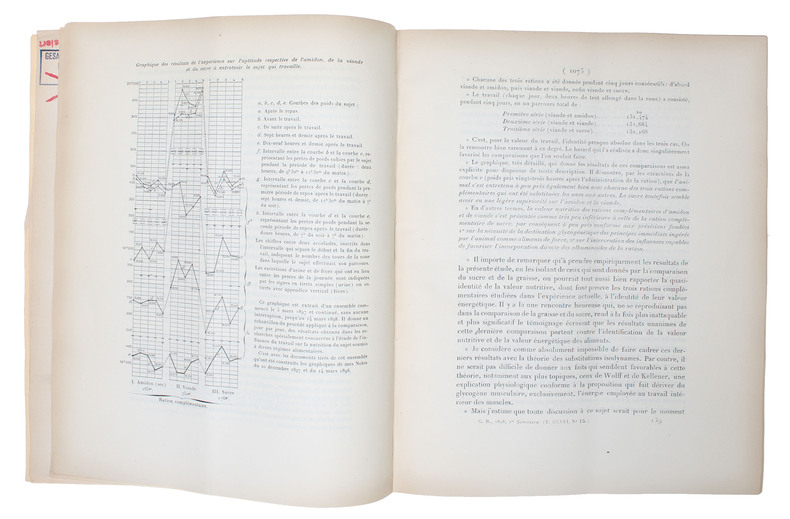
‎"CURIE, (MARIE) SKLODOWSKA. - THE DISCOVERY OF THE RADIOACTIVITY OF THORIUM - COINING THE TERM 'RADIOACTIVITY'‎

‎Rayons émis par les composés de l'uranium et de thorium. Presentée par M. Lippmann. Séance du Mardi 12 Avril 1898).‎

‎Paris, Gauthier-Villars, 1898. 4to. No wrappers. In: ""Comptes Rendus Hebdomadaires des Séances de L'Academie des Sciences"", Tome 126, No 15). Entire issue offered. With htitle and titlepage to vol. 126. Pp. 1059-1110. Curie's paper: pp. 1101-1103.‎

‎First printing of this milestone paper, being the first ""Note"" from Marie Curie about ""radioactivity"". This same ""Note"" contains a the fundamental observation: ""Two uranium ores... are much more active than uranium itself. This fact... leads one to believe that these ores may contain an element much more active than uranium."" This paper gives the first proof of the fact that radiation is an atomic property.""Henri Becquerel, discovered (1896) that uranium salts shielded from light for several months spontaneously emit rays related in their effects to Roentgen rays. Mme. Curie became enthusiastic about this subject filled with the unknown and, as she later acknowledged, involving no bibliographic research.The first step in the research was to determine whether there existed other elements capable, like uranium, of emitting radiation. Abandoning the idea of hyperfluorescence, couldn’t one calculate by electrical measurement the effects on the conductivity of air that were revealed by the gold-leaf electroscope? Pierre Curie and his brother Jacques had constructed an extremely sensitive apparatus to measure weak currents"" Mme. Curie employed it in testing both pure substances and various ores. In her first ""Note"" in the Comptes rendus""de l Académie des sciences (12 April 1898) she described the method that she followed throughout her life, the method that enabled her to make comparisons through time and crosschecks with other techniques:""I employed... a plate condenser, one of the plates being covered with a uniform layer of uranium or of another finely pulverized substance [(diameter of the plates, eight centimeters"" distance between them, three centimeters). A potential difference of 100 volts was established between the plates.]. The current that traversed the condenser was measured in absolute value by means of an electrometer and a piezoelectric quartz. In general she preferred the zero method, in which the operator compensates for the current created by the active material by manipulating the quartz. All of her students followed this procedure.""(DSB).The first results came in 1898: the measurements varied between 83 × 10-12 amperes for pitch blende to less than 0.3 × 10⁻¹² for almost inactive salts, passing through 53 × 10-12 for thorium oxide and for chalcolite (double phosphate of uranium and copper). Thorium would thus be ""radioactive"" (the term is Mme. Curie’s" its radioactive properties were discovered at the same time, independently, by Schmidt in Germany.‎

Référence libraire : 46852

Livre Rare Book

Herman H. J. Lynge & Son
Copenhagen Denmark Dinamarca Dinamarca Danemark
[Livres de Herman H. J. Lynge & Son]

€872.95 Acheter

‎"BECQUEREL, HENRI. - THE DISCOVERY OF RADIO-ACTIVITY - THE BEGINNING OF THE NUCLEAR AGE‎

‎Sur les radiations émises par phosphorescence. (+) Sur les radiations invisibles émises par les corps phosphorescents. (+) Sur quelques propriétés nouvelles des radiations invisibles émises par divers corps phosphorescents. (+) Sur les radiation...‎

‎Paris, Gauthier-Villars, 1896. 4to. Near contemp. full cloth. Spine gilt and with gilt lettering. Bookmark, ""The Chemists Club"" in gold on lower part of spine. Light wear along edges. In: ""Comptes Rendus Hebdomadaires des Séances de L'Academie des Sciences"", Tome 122 (Entire volume offered).1633 pp. The papers: 420-421, pp. 501-502, pp. 559-564, pp. 689-694, pp. 762-767 and pp. 1086-1088.‎

‎First appearance of the six landmark papers in which Becquerel documents his discovery of Radio-activity, PROMPTING THE NUCLEAR AGE.Becquerel was an expert in fluorescence and phosphorescence, continuing the work of his father and grandfather. Follwing the discovery of X-rays by Röntgen, Bexquerel investigated fluorescent materials to see if they also emitted X-rays. He exposed a fluorescent uranium salt, pechblende, to light and then placed it on a wrapped photographic plate.He found that a faint image was left on the plate, which he believed was due to the pichblende emitting the light it had absorbed as a more penetrating radiation.. However, by chace, he left a sample that had not been exposed to light on top of a photographic plate in a drawer. he noticed that the photographic plate also had a a faint image of the pechblende. After several chemical tests he concluded that these ""Becquerel rays"" were a property of atoms. He had, by chace, discovered radio-activity and prompted thee beginning of the nuclear age. He shared the Nobel Prize for Physics in 1903 with Marie and Pierre Curie. The ""Becquerel Rays"" were later discovered to be a composite of three forms of emanation, distinguished by Rutherford as alpha, beta and gamma rays.Dibner: 163 (the later Mémoire from 1903) - PMM: 393 (1903- Mémoire) - Garrison & Morton: 2001 (only the first paper). - Magie ""A Sourve Book in Physics"" p. 610 ff. - Norman:157.‎

Référence libraire : 46854

Livre Rare Book

Herman H. J. Lynge & Son
Copenhagen Denmark Dinamarca Dinamarca Danemark
[Livres de Herman H. J. Lynge & Son]

€1,141.55 Acheter

‎"[THE ECONOMIST - HITLER CALLING FOR AN ""EXPORT BATTLE""].‎

‎The Real Threat to Our Export. [The Economist, Weekly Commercial Times, Bankers' Gazette, and Railway Monitor: A Political Literary, and General Newspaper].‎

‎London, The Economist Office, 1939. Small folio. Bound with the original wrappers in comtemporary half cloth. Entire volume 134, January - March, 1939, of The Economist. Binding with minor wear, otherwise fine and clean. Pp. VIII, 660, 17-24.‎

‎Original printing of The Economist - the most important and influential economic journal worldwide - from the year 1939 where Hitler invaded Poland and thereby initiated The Second World War.On January 30 Hitler gave a speech before the Reichstag calling for an ""export battle"" to increase German foreign exchange holdings. The same speech also sees Hitler's ""prophecy"" where he warns that if ""Jewish financers"" start a war against Germany, the result will be the annihilation of the Jewish race in Europe"". Hitler's speech and general economic policy (effectuated by Dr. Schacht) is an important subject in the present issues of The Economist‎

Référence libraire : 46859

Livre Rare Book

Herman H. J. Lynge & Son
Copenhagen Denmark Dinamarca Dinamarca Danemark
[Livres de Herman H. J. Lynge & Son]

€335.75 Acheter

‎[THE ECONOMIST].‎

‎[The Economist, Weekly Commercial Times, Bankers' Gazette, and Railway Monitor: A Political Literary, and General Newspaper].‎

‎London, The Economist Office, 1923. Small folio. Bound in comtemporary half calf. Entire volume 96, January - June, 1923, of The Economist. Binding with wear, otherwise fine and clean. Pp. XII, 1480.‎

‎Original printing of The Economist - the most important and influential economic journal worldwide - from the year 1923, with many articles about the hyperinflation in the Weimar Republic.‎

Référence libraire : 46860

Livre Rare Book

Herman H. J. Lynge & Son
Copenhagen Denmark Dinamarca Dinamarca Danemark
[Livres de Herman H. J. Lynge & Son]

€134.30 Acheter

‎[THE ECONOMIST].‎

‎[The Economist, Weekly Commercial Times, Bankers' Gazette, and Railway Monitor: A Political Literary, and General Newspaper].‎

‎London, The Economist Office, 1923 Small folio. Bound with the originalwrappers in comtemporary half calf. Entire volume 97, July - December, 1923, of The Economist. Binding with wear, otherwise fine and clean. Pp. XII, 1172, (2).‎

‎Original printing of The Economist - the most important and influential economic journal worldwide - from the year 1923 minimum wage is established by law in the United States.‎

Référence libraire : 46862

Livre Rare Book

Herman H. J. Lynge & Son
Copenhagen Denmark Dinamarca Dinamarca Danemark
[Livres de Herman H. J. Lynge & Son]

€134.30 Acheter

‎[THE ECONOMIST].‎

‎[The Economist, Weekly Commercial Times, Bankers' Gazette, and Railway Monitor: A Political Literary, and General Newspaper].‎

‎London, The Economist Office, 1937. Small folio. Bound with the original wrappers in comtemporary half calf. Entire volume 129, October - December, 1937, of The Economist. Wear to capitals, otherwise fine and clean. Pp. XII, 668, 17-25.‎

‎Original printing of The Economist - the most important and influential economic journal worldwide - from the year 1937.‎

Référence libraire : 46863

Livre Rare Book

Herman H. J. Lynge & Son
Copenhagen Denmark Dinamarca Dinamarca Danemark
[Livres de Herman H. J. Lynge & Son]

€134.30 Acheter

‎[THE ECONOMIST].‎

‎[The Economist, Weekly Commercial Times, Bankers' Gazette, and Railway Monitor: A Political Literary, and General Newspaper].‎

‎London, The Economist Office, 1938. Small folio. Bound with the original wrappers in comtemporary half calf. Entire volume 132, July - September, 1938, of The Economist. Wear to extremities, internally fine and clean. Pp. VIII, 624, 17-24.‎

‎Original printing of The Economist - the most important and influential economic journal worldwide - from the year 1938.‎

Référence libraire : 46864

Livre Rare Book

Herman H. J. Lynge & Son
Copenhagen Denmark Dinamarca Dinamarca Danemark
[Livres de Herman H. J. Lynge & Son]

€134.30 Acheter

‎[THE ECONOMIST].‎

‎[The Economist, Weekly Commercial Times, Bankers' Gazette, and Railway Monitor: A Political Literary, and General Newspaper].‎

‎London, The Economist Office, 1938. Small folio. Bound with the original wrappers in comtemporary half calf. Entire volume 133, October - December, 1938, of The Economist. Wear to capitals, otherwise fine and clean. Pp. VIII, 736,17-28.‎

‎Original printing of The Economist - the most important and influential economic journal worldwide - from the year 1938.‎

Référence libraire : 46866

Livre Rare Book

Herman H. J. Lynge & Son
Copenhagen Denmark Dinamarca Dinamarca Danemark
[Livres de Herman H. J. Lynge & Son]

€134.30 Acheter

‎"[THE ECONOMIST - THE PANAMA CANAL].‎

‎The Panama Canal. [The Economist, Weekly Commercial Times, Bankers' Gazette, and Railway Monitor: A Political Literary, and General Newspaper]. - [THE ECONOMIST - THE PANAMA CANAL]‎

‎London, The Economist Office, 1879. Small folio. Bound in comtemporary half cloth. Entire volume 37, July - December, 1879, of The Economist. Minor wear to extremities and a few repairs to a few leaves, otherwise fine and clean. Pp. 761-1504.‎

‎Original printing of The Economist - the most important and influential economic journal worldwide - from the year 1879. The initial planning of the Panama Canal began in 1879. The enormous endeavor of digging the Canal was reflected in The Economist: ""The canal proposed by M. de Lesseps, and intended to pierce the Isthmus of Panama is in many respects a bolder enterprise even than the Suez Canal. The engineering difficulties are far greater, the climate is a much more serious obstacle to labour, and especially to that of Europeans, and, finally, the possibility of a rival plan being carried out is much greater.""‎

Référence libraire : 46867

Livre Rare Book

Herman H. J. Lynge & Son
Copenhagen Denmark Dinamarca Dinamarca Danemark
[Livres de Herman H. J. Lynge & Son]

€335.75 Acheter

‎"HERAPATH, JOHN - THE KINETIC THEORY OF GASES.‎

‎On the Physical Properties of Gases. (To Dr. Thomsen) (+) A Mathematical Inquiry into the Causes, Laws, and principal Phaenomena of heat, Gases, Gravitation, &c. (3 Parts).‎

‎London, Baldwin, Cradock, and Joy, 1816 a. 1821. Bound in 2 uniform contemp. moiré boards. Light wear along edges and a fes smaller scratches. In: ""Annals of Philosophy"" or, Magazine of Chemistry, Mineralogy, Mechanics, Natural History... By Thomas Thomson."", Vol. VIII and New series Vol. I. VIII,479 pp. a. 9 engraved plates, VIII,479 pp. a. 7 engraved plates. (Entire volumes offered). Herapath's papers: pp. 56-60 (1816) a. pp. 273-293, 340-351 a. 401-416.‎

‎First printing of these contoversial papers where Herapath revived the kinetic theory of gases. His theory was more or less neglected by the scientific community at his time. The kinetic theory remained dormant and forgotten after Euler's and Bernouilli's work ""until 1816, when Herapath proposed a theory which is essential Bernoulli's. Unfortunately he chose to define temperature as being proportional to the momentum rather than the kinetic energy of molecules. Herapath was the first to show, more or less, that kinetic theory can provide simple explanations for the changes of state, diffusion, and the propagation of sound.""(Trousdell ""Essayas in the History of Mechanics"", pp. 283 ff.).Euler, Bernoulli, Herapath and Waterston may be considered the principal scientists who prior to 1850 attempted a more or less complete mathematical treatment of gases, based on a set of molecular postulates. (Jamie Wisniak).""Having published a preliminary notice of his theory in the Annals of Philosophy in 1816, Herapath submitted a detailed account to the Royal Society in 1820. Davy, who was elected to the presidency of the Society in November of that year, was primarily responsible for the fate of the paper. Although Davy was already known as an advocate of the qualitative idea that heat is molecular motion, he found Herapath’s quantitative development too speculative and complicated"" he rejected the hypothesis of an absolute temperature implying an ""absolute zero"" of cold. Having been told that his paper would not be accepted for publication in the Philosophical Transactions, Herapath withdrew it and published it instead in the Annals of Philosophy in 1821. Five years later he launched an attack on Davy in the Times of London, accusing him of circulating unfounded criticisms of his experimental work, which prevented its publication. Although Davy ignored a series of letters and challenges published in the Times, Herapath later claimed Davy’s resignation from the presidency of the Royal Society (1827) as a victory for himself.""(DSB).‎

Référence libraire : 46878

Livre Rare Book

Herman H. J. Lynge & Son
Copenhagen Denmark Dinamarca Dinamarca Danemark
[Livres de Herman H. J. Lynge & Son]

€738.65 Acheter

‎"MAYER, J.R. (JULIUS ROBERT). - THE FIRST STATEMENT OF THE CONSERVATION OF ENERGY.‎

‎Bemerkungen über die Kräfte der unbelebten Natur.‎

‎Heidelberg, C.F. Winter, 1842. Bound in a nice later hcalf. Raised bands, titlelabel with gilt lettering. In: ""Annalen der Chemie und Pharmacie. herausgegeben von Friedrich Wóhler und Justus Liebig"", Vol. 42. (6),356 pp. Mayer's paper: pp. 233-240. Volume 42 is offered bound together with vol. 41. (8),376 pp. a. 1 folded plate. (This volume contains importent cehemical papers by Kolbe, Cahours, Kopp, Wöhler, Laurent and Liebig (the first printing of Liebig's famous work on animal physiology and pathology)‎

‎First printing of one of the most important papers in physics, chemistry and physiology in the 19th century. The paper is the first to propose an equivalence of all forms of energy, including heat, and a conservation of total energy. Although Mayer was the first to set forth the general law of the conversation of energy (the first thermodynamical law), it was James Joule who first put the law on firm footing. ""The paper of 1842 (the paper offered) set out Mayer’s definitive view on the conservation of force and established his claim to priority"" historically the paper also provides insight into the processes through which Mayer arrived at his theory.""(DSB).""Originally trained as a physician, mayer did not enjoy medical practice. About 1840 he began to be interested in physics and he entered thhe field of research, ... In 1842 he not only presented a figure for the mechanical equivalent of heat, but he also clearly presented his belief in the conversation of energy. He had some difficulty getting his paper on the subject published but Liebig finally accepted for the importent journal he edited. Though Mayer was five years ahead of Joule his paper aroused no interest, and in the end it was Joule, with his imposing experimental background. who received credit for working out the mechanical equivalent of heat. And it was Helmholtz who recieved credit for announcing the law of conservation of energy because he announced it so much more systematically. Yet Mayer went further than either of the other two, for he included living phenomena in the realm of energy conservation (a daring step in a decade when vitalism, with its view that the laws of inanimate nature did not apply to living systems, was still a considerable force). Mayer argued that solar energy was the ultimate source of all energy on earth, both living and non-living. He further suggested that solar energy was derived from the slow contraction of the sun, or by the fall of meteors into the sun, in either case kinetic energy being converted to radiant energy.""(Asimov)""After 1860, Mayer was finally given the recognition he deserved. Many of his articles were translated into English, and such well-known scientists as Rydolph Clausius in Germany and John Tyndall in England began to champion Mayer as the founder of the law of the conservation of energy.""(Alan Lightman ""Great Ideas in Physics"", p. 8).Parkinson ""Breakthroughs"" 1842 P. - Magee ""A Source Book in Physics"", p. 196 ff. - Dibner: 157 (listing the offprint with a different title) - PMM: 330 (offprint-version). - Garrison & Morton: 606.‎

Référence libraire : 46883

Livre Rare Book

Herman H. J. Lynge & Son
Copenhagen Denmark Dinamarca Dinamarca Danemark
[Livres de Herman H. J. Lynge & Son]

€3,357.50 Acheter

‎"JACOBI, C.G.J. - KINETICS OF THE TOP.‎

‎Sur la rotation d'un corps.‎

‎(Berlin, Georg Reimer, 1850). 4to. Later marbled wrappers. In ""Journal für die reine und angewandte Mathematik, 39. Band, 24 Heft. Jacobi's paper takes up the whole issue . pp. 293-350.‎

‎First printing of main paper in Rigic Body Dynamics, where Jacobi studied the motion of a top and derived the analytic solution for the motion of a free body and defined the so-called ""Jacobi analytic functions"". The problem was first treated by Leonhard Euler in 1758 in the case where the fixed point is the centre of gravity of the top, but it was Jacobi who first solved the problem completely, making use of elliptic functions which he himself had introduced.‎

Référence libraire : 46889

Livre Rare Book

Herman H. J. Lynge & Son
Copenhagen Denmark Dinamarca Dinamarca Danemark
[Livres de Herman H. J. Lynge & Son]

€268.60 Acheter

‎"LE VERRIER, URBAIN JEAN JOSEPH. - PREDICTING THE EXISTENCE OF THE PLANET NEPTUN.‎

‎Paris, Bachelier, 1846. 4to. No wrappers. In: ""Comptes rendus hebdomadaires des séances de l’Académie des sciences"", Vol. 23, No 9 (entire issue offered). With htitle and titlepage to vol. 23. Pp. 425-484. Le Verrier's paper: pp. 428-438.‎

‎First printing of this important paper in the history of astronomy in which Le Verrier predicted the existence of a new planet, determining its orbit and the mass as well as its actual position, so that, by informing Dr. Galle the following month, where he should look for it in the sky. The same evning when Galle had received the letter, he found close to the position given by Le Verrier a strange body showing a small planetary disc, which was soon recognized as a new planet, known now as Neptune. Adams in England, independently made the same prediction.""Until 1846 there was no theory of Uranus that permitted its movements to be represented satisfactorily. In 1821 Bouvard had constructed tables that, abandoning the older positions, adhered very closely to recent observations. Yet twenty years later a discrepancy of two minutes had already been observed, and several astronomers suggested that it might result from the attraction of an unknown planet. In 1845 Arago presented the problem to Le Verrier, who began by establishing a precise theory of Uranus. He then demonstrated that its observed perturbations could not be explained as the effect of the actions of Jupiter and Saturn, whatever modifications might eventually be made in the values assigned to the masses of those planets. He began to search for signs of an unknown disturbing planet. Finally, in a third memoir on the subject, appearing on 31 August 1846, Le Verrier fixed the exact position of the unknown planet and gave its apparent diameter.""(DSB)‎

Référence libraire : 46890

Livre Rare Book

Herman H. J. Lynge & Son
Copenhagen Denmark Dinamarca Dinamarca Danemark
[Livres de Herman H. J. Lynge & Son]

€604.35 Acheter

‎"KOENIG (KÖNIG), SAMUEL. - GIVING RISE TO ONE OF THE UGLIEST SCIENTIFIC CONTROVERSIES.‎

‎De universali Principio aequilibrii & motus, in Vi viva reperto, deque nexu inter Vim Vivam & Sctionem, utriusque Minimo, Dissertatio. (+) ...continuata & finita. (2 Parts).‎

‎Leipzig, Gleditsch & Lanckis, 1751. 4to. No wrappers. In: ""Nova Acta Eruditorum, Anno MDCCLI"", March- Issue, Pars I-II. Entire issue in 2 parts offered. With titlepage to the volume 1751. Pp. 97-192. Koenig's paper: pp. 125-135 a. pp. 162-176. With 2 engraved plates. Titlepage with 2 stamps and a bit soiled. Leaves as usual a bit browned.‎

‎First printing of this important paper in which Koenig set forth his ""Law of least Action"". The law states that the kinetic energy of a system of mass points is equal to the sum of the kinetic energy of the motion of the system relative to the center of gravity and of the kinetic energy of the total mass of the system considered as a whole, which moves as the center of gravity of the system.""While still in Franeker, Koenig wrote the draft of his important essay on the principle of least action, which was directed against Maupertuis. The controversy touched off by this work, which was published in March 1751, resulted in perhaps the ugliest of all the famous scientific disputes. Its principal figures were Koenig, Maupertuis, Euler, Frederick II, and Voltaire" and, as is well known, it left an unseemly stain on Euler’s otherwise untarnished escutcheon. The quarrel occupied Koenig’s last years almost completely" moreover, he had been ill for several years before it started. Koenig emerged the moral victor from this affair, in which all the great scientists of Europe—except Maupertuis and Euler—were on his side. The later finding of Kabitz2 testifies to Koenig’s irreproachable character.""(DSB).‎

Référence libraire : 46906

Livre Rare Book

Herman H. J. Lynge & Son
Copenhagen Denmark Dinamarca Dinamarca Danemark
[Livres de Herman H. J. Lynge & Son]

€470.05 Acheter

‎"CLAUSIUS, R. (RUDOLF). - THE HEATH-DEATH OF THE UNIVERSE - ESTABLISHING THE SECOND LAW OF THERMODYNAMICS.‎

‎Ueber eine veränderte Form des zweiten Hauptgesatzes der mechanichen Wärmetheorie.‎

‎Leipzig, Johann Ambrosius Barth, 1854. Contemp. marbled boards. In: ""Annalen der Physik und Chemie. Hrsg. von J.C. Poggendorff"", Vierte Reihe Bd. 3, (= Poggendorff Bd. 93,). Entire volume offered. Two stamps to titlepage. X,632 pp. and 4 folded engraved plates. Clausius's paper: pp. 481-506. Internally clean and fine.‎

‎First printing of this milestone paper in thermodynamics, which together with his paper from 1850, established the second law of thermodynamics. In the offered paper Clausius introduces the symbol T for the universal function of temperature (a + 1) and he introduces the concept of ""entropy"" (the greek word for 'transformation'), but without using the word (Clausius introduced the word later in 1865), he calls this new theorem ""the principle of the equivalence of transformations"". This principle paints a dramatic picture of the end of the world, the so-called ""heath-death of the universe"".""Entropy, on the other hand, of the complementary experience of water seeking its own level, of hot bodies cooling, of springs untensing, of magnetism wearing off and electrical charges leaking away, of a destiny suchThat no life lives forever" - That dead men rise up never" that even the weariest river Winds somewhere safe to sea: a world getting old and running down.""(Gillespie in ""The edge of Objectivity"" p. 400-01.).""Clausius discovered that if he took the ratio of the heat content of a system and its absolute temperature, this ration would always increase in any process taken place in a closed system. (A closed system is one that loses no energy to the outside world and gains no energy from it.) With perfect efficiency, which is never realized in the real world, of course, the ratio would remain constant, but i would never, under any circumstances, decrease.""(Asimov). - Parkinson: Breakthroughs 1854 C.‎

Référence libraire : 46907

Livre Rare Book

Herman H. J. Lynge & Son
Copenhagen Denmark Dinamarca Dinamarca Danemark
[Livres de Herman H. J. Lynge & Son]

€2,014.50 Acheter

‎"DRAPER, (JOHN) WILLIAM. - THE FIRST DAGUERREOTYPE PORTRAIT.‎

‎On the Process of Daguerreotype, and its application to taking Portraits from the Life.‎

‎London, Richard and John Taylor, 1840. Contemp. hcalf. A nic to spine at upper hinge. Hinges weakening (not loose). Gilt lettering to spine ""Philosophical Magazine"" - Vol.XVII. In: ""The London, Edinburgh, and Dublin Philosophical Magazine and Journal of Science. Conducted by David Brewster et al."". Vol. XVII. A stamp to titlepage and a few other pages. Entire volume offered. VIII,552 pp. Draper'spaper: pp. 217-225.‎

‎First printing of the famous paper in which Draper relates how he was able to made the first photographic portrait on a daguerreotype plate, giving an ennormously long exposure. The subject of the portrait, Draper's assistant, powdered his face with flour and sat in front of the camera for a half hour facing the sunlight.Draper stated that it is possible to make portraits in full sunlight, using mirrors as light reflectors. ""But in the reflected sunshine, the eye cannot support the effulgence of the rays. It is therefore necessary to pass them through some blue medium, which shall abstract from them their heat and take away their offensive brilliancy. Ihave used for this purpose blue glass, and also ammoniaco-sulphate of copper, contained in a large trough of plate glass, the interstice being about an inch thick."" (p. 217 in the paper offerd).""Draper first achieved wide celebrity for his pioneering work in photography. As early as 1837, while still in Virginia, he had followed the example of Wedgwood and Davy in making temporary copies of objects by the action of light on sensitized surfaces. When the details of Daguerre’s process for fixing camera images were published in various New York newspapers on 20 September 1839, Draper was ready for the greatest remaining challenge, to take a photographic portrait. A New York mechanic, Alexander S. Wolcott, apparently won the race by 7 October. But if Draper knew of this, he persisted in his own experiments and succeeded in taking a portrait not later than December 1839. His communication to the Philosophical Magazine, dated 31 March 1840, was the first report received in Europe of any photographer’s success in portraiture. The superb likeness of his sister Dorothy Catharine, taken not later than July 1840, with an exposure of sixty-five seconds, seems to be the oldest surviving photographic portrait.""(DSB).The volume contains also Michael Faraday's importent letter to Gay-Lussac on induction in the first English version. ""On Magneto-electric induction."", pp. 281-89 a. pp.356-366. (Originally published in French in ""Annales de Chimie et Physique"" in 1832.‎

Référence libraire : 46912

Livre Rare Book

Herman H. J. Lynge & Son
Copenhagen Denmark Dinamarca Dinamarca Danemark
[Livres de Herman H. J. Lynge & Son]

€1,611.60 Acheter

‎"RUTHERFORD, E. (ERNEST). - THE ALCHEMIST'S DREAM FULFILLED, THE CHANGE OF ONE ELEMENT INTO ANOTHER.‎

‎Collision of alpha Particles with Light Atoms. (4 Parts). I. Hydrogen. II. Velocity of the Hydrogen Atom. III. Nitrogen and Oxygen Atoms. IV. An Anomalous Effect in Nitrogen. - [SPLITTING THE ATOM PMM 411.]‎

‎London, Taylor and Francis, 1919. Recent full cloth. Titlelabel in leather on spine with gilt lettering. In: ""The London, Edinburgh, and Dublin Philosophical Magazine and Journal of Science"" Sixth Series, Vol. XXXVII. Pp. VIII,616 pp. a. 6 plates. A stamp to top of p. 537. Rutherford's paper: pp. 537-587.‎

‎First appearance of this seminal paper which contains Rutherford's discovery of artificial transmutation. He here discovered, that the atomic nucleus (discovered by him in 1911) itself had a structure, when, by bombarding nitrogen with alpha particles, he produced THE FIRST ARTIFICIAL TRANSFORMATION OF AN ELEMENT INTO ANOTHER, and what was left after the bombardment had to be those of oxygen atoms. - Thus thus began the age of nuclear physics.""Rutherford was .. the first man ever to change one element into another as a result of the manipulations of his own hands. He had achieved the dream of the alchemists. He had also demonstrated the first man-made ""nuclear reaction"". By 1924 Rutherford had managed to knock protons out of the nuclei of most of the lighter elements."" (Asimov).""A few years before, Marsden had noticed scintillations on a screen placed far beyond the range of alpha particles when these particles were allowed to bombard hydrogen. Rutherford repeated the experiment and showed that the scintillations were caused by hydrogen nuclei or protons. This was easily understood, but when he substituted nitrogen for the hydrogen, he saw the same proton flashes. The explanation he gave in 1919 stands beside the transformation theory of radioactivity and the nuclear atom as one of Rutherford’s most important discoveries. This, he said, was a case of artificial disintegration of an element. Unstable, or radioactive, atoms disintegrated spontaneously"" but here a stable nucleus was disrupted by the alpha particle, and a proton was one of the pieces broken off."" (DSB).PMM: 411.‎

Référence libraire : 46915

Livre Rare Book

Herman H. J. Lynge & Son
Copenhagen Denmark Dinamarca Dinamarca Danemark
[Livres de Herman H. J. Lynge & Son]

€2,215.95 Acheter

‎"WILSON, C.T.R. - THE IMPROVED VERSION OF ""WILSONS CLOUD-CHAMBER"".‎

‎On a Method of making Visible the Paths of Ionising Particles through a Gas.‎

‎London, Harrison and Sons, 1911. Small 4to. Contemp. full cloth. Spine gilt and with gilt lettering. A stamp to verso of titlepage and a few other leaves. In: ""Proceedings of the Royal Society of London. Series A."", Vol. LXXXV. XXIII,605,XXIV pp. and 11 plates. (Entire volume offered). Wilson's paper: pp. 285-288 a. 1 plate. Clean and fine.‎

‎First appearance of the paper which describes the final version of his invention, the famous Cloud-Chamber, - the first Cloud Chamber was invented by him in 1896 - for making visible and photographing the paths of charged particles, an invention for which Wilson received a share of the Nobel Prize in 1827. By using the Cloud Chamber he was here (1911) able to observe the track of an alpha ray by condensing water drops onto the ions produced by its passage.The Cloud Chamber, which Rutherford called ""the most original apparatus in the whole history of physics"", became standard equipment in physics laboratories, and made possible numerous important discoveries in the fields of particle and nuclear physicsAfter 1896 ""Wilson continued to experiment with ultraviolet radiation and other techniques for producing condensation effects, but soon concentrated on atmospheric electricity, not returning to the cloud chamber until December 1910. He designed an improved chamber with new methods of illumination and the possibility of photographing the results. At this time Wilson realized that it might be possible to reveal the track of an a ray by condensing water drops onto the ions produced by its passage. During March 1911 he saw this effect produced in his apparatus. Thus, the elucidation of phenomena seen in the Scottish hills led to the possibility of studying the processes of radioactivity, and the Wilson cloud chamber became an important piece of laboratory equipment. But it was in the study of cosmic rays that it achieved its full power, particularly in the refined form developed by Patrick Blackett, in which it was possible to study particles of very high energy and the production of electron-positron pairs with the chamber situated in a strong magnetic field."" (DSB).‎

Référence libraire : 46922

Livre Rare Book

Herman H. J. Lynge & Son
Copenhagen Denmark Dinamarca Dinamarca Danemark
[Livres de Herman H. J. Lynge & Son]

€470.05 Acheter

‎"BROGLIE (DEBROGLIE), LOUIS de. - DISCOVERY OF THE WAVE THEORY OF MATTER AND CREATION OF WAVE-MECHANICS.‎

‎Ondes et quanta. Note de M. Louis de Broglie, présentée par M. Jean Perrin. (Séance du 10 Septembre 1923). (+) Quanta de lumière, diffraction et interférences. Note de M. Louis de Broglie, transmise par M. Jean Perrin. (Séance du 24 Septembre 1923). (...‎

‎Paris, Gauthier-Villars et Cie, 1923. 4to. Bound in 2 contemp. full cloth. Spines gilt and with gilt lettering. In: ""Comptes Rendus Hebdomadaires des Séances de L'Academie des Sciences"", Tome 177. With htitle a. titlepage. 1513 pp. (Entire volume offered). De Broglie's papers: pp. 507-510, pp. 548-551 a. pp. 630-32. Clean and fine. A stamp to verso of titlepage.‎

‎First edition of these papers which ESTABLISHED A NEW ERA IN PHYSICS by introducing the epochal new principle that particle-wave duality should apply not only to radiation but also to matter and thus CREATING QUANTUM MECHANICS. These 3 papers were extended to form his doctoral thesis of 1924 ""Recherches sur la Théorie des Quanta.""De Broglie relates ""After long reflection in solitude and meditation, I suddenly had the idea, during the year 1923, that the discovery made by Einstein in 1905 should be generalized by extending it to all material particles and notably to electrons"" (Preface to his PhD thesis 1924).""He made the leap in his September 10, 1923, paper: E=hv should hold not only for photons but also for electrons, to which he assigns a 'fictitious associated wave'. In his September 24 paper, he indicated the direction in which one 'should seek experimental confirmations of our ideas': a stream of electrons traversing an aperture whose dimensions are small compared with the wavelenght of the electron waves 'should show diffraction phenomena' .""(Pais ""Subtle is the Lord"", pp. 425-436).In the third paper (October 8) he discusses ""The interplay between the propagation of the particle and of the waves could be expressed in more formal terms as an identity between the fundamental variational principles of Pierre de Fermat (rays), and Pierre Louis Maupertuis (particles) as de Broglie discussed it further in his last communication . Therein he also considered some thermodynamic consequences of his generalized wave-particle duality. He showed in particular how one could, using Lord Rayleigh’s 1900 formula for the number of stationary modes for phase waves, obtain Planck’s division of the mechanical phase space into quantum cells.Louis de Broglie achieved a worldwide reputation for his discovery of the wave theory of matter, for which he received the Nobel Prize for physics in 1929. His work was extended into a full-fledged wave mechanics by Erwin Schrödinger and thus contributed to the creation of quantum mechanics. After an early attempt to propose a deterministic interpretation of his theory, de Broglie joined the Copenhagen school’s mainstream noncausal interpretation of the quantum theory.""(DSB).""This idea [i.e. de Broglie's that matter might behave as waves] was tested and confirmed by Davisson and Germer in 1927... Thus the duality of both light and matter had been established, and physicists had to come to terms with fundamental particles which defied simple theories and demanded two sets of 'complementary' descriptions, each applicable under certain circumstances, but incompatible with one another."" (Printing and the Mind of Man, 417).‎

Référence libraire : 46949

Livre Rare Book

Herman H. J. Lynge & Son
Copenhagen Denmark Dinamarca Dinamarca Danemark
[Livres de Herman H. J. Lynge & Son]

€4,029.00 Acheter

‎"BROGLIE, LOUIS de. - DISCOVERY OF THE WAVE THEORY OF MATTER AND CREATION OF WAVE-MECHANICS.‎

‎A Tentative Theory of Light Quanta.‎

‎London, Taylor and Francis, 1924. Later full buckram, gilt lettering to spine. In: Philosophical Magazine conducted by Oliver Joseph Lodge etc."", Vol. 47. - Sixth Series. VIII,1168 pp. and 8 plates. (Entire volume offered). De Broglie's paper: pp. 446-458. Internally clean and fine.‎

‎First English version of the papers which ESTABLISHED A NEW ERA IN PHYSICS by introducing the epochal new principle that particle-wave duality should apply not only to radiation but also to matter and thus CREATING QUANTUM MECHANICS. The English paper is a translation of de Broglie's 3 ""Notes "" which he published in ""Comptes Rendus"" in September and October 1923 (Ondes et quanta. - Quanta de lumière, diffraction et interférences. - Les quanta, la théorie cinétique des gaz et le principe de Fermat). These 3 papers were extended to form his doctoral thesis of 1924 ""Recherches sur la Théorie des Quanta."" - This English edition (of the papers) was published before his thesis of 1924 as the paper is dated October 1, 1923, and published here in the Februar issue of Philosophical Magazine, months before the thesis.The English version contains furthermore an addition, a postscript, which contains a generalization of the theory which is consistent with the special theory of relativity, and NOT published in ""Comptes Rendues"" in 1923.With the three communications to the Academy of Sciences (the 3 Comptes Rendus papers) in the fall of 1923 de Broglie had presented the main ideas of his unified dynamics of light quanta and atoms. He was confident enough about his results that he submitted them also in English in the offered paper. At the end of the paper he summarized his results. De Broglie relates ""After long reflection in solitude and meditation, I suddenly had the idea, during the year 1923, that the discovery made by Einstein in 1905 should be generalized by extending it to all material particles and notably to electrons"" (Preface to his PhD thesis 1924).""He made the leap in his September 10, 1923, paper: E=hv should hold not only for photons but also for electrons, to which he assigns a 'fictitious associated wave'. In his September 24 paper, he indicated the direction in which one 'should seek experimental confirmations of our ideas': a stream of electrons traversing an aperture whose dimensions are small compared with the wavelenght of the electron waves 'should show diffraction phenomena' .""(Pais ""Subtle is the Lord"", pp. 425-436).In the third paper (October 8) he discusses ""The interplay between the propagation of the particle and of the waves could be expressed in more formal terms as an identity between the fundamental variational principles of Pierre de Fermat (rays), and Pierre Louis Maupertuis (particles) as de Broglie discussed it further in his last communication . Therein he also considered some thermodynamic consequences of his generalized wave-particle duality. He showed in particular how one could, using Lord Rayleigh’s 1900 formula for the number of stationary modes for phase waves, obtain Planck’s division of the mechanical phase space into quantum cells.Louis de Broglie achieved a worldwide reputation for his discovery of the wave theory of matter, for which he received the Nobel Prize for physics in 1929. His work was extended into a full-fledged wave mechanics by Erwin Schrödinger and thus contributed to the creation of quantum mechanics. After an early attempt to propose a deterministic interpretation of his theory, de Broglie joined the Copenhagen school’s mainstream noncausal interpretation of the quantum theory.""(DSB).""This idea [i.e. de Broglie's that matter might behave as waves] was tested and confirmed by Davisson and Germer in 1927... Thus the duality of both light and matter had been established, and physicists had to come to terms with fundamental particles which defied simple theories and demanded two sets of 'complementary' descriptions, each applicable under certain circumstances, but incompatible with one another."" (Printing and the Mind of Man, 417).This volume of Philosophical Magazine contains another importent paper in the history of Quantum Mechanics"": ""The Quantum Theory of Radiation"" by BOHR, KRAMERS AND SLATER, pp. 785-802. ""After Kramers had succeeded in extending the scope of the correspondence argument to the theory of optical dispersion ""thus rounding off a treatment of the interaction of atomic systems with radiation that accounted for all emission, absorption, and scattering processes"" Bohr ventured to propose a systematic formulation of the whole theory, in which what he called the virtual character of the classical model was emphasized. In this he was aided by Kramers and a young American visitor, J. C. Slater, and the new theory was published in 1924 under the authorship of all three. The most striking feature of this remarkable paper, ""The Quantum Theory of Radiation,"" was the renunciation of the classical form of causality in favor of a purely statistical description. Even the distribution of energy and momentum between the radiation field and the ""virtual oscillators"" constituting the atomic systems was assumed to be statistical, the conservation laws being fulfilled only on the average. This was going too far: the paper was hardly in print before A. H. Compton and A. W. Simon had established by direct experiment the strict conservation of energy and momentum in an individual process of interaction between atom and radiation. Nevertheless, this short-lived attempt exerted a profound influence on the course of events"" what remained after its failure was the conviction that the classical mode of description of the atomic processes had to be entirely relinquished."" (DSB).‎

Référence libraire : 46950

Livre Rare Book

Herman H. J. Lynge & Son
Copenhagen Denmark Dinamarca Dinamarca Danemark
[Livres de Herman H. J. Lynge & Son]

€2,014.50 Acheter

‎"BELL, ALEXANDER GRAHAM. - ""THE GREATEST INVENTION I HAVE EVER MADE"": THE PHOTOPHONE.‎

‎On the Production and Reproduction of Sound by Light. (Read before the American Association for the Advancement of Science, in Boston, August 27, 1880).‎

‎(New Haven), 1880. 8vo. Modern plain wrappers. In: American Journal of Science"", Third series, Vol. XX, No. 118, October 1880. Frontispiece-plate. Pp. 257-352 (entire issue offered). Bell's paper: pp. 305-324 and 11 textillustrations. A small stamp to verso of plate and the first leaf.‎

‎First printing of this important paper in which Bell describes his and Charles Sumner Tainter's, his assistent, invention of the Photophone or Radiophone, THE PROGENITOR OF MODERN FIBER OPTICS. This invention made possible the world's FIRST WIRELESS TELEPHONE MESSAGE, and the first call was sent from the Franklin Scool to the window of Bell's laboratory, some 213 meter away.""On June 3, 1880, Alexander Graham Bell transmitted the first wireless telephone message on his newly invented ""photophone."" Bell believed the photophone was his most important invention. The device allowed for the transmission of sound on a beam of light. Of the eighteen patents granted in Bell's name alone, and the twelve he shared with his collaborators, four were for the photophone. Bell's photophone worked by projecting voice through an instrument toward a mirror. Vibrations in the voice caused similar vibrations in the mirror. Bell directed sunlight into the mirror, which captured and projected the mirror's vibrations. The vibrations were transformed back into sound at the receiving end of the projection. The photophone functioned similarly to the telephone, except the photophone used light as a means of projecting the information, while the telephone relied on electricity."" (Mary Bellis).The first successful attempts were based upon the properties of selenium: ""The electric resistance of which varies with the degree of illumination to which it is exposed. Hence, given a transmitting instrument, such as a flexible mirror, by which the vibrations of a sound could throw into vibrations a beam of light, a receiver, consisting of sensitive selenium, forming part of an electric circuit with a battery and a telephone, should suffice to translate the varying intensities of light into corresponding varying intensities of electric current, and finally into vibrations of the telephone disk audible once more as sound."" (Prescott, George. Bell's Electric Speaking Telephone. 313 p.).‎

Référence libraire : 46951

Livre Rare Book

Herman H. J. Lynge & Son
Copenhagen Denmark Dinamarca Dinamarca Danemark
[Livres de Herman H. J. Lynge & Son]

€1,141.55 Acheter

‎"RUTHERFORD, E. (ERNEST) and T. ROYDS. - THE FINAL PROOF OF THE NATURE OF ALPHA-PARTICLES.‎

‎The Nature of the alpha Particle.‎

‎Manchester, 1909. 8vo. Contemp. full cloth. Orig. printed paper label on spine (a bit chipped). In: ""Memoirs and Proceedings of the Manchester Literary & Phlosophical Society. (Manchester Memoirs.). Volume LIII. (1908-09). Entire volume offered. The volume contains 24 papers, all with seperate pagination. Rutherford's paper: pp. 1-3.‎

‎First printing of the paper which Rutherford and Royds gave the final proof that the alpha particle are atoms of helium. The present paper was read on November 3rd 1908 and published on the 19th. It was reprinted in Philosophical Magazine and that paper is dated November 13, 1908 and published February 1909.""After nearly a decade of labor, Rutherford was finally prepared to state... what the alpha particle really was ""We may conclude that an alpha-particle is a helium atom, or, to be more precise, the alpha-particle, after it has lost its positive charge, is a helium atom"". In a paper together with Royds, completed in November 1908, he was even more emphatic: ""We can conclude with certainty... that the alpha-particle is a helium atom... They had shown that a discharge sent through a volume in which alpha-particles from radium had been collected produced the characteristic helium spectrum !""(Pais ""Inward Bound"", p. 61).""Rutherford’s early conviction that the alpha particle was a doubly charged helium atom, but he had not succeeded in proving that belief. In 1908 he and Geiger were able to fire alpha particles into an evacuated tube containing a central, charged wire and to record single events. Ionization by collision, a process studied by Rutherford’s former colleague at Cambridge, J. S. E. Townsend, caused a magnification of the single particle’s charge sufficient to give the electrometer a measurable ""kick."" By this means they were able to count, for the first time accurately and directly, the number of alpha particles emitted per second from a gram of radium.This experiment enabled Rutherford and Geiger to confirm that every alpha particle causes a faint but discrete flash when it strikes a luminescent zinc sulfide screen, and thus led directly to the widespread method of scintillation counting. It was also the origin of the electrical and electronic methods of particle counting in which Geiger later pioneered. But at this time the scintillation technique, now proved reliable, was more convenient. This counting work also led Rutherford and Geiger to the most accurate value of the fundamental electric charge e before Millikan performed his oil-drop experiment. They measured the total charge from a radium source and divided it by the number of alphas counted to obtain the charge per particle. Since this figure was about twice the previous values of e. they concluded that the alpha was indeed helium with a double charge. But Rutherford still desired decisive, direct proof"" and here his skilled glassblower came to his aid. Otto Baumbach in 1908 was able to construct glass tubes thin enough to be transparent to the rapidly moving alpha particles yet capable of containing a gas. Such a tube was filled with emanation and was placed within a larger tube made of thicker glass. In time, alpha particles from the decaying emanation penetrated into and were trapped in the space between inner and outer tubes: and when ROYDS SPARKED THE MATERIAL IN THIS SPACE, THEY SAW THE SPECTRUM OF HELIUM."" (DSB).The volume contains 2 other importent papers by Rutherford 1. ""Some Properties of the Radium Emanations"" (issued Nov. 19th, 1908) and 2. together withY. Tuomikoski ""Differences in the Decay of the Radium Emanations"" (issued April 7th, 1909).‎

Référence libraire : 46953

Livre Rare Book

Herman H. J. Lynge & Son
Copenhagen Denmark Dinamarca Dinamarca Danemark
[Livres de Herman H. J. Lynge & Son]

€604.35 Acheter

‎"EINSTEIN, A., L. INFELD & B. HOFFMANN. - EINSTEIN'S LAST CONTRIBUTION TO GENERAL RELATIVITY - THE ROUND OFF OF GENERAL RELATIVITY.‎

‎The gravitational Equations and the problem of Motion. (I-) II. (Part II only with Infeld).‎

‎Baltimore, Princeton University Press, 1938 a.1940. Royal8vo. Bound in 2 full cloth, gilt lettering to spines. In: Annals of Mathematics"", Series 2, Vol. 39 and vol. 40. (Entire volumes offered). The papers: pp. 65-100 a. pp. 455-464. Clean and fine.også on a generalization...... pais p. 496‎

‎First appearance of these two importent papers on the General theory of Relativity, in which is shown that the equation of motion follows directly from the field equation that defined the geometry.""Einstein's last importent contribution to general relativity deals again with the problem of motion. It is the work done with Leopold Indfeld and Banesh Hoffmann on the N-body problem of motion. In these papers, the gravitational field is no longer treated as external. Instead, it and the motion of its (singular) sources are treated simultaneously. A new approximation scheme is introduced in which the fields are no longer necessarily weak but in which the source velocities are small compared with the light velocity... (These equations) are widely used in analyses of planetary orbits in the solar system.""(Pais ""Subtle is the Lord"", pp. 290-91).Weil: 202 a. 205, both with an asterix, denoting a major paper. - Boni: 236 a. 236.1.‎

Référence libraire : 46954

Livre Rare Book

Herman H. J. Lynge & Son
Copenhagen Denmark Dinamarca Dinamarca Danemark
[Livres de Herman H. J. Lynge & Son]

€1,007.25 Acheter

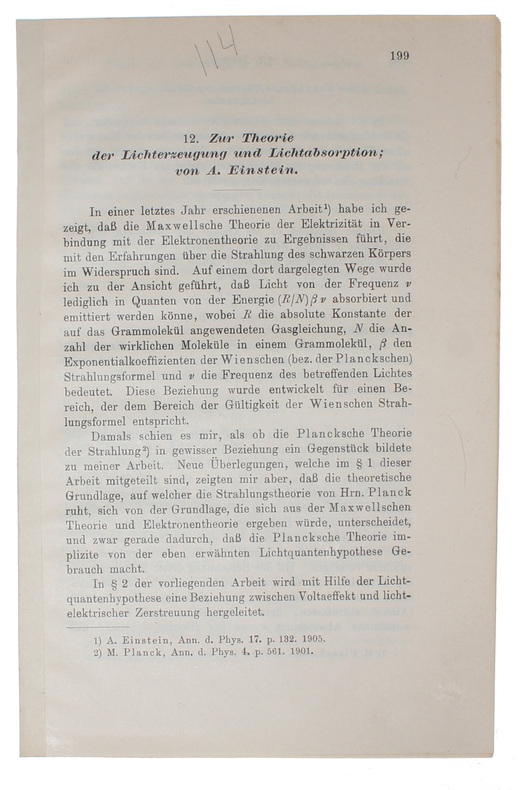
‎EINSTEIN, ALBERT. - THE NOBEL-PRIZE PAPER.‎

‎Zur Theorie der Lichterzeugung und Lichtsabsorption" (Eingegangen 13. März 1906). (On the Theory of Light Production and Light Absorption).‎

‎(Leipzig, Johann Ambrosius Barth, 1906). No wrappers. Extracted from ""Annalen der Physik"" Vierte Folge. Bd. 20. Pp. 199-206. Clean and fine.‎

‎First printing of one of the papers for which Einstein was awarded the Nobel Prize in 1921. It was for the papers ""Ueber einen die Erzeugung und Verwandlung des Lichtes betreffenden heuristischen Gesichtspunkt"" of 1905 and ""Zur Theorie der Lichterzeugung...( Theory of light emission and absorption), the offered item, that Einstein received the prize: ""for his services to theoretical physics and especially for his discoveryof the law of the photoelectrical effect"" - his reward was not based on relativity.""The quantum theory has affected virtually every branch of physics. Its earliest and one of its most significant developments was Einstein's application of the theory to what is known as the 'photo-electrical effect'....Einstein explained this effext by suggesting that the classical view that light is emitted in the form of continous waves must be abandoned. The photo-electrical effect could be explained only as an example of quantum action where the waves of light or X-rays are emitted in minute particles or bullets. It is he size of the bullet (the wave-lenght of the radiation) which determines the number of electrons ejected. It was for this, and not for the theory of relativity, that Einstein was awarded the Nobel Prize in 1921. Einstein's two fundamental papers on this subject are ""Ueber einem Erzeugung...."" 1905 and Zur Theorie der Lichterzeugung (the paper offered here)"" (PMM the note to 391).Weil: 12 (with an asterix, denoting a major paper) - Boni:12.‎

Référence libraire : 46956

Livre Rare Book

Herman H. J. Lynge & Son
Copenhagen Denmark Dinamarca Dinamarca Danemark
[Livres de Herman H. J. Lynge & Son]

€470.05 Acheter

‎EINSTEIN, ALBERT. - THE PHOTOELECTRIC EQUATION.‎

‎Zur Theorie der Lichterzeugung und Lichtsabsorption (withbound:) Das princip von der Erhaltung der Schwerpunktsbewegung und die Trägheit der Energie" (2 papers).‎

‎Leipzig, Johann Ambrosius Barth, 1906. Bound together in one contemp. halfcalf. Spine gilt. Minor scratches to spine. A stamp to titlepage and htitle. ""Annalen der Physik. Vierte Folge. Band 20. Herausgegeben von Paul Drude."" , Portrait (Paul Drude), VIII,1048 pp. and 6 plates. Einstein papers: pp. 199-206 and 627-33. The entire volume offered.‎

‎Both papers first edition. It was for the papers ""Ueber einen die Erzeugung und Verwandlung des Lichtes betreffenden heuristischen Gesichtspunkt"" of 1905 and ""Zur Theorie der Lichterzeugung...( Theory of light emission and absorption), the offered item), that Einstein was awarded the Nobel Prize in 1921.""The quantum theory has affected virtually every branch of physics. Its earliest and one of its most significant developments was Einstein's application of the theory to what is known as the 'photo-electrical effect'....Einstein explained this effext by suggesting that the classical view that light is emitted in the form of continous waves must be abandoned. The photo-electrical effect could be explained only as an example of quantum action where the waves of light or X-rays are emitted in minute particles or bullets. It is he size of the bullet (the wave-lenght of the radiation) which determines the number of electrons ejected. It was for this, and not for the theory of relativity, that Einstein was awarded the Nobel Prize in 1921. Einstein's two fundamental papers on this subject are ""Ueber einem Erzeugung...."" 1905 and Zur Theorie der Lichterzeugung (the paper offered here)"" (PMM the note to 391). In the second paper (Principle of the conservation of the centre of mass motion and the inertia of energy) he shows that the conservation of mass is a special application of his energy principle (E= Mc2) - Weil: 12 & 13.Among the many papers in this volume we have Max von Laue: Zur Thermodynamik der Inteferenzerscheinungen. pp. 365-378.‎

Référence libraire : 46962

Livre Rare Book

Herman H. J. Lynge & Son
Copenhagen Denmark Dinamarca Dinamarca Danemark
[Livres de Herman H. J. Lynge & Son]

€872.95 Acheter

‎"BERZELIUS, JÖNS JACOB. - THE INTERNATIONAL LANGUAGE OF CHEMISTRY INTRODUCED.‎

‎Experiments on the Nature of Azote, of Hydrogen, and of Ammonia, and upon the Degrees of Oxidation of which Azote is susceptible. (+) Essay on the Cause of Chemical Proportions, and on some Circumstances relating to them: together with a short and eas...‎

‎London, Robert Baldwin, 1813 a. 1814. 8vo. 2 contemp. hcalf. Marbled boards. Spines lacks and boards detached. In: ""Annals of Philosophy"" or Magazine of Chemistry, Mineralogy, Mechanics... By Thomas Thomson"". Vol. II and Vol. III. Entire volumes offered. Berzelius' papers: pp. 276-284, 357-368 (the first paper in vol. II), pp. 443-454 (vol. II) a. pp. 51-62, 93-106, 244-257 a. 353-364. (vol. III). Internally fine and clean.‎

‎First printing of these milestone papers in the history of chemistry, where Berzelius introduced his famous chemical symbolism whereby an element is generally represented by the first letter of its Latin name, or, in the event of elements having the same first letter, by the first two letters. Even though his atomic symbols were introduced in 1813 (see the note on p. 359 in the first paper), it was quite a few years before Berzelius's symbols were adopted by the chemistry community. But once accepted, they became the new international language of chemistry.Berzelius ""contributed more to the development of the atomic theory and to the setting up of accurate values of the atomic weights than did any other worker of the time. Of his contributions, moreover, to the development of the atomic theory and the advancement of chemical science, not the least valuable was the introduction of a chemical symbolism which, with slight modification, is in use at the present day. By giving his symbols a quantitative meaning - the symbol of an element representing one atomic proportion by weight - it was possible ""to show briefly and clearly the number of elementary atoms in each compound and, after the determination of their relative weights, present the results of each analysis in a simple and easely retained manner"". This symbolism was speedily adopted on the Continent but, in England, only after some considerable time.""(Findlay ""A Hundred Years of Chemistry"", p. 14.).Parkinson ""Breakthroughs"", 1813 C. - Leicester & Klickstein ""A Source Book in Chemistry"", p. 258 ff. - Holmberg 1813:28 a. The volume contains other notable papers THOMAS THOMSON ""On the Discovery of the Atomic Theory"", pp. 329-338. and JOHN DALTON ""Remarks on the Essay of Dr. Berzelius on the Cause of Chemical Proportions"", pp. 174-180 (Vol. III).‎

Référence libraire : 46988

Livre Rare Book

Herman H. J. Lynge & Son
Copenhagen Denmark Dinamarca Dinamarca Danemark
[Livres de Herman H. J. Lynge & Son]

€1,611.60 Acheter

‎"DIRAC, P.A.M. - THE ALGEBRA OF QUANTUM MECHANICS.‎

‎The Elimination of the Nodes in Quantum Mechanics. (+) Relativity Quantum Mechanics with an Application to Compton Scattering. (2 papers).‎

‎London, Roayl Society, 1926. Royal 8vo. Full cloth. Gilt lettering to spine. In: ""Proceedings of the Royal Society"". Series A, Vol. 111. V,753,LIII pp., textillustr. and plates. (Entire volume offered).‎

‎First appearance of these papers constituting Dirac's own theory of quantum mechanics.""Dirac wanted to establish an algebra for quantum variables, or, as he now termed them, q-numbers... He wanted his q-number algebra to be a general and purely mathematical theory that could then be applied to problem of physics. Although it soon turned out that q-number algebra was equivalent to matrix mechanics, in 1926 Dirac's theory was developed as an original alternative to both wave mechanics and matric mechanics. It was very much Dirac's own theory, and he stuck to it without paying much attention to what went on inmatrix mechanics... In the summer of 1926, Dirac published a new and very general version of q-number algebra, this timepresented as a purely mathematical theory. In this paper (offered here) he did not refer to physics at all... The work had little impact on the physics community but seems to have been appreciated by those who cultivated the mathematical aspects of quantum physics. Most of the results obtained by Dirac in his paper ""The Elimination of the Nodes in Quantum Mechanics"" had been found earlier by the German theorists using a method of matric mechanics, but Dirac was able to improve on some of the results and deduce them from his own system of quantum mechanics.""(Helge Kragh).‎

Référence libraire : 46991

Livre Rare Book

Herman H. J. Lynge & Son
Copenhagen Denmark Dinamarca Dinamarca Danemark
[Livres de Herman H. J. Lynge & Son]

€470.05 Acheter

‎"CHADWICK, J. (JAMES) & E.S. BIELER. - THE DISCOVERY OF THE STRONG NUCLEAR FORCES.‎

‎The Collisions of alpha particles with Hydrogen Nuclei.‎

‎(London, Taylor and Francis), 1921. Blank wrapper. In: ""The London, Edinburgh, and Dublin Philosophical Magazine and Journal of Science"" Sixth Series, Vol.42, No. 252, December 1921. Pp. 873-1024, textillustr. a. 1 plate. (Entire issue offered). Chadwick & Bieler's paper: pp. 923-940, textillustr.‎

‎First printingof this milestone paper in which the strong nuclear forces are mentioned for the first time.""It was only in 1921 that Chadwick had first shown that, at very small distances, the interactions of alpha particles with the atomic nucleus did not follow exactly the inverse square law predicted from the repulsion of their positive electrical scharges. Chadwick concluded that his experiments showed that these nuclear forces are of ""very great intensity"". According to Pais, this is THE FIRST PUBLISHED STATEMENT ABOUT THE EXISTENCE OF A STRONG NUCLEAR FORCE. This 'new force' interpretation was disputed untill well into 1920s.""(Hey & Walters).""In any event, Chadwick and Bieler's final conclusion avoid all reference to a possible electromagnetic cause for the deviations from the simple theory: ""The present experiments do not seem to throw any light on the nature of the law of variation of the forces at the seat of an electric charge, but merely show that the forces are of very great intensity... It is our task to find some field of force which will reproduce these effects."" I consider this statement, made in 1921, as marking the birth of the strong interaction.""(Pais in ""Inward Bound"", p. 240).‎

Référence libraire : 46992

Livre Rare Book

Herman H. J. Lynge & Son
Copenhagen Denmark Dinamarca Dinamarca Danemark
[Livres de Herman H. J. Lynge & Son]

€604.35 Acheter

‎"CAILLETET, L. - RAOUL PICTET - THE LIQUEFACTION OF OXYGEN A BREAKTHROUGH IN LOW-TEMPERATURE CHEMISTRY.‎

‎De la Condensation de l'oxygè et de l'oxyde de carbone. (Cailletet) + Expériences sur la liquéfaction de l'oxygéne. (2 papers).‎

‎Paris, Gauthier-Villars, 1877. 4to. No wrappers. In: ""Comptes Rendus Hebdomadaires des Séances de L'Academie des Sciences"", Tome 85, No 26 (entire issue offered). With htitle and titlepage to vol. 85. Titlepage with a stamp on verso, seen on front. Pp. 1185-1248. Cailletet's paper: pp. 1213-1214. Pictet's paper: pp. 1214-1217. With an illustration of the apparatus in the text.‎

‎First printing of these two milestone papers in Low-temperature Chemistry. This process of liquefaction of oxygene was achieved independently, in the same year, by Cailletet and Pictet, using different methods. Cailletet used the Joule-Thomson effect"" oxygen was cooled while highly compressed, then allowed to rapidly expand, cooling it further, resulting in the production of small droplets of liquid oxygen. Pictet's method was more elaborate, using compounds pumps. (This compound is shown on the illustration in the text).Parkinson ""Breakthroughs"", 1877 C. - Magee ""Source Books in Physics"" p. 192-93 (Cailletet) and pp. 194-96 (Pictet).‎

Référence libraire : 47000

Livre Rare Book

Herman H. J. Lynge & Son
Copenhagen Denmark Dinamarca Dinamarca Danemark
[Livres de Herman H. J. Lynge & Son]

€604.35 Acheter

‎FÆRØERNE - HOLM, P.A.‎

‎Skildringer og Sagn fra Færøerne. Med et Kaart og to Afbildninger. Andet, forøgede Oplag.‎

‎Kjøbenhavn, Schønbergs Forlag, 1860. Samtidigt hshirtbd. med rygforgyldning. (6),132 pp., litograferet kort samt 2 træsnitillustrationer, det ene helsides, det andet halvsides. Spredte brunpletter, mest bagerst.‎

Référence libraire : 47002

Livre Rare Book

Herman H. J. Lynge & Son
Copenhagen Denmark Dinamarca Dinamarca Danemark
[Livres de Herman H. J. Lynge & Son]

€201.45 Acheter

‎"CURIE, JACQUES et PIERRE. - THE DISCOVERY OF PIEZOELECTRICITY.‎

‎Développement, par pression, de l'èlectricité polaire dans les cristaux hémièdres à faces inclinées. Note de MM. Jacques et Pierre Curie, présentée par M. Friedel.‎

‎Paris, Gauthier-Villars, 1880. 4to. No wrappers. In: ""Comptes Rendus Hebdomadaires des Séances de L'Academie des Sciences"", Tome 91, No 5 (entire issue offered). Pp. 251-310. The Curie's paper: pp. 294-295.‎

‎First apperance of the paper in which the two brothers announced their discovery of the Piezoelectric Effect, as they observed how an electric potential appeared across crystals of quartza and of Rochelle salt when pressure was applied to them. The potential varied directly with the pressure, and they named the phenomenon Piezoelectricity, meaning ""to press"" (Greek). Crystals with piezoelectric properties form an essential portion of sound-electronics devices such as microphones and record-players.""The applications of piezoelectric crystals are innumerable"" one of the most important is their use in frequency stabilization of oscillating electromagnetic cirasciots for radio broadcasting stations. They are used in most piezometers for measuring with great precision either very strong pressure variations, such as those of a cannon at the moment of firing, or very weak ones, such as artery pulsations. These applications have led to the creation of a new industry, the manufacture of large ""mono"" such as quartz obtained hydrothermally around 500°C. under high water pressures, or crystals such as Rochelle salt, obtained from aqueous solutions. These two substances were mentioned in the Curie brothers’ report announcing the discovery of piezoelectricity."" (DSB).""The first experimental demonstration of a connection between macroscopic piezoelectric phenomena and crystallographic structure was published in 1880 by Pierre and Jacques Curie. Their experiment consisted of a conclusive measurement of surface charges appearing on specially prepared crystals (tourmaline, quartz, topaz, cane sugar and Rochelle salt among them) which were subjected to mechanical stress. These results were a credit to the Curies' imagination and perseverance, considering that they were obtained with nothing more than tinfoil, glue, wire, magnets and a jeweler's saw."" (Piezo Systems, Inc.).Magee ""A Source Book in Physics"", p. 547 ff.‎

Référence libraire : 47008

Livre Rare Book

Herman H. J. Lynge & Son
Copenhagen Denmark Dinamarca Dinamarca Danemark
[Livres de Herman H. J. Lynge & Son]

€604.35 Acheter

‎"FRESNEL, A. (AUGUSTIN). - THE ""SECOND MEMOIR"" OF 1827, FIRST ENGLISH EDITION.‎

‎Memoir on Double Refraction. (From the Mémoires de l'Academie Royale des Sciences d l'Institut de France, tome vii. 1827).‎

‎London, Taylor and Francis, 1852. 8vo. Without wrappers. In: ""Scientific Memoirs, selected from Transactions of Foreign Academies of Science... Edited by Richard Taylor."", Vol. V, Part XVIII. With titlepage to Vol. V. Pp. (151-) 352 (entire part offered). Fresnel's paper: pp. 238-333. Clean and fine. Titlepage with a small faint stamp.‎

‎First appearance in English of Fresnel's famous memoir - the memoir of 1827, his so-called second memoir - in which some of his groundbreaking discoveries concerning light is stated. He applies the concept of transverse waves to double refraction and representing the final construction, in the form of an equation of the fourth degree.In the paper Fresnel also explained the fact,that in some cases of quartz the rotation of polarization is from left to right and in other cases from right to left.. He proposed the term 'helical' to denote the property of rotating the plane of polarization, exhibited by such bodies as quartz. The term 'natural rotatory polarisation' is however, generally used.This memoir contains the first printing of three unpublished memoirs from 1821 and 1822 (Mémoire sur la double refraction.Extrait Read 26. Nov., 1821 - Supplement, presented 22 January 1822 - Second Supplement, presented April 1, 1822. - Explication de la réfraction dans le système des Ondes from ""Bulletin Soc. Philom."", 1821. See Jed. Z. Buchwald ""The Rise of the Wave Theory of Light"", pp. 461-63.‎

Référence libraire : 47019

Livre Rare Book

Herman H. J. Lynge & Son
Copenhagen Denmark Dinamarca Dinamarca Danemark
[Livres de Herman H. J. Lynge & Son]

€470.05 Acheter

‎"DIRAC, P.A.M. (PAUL ADRIEN MAURICE). - THE RADIATION THEORY, THE BIRTH OF QUANTUM ELECTRODYNAMICS‎

‎The Quantum Theory of Emission and Absorption of Radiation. (+) The Quantum Theory of Dispersion. (2 Papers).‎

‎London, Harrison And Sons, Ltd., 1927. Royal8vo. Contemp. full cloth. A small stamp on verso of titlepage. In: ""Proceedings of the Royal Society of London"", Series A, Vol. 114. VI,IX,748 pp. (entire volume offered). Dirac's papers: pp. 243-265 a. pp. 710-728. Clean and fine.‎

‎First appearance of these milestone papers in Quantum Physics, constituting the first step in Quantum Field Theory and the invention of the Second Quantifization Method. By these papers Dirac ""gave the foundation for that theory, quantum electrodynamics""(Pais).""A New Radiation Theory. Dirac liked his transformation theory because it was the outcome of a planned line of research and not a fortuitous discovery. He forced his future investigations to fit it. The first results of this strategy were almost miraculous. First came his new radiation theory, in February 1927, which quantized for the first time James Clerk Maxwell’s radiation in interaction with atoms. Previous quantum-mechanical studies of radiation problems, except for Jordan’s unpopular attempt, retained purely classical fields. In late 1925 Jordan had applied Heisenberg’s rules of quantization to continuous free fields and obtained a light-quantum structure with the expected statistics (Bose Einstein) and dual fluctuation properties. Dirac further demonstrated that spontaneous emission and its characteristics—previously taken into account only by special postulates—followed from the interaction between atoms and the quantum field. Essential to this success was the fact that Dirac’s transformation theory eliminated from the interpretation of the quantum formalism every reference to classical emitted radiation, contrary to Heisenberg’s original point of view and also to Schrödinger’s concept of ? as a classical source of field.This work was done during Dirac’s visit to Copenhagen in the winter of 1927. Presumably to please Bohr, who insisted on wave-particle duality and equality, Dirac opposed the ""corpuscular point of view"" to the quantized electromagnetic ""wave point of view."" He started with a set of massless Bose particles described by symmetric ? waves in configuration space. As he discovered by’ playing with the equations, ’ this description was equivalent to a quantized Schrödinger equation in the space of one particle"" this’ second quantization’ was already known to Jordan, who during 1927 extended it into the basic modern quantum field representation of matter. Dirac limited his use of second quantization electromagnetic to radiation: to establish that the corpuscular point of view, once brought into this form, was equivalent to the wave point of view.""(DSB).‎

Référence libraire : 47023

Livre Rare Book

Herman H. J. Lynge & Son
Copenhagen Denmark Dinamarca Dinamarca Danemark
[Livres de Herman H. J. Lynge & Son]

€1,141.55 Acheter

‎"KORTEWEG, D.J. & G. DE VRIES - THE KORTEWEG-DE VRIES EQUATION FOR THE SOLITARY WAVE‎

‎On the Change of Form of Long Waves advancing in a Rectangular Canal, and on a New Type of Long Stationary Waves.‎

‎London,Taylor and Francis, 1895. 8vo. Contemp. hcalf. Gilt lettering to spine. A stamp at foot of titlepage. In: No wrappers. In: ""The London, Edinburgh and Dublin Philosophical Magazine and Journal of Science"", Vol. XXXIX, Fifth Series. VI,(1),552 pp. a. 7 plates. The paper: pp. 422-443. Internally clean and fine.‎

‎First appearance of the paper in which the authors set forth the equation which bears their name.The equation is named for Diederik Korteweg and Gustav de Vries who studied it, though the equation first appears in Boussinesqs work, 1877.""In mathematics and physics, a soliton is a self-reinforcing solitary wave (a wave packet or pulse) that maintains its shape while it travels at constant speed. Solitons are caused by a cancellation of nonlinear and dispersive effects in the medium.... Solitons arise as the solutions of a widespread class of weakly nonlinear dispersive partial differential equations describing physical systems. The soliton phenomenon was first described by John Scott Russell (1808-1882) who observed a solitary wave in the Union Canal in Scotland. He reproduced the phenomenon in a wave tank and named it the ""Wave of Translation"".Scott Russell's experimental work seemed at odds with Isaac Newton's and Daniel Bernoulli's theories of hydrodynamics. George Biddell Airy and George Gabriel Stokes had difficulty accepting Scott Russell's experimental observations because they could not be explained by the existing water wave theories. Their contemporaries spent some time attempting to extend the theory but it would take until the 1870s before Joseph Boussinesq and Lord Rayleigh published a theoretical treatment and solutions. In 1895 Diederik Korteweg and Gustav de Vries provided what is now known as the Korteweg-de Vries equation, including solitary wave and periodic cnoidal wave solutions."" (Wikipedia).‎

Référence libraire : 47026

Livre Rare Book

Herman H. J. Lynge & Son
Copenhagen Denmark Dinamarca Dinamarca Danemark
[Livres de Herman H. J. Lynge & Son]

€268.60 Acheter

‎"WURTZ, ADOLPHE. - ANNOUNCING THE DISCOVERY OF THE AMINES IN CHEMISTRY.‎

‎Sur une série d'alcalis organiques homologues avec l'ammoniaque.‎

‎(Paris, Bachelier), 1849. 4to. No wrappers. In: ""Comptes Rendus Hebdomadaires des Séances de L'Academie des Sciences"", Tome 28, No 7. Pp. 189-240 (entire issue offered). Wurtz's paper: pp. 223-226.‎

‎First appearance of the announcement of Wurtz's outstanding discovery of Liebig’s prediction, that there might be organic compounds analogous to ammonia and derivable from it by the replacement of hydrogen - the amines. The entire memoir was not published in full until 1855 in 'Annales de Chimie et de Physique'.Wurtz is most noted for his investigation of glycols and for his discovery of the amines. The latter discovery in 1849 (the paper offered) was very significant at the time, for ot suggested the possibility of a new type, the ammonia type, which helped to explain the behaviour of nitrogenous compounds. (Leicester & Klickstein ""A Source Book.."", pp. 362-63). - Parkinson ""Breakthroughs"" 1849 C.‎

Référence libraire : 47031

Livre Rare Book

Herman H. J. Lynge & Son
Copenhagen Denmark Dinamarca Dinamarca Danemark
[Livres de Herman H. J. Lynge & Son]

€335.75 Acheter

Nombre de résultats : 506,698 (10134 Page(s))

Première page Page précédente 1 ... 16 17 18 [19] 20 21 22 ... 1466 2910 4354 5798 7242 8686 10130 ... 10134 Page suivante Dernière page