|
[CHINA -- CHINESE CIVIL WAR & MISSION BUILDING]. [GEBHARDT, Arnold; SIMON, Gertrude (Photographers); MUELLER, Reinhold "RJ" (Pho
Enshih formerly Shihnan picture album. Building Committee. . . ; Description of pictures by numbers. . . An outstanding photo album filled with numbered photographs together with descriptive list and introduction by Rev. Mueller assembled following the Lutheran Church Missouri Synod missionaries return to Shihnan station in the aftermath of the Communist-Nationalist Civil War 1927-1930.
Enshih Shihnan Hubei China: R.J. Mueller Rev. Gebhardt Miss Simon LCMS ca. 1930-1937. Two vols. 1st - Oblong folio. 11.25 x 15 in. 48 pp unpaginated. thick black paper stock w/ 103 original silver gelatin photographs sized 2.75 x 3.5 in. all neatly numbered in ink MS at corners affixed to the leaves. Contemporary black flexible board post-binder punch-sewn & glued at spine in black paper paper title label partially torn on front cover Building Committee title label affixed to first page minor chipping edgewear to fore-edges some scuffing tidemark to fore-edges still a VG- exemplar w/ all images with bright strong contrast; 2nd - 4to. 8 leaves carbon copy typescript on onion-skin ruled paper some ink annotations corrections 1 pencil MS annotated correction still VG signed by R.J. Mueller on first leaf dated April 24 1937 from the library of David G. Kohl 1946-2025 former art teacher at the Hong Kong International School musician artist and historian. A remarkable photo album with images shot by three different Lutheran Church Missouri Synod LCMS missionaries in China along with the descriptive contents list compiled by Rev. R.J. Mueller detailing the purpose and composition. He writes that the Enshih Shihnan Mission had prepared three albums “one for the Mission Board one for the Building Committee of General Conference and one at the Enshih Station. The numbers all agree. However not all pictures listed appear in all books.†This “Building Committee†album was intended to focus primary on the structures homes chapels of the mission as well as surrounding areas and was intended to aid in speeding up communications for fundraising and building affairs issues as correspondents could then merely refer to the master list of numbers held by all three parties. Enshih China was one of the final mission stations established by the LCMS far from their other missions and when Gebhardt returned to Enshih following the Civil War in 1928 there was significant damage to the mission structures to be repaired. Looting by bandits and marauding soldiers had caused over $ 2000 in damage but was encouraged to find that the Lutheran evangelist Shen had continued the mission chapel school orphanage. He would later be joined by Mueller and others although primarily composed of Chinese Staff. These photos in the album includes views of Mueller’s residence windows frames and gutters looted; screens torn doors boarded up as well as views of the native house and threshing floor adapted into an orphanage at Yao Wan after 1930. Several others show the extent of the protective walls built around the properties farm houses the gates as well as farms bridges and nearby fields at Enshih. Landmarks such as rocks shaped like Elephants in the river and Big and Little Hog creek below farmland. A very nice series of photos depict the Ts’i Ts-ung-fu funeral the blind deaf and other orphans about 1931 as well as textiles drying in the sun. Other photos capture the Ch’i-li-ping market fortune teller temple noodle stand and the T’ai shan shrine at Ch’i-li-p’ing. More photos depict Hu Ping-chih the orphanage secretary Yuen Ye-chih cashier in 1934 Hsieh T’i-ya seminary student who died later in 1937; along with the mission pulpit nearby streets and the rear view of the Yao Wan houses.Of additional interest are the images of the rugged roads to Liang Shui-chin the temple and steep steps drying opium in Kuan-p’e which was a small town between the East Gate and Yao Wan before opium raising was banned in 1934; along with the nearby Ch’ing-Ching Clear River at the high water stage the front of the True Light Chapel in 1934 as well as the gravestone of Mr. & Mrs. Wang Japanese-Lutherans who had died in 1930. The final photo No. 169 again shows the Clear River below the city. Mueller 1905-1998 graduated from seminary in 1929 and left for China with his wife Dorothy for the Evangelical Lutheran Foreign Mission Board returned briefly to the U.S. from 1937-1940 spent 1939-1942 teaching at a Lutheran seminary in China while being bombed by the Japanese and also served in Shanghai where he would supervise the Lutheran Hour and Lutheran Hour offices. Although he and his wife briefly returned to the United States in 1946 following World War II they subsequently served again in Shanghai China into the early years of Communist rule by Mao tse-tung before returning again to the U.S. See: David Kohl Lutherans on the Yangtze: A Hundred Year History of the Missouri Synod in China 2014 pp. 103 124 131 132 166 174 99-131. R.J. Mueller, Rev. Gebhardt, Miss Simon, LCMS, unknown
Referenz des Buchhändlers : 64035
|
|
|
[CHINA -- JAPAN]. COBLE, Parks M
Facing Japan: Chinese politics and Japanese Imperialism 1931-1937.
Cambridge MA: Harvard University Council on East Asian Studies 1991. Thick 8vo. xi 1 492 pp. plus 8 pp. publisher’s ads. With 4 maps. Black cloth silver lettering w/ d.j. political cartoon cover art slight shelfwear NF/NF copy. First edition of this work which focuses on the impact of Japanese military and economic incursions and attacks on Nationalist China during the 1930’s leading to the Second Sino-Japanese War while Chiang Kai-shek continually tried to unite the country. Due to their weak military and economic his ongoing focus on the Communist movement led to public support for the Communists as he continued to back away from confronting Japan. Harvard University, Council on East Asian Studies, hardcover
Referenz des Buchhändlers : 58303
|
|
|
[CHINA -- ART]. CAHILL, James
Hills beyond a river. Chinese painting of the Yuan Dynasty 1279-1368; Parting at the shore Chinese painting of the Early and Middle Ming Dynasty 1368-1580; The distant mountains. Chinese painting of the Late Ming Dynasty 1570-1640.
New York: Weatherhill 1976-1982. Three vols. Folio. xv 3 198; xiv 2 281 1; xvi 302 2 pp. Double-page illust. titles in each vol. with 393 plates 43 colour plates numerous maps. Publisher’s blue brown and red cloth respectively all with d.j.s slight shelfwear NF/NF set. First editions of the first three volumes of Cahill’s “A History of Chinese Painting.†These lavishly illustrated works provide an invaluable reference to the texture breadth and achievements of Chinese art in the Yuan and Ming Dynasties. Weatherhill, hardcover
Referenz des Buchhändlers : 52229
|
|
|
[CHINA -- ATLAS]. HERRMANN, Albert
Historical and commercial atlas of China. Harvard-Yenching Institute Monograph Series Volume I.
Taipei Taiwan: Ch’eng Wen Publishing Co. P.O. box 22605 1970. Folio. 8.25 x 13.25 in. 112 pp. With 84 colour maps & diagrams many double-page. Blue linen gilt lettering on spine NF copy. First Taipei Ch’eng Wen reprint edition of this uncommon atlas first issued by Harvard University press in 1935. The colour maps trace China’s geography and political development from 1900 B.C. through 1930 with detailed maps charting the evolution of Asia and Asiatic empires. Of particular interest are the two final maps tracing the Chinese diaspora throughout the world and specifying population numbers of Chinese-Americans in the U.S. between the Wars. Ch’eng Wen Publishing Co., P.O. box 22605, unknown
Referenz des Buchhändlers : 58684
|
|
|
[CHINA -- WORLD WAR II]. LLEWELLYN, Bernard
I left my roots in China.
New York: Oxford University Press 1953. 8vo. 175 1 pp. Photo frontisp. numerous photo plates. Tan tweed boards gilt lettering on spine w/ d.j. photo cover art of Chinese refugees NF/NF copy from the library of David Kohl 1946-2025 former art teacher at the Hong Kong International School musician artist and historian. First American edition of this well-written memoir detailing the author’s experiences driving medical supplies landed at Rangoon over the Burma Road during World War II into the middle of China resulting in travels over 2 1/2 years in Free China along the edges of Chinese Tibet visiting Beijing staying with leper colonies delousing the Chinese Army and working with refugees on the Yellow River. Oxford University Press, hardcover
Referenz des Buchhändlers : 64144
|
|
|
[CHINA -- TEXTILES]. KIRBY, Thomas E (Auctioneer).
Illustrated catalogue of a grand collection of beautiful old Chinese rugs and carpets to be sold at unrestricted public sale by direction of the Tiffany Studios. . . .
New York NY: American Art Galleries American Art Association 1916. Tall 8vo. 94 pp unpaginated. Colour frontisp. colour plates 4 large folding black & white photo plates photo illustrations throughout neatly written ink manuscript realized prices throughout. Thick card stock covers w/ d.j. wrap printed in red & black w/ Tiffany Studios monogram lozenge logo upper left front cover minor bumping to corners dustsoiling shelfwear still VG/VG copy from the library of Tom Atiyeh w/ Atiyeh Bros. Inc. 604 SW 10th Ave. Portland Oregon ownership stamp on ffep. First edition of this well-illustrated auction catalogue for The Tiffany Studios famed Chinese rug collection which not only served as inspiration for many of their Arts & Crafts era designs but also offered their customers access to these historic rarities. They state in the foreword that “this company was the pioneer in presenting to individual collectors and to the public fine and authentic specimens of Chinese art in weaving and it succeeded in creating and for many years in maintaining through its representatives in China and elsewhere the largest and most beautiful assemblage of antique Chinese rugs. Worldcat locates 4 copies Duke Berlin Kunstbiblio Museen Boston MFA Montreal Musee des Beaux-Arts. American Art Galleries, American Art Association, unknown
Referenz des Buchhändlers : 63975
|
|
|
[CHINA -- SECOND SINO-JAPANESE WAR]. [JIANG, Wenxin] 江文新
In Chinese 列強è»å‚™ - Lie qiang jun bei Military readiness of the great powers.
Changsha: 商務å°æ›¸é¤¨ - Shangqu yinshuguan Commercial Press Minguo 26 1937. 8vo. 362 18 pp. With photo illustrations throughout tables charts several large folding tables at rear. Printed softcovers as issued minor chipping head & foot of spine old dampstain ring front cover chipping edgewear uniform toning some scuffing & wear to a couple fore-edge creases of folding tables at rear still a G- copy from the library of Otto C. Winzen 1917-1979 pioneering German-American aeronautical engineer was interned during World War II and later significantly advanced material and construction of high-altitude balloons after World War II. First edition of this very scarce Chinese analysis of the military build-up by the major powers around the World with a focus on aviation developments by Allied powers Nazi Germany and more importantly the Imperial Japanese Army air forces. There are references to the 1931 Mukden incident the Japanese occupation of Manchuria and the following events leading to the Second Sino-Japanese War leading to events such as the Rape of Nanking and World War II. Worldcat locates 3 copies National Lib. of China - Beijing Wuhan Univ. U of Hong Kong. 商務å°æ›¸é¤¨ - Shangqu yinshuguan, [Commercial Press], paperback
Referenz des Buchhändlers : 63311
|
|
|
[CHINA -- PHOTOGRAPHS].
In Chinese & English. Views of China. Volume 1; Volume 2 Cover title.
Shanghai China: Commercial Press Ltd. Minguo 9 1920. Oblong 8vo. 44; 44 pp. With 89 photographic plates & illustrations all identified in Chinese & English. Original printed softcovers black lettering on front covers of both vols. Commercial Press company logo on back covers minor dustsoiling creasing small Merry Xmas labels on left fore-edge of front covers still a VG- set. First edition of this scarce photographic souvenir of China soon while Sun Yat-Sen was attempting to establish the Chinese Republican Party as the ruler of China during the Guandong-Guangxi War which resulted in the Military Government in Guangzhou 1921-1925 and then the National Government 1925-1927. This fascinating photographic survey of China depicts the cities towns villages rivers temples including the Yellow Crane Tower in Wuchang Hubei the Iron Bridge over the Yellow River which was finished in 1907 at the end of the Qing Dynasty the famed railway tunnel of Man-shan on the Peking-Hankow Railway in Hunan Province historic sites as well as images of the Tibetan Himalayas including Mt. Everest as the last photo. Commercial Press in Shanghai printed a number of these “Views of China†from about 1910 to 1925 most with different photo images from each other and varying number of pages and formats. No copies located in Worldcat 1 copy of a 1915 edition with similar pagination located at Univ. of London. Commercial Press, Ltd., paperback
Referenz des Buchhändlers : 53104
|
|
|
[CHINA -- SINO-JAPANESE WAR NAVAL HISTORY]. [SINO-JAPANESE WAR COMMEMORATIVE NAVY PHOTO ALBUM PUBLICATION COMMITTEE].
In Japanese. å ±é“写真海è»ä½œæˆ¦è¨˜éŒ„ HÅdÅ shashin kaigun sakusen kiroku Report photographs: Navy strategic record: the continent.
Tokyo: å›½éš›å ±é“ Kokusai hodo æ˜å’Œ Showa 19 1944. Tall 8vo. 232 pp inpaginated. With 100’s of photo illustrations two-colour maps sections chapter titles in green & black. Blue publisher’s cloth white lettering on spine turquoise-coloured lettering front cover some scuffing & rubbing edgewear minor sunning to spine still G copy from the library of Otto C. Winzen 1917-1979 pioneering German-American aeronautical engineer was interned during World War II and later significantly advanced material and construction of high-altitude balloons after World War II. First edition of this very scarce photographic history of the Imperial Japanese movements battles and actions in the Sino-Japanese War and across China later in World War II. Many of the photos and text focus on the impact of the Japanese Naval Air Force with photos of amphibious aircraft aerial bombing campaigns and continued action across Japanese- and Chinese-controlled areas. Worldcat locates 2 copies TX A&M National Diet Library. å›½éš›å ±é“ Kokusai hodo, hardcover
Referenz des Buchhändlers : 63313
|
|
|
[CHINA -- OPIUM WARS]. MINETA FUKO
In Japanese. Kaigai Shinwa Shui. Gleanings from the foreign news: relations between China and Great Britain and the story of the Opium War based on the I fei fan chiang lu. Illustrated by Utagawa Sadahide.
Edo Tokyo: n.p. Kaei 2 1849. Five vols. Tall 8vo. 40; 44; 48; 42; 34 pp. With 1 double-page colour woodblock map 18 double-page woodblocks 7 w/ colour 1 single-page woodblock plate. Uniformly bound in textured embossed pattern limp softcovers manuscript titles punch-sewn at gutter margins wear soiling some worming through fore-edges text in portions thumbing to fore-edges soiling lower 2/3 of front title leaf stating “Forbidden from Sale†torn away still a G- reference set of this noted rarity. First edition of the author’s “second series†recounting further events in the First Opium War fought between Great Britain and China in 1839-1842. The text and illustrations vividly stressed the terrible effects of opium on Qing Dynasty China and the brave Chinese resisting the British military. Buttressed with striking illustrations by Utagawa Sadahide 1807-1879/79 which depict such incidents as Chinese fire-boats approaching a British warship; a captured spy; Chenshi the Monk putting up a valiant fight; a Chinese Woman warrior fighting the British; a Taiwanese fort sinking a British Warship; the fall of Zhenhai; French diplomatic ships arriving on the Yangtze and even an omen appearing in the heavens. In addition there are a number of woodblock prints depicting British cannons mortars and firearms employed during the Opium Wars. The Kaigai Shinwa printed on Mino paper was written in a sensationalistic and simple style with Japanese syllabaries attached to all Chinese characters and intended as a cautionary tale advising Japan and other Asian countries of the pitfalls of foreign invaders and intervention just four years before the appearance of Perry’s squadron in Tokyo Bay. Mineta Fuko 1817-1883 was thrown into prison for having published the work without official consent and later after he was released was deprived of the right to live in Edo Kyoto or Osaka -- the santo kamae tri-urban banishment and many of the volumes were seized and others were censored or removed. See: Timothy Brook & Bob Tadashi Wakabayashi Opium Regimes: China Britain and Japan 1839-1952 2000 pp. 60-65; Masuda Wataru Seigaku tozen to Chukoku jijo: zassho sakki The Eastern Spread of Western Learning and Conditions in China: Notes on Various Books 14. Kaigai Shinwa. . . Tokyo 1979 Translated by Joshua A. Fogel UCSB pp. 27-39. n.p., paperback
Referenz des Buchhändlers : 56871
|
|
|
[CHINA -- ART]. [ZHANG, Zeduan].
In Japanese. Qingming shang he tu Along the river during the Qingming Festival.
Kyoto: n.p. ca. Taisho 1-15 1912-1926. 4to. 20 pp unnumbered illustrated throughout and printed in red & black on gold silk bound in accordion-style format w/ embossed gray silk covers printed label mounted on front cover rounded corners minor shelfwear slight rubbing very minor bowing to covers slight soiling to couple leaves at lower fore-edge imperceptible on image still an excellent copy. First edition thus of this exceedingly scarce and deluxe Japanese production of the famed Song Dynasty painting by Zhang Zeduan 1085-1145 capturing daily life street and river scenes during the Qingming Festival in Bianjing Kaifeng. This painting is considered one of the great treasures of China and the Song Dynasty original and the Qing dynasty originals are preserved as national treasures in Beijing and Taipei respectively. The long sprawling work includes 100s of human figures period boats sedan chairs temples merchants working peddlers jugglers monks and a boat nearly crashing into the central bridge. No copies located in Worldcat; National Library of Australia has an exemplar 6333308. n.p., unknown
Referenz des Buchhändlers : 51698
|
|
|
[CHINA -- BOXER REBELLION]. WEALE, BL Putnam [pseud of Bertram Lenox Simpson]. B L
Indiscreet letters from Peking: being the notes of an eye-witness which set forth in some detail from day to day the real story of the siege and sack of a distressed capital in 1900 -- the Year of Great Tribulation. . . .
London UK: Hurst & Blackett Ltd. ca. 1910 c. 1906. 8vo. xii 310 pp. Frontisp. 1 map. Brick-red pictorial cloth black lettering & illust. front cover & spine minor edgewear scuffing some rubbing occasional interior foxing still VG- copy w/ former ownership markings on ffep. from the library of David G. Kohl 1946-2025 former art teacher at the Hong Kong International School musician artist and historian. Fifth edition of ostensibly what claims to be an eye-witness account of the Boxer Rebellion while the author was in China during the siege of the legations and later became Brigade interpreter for the British Expeditionary Force. The semi-notorious author was dismissed from the Chinese Maritime Customs Service perhaps from the looting and questionable behavior mentioned in his book including taking over a Manchu home filled with women Simpson 1877-1930 later worked as a Daily Telegraph correspondent in the Far East but later was killed after taking control of customs in Tianjin for Yan Xishan. See: Lanxin Xiang The Origins of the Boxer War: A Multinational Study 2003; Jacqueline Young Rewriting the Boxer Rebellion: The Imaginative Creations of Putnam Weale Edmund Backhouse and Charles Welsh Mason Victorian Newsletter Vol. 114 Fall 2008. Hurst & Blackett, Ltd., hardcover
Referenz des Buchhändlers : 64051
|
|
|
[CHINA -- XI SHENG MO]. TAYLOR, Mrs Howard (nee Geraldine Guinness).
One of Chinas scholars. The early life & conversion of Pastor Hsi; Pastor Hsi of North China. One of Chinas Christians. With illustrations. . .
Shanghai London Philadelphia: China Inland Mission The Religious Tract Society 1920. Two vols. in one. Thick 12mo. xi 1 196 2; xxii 400 2 pp. Gray ribbed cloth black lettering on front cover gilt lettering on spine very minor shelfwear slight bumping rubbing VG copy w/ former ownership signature on ffep. Later omnibus edition of these biographies of Pastor Hsi a recovering Opium addict. Of interest are the substantial sections devoted to the Opium trade and implements as well as the Boxer Rebellion. China Inland Mission, The Religious Tract Society, hardcover
Referenz des Buchhändlers : 52482
|
|
|
[CHINA -- WOMEN]. NEVIUS, Helen S[anford] C[oan].
Our life in China.
New York NY: Hurst & Co. 1891. 12mo. vi 7-504 pp. Frontisp. Decorated emerald-green publisher’s cloth gilt & black ornament borders lettering front cover & spine patterned endpapers uniform interior toning throughout as typical with 19th-Century Hurst publications still a VG copy from the library of David Kohl 1946-2025 former art teacher at the Hong Kong International School musician artist and historian. First Hurst edition of this well-written memoir first published in 1869 by Robert Carter detailing her life as a Presbyterian missionary to China with husband John Nevius 1829-1893 after first sailing for China in March 1853 arriving in Ningbo Hangzhou Yantai then Chefoo in China’s Shandong Province. The couple’s efforts included diligently learning the Chinese language setting up schools for Chinese women and young female children coping with Cholera outbreaks warlords bandits and setting up schools. One particular section of the memoir focuses on preparing tea and tea leaves for market and how the varieties were determined as well as traveling up the Yangtze River. Despite her frequent illnesses Helen Nevius 1833-1910 devoted considerable time and support into her husband John’s development of the “Nevius Method†of missionary efforts in China whihc emphasized personal evangelism Bible centric instruction self-propagation and self-government encouraging local fundraising church and mission building and cooperation with other missionaries along with continually building and expanding schools which received partial subsidies. They were frequently apart for extended periods due to her frequent poor health and over 40 years returning to the U.S. from China due to incapacity and overwork. See: Joshua Bowman The “Nevius Method:†Retrieving Theological and Missiological Criteria for Money in Missions Training Leaders 2026. Hurst & Co., hardcover
Referenz des Buchhändlers : 64156
|
|
|
[CHINA -- PHOTOGRAPHS]. [ZUMBRUN, John David].
Peking Art Series II. Bei Jing : meishu-p'in di-er bu.
Peking China & Brooklyn NY: The Camera Craft Co. The Albertype Co. ca. 1915. Oblong folio. 13 x 10 in. 20 leaves unnumbered. each w/ mounted 5 x 7 in. collotype photograph mounted w/in embossed border on leaf printed text below. Publisher’s illustrated softcovers yapp fore-edges punch-sewn at gutter margin w/ gray silk braid minor chipping & tears some scuffing small loss at left lower corner at foot of spine still a VG- copy w/ all the interior images in excellent original condition. First edition of this rare souvenir Chinese export album documenting architectural wonders and Chinese people in and around Beijing during the second decade of the 20th Century. The photographer has included views of Hatamen Street Arches Views of the Summer Palace including the Marble barge followed by a donkey-drawn cart Chinese Plowmen Peking Bird Man holding cage the Grand Canal the Great Wall of China and more. Zumbrun 1875-1949 was an American photographer who after serving in the U.S. Army set up his Camera Craft Company photographic studio in Beijing in the 16 Legation District in 1910 where he remained until 1929 capturing a China in transition from townsmen to tradesman farmers the Forbidden City Summer Palace Great Wall much of which would later be swept away during the Sino-Japanese War Japanese Occupation of Manchuria and the Communist rise to power. Worldcat locates 2 copies Harvard Brooklyn Museum. The Camera Craft Co., The Albertype Co., paperback
Referenz des Buchhändlers : 59953
|
|
|
[CHINA -- FUJIAN PRC & HONG KONG]. ATIYEH, Governor Vic; [Governor HU PING]; [CHONG, Vicwood KT] K T
Receptions for the Governor of Oregon and the Delegations at Fujian People’s Republic of China/Hong Kong. Honoted by Vicwood K.T. Chong Victory Bros. & Co. . . .
Portland OR Hong Kong & Fujian China: State of Oregon Atiyeh Bros. Inc. Victory Bros. & Co. September 1984. Thick oblong 4to. 12.75 x 12.5 in. 42 pp unpaginated. thick mylar sleeved leaves. With 252 colour snapshot photographs sized 3.5 x 5 in. all carefully mounted w/in on adhesive backed pages arranged in tranches of 6 photos each page. Original padded simulated red calf binding elaborate gilt borders & lettering on front cover in English Chinese on back cover slight shelfwear still a NF exemplar from the library of Tom Atiyeh son of Vic Atiyeh 1923-2014 . Original souvenir photo album presented to then Oregon Governor Vic Atiyeh following his extended trade missions to Japan Hong Kong and China in September 1984 to open up lucrative trade and business relationships in Asia in order to diversify and reposition Oregon’s economy during the early 1980’s recession. As Governor of Oregon from 1979-1987 he worked tirelessly to reorient Oregon’s economy and build ties with Japan and China especially and as an Arab-American also traveled to the Middle East as well where he met Assad. With the assistance of Vicwood K.T. Chong prominent Hong Kong entrepreneur and philanthropist whose Chong Bros. Co. owned and operated vast timber and sawmill operations across the Philippines and China Atiyeh was able to arrange meetings with Governor Hu Ping of China’s Fujian Province during his trade mission in 1984. Many of the photographs depict Atiyeh Vicwood K.T. Chong and Governor Hu Ping at the receptions in Hong Kong and mainland China as well along with many dignitaries and guests in both. Atiyeh International a separate division of the Arab-American family firm of Atiyeh Bros. Rugs had already moved their operations from Iran following the fall of the Shah and the Iranian Revolution to Heibei China where they had quickly established longterm contracts and relationships with textile firms reviving previous patterns as well as emphasizing the developing Pacific Rim trade routes to the Pacific Northwest. Atiyeh was a remarkably successful Oregon governor who worked to attract large businesses such as the tech industry and what became the Silicon Forest trade routes to Asia as well as the Columbia River Gorge National Scenic Area in conjunction with Washington Governor John Spellman. State of Oregon, Atiyeh Bros., Inc., Victory Bros. & Co., unknown
Referenz des Buchhändlers : 64165
|
|
|
[CHINA -- KOREAN WAR]. RIGG, Lt Col Robert B
Red China’s fighting hordes: a realistic account of the Chinese Communist Army by a U.S. Army officer who gained his intimate knowledge of this huge incongruous force the hard way.
Harrisburg PA: Military Service Publishing Co. 1952. 8vo. xiv 378 pp. Double-page title numerous photos maps text illustrations. Gold pictorial publisher’s cloth lettering & illustration in red & black minor rubbing edgewear w/ d.j. cover art repeated minor chipping & tears to spine old tape repair head of spine scuffing soiling still VG-/G- copy from the library of David Kohl 1946-2025 former art teacher at the Hong Kong International School musician artist and historian Paul Elder’s Books label on rear pastedown. Second printing of this eye-witness account to the training and formation of the Chinese Communist Army following World War II while serving as an American observer with the Soviet Occupation forces in Manchuria. He offers detailed Army military intelligence how the army was organized training methods and more as the Chinese continued to be a growing threat during the Korean War. Military Service Publishing Co., hardcover
Referenz des Buchhändlers : 64247
|
|
|
[CHINA -- SINO-JAPANESE WAR].
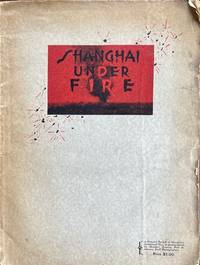
Shanghai under fire. July -- September 1937. A pictorial record of Shanghai’s undeclared war as photographed by Shanghai Evening Post & Mercury Staff photographers.
Shanghai China: Post-Mercury Co. 17-21 Avenue Edward VII Shanghai Evening Post & Mercury 1937. 4to. 9 x 12 in. xv 1 88 pp. With 100s of text photo illustrations on gray-blue tinted paper. Colour-illustrated softcovers cover art photo of red & black tinted smoking skyline of Shanghai w/ bomb bursts illustrated on front cover “Shanghai Area War Maps†on endpapers -- surprisingly light interior toning to the XV pp. of text on light-gray tinted paper bumping & wear at covers some dustsoiling chipping head & foot of spine still G copy stapled as issued. First edition 1st printing of this scarce illustrated pro-China work documenting the opening campaigns by the Imperial Japanese Army Air Force and Navy during the Second Sino-Japanese War. Hostilities had increased throughout the 1930s following the first Sino-Japanese War in which Japan had conquered and absorbed Manchuria into the Japanese Empire. Chiang Kai-shek’s nationalist forces joined with the warlords of Hunan and Szechwan provinces to fight the Japanese after a number of provocations in the summer of 1937. Chiang Kai-shek believed that by initially attacking and bombing Japanese naval installations and troops in and around Shanghai he would force the foreign powers to ally with China to fight against Japan to protect their enormous investments in southern China. The Nationalist Chinese armies held out for three months against ferocious bombardment and shelling by the Japanese from planes based in Taiwan and ships on the Huangpu River inflicting huge numbers of casualties on the Chinese and eventually forcing the Chinese to retreat from Shanghai to Nanking with Japanese reinforcements constantly decimating them. These images show victims at the South Station bombings caring for Chinese wounded Chinese women training as soldiers and nurses in the aftermath of the North Station Area shelling and bombing bitter retreat by Chinese soldiers the advances and marching of Japanese forces in Shanghai and beyond. This would later be revised and reissued in March 1938; See: Dorothy Perkins Japan Goes to War: A Chronology of Japanese Military Expansion 1997 pp. 127-135; Crittall in Shanghai -- Some Photos Unearthed December 22 2008. Post-Mercury, Co., 17-21 Avenue Edward VII, Shanghai Evening Post & Mercury, paperback
Referenz des Buchhändlers : 60087
|
|
|
[CHINA -- MUSIC]. KOO, TZ [TZU-JEN KU]. T Z
Songs of Cathay: an anthology of songs current in various parts of China among her people. Compiled by. . . Min jian yin yue.
Shanghai China: Association Press 20 Museum Road 1930. 4to. 56 pp unpaginated. musical scores throughout. Decorated blue publisher’s cloth bamboo illust. & lettering in Chinese & English on front cover in silver minor edgewear faint tidemark lower fore-edge textblock still G copy w/ former ownership markings on title. Fourth printing of this anthology of Chinese folk songs including patriotic Chinese Republic songs as well. Association Press, 20 Museum Road, hardcover
Referenz des Buchhändlers : 54998
|
|
|
[CHINA -- XINJIANG]. SHIPTON, Diana
The antique land. Decorations by Jill Davis.
London: Hodder & Stoughton Ltd. 1950. 8vo. ix 1 xi-219 1 pp. Photo frontisp. numerous photo plates text illustrations. Blue-green publisher’s cloth gilt illust. on front cover gilt lettering on spine map endpapers edgewear rubbing rubbing to corners minor bumping w/ d.j. cover art by Jean Maln chipping tears w/ minor loss to spine closed tears to fore-edges old tape repairs still G/Fair copy w/ former ownership signature on ffep. First edition stated of this memoir of the novelty and dangers faced by the author and her husband Eric Shipton noted British Himalayan mountaineer who participated in many of the Mt. Everest expeditions in the 1930s and later in 1951. This fascinating account of China during and after World War II provides an engaging narrative of his years as British Consul-General at Kashgar. Hodder & Stoughton, Ltd., hardcover
Referenz des Buchhändlers : 53183
|
|
|
[CHINA -- ART]. HO, Wai-Kam, & SMITH, Judith G (E
The century of Tung Chi-chang 1555-1636: Vol. 1
paperback. Good. Access codes and supplements are not guaranteed with used items. May be an ex-library book. paperback
Referenz des Buchhändlers : 029597138X.G ISBN : 029597138X 9780295971384

|
|
|
[CHINA -- ART]. HO, Wai-Kam, & SMITH, Judith G (Eds)
The century of Tung Ch’i-ch’ang 1555-1636. Volume I. . . .
Kansas City MO & Seattle WA: Nelson-Atkins Museum of Art Univ. of Washington Press 1992. Folio. 475 1 pp. 100s of colour and blk & wht text illusts. many full page some double-page. Colour-illust. softcvrs mnr shlfwr slght rubbng still a VG copy. First softcover edition of this massive catalogue of the works of the famed 16th-Century Chinese painter calligrapher and art theorist. This exhibition catalogue draws heavily from the Beijing Palace Museum. Nelson-Atkins Museum of Art, Univ. of Washington Press, paperback
Referenz des Buchhändlers : 44607 ISBN : 029597138x 9780295971384
|
|
|
[CHINA -- ART].
The forest of stone tablets. . . Text in Chinese.
JiangSu China: Beilin Museum 1993. 4to. 211 1 pp. Numerous illustrations photo illustrations. Colour-illustrated softcovers NF. First edition thus of this exhibition catalogue for the Xian Forest of Stone Tables Steles Museum located inside the Xian City Wall based on a Confucian temple. The collection preserves over 3000 stone epigraphs in separate exhibition rooms. Beilin Museum], paperback
Referenz des Buchhändlers : 50532
|
|
|
[CHINA -- PHOTOGRAPHS]. MENNIE, Donald
The pageant of Peking: comprising . . . Vandyck photogravures of Peking and environs from photographs . . .
Shanghai: A.S. Watson & Co. Ltd. Printed & Bound by Kelly & Walsh Ltd. 1921. Folio. 6 40 pp. Title in red & black rubricated decorated initial with 66 tipped-in sepia- and aqua-tinted photogravures each w/ printed border explanatory text on facing page. Publisher’s decorated blue silk over beveled boards gilt lettering stamped on front cover rebacked in blue silk gilt lettering on spine in equivalent font wear to fore-edges of boards w/ minor loss at fore-edges on front & back covers minor bumping & wear to corners still VG- copy w/ interior in excellent condition from the library of Dr. Leonard William Buck 1891-1953 scion of the famed Buck family in Vacaville CA whose holdings included Bucktown and the ranch where the California Medical Facility is located. Dr. Buck traveled to Asia on behalf of the California Grower’s and Shipper’s protective League at the behest of his brother Frank in 1921. Second edition of this large and beautiful photographic souvenir portraying the ancient Chinese capital and surrounding countryside. The striking images by Mennie portray Chinese temples palaces peddlers laborers ancient walled cities Chinese shops and Chinese eating at outdoor tables at the beginning of the 20th century. Mennie 1875/6-1941 trained as a chemist and worked as an amateur photographer in Scotland. He initially began working in China as an assistant in the firm of Mactavish & Lehman & Co. in Beijing later working for the Mactavish Photo Shop in Shanghai as one of the first producers in China of picture postcards. He later joined the A.S. Watson & Co. -- chemists druggists wine spirits & cigar Merchants who also dealt in all kinds of photographic chemicals and equipment later becoming their managing director the firm still flourishes to this day as one of the largest health and beauty retailers in the world. Mennie contributed photographic images for numerous works and published several of his own images. He died in the Japanese Lungwha internment camp near Shanghai in 1941. See: Worswick & Spence Imperial China: Photographs 1850-1912 1979. A.S. Watson & Co., Ltd., Printed & Bound by Kelly & Walsh, Ltd., hardcover
Referenz des Buchhändlers : 53107
|
|
|
[CHINA -- WOMEN]. O'HARA, Albert Richard
The position of woman in early China according to the Lieh Nu Chuan “The biographies of Chinese women.â€
Taipei Taiwan: Mei Ya Publications Inc. 1971. 8vo. xii 302 pp. Red publisher’s cloth black lettering w/ d.j. minor chipping head of spine couple minor closed tears still NF/G copy from the library of David Kohl 1946-2025 former art teacher at the Hong Kong International School musician artist and historian. Second edition of this analysis and translation of the famed Western Han Dynasty work 77-6 B.C. containing 125 biographies of women extending fro the virtuous to the virtueless focused on how a nation’s prosperity and adversity were highly influenced by women. This edition was first adapted from an extended thesis by the author and originally published in a very small run expanded for this Taiwanese printing. Mei Ya Publications, Inc., hardcover
Referenz des Buchhändlers : 64258
|
|
|
[CHINA -- JAPANESE MANCHUKUO]. HSIAO-HSU,Premier Cheng [ZHENG XIAOXU].
Wang tao The Kingly Way: an outline of the political-moral code of the Manchoukuo government.
Dairen Dalian Manchukuo China: The Manchuria Daily News 1934. 8vo. 4 41 1 pp. Photo plate. Beige-coloured textured softcovers black lettering front cover minor corner creasing still a VG bright copy from the library of Tom Atiyeh. First offprint edition of this very scarce work outlining the governing philosophy and justifying principles outlined by Manchu loyalist advisor to former Hsuan-tung Emperor Pu-yi and politician who believed that by aligning with the Japanese Empire the Qing Dynasty could be restored in Manchuria and combat China’s rampant warlords. Following 1924 when Feng Yu-hsiang had occupied Peking deposed the rump Emperor and forced Pu-Yi and Zheng Xiaoxu 1860-1938 he had dedicated himself to restoring the Xing Dynasty and their rule. The state of Manchoukuo a Japanese puppet state was established March 1 1934 with Zheng Xiaoxiu serving as the first prime minister until 1935 when the Japanese forced the Emperor to remove him from the payroll and he was succeeded by Zhang Jinghui. The Manchuria Daily News, paperback
Referenz des Buchhändlers : 63968
|
|
|
[CHINA -- ART]. WU TAO-TZE [WU DAOZI] & [LI LUNG MIN (MIEN)]. MARTIN F[redrik] R[obert] (Ed)
Zeichnungen nach Wu Tao-Tze aus der Gotter- und Sagenwelt Chinas. . . In Chinese on front cover of portfolio & slipcase: “Precious things in ink by Wu Tao-Tzeâ€.
Munich: Verlag von F. Bruckmann A.G. 1913. Oblong Atlas folio. 20.75 x 19.5 in. 4 12 pp. w/ 51 tipped-in collotype plates 1 partially coloured all retaining their original tissue guards. Loose portfolio held in folding covers minor bumping to corners of textblock some very light toning 1st couple leaves w/ very slight closed tear at upper left corner w/ open-backed slipcase w/ printed labels on covers wear toning some scuffing minor dampstaining soiling still a VG/G- exemplar. First edition thus of this remarkable group of collotypes reproducing drawings made from the famed frescoes of the renowned Tang Dynasty artist Wu Tao-Tze -- Godoshi in Japanese 680-760. Believed to have painted hundreds of frescoes on Temples representing the Buddhist purgatory or inferno they were of such dramatic power many on viewing them repented of their sins and nearly all were destroyed through the Cultural Revolution and development. All his artworks have either been preserved by being incised on stone as woodcuts or as Chinese brush drawings. These drawings taken from Dr. Martin’s Collection were rendered originally by Li Lung Mien 1070-1106 a Sung master painter and superb draftsman who has been often considered the Leonardo da Vinci of China. He was renowned for his paintings of horses and also adept at painting landscapes as well as works with Buddhist and Taoist themes. Each collotype reproduction within this portfolio has been printed on a tinted background to simulate the originals and then mounted on thick laid paper along with a critique by Anders Zorn and notes were by Dr. Haenisch. See: Reviews & Notices The International Studio Vol. LII 1914 pp. 255-256; Recent Publications of Chinese Subjects Journal of the Royal Asiatic Society Vol. LIV Issue 1 1922 p. 99. Verlag von F. Bruckmann A.G., unknown
Referenz des Buchhändlers : 56870
|
|
|
[CHINA CARTOGRAPHIC PUBLISHING HOUSE]. 地图出版社.
世界分国地图. Shi jie fen guo di tu. Atlas of the World.
上海.Shanghai.: 地图出版社. Ti du chu ban she. 1st edition 3rd Printing. 1957. 37 maps in colour signs of wear at extremities on covers a stamp and a prior owner's signature rear free endpaper hinge starting good copy in hardback. Text in Chinese. 17.6 x 12.5cm. This Chinese language atlas includes two world maps along with five continental maps. The remaining thirty maps are countries and regions including China Mongolia North Korea Japan Soviet Unions Poland Germany UK France Spain Australia US Arabian Peninsula South and North Poles and more. . 地图出版社. [Ti du chu ban she]. hardcover
Referenz des Buchhändlers : 164737

|
|
|
[CHINA CARTOGRAPHIC PUBLISHING HOUSE]. 地图出版社.
中國交通旅行圖. Zhongguo jiao tong lü xing tu. Transportation Tourist Map of China.
北京. Beijing.: 地图出版社.Di tu chu ban she. 1963. Large folding tourist map of Chinese transportation in colour four inset maps scale 1: 8000000 printed both sides with travel information on reverse. Stamp of a prior dealer in Guangzhou on reverse. Creases on corners occasional small holes along folds very lignt browning lower margin generally good. Text in Chinese. Sheet measures 53.8x 76.4cm. It was first published in 1957 and this map is the 2nd Edition 20th print published in 1963. The four inset maps feature regions of Hainan and surrounding islands Beijing and Tianjin region Shanghai Ningbo and Hangzhou Region and the national commercial airline route. <br>Transportation mileage tables including roads railways and inland waterways alongside general knowledge for travel via railways coaches commercial aeroplanes and cruisers. . 地图出版社.[Di tu chu ban she]. unknown
Referenz des Buchhändlers : 137007

|
|
|
[CHINA EXPORT WATERCOLOURS ON PITH PAPER].
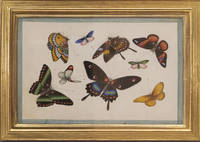
A Group of Four Butterflies.
Canton ca. 1860. . Watercolour and gouache studies on pith paper overall dimensions 33 x 23.5cm. framed and glazed.<br /> Pith seems not to have been adopted for painting until about 1820. Some European museums claim that their paintings on pith often erroneously called "rice paper" or "mulberry pith" come from the end of the eighteenth century but there do not seem to be any dateable examples that are so early. There is a record of the Kaiser Franz of Austria buying some albums from an English Consul-General Watts in 1826. We know of an Italian Count who visited Canton in 1828 and had over 350 paintings on pith in his baggage when he died in Ambon two years later. In the British Library there is a scrap-book containing six pith paintings and a journal entry by a serving British officer who sent them home from India in 1829. These examples and contemporary accounts by visitors to Canton suggest that there was a flourishing trade in pith paintings by the early 1830s.<br /><br />Pith presumably came into use for painting to satisfy the increasing demand for small inexpensive and easily transported souvenirs following the massive growth in the China Trade in the first quarter of the nineteenth century. Paintings in oils on board and canvas were costly and difficult to carry home. Earlier and more prestigious export water-colours had often been on a larger scale and painted on fine Chinese paper or on paper imported from Europe. The albums of pith paintings and later the little glass-fronted boxes were inexpensive light easy to pack and gave the pictures some protection on the long voyage home. Because many were sold in albums and hence protected from the light they retain their bright colours to this day.<br /><br />Pith comes from the central column of spongy cellular tissue in the stem of a small tree called Tetrapanax Papyrifera native to south-west China. It has had a variety of uses some going back many centuries. At the imperial court both men and women wore coloured flowers made from pith in their hair. For use in painting it is cut by hand with a knife into thin sheets from short lengths of the spongy tissue. Cutting is highly skilled and the constraints of the process mean that the finished sheets for painting seldom if ever measure more than about 30cms by 20cms. The sheets are dried trimmed and used for painting without any further processing.<br /><br />Because of the nature of pith and its cellular structure the gouache used by the Chinese sat on the surface and produced a bright and even sparkling effect. Very fine detail could be achieved but pith did not lend itself to the flat wash of colour favoured for European watercolours. <br /><br />Carl Crossman in his book The Decorative Arts of the China Trade originally published under the title The China Trade gives an excellent list of export painters with a note of those known to have painted on pith. These include Tingqua Sunqua and Youqua. From 1757 until 1842 Canton was the only Chinese port open to trade with the west and it is no surprise that of the eight studios identified by Crossman as producing works on pith six were in Canton. <br /><br />It seems that the 1830s and 1840s may have been the heyday of pith painting. The international trading bases the waterfront 'factories' on the 'Hongs' in Canton where they were produced were partially burnt during the First Opium War 1839-41 and totally destroyed in a fire of 1856. The foreign trading companies then moved to Honan and subsequently put up splendid new offices on reclaimed land at Shamian Island a little up river. As the result of the Treaty of Nanking in 1842 additional Chinese ports were opened up for foreign trade and Hong Kong was established as a major trading centre. <br /><br />By 1860 references to China in the Illustrated London News plentiful three years earlier were few and far between. That is not to say that painting on pith ceased. Nicholas the second was given paintings on pith when he visited Canton in 1891 and the last Emperor is said to have sent him a gift which included pith paintings in 1907 though these could have been examples of much earlier work. <br /><br />Painters on pith did not in general sign their work the sole exception is Sunqua whose name can be found on the face of three paintings on pith. <br /><br />There are collections of paintings on pith in the Ashmolean the British Museum the Fitzwilliam the Hermitage the Peabody/Essex Museum in Massachusetts and the Hong Kong Museum of Art. However because paintings on pith are not in general regarded as fine art they are usually to be found in ethnographic or specialised collections.<br /> Canton, ca. 1860. unknown
Referenz des Buchhändlers : 109513
|
|
|
[CHINA EXPORT WATERCOLOURS ON PITH PAPER].
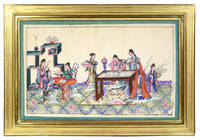
A Group of 6 Watercolours of Courtly Ladies at Leisure.
Canton 2nd half of 19th century. . Six watercolour and gouache studies on pith paper edged in turquoise silk ribbon and laid on paper; framed glazed and overall size: 27 x 39.4 x 2 cm.<br /> An exquisite group of interior scenes exclusively of noblewomen and ladies in waiting engaging in various genteel activities such as flower arranging painting poetry reading and writing surrounded by elegant Qing dynasty furniture and ornaments including unusual asymmetrical display cabinets exotic bird swings and porcelain vases all standing or sitting on elaborately patterned silk carpets.<br /><br />Pith seems not to have been adopted for painting until about 1820. Some European museums claim that their paintings on pith often erroneously called 'rice paper' or 'mulberry pith' come from the end of the eighteenth century but there do not seem to be any dateable examples that are so early. There is a record of the Kaiser Franz of Austria buying some albums from an English Consul-General Watts in 1826. We know of an Italian Count who visited Canton in 1828 and had over 350 paintings on pith in his baggage when he died in Ambon two years later. In the British Library there is a scrap-book containing six pith paintings and a journal entry by a serving British officer who sent them home from India in 1829. These examples and contemporary accounts by visitors to Canton suggest that there was a flourishing trade in pith paintings by the early 1830s.<br /><br />Pith presumably came into use for painting to satisfy the increasing demand for small inexpensive and easily transported souvenirs following the massive growth in the China Trade in the first quarter of the nineteenth century. Paintings in oils on board and canvas were costly and difficult to carry home. Earlier and more prestigious export water-colours had often been on a larger scale and painted on fine Chinese paper or on paper imported from Europe. The albums of pith paintings and later the little glass-fronted boxes were inexpensive light easy to pack and gave the pictures some protection on the long voyage home. Because many were sold in albums and hence protected from the light they retain their bright colours to this day.<br /><br />Pith comes from the central column of spongy cellular tissue in the stem of a small tree called Tetrapanax Papyrifera native to south-west China. It has had a variety of uses some going back many centuries. At the imperial court both men and women wore coloured flowers made from pith in their hair. For use in painting it is cut by hand with a knife into thin sheets from short lengths of the spongy tissue. Cutting is highly skilled and the constraints of the process mean that the finished sheets for painting seldom if ever measure more than about 30 by 20 cm. The sheets are dried trimmed and used for painting without any further processing.<br /><br />Because of the nature of pith and its cellular structure the gouache used by the Chinese sat on the surface and produced a bright and even sparkling effect. Very fine detail could be achieved but pith did not lend itself to the flat wash of colour favoured for European watercolours. <br /><br />Carl Crossman in his book The Decorative Arts of the China Trade originally published under the title The China Trade gives an excellent list of export painters with a note of those known to have painted on pith. These include Tingqua Sunqua and Youqua. From 1757 until 1842 Canton was the only Chinese port open to trade with the west and it is no surprise that of the eight studios identified by Crossman as producing works on pith six were in Canton. <br /><br />It seems that the 1830s and 1840s may have been the heyday of pith painting. The international trading bases the waterfront 'factories' on the 'Hongs' in Canton where they were produced were partially burnt during the First Opium War 1839-41 and totally destroyed in a fire of 1856. The foreign trading companies then moved to Honan and subsequently put up splendid new offices on reclaimed land at Shamian Island a little up river. As the result of the Treaty of Nanking in 1842 additional Chinese ports were opened up for foreign trade and Hong Kong was established as a major trading centre. <br /><br />By 1860 references to China in the Illustrated London News plentiful three years earlier were few and far between. That is not to say that painting on pith ceased. Nicholas the second was given paintings on pith when he visited Canton in 1891 and the last Emperor is said to have sent him a gift which included pith paintings in 1907 though these could have been examples of much earlier work. <br /><br />Painters on pith did not in general sign their work the sole exception is Sunqua whose name can be found on the face of three paintings on pith. <br /><br />There are collections of paintings on pith in the Ashmolean the British Museum the Fitzwilliam the Hermitage the Peabody/Essex Museum in Massachusetts and the Hong Kong Museum of Art. However because paintings on pith are not in general regarded as fine art they are usually to be found in ethnographic or specialised collections.<br /> [Canton, 2nd half of 19th century]. unknown
Referenz des Buchhändlers : 94512
|
|
|
[CHINA EXPORT WATERCOLOURS ON PITH PAPER].
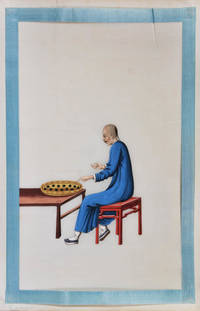
Album of gouaches depicting the manufacture of tea.
c.1830 . 4to album 33 x 26 cml; 24 gouaches on pith paper each one 30.5 x 20.4 cm all mounted on paper and framed with a pale blue silk fabric border; bookplate 3 plates with small tears approx 2 cm length at margins; bound in contemporary patterned decorated silk boards some pencilling on front pastedown ; overall an attractive copy. <br /> An excellent example of rare Chinese album on pith paper on tea cultivation depicting each process in detail. <br /><br />Pith seems not to have been adopted for painting until about 1820. Some European museums claim that their paintings on pith often erroneously called 'rice paper' or 'mulberry pith' come from the end of the eighteenth century but there do not seem to be any dateable examples that are so early. There is a record of the Kaiser Franz of Austria buying some albums from an English Consul-General Watts in 1826. We know of an Italian Count who visited Canton in 1828 and had over 350 paintings on pith in his baggage when he died in Ambon two years later. In the British Library there is a scrap-book containing six pith paintings and a journal entry by a serving British officer who sent them home from India in 1829. These examples and contemporary accounts by visitors to Canton suggest that there was a flourishing trade in pith paintings by the early 1830s.<br /><br />Pith presumably came into use for painting to satisfy the increasing demand for small inexpensive and easily transported souvenirs following the massive growth in the China Trade in the first quarter of the nineteenth century. Paintings in oils on board and canvas were costly and difficult to carry home. Earlier and more prestigious export water-colours had often been on a larger scale and painted on fine Chinese paper or on paper imported from Europe. The albums of pith paintings and later the little glass-fronted boxes were inexpensive light easy to pack and gave the pictures some protection on the long voyage home. Because many were sold in albums and hence protected from the light they retain their bright colours to this day.<br /><br />Pith comes from the central column of spongy cellular tissue in the stem of a small tree called Tetrapanax Papyrifera native to south-west China. It has had a variety of uses some going back many centuries. At the imperial court both men and women wore coloured flowers made from pith in their hair. For use in painting it is cut by hand with a knife into thin sheets from short lengths of the spongy tissue. Cutting is highly skilled and the constraints of the process mean that the finished sheets for painting seldom if ever measure more than about 30 by 20 cm. The sheets are dried trimmed and used for painting without any further processing.<br /><br />Because of the nature of pith and its cellular structure the gouache used by the Chinese sat on the surface and produced a bright and even sparkling effect. Very fine detail could be achieved but pith did not lend itself to the flat wash of colour favoured for European watercolours. <br /><br />Carl Crossman in his book The Decorative Arts of the China Trade originally published under the title The China Trade gives an excellent list of export painters with a note of those known to have painted on pith. These include Tingqua Sunqua and Youqua. From 1757 until 1842 Canton was the only Chinese port open to trade with the west and it is no surprise that of the eight studios identified by Crossman as producing works on pith six were in Canton. <br /><br />It seems that the 1830s and 1840s may have been the heyday of pith painting. The international trading bases the waterfront 'factories' on the 'Hongs' in Canton where they were produced were partially burnt during the First Opium War 1839-41 and totally destroyed in a fire of 1856. The foreign trading companies then moved to Honan and subsequently put up splendid new offices on reclaimed land at Shamian Island a little up river. As the result of the Treaty of Nanking in 1842 additional Chinese ports were opened up for foreign trade and Hong Kong was established as a major trading centre. <br /><br />By 1860 references to China in the Illustrated London News plentiful three years earlier were few and far between. That is not to say that painting on pith ceased. Nicholas the second was given paintings on pith when he visited Canton in 1891 and the last Emperor is said to have sent him a gift which included pith paintings in 1907 though these could have been examples of much earlier work. <br /><br />There are collections of paintings on pith in the Ashmolean the British Museum the Fitzwilliam the Hermitage the Peabody/Essex Museum in Massachusetts and the Hong Kong Museum of Art. However because paintings on pith are not in general regarded as fine art they are usually to be found in ethnographic or specialised collections.<br /> [c.1830] hardcover
Referenz des Buchhändlers : 100987
|
|
|
[CHINA EXPORT WATERCOLOURS ON PITH PAPER].
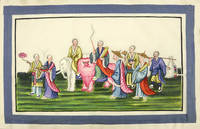
Ceremonies with fantastic animals.
Canton 2nd half of 19th century. . A set of 10 watercolour and gouache studies on pith paper; one with a long horizontal closed tear. Contemporary red patterned silk binding; upper hinge broken and upper cover detached.<br /> <br />Pith seems not to have been adopted for painting until about 1820. Some European museums claim that their paintings on pith often erroneously called "rice paper" or "mulberry pith" come from the end of the eighteenth century but there do not seem to be any dateable examples that are so early. There is a record of the Kaiser Franz of Austria buying some albums from an English Consul-General Watts in 1826. We know of an Italian Count who visited Canton in 1828 and had over 350 paintings on pith in his baggage when he died in Ambon two years later. In the British Library there is a scrap-book containing six pith paintings and a journal entry by a serving British officer who sent them home from India in 1829. These examples and contemporary accounts by visitors to Canton suggest that there was a flourishing trade in pith paintings by the early 1830s.<br /><br />Pith presumably came into use for painting to satisfy the increasing demand for small inexpensive and easily transported souvenirs following the massive growth in the China Trade in the first quarter of the nineteenth century. Paintings in oils on board and canvas were costly and difficult to carry home. Earlier and more prestigious export water-colours had often been on a larger scale and painted on fine Chinese paper or on paper imported from Europe. The albums of pith paintings and later the little glass-fronted boxes were inexpensive light easy to pack and gave the pictures some protection on the long voyage home. Because many were sold in albums and hence protected from the light they retain their bright colours to this day.<br /><br />Pith comes from the central column of spongy cellular tissue in the stem of a small tree called Tetrapanax Papyrifera native to south-west China. It has had a variety of uses some going back many centuries. At the imperial court both men and women wore coloured flowers made from pith in their hair. For use in painting it is cut by hand with a knife into thin sheets from short lengths of the spongy tissue. Cutting is highly skilled and the constraints of the process mean that the finished sheets for painting seldom if ever measure more than about 30cms by 20cms. The sheets are dried trimmed and used for painting without any further processing.<br /><br />Because of the nature of pith and its cellular structure the gouache used by the Chinese sat on the surface and produced a bright and even sparkling effect. Very fine detail could be achieved but pith did not lend itself to the flat wash of colour favoured for European watercolours. <br /><br />Carl Crossman in his book The Decorative Arts of the China Trade originally published under the title The China Trade gives an excellent list of export painters with a note of those known to have painted on pith. These include Tingqua Sunqua and Youqua. From 1757 until 1842 Canton was the only Chinese port open to trade with the west and it is no surprise that of the eight studios identified by Crossman as producing works on pith six were in Canton. <br /><br />It seems that the 1830s and 1840s may have been the heyday of pith painting. The international trading bases the waterfront 'factories' on the 'Hongs' in Canton where they were produced were partially burnt during the First Opium War 1839-41 and totally destroyed in a fire of 1856. The foreign trading companies then moved to Honan and subsequently put up splendid new offices on reclaimed land at Shamian Island a little up river. As the result of the Treaty of Nanking in 1842 additional Chinese ports were opened up for foreign trade and Hong Kong was established as a major trading centre. <br /><br />By 1860 references to China in the Illustrated London News plentiful three years earlier were few and far between. That is not to say that painting on pith ceased. Nicholas the second was given paintings on pith when he visited Canton in 1891 and the last Emperor is said to have sent him a gift which included pith paintings in 1907 though these could have been examples of much earlier work. <br /><br />Painters on pith did not in general sign their work the sole exception is Sunqua whose name can be found on the face of three paintings on pith. <br /><br />There are collections of paintings on pith in the Ashmolean the British Museum the Fitzwilliam the Hermitage the Peabody/Essex Museum in Massachusetts and the Hong Kong Museum of Art. However because paintings on pith are not in general regarded as fine art they are usually to be found in ethnographic or specialised collections.<br /> Canton, 2nd half of 19th century]. unknown
Referenz des Buchhändlers : 91713
|
|
|
[CHINA EXPORT WATERCOLOURS ON PITH PAPER].
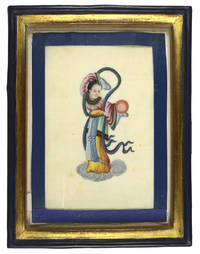
Deities.
Canton c.1860. . A set of 6 watercolour and gouache studies on pith paper each surrounded by blue fabric borders.<br /> Pith seems not to have been adopted for painting until about 1820. Some European museums claim that their paintings on pith often erroneously called "rice paper" or "mulberry pith" come from the end of the eighteenth century but there do not seem to be any dateable examples that are so early. There is a record of the Kaiser Franz of Austria buying some albums from an English Consul-General Watts in 1826. We know of an Italian Count who visited Canton in 1828 and had over 350 paintings on pith in his baggage when he died in Ambon two years later. In the British Library there is a scrap-book containing six pith paintings and a journal entry by a serving British officer who sent them home from India in 1829. These examples and contemporary accounts by visitors to Canton suggest that there was a flourishing trade in pith paintings by the early 1830s.<br /><br />Pith presumably came into use for painting to satisfy the increasing demand for small inexpensive and easily transported souvenirs following the massive growth in the China Trade in the first quarter of the nineteenth century. Paintings in oils on board and canvas were costly and difficult to carry home. Earlier and more prestigious export water-colours had often been on a larger scale and painted on fine Chinese paper or on paper imported from Europe. The albums of pith paintings and later the little glass-fronted boxes were inexpensive light easy to pack and gave the pictures some protection on the long voyage home. Because many were sold in albums and hence protected from the light they retain their bright colours to this day.<br /><br />Pith comes from the central column of spongy cellular tissue in the stem of a small tree called Tetrapanax Papyrifera native to south-west China. It has had a variety of uses some going back many centuries. At the imperial court both men and women wore coloured flowers made from pith in their hair. For use in painting it is cut by hand with a knife into thin sheets from short lengths of the spongy tissue. Cutting is highly skilled and the constraints of the process mean that the finished sheets for painting seldom if ever measure more than about 30cms by 20cms. The sheets are dried trimmed and used for painting without any further processing.<br /><br />Because of the nature of pith and its cellular structure the gouache used by the Chinese sat on the surface and produced a bright and even sparkling effect. Very fine detail could be achieved but pith did not lend itself to the flat wash of colour favoured for European watercolours. <br /><br />Carl Crossman in his book The Decorative Arts of the China Trade originally published under the title The China Trade gives an excellent list of export painters with a note of those known to have painted on pith. These include Tingqua Sunqua and Youqua. From 1757 until 1842 Canton was the only Chinese port open to trade with the west and it is no surprise that of the eight studios identified by Crossman as producing works on pith six were in Canton. <br /><br />It seems that the 1830s and 1840s may have been the heyday of pith painting. The international trading bases the waterfront 'factories' on the 'Hongs' in Canton where they were produced were partially burnt during the First Opium War 1839-41 and totally destroyed in a fire of 1856. The foreign trading companies then moved to Honan and subsequently put up splendid new offices on reclaimed land at Shamian Island a little up river. As the result of the Treaty of Nanking in 1842 additional Chinese ports were opened up for foreign trade and Hong Kong was established as a major trading centre. <br /><br />By 1860 references to China in the Illustrated London News plentiful three years earlier were few and far between. That is not to say that painting on pith ceased. Nicholas the second was given paintings on pith when he visited Canton in 1891 and the last Emperor is said to have sent him a gift which included pith paintings in 1907 though these could have been examples of much earlier work. <br /><br />Painters on pith did not in general sign their work the sole exception is Sunqua whose name can be found on the face of three paintings on pith. <br /><br />There are collections of paintings on pith in the Ashmolean the British Museum the Fitzwilliam the Hermitage the Peabody/Essex Museum in Massachusetts and the Hong Kong Museum of Art. However because paintings on pith are not in general regarded as fine art they are usually to be found in ethnographic or specialised collections.<br /> Canton, c.1860]. unknown
Referenz des Buchhändlers : 86239
|
|
|
[CHINA EXPORT WATERCOLOURS ON PITH PAPER].
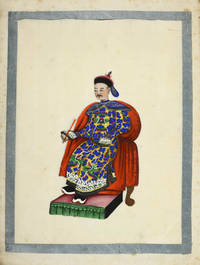
Nobility in Costumes.
Canton ca. 1860. . Album 29.5 x 21.5 cm with 12 watercolour and gouache on pith paper each laid on paper with a light blue ribbon; one a bit stained in brown. Contemporary binding of patterned brown paper; very rubbed.<br /> A lovely variety of Chinese official costumes in fine condition and bright colours.<br /><br />Pith seems not to have been adopted for painting until about 1820. Some European museums claim that their paintings on pith often erroneously called "rice paper" or "mulberry pith" come from the end of the eighteenth century but there do not seem to be any dateable examples that are so early. There is a record of the Kaiser Franz of Austria buying some albums from an English Consul-General Watts in 1826. We know of an Italian Count who visited Canton in 1828 and had over 350 paintings on pith in his baggage when he died in Ambon two years later. In the British Library there is a scrap-book containing six pith paintings and a journal entry by a serving British officer who sent them home from India in 1829. These examples and contemporary accounts by visitors to Canton suggest that there was a flourishing trade in pith paintings by the early 1830s.<br /><br />Pith presumably came into use for painting to satisfy the increasing demand for small inexpensive and easily transported souvenirs following the massive growth in the China Trade in the first quarter of the nineteenth century. Paintings in oils on board and canvas were costly and difficult to carry home. Earlier and more prestigious export water-colours had often been on a larger scale and painted on fine Chinese paper or on paper imported from Europe. The albums of pith paintings and later the little glass-fronted boxes were inexpensive light easy to pack and gave the pictures some protection on the long voyage home. Because many were sold in albums and hence protected from the light they retain their bright colours to this day.<br /><br />Pith comes from the central column of spongy cellular tissue in the stem of a small tree called Tetrapanax Papyrifera native to south-west China. It has had a variety of uses some going back many centuries. At the imperial court both men and women wore coloured flowers made from pith in their hair. For use in painting it is cut by hand with a knife into thin sheets from short lengths of the spongy tissue. Cutting is highly skilled and the constraints of the process mean that the finished sheets for painting seldom if ever measure more than about 30cms by 20cms. The sheets are dried trimmed and used for painting without any further processing.<br /><br />Because of the nature of pith and its cellular structure the gouache used by the Chinese sat on the surface and produced a bright and even sparkling effect. Very fine detail could be achieved but pith did not lend itself to the flat wash of colour favoured for European watercolours. <br /><br />Carl Crossman in his book The Decorative Arts of the China Trade originally published under the title The China Trade gives an excellent list of export painters with a note of those known to have painted on pith. These include Tingqua Sunqua and Youqua. From 1757 until 1842 Canton was the only Chinese port open to trade with the west and it is no surprise that of the eight studios identified by Crossman as producing works on pith six were in Canton. <br /><br />It seems that the 1830s and 1840s may have been the heyday of pith painting. The international trading bases the waterfront 'factories' on the 'Hongs' in Canton where they were produced were partially burnt during the First Opium War 1839-41 and totally destroyed in a fire of 1856. The foreign trading companies then moved to Honan and subsequently put up splendid new offices on reclaimed land at Shamian Island a little up river. As the result of the Treaty of Nanking in 1842 additional Chinese ports were opened up for foreign trade and Hong Kong was established as a major trading centre. <br /><br />By 1860 references to China in the Illustrated London News plentiful three years earlier were few and far between. That is not to say that painting on pith ceased. Nicholas the second was given paintings on pith when he visited Canton in 1891 and the last Emperor is said to have sent him a gift which included pith paintings in 1907 though these could have been examples of much earlier work. <br /><br />Painters on pith did not in general sign their work the sole exception is Sunqua whose name can be found on the face of three paintings on pith. <br /><br />There are collections of paintings on pith in the Ashmolean the British Museum the Fitzwilliam the Hermitage the Peabody/Essex Museum in Massachusetts and the Hong Kong Museum of Art. However because paintings on pith are not in general regarded as fine art they are usually to be found in ethnographic or specialised collections.<br /> Canton, ca. 1860]. unknown
Referenz des Buchhändlers : 90282
|
|
|
[CHINA HISTORY MUSEUM]. 中国历史博物馆 (EDITOR).
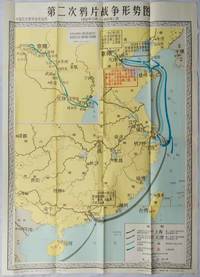
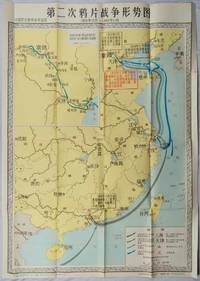
第二次鸦片战争形势图. Di er yapian zhanzheng xingshi tu. Situational Map of the Second Opium War.
Shanghai.: 地图出版社.Map Press. First Edition. 1980. Colourful folding teaching reference wall map of China during the Second Opium War October 1956 - November 1860. Includes an inset at top left of the route that French and British invaders took in 1860 and a key at bottom right explaining the dates of different invasion routes. Text boxes explain key events. Original wrapper creased on top edge with a red "山东济南第五十." stamp. Bottom right corner of map very slightly worn else in excellent bright crisp condition. 106 x 76cm. Text in simplified Chinese characters. . 地图出版社.[Map Press]. unknown
Referenz des Buchhändlers : 216471
|
|
|
[CHINA HISTORY MUSEUM]. 中国历史博物馆 (EDITOR).
第二次鸦片战争形势图. Di er yapian zhanzheng xingshi tu. Situational Map of the Second Opium War.
Shanghai.: 地图出版社.Map Press. First Edition. 1980. Colourful folding educational wall map of China during the Second Opium War October 1956 - November 1860. Includes an inset at top left of the route that French and British invaders took in 1860 and a key at bottom right explains the dates of different invasion routes. Text boxes explain key events. Original wrapper repaired with cellotape and washi paper. Bottom right corner of map very slightly worn else in excellent bright crisp condition. 106 x 76cm. Text in simplified Chinese characters. . 地图出版社.[Map Press]. unknown
Referenz des Buchhändlers : 216702
|
|
|
[CHINA JIANZHI PAPER-CUTTING - WOMEN].
Legends of ancient China. The cut-outs Jianzhi of Temple Hill are an adaptation of figures of animals plants insects dragons etc. cut by the women of Shantung. . . .
Chefoo Yantai China: Self-Help Dept. Women’s Bible School Presbyterian Mission ca. 1930. Oblong 4to. 9.25 x 7 in. 18 leaves unnumbered. w/ title leaf promotional explanatory leaf laid-in printed text on tissue papers w/ borders each facing the delicately cut-out silhouette Jianzhi paper designs on the facing leaves of thick paper stock. Pictorial silk flexible covers punch-sewn at gutter margin as issued w/ black silk braid NF copy. First edition thus of this beautiful album of mounted paper Jianzhi silhouette cut-outs prepared and cut from stencil drawings from a pattern. The introductory laid-in leaf details the steps of preparing the pattern sewing down the stencil to ten thicknesses and thereupon using tiny scissors and knives of various shapes to create the subsequent designs. Typically these are good for making ten at a time and then pasted on cards. These were fundraisers for the China Inland Mission Women’s Bible College in Chefoo Yantai and copies would have different stories and designs. This particular copy includes Wen Yen Beh and the Lost Ball; Djang Liang and Whang Hsi Gung; Han Hsien and Hsiao Nine; Outwitting of Wang Shen; The friend who failed; How the frogs got their croak; and finally Story of Si Mah Gwang. These original occupational works enhanced vocational training for Chinese women in developing a skill aided funding for the Women’s Bible College but also contributed to funding the Temple Hill Hospital at the CIM also known as the Yuhuangding Hospital. It later served during World War II during the 1942-43 Japanese Occupation as an internment camp. Worldcat locates 4 similar copies w/ varying supposed dates and frequently different stories or legends Texas A&M Peabody Essex Royal Danish Library & UBC. Self-Help Dept., Women’s Bible School, Presbyterian Mission, unknown
Referenz des Buchhändlers : 64082
|
|
|
[CHINA MARINES] TREDER, John P
Archive of Letters and Photographs of a U.S. Marine in China and the Philippines 1912-1913
Ripon CA: S.i. ca.1912-1913. A small archive of photographs and letters relating to the Marine Corps career 1909-1913 of John P. Treder a Polish-born resident of Ripon California. Includes 26 original vintage photographic prints a few commercial but most apparently vernacular of scenes in China and the Philippines; three pieces of printed ephemera and 9 ALS. A few photographs with marginal creasing or tears and light soil; letters folded in original mailing envelopes; overall Very Good. <br /> <br /> In February 1912 a small occupying force of U.S. Marines was sent to Peking to protect American interests during the brief but violent spate of riots that took place there following the Revolution of 1911 and the subsequent abdication of the Dowager Empress. John born Joannes P. Treder a Private in Company "E" of the U.S. 2nd Marines was part of this occupying force; this small but informative collection of commercial and vernacular photographs would have been collected by him during the brief interval of his Chinese service between February and April of 1912. The photographs include views of Peking; garrisons of both American and Chinese troops; and a few amateur snapshots of what we presume to be Treder in the company of friends including a fascinating series of four photographs of a bloody bare-knuckle fistfight between two soldiers. One commercially produced image depicts a pair of decapitated heads with the printed caption "A Pair Who Paid / Peking." Another - probably a vernacular image - shows an alleyway littered with dead bodies the victims lying face-down in the mud at least one with his hands tied behind his back. As the Marine presence in Peking was small about 200 troops and brief about eight weeks these photographs must be among the very few images of the Peking Riots extant in the West. This sets this collection apart from those assembled during the Boxer Rebellion of ten years earlier - a broader conflict which spawned a profusion of sensationalistic commercial images not dissimilar from the ones collected here and for which we mistook these images at first glance.<br /> <br /> Also present here are several photographic views of Manila and Subic Bay in the Philippines the usual home of the 2nd Marines; three pieces of printed ephemera; and a clutch of letters from various members of Treder's family addressed to him after his return stateside in 1913. In the year prior to his mustering out Treder was stationed aboard the Receiving Ship Saratoga at Mare Island in northern California; the family writes from their farm in Ripon situated about midway between Stockton and Modesto in the Central Valley. The letters touch frankly on family matters including the hardships of farm life; their continued attempts to sell out; and some unspecified financial setbacks suffered by Treder's father. According to genealogical websites the Treder family originally from north Poland emigrated to California from Wisconsin some time around the turn of the century. S.i. unknown
Referenz des Buchhändlers : 37938
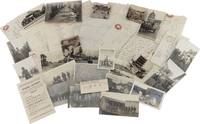
|
|
|
[CHINA PHOTO ALBUM]
CHINA TRAVEL 1891-1903: USA PORT ARTHUR TIENTSIN SUZHOUHSI-KU CHEFOO HONO
China 1891-1903. Leather spine & corners over green cloth oblong: 33 x 24 cm.249 b.w. & 3 hand-colored photos firm clean & solidly bound all photos laid downmost with pencil captions & date. STUNNING COLLECTION OF EARLY IMAGES . . . ORIGINAL DATED 1891-1903 PHOTOGRAPHIC ALBUM . . . PLACES IN MASSACHUSETTS NEW YORK U.S. EAST COAST HAWAII . . . CHINA MANCHURIA &c. . THE PHOTOS: The album contains various sizes & types of photos for the most part they are either silver-gelatin types or glossy finish most are black & white finish with a few hand-colored. All photos are laid down. Size in centimeters range from the smallest: 2.8 x 4.2 cm to the largest: 28 x 21 cm. There are 249 various kinds of photo processed black & whites and 3 hand-colored Japanese photos in all. . PHOTO DESCRIPTIONS BY PAGE NUMBERS PENCILED IN UPPER CORNERS 52 PAGES IN ALL: . Most with pencil captions & some with dates: . 1. 1 Photo: THE "STARS & STRIPES" photo of the U.S. Flag . 8 x 8 cm. . 2. & 3. Pictures of 2 lions 2 horse not photos clips from . unknown source. . 4. 2 Photos: most likely around the Massachusetts area: a. Tipped over house. "After the storm Atlantic Coast U.S.A. b. Beached ship. "After the storm Atlantic coast U.S.A." . 16.5 x 11.5 cm. . 5. 2 Photos: a. U.S.A. General Putnam's house. Revolutionary War . Rutland Mass.16.5 x 11.5 cm. b. U.S.A. Birch grove in the Adirondacks New York 16.5 x . 11.5 cm. . 6. & 7. 2 Photos all the same size. a. PORT ARTHUR CHINA 1900 16.5 x 11.5 cm. b. ditto c. ditto d. ditto . 8. 4 Photos: oval square round a. Claude L. Hall Roxbury 1899 cutout portrait5.5 x 5.5 cm b. Douglas Huntington New York 1900 2.3 x 3.5 cm. oval c. Capt. Hatch U.S.S. New Orleans 3 x 4.2 cm. square d. Susie A. Nye Sugamore U.S.A. albumen type 9.5 cm. roun e. Gertrude E. Spurr 1899. Melrose 4.2 x 7.2 cm. square . 9. 4 Photos: all oval cut outs albumen types. a. Charles S. Fuller Cambridge 1891 8 x 11.2 cm. b. E. Gertrude Dymond 91 Roxbury size ditto c. Alice J. Raymond Cambridge 1891 size ditto d. Gertrude E. Spurr Boston 1891 size ditto . 10. 3 Photos: a. Mama at Leomuslir U.S.A. May 1903 5.4 x 8 cm. b. Mrs. Caleb Saundres of Lawrence U.S.A. and her tiny lap . dog 1903 10 x 18 cm. c. Massachusetts U.S.A. Shows 4 horse-team buggy with . riders. 16.5 x 11.5 cm. . 11. 9 Photos:Aboard Steamship Heading to China actually 3: a. Captain Patterson of the China Merchants Steamship . Navigation Company 4 & 4 photos per print 7 in all of . him 10.8 x 4.3 & 5.8 x 4/3 cm. b. Hsing Fung in Chinese waters: captions for each of the . 4 people: Mrs. Nye Mrs. Roller Captain Patterson . Captain Roller on board 1902 8.4 x 8.3 cm. c. 4 people: Captain Patterson Mrs. Roller Captain Roller . Dr. Nye China on board C.M. Hsing Fun 19028.4 x 8.3 cm . 12. 3 Tientsin Photos: a. Coolies carrying wool Tientsin. 1902 8.4 x 8.3 cm. . b. Hoisting sail on Chinese boat Island canal Tientsin . 1901 8.4 x 8.3 cm. c. Tientsin Posing for their picture 1903 8.4 x 8.3 cm. . 13. 4 Tientsin Photos: a. Chinese kids fishing Tientsin 1903 8.4 x 8.3 cm. b. Our tennis orator Tientsin 1902 10 x 14.2 cm. c. Chinese soldiers on Chinese ponies Tientsin 1903 10 x . 14.2 cm. d. Chinese kids Tientsin 1902 9 x 6 cm. . 14. 6 Photos: a. Harry S. Nye Los Angeles Ca. Sept.16 1900 11.8 x 2.4 . cm. 6 views. b. Edwin H. Jose Jr. 1898 Whiteface N.H. c. U.S.A. Horvace F. Cooks & Joto Leominster Mass. 1902 . 5.5 x 8.3 cm. d. Ellen R. Nye Sagamore Bach 1899 5.5 x 8.3 cm. e. Harold J. Cook Alice L Jose Grace P. Cook Susan C. . Will Leominster Mass U.S.A. 1898 8.5 x 8 cm. f. Jor Leominster Mass U.S.A. 1902 83 x 55 cm. . 15. 5 Tientsin Photos all the same size: a. 1902 Mrs. Daniel B. Nye Tientsin China riding . rickshaw 8.5 x 8 cm. cm. b. One corner of our home Tientsin China 1902 Rue de . France. c. 1902 Dr. Daniel B. Nye Tientsin China riding rickshaw. d. Rue de France 1902 our home Tientsin China. e. Rue de France 1902 our home Tientsin China. . 16. 4 Tientsin Photos: a. Mary Allen as "Old Lady who Lived in the shoe" at church . of England's fair Tientsin China 1902 13.7 x 9.3 cm. b. A typical Chinese temple pagoda 8.5 x 8 cm. cm. c. At the mouth of a pottery kiln China 1902 ditto size. d. Children who took part in the Church of England fair at . Tientsin China 1912 13.7 x 9.3 cm. . 17. 1 Large Tientsin photo: a. Tientsin China 1904 photo of 14 foreign women each . dressed in the same kind of dress similar to 15 a "old . lady who lived in a shoe" 27.5 x 21.5 cm. . 18. 5 Mass. Photos first 4 faded: a. Witch house Salem Mass. U.S.A. 11.5 x 9.2 cm. b. House in which was born a famous witch Ann Hutchinson . Dainero Mass U.S.A. 11.5 x 9.2 cm. c. Edwin H. Jose Jr. Cambridge Mass U.S.A. 4.5. x 10 cm. d. Old Fort Sewall Marblehead Mass. U.S.A. 9.7 x 9.5 cm. e. Cutout portrait Ellen Nye Crowell Sagamore Mass. . U.S.A. 5 x 4.5 cm. . 19. 4 China Photos all the same size.: a. Dr. Drake rowing Major O'Brian washing boat Grand . Canal China 1902 8.5 x 8 cm. b. Speaks for itself. c. Mrs. D.B. Nye Grand Canal China sampan 1902 d. A yard of roses Hsi-Ku China 1902. . 20. 1 Large Chefoo photo: a. Chefoo China from Temple hill. Panoramic view of the . city 1903 20 x 14.7 cm. . 21. 4 Galesburg Il. Photos all same size; a. Uncle Alpheus' house at Galesburg Illinois 12 x 9.5 cm. b. Willard Dean New years' Day 1902 Galesburg U.S.A. c. At aunt Lizzie's Galesburg Aug. 1901. d. Uncle Alpheus & Aunt Lizzie in the library 1901 . 22. 2 Chefoo China Photos: a. Chow time at Deaf & Dup school Chefoo China9.7 x 7 cm. b. Mrs. Mills teaching sound to the deaf & dumb children . Chefoo China 1902 size ditto. . 23. 4 PHOTOS; HONOLULU & MT. PLEASANT MASS.: a. Leaving Honolulu H.T.on Hong Kong Maru 19018.5 x 8 cm b. Mama. Mt Pleasant St. Cambridge Mass 1903 12 x 9.5 cm. c. Mamma Mt Pleasant St. Cambridge Mass 1903 12 x 9.5 cm. d. Leaving Honolulu H.T.8.5 x 8 cm. cm. . H.T. means Hawaiian Territory now commonly called "T.H. . 24. 1 China Photo: a. The old Cedar Grove at the Ming Tombs Trees 300 years . old June 1903. China 9.7 x 7 cm. . 25. Three Naukow Pass China photos all same size: a. A laden camel caravan passing through Naukow Pass to . Kalgan June 1903 9.7 x 7 cm. b. Mr. Westerdorf and a caravan at rest at a hamlet in the . Naukow Pass June 1903. c. A difficult road Through Naukow Pass June 1903 Boy on a . Donkey. . 26. 4 Photos of Japan all same size: a. Japan 1901 Hakone Lake 13.3 x 9 cm. b. Japan 1901 Yumoto hand colored. c. Fujiya Miyanoshita hand colored c. Miyanoshita Japan 1901 hand colored 2 left corners . torn away. . 27. 6 Photos of Chefoo China: a. En route to Temple Hill Chefoo China 1903 she is . being carried by two coolies ca. 8 x 6 cm. b. Qu Lieuws Ryukyu Mud World 1902 4.5 x 5.8 cm. c. Same caption as b ca. 8 x 6 cm. d. Same caption as a ca. 8 x 6 cm. e. Chefoo Harbor in the background 1903 ca. 8 x 6 cm. d. same caption as e ca. 8 x 6 cm. . 28. 5 Peking & near Peking China photos: a. Mr. Westerdorf ready to start from the inn at . Tschong-ping-Jir June 1903 9.7 x 7 cm. b. Peking from drum tower looking toward the Forbidden City . ditto size c. Mr. Westerdorf on Rice Road Techong-ping-jir June 1903 . ditto size. d. Queen's Hotel at Wei-hai-Wei August 1903 oval 6.2 x . 6.8 cm. e. The main street and South Gate with bell in it . Tschong-ping-Jir June 1903 9.7 x 7 cm. . 29. 4 Peking China Photos 1903. all same size 9.7 x 7 cm.: a. A whole in the Great Wall at Pa li-ling June. b. Native bridge near Sehah-ho-chow on the way to the Great . Wall from Peking June. c. The main entrance to the largest Ming Tombs June. d. 3000 years old stones at Confucius Temple Peking 1903. . 30-38 A series of 10 RARE original photos of the YAO people and other views of northwestern "Kwangtung Guangdong area 9 of 10 are large size: 19 x 14 cm. dated 1903. . The American visitors go to see the native Yao people in their primitive villages and environs. . Excellent ethnographic examples clear fine RARE images. . a. Family scene in primitive mud-brick hut thatched roof dirt poor but in native home-spun embroidered & stitched clothing. Grandma & another woman wears the traditional "Bow" elaborate hair dress. With a long caption: "A group of Yao people Kwantung province." . b. "Dwelling house of the Yao people made of bamboo & grass." Thatched hut in the rocky hillside wilderness. . c. Terraced cultivated hillsides in the Yao peoples country." d. Yao woman and her son working in the tea fields." . c. "Rain clothing worn by the Chinese in Kwantung.bamboo hats grass capes and skirts." Shows two river craft. . 36. "Wall washed away at time of cloud burst at Chefoo-China July 1903" 8.5 x 6.5 cm. . Continue with large format photos 19 x 14 cm. dated 1903 of northwest northern part of Kwangtung: . 37. "In the northern part of Kwantung province nearly every village has a large house beside the village which is intended as a place of retreat for the villages in attack by robbers. fort house." . 38. "Temple Dr. Drake lived in for a short time." . 39. Return to the first format: 4 China photos 1903: a. "Chinese beggar at Chefoo" 7 x 9 cm. b. "Typical entrance to Chinese Temples" Peking 14.5 x 10 . cm. c. "View of Chefoo North China" ditto size. d. "Temple built to the Gods by a young Chinese who vowed to . built of if the Gods would cure him of sickness 100 mile . from Peking" 7 x 9 cm. . 40. 4 Photos of USA: a. The U.S.S. Olympia going down the Hudson River to . anchor after saluting at Grant's tomb During the Dewey . celebrations. The U.S.S. Chicago behind her. USA. Compose . of 2 separate but adjoining photostogether:16.8 x 12 cm . b. Blanch Jewel Boston U.S.A. 1891 outline photo 3 x 8 . cm. 1891. c. Mr. ad Mrs. Caleb Saunders Laurence Mass. 7 x 12.5 cm. . An elaborately dressed couple. . 41. 3 Famous Forbidden city Peking China photos all the . same size: 9.8 x 8 cm.: a. Dr. Westerdorf at one of the gates to Confucius Temple. b. Sacred stone dragon Confucius Temple c. Mr. Westerdorf and 'boy" under the Marble Arch of Llama . Temple Peking. . 42. 6 Photos Sagamore Mass. & Honolulu 1901: a. "Our Home" Sagamore Mass. 8.5 x 7.5 cm. b. 1900 Falls at Newton Mass. round photo: 7.8 x 8 cm. c. Honolulu Hawaii 1901 8 x 5 cm. d. Our barn Sagamore Mass. 8 x 5 cm. e. "Winchester U.S.A. duds" shows 3 kids 1 in American . Indian dress the others cowboy "duds" 4.5 x 6 cm. f. Mr. Stowell leaving 1901 Honolulu 8.5 x 6.5 cm. . 43. 3 Photos Tientsin China 1902 all 8.5 x 6.5 cm.: a. "Rue de France: Dr. Nye in his Tientsin office Mr. . Roding in the dental chair." b. Daniel Butler Nye DDS in his office at Tientsin. c. Dest in Rue de France office. . 44. 5 Photos aboard ship in China all 8.5 x 6.5 cm.1901: . corners clipped: a. Lt. Morgan asleep in his bunk on U.S.S. Monocacy Tanku b. Drill aboard U.S.S. Monocacy Tangku c. U.S.S. Monocacy leaving dry dock Tongku d. " " ditto e. " " " . 45. 5 China Photos of the U.S.S. Moncacy Tongku 1901 a. Captain Roller of the U.S.S. Monocacy 8.5 x 6.5 cm. b. Mrs. Roller " " " ditto c. U.S.S. Monocacy leaving dry dockTongku faded7.5 x 6.5 d. ditto above e. ditto above not faded same size . 46. 6 China Tientsin & U.S.A. photos 1902-03: a. Part of front room at Rue de France 1902 8.5 x 6.5 cm. b. Mama on Amb. Emmuii's Piazzco Leominster Mass 1903 . 5.5 x 8 cm. c. "Ah Chin" in dining room Rue de France 6.6 x 4.8 cm. d. Corner of front room at Rue de France 19024.2 x 8.2 cm. e. Round photo "Enjoying Kipling 1902 4 x 4.5 cm. f. Side board in dining room at Rue de France 8.5 x 6.5 cm. . 47. 8 Blue pictures of photos of family & friends. . 48. 2 Photos of Peking & Shanghai China: a. Temple in which the Emperor was imprisoned . Empress Dowager Peking 1900 14.5 x 10 cm. by the b. Chinese pagoda Shanghai ca. 9 x 12 cm. . 49. blank . 50. 6 Photos of Tientsin China: a. Grand StandTientsin Race Club in Race Way 19027.8 x 5. b. Japanese Temple 8.5 x 11 cm. c. Hsi Shan Terrace Tongshan 1903 Residence of Me and . Mrs. G.B. Wikow 12 x 9.5 cm. d. French market Tientsin 1902 8.7 x 3 cm. e. Chinese children Tientsin 1902 2.5 x 4 cm. . 51. 3 Photos of China: a. Old tombs in interior of China. Where a man became old and useless he would have this tomb built around him with only small opening at top where his family put in food each day until he died. 15 x 10 cm.Korean penciled above this . b. Making pottery Tientsin 1902 9.7 x 7 cm. c. Blind musician Chefoo 1903 9 x 10.5 cm. . 52. 4 China Photos. a. God of Transmigration In Buddhist Hall breaking the bones of wicked Chinese on the Wheel of torture by the Monkey King 15 x 10.5 cm. . b. Rear view of the 'steam roller' making roads Tientsin . 1902 7.5 x 6 cm. c. Chinese prisoners going for trial British concession . Tientsin 1902 7 x 8.5 cm. d. Photo of Boxer placard 1900 15 x 10.5 cm. . End of photo album. . A rough list of names places dates &c. in order of appearance: . 1900 Los Angeles Sept. 151900: Harry S. Nye 1898 Whiteface N.H. Edwin H. Jose Jr. 1898 Mass. Horace F. cook Alice F. Jose Grace P. Cook Samuel C. Willard Leominster Mass. 1902 Horvath F. Cook and "Joe" dog Leominster Mass. 1902 "Joe" Leominster Mass. 1898 Ellen R. Ne Sagamore Beach Tientsin 1902-1903 . OF ANTHROPOLOGICAL INTEREST: PHOTOS OF YAO PEOPLE: . The album contains 5 superb images large size: 19.5 x 14 cm. illustrating the Yao minority in native costume their hand-made dwellings terraced rice paddy sea-worthy vessels tea fields &c. Each with lengthy pencil caption dated 1903 documenting Yao living in Kwantung province. Located in southern tip of the Liaodong Peninsula near Port Arthur Manchuria. . About the Yao nationality its great majority branch is also known as Mien or Pinyin: Yáo zú; and as "Ngui Dao" in Vietnamese. They form one of the 55 ethnic minority groups officially recognized by the People's Republic of China where they reside in the mountainous terrain of the southwest and south. They also form one of the 54 ethnic groups officially recognized by Vietnam. In the last census in 2000 they numbered 2637421 in China and roughly 470000 in Vietnam. . Origins of the Yao Iu-Mien can be traced back 2000 years ago starting in Hunan Province. . The Yao people were among the rebels during the Miao Rebellions Ming Dynasty along with the Miao people against the Ming dynasty. . Around 1890 the Guangdong government started taking action against Yao in northwestern Guangdong. . Emigration from the late 1800s to early 19th century the Yao migrated into Thailand Vietnam and the highlands of Laos. The migration was agitated by the opium trade said by the Chinese government. But The Iu Mien say all the emigration was because of the Chinese taking their land. . A group of 61000 people on the island of Hainan speak the Yao language Kim Mun 139000 speakers of Kim Mun live in other parts of China Yunnan and Guangxi and 174500 live in Laos and Vietnam. . Color photos are posted to our website. . CONDITION: THE IMAGES: The photographs are for the most part very clear vivid most little or no fading saying that there are a few each noted that are faded. There are 3 hand-colored Japanese images. Naturally there is some of the typical fading of some of the photos depending on the process. By and large overall an excellent examples. . Prior to coming to us there was a small number of photos extracted from the album the above list and count are accurate for what is present. . The captions are original in pencil in some places for better understanding we added "." to capture the creator's affect or to separate our comments. . THE ALBUM: The album has red 3/4 leather binding the spine is neatly re-backed the corners also neatly replaced with matching leather with gold-stamped cover title: "PHOTOGRAPHIEN" & spine title: "CHINA 1900-1903." . The balance of the covers are in green cloth which has gold rule lines with cover title: "Photographien" most likely of German/Austrian origin ca. 1880-90's vintage. . Album pages are solidly cloth hinged firm and serviceable there are no stains or other obtrusive marks inside. . There are a few lower right page corners rubbed chipped a few broken away typical for an item 120 years old. . BIBLIOGRAPHY: en-wikipedia-org/wiki/Yao_people . . unknown
Referenz des Buchhändlers : 41046101
|
|
|
[CHINA PICTORIAL - REFORM AND OPENING UP].
China Pictorial.
Beijing.: China Pictorial. 1985. Six issues from 1985. Black and white and colour photographic illustrations throughout to accompany articles 44pp. Minor wear extremities pictorial wrappers all in very good condition. Text in English. 37 x 26cm. Includes issues numbers 1 2 3 6 7 and 8. <br> <br>Articles include: Ye Jianying - An Eminent Army Commander Takins in China Egrets and Herons Pelicans Xinjiang Pioneers A Town in the Gobi 'Life' - a Feature Film Important Discoveries at Xia Ruins Ancient Capital of the Shang Dynasty Tianshan Mountains Glacial Station China's First Research Base in Antarctica A Scientific Survey of the Southern Ocean Tianjin Matteo Ricci and His Autumn of Beijing Suburbs. . China Pictorial. unknown
Referenz des Buchhändlers : 217468
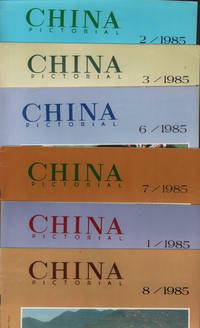
|
|
|
[CHINA PICTORIAL - REFORM AND OPENING UP].
China Pictorial.
Beijing.: China Pictorial. 1980. Broken run of five issues of China Pictorial. Black and white and colour photographic illustrations throughout to accompany articles 43 - 44pp. Pictorial wrappers minor wear extremities and spines else in very good condition. Text in English. 37 x 26cm. Includes issue numbers 3 4 7 8 and 9. <br> <br>Many articles in this incomplete set are of interest because they feature China moving on from the Cultural Revolution and the Gang of Four and focusing instead on modernising and scientific progress. Articles on this theme include A Scientific Excursion in Tibet Scientific Investigations in the Qinghai-Tibet Plateau Chinese Test Pilots The China International Trust and Investment Corporation New Factories and Mines Surveying the South Pacific Clouds and Earthquakes and The Chinese River Dolphin. <br> <br>Other topics of interest include Sixty Years on Stamp Collecting Sun Yat-Sen's Mausoleum and various other tourist destinations: Hainan Island Mt Hengshan Mt Huashan and Dunhuang. Two articles are about important ancient artefacts Art Treasures Unearthed in Suixian County and another recently unearthed and hugely important treasure the Terracotta Warriors. There is an article dedicated to the author Mao Dun and another to the 1979 restaging of Lao She's play 'Teahouse'. The article Upturn in Chinese Cinema with portraits of film stars indicates how the purpose of cinema has changed in just a few short years. . China Pictorial. unknown
Referenz des Buchhändlers : 217485
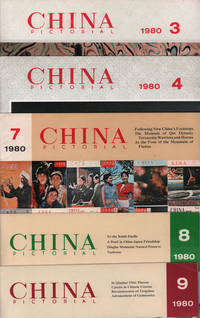
|
|
|
[CHINA PICTORIAL - REFORM AND OPENING UP].
China Pictorial.
Beijing.: China Pictorial. Nos. 1-121978. A complete run of 12 issues. Black and white and colour photographic illustrations throughout to accompany articles 43 - 44pp. Pictorial wrappers minor wear extremities and spines else in very good condition. Text in English. 37 x 26cm. The Cultural Revolution having come to an end with the passing of Chairman Mao in 1976 issues in 1978 focus on life returning to normal after the downfall of the Gang of Four. Many articles feature explanations of problems caused by the Gang of Four e.g. The Anshan Iron and Steel Complex After the Downfall of the Gang of Four Commune-run Enterprises The Revolutionization of Beijing Opera and discuss newly staged productions such as the 'Red Lantern Society' the film 'Hai Hsia' and the plays 'Red Hearts' and 'Yang Kai-hui'. Numerous articles also refer to the Gang of Four such as Old Doctors in the PLA Hospital the New Look of Beijing University and the articles on authors Guo Moruo and Wei Wei. <br> <br>Chairman Hua meeting foreign leaders and his visits to notable Chinese sites is heavily featured in the first few pages of nearly every issue with Deng Xiaoping also included. Other articles include the new Long March to Modernisation Chinese Medicine Tangshan The Tahsingkou Forestry Area Paulownia and Farming Fishes of the Yangtze Archaeological Finds from the Yin Ruins Women Scientists and Technicians in Peking The 1978 National Middle School Students' Mathematics Contest Developments in Maotian Song and Dance and Science and Technology in Xinjiang Commemoration of Mao and the 80th Birthday of Premier Zhou En-lai and the Index to China Pictorial 1978. . China Pictorial. unknown
Referenz des Buchhändlers : 217484
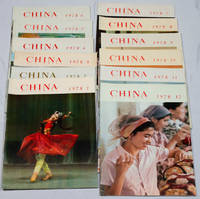
|
|
|
[China Post]
Stamps of China. Painting and Calligraphy
Hardcover. Pictorial boards. Comes in pictorial cardboard clamshell box. Presents forty-one stamps based on the works of Wu Chang Shuo Qi Bai Shi Huang Bin Hong Pan Tian Shou Bao Shi Xiang Ning Zheng Ban Qiao and Ba Da Shan Ren. Text in English and Chinese. A fine copy in fine clamshell box. hardcover
Referenz des Buchhändlers : 38234
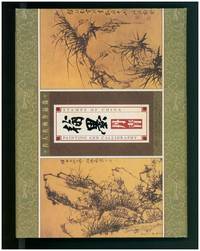
|
|
|
[CHINA RECONSTRUCTS - GREAT LEAP FORWARD] CHING CHUNG-HWA AND OTHERS (EDITED BY).
China Reconstructs.
Peking.: China Welfare Institute. Vol. X Nos. 2-5 7-121960. A broken run of 10 issues of the magazine China Reconstructs 1961 Issue 1 January and Issue 6 June are missing. All are in original coloured pictorial wrappers profusely illustrated throughout in black and white with some colour photographic illustrations usually 44pp. Number 12 features an index for the full year. Text in English except for Language Corner 30.5 x 22.5cm.Some occasional wear to wrapper spines slight soiling at opening edges else in good condition. This influential magazine was established by Soong Ching-ling in 1949. Published in 6 languages including Arabic and Chinese the purpose was to present a very positive view of Chinese life and culture to the outside world. <br> <br>Articles in these issues include many of educational and cultural interest: Bringing Opera to the Village Pearls Cleansed of Sand College courses by Television Four Master Painters Table Tennis - A Popular Sport in China Peking University's New Intellectuals Violins and Pianos for China The Twenty-four Solar Terms An Opera for Millions The Essays of Lu Hsun My Last Meetings with Mei Lan-Fang Soochow Storytelling Debate on Architectural Style The Stone Arch - Symbol of Chinese Bridges The Education of Inner Mongolia New Music in Shanghai The Minority Peoples of Yunnan. <br> <br>Articles of particular historical significance at this time when the Great Leap Forward was ending include: Agriculture - Foundation of the National Economy Rivals Help Each Other - for More Steel Commune Dining Hall Building up Productive Power The Revolutionary Years Chu Tse-ching Refused U.S. Relief Food and more. <br> <br>Issue Number 12 has an index for the whole year inserted. . China Welfare Institute. unknown
Referenz des Buchhändlers : 217584
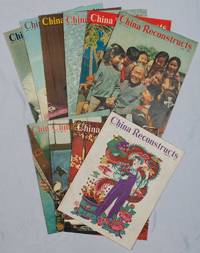
|
|
|
[CHINA RECONSTRUCTS - GREAT LEAP FORWARD] CHING CHUNG-HWA AND OTHERS (EDITED BY).
China Reconstructs.
Peking.: China Welfare Institute. Vol. IX Nos. 2 3 5-121960. A broken run of 10 issues of the magazine China Reconstructs 1960 Issue 1 January and Issue 4 April are not included. All are in original coloured pictorial wrappers profusely illustrated throughout in black and white with some colour photographic illustrations usually 40pp. Number 12 features a fold out pictorial plate. Text in English except for Language Corner 30.5 x 23cm. Some occasional wear to wrapper spines and slight soiling at opening edges. One leaf from Number 8 pp 31/32 is missing. Spine of Number 10 has washi paper minor repair otherwise in very good condition. This influential magazine was established by Soong Ching-ling in 1949. Published in 6 languages including Arabic and Chinese the purpose was to present a very positive view of Chinese life and culture to the outside world. <br> <br>Articles in these issues include many of cultural interest: A Family Reunited "Family Reunion" by Lao Sheh Dunhuang Memories Lhasa's Year of New Life An Actor and His Responsibility Artists Bombard Imperialism Memoirs of the Revolution A Poet of the Working Class Shaohsing's Famous Wine - New Look For an Old Product. <br> <br>Articles of particular historical significance at this time of the Great Leap Forward include: North China's Biggest Reservoir New Yangtze Bridge at Chungking The Metallurgical Industry Is Transformed Farm Women Say: Dining Halls are Good! Achievements of the Continued Great Leap forward in 1959 with a pull-out coloured chart Observations on the Sino-Indian Border Issue 100000 Varieties of Goods Flashes on the Technical Revolution A New Revolution "Pushes Back the Skies" From Grain Shortage to Grain Surplus Where Returned "Overseas Chinese" are Farming "Red Flag" - A City People's Commune The 12 Year Programme - Blueprint for China's Modern Agriculture Commune-run Economy Spells Prosperity A Revolution in Rice Cultivation Storm over Asia Cities Help the Farm Meeting the Need for Fertilizer The Continued Leap Forward The Thought of Mao Tse-tung Casts Its Light Everywhere with a fold out coloured pictorial chart. <br> <br>Issue Number 12 has an index for the whole year inserted. . China Welfare Institute. unknown
Referenz des Buchhändlers : 217580
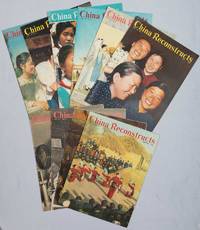
|
|
|
[CHINA RECONSTRUCTS - GREAT LEAP FORWARD] CHING CHUNG-HWA AND OTHERS (EDITED BY).
China Reconstructs.
Peking.: China Welfare Institute. Vol. VIII. Nos. 1-4 6-121959. A broken run of 11 issues of the magazine China Reconstructs 1959. Issue 5 May 1959 is missing. All are in original coloured pictorial wrappers profusely illustrated throughout in black and white with some colour photographic illustrations usually 40pp. Number 12 includes an index for the full year. Text in English except for Language Corner 30.5 x 23cm. Some occasional wear to spines. Some insect damage to a few leaves in places else in very good condition. This influential magazine was established by Soong Ching-ling in 1949. Published in 6 languages including Arabic and Chinese the purpose was to present a very positive view of Chinese life and culture to the outside world. <br> <br>Articles in these issues include many of educational and cultural interest: Making Documentary Films in China Merging Factory and School Peking After 10 Years Checkerboard of Canals Women of the Communes How We Dug More Coal Than Britain Opening an Imperial Tomb New Blossoms On An Old Tree Szechuan Opera is Reborn Tibetan Serfdom Nears Its End "The Philanthropist" by Lao Sheh Pottery Tomb Figures Learning from Ancient China's Medicine The Traditional Theatre Today Tracing the Thread of the Past The Great Decade - A Prelude to Progress Yet Greater with a pictorial fold-out. <br> <br>Articles of particular historical significance at the beginning of the Great Leap Forward include: A Leap That Has Made History Lushan's "Pig-Iron" Sputnik A Glorious Era: A Glorious People with a photographic illustration of Soong Ching Ling near the furnace set up in her garden The Building of a Giant How China Gets High Farm Yields Back Street Rolling Mill New View of Water Conservancy The Race for Electric Power Economic Achievements The Bumper Crop Charter The Leap Forward Continues The New Trend in Local Steel Manufacture and more. <br> <br>Issue Number 12 has an index for the whole year inserted. . China Welfare Institute. unknown
Referenz des Buchhändlers : 217587
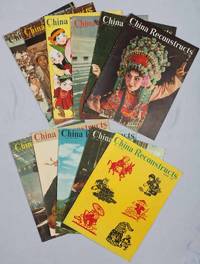
|
|
|
[CHINA RECONSTRUCTS] CHING CHUNG-HWA AND OTHERS (EDITED BY).
China Reconstructs.
Peking.: China Welfare Institute. Vol. XV. Numbers 3-61966. A broken run of 4 numbers of the magazine China Reconstructs 1966 March - June inclusive. All are in original coloured pictorial wrappers profusely illustrated throughout in black and white with some colour photographic illustrations usually 44pp. Text in English except for Language Corner 30.5 x 23cm. Number 5 has a little insect damage to wrappers and lower edges near spine with minor repairs made with archival washi paper else in good condition. This influential magazine was established by Soong Ching-ling in 1949. Published in 6 languages including Arabic and Chinese the purpose was to present a very positive view of Chinese life and culture to the outside world. <br> <br>Articles in these issues include many of educational political and cultural interest: A Canal Cut Through the Mountains The 'Big Red 1 Gets a Mauling' about South Vietnam U.S. Must Get Out of Vietnam A Television Cameraman in South Vietnam On the Szechuan-Tibet Railway Science Films Educate Millions New Finds of Vertebrate Fossils and more. <br> <br>Articles of particular historical or industrial significance at the beginning of the Cultural Revolution include: Animated Cartoon Films Teach the Young A Revolution in Sculpture Self Reliance Has Proved Itself Revolution in Machine Designing The 'Man of Iron' - Wang Chin-Hsi Writers of the Socialist Age Laughing Away Old Ideas and more. . China Welfare Institute. unknown
Referenz des Buchhändlers : 217631
|
|
|
[CHINA RECONSTRUCTS - HUNDRED FLOWERS CAMPAIGN] CHING CHUNG-HWA AND OTHERS (EDITED BY).
China Reconstructs.
Peking.: China Welfare Institute. Vol. VI Nos. 1-121958. A complete run of 12 issues of the magazine China Reconstructs 1957. All are in original coloured pictorial wrappers profusely illustrated throughout in black and white with some colour photographic illustrations usually 32pp. Number 5 May one leaf reattached some occasional wear to wrapper spines else all are in very good condition. Text in English except for Language Corner. 30.5 x 23cm. This influential magazine was established by Soong Ching-ling in 1949. Published in 6 languages including Arabic and Chinese the purpose was to present a very positive view of Chinese life and culture to the outside world. Of note is the January issue wrapper; a 5th birthday greeting for China Reconstructs from regular contributing artists with their view of life in the magazine. <br> <br>Articles in these issues include many of cultural interest: "A Writer Speaks of Writing" Lao Sheh Peonies Gardens of Soochow New Chinese Woodcuts "The Double-Fifth Festival" by Lu Hsun Door Gods Stage Design First Asian Film Week China and Japan: Ancient Cultural Relations Old Palys; A Treasury Reopened. <br> <br>Articles of particular historical significance at this time when the campaign "Let a Hundred Flowers Bloom" was just finishing include: Second Five-Year Plan A Hundred Schools Contend The Great Debate A Day in a Szechuan Co-op Can China Feed Her People China Gets an Alphabet A Capitalist's Experience "Free Market" in Vegetables Educated Peasants - A New Concept US Penetration in Taiwan Ending the Scourge of Schistosomiasis Water Conservancy 2000 Years Ago What's Happening in Former Private Firms and more. <br>Issue Number 12 has an index for the whole year inserted. . China Welfare Institute. unknown
Referenz des Buchhändlers : 217575
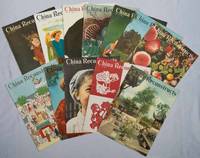
|
|
|
[China Reconstructs]
Table Tennis and Friendship
Peking: China Reconstructs 1971. 1st edition. Nice copy. large octavo. pictorial wrappers 44pp. colour & b/w plates Supplement to China Reconstructs: Superb photographic account of International Table Tennis in China with many action photos of the leading Chinese players. Scarce China Reconstructs unknown
Referenz des Buchhändlers : 146680
|
|

 Per e-mail erhalten
 Als pdf-Dokument herunterladen
 RSS feed
 Permanenter link


