|
|
|
Carl Sandburg, Illustrator Gregory Masurovsky (Artist's Portfolio)
Seven Poems-Signed by Artist
Associated American Artists NY 1970. Text printed in France by Pierre Jean Mathan. Etchings printed by Atelier George's Leblanc. Sandburgs poems have been illustrated with seven original copper plate etchings by Gregory Masurovsky. The book is number 127 of a Signed and numbered edition of 150. In addition each of the etchings has been numbered and signed by the artist in pencil. The book/portfolio is fine and housed as issued in a fine slipcase. Associated American Artists hardcover
Référence libraire : 0512086

|
|
|
CARLEGLE Charles-Emile
La Rivière. Costume de fantaisie (pl.3, La Gazette du Bon ton, 1912-1913 n°4)
- Lucien Vogel éditeur, Paris Février 1913, 19x24,5cm, une feuille. - Original color print, printed on vergé paper, signed in the plate. An original print used to illustrate the Gazette du bon ton, one of the most attractive and influential 20th century fashion magazines, featuring the talents of French artists and other contributors from the burgeoning Art Deco movement. A celebrated fashion magazine established in 1912 by Lucien Vogel, La Gazette du bon ton appeared until 1925, with a hiatus from 1915 to 1920 due to the war (the editor-in-chief having been called up for service). It consisted of 69 issues printed in only 2,000 copies each and notably illustrated with 573 color plates and 148 sketches of the models of the great designers. Right from the start, this sumptuous publication "was aimed at bibliophiles and fashionable society," (Françoise Tétart-Vittu, "La Gazette du bon ton", in Dictionnaire de la mode, 2016) and was printed on fine vergé paper using a type cut specially for the magazine by Georges Peignot, known as Cochin, later used (in 1946) by Christian Dior. The prints were made using stencils, heightened in colors, some highlighted in gold or palladium. The story began in 1912, when Lucien Vogel, a man of the world involved in fashion (he had already been part of the fashion magazine Femina) decided, with his wife Cosette de Brunhoff - the sister of Jean, creator of Babar - to set up the Gazette du bon ton, subtitled at the time: "Art, fashion, frivolities." Georges Charensol noted the reasoning of the editor-in-chief: "'In 1910,' he observed, 'there was no really artistic fashion magazine, nothing representative of the spirit of the time. My dream was therefore to make a luxury magazine with truly modern artists...I was assured of success, because when it comes to fashion, no country on earth can compete with France.'" ("Un grand éditeur d'art. Lucien Vogel" in Les Nouvelles littéraires, no. 133, May 1925). The magazine was immediately successful, not only in France but also in the United States and Latin America. At first, Vogel put together a team of seven artists: André-Édouard Marty and Pierre Brissaud, followed by Georges Lepape and Dammicourt, as well as eventually his friends from school and the School of Fine Arts, like George Barbier, Bernard Boutet de Monvel and Charles Martin. Other talented people soon came flocking to join the team: Guy Arnoux, Léon Bakst, Benito, Boutet de Monvel, Umberto Brunelleschi, Chas Laborde, Jean-Gabriel Domergue, Raoul Dufy, Édouard Halouze, Alexandre Iacovleff, Jean Émile Laboureur, Charles Loupot, Chalres Martin, Maggie Salcedo. These artist, mostly unknown when Lucien Vogel sought them out, later became emblematic and sought-after artistic figures. It was also they who worked on the advertising drawings for the Gazette. The plates put the spotlight on, and celebrate, dresses by seven designers of the age: Lanvin, Doeuillet, Paquin, Poiret, Worth, Vionnet and Doucet. The designers provided exclusive models for each issue. Nonetheless, some of the illustrations are not based on real models, but simply on the illustrator's conception of the fashion of the day. The Gazette du bon ton was an important step in the history of fashion. Combining aesthetic demands with the physical whole, it brought together - for the first time - the great talents of the artistic, literary, and fashion worlds; and imposed, through this alchemy, a completely new image of women: slender, independent and daring, which was shared by the new generation of designers, including Coco Chanel, Jean Patou, Marcel Rochas, and so on... Taken over in 1920 by Condé Montrose Nast, the Gazette du bon ton was an important influence on the new layout and aesthetics of that "little dying paper" that Nast had bought a few years earlier: Vogue. [FRENCH VERSION FOLLOWS] Estampe originale en couleur, tirée sur papier vergé et signée en bas à droite. Gravure originale réalisée pour l'illustratio

|
|
|
CARLEGLE Charles-Emile
Le Bon Oncle. Costumes d'enfants (pl.2, La Gazette du Bon ton, 1914 n°1)
- Lucien Vogel éditeur, Paris Janvier 1914, 19x24,5cm, une feuille. - Original color print, printed on vergé paper, signed in the plate. An original print used to illustrate the Gazette du bon ton, one of the most attractive and influential 20th century fashion magazines, featuring the talents of French artists and other contributors from the burgeoning Art Deco movement. A celebrated fashion magazine established in 1912 by Lucien Vogel, La Gazette du bon ton appeared until 1925, with a hiatus from 1915 to 1920 due to the war (the editor-in-chief having been called up for service). It consisted of 69 issues printed in only 2,000 copies each and notably illustrated with 573 color plates and 148 sketches of the models of the great designers. Right from the start, this sumptuous publication "was aimed at bibliophiles and fashionable society," (Françoise Tétart-Vittu, "La Gazette du bon ton", in Dictionnaire de la mode, 2016) and was printed on fine vergé paper using a type cut specially for the magazine by Georges Peignot, known as Cochin, later used (in 1946) by Christian Dior. The prints were made using stencils, heightened in colors, some highlighted in gold or palladium. The story began in 1912, when Lucien Vogel, a man of the world involved in fashion (he had already been part of the fashion magazine Femina) decided, with his wife Cosette de Brunhoff - the sister of Jean, creator of Babar - to set up the Gazette du bon ton, subtitled at the time: "Art, fashion, frivolities." Georges Charensol noted the reasoning of the editor-in-chief: "'In 1910,' he observed, 'there was no really artistic fashion magazine, nothing representative of the spirit of the time. My dream was therefore to make a luxury magazine with truly modern artists...I was assured of success, because when it comes to fashion, no country on earth can compete with France.'" ("Un grand éditeur d'art. Lucien Vogel" in Les Nouvelles littéraires, no. 133, May 1925). The magazine was immediately successful, not only in France but also in the United States and Latin America. At first, Vogel put together a team of seven artists: André-Édouard Marty and Pierre Brissaud, followed by Georges Lepape and Dammicourt, as well as eventually his friends from school and the School of Fine Arts, like George Barbier, Bernard Boutet de Monvel and Charles Martin. Other talented people soon came flocking to join the team: Guy Arnoux, Léon Bakst, Benito, Boutet de Monvel, Umberto Brunelleschi, Chas Laborde, Jean-Gabriel Domergue, Raoul Dufy, Édouard Halouze, Alexandre Iacovleff, Jean Émile Laboureur, Charles Loupot, Chalres Martin, Maggie Salcedo. These artist, mostly unknown when Lucien Vogel sought them out, later became emblematic and sought-after artistic figures. It was also they who worked on the advertising drawings for the Gazette. The plates put the spotlight on, and celebrate, dresses by seven designers of the age: Lanvin, Doeuillet, Paquin, Poiret, Worth, Vionnet and Doucet. The designers provided exclusive models for each issue. Nonetheless, some of the illustrations are not based on real models, but simply on the illustrator's conception of the fashion of the day. The Gazette du bon ton was an important step in the history of fashion. Combining aesthetic demands with the physical whole, it brought together - for the first time - the great talents of the artistic, literary, and fashion worlds; and imposed, through this alchemy, a completely new image of women: slender, independent and daring, which was shared by the new generation of designers, including Coco Chanel, Jean Patou, Marcel Rochas, and so on... Taken over in 1920 by Condé Montrose Nast, the Gazette du bon ton was an important influence on the new layout and aesthetics of that "little dying paper" that Nast had bought a few years earlier: Vogue. [FRENCH VERSION FOLLOWS] Estampe originale en couleur, tirée sur papier vergé, signée en bas à gauche de la planche. Gravure originale réalisée pour l

|
|
|
CARLETTI, Mario (Torino 1912 - Cossato 1977),
Senza titolo
Acquaforte appartenete alla cartella ''Venezia 73'' contenente 31 opere grafiche di maestri italiani ed un saggio di Piero Chiara, pubblicata dall'Unesco Firma a matita. Il foglio reca il timbro a secco del Museo di Castelvecchio di Verona e quello della Stamperia del Cappello. Esemplare 96/100. cm 39 x 50 (Foglio 50 x 70). . . Ottimo (Fine). . 100 + XI f.c.. .

|
|
|
carlo lasinio
Logge di Raffaello
13 tavole sciolte che raffigurano le Logge di Raffaello, incise da Carlo Lasinio, dimensioni del foglio cm 46x62, dell’impronta della lastra 37x50,5. Rossetti 6053.
|
|
|
Carlson, Victor and John Ittmann
Regency to Empire: French Printmaking 1715-1814
This is a very good softcover copy with just light cover wear. Completely clean inside and out. The spine is not creased, binding firm. This catalog was prepared to accompany the traveling exhibition that opened at the Baltimore Museum of Art from November 10, 1984 to January 6, 1985. Exhibition and catalog curated by Victor Carlson and John Ittmann. Illustrated mostly in black & white, some color plates. 165 illustrations. Includes biographies of the artists. Bibliography. Glossary of French engraving terms. Essays by George Levitine, Richard Campbell, David Becker and Mary Myers. 11" high X 9" wide, 371 pages. Large heavy book, foreign shipping will be extra. This book will be securely wrapped and packed in a sturdy box and shipped with tracking.
|
|
|
CARMASSI, Arturo (Lucca, 1925 - Empoli, 2015),
Senza titolo
Acquaforte facente parte delle pubblicazioni edite nel 50° anniversario della fondazione del PCI Firma e data su lastra e su foglio a matita. Esemplare 82/100. Cm 64x44 (Foglio 70x50). . . Ottimo (Fine). . Tiratura100 + alcune p.a.. .

|
|
|
CARMI, Eugenio (Genova, 1920 - Lugano, 2016),
Eva in terra 4
Litografia originale a colori. Una delle 4 litografie della cartella di Eugenio Carmi, su testo di Grytzko Mascioni. Firma, data e numerazione a matita. Litografia stampata a braccia su torchio litografico. Carta della cartiera Magnani di Pescia. Timbro a secco della stampatoria Il Torchio di Porta Romana. Tiratura: 99 + XXV + copie ad personam num. A/Z. Esemplare C/Z. Lastre biffate dopo la stampa.. Cm 53,5x35 (Foglio 70x50). . . Molto buono (Very Good). Alcune piccole fioriture ai margini bianchi del foglio. . . Eugenio Carmi ha fatto la sua prima mostra alla Galleria Numero di Firenze nel 1958. Nel 1963 fonda il Gruppo Cooperativo di Boccadasse, di cui è emanazione la Galleria del Deposito, una galleria sperimentale della quale fanno parte artisti europei, fra cui Max Bill e Victor Vasarely, critici, fotografi e architetti, fra cui Konrad Wachsmann. Nel 1966 partecipa alla Biennale di Venezia, nel 1970 riceve il premio alla Biennale internazionale di Cracovia e nel 1974 alla Triennale internazionale di Wroclaw. Molte le sue mostre e seminari in Europa e negli USA. "L'arte, è libertà di farcene quello che ce ne pare: io ho preso i coriandoli (pur nel loro estro lieto e fantastico, rigorosissimi) di Eugenio Carmi - coriandoli ritagliati con minuziosa maestria dalla mappa universale di un raffinatissimo sentimento estetico - per farne un carnevale di volatili riflessioni erotiche, di corte ma intensamente sentite divagazioni intorno a quell'ombelico amoroso del tutto, che l'opera e l'occasione mi è sembrato imponessero come chiave di volta (più che di lettura) di una ricostruzione e rivisitazione di ciò che siamo, ponte vitale (di viscere e umori e pensieri) che transita sugli abissi del mistero o del vuoto. Carmi sara d'accordo?" (Grytzko Mascioni, Origlio, 15 giugno 1984: testo che accompagna lam cartella)

|
|
|
CARMI, Eugenio (Genova, 1920 - Lugano, 2016),
Senza titolo
Acquatinta a colori, frottage e lamina d'argento sterling, appartenente al portfolio con testo introduttivo di Luciano Caramel e sei acquetinte a colori di Carmi (di cui quattro con collages, frottages e applicazioni di lamine d'argento sterling) tirato in un'edizione di 225 esemplari. Il portfolio accompagnava i volumi di Umberto Eco ''I tre cosmonauti'' e ''La bomba e il generale'' Firma, data e numerazione a matita. Timbro a secco dello stampatore Giorgio Upiglio. Stampata su carta Velin Arches. Tiratura di 200 + XXV esemplari. Esemplare 172/200. cm 44,1x34,5 (Foglio 63x45). . . Ottimo (Fine). . . . Eugenio Carmi ha fatto la sua prima mostra alla Galleria Numero di Firenze nel 1958. Nel 1963 fonda il Gruppo Cooperativo di Boccadasse, di cui è emanazione la Galleria del Deposito, una galleria sperimentale della quale fanno parte artisti europei, fra cui Max Bill e Victor Vasarely, critici, fotografi e architetti, fra cui Konrad Wachsmann. Nel 1966 partecipa alla Biennale di Venezia, nel 1970 riceve il premio alla Biennale internazionale di Cracovia e nel 1974 alla Triennale internazionale di Wroclaw. Molte le sue mostre e seminari in Europa e negli USA

|
|
|
CARMI, Eugenio (Genova, 1920 - Lugano, 2016),
Senza titolo
Acquatinta appartenente al portfolio con testo introduttivo di Luciano Caramel e sei acquetinte a colori di Carmi (di cui quattro con collages, frottages e applicazioni di lamine d'argento sterling) tirato in un'edizione di 225 esemplari. Il portfolio accompagnava i volumi di Umberto Eco ''I tre cosmonauti'' e ''La bomba e il generale'' Firma, data e numerazione a matita. Timbro a secco dello stampatore Giorgio Upiglio. Stampata su carta Velin Arches. Tiratura di 200 + XXV esemplari. Esemplare p.d.a.. cm 44x34 (Foglio 63x45). pp.. . Ottimo (Fine). . . . Eugenio Carmi ha fatto la sua prima mostra alla Galleria Numero di Firenze nel 1958. Nel 1963 fonda il Gruppo Cooperativo di Boccadasse, di cui è emanazione la Galleria del Deposito, una galleria sperimentale della quale fanno parte artisti europei, fra cui Max Bill e Victor Vasarely, critici, fotografi e architetti, fra cui Konrad Wachsmann. Nel 1966 partecipa alla Biennale di Venezia, nel 1970 riceve il premio alla Biennale internazionale di Cracovia e nel 1974 alla Triennale internazionale di Wroclaw. Molte le sue mostre e seminari in Europa e negli USA

|
|
|
CARPZOV, Benedikt
Jurisprudentia ecclesiastica, seu consistorialis rerum et quaestionum in ... Principis Electoris Saxoniae Senatu ecclesiastico et consistorio supremo probe ventilatarum ... definitiones succinctas ... exhibens libr. III. Quorum. I: Materiae de juribus episcopalibus. - II: Causis matrimonialibus. - III: Judicio et Foro ecclesiastico ...visuntur. Editio novissima, revisa et mendis purgata. 2 Teile in 1 Band.
Leipzig, Starck, 1708. Folio. 20 (statt 21) Bl., 253, 884 S., 64 Bl.; 100 S., 4 Bl. Mit 2 blattgr. Textkupfern (ohne den Kupfertitel). Pergament d. Zeit (etwas verstaubt u. fleckig). [2 Warenabbildungen]
Référence libraire : 627567

|
|
|
CARPZOV, Benedikt
Responsa juris electoralia in Serenissimi ac Potentissimi Archiprincipis Electoris Saxon. Supremo, quod vocant, appellationum judicio illustrissimo, et scabinatu Lipsiensi, ad quaestiones in schola doctorum dubias, foro controversas, et judicio contradictorio.multum agitas etc in publicum edita. Libri sex.
Leipzig, Gleditsch, 1709. Folio. 14 Bl., 302, 314, 400 S., 60 Bl. Pergament d. Zeit mit neuem Rückentitel.
Référence libraire : 628311
|
|
|
CARRA', Carlo (Quargnento, 1881 - Milano, 1966),
Piccolo molo I, 1924
Acquaforte su rame. Tirata in 25 es. nel 1924, in 125 es. da Prandi nel 1957 e in tiratura postuma nel 1971 per la cartella ''Opera grafica di Carrà'' Firma sul retro del figlio dell'Artista, Massimo Carrà. Esemplare V/X. Cm 6x6 (Foglio 50x35). . . . . Tiratura 60 + X f.c.. .

|
|
|
CARRACCI Annibale (1560-1609)
Le triomphe de Galathée
Eau-forte et burin .Faussement attribué à Annibal Carrache, alors qu'il s'agit d'une estampe anonyme d'après Augustin Carrache. In L'art érotique sous la Renaissance, tome 3, page 860. en feuille Très bon 24,5 x 44,5 cm
Référence libraire : 8623

|
|
|
CARRACHE Annibal
Suzanne au bain
Rare estampe, coupée à la marque du cuivre et contrecollée. En feuille Moyen 1 volume in-8°
Référence libraire : 14373

|
|
|
CARRERA, Gino (Casalpusterlengo 1923-2001),
Senza titolo
Acquaforte appartenete alla cartella ''Venezia 73'' contenente 31 opere grafiche di maestri italiani ed un saggio di Piero Chiara, pubblicata dall'Unesco Firma a matita. Il foglio reca il timbro a secco del Museo di Castelvecchio di Verona e quello della Stamperia del Cappello. Esemplare 96/100. cm 50 x 70. . . Ottimo (Fine). . 100 + XI f.c.. .

|
|
|
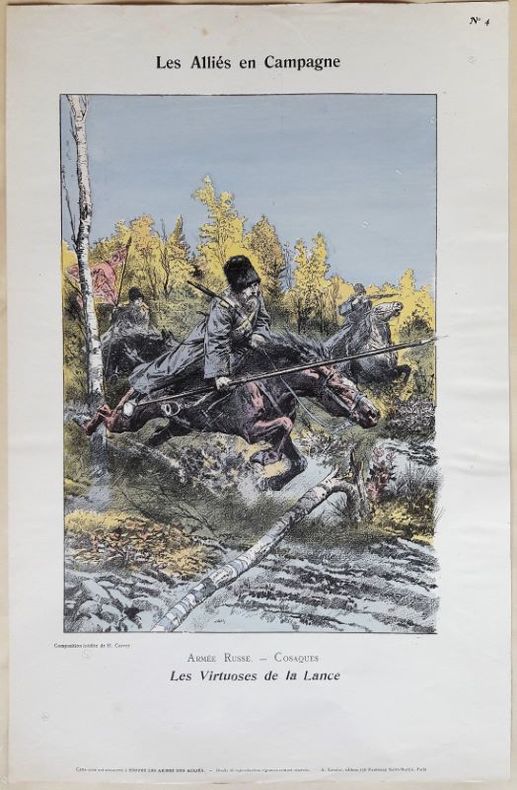
CARREY (H.).
les Alliés en campagne. N°4. Armée russe. Cosaques. Les virtuoses de la Lance.
A. Lasnier éditeur, 50X33 cm.
Référence libraire : 16356
|
|
|
CARREY.
Les Alliés en camapgne. N°3. Armée belge-Généralissime. Le Roi Albert 1er.
A. Lasnier éditeur, 50X33 cm.
Référence libraire : 16357

|
|
|
CARREY.
Les Alliés en campagne. N°2. Armée anglaise. Artillerie de Campagne. En position d'attente. .
A. Lasnier éditeur, 50X33 cm.
Référence libraire : 16355

|
|
|
Carroll Lewis et al Engravings by S. P. Avery
The Harp of a Thousand Strings
New York: Dick & Fitzgerald 1858. First edition. Cloth. Very Good. Cloth 8vo. Dark brown pebbled cloth covers with raised floral decorations gilt lettering and design element with man hoisting up a harp on his back. viii 9-368 numbered pages followed by 16 pp of advertisements. Engraved frontis with most of tissue guard still present. A collection of humorous writings that includes the first appearance in book ofmr of any of Lewis Carroll's writings "Novelty and Romancement A Broken Spell". Unusual personalized bookmark on the first endpaper else a very good example with light but even wear to cloth covers. Interior paper has occasional smudges. A sound copy overall. Dick & Fitzgerald unknown books
Référence libraire : 29181

|
|
|
Carroll, Eugene A
The Print Images of Rosso Fiorentino
This is a very good softcover copy with just light cover wear. Completely clean inside and out. Essay by scholar Eugene Carroll on the great 16th century Italian artist Rosso Fiorentino and his print production. Illustrated in black & white with 49 plates. 9" high X 6" wide, 61 pages. This book will be securely packed and shipped with tracking.
|
|
|
Carroll, Lewis
THE HUNTING OF THE SNARK
Silver Spring MD: The Lewis Carroll Society of America / Univ. of California Press 1983. First Limited edition. Paperback. Fine/fine. Woodcut illustrations by Barry Moser. Folio white stiff wrappers light blue dust jacket <br/><br/>Copy no. 318 of only 350 copies numbered and signed by the illustrator. This is Carroll Studies Number 7 with an Introduction by Jame R. Kincaid. Woodcut illustrations by Barry Moser. The Lewis Carroll Society of America / Univ. of California Press paperback
Référence libraire : 0005380 ISBN : 0520051386 9780520051386

|
|
|
CARROLL, Robert (Painesville, Ohio 1934),
Vescovato
Litografia originale su pietra Bavarese impressa a 5 colori Carta magnani di Pescia. Timbro a secco dell'Artista e dell'Editore. Certificato di autenticità rilasciato dall'Editore con la sua firma e quella dell'Artista. Esemplare 60/75. Cm 45x63 (Foglio 50,5 x 70). pp.. . . . Tiratura 75 + XXV + 20 p.d.a. + 10 H.C.. .

|
|
|
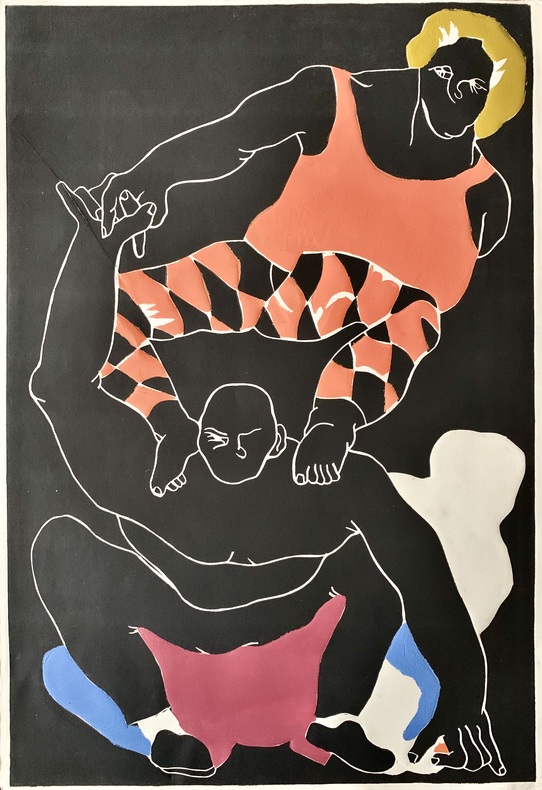
CARRÀ (Carmelo).
Acrobatie.
Linogravure signée et datée 1971, tirage à 3 ex. (52,5/75 cm). Bon état.
Référence libraire : awd-649
|
|
|
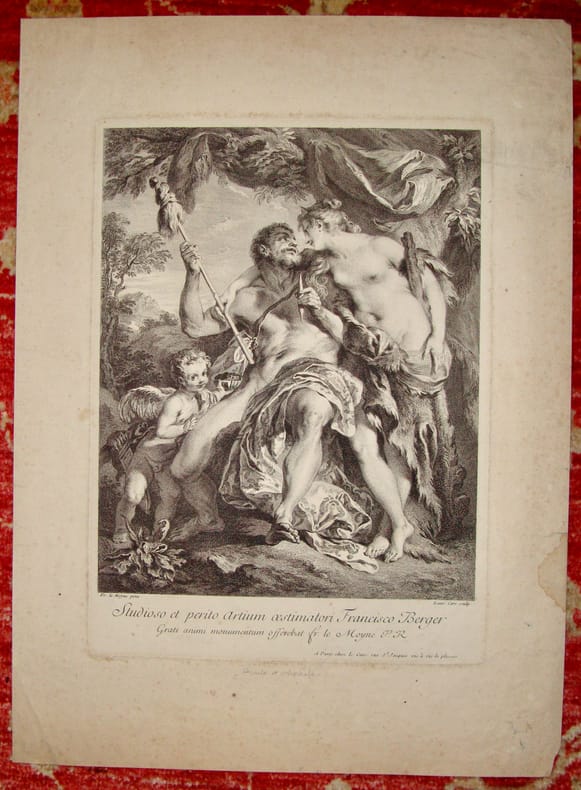
CARS Laurent
Hercule et Omphale
Très belle épreuve d'après Le Moyne en feuille Bon Paris Cars XVIIIè 54 x 39,5 cm
Référence libraire : 14609
|
|
|
CARUSO, Bruno (Palermo, 1927 - Roma, 2018)
Padrone e cane
Acquaforte appartenente al volume ''Viaggio a Gerusalemme'' di Bruno Caruso, Ancona, Bucciarelli, 1974 Firma e numerazione a matita (firma e titolo su lastra). Esemplare p.d.a.. Cm 23,5x17,8 (Foglio 35x25,5). . . Ottimo (Fine). . . .

|
|
|
CARUSO, Bruno (Palermo, 1927 - Roma, 2018)
Ricordo della casa di tolleranza
Acquaforte dalla cartella ''Tolleranza'' composta da 4 acqueforti originali e un testo di Tommaso Chiaretti (pubblicata su ''Bruno Caruso. Acqueforti 1948-1993'', catalogo della mostra al Centro Pasolini di Agrigento, ed. Collezionisti d'Arte, Palermo 1993) Firma e numerazione a matita. Titolo e firma su lastra. Stampata dalla Stamperia F di Roma. Esemplare p.d.a.. cm 29,5x24 (Foglio 50x35). . . Ottimo (Fine). . Tiratura 80 + 4 p.d.a.. .

|
|
|
CARUSO, Bruno (Palermo, 1927 - Roma, 2018)
Senza titolo
Acquaforte facente parte del volume di Remer ''L'uomo, questo..'' stampato a Roma nel 1980 a spese dell'Autore Firma solo su lastra. Cm 24,3x14,9 (Foglio 35x25). . . Ottimo (Fine). . . .

|
|
|
Carver, Raymond (Poems), Illustrated by McChesney, Robert (Prints)
WINTER INSOMNIA.
SANTA CRUZ: KAYAK. 1970. Fine with no dust jacket. 1970. First Edition; First Printing. Softcover. Fine in printed wrappers. Trace of rubbing on printed price at rear cover. One of a 1000 copies. . SANTA CRUZ: KAYAK. 1970 paperback
Référence libraire : 16615
|
|
|
Cary, Alice and Phoebe (Editors).
THE JOSEPHINE GALLERY.
287p. Plus lithographed frontis and full page plates. All edges gold. 4to. Original embossed cloth binding. Spine taped. Plates heavily foxed. Some signatures loose. WOMEN 2
|
|
|
Carzou. Texte de Robert Rey.
Carzou. L'apocalypse.
Paris, Imprimerie Nationale. André Sauret, éditeur., 1959, in-4, broché sous couverture rempliée, 163 pages. Bon état. 6 lithographies originales (dont la couverture) tirées sur les presse de Mourlot Frères. Exemplaire provenant de la bibliothèque d'un graphiste, qui a soigneusement contre-collé des documents et reproductions de l'artiste, augmentant la valeur documentaire de l'ouvrage.
Référence libraire : 70571

|
|
|
Casati, A., dessinateur
Parodie du tableau de la Clytemnestre - Lithographie originale coloriée sur Velin blanc.
Planche HT parue dans La Caricature politique, morale, littéraire et scénique, volume 7, 23 janvier 1834 (Planche n°353) • Hauteur: 27cmx Largeur: 35.5cm - Image: Hauteur: 18.7cmx Largeur: 20.8cm - Titre en bas au centre : « Parodie du tableau de la Clytemnestre. » ; indications : en ht à gche : « La Caricature (Journal) N°168. », en ht à dte : « Pl. 353. »Inscription - Dans la lettre : « Chez Aubert, galerie véro dodat. » [éditeur], « L. de Becquet, rue Furstemberg 6. » [imprimeur] ; dans l’image, en bas à gche, signature : « a. c. » [A. Casati, dessinateur lithographe]
Référence libraire : 26365

|
|
|
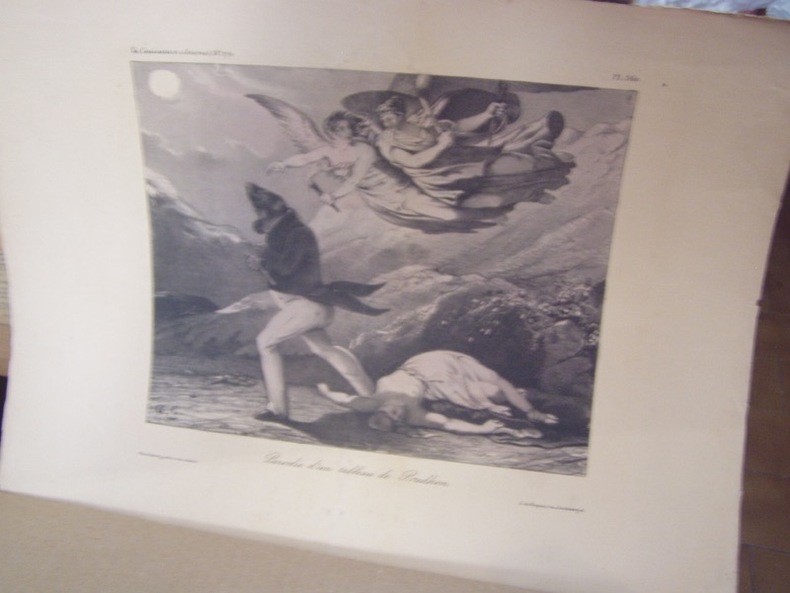
Casati, A., dessinateur lithographe
Parodie d’un tableau de Prudhon - Lithographie originale en noir sur Velin blanc.
Lithographie - Planche HT parue dans La Caricature politique, morale, littéraire et scénique, volume 7, 13 février 1834 (Planche n°360) - Œuvre : Hauteur: 27cm x Largeur: 35.5cm - Image: Hauteur: 18.3cm x Largeur: 21.7cm- Titre en bas au centre : « Parodie d’un tableau de Prudhon. » ; indications : en ht à gauche : « La Caricature (Journal) N°170. », en ht à dte : « Pl. 360. »Inscription - Dans la lettre : « Chez Aubert, galerie véro dodat. » [éditeur], « L. de Becquet, rue Furstemberg 6. » [imprimeur] ; dans l’image, en bas à gche, signature : « a. c. » [A. Casati, dessinateur lithographe]
Référence libraire : 25258
|
|
|
CASCELLA, Pietro (Pescara, 1921 - Pietrasanta, 2008),
Senza titolo
Stampa da bassorilievo Firma a matita. Carta Ventura. Esemplare p.d.a.. cm 36,5 x 46 (Foglio 42 x 50). . . Ottimo (Fine). . Tiratura 125 + XXV. .

|
|
|
CASELLA Georges
(Nouveaux ajustements pour les sports d'hiver in La Gazette du bon ton)
- Lucien Vogel éditeur, Paris s.d. [circa 1920], 18x24,5cm, deux doubles feuillets. - Extrait original tiré de La Gazette du bon ton, illustré de treize dessins en couleurs signés M.T. Célèbre revue de mode fondée en 1912 par Lucien Vogel, La Gazette du bon ton a paru jusqu'en 1925 avec une interruption durant la Guerre de 1915 à 1920, pour cause de mobilisation de son rédacteur en chef. Elle se constitue de 69 livraisons tirées à seulement 2000 exemplaires et est illustrée notamment de 573 planches en couleurs et de 148 croquis représentant des modèles de grands couturiers. Dès leur parution, ces luxueuses publications « s'adressent aux bibliophiles et aux mondains esthètes » (Françoise Tétart-Vittu « La Gazette du bon ton » in Dictionnaire de la mode, 2016). Imprimées sur beau papier vergé, elles utilisent une police typographique spécialement créée pour la revue par Georges Peignot, le caractère Cochin, repris en 1946 par Christian Dior. Les estampes sont réalisées grâce à la technique du pochoir métallique, rehaussées en couleurs et pour certaines soulignées à l'or ou au palladium. L'aventure commence en 1912 lorsque Lucien Vogel, homme du monde et de la mode - il a déjà participé à la revue Femina - décide de fonder avec sa femme Cosette de Brunhoff (sur de Jean, le père de Babar) La Gazette du bon ton dont le sous-titre est alors « Art, modes et frivolités ». Georges Charensol rapporte les propos du rédacteur en chef : « En 1910, observe-t-il, il n'existait aucun journal de mode véritablement artistique et représentatif de l'esprit de son époque. Je songeais donc à faire un magazine de luxe avec des artistes véritablement modernes [...] J'étais certain du succès car pour la mode aucun pays ne peut rivaliser avec la France. » (« Un grand éditeur d'art. Lucien Vogel » in Les Nouvelles littéraires, n°133, mai 1925). Le succès de la revue est immédiat, non seulement en France, mais aussi aux Etats-Unis et en Amérique du Sud. À l'origine, Vogel réunit donc un groupe de sept artistes : André-Édouard Marty et Pierre Brissaud, suivis de Georges Lepape et Dammicourt ; et enfin ses amis de l'École des beaux-arts que sont George Barbier, Bernard Boutet de Monvel, ou Charles Martin. D'autres talents viennent rapidement rejoindre l'équipée : Guy Arnoux, Léon Bakst, Benito, Boutet de Monvel, Umberto Brunelleschi, Chas Laborde, Jean-Gabriel Domergue, Raoul Dufy, Édouard Halouze, Alexandre Iacovleff, Jean Émile Laboureur, Charles Loupot, Charles Martin, Maggie Salcedo. Ces artistes, inconnus pour la plupart lorsque Lucien Vogel fait appel à eux, deviendront par la suite des figures artistiques emblématiques et recherchées. Ce sont ces mêmes illustrateurs qui réalisent les dessins des publicités de la Gazette. Les planches mettent en lumière et subliment les robes de sept créateurs de l'époque : Lanvin, Doeuillet, Paquin, Poiret, Worth, Vionnet et Doucet. Les couturiers fournissent pour chaque numéro des modèles exclusifs. Néanmoins, certaines des illustrations ne figurent aucun modèle réel, mais seulement l'idée que l'illustrateur se fait de la mode du jour. La Gazette du bon ton est une étape décisive dans l'histoire de la mode. Alliant l'exigence esthétique et l'unité plastique, elle réunit pour la première fois les grands talents du monde des arts, des lettres et de la mode et impose, par cette alchimie, une toute nouvelle image de la femme, élancée, indépendante et audacieuse, également portée par la nouvelle génération de couturiers Coco Chanel, Jean Patou, Marcel Rochas... Reprise en 1920 par Condé Montrose Nast, La Gazette du bon ton inspirera largement la nouvelle composition et les choix esthétiques du « petit journal mourant » que Nast avait racheté quelques années auparavant : le magazine Vogue. Très bel exemplaire. [ENGLISH DESCRIPTION ON DEMAND]

|
|
|
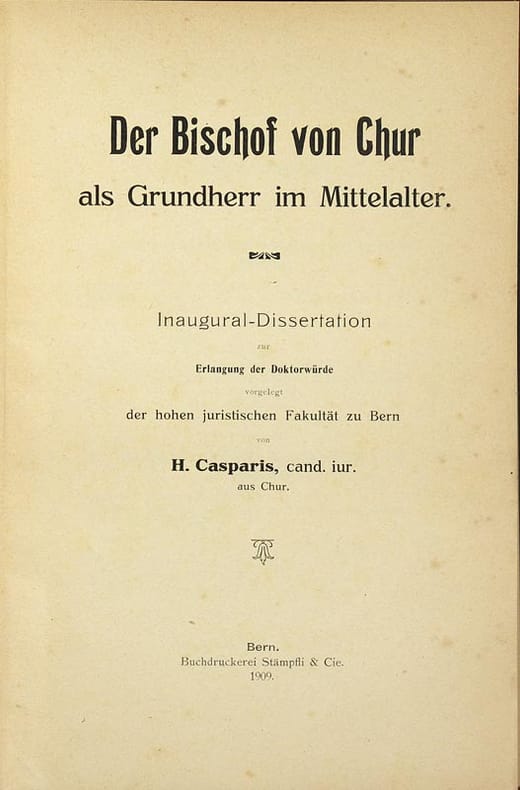
Casparis, Hans
Der Bischof von Chur als Grundherr im Mittelalter.
Bern, Stämpfli & Cie, 1909. 8°. VIII, 172 S. Späterer Halblederband. + Wichtig: Für unsere Kunden in der EU erfolgt der Versand alle 14 Tage verzollt ab Deutschland / Postbank-Konto in Deutschland vorhanden +, 3157D
Référence libraire : 3157DB

|
|
|
Casparis, Hans:
Der Bischof von Chur als Grundherr im Mittelalter.
Bern, Stämpfli & Cie, 1909. 8°. VIII, 172 S. Späterer Halblederband.
Référence libraire : 3157DB
|
|
|
Cassatt, Mary; Adelyn D. Breeskin (intro); Donald H. Karshan (foreword)
The Graphic Art of Mary Cassatt
A clean, unmarked book with a tight binding. Previous owner's "War is not healthy for children and other living things," sticker inside. Full tan cloth boards. 8 3/8"w x 10 1/4"h. 112 pages. Biographical chronology. List of Cassatt exhibitions featuring prints. 85 plates.

|
|
|
CASSINARI, Bruno (Piacenza, 1912 - Milano, 1992),
I pastori
Litografia originale. Opera facente parte del portfolio di 12 litografie "I pastori", edito da Siro Teodorani nel 1973 Firma e numerazione a matita dell'Artista. Timbri a secco dello stampatore. Stampa su carta Japon. Esemplare T/Z. Foglio cm 77 x 57. . . Ottimo (Fine). . . .

|
|
|
CASSINARI, Bruno (Piacenza, 1912 - Milano, 1992),
I pastori
Litografia originale. Opera facente parte del portfolio di 12 litografie "I pastori", edito da Siro Teodorani nel 1973 Firma e numerazione a matita dell'Artista. Timbri a secco dello stampatore Siro Teodorani. Stampa su carta Japon. Esemplare W/Z . Foglio cm 57x77. . . Ottimo (Fine). . . .

|
|
|
CASSINARI, Bruno (Piacenza, 1912 - Milano, 1992),
I pastori
Litografia originale. Opera facente parte del portfolio di 12 litografie "I pastori", edito da Siro Teodorani nel 1973 Firma e numerazione a matita dell'Artista. Timbri a secco dello stampatore Siro Teodorani. Stampa su carta Japon. Esemplare W/Z. . Foglio cm 57 x 77. . . Ottimo (Fine). . . .

|
|
|
CASSINARI, Bruno (Piacenza, 1912 - Milano, 1992),
I pastori
Litografia originale. Opera facente parte del portfolio di 12 litografie "I pastori", edito da Siro Teodorani nel 1973 Firma e numerazione a matita dell'Artista. Timbri a secco dello stampatore Siro Teodorani. Stampa su carta Japon. Esemplare W/Z. Foglio cm 57 x 77. . . Ottimo (Fine). . . .

|
|
|
CASSINARI, Bruno (Piacenza, 1912 - Milano, 1992),
I pastori
Litografia originale. Opera facente parte del portfolio di 12 litografie "I pastori", edito da Siro Teodorani nel 1973 Firma e numerazione a matita dell'Artista. Timbri a secco dello stampatore Siro Teodorani. Stampa su carta Japon. Esemplare W/Z. Foglio cm 57 x 77. . . Ottimo (Fine). . . .

|
|
|
CASSINARI, Bruno (Piacenza, 1912 - Milano, 1992),
I pastori
Litografia originale. Opera facente parte del portfolio di 12 litografie "I pastori", edito da Siro Teodorani nel 1973 Firma e numerazione a matita dell'Artista. Timbri a secco dello stampatore Siro Teodorani. Stampa su carta Japon. Esemplare W/Z. Foglio cm 57 x 77. . . Ottimo (Fine). . . .

|
|
|
CASSINARI, Bruno (Piacenza, 1912 - Milano, 1992),
I pastori
Litografia originale. Opera facente parte del portfolio di 12 litografie "I pastori", edito da Siro Teodorani nel 1973 Firma e numerazione a matita dell'Artista. Timbri a secco dello stampatore Siro Teodorani. Stampa su carta Japon. Esemplare W/Z. Foglio cm 57 x 77. . . Ottimo (Fine). . . .

|
|
|
CASSINARI, Bruno (Piacenza, 1912 - Milano, 1992),
I pastori
Litografia originale. Opera facente parte del portfolio di 12 litografie "I pastori", edito da Siro Teodorani nel 1973 Firma e numerazione a matita dell'Artista. Timbri a secco dello stampatore Siro Teodorani. Stampa su carta Japon. Esemplare W/Z. Foglio cm 57 x 77. . . Ottimo (Fine). . . .

|
|
|
CASSINARI, Bruno (Piacenza, 1912 - Milano, 1992),
I pastori
Litografia originale. Opera facente parte del portfolio di 12 litografie "I pastori", edito da Siro Teodorani nel 1973 Firma e numerazione a matita dell'Artista. Timbri a secco dello stampatore Siro Teodorani. Stampa su carta Japon. Esemplare W/Z.. Foglio cm 57 x 77. . . Ottimo (Fine). . . .

|
|
|
CASSINARI, Bruno (Piacenza, 1912 - Milano, 1992),
I pastori
Litografia originale. Opera facente parte del portfolio di 12 litografie "I pastori", edito da Siro Teodorani nel 1973 Firma e numerazione a matita dell'Artista. Timbri a secco dello stampatore Siro Teodorani. Stampa su carta Japon. Esemplare W/Z. Foglio cm 57 x 77. . . Ottimo (Fine). . . .

|
|
|
CASSINARI, Bruno (Piacenza, 1912 - Milano, 1992),
I pastori
Litografia originale. Opera facente parte del portfolio di 12 litografie "I pastori", edito da Siro Teodorani nel 1973 Firma e numerazione a matita dell'Artista. Timbri a secco dello stampatore Siro Teodorani. Stampa su carta Japon. Esemplare W/Z. Foglio cm 57 x 77. . . Ottimo (Fine). . . .

|
|
|
CASSINARI, Bruno (Piacenza, 1912 - Milano, 1992),
I pastori
Litografia originale. Opera facente parte del portfolio di 12 litografie "I pastori", edito da Siro Teodorani nel 1973 Firma e numerazione a matita dell'Artista. Timbri a secco dello stampatore Siro Teodorani. Stampa su carta Japon. Esemplare W/Z.. Foglio cm 57 x 77. . . Ottimo (Fine). . . .

|
|
|

 Recevoir par e-mail
 Télécharger en PDF
 Flux RSS
 Lien permanent


