|
|
|
GOETZ ,Henri (New York 1909 - Nizza 1989),
Senza titolo
Carborundum Firma e numerazione a matita. Timbro a secco dello stampatore Giorgio Upiglio. Carta delle Cartiere Filicarta. Esemplare 4/25. cm 23x30 (Foglio 36x49,5). . . Ottimo (Fine). . Tiratura 25. .

|
|
|
GOETZ ,Henri (New York 1909 - Nizza 1989),
Senza titolo
Carborundum Firma e numerazione a matita. Timbro a secco dello stampatore Giorgio Upiglio. Carta delle Cartiere Filicarta. Esemplare 16/25. cm 18x13 (Foglio 50x36). . . Ottimo (Fine). . Tiratura 25. .

|
|
|
GOETZ ,Henri (New York 1909 - Nizza 1989),
Senza titolo
Carborundum e acquaforte Firma e numerazione a matita. Timbro a secco dello stampatore Giorgio Upiglio. Carta delle Cartiere Filicarta. Esemplare 16/25. cm 23x29,5 (Foglio 36x50). . . Ottimo (Fine). . Tiratura 25. .

|
|
|
GOETZ ,Henri (New York 1909 - Nizza 1989),
Senza titolo
Carborundum Firma e numerazione a matita. Timbro a secco dello stampatore Giorgio Upiglio. Carta delle Cartiere Filicarta. Esemplare 16/25. cm 32x23 (Foglio 51,5x36). . . Ottimo (Fine). . Tiratura 25. .

|
|
|
GOETZ ,Henri (New York 1909 - Nizza 1989),
Senza titolo
Carborundum e acquaforte Firma e numerazione a matita. Timbro a secco dello stampatore Giorgio Upiglio. Carta Goya. Esemplare 13/25. cm 18x27,5 (Foglio 35,5x51,5). . . Ottimo (Fine). . Tiratura 25. .

|
|
|
GOETZ ,Henri (New York 1909 - Nizza 1989),
Senza titolo
Carborundum Firma e numerazione a matita. Timbro a secco dello stampatore Giorgio Upiglio. Carta delle Cartiere Filicarta. Esemplare 12/25. cm 23x30 (Foglio 36x51,5). . . Ottimo (Fine). . Tiratura 25. .

|
|
|
GOETZ ,Henri (New York 1909 - Nizza 1989),
Senza titolo
Carborundum e acquaforte Firma e numerazione a matita. Timbro a secco dello stampatore Giorgio Upiglio. Carta Goya. Esemplare 7/25. cm 24,5x32,5 (Foglio 36x51,5). . . Ottimo (Fine). . Tiratura 25. .

|
|
|
GOETZ ,Henri (New York 1909 - Nizza 1989),
Senza titolo
Carborundum e acquaforte Firma e numerazione a matita. Timbro a secco dello stampatore Giorgio Upiglio. Carta Goya. Esemplare 5/25. cm 27,5x17,5 (Foglio 51,5x36). . . Ottimo (Fine). . Tiratura 25. .

|
|
|
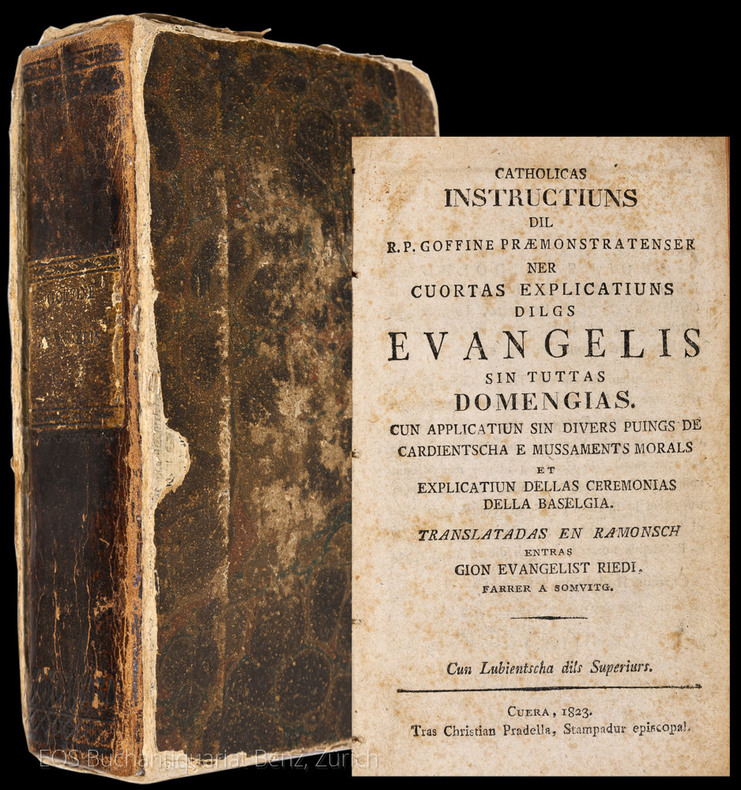
Goffiné, Leonhard
Catholicas instructiuns dil R. P. (Leonhard) Goffine Praemonstratenser ner cuortas explicatiuns dilgs evangelis sin tuttas domengias ... translatadas in ramonsch entras Gion Evangelist Riedi.
Cuera, Pradella, 1823. 8". XII, 418, 263, (5) S. Halblederband der Zeit in Pappschuber. + Wichtig: Für unsere Kunden in der EU erfolgt der Versand alle 14 Tage verzollt ab Deutschland / Postbank-Konto in Deutschland vorhanden +, A 2 Teile in 1 Band.
Referenz des Buchhändlers : 7180CB

|
|
|
Goffiné, Leonhard:
Catholicas instructiuns dil R. P. (Leonhard) Goffine Praemonstratenser ner cuortas explicatiuns dilgs evangelis sin tuttas domengias ... translatadas in ramonsch entras Gion Evangelist Riedi.
2 Teile in 1 Band. Cuera, Pradella, 1823. 8". XII, 418, 263, (5) S. Halblederband der Zeit in Pappschuber.
Referenz des Buchhändlers : 7180CB
|
|
|
GOIA, Giuseppe (Monfalcone 1947),
Senza titolo
Acquaforte Carta Pescia. Firma a matita. Esemplare 4/90. Cm 35x24. . . . . Tiratura 90 + X. .

|
|
|
Goldman Paul; British Museum. Dept. of Prints and Drawings
Shadow of the forest: Prints of the Barbizon School
London England: British Museum 1993. Softcover. VG slight bends at top of spine and lower corner. White wraps BW pictorial. 61 pp. Profuse BW illustrations. Catalogue of a touring loan exhibition at Glynn Vivian Art Gallery and Museum Swansea 13 March-24 April 1993; Ashmolean Museum Oxford 25 May-18 July 1993; National Gallery of Scotland Edinburgh 7 October-19 December 1993; and Whitworth Art Gallery Manchester 14 January-5 March 1994. Includes works by Jules Dupre Henri Harpignies Jules Michelin Adolphe Appian Charles Jacque Paul Huet Daubigny Rousseau Millet Corot many others. British Museum paperback books
Referenz des Buchhändlers : 130195 ISBN : 0861599985 9780861599981

|
|
|
Goldsmith, Oliver
The Deserted Village
A clean, unmarked book with a tight binding. Green cloth spine and gilt title and holly decoration on front cover. Edge wear and peeling paper on edges of cover.6 1/2"w x7 7/8"h. 46 pages. Black and white illustrations by Hammatt Billings. No date; circa 1890's.

|
|
|
Golf. –
Serendipity. For the Friends of Sunflower Ltd.
Zürich, Conzett Verlag, 1998. 4° (quadratisch). (40) Blatt mit zahlreichen Abb. nach Fotografien von Brian Morgan und Barbara Stucki. Aufklappbarer Orig.-Lederband.
Referenz des Buchhändlers : 30686AB

|
|
|
Gollomb, Joseph
Albert Schweitzer: Genius in der Wildnis.
Olten-Stuttgart-Salzburg, Fackelvlg, o.J. 8°. 286 S. Geb. + Wichtig: Für unsere Kunden in der EU erfolgt der Versand alle 14 Tage verzollt ab Deutschland / Postbank-Konto in Deutschland vorhanden +
Referenz des Buchhändlers : 2918AB
|
|
|
Gollomb, Joseph:
Albert Schweitzer: Genius in der Wildnis.
Olten-Stuttgart-Salzburg, Fackelvlg, o.J. 8°. 286 S. Geb.
Referenz des Buchhändlers : 2918AB
|
|
|
GOLTZIUS Hendrik
La Gourmandise
De la série des 7 péchés capitaux. Bartsch T. III n° 272 Gravé par, ou sous la direction de Jacques Matham. Rogné aux filets d’encadrement, légende en pied. Belle épreuve avec inscription au dos : Claude Augustin Mariette XVIIè 22 x 14,5
Referenz des Buchhändlers : 5362

|
|
|
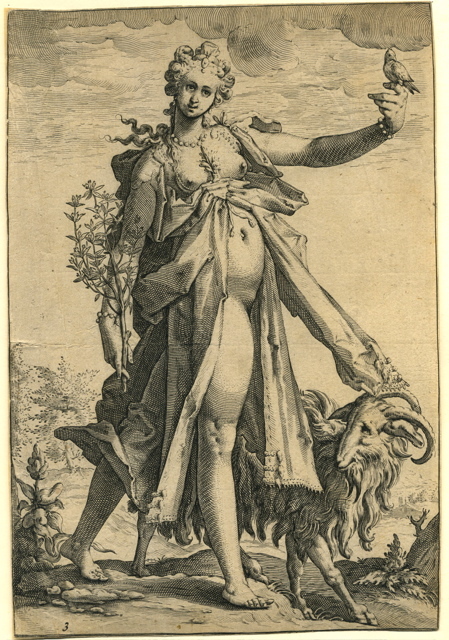
GOLTZIUS Hendrik
La Luxure ( L’ Impureté )
De la série des 7 péchés capitaux. Bartsch T. III n° 273 Gravé par, ou sous la direction de Jacques Matham. Marges insignifiantes, sans la légende dans la marge inférieure. Belle épreuve. XVIIè 22 x 14,5
Referenz des Buchhändlers : 5364
|
|
|
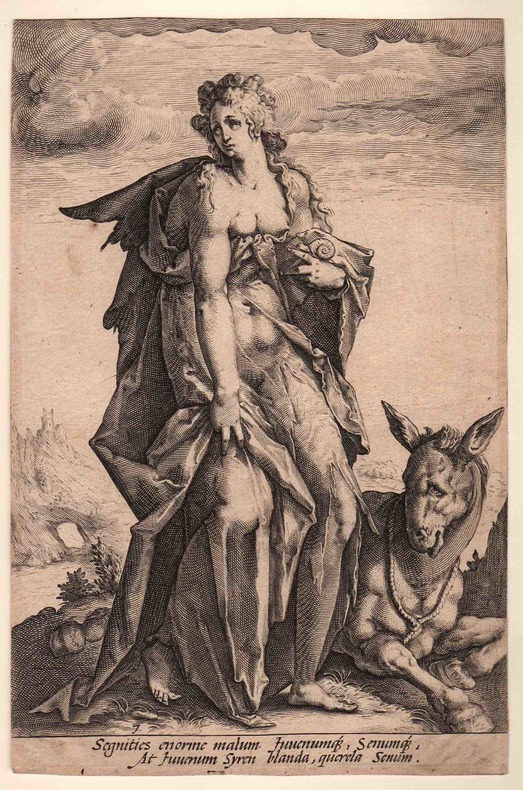
GOLTZIUS Hendrik
La Paresse
De la série des 7 péchés capitaux. Bartsch T. III n° 277 Gravé par, ou sous la direction de Jacques Matham.Rogné aux filets d’encadrement, légende en pied. Belle épreuve avec inscription au dos : Claude Augustin Mariette XVIIè 22 x 14,5
Referenz des Buchhändlers : 5360
|
|
|
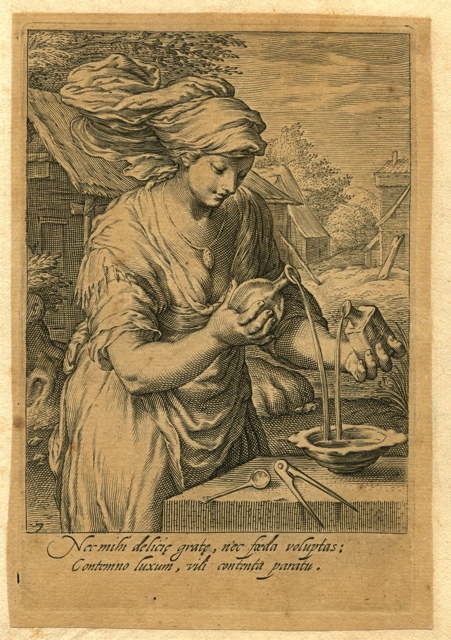
GOLTZIUS Hendrik
La Tempérance
Bartsch T. III n° 123. Suite de sept estampes : les Vertus. Gravé par Jacques Matham. Belle épreuve contrecollée anciennement. XVIIè 15,2 x 10,4
Referenz des Buchhändlers : 5369
|
|
|
Gomier, Louis.
Sine Macula. Wohl Rom, um 1730.
Gestochene Kupferplatte (117:174 mm). Hübsches Bildnis der Madonna in Andacht, mit über die Brust gelegten Händen, nach einem Gemälde von Carlo Maratti (1625-1713). Signiert vom Pariser Kupferstecher Louis Gomier, der 1713-30 in Rom tätig war und auch nach Pietro da Cortona, Ciro Ferri und An. Carracci stach. "Zu seinen Hauptblättern gehören eine Ansicht der Bernini-Fontände und des Obelisken auf der Piazza Navona [...] Auch war er Mitarbeiter an Mich. Mercati's Metallotheca [...] und stach einige Porträts nach eigener Zeichnung, darunter die der Königin Marie Eleonore Jos. von Polen und des Fürsten Lubomirski" (Thieme/B. 14, 364). Die Platte trägt noch den Verlegervermerk "typis Salmoni" (wohl ein Hinweis auf den römischen Drucker Giovanni Generoso Salmoni?).
|
|
|
GONCOURT Edmond de.
Outamaro - Le peintre des maisons vertes. Troisème mille.
1904 Paris, Bibliothèque Charpentier, Fasquelle éditeur, 1904; in-18° demi-basane bleu-nuit à coins, dos à nerfs muet, gardes et contreplats bleu vif, 1er plat de la couverture conservé; (2)ff., III, 265, (1)pp.
Referenz des Buchhändlers : 10007
|
|
|
Gonzalez Gerth Miguel with preface by Richmond Lattimore & wood engravings by John Roy
The Infinite Absence: poems
Iowa City: Printed for the author at The Stone Wall Press 1964. Hardcover. 20p. 8x5 inches landscape layout preface woodcuts tissue guards rubricated title page #169/250 limited first edition thus in sewn blue boards and gilt. Printed for the author at The Stone Wall Press hardcover books
Referenz des Buchhändlers : 240569

|
|
|
Gonzalez-Gerth, Miguel with preface by Richmond Lattimore & wood engravings by John Roy
The Infinite Absence: poems
Iowa City: Printed for the author at The Stone Wall Press 1964. Hardcover. 20p. 8x5 inches landscape layout preface woodcuts tissue guards rubricated title page #169/250 limited first edition thus in sewn blue boards and gilt. Printed for the author at The Stone Wall Press hardcover
Referenz des Buchhändlers : 240569
|
|
|
Goppelsröder, Friedrich
Ueber die chemische Beschaffenheit von Basel's Grund-, Bach-, Fluss- & Quell-Wasser. Mit besonderer Berücksichtigung der sanitarischen Frage.
Basel, Schweighauserische Verlagsbuchhandlung, 1867. 8°. 97 S. Mit 9 Falttabellen. Pappband der Zeit (Rücken mit kleinen Rissen u. Materialverlust, berieben u. bestossen). + Wichtig: Für unsere Kunden in der EU erfolgt der Versand alle 14 Tage verzollt ab Deutschland / Postbank-Konto in Deutschland vorhanden +
Referenz des Buchhändlers : 22500AB
|
|
|
Goppelsröder, Friedrich:
Ueber die chemische Beschaffenheit von Basel's Grund-, Bach-, Fluss- & Quell-Wasser. Mit besonderer Berücksichtigung der sanitarischen Frage.
Basel, Schweighauserische Verlagsbuchhandlung, 1867. 8°. 97 S. Mit 9 Falttabellen. Pappband der Zeit (Rücken mit kleinen Rissen u. Materialverlust, berieben u. bestossen).
Referenz des Buchhändlers : 22500AB
|
|
|
Gordon, Ayala [Curator]
Homage to the Jerusalem Print Workshop [IN HEBREW AND ENGLISH]
IN HEBREW AND ENGLISH. 21.5X21.5 cm. Unnumbered pages. Softcover. In good condition.
|
|
|
Gore , Mrs; Thomas Allom (engravings)
PARIS IN 1841 BY MRS. GORE
London 1842 first edition Longman Brown Gree. Hardcover. Large octavo 268p. illustrated with 21 engravings by Allom original lime green cloth with full floral gilt trim and original yellow end papers. All edges gilt. Good Plus light foxing on initial pages and on some of the plates spine faded to tan. Uneven discoloration on cover cloth. Binding secure; no ownership marks. . hardcover
Referenz des Buchhändlers : a88179
|
|
|
Gorelik, Sch. / Budko, Joseph [Artist] / Goldenring, Stefania; Strasser, Nadia [Tr.]
Jüdische Köpfe [WITH FOUR ORIGINAL LITHOGRAPHS]. Lithographien von Joseph Budko.
RARE book illustrated by Joseph Budko (1888-1940) - one of the greatest Jewish graphic artists, who started the revival of woodcut and one of the first great modern book illustrators. Includes FOUR ORIGINAL LITHOHRAPHS depicting Theodor Herzl, Marko Baruch, J.L.Perez, and Baruch Spinoza. 295x245mm. 114 pages. Illustrated board Hardcover with gilt cloth spine. Cover yellowing, age-stained, slightly stained and curved. Cover corners and edges bumped and peeling. Spine partly detached from binding (hinges partly cracked). Spine upper edge tattered, bottom edge missing. Ink writing on front whitepage upper edge. Inner cover and pages age-stained to various degrees. Some pages upper edge water-stained - no damage to text or plates. Pages yellowing, wavy and rough-cut (as published). [SUMMARY]: This extremely rare book with four original lithographs by one of the greatest modern Jewish artists is otherwise in good condition.
|
|
|
Gorr, Shmuel / Gelman, Manuel / Pins, Jacob [Illustr.]
Out of The Depths: Selected Poems and Essays [SIGNED AND DEDICATED BY AUTHOR'S SISTER] Limited Edition. Introduction by Manuel Gelman. Illustrated by Jacob Pins.
220x140mm. 20 pages. Gilt softcover. Inner cover illustrated. Cover corners/edges and spine edges slightly worn. Else in good condition.
|
|
|
GOSE Francisco Javier
Il a été primé. Robe du soir (pl.21, La Gazette du Bon ton, 1914 n°3)
- Lucien Vogel éditeur, Paris Mars 1914, 19x24,5cm, une feuille. - Original color print, printed on vergé paper, signed in the plate. An original print used to illustrate the Gazette du bon ton, one of the most attractive and influential 20th century fashion magazines, featuring the talents of French artists and other contributors from the burgeoning Art Deco movement. A celebrated fashion magazine established in 1912 by Lucien Vogel, La Gazette du bon ton appeared until 1925, with a hiatus from 1915 to 1920 due to the war (the editor-in-chief having been called up for service). It consisted of 69 issues printed in only 2,000 copies each and notably illustrated with 573 color plates and 148 sketches of the models of the great designers. Right from the start, this sumptuous publication "was aimed at bibliophiles and fashionable society," (Françoise Tétart-Vittu, "La Gazette du bon ton", in Dictionnaire de la mode, 2016) and was printed on fine vergé paper using a type cut specially for the magazine by Georges Peignot, known as Cochin, later used (in 1946) by Christian Dior. The prints were made using stencils, heightened in colors, some highlighted in gold or palladium. The story began in 1912, when Lucien Vogel, a man of the world involved in fashion (he had already been part of the fashion magazine Femina) decided, with his wife Cosette de Brunhoff - the sister of Jean, creator of Babar - to set up the Gazette du bon ton, subtitled at the time: "Art, fashion, frivolities." Georges Charensol noted the reasoning of the editor-in-chief: "'In 1910,' he observed, 'there was no really artistic fashion magazine, nothing representative of the spirit of the time. My dream was therefore to make a luxury magazine with truly modern artists...I was assured of success, because when it comes to fashion, no country on earth can compete with France.'" ("Un grand éditeur d'art. Lucien Vogel" in Les Nouvelles littéraires, no. 133, May 1925). The magazine was immediately successful, not only in France but also in the United States and Latin America. At first, Vogel put together a team of seven artists: André-Édouard Marty and Pierre Brissaud, followed by Georges Lepape and Dammicourt, as well as eventually his friends from school and the School of Fine Arts, like George Barbier, Bernard Boutet de Monvel and Charles Martin. Other talented people soon came flocking to join the team: Guy Arnoux, Léon Bakst, Benito, Boutet de Monvel, Umberto Brunelleschi, Chas Laborde, Jean-Gabriel Domergue, Raoul Dufy, Édouard Halouze, Alexandre Iacovleff, Jean Émile Laboureur, Charles Loupot, Chalres Martin, Maggie Salcedo. These artist, mostly unknown when Lucien Vogel sought them out, later became emblematic and sought-after artistic figures. It was also they who worked on the advertising drawings for the Gazette. The plates put the spotlight on, and celebrate, dresses by seven designers of the age: Lanvin, Doeuillet, Paquin, Poiret, Worth, Vionnet and Doucet. The designers provided exclusive models for each issue. Nonetheless, some of the illustrations are not based on real models, but simply on the illustrator's conception of the fashion of the day. The Gazette du bon ton was an important step in the history of fashion. Combining aesthetic demands with the physical whole, it brought together - for the first time - the great talents of the artistic, literary, and fashion worlds; and imposed, through this alchemy, a completely new image of women: slender, independent and daring, which was shared by the new generation of designers, including Coco Chanel, Jean Patou, Marcel Rochas, and so on... Taken over in 1920 by Condé Montrose Nast, the Gazette du bon ton was an important influence on the new layout and aesthetics of that "little dying paper" that Nast had bought a few years earlier: Vogue. [FRENCH VERSION FOLLOWS] Estampe originale en couleur, tirée sur papier vergé, signée en bas à droite de la planche. Gravure originale réalisée pour l'il

|
|
|
GOSE Francisco Javier
Les Premières Roses. Costume Tailleur pour le matin (pl.2, La Gazette du Bon ton, 1912-1913 n°5)
- Lucien Vogel éditeur, Paris Mars 1913, 19x24,5cm, une feuille. - Original color print, printed on vergé paper, signed in the plate. An original print used to illustrate the Gazette du bon ton, one of the most attractive and influential 20th century fashion magazines, featuring the talents of French artists and other contributors from the burgeoning Art Deco movement. A celebrated fashion magazine established in 1912 by Lucien Vogel, La Gazette du bon ton appeared until 1925, with a hiatus from 1915 to 1920 due to the war (the editor-in-chief having been called up for service). It consisted of 69 issues printed in only 2,000 copies each and notably illustrated with 573 color plates and 148 sketches of the models of the great designers. Right from the start, this sumptuous publication "was aimed at bibliophiles and fashionable society," (Françoise Tétart-Vittu, "La Gazette du bon ton", in Dictionnaire de la mode, 2016) and was printed on fine vergé paper using a type cut specially for the magazine by Georges Peignot, known as Cochin, later used (in 1946) by Christian Dior. The prints were made using stencils, heightened in colors, some highlighted in gold or palladium. The story began in 1912, when Lucien Vogel, a man of the world involved in fashion (he had already been part of the fashion magazine Femina) decided, with his wife Cosette de Brunhoff - the sister of Jean, creator of Babar - to set up the Gazette du bon ton, subtitled at the time: "Art, fashion, frivolities." Georges Charensol noted the reasoning of the editor-in-chief: "'In 1910,' he observed, 'there was no really artistic fashion magazine, nothing representative of the spirit of the time. My dream was therefore to make a luxury magazine with truly modern artists...I was assured of success, because when it comes to fashion, no country on earth can compete with France.'" ("Un grand éditeur d'art. Lucien Vogel" in Les Nouvelles littéraires, no. 133, May 1925). The magazine was immediately successful, not only in France but also in the United States and Latin America. At first, Vogel put together a team of seven artists: André-Édouard Marty and Pierre Brissaud, followed by Georges Lepape and Dammicourt, as well as eventually his friends from school and the School of Fine Arts, like George Barbier, Bernard Boutet de Monvel and Charles Martin. Other talented people soon came flocking to join the team: Guy Arnoux, Léon Bakst, Benito, Boutet de Monvel, Umberto Brunelleschi, Chas Laborde, Jean-Gabriel Domergue, Raoul Dufy, Édouard Halouze, Alexandre Iacovleff, Jean Émile Laboureur, Charles Loupot, Chalres Martin, Maggie Salcedo. These artist, mostly unknown when Lucien Vogel sought them out, later became emblematic and sought-after artistic figures. It was also they who worked on the advertising drawings for the Gazette. The plates put the spotlight on, and celebrate, dresses by seven designers of the age: Lanvin, Doeuillet, Paquin, Poiret, Worth, Vionnet and Doucet. The designers provided exclusive models for each issue. Nonetheless, some of the illustrations are not based on real models, but simply on the illustrator's conception of the fashion of the day. The Gazette du bon ton was an important step in the history of fashion. Combining aesthetic demands with the physical whole, it brought together - for the first time - the great talents of the artistic, literary, and fashion worlds; and imposed, through this alchemy, a completely new image of women: slender, independent and daring, which was shared by the new generation of designers, including Coco Chanel, Jean Patou, Marcel Rochas, and so on... Taken over in 1920 by Condé Montrose Nast, the Gazette du bon ton was an important influence on the new layout and aesthetics of that "little dying paper" that Nast had bought a few years earlier: Vogue. [FRENCH VERSION FOLLOWS] Estampe originale en couleur, tirée sur papier vergé et signée en bas à droite dans la planche. Gravure originale réalisée pour

|
|
|
GOSE Francisco Javier
Suis-je belle ce soir ? Robe pour le casino (pl.63, La Gazette du Bon ton, 1914 n°7)
- Lucien Vogel éditeur, Paris Juillet 1914, 18x24cm, une feuille. - Double original color print, printed on vergé paper, signed in the plate. An original print used to illustrate the Gazette du bon ton, one of the most attractive and influential 20th century fashion magazines, featuring the talents of French artists and other contributors from the burgeoning Art Deco movement. A celebrated fashion magazine established in 1912 by Lucien Vogel, La Gazette du bon ton appeared until 1925, with a hiatus from 1915 to 1920 due to the war (the editor-in-chief having been called up for service). It consisted of 69 issues printed in only 2,000 copies each and notably illustrated with 573 color plates and 148 sketches of the models of the great designers. Right from the start, this sumptuous publication "was aimed at bibliophiles and fashionable society," (Françoise Tétart-Vittu, "La Gazette du bon ton", in Dictionnaire de la mode, 2016) and was printed on fine vergé paper using a type cut specially for the magazine by Georges Peignot, known as Cochin, later used (in 1946) by Christian Dior. The prints were made using stencils, heightened in colors, some highlighted in gold or palladium. The story began in 1912, when Lucien Vogel, a man of the world involved in fashion (he had already been part of the fashion magazine Femina) decided, with his wife Cosette de Brunhoff - the sister of Jean, creator of Babar - to set up the Gazette du bon ton, subtitled at the time: "Art, fashion, frivolities." Georges Charensol noted the reasoning of the editor-in-chief: "'In 1910,' he observed, 'there was no really artistic fashion magazine, nothing representative of the spirit of the time. My dream was therefore to make a luxury magazine with truly modern artists...I was assured of success, because when it comes to fashion, no country on earth can compete with France.'" ("Un grand éditeur d'art. Lucien Vogel" in Les Nouvelles littéraires, no. 133, May 1925). The magazine was immediately successful, not only in France but also in the United States and Latin America. At first, Vogel put together a team of seven artists: André-Édouard Marty and Pierre Brissaud, followed by Georges Lepape and Dammicourt, as well as eventually his friends from school and the School of Fine Arts, like George Barbier, Bernard Boutet de Monvel and Charles Martin. Other talented people soon came flocking to join the team: Guy Arnoux, Léon Bakst, Benito, Boutet de Monvel, Umberto Brunelleschi, Chas Laborde, Jean-Gabriel Domergue, Raoul Dufy, Édouard Halouze, Alexandre Iacovleff, Jean Émile Laboureur, Charles Loupot, Chalres Martin, Maggie Salcedo. These artist, mostly unknown when Lucien Vogel sought them out, later became emblematic and sought-after artistic figures. It was also they who worked on the advertising drawings for the Gazette. The plates put the spotlight on, and celebrate, dresses by seven designers of the age: Lanvin, Doeuillet, Paquin, Poiret, Worth, Vionnet and Doucet. The designers provided exclusive models for each issue. Nonetheless, some of the illustrations are not based on real models, but simply on the illustrator's conception of the fashion of the day. The Gazette du bon ton was an important step in the history of fashion. Combining aesthetic demands with the physical whole, it brought together - for the first time - the great talents of the artistic, literary, and fashion worlds; and imposed, through this alchemy, a completely new image of women: slender, independent and daring, which was shared by the new generation of designers, including Coco Chanel, Jean Patou, Marcel Rochas, and so on... Taken over in 1920 by Condé Montrose Nast, the Gazette du bon ton was an important influence on the new layout and aesthetics of that "little dying paper" that Nast had bought a few years earlier: Vogue. [FRENCH VERSION FOLLOWS] Estampe double originale en couleur, tirée sur papier vergé, signée en bas à droite de la planche. Gravure originale réa

|
|
|
GOSE Georges
L'Arbre de mai. Robes simples pour l'été (pl.42, La Gazette du Bon ton, 1914 n°5)
- Lucien Vogel éditeur, Paris Mai 1914, 36,5x24cm, une feuille. - Double original color print heightened with gold, printed on vergé paper, signed in the plate. An original print used to illustrate the Gazette du bon ton, one of the most attractive and influential 20th century fashion magazines, featuring the talents of French artists and other contributors from the burgeoning Art Deco movement. A celebrated fashion magazine established in 1912 by Lucien Vogel, La Gazette du bon ton appeared until 1925, with a hiatus from 1915 to 1920 due to the war (the editor-in-chief having been called up for service). It consisted of 69 issues printed in only 2,000 copies each and notably illustrated with 573 color plates and 148 sketches of the models of the great designers. Right from the start, this sumptuous publication "was aimed at bibliophiles and fashionable society," (Françoise Tétart-Vittu, "La Gazette du bon ton", in Dictionnaire de la mode, 2016) and was printed on fine vergé paper using a type cut specially for the magazine by Georges Peignot, known as Cochin, later used (in 1946) by Christian Dior. The prints were made using stencils, heightened in colors, some highlighted in gold or palladium. The story began in 1912, when Lucien Vogel, a man of the world involved in fashion (he had already been part of the fashion magazine Femina) decided, with his wife Cosette de Brunhoff - the sister of Jean, creator of Babar - to set up the Gazette du bon ton, subtitled at the time: "Art, fashion, frivolities." Georges Charensol noted the reasoning of the editor-in-chief: "'In 1910,' he observed, 'there was no really artistic fashion magazine, nothing representative of the spirit of the time. My dream was therefore to make a luxury magazine with truly modern artists...I was assured of success, because when it comes to fashion, no country on earth can compete with France.'" ("Un grand éditeur d'art. Lucien Vogel" in Les Nouvelles littéraires, no. 133, May 1925). The magazine was immediately successful, not only in France but also in the United States and Latin America. At first, Vogel put together a team of seven artists: André-Édouard Marty and Pierre Brissaud, followed by Georges Lepape and Dammicourt, as well as eventually his friends from school and the School of Fine Arts, like George Barbier, Bernard Boutet de Monvel and Charles Martin. Other talented people soon came flocking to join the team: Guy Arnoux, Léon Bakst, Benito, Boutet de Monvel, Umberto Brunelleschi, Chas Laborde, Jean-Gabriel Domergue, Raoul Dufy, Édouard Halouze, Alexandre Iacovleff, Jean Émile Laboureur, Charles Loupot, Chalres Martin, Maggie Salcedo. These artist, mostly unknown when Lucien Vogel sought them out, later became emblematic and sought-after artistic figures. It was also they who worked on the advertising drawings for the Gazette. The plates put the spotlight on, and celebrate, dresses by seven designers of the age: Lanvin, Doeuillet, Paquin, Poiret, Worth, Vionnet and Doucet. The designers provided exclusive models for each issue. Nonetheless, some of the illustrations are not based on real models, but simply on the illustrator's conception of the fashion of the day. The Gazette du bon ton was an important step in the history of fashion. Combining aesthetic demands with the physical whole, it brought together - for the first time - the great talents of the artistic, literary, and fashion worlds; and imposed, through this alchemy, a completely new image of women: slender, independent and daring, which was shared by the new generation of designers, including Coco Chanel, Jean Patou, Marcel Rochas, and so on... Taken over in 1920 by Condé Montrose Nast, the Gazette du bon ton was an important influence on the new layout and aesthetics of that "little dying paper" that Nast had bought a few years earlier: Vogue. [FRENCH VERSION FOLLOWS] Estampe double originale en couleur rehaussée à l'or, tirée sur papier vergé, signée en bas à gauche

|
|
|
GOUDIACHVILI Lado
Marchand de yaourt (pl.40, La Gazette du Bon ton, 1924-1925 n°5)
- Lucien Vogel éditeur, Paris 1924-1925, 18x24cm, une feuille. - Original color print, printed on vergé paper, non signed. An original print used to illustrate the Gazette du bon ton, one of the most attractive and influential 20th century fashion magazines, featuring the talents of French artists and other contributors from the burgeoning Art Deco movement. A celebrated fashion magazine established in 1912 by Lucien Vogel, La Gazette du bon ton appeared until 1925, with a hiatus from 1915 to 1920 due to the war (the editor-in-chief having been called up for service). It consisted of 69 issues printed in only 2,000 copies each and notably illustrated with 573 color plates and 148 sketches of the models of the great designers. Right from the start, this sumptuous publication "was aimed at bibliophiles and fashionable society," (Françoise Tétart-Vittu, "La Gazette du bon ton", in Dictionnaire de la mode, 2016) and was printed on fine vergé paper using a type cut specially for the magazine by Georges Peignot, known as Cochin, later used (in 1946) by Christian Dior. The prints were made using stencils, heightened in colors, some highlighted in gold or palladium. The story began in 1912, when Lucien Vogel, a man of the world involved in fashion (he had already been part of the fashion magazine Femina) decided, with his wife Cosette de Brunhoff - the sister of Jean, creator of Babar - to set up the Gazette du bon ton, subtitled at the time: "Art, fashion, frivolities." Georges Charensol noted the reasoning of the editor-in-chief: "'In 1910,' he observed, 'there was no really artistic fashion magazine, nothing representative of the spirit of the time. My dream was therefore to make a luxury magazine with truly modern artists...I was assured of success, because when it comes to fashion, no country on earth can compete with France.'" ("Un grand éditeur d'art. Lucien Vogel" in Les Nouvelles littéraires, no. 133, May 1925). The magazine was immediately successful, not only in France but also in the United States and Latin America. At first, Vogel put together a team of seven artists: André-Édouard Marty and Pierre Brissaud, followed by Georges Lepape and Dammicourt, as well as eventually his friends from school and the School of Fine Arts, like George Barbier, Bernard Boutet de Monvel and Charles Martin. Other talented people soon came flocking to join the team: Guy Arnoux, Léon Bakst, Benito, Boutet de Monvel, Umberto Brunelleschi, Chas Laborde, Jean-Gabriel Domergue, Raoul Dufy, Édouard Halouze, Alexandre Iacovleff, Jean Émile Laboureur, Charles Loupot, Chalres Martin, Maggie Salcedo. These artist, mostly unknown when Lucien Vogel sought them out, later became emblematic and sought-after artistic figures. It was also they who worked on the advertising drawings for the Gazette. The plates put the spotlight on, and celebrate, dresses by seven designers of the age: Lanvin, Doeuillet, Paquin, Poiret, Worth, Vionnet and Doucet. The designers provided exclusive models for each issue. Nonetheless, some of the illustrations are not based on real models, but simply on the illustrator's conception of the fashion of the day. The Gazette du bon ton was an important step in the history of fashion. Combining aesthetic demands with the physical whole, it brought together - for the first time - the great talents of the artistic, literary, and fashion worlds; and imposed, through this alchemy, a completely new image of women: slender, independent and daring, which was shared by the new generation of designers, including Coco Chanel, Jean Patou, Marcel Rochas, and so on... Taken over in 1920 by Condé Montrose Nast, the Gazette du bon ton was an important influence on the new layout and aesthetics of that "little dying paper" that Nast had bought a few years earlier: Vogue. [FRENCH VERSION FOLLOWS] Estampe originale en couleur, tirée sur papier vergé, non-signée. Gravure originale réalisée pour l'illustration de La Gazette du bon ton

|
|
|
GOUDIACHVILI Lado
Paysage (pl.39, La Gazette du Bon ton, 1924-1925 n°5)
- Lucien Vogel éditeur, Paris 1924-1925, 18x24cm, une feuille. - Original color print, printed on vergé paper, signed in the plate. An original print used to illustrate the Gazette du bon ton, one of the most attractive and influential 20th century fashion magazines, featuring the talents of French artists and other contributors from the burgeoning Art Deco movement. A celebrated fashion magazine established in 1912 by Lucien Vogel, La Gazette du bon ton appeared until 1925, with a hiatus from 1915 to 1920 due to the war (the editor-in-chief having been called up for service). It consisted of 69 issues printed in only 2,000 copies each and notably illustrated with 573 color plates and 148 sketches of the models of the great designers. Right from the start, this sumptuous publication "was aimed at bibliophiles and fashionable society," (Françoise Tétart-Vittu, "La Gazette du bon ton", in Dictionnaire de la mode, 2016) and was printed on fine vergé paper using a type cut specially for the magazine by Georges Peignot, known as Cochin, later used (in 1946) by Christian Dior. The prints were made using stencils, heightened in colors, some highlighted in gold or palladium. The story began in 1912, when Lucien Vogel, a man of the world involved in fashion (he had already been part of the fashion magazine Femina) decided, with his wife Cosette de Brunhoff - the sister of Jean, creator of Babar - to set up the Gazette du bon ton, subtitled at the time: "Art, fashion, frivolities." Georges Charensol noted the reasoning of the editor-in-chief: "'In 1910,' he observed, 'there was no really artistic fashion magazine, nothing representative of the spirit of the time. My dream was therefore to make a luxury magazine with truly modern artists...I was assured of success, because when it comes to fashion, no country on earth can compete with France.'" ("Un grand éditeur d'art. Lucien Vogel" in Les Nouvelles littéraires, no. 133, May 1925). The magazine was immediately successful, not only in France but also in the United States and Latin America. At first, Vogel put together a team of seven artists: André-Édouard Marty and Pierre Brissaud, followed by Georges Lepape and Dammicourt, as well as eventually his friends from school and the School of Fine Arts, like George Barbier, Bernard Boutet de Monvel and Charles Martin. Other talented people soon came flocking to join the team: Guy Arnoux, Léon Bakst, Benito, Boutet de Monvel, Umberto Brunelleschi, Chas Laborde, Jean-Gabriel Domergue, Raoul Dufy, Édouard Halouze, Alexandre Iacovleff, Jean Émile Laboureur, Charles Loupot, Chalres Martin, Maggie Salcedo. These artist, mostly unknown when Lucien Vogel sought them out, later became emblematic and sought-after artistic figures. It was also they who worked on the advertising drawings for the Gazette. The plates put the spotlight on, and celebrate, dresses by seven designers of the age: Lanvin, Doeuillet, Paquin, Poiret, Worth, Vionnet and Doucet. The designers provided exclusive models for each issue. Nonetheless, some of the illustrations are not based on real models, but simply on the illustrator's conception of the fashion of the day. The Gazette du bon ton was an important step in the history of fashion. Combining aesthetic demands with the physical whole, it brought together - for the first time - the great talents of the artistic, literary, and fashion worlds; and imposed, through this alchemy, a completely new image of women: slender, independent and daring, which was shared by the new generation of designers, including Coco Chanel, Jean Patou, Marcel Rochas, and so on... Taken over in 1920 by Condé Montrose Nast, the Gazette du bon ton was an important influence on the new layout and aesthetics of that "little dying paper" that Nast had bought a few years earlier: Vogue. [FRENCH VERSION FOLLOWS] Estampe originale en couleur, tirée sur papier vergé, signée en bas à gauche de la planche. Gravure originale réalisée pour l'illu

|
|
|
GOYA Francisco / MICKO Miroslav ( texte de )
LES CAPRICES
Paris Editions Cercle d'Art 1960 in 4 (27,5x21,5) 1 volume reliure toilée de l'éditeur sous jaquette illustrée, 29 pages, suivies des reproductions horrs-texte (légendées en regard) des 80 planches des ''Caprices'' de Goya, et de 16 pages (titres,commentaires de Goya et notes). Bel exemplaire ( Photographies sur demande / We can send pictures of this book on simple request )
Referenz des Buchhändlers : 36991
|
|
|
GRABER, H. (Hrsg.)
Nach eigenen und fremden Zeugnissen. 5 Bde.
Basel, Schwabe, 1940 - 1946. Gr.-8vo. Mit Tafeln. OLwdbde (1 Bd gering fleckig).
Referenz des Buchhändlers : 1225799
|
|
|
Grafik - DE NAVE Francine (Ed.)
Letters proeven Prenten smaken. La saveur des caractères. Le goôut des estampes. catalogus nav de dubbeltentoonstelling in het Museum Plantin Moretus en het Prentenkabinet van 16-10-2004 tot 16-01-2005. In French and Netherlands.
Musea Antwerpen. Sttad Antwerpen 2014. 191 pages. With a lot of illustrations, mostly in colour. Illustrated original softcover binding. 29x23 cm
Referenz des Buchhändlers : 140688

|
|
|
Graham CLARKE (1941- )
Graham Clarke, gravure originale : "Mullion Cove" 1976. Titrée, numérotée 286/350 et signée au crayon.
49x61 cm. Sur papier vélin filigrané "hand made 1976 HAYLE MILL ". Mouillure angulaire, sinon très bon état.
Referenz des Buchhändlers : 83431

|
|
|
GRAND CARTERET John
L’enseigne son histoire, sa philosophie, ses particularités.
L’enseigne son histoire, sa philosophie, ses particularités. Les boutiques, les maisons, la Rue, la réclame commerciale à Lyon. Croquis vibrants de Gustave GIRRANE. Estampes documentaires et pièces anciennes. Librairie Dauphinoise H. FALQUE et F. PERRIN Grenoble Libraire Savoyarde François DUCLOZ Moutiers 1902. Cet ouvrage qui ne sera jamais réimprimé. A été tiré à 1200 exemplaire. Exemplaire n°952. In 4 demi chagrin marron, 24x305mm, reliure postérieure muette. Faux titre, frontispice en couleurs sous serpente, titre, XXVIII 466 pages, non rogné. 222 illustrations dans le texte, 9 illustrations hors texte, 145 estampes documentaires. Achevé d’imprimé le 31 décembre 1901 Papier vélin des papeteries de Veuve AUSSEDAT, à CRAN près ANNECY. Deux plats de couverture à rabats, conservés. Le premier plat est illustré en couleurs. Poids 3kg. En partie non coupé. Bel exemplaire à grandes marges
Referenz des Buchhändlers : 14478

|
|
|
GRAND-CARTERET, John - GIRRANE, Gustave.
L'Enseigne. Son Histoire. Sa Philosophie. Ses Particularités. Les Boutiques. Les Maisons. La Rue. La Réclame commerciale à Lyon. Croquis vivants de Gustave Girrane. Estampes documentaires et pièces anciennes.
Grenoble, Librairie Dauphinoise et Moutiers, Librairie Savoyarde, 1902, 1 volume in-4 de 295x225 mm environ, faux-titre avec justificatif de tirage au dos, 1 frontispice couleurs, titre en rouge et noir, 1 f. (Dédié à), 2ff. (Lettre d'Edouard Detaille à John Grand-Carteret), xxviii-466-1- pages, demi-chagrin bleu marine, titres dorés sur dos lisse, orné de motifs et pointillés dorés, gardes marbrées, tête dorée, couvertures conservées. Exemplaire N° 512, d'un tirage unique à 1250 exemplaires. Résumé de l'illustration : Croquis de Gustave Girrane : 15 Encadremets de chapitres (tirés en bistre) - 9 planches hors-texte (coloriées ou fond teinté) - 222 illustrations dans le texte - 145 Anciennes Estampes et Documents, Illustrations dans le texte (une hors-texte), soit un total de 391 illustrations. Infimes frottements sur les coins et coiffes, sinon bon état.
Referenz des Buchhändlers : 104252

|
|
|
GRAND-CATERET, John
L'enseigne. Son histoire & sa philosophie. Ses particularités (Les boutiques, les Maisons, la Rue, la Réclame commerciale à Lyon)
1902 Librairie dauphinoise, H. Falque et F. Perrin, Grenoble, Libraire savoyarde, François Ducloz, Moutiers - MCMII (1902) - Fort In-4, reliure demi-basane rouge, plats marbrés rouge et noir, dos à 5 nerfs, pièces de titre et caissons dorés - 467 pages - Ouvrage illustré de nombreux dessins en noir et en couleurs, in et hors-texte de Gustave Girrane.- Contient le fac-similé d'une lettre du peintre Edouard Detaille à John Grand-Carteret - Cet ouvrage qui ne sera jamais réimprimé a été tiré à 1250 exemplaire, exemplaire numéroté n° 190.
Referenz des Buchhändlers : 123471

|
|
|
GRANDGERARD Lucien- Lucien-Henri GRANDGERARD (1880-1970)
La cueillette des groseilles - pointe-séche originale signée
1932 Belle épreuve sur Japon, avant la lettre, avec remarque, signée au crayon, numérotée au tampon 063/144 au verso, publiée par la Société Française des Amis des Arts 1932, avec leur timbre sec (Lugt 121)- Avec margesDimensions du feuillet: 460 x 300 mm.- Dimensions au coup de planche: 290 x 228 mm.,bon état
Referenz des Buchhändlers : 27295

|
|
|
Grandville
MOYENS COERCITIFS Employés définitivement et sans remise contre la citadelle d’Anvers, après négociations, notifications, ratifications, sommations et mystification sans solution.Lithographie double coloriée sur blanc- Hand-coloured lithograph,.
Planche HT parue dans La Caricature politique, morale, littéraire et scénique, volume 5, 13 décembre 1832 (Planche n°227-228)- Lithographie - Œuvre: Hauteur: 35.8cmx Largeur: 52.9cm - Image: Hauteur: 22cmx Largeur: 40cm - Titre en bas au centre : « MOYENS COERCITIFS » ; légende plus bas au centre : « Employés définitivement et sans remise contre la citadelle d’Anvers, après négociations, notifications, // ratifications, sommations et mystification sans solution. » ; indications : en ht à gche : « La Caricature (Journal) N° 110. », en ht à dte : « Pl. 227 et 228. »Inscription - Dans la lettre : « Lith. de Becquet, rue Childebert N°9 » [imprimeur], « On s’abonne chez Aubert, galerie véro dodat. » [éditeur] ; dans l’image, sur le dossier d’un fauteuil, à gche, signature : « JJG » [Jean-Jacques Grandville, dessinateur]
Referenz des Buchhändlers : 25640

|
|
|
Grandville
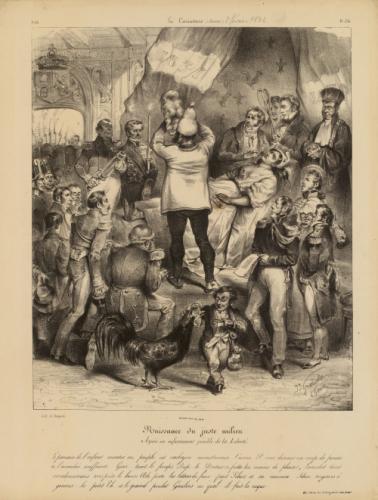
Naissance du juste milieu.Après un enfantement pénible de la Liberté.Lithographie originale en noir sur Velin blanc.
1832 Planche HT parue dans La Caricature morale, religieuse, littéraire et scénique, volume 3, 2 février 1832, (Planche n°134);taches en marge.LithographieDimensions - Œuvre: Hauteur: 35.6cmx Largeur: 27cm - Image: Hauteur: 27.4cmx Largeur: 23cm - Titre en bas au centre : « Naissance du juste milieu. / Après un enfantement pénible de la Liberté. » ; légende plus bas au centre : « Le parrain de l’enfant montre au peuple cet embryon monstrueux. Casim.. P.. veut donner un coup de pouce / à l’accouchée souffrante. Guiz.. tient le forceps, Dup.. le Docteur se frotte les mains de plaisir, Lancelot tient / ses adoucissans [adoucissants] tous préts [prêts] le baron Ath.. porte les lettres de faire part Sébast.. et sa nourrice. Schon.. toujours à / genoux. le petit Th… et le grand poulet Gaulois au quel [auquel] il fait la nique. » ; indications, en ht à gche : « N°66 », en ht au centre : « La Caricature (Journal) », en ht à dte : « Pl. 154. »- Dans la lettre : « Lith de Delaporte » [imprimeur], « On s’abonne chez Aubert, galerie véro dodat » [éditeur] ; dans l’image, en bas à dte, signature : « J.J. Grandville / E. Forest » [Jean-Jacques Grandville, dessinateur, et Eugène Forest, lithographe]Inscription - Sur la feuille reposant sous la main de la Liberté, les dates des trois journées révolutionnaires de Juillet : « 27.28.29. » juillet 1830 ; sur le drapeau à l’arrière-plan à gche: « 1831 » ; sur le drapeau à l’arrière.-plan à dte : « 1[…]0 [1830] » ; sur la bourse accrochée à la taille de Thiers : « 100.000 ». A l’arrière-plan à gche, un blason surmonté d’une couronne. Il porte les symboles caricaturaux du régime de Juillet : un bonnet de coton (folie), deux seringues à clystère entrecroisées, un sac d’argent et un coq (?)
Referenz des Buchhändlers : 25610
|
|
|
Grandville
Pendant qu’il plume son coq, le russe, l’autrichien et le prussien prennent des libertés avec françe oise sa femme.- Lithographie originale en noir sur Velin blanc.
1832 Planche HT parue dans La Caricature politique, morale, littéraire et scénique, volume 4, 4 octobre 1832 (Planche n°205) Lithographie - Œuvre : Hauteur: 27cmx Largeur: 35.6cm - Image Hauteur: 17.9cmx Largeur: 26.9cm - Titre en bas au centre : « Pendant qu’il plume son coq, le russe, l’autrichien et le prussien prennent des libertés avec // françe oise sa femme. » ; indications, en ht au centre : « Caricature (Journal) // N°100. », en ht à dte : « Pl. 205 »- Dans la lettre : « Lith. de Becquet, r. Childebert, N°9 » [imprimeur], « On s’abonne chez Aubert, passage Vero-Dodat. » ; dans l’image, en bas à dte, signature : « M. d’après J. J. Grandville »
Referenz des Buchhändlers : 25252
|
|
|
Grandville - Forest, Eugène-Hippolyte
Encore une fois… Madame, voulez vous ou ne voulez vous pas divorcer, vous êtes parfaitement libre (IFF 43).Lithographie originale en noir sur Velin blanc.
1832 Lithographie - Planche HT parue dans La Caricature morale, religieuse, littéraire et scénique, volume 3, 9 février 1832, (Planche n°135) - Œuvre :Hauteur: 27cmx Largeur: 35.6cm - Image: Hauteur: 19.1cmx Largeur: 23.4cm- Titre en bas au centre : « Encore une fois… Madame, voulez vous ou ne voulez vous pas divorcer, vous êtes parfaitement libre. » ; indications, en ht au centre : « La Caricature (Journal) / (N°67.) », en ht à dte : « Pl. 135. »- Dans la lettre : « Lith. de Delaporte. » [imprimeur], « On s’abonne chez Aubert, galerie véro dodat. » [éditeur] ; dans l’image, en bas à gche, signature : « JJ. Grand / E. For. / H. Del. » [Jean-Jacques Grandville, dessinateur, Eugène Forest, lithographe, et « H. Del. » ( ?)]Inscription - Sur le papier tenu par Louis-Philippe : « Loi Du / Divorce / 1831 / Article » ; sur les papiers posés sur la table : « Promesse / avec […] », « Allian[…] [Alliance] / Liber[…] [Liberté] », « HOTEL / DE / VILLE » (allusion au prétendu programme de l’hôtel de ville auquel se référa fréquemment l’opposition républicaine, mais dont Louis-Philippe nia l’existence); sur les journaux jonchant le sol en bas à dte : « NÉMÉSIS », « LA CARICATURE », « La Tribune », « La Révolu[…] [Révolution] / de 1830 » (journaux de l’opposition); sur les cadres accrochés au mur du fond : « VALMY », « Jemmapes » ; à gche sur le mur, étiquettes d’un calendrier avec les dates des Trois GlorieusesDescription iconographique:La table des matières donne une précision sur le titre : « Le divorce d’Harpagon et de la Liberté ». Scène de ménage entre Louis-Philippe et la figure de la France républicaine, incarnée par une femme portant un bonnet phrygien à cocarde tricolore. Le roi brandit la loi du divorce de 1831 de la main gche et une masse de la main dte. Tous les éléments présents dans cet intérieur tendent à rendre sensible le décalage entre la fidélité aux idées républicaines rappelée par le roi (pendule de l’hôtel de ville, pavé de la révolution de juillet sous verre, tel une relique, son engagement révolutionnaire dans les batailles de Jemmapes et Valmy rappelé dans les tableaux accrochés au mur), et la réalité, c’est-à-dire, son éloignement de l’idéal révolutionnaire (coq enchaîné, buste brisé de La Fayette, journaux de l’opposition jetés à terre), et traitement infligée à la République, son épouse, dont il veut divorcer. La pl. met ainsi en lumière la volonté du roi de rompre avec les principes républicains.En outre, la pl. constitue une allusion à la loi sur le rétablissement du divorce qui venait d’être votée par la Chambre des députés (janvier 1832) et rejetée par les Pairs. Sur le même thème, cf. article du numéro 47, p. 367-370.Personne / Personnage représenté:Du Motier de La Fayette, Gilbert, marquis; Louis-Philippe Ier, roi des Français
Referenz des Buchhändlers : 25248

|
|
|
Grandville & E.Forest.-
Cérémonie des cendres politiques. (Suite) Lithographie, Coloriée Hand-coloured lithograph,-
1833 Planche HT parue dans La Caricature politique, morale, littéraire et scénique, volume 5, 28 février 1833 (Planche n°250) - Hauteur: 27.3cm x Largeur: 35.8cmDimensions - Image :Hauteur: 20cmx Largeur: 28cmTitre en ht au centre : « Cérémonie des cendres politiques. // (Suite) » ; légendes en bas, de gche à dte: « Pere [Père]-Scie, // ange de la morgue. », « Madrier-Longeau, // Girafe. », « Nargout », « Guizotin // doctrinain. », « Berthe en poissarde », « Bey-dok en marlou. », « Chonaine et // Stephanus // ivres…de joie. », « leur valet // en Figaro. », « M. Vienn.. », « Air du déserteur », et, sous une partition de musique : « Le roi pas-sait [passait] etc etc » ; indications : en ht à dte : « La Caricature (Journal) Pl. 250 // N°121. »Inscription - Dans la lettre : « L. de Becquet, rue Childebert N°9. » [imprimeur], « On s’abonne chez Aubert, galerie véro dodat. » ; dans l’image, en bas à gche, signature : « JJ. Grandville // E. Forest » [Jean-Jacques Grandville, dessinateur, et Eugène Forest, lithographe]Pl. n°2 de la série "Cérémonie des cendres politiques". Cf. pl. n°1 (pl. 248 du numéro 120) et pl. n°3 (pl. 251 du numéro 121). Suite du cortège dans lequel on peut reconnaître : Persil en bourreau, affublé d’un grand nez en forme de scie dont le bout est rougi par le sang, portant la coiffe de magistrat, portant un tablier de boucher où apparaît le portrait d’un homme et sur lequel peut se lire « PEINE // DE // MORT // TOUJOURS ! // 5000000000000 // AMENDES ». Il porte une hache de la main dte (décorée d’une poire), tandis que sa main gche est salie par du sang. Madier de Montjau chevauche une fausse girafe pourve de deux jambes d’hommes montées sur des échasses. La girafe est couverte par un carapaçon orné du motif de la poire à face humaine (Louis-Philippe). D’Argout en polichinelle vient ensuite, son costume ayant pris la forme de son grand nez au niveau du buste. Puis Guizot, en ecclésiastique tenant un petit ouvrage ouvert, fervent défenseur de la doctrine, « Berthe en poissarde », « Bey-dok en marlou » (identification difficile de ces deux personnages), puis Schonen, et la figure du "Constitutionnel", soutenu par l’incarnation du journal "Le Figaro" lequel, partageant depuis 1832 les idées du gouvernement, se fait maintenant le soutien de ses membres (« veut les relever de la boue dans laquelle il les a traînés si longtemps » in explication). Se trouve ensuite Viennet récitant des airs d’orgue de Barbarie décoré d’un motif de poire. La pl. se moque de son activité de poète.
Referenz des Buchhändlers : 25196

|
|
|
Grandville & E.Forest.-
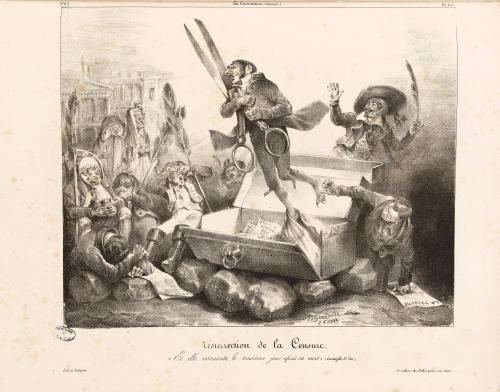
Résurrection de la Censure Et elle ressuscita le troisième jour après sa mort » (évangile St Luc) - Lithographie en noir.
1832 Planche HT parue dans La Caricature morale, religieuse, littéraire et scénique, volume 3, 5 janvier 1832, (Planche n°125)- Lithographie - Œuvre: Hauteur: 27cmx Largeur: 35.6cm - Image: Hauteur: 27.8cmx Largeur: 26.6cm- Titre en bas au centre : « Résurrection de la Censure. » ; légende plus bas au centre : « Et elle ressuscita le troisième jour après sa mort » (évangile St Luc) » ; indications, en ht à gche : « N°62. », en ht au centre : « La Caricature (Journal) », en ht à dte : « Pl. 125. Inscription - Dans la lettre : Lith. de Delaporte » [imprimeur], « On s’abonne chez Aubert, galerie véro-dodat. » [éditeur] ; dans l’image, en bas au centre, signature : « J.J. Grandville / E. Forest [Jean-Jacques Grandville, dessinateur, et Eugène Forest, lithographe]Inscription - Sur les façades de théâtre, de gche à dte : « THEA[…] [THÉÂTRE] DE VARIÉTÉS », « […] [THÉÂTRE] NOUVEAU » ; noms des journaux indiqués sur des personnages ou des numéros épars : « CONSTITUTION[…] [CONSTITUTIONNEL] », « LA FRANCE [ ?] », « LA TRIBUNE » ; dans la boîte, sur des papiers : « PROCES du / MARECHAL / NEY » (maréchal Ney condamné à mort en 1815 ; jugé injuste par La Caricature); sur des pierres en bas,
Referenz des Buchhändlers : 24407
|
|
|

 Per e-mail erhalten
 Als pdf-Dokument herunterladen
 RSS feed
 Permanenter link


