|
Maria Rosa Simon, Maria Constanza Fleitas et al,
Fungal Pathogenesis In Plants And Crops
Koros 2016. 1St. Hardcover. New. Koros hardcover
書籍販売業者の参照番号
: DBS-9781781638330 ISBN : 1781638330 9781781638330
|
|
|
Maria Susana Azzi, Simon Collier
Le Grand Tango: The Life and Music of Astor Piazzolla
New York: Oxford University Press 2000. 1st Edition . Hardcover. Very Good/Very Good. 8vo - over 7¾ - 9¾" tall. Foreword by Yo-Yo Ma. 1st printing. 326pp. A little shelfwear very good in sl worn dust jacket <br/> <br/> Oxford University Press hardcover
書籍販売業者の参照番号
: 006934
|
|
|
Mariam Garibyan, Simon McLeish, and John Paschoud
Access and Identity Management for Libraries: Controlling access to online information
Facet Publishing 2013. Paperback. New. This book provides practical guidance to ensuring that your users can access and personalise the online resources they are entitled to use with the minimum of fuss. Facet Publishing paperback
書籍販売業者の参照番号
: FacetPub-9781856045889 ISBN : 1856045889 9781856045889

|
|
|
Mariam Garibyan, Simon McLeish, and John Paschoud
Access and Identity Management for Libraries: Controlling access to online information
Facet Publishing 2017. Hardcover. New. This book provides practical guidance to ensuring that your users can access and personalise the online resources they are entitled to use with the minimum of fuss. Facet Publishing hardcover
書籍販売業者の参照番号
: FacetPub-9781783303106 ISBN : 1783303107 9781783303106

|
|
|
Mariam Garibyan, Simon McLeish, and John Paschoud
Access and Identity Management for Libraries: Controlling access to online information
Facet Publishing 2013. Paperback. New. This book provides practical guidance to ensuring that your users can access and personalise the online resources they are entitled to use with the minimum of fuss. Facet Publishing paperback
書籍販売業者の参照番号
: FacetPub-9781856045889 ISBN : 1856045889 9781856045889
|
|
|
Mariam Garibyan, Simon McLeish, and John Paschoud
Access and Identity Management for Libraries: Controlling access to online information
Facet Publishing 2017. Hardcover. New. This book provides practical guidance to ensuring that your users can access and personalise the online resources they are entitled to use with the minimum of fuss. Facet Publishing hardcover
書籍販売業者の参照番号
: FacetPub-9781783303106 ISBN : 1783303107 9781783303106
|
|
|
Marianne Leuzinger-Bohleber , Simon Arnold and Mark Solms
The Unconscious: A bridge Between Psychoanalysis and Cognitive Neuroscience
Routledge 2017. Hardcover. New. Routledge hardcover
書籍販売業者の参照番号
: Manohar-9781138920446 ISBN : 1138920444 9781138920446

|
|
|
Marianne Leuzinger-Bohleber , Simon Arnold and Mark Solms
The Unconscious: A bridge Between Psychoanalysis and Cognitive Neuroscience
Routledge 2017. Hardcover. New. Routledge hardcover
書籍販売業者の参照番号
: Manohar-9781138920446 ISBN : 1138920444 9781138920446
|
|
|
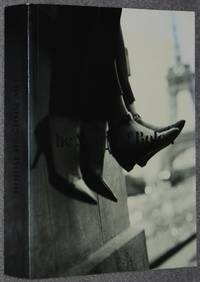
Marie and Annica Eklund ; Photography by Tobias Regell ; art direction by Tor Norinder ; interviews by Simon Mills
The Story of Bolon
<p>Filled with evocative black and white photographs by Tobias Regell and edited by Simon Mills The Story of Bolon recalls the history of the cult Swedish woven flooring company and the personalities that have brought Bolon to life. 270 pages ill. ; 20 cm. Slight shelf wear to edges no inscriptions reading crease to spine. Photographs available on request. All books dispatched same or next working day in robust packaging.</p> Bolon paperback
書籍販売業者の参照番号
: 017859
|
|
|
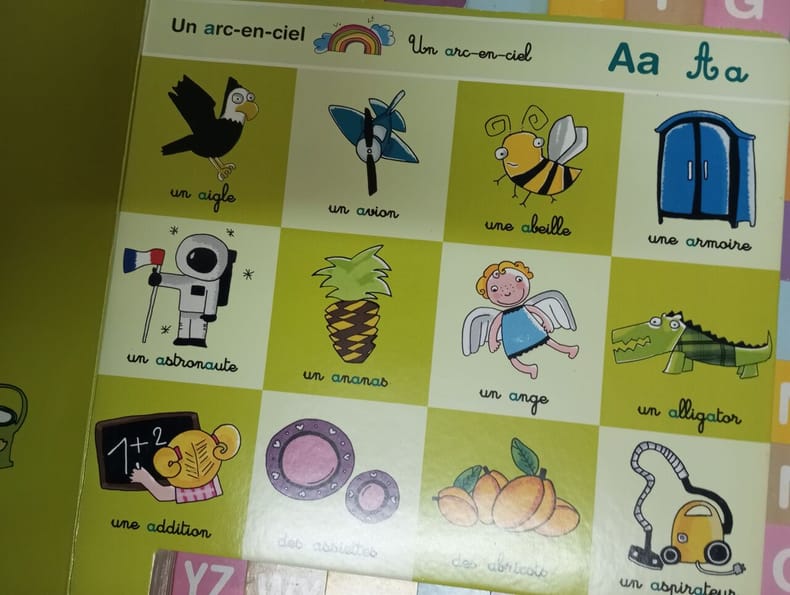
Marie Delhoste Jany Loriot Maud Simon
Mon grand abécédaire avec des onglets en tout-carton pour les petites mains : 500 Mots-clés pour l'apprentissage de la lecture et de l'écriture. Testé ... 52 saynètes pour comprendre par l'image
Thomas Jeunesse 2008 48 pages 25 8x2 8x26cm. 2008. board_book. 48 pages.
書籍販売業者の参照番号
: 500101112
|
|
|
Marie Jalowicz Simon
Underground in Berlin: A Young Woman's Extraordinary Tale of Survival in the Heart of Nazi Germany
Hardback. New. hardcover
書籍販売業者の参照番号
: B9780316382090 ISBN : 0316382094 9780316382090

|
|
|
Marie Simon
Ce que j'appelle jaune Marie Simon
TASCHEN 2016. 2016. Softcover. Ce que j'appelle jaune <br/><br/>Ce que j'appelle jaune Marie Simon TASCHEN paperback
書籍販売業者の参照番号
: BN243821 ISBN : 2756110965 9782756110967

|
|
|
Marie Simon
Gone to ground
WF Howes Ltd 2015. Hardcover. New/New. <p><strong>Author:</strong> Marie Simon</p><p><strong>Publisher:</strong> WF Howes Ltd</p><p><strong>Binding:</strong> Hardcover</p><p><strong>ISBN:</strong> 9781510012370</p><p><strong>Release Date:</strong> 2015</p><p><strong>Number Of Pages:</strong> 503</p><p><strong>Details:</strong> Amaryllis Mississippi is a scrappy little town of strong backbone and southern hospitality. A brick-paved Main Street a park and a legendary ghost in the local cemetery are all part of its heritage. Everybody knows everybody in Amaryllis and gossip wafts on the breeze. Its people are friendly its families tight. On the surface Amaryllis seems much like the flower for which it’s named—bright and fragrant. But the Amaryllis flower is poison.In the past three years five unsolved murders have occurred within the town. All the victims were women and all were killed in similar fashion in their own homes. And just two nights ago—a sixth murder.Clearly a killer lives among the good citizens of Amaryllis. And now three terrified women are sure they know who he is—someone they love. None is aware of the others’ suspicions. And each must make the heartrending choice to bring the killer down. But each woman suspects a different man.Endorsements/"The popular novelist's talent continues to flower . . . sales will flourish."-- Publishers Weekly“What do you do with a truth that could shatter your world That’s the question at the heart of this rollercoaster suspense thriller. With memorable characters and intriguing plot twists Collins leads her readers through a high-octane course as each woman confronts the price she would pay for justice.â€--CBA Retailers Resources</p> WF Howes Ltd hardcover
書籍販売業者の参照番号
: 9781510012370-2025 ISBN : 1510012370 9781510012370
|
|
|
Marie Simon
Voyageurs : Petite histoire du nécessaire et du superflu
Editions Pratiques Automobiles (EPA) (14 janvier 2004)
書籍販売業者の参照番号
: lc_74880
|
|
|
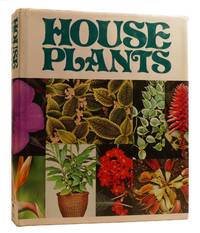
Mariella Catherine Atthill and Simon Pleasance Pizzetti
HOUSE PLANTS
New York: Chartwell 1976. First Edition; First Printing. Hardcover. Near Fine in a Near Fine dust jacket. Chartwell hardcover
書籍販売業者の参照番号
: 215160
|
|
|
Marielle HUCLIEZ
JARDINS et PARCS CONTEMPORAINS: FRANCE
Un ouvrage de 160 pages, format 240 x 290 mm, illustré, broché couverture couleurs rempliée, publié en 1998, Editions Telleri, bon état
書籍販売業者の参照番号
: LFA-126731091
|
|
|
Marielle Simon
Improving Large-Scale Assessment in Education: Theory Issues and Practice
new. unknown
書籍販売業者の参照番号
: 17711415-n ISBN : 0415894573 9780415894579

|
|
|
Marielle Simon
Improving Large-Scale Assessment in Education: Theory Issues and Practice
like new. unknown
書籍販売業者の参照番号
: 17711415 ISBN : 0415894573 9780415894579
|
|
|
Marielle Simon
Improving Large-Scale Assessment in Education: Theory Issues and Practice
Paperback / softback. New. paperback
書籍販売業者の参照番号
: A9780415894579 ISBN : 0415894573 9780415894579

|
|
|
Marilyn K Simon
Math Mastery
Kendall/Hunt Publishing Company 1992-06. Paperback. Very Good. 0x0x0. Appears unread.Binding tight. Pages not marked by notes or highlighting. Kendall/Hunt Publishing Company paperback
書籍販売業者の参照番号
: B4240716041 ISBN : 0840377800 9780840377807
|
|
|
Marilyn K Simon
The Dissertation Cookbook: From Soup to Nuts : A Practical Guide to Help You Start and Complete Your Dissertation
paperback. Good. Access codes and supplements are not guaranteed with used items. May be an ex-library book. paperback
書籍販売業者の参照番号
: 0840370377.G ISBN : 0840370377 9780840370372

|
|
|
Marilyn K Simon
The Dissertation Cookbook: From Soup to Nuts : A Practical Guide to Help You Start and Complete Your Dissertation
New. paperback. New. Satisfaction Guaranteed or your money back. paperback
書籍販売業者の参照番号
: 0840370377 ISBN : 0840370377 9780840370372
|
|
|
Marilyn Simon
Dissertation And Scholarly Research: Recipes for Success: A Practical Guide to Start And Complete Your Dissertation Thesis or Formal Research Project
paperback. Good. Access codes and supplements are not guaranteed with used items. May be an ex-library book. paperback
書籍販売業者の参照番号
: 0757525016.G ISBN : 0757525016 9780757525018

|
|
|
Marilyn Simon; J Bruce Francis
THE DISSERTATION AND RESEARCH COOKBOOK: FROM SOUP TO NUTS A PRACTICAL GUIDE TO HELP YOU START AND COMPLETE YOUR DISSERTATION OR RESEARCH PROJECT
Kendall Hunt Publishing 2001-07-27. Paperback. New. New. In shrink wrap. Looks like an interesting title! Kendall Hunt Publishing paperback
書籍販売業者の参照番号
: Q-078728405X ISBN : 078728405X 9780787284053
|
|
|
Marilyn Simon
THE DISSERTATION AND RESEARCH COOKBOOK: FROM SOUP TO NUTS A PRACTICAL GUIDE TO HELP YOU START AND COMPLETE YOUR DISSERTATION OR RESEARCH PROJECT
Brand: Kendall Hunt Pub Co 2001-07-27. 3. paperback. New. 8.25x0.50x10.75. Buy with confidence. Excellent Customer Service & Return policy. Brand: Kendall Hunt Pub Co paperback
書籍販売業者の参照番号
: DADAX078728405X ISBN : 078728405X 9780787284053
|
|
|
Marinela-Cristina Simon
Voluntariatul in domeniul social
Used. For more details please contact me unknown
書籍販売業者の参照番号
: 144653
|
|
|
Marinker, Simon
Assassination Preparations & Consequences
paperback. Good. Access codes and supplements are not guaranteed with used items. May be an ex-library book. paperback
書籍販売業者の参照番号
: 1553691288.G ISBN : 1553691288 9781553691280

|
|
|
Marinker, Simon
Beyond the Citadel - The Complete Trilogy Signed By Author
Victoria BC Canada: Trafford Publishing 1999. Book. Fine. Paperback. Signed by Authors. Reprint. 4to - over 9¾" - 12" tall. 656 pages. Author's signature upon title page. At the close of a surgical operation the surgeons take off their masks and talk about both profession-related and unrelated matters. In the same manner this narrative novel presented in trilogy fashion takes the mask off the medical profession and its practicioners both generalists and specialists. It presents many underlying secrets that are often not available to the lay public at large. The protaganist a Canadian surgeon is revealed in both his professional and private life his avocations and romances his family life challenges triumphs and defeats. Minor wrinkle to bottom edge of illustrated front cover else virtually as new. Excellent copy. Trafford Publishing Paperback
書籍販売業者の参照番号
: 86901795 ISBN : 1552122387 9781552122389

|
|
|
Marinker, Simon
Beyond the Citadel - The Complete Trilogy *Signed By Author*
656 pages. Author's signature upon title page. At the close of a surgical operation, the surgeons take off their masks and talk about both profession-related and unrelated matters. In the same manner, this narrative novel, presented in trilogy fashion, takes the mask off the medical profession and its practicioners, both generalists and specialists. It presents many underlying secrets that are often not available to the lay public at large. The protaganist, a Canadian surgeon, is revealed in both his professional and private life, his avocations and romances, his family life, challenges, triumphs and defeats. Minor wrinkle to bottom edge of illustrated front cover else virtually as new. Excellent copy. Book
|
|
|
Marinus Simon Baljon, Johannes
Encyclopedie der Christelijke Theologie
hardcover. Good. Access codes and supplements are not guaranteed with used items. May be an ex-library book. hardcover
書籍販売業者の参照番号
: 1020889829.G ISBN : 1020889829 9781020889820

|
|
|
Mario SIMON - Andre-Edouard WOODRUFF - Paul POIRET
Croquis de mode : Croquis de mode d'été par Mario Simon Croquis La Gazette du Bon ton 1920 n°3. - Les modes en l'an de grâce Mil neuf cent vingt un Croquis La Gazette du Bon ton 1921 n°3 - Pour la Riviera. Robes garnies de fleurs naturelles dans la mesure où l'on en a et où l'on ne préfère pas d'employer moins coûteuses les fleurs artificielles Croquis La Gazette du Bon ton 1921 n°10. - Costumes tailleur de fantaisie ornés de colifichets Croquis La Gazette du Bon ton 1922 n°4. - Fashion sketches: Summer fashion sketches by Mario Simon Sketches La Gazette du Bon ton 1920 no. 3. Fashions in the Year of Grace Nineteen Twenty-One Sketches La Gazette du Bon ton 1921 no. 3. For the Riviera. Dresses trimmed with
Paris: Lucien Vogel éditeur 1920. Fine. Lucien Vogel éditeur Paris 1920-1922 18 x 24 cm relié FASHION POIRET Paul & WORTH Charles Frederick & BEER & DOEUILLET Georges & LANVIN Jeanne & SIMON Mario & WOODRUFF André-Edouard. Croquis de mode Lucien Vogel éditeur Paris 1920-1922 18 x 24 cm bound Set of 24 original lithographs in color on vergé paper: Croquis de mode d'été par Mario Simon Croquis La Gazette du Bon ton 1920 n° 3. Les modes en l'an de grâce Mil neuf cent vingt un Croquis La Gazette du Bon ton 1921 n° 3 Pour la Riviera. Robes garnies de fleurs naturelles dans la mesure où l'on en a et où l'on ne préfère pas d'employer moins coûteuses les fleurs artificielles Croquis La Gazette du Bon ton 1921 n° 10. Costumes tailleur de fantaisie ornés de colifichets Croquis La Gazette du Bon ton 1922 n° 4. Original prints used to illustrate the Gazette du Bon ton one of the most attractive and influential 20th century fashion magazines featuring the talents of French artists and other contributors from the burgeoning Art Deco movement. A celebrated fashion magazine established in 1912 by Lucien Vogel la Gazette du Bon ton appeared until 1925 with a hiatus from 1915 to 1920 due to the war the editor-in-chief having been called up for service. It consisted of 69 issues printed in only 2000 copies each and notably illustrated with 573 color plates and 148 sketches of the models of the great designers. Right from the start this sumptuous publication was aimed at bibliophiles and fashionable society Françoise Tétart-Vittu La Gazette du Bon ton in Dictionnaire de la mode 2016 and was printed on fine vergé paper using a type cut specially for the magazine by Georges Peignot known as Cochin later used in 1946 by Christian Dior. The prints were made using stencils heightened in colors some highlightened in gold or palladium. The story began in 1912 when Lucien Vogel a man of the world involved in fashion he had already been part of the fashion magazine Femina decided with his wife Cosette de Brunhoff the sister of Jean creator of Babar to set up the Gazette du Bon ton subtitled at the time: Art fashion frivolities. Georges Charensol noted the reasoning of the editor-in-chief: In 1910' he observed there was no really artistic fashion magazine nothing representative of the spirit of the time. My dream was therefore to make a luxury magazine with truly modern artists
I was assured of success because when it comes to fashion no country on earth can compete with France. Un grand éditeur d'art. Lucien Vogel in Les Nouvelles littéraires n° 133 May 1925. The magazine was immediately successful not only in France but also in the United States and Latin America. At first Vogel put together a team of seven artists: André-Édouard Marty and Pierre Brissaud followed by Georges Lepape and Dammicourt as well as eventually his friends from school and the School of Fine Arts like George Barbier Bernard Boutet de Monvel and Charles Martin. Other talented people soon came flocking to join the team: Guy Arnoux Léon Bakst Benito Boutet de Monvel Umberto Brunelleschi Chas Laborde Jean-Gabriel Domergue Raoul Dufy Édouard Halouze Alexandre Iacovleff Jean Émile Laboureur Charles Loupot Chalres Martin Maggie Salcedo. These artist mostly unknown when Lucien Vogel sought them out later became emblematic and sought-after artistic figures. It was also they who worked on the advertising drawings for the Gazette. The plates put the spotlight on and celebrate dresses by seven designers of the age: Lanvin Doeuillet Paquin Poiret Worth Vionnet and Doucet. The designers provided exclusive models for each issue. Nonetheless some of the illustrations are not based on real models but simply on the illustrator's conception of the fashion of the day. The Gazette du Bon ton was an important step in the history of fashion. Combining aesthetic demands with the physical whole it brought toge Lucien Vogel éditeur unknown
書籍販売業者の参照番号
: 55409

|
|
|
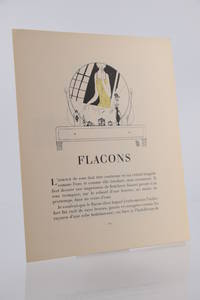
Mario SIMON - Marcel ASTRUC
La Citröen et les sports - L'aviation 10 HP. Torpédo-sports La Gazette du Bon ton 1922 n°10
Paris: Lucien Vogel éditeur 1922. Fine. Lucien Vogel éditeur Paris 1922 19.50 x 24.50 cm une feuille Text ""Flacons"" on double page by Marcel Astruc illustrated with five original colored drawings in the text by Mario Simon. Original print by Mario Simon on the last page of the double sheet. La Gazette du bon ton one of the most beautiful and influential fashion magazines of the 20th century celebrating the talent of French creators and artists at the height of the Art Deco movement. Famous fashion magazine founded in 1912 by Lucien Vogel La Gazette du bon ton was published until 1925 with an interruption during the War from 1915 to 1920 due to the mobilization of its editor-in-chief. It consists of 69 issues printed in only 2000 copies and is illustrated notably with 573 color plates and 148 sketches representing models by great couturiers. From their publication these luxurious publications ""were aimed at bibliophiles and worldly aesthetes"" Françoise Tétart-Vittu ""La Gazette du bon ton"" in Dictionnaire de la mode 2016. Printed on fine laid paper they use a typeface specially created for the magazine by Georges Peignot the Cochin character adopted in 1946 by Christian Dior. The prints are created using the metal stencil technique heightened in colors and some outlined in gold or palladium. The adventure begins in 1912 when Lucien Vogel a man of the world and fashion - he had already participated in the magazine Femina - decides to found with his wife Cosette de Brunhoff sister of Jean the father of Babar the Gazette du bon ton whose subtitle was then ""Art modes et frivolités"". Georges Charensol reports the words of the editor-in-chief: ""In 1910 he observes there existed no fashion journal that was truly artistic and representative of the spirit of its time. I therefore thought of creating a luxury magazine with truly modern artists . I was certain of success because for fashion no country can rival France."" ""Un grand éditeur d'art. Lucien Vogel"" in Les Nouvelles littéraires n°133 May 1925. The success of the magazine is immediate not only in France but also in the United States and South America. Originally Vogel thus brings together a group of seven artists: André-Édouard Marty and Pierre Brissaud followed by Georges Lepape and Dammicourt; and finally his friends from the École des beaux-arts who are George Barbier Bernard Boutet de Monvel or Charles Martin. Other talents quickly come to join the team: Guy Arnoux Léon Bakst Benito Boutet de Monvel Umberto Brunelleschi Chas Laborde Jean-Gabriel Domergue Raoul Dufy Édouard Halouze Alexandre Iacovleff Jean Émile Laboureur Charles Loupot Charles Martin Maggie Salcedo. These artists mostly unknown when Lucien Vogel calls upon them will subsequently become emblematic and sought-after artistic figures. These same illustrators create the drawings for the Gazette's advertisements. The plates highlight and sublimate the dresses of seven creators of the period: Lanvin Doeuillet Paquin Poiret Worth Vionnet and Doucet. The couturiers provide exclusive models for each issue. Nevertheless some of the illustrations feature no real model but only the illustrator's idea of contemporary fashion. La Gazette du bon ton is a decisive step in the history of fashion. Combining aesthetic demand and plastic unity it brings together for the first time the great talents of the world of arts letters and fashion and imposes through this alchemy a completely new image of woman slender independent and audacious also carried by the new generation of couturiers Coco Chanel Jean Patou Marcel Rochas. Taken over in 1920 by Condé Montrose Nast the Gazette du bon ton would largely inspire the new composition and aesthetic choices of the ""dying little journal"" that Nast had bought a few years earlier: Vogue magazine. Lucien Vogel éditeur unknown
書籍販売業者の参照番号
: 84837
|
|
|
Mario SIMON - (Gustave BEER)
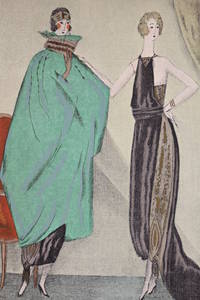
Les Deux Soeurs. Manteau et robe pour le soir de Beer pl.54 La Gazette du Bon ton 1920 n°7
Paris: Lucien Vogel éditeur 1920. Fine. Lucien Vogel éditeur Paris Septembre 1920 18 x 24 cm une feuille Original color print printed on vergé paper signed in the plate. An original print used to illustrate the Gazette du bon ton one of the most attractive and influential 20th century fashion magazines featuring the talents of French artists and other contributors from the burgeoning Art Deco movement. A celebrated fashion magazine established in 1912 by Lucien Vogel La Gazette du bon ton appeared until 1925 with a hiatus from 1915 to 1920 due to the war the editor-in-chief having been called up for service. It consisted of 69 issues printed in only 2000 copies each and notably illustrated with 573 color plates and 148 sketches of the models of the great designers. Right from the start this sumptuous publication was aimed at bibliophiles and fashionable society Françoise Tétart-Vittu La Gazette du bon ton in Dictionnaire de la mode 2016 and was printed on fine vergé paper using a type cut specially for the magazine by Georges Peignot known as Cochin later used in 1946 by Christian Dior. The prints were made using stencils heightened in colors some highlighted in gold or palladium. The story began in 1912 when Lucien Vogel a man of the world involved in fashion he had already been part of the fashion magazine Femina decided with his wife Cosette de Brunhoff the sister of Jean creator of Babar to set up the Gazette du bon ton subtitled at the time: Art fashion frivolities. Georges Charensol noted the reasoning of the editor-in-chief: In 1910 he observed there was no really artistic fashion magazine nothing representative of the spirit of the time. My dream was therefore to make a luxury magazine with truly modern artists
I was assured of success because when it comes to fashion no country on earth can compete with France. Un grand éditeur dart. Lucien Vogel in Les Nouvelles littéraires no. 133 May 1925. The magazine was immediately successful not only in France but also in the United States and Latin America. At first Vogel put together a team of seven artists: André-Édouard Marty and Pierre Brissaud followed by Georges Lepape and Dammicourt as well as eventually his friends from school and the School of Fine Arts like George Barbier Bernard Boutet de Monvel and Charles Martin. Other talented people soon came flocking to join the team: Guy Arnoux Léon Bakst Benito Boutet de Monvel Umberto Brunelleschi Chas Laborde Jean-Gabriel Domergue Raoul Dufy Édouard Halouze Alexandre Iacovleff Jean Émile Laboureur Charles Loupot Chalres Martin Maggie Salcedo. These artist mostly unknown when Lucien Vogel sought them out later became emblematic and sought-after artistic figures. It was also they who worked on the advertising drawings for the Gazette. The plates put the spotlight on and celebrate dresses by seven designers of the age: Lanvin Doeuillet Paquin Poiret Worth Vionnet and Doucet. The designers provided exclusive models for each issue. Nonetheless some of the illustrations are not based on real models but simply on the illustrators conception of the fashion of the day. The Gazette du bon ton was an important step in the history of fashion. Combining aesthetic demands with the physical whole it brought together for the first time the great talents of the artistic literary and fashion worlds; and imposed through this alchemy a completely new image of women: slender independent and daring which was shared by the new generation of designers including Coco Chanel Jean Patou Marcel Rochas and so on
Taken over in 1920 by Condé Montrose Nast the Gazette du bon ton was an important influence on the new layout and aesthetics of that little dying paper that Nast had bought a few years earlier: Vogue. Lucien Vogel éditeur unknown
書籍販売業者の参照番号
: 54796
|
|
|
Mario SIMON - (Gustave BEER)
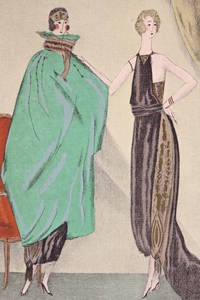
Les Deux Soeurs. Manteau et robe pour le soir de Beer pl.54 La Gazette du Bon ton 1920 n°7
Paris: Lucien Vogel éditeur 1920. Fine. Lucien Vogel éditeur Paris Septembre 1920 18 x 24 cm une feuille original print in color printed on laid paper signed enhaut left of the board. Original content produced for the illustration of The Gazette fashionable one of the finest and most influential twentieth century fashion magazines celebrating the talent of creators and artists French burgeoning art deco. Famous fashion magazine founded in 1912 by Lucien Vogel The Gazette fashionable appeared until 1925 with an interruption during the War of 1915 to 1920 due to mobilization of its editor. She is 69 Deliveries from just 2000 copies and is illustrated including 573 color plates and 148 sketches depicting models of fashion designers. Upon publication these luxury publications ""are for bibliophiles and worldly aesthetes"" Françoise Tétart-Vittu ""good Gazette of tone"" in the fashion dictionary 2016. Printed on fine laid paper they use a typeface created specifically for the magazine by Georges Peignot the Cochin character taken in 1946 by Christian Dior. The prints are made with the technique of metal stencil enhanced color and some outlined in gold or palladium. The adventure began in 1912 when Lucien Vogel man of the world and fashion - it has already participated in Femina magazine - decided to found with his wife Cosette de Brunhoff John's sister the father of Babar Gazette good tone in which the subtitle is then ""Art fashions and frivolities."" Georges Charensol quotes the editor: ""In 1910 he observed there was no truly artistic fashion magazine and representative of the spirit of his time. So I thought of making a glossy magazine with truly modern artists . I was certain of success because no country for fashion can compete with France. """" A great art editor. Lucien Vogel ""in Literary News No. 133 May 1925. The success of the magazine is immediate not only in France but also the US and South America. Originally Vogel therefore brings together a group of seven artists: André-Édouard Marty and Pierre Brissaud followed by Georges Lepape and Dammicourt; and finally his friends from the School of Fine Arts as are George Barbier Bernard Boutet de Monvel or Charles Martin. Other talents come quickly reach the equipped Guy Arnoux Léon Bakst Benito Boutet de Monvel Umberto Brunelleschi Chas Laborde Jean-Gabriel Domergue Raoul Dufy Edward Halouze Alexander Iacovleff Jean Emile Laboureur Charles Loupot Charles Martin Maggie Salcedo. These artists mostly unknown when Lucien Vogel appealed to them will eventually become iconic figures and artistic sought. These are the same illustrators who make the drawings advertisements Gazette. The boards highlight the dresses and sublime seven artists of the time: Lanvin Doeuillet Paquin Poiret Worth Vionnet and Doucet. The designers provide for each number of exclusive models. Nevertheless some of Illustrations contained no real model but only the idea that the illustrator is done in the fashion of the day. Gazette fashionable is a milestone in the history of fashion. Combining the aesthetic requirement and plastic unit it brings together for the first time the great talents of the world of arts literature and fashion and imposed by this alchemy a new image of women slender independent and bold also driven by the new generation of designers Coco Chanel Jean Patou Rochas Marcel . Recovery in 1920 by Condé Montrose Nast Gazette fashionable modeled for the new composition and the aesthetic choices of the ""little dying newspaper"" that Nast had bought a few years ago: the Vogue magazine. Lucien Vogel éditeur hardcover
書籍販売業者の参照番号
: 57572
|
|
|
Mario SIMON
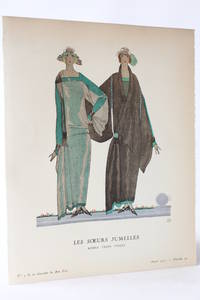
Les Soeurs jumelles. Robes trois voiles pl.34 La Gazette du Bon ton 1922 n°5
Paris: Lucien Vogel éditeur 1922. Fine. Lucien Vogel éditeur Paris 1922 18 x 24 cm une feuille Original color print printed on vergé paper signed in the plate. An original print used to illustrate the Gazette du bon ton one of the most attractive and influential 20th century fashion magazines featuring the talents of French artists and other contributors from the burgeoning Art Deco movement. A celebrated fashion magazine established in 1912 by Lucien Vogel La Gazette du bon ton appeared until 1925 with a hiatus from 1915 to 1920 due to the war the editor-in-chief having been called up for service. It consisted of 69 issues printed in only 2000 copies each and notably illustrated with 573 color plates and 148 sketches of the models of the great designers. Right from the start this sumptuous publication was aimed at bibliophiles and fashionable society Françoise Tétart-Vittu La Gazette du bon ton in Dictionnaire de la mode 2016 and was printed on fine vergé paper using a type cut specially for the magazine by Georges Peignot known as Cochin later used in 1946 by Christian Dior. The prints were made using stencils heightened in colors some highlighted in gold or palladium. The story began in 1912 when Lucien Vogel a man of the world involved in fashion he had already been part of the fashion magazine Femina decided with his wife Cosette de Brunhoff the sister of Jean creator of Babar to set up the Gazette du bon ton subtitled at the time: Art fashion frivolities. Georges Charensol noted the reasoning of the editor-in-chief: In 1910 he observed there was no really artistic fashion magazine nothing representative of the spirit of the time. My dream was therefore to make a luxury magazine with truly modern artists
I was assured of success because when it comes to fashion no country on earth can compete with France. Un grand éditeur dart. Lucien Vogel in Les Nouvelles littéraires no. 133 May 1925. The magazine was immediately successful not only in France but also in the United States and Latin America. At first Vogel put together a team of seven artists: André-Édouard Marty and Pierre Brissaud followed by Georges Lepape and Dammicourt as well as eventually his friends from school and the School of Fine Arts like George Barbier Bernard Boutet de Monvel and Charles Martin. Other talented people soon came flocking to join the team: Guy Arnoux Léon Bakst Benito Boutet de Monvel Umberto Brunelleschi Chas Laborde Jean-Gabriel Domergue Raoul Dufy Édouard Halouze Alexandre Iacovleff Jean Émile Laboureur Charles Loupot Chalres Martin Maggie Salcedo. These artist mostly unknown when Lucien Vogel sought them out later became emblematic and sought-after artistic figures. It was also they who worked on the advertising drawings for the Gazette. The plates put the spotlight on and celebrate dresses by seven designers of the age: Lanvin Doeuillet Paquin Poiret Worth Vionnet and Doucet. The designers provided exclusive models for each issue. Nonetheless some of the illustrations are not based on real models but simply on the illustrators conception of the fashion of the day. The Gazette du bon ton was an important step in the history of fashion. Combining aesthetic demands with the physical whole it brought together for the first time the great talents of the artistic literary and fashion worlds; and imposed through this alchemy a completely new image of women: slender independent and daring which was shared by the new generation of designers including Coco Chanel Jean Patou Marcel Rochas and so on
Taken over in 1920 by Condé Montrose Nast the Gazette du bon ton was an important influence on the new layout and aesthetics of that little dying paper that Nast had bought a few years earlier: Vogue. Lucien Vogel éditeur unknown
書籍販売業者の参照番号
: 54988
|
|
|
Mario SIMON - (Paul POIRET)
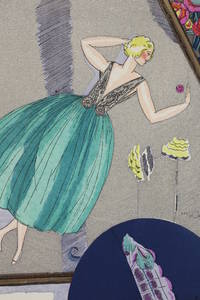
Mirage. Robe du soir de Paul Poiret pl.31 La Gazette du Bon ton 1920 n°4
Paris: Lucien Vogel éditeur 1920. Fine. Lucien Vogel éditeur Paris Mai 1920 18 x 24 cm une feuille Original color print heightened with palladium printed on vergé paper signed in plate. An original print used to illustrate the Gazette du bon ton one of the most attractive and influential 20th century fashion magazines featuring the talents of French artists and other contributors from the burgeoning Art Deco movement. A celebrated fashion magazine established in 1912 by Lucien Vogel La Gazette du bon ton appeared until 1925 with a hiatus from 1915 to 1920 due to the war the editor-in-chief having been called up for service. It consisted of 69 issues printed in only 2000 copies each and notably illustrated with 573 color plates and 148 sketches of the models of the great designers. Right from the start this sumptuous publication was aimed at bibliophiles and fashionable society Françoise Tétart-Vittu La Gazette du bon ton in Dictionnaire de la mode 2016 and was printed on fine vergé paper using a type cut specially for the magazine by Georges Peignot known as Cochin later used in 1946 by Christian Dior. The prints were made using stencils heightened in colors some highlighted in gold or palladium. The story began in 1912 when Lucien Vogel a man of the world involved in fashion he had already been part of the fashion magazine Femina decided with his wife Cosette de Brunhoff the sister of Jean creator of Babar to set up the Gazette du bon ton subtitled at the time: Art fashion frivolities. Georges Charensol noted the reasoning of the editor-in-chief: In 1910 he observed there was no really artistic fashion magazine nothing representative of the spirit of the time. My dream was therefore to make a luxury magazine with truly modern artists
I was assured of success because when it comes to fashion no country on earth can compete with France. Un grand éditeur dart. Lucien Vogel in Les Nouvelles littéraires no. 133 May 1925. The magazine was immediately successful not only in France but also in the United States and Latin America. At first Vogel put together a team of seven artists: André-Édouard Marty and Pierre Brissaud followed by Georges Lepape and Dammicourt as well as eventually his friends from school and the School of Fine Arts like George Barbier Bernard Boutet de Monvel and Charles Martin. Other talented people soon came flocking to join the team: Guy Arnoux Léon Bakst Benito Boutet de Monvel Umberto Brunelleschi Chas Laborde Jean-Gabriel Domergue Raoul Dufy Édouard Halouze Alexandre Iacovleff Jean Émile Laboureur Charles Loupot Chalres Martin Maggie Salcedo. These artist mostly unknown when Lucien Vogel sought them out later became emblematic and sought-after artistic figures. It was also they who worked on the advertising drawings for the Gazette. The plates put the spotlight on and celebrate dresses by seven designers of the age: Lanvin Doeuillet Paquin Poiret Worth Vionnet and Doucet. The designers provided exclusive models for each issue. Nonetheless some of the illustrations are not based on real models but simply on the illustrators conception of the fashion of the day. The Gazette du bon ton was an important step in the history of fashion. Combining aesthetic demands with the physical whole it brought together for the first time the great talents of the artistic literary and fashion worlds; and imposed through this alchemy a completely new image of women: slender independent and daring which was shared by the new generation of designers including Coco Chanel Jean Patou Marcel Rochas and so on
Taken over in 1920 by Condé Montrose Nast the Gazette du bon ton was an important influence on the new layout and aesthetics of that little dying paper that Nast had bought a few years earlier: Vogue. Lucien Vogel éditeur unknown
書籍販売業者の参照番号
: 54770
|
|
|
Mario SIMON
Les Deux Soeurs. Manteau et robe pour le soir, de Beer (pl.54, La Gazette du Bon ton, 1920 n°7)
Lucien Vogel éditeur | Paris Septembre 1920 | 18 x 24 cm | une feuille
書籍販売業者の参照番号
: 54796
|
|
|
Mario SIMON
Les Deux Soeurs. Manteau et robe pour le soir, de Beer (pl.54, La Gazette du Bon ton, 1920 n°7)
Lucien Vogel éditeur | Paris Septembre 1920 | 18 x 24 cm | une feuille
書籍販売業者の参照番号
: 57572
|
|
|
Mario SIMON
Les Soeurs jumelles. Robes trois voiles (pl.34, La Gazette du Bon ton, 1922 n°5)
Lucien Vogel éditeur | Paris 1922 | 18 x 24 cm | une feuille
書籍販売業者の参照番号
: 54988
|
|
|
Mario SIMON
Mirage. Robe du soir, de Paul Poiret (pl.31, La Gazette du Bon ton, 1920 n°4)
Lucien Vogel éditeur | Paris Mai 1920 | 18 x 24 cm | une feuille
書籍販売業者の参照番号
: 54770
|
|
|
Mario SIMON - André-Edouard WOODRUFF - Paul POIRET
Croquis de mode : Croquis de mode d'été par Mario Simon (Croquis, La Gazette du Bon ton, 1920 n°3). - Les modes en l'an de grâce Mil neuf cent vingt un (Croquis, La Gazette du Bon ton, 1921 n°3) - Pour la Riviera. Robes garnies de fleurs naturelles, dans la mesure où l'on en a et où l'on ne préfère pas d'employer, moins coûteuses, les fleurs artificielles (Croquis, La Gazette du Bon ton, 1921 n°10). - Costumes tailleur de fantaisie ornés de colifichets (Croquis, La Gazette du Bon ton, 1922 n°4). -
Lucien Vogel éditeur | Paris 1920-1922 | 18 x 24 cm | relié
書籍販売業者の参照番号
: 55409
|
|
|
Mario SIMON - Marcel ASTRUC
La Citröen et les sports - L'aviation 10 HP. Torpédo-sports (La Gazette du Bon ton, 1922 n°10)
Lucien Vogel éditeur | Paris 1922 | 19.50 x 24.50 cm | une feuille
書籍販売業者の参照番号
: 84837
|
|
|
Mariot-Didieux, Simon
Le chasseur médecin ou Traité complet sur les maladies du chien. 3e édition French Edition
paperback. Good. Access codes and supplements are not guaranteed with used items. May be an ex-library book. paperback
書籍販売業者の参照番号
: 2329264852.G ISBN : 2329264852 9782329264851

|
|
|
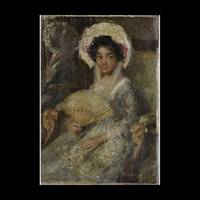
Maris, Simon
Young woman with fan Photo Rag 308 A2
Contentum Ltd. Loose sheet. New. High-quality art print based on an original work from the Rijksmuseum. Created in the 20th century 1906. Professionally printed on premium fine-art paper Photo Rag 308 in size A2. The artwork is printed with a white border museum-style presentation. Contentum Ltd. unknown
書籍販売業者の参照番号
: 3595848
|
|
|
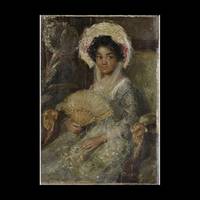
Maris, Simon
Young woman with fan Museum Etching Museum Quality A2
Contentum Ltd. Loose sheet. New. High-quality art print based on an original work from the Rijksmuseum. Created in the 20th century 1906. Professionally printed on premium fine-art paper Museum Etching museum quality in size A2. The artwork is printed with a white border museum-style presentation. Contentum Ltd. unknown
書籍販売業者の参照番号
: 3595850
|
|
|
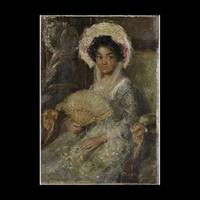
Maris, Simon
Young woman with fan Photo Rag Bright White Premium Quality A2
Contentum Ltd. Loose sheet. New. High-quality art print based on an original work from the Rijksmuseum. Created in the 20th century 1906. Professionally printed on premium fine-art paper Photo Rag Bright White premium quality in size A2. The artwork is printed with a white border museum-style presentation. Contentum Ltd. unknown
書籍販売業者の参照番号
: 3595849
|
|
|
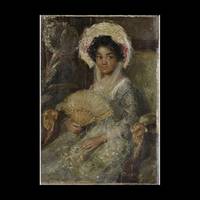
Maris, Simon
Young woman with fan Museum Etching Museum Quality A3
Contentum Ltd. Loose sheet. New. High-quality art print based on an original work from the Rijksmuseum. Created in the 20th century 1906. Professionally printed on premium fine-art paper Museum Etching museum quality in size A3. The artwork is printed with a white border museum-style presentation. Contentum Ltd. unknown
書籍販売業者の参照番号
: 3595847
|
|
|
MARIUS Simon 1573 1624 ZINNER Ernst 1886 1970.
"Zur Ehrenrettung des Simon Marius."
Offprint from:: Vierteljahrsschrift der Astronomischen Gesellschaft 1942. 1942. 77. Jahrgang. I. Heft. . . 8vo. 53 pp. Embossed library stamp on front cover with a few additional markings. Printed wrappers; spine rubbed. Very good. RARE. "Simon Marius latinized from German Simon Mayr January 10 1573 – December 26 1624 was a German astronomer. He was born in Gunzenhausen near Nuremberg but he spent most of his life in the city of Ansbach." Wikipedia. Vierteljahrsschrift der Astronomischen Gesellschaft, 1942. unknown books
書籍販売業者の参照番号
: Z1923
|
|
|
Marius U. - Simon Lambert - Henri U.
Partition de la chanson : J'ai la dingue Marius U. le transformatiste Extra Rapide
Partitions sur la Santé et médecine La renaissance Musicale 1920
書籍販売業者の参照番号
: 97592

|
|
|
Marjot, Thomas (Editor) / McGregor, Colleen (Editor) / Ambrose, Tim (Editor) / Travis, Simon (Consultant Editor) / Cobbold, Jere
Best of Five MCQS for the European Specialty Examination in Gastroenterology and Hepatology Oxford Higher Specialty Training
Oxford University Press 2021. Paperback. New. 2nd edition. 384 pages. 6.10x9.20x0.90 inches. Oxford University Press paperback
書籍販売業者の参照番号
: __0198834373 ISBN : 0198834373 9780198834373

|
|

 検索結果のメールを受信する
 PDFファイルの検索結果をダウンロード
 RSSフィード
 パーマネントリンク


