|
Jean-Baptiste Prosper JOLLOIS - Edouard DEVILLIERS (delineavit) - CHABROL
DESCRIPTION DE L'EGYPTE. Koum Omboû (Ombos). Plan, coupe, et élévation du grand temple, Bas-reliefs du même temple, Détails de hiéroglyphes. (ANTIQUITES, volume I, planche 41)
Imprimerie Impériale | Paris 1809-1829 | 71 x 54 cm | une feuille
Referentie van de boekhandelaar : 25952
|
|
|
Jean-Baptiste Prosper JOLLOIS - Edouard DEVILLIERS (delineavit) - COQUET
DESCRIPTION DE L'EGYPTE. Détails du chapiteau du temple de l'ouest. (ANTIQUITES, volume I, planche 21)
Imprimerie Impériale | Paris 1809-1829 | 54 x 71 cm | une feuille
Referentie van de boekhandelaar : 25962
|
|
|
Jean-Baptiste Prosper JOLLOIS - Edouard DEVILLIERS (delineavit) - LEISNIER (sculpsit)
DESCRIPTION DE L'EGYPTE. Ile de Philae. Diverses coupes du grand temple et des deux pylônes, Détails des lions placés devant le premier pylône. (ANTIQUITES, volume I, planche 9)
Imprimerie Impériale | Paris 1809-1829 | 71 x 54 cm | une feuille
Referentie van de boekhandelaar : 25984
|
|
|
Jean-Baptiste Prosper JOLLOIS - Edouard DEVILLIERS (delineavit) - CORABOEUF (delineavit)
DESCRIPTION DE L'EGYPTE. Thèbes. Memnomium. Plan topographique du tombeau d'Osymandyas, des deux colosses de la plaine et des ruines environnantes. (ANTIQUITES, volume II, planche 19)
Imprimerie Impériale | Paris 1809-1829 | 71 x 53.50 cm | une feuille
Referentie van de boekhandelaar : 26041
|
|
|
Jean-Baptiste Prosper JOLLOIS - Edouard DEVILLIERS (delineavit) - DUTERTRE (delineavit)
DESCRIPTION DE L'EGYPTE. Thèbes. Memnomium. Bas-reliefs sculptés dans la salle hypostyle et sur le premier pylône du tombeau d'Osymandyas. (ANTIQUITES, volume II, planche 31)
Imprimerie Impériale | Paris 1809-1829 | 53.50 x 71 cm | une feuille
Referentie van de boekhandelaar : 26056
|
|
|
Jean-Baptiste Prosper JOLLOIS - Edouard DEVILLIERS (delineavit) - SAINT GENIS (delineavit)
DESCRIPTION DE L'EGYPTE. Thèbes. Memnomium. Plan topographique de divers monuments situés au nord du tombeau d'Osymandyas. (ANTIQUITES, volume II, planche 38)
Imprimerie Impériale | Paris 1809-1829 | 71 x 53.50 cm | une feuille
Referentie van de boekhandelaar : 26062
|
|
|
Jean-Baptiste Prosper JOLLOIS - Edouard DEVILLIERS (delineavit) - LE ROY
DESCRIPTION DE L'EGYPTE. Thèbes. Bybân el Molouk. Statues et fragments de granit noir et de granit rouge trouvés dans les tombeaux des rois à l'ouest, Couvercles de vases trouvés dans les hypogées. (ANTIQUITES, volume II, planche 81)
Imprimerie Impériale | Paris 1809-1829 | 71 x 53.50 cm | une feuille
Referentie van de boekhandelaar : 26089
|
|
|
Jean-Baptiste Prosper JOLLOIS - Edouard DEVILLIERS (delineavit) - DUTERTRE (delineavit)
DESCRIPTION DE L'EGYPTE. Thèbes. Bybân el Molouk. Peintures recueillies dans le cinquième tombeau des rois à l'est, Autres peintures des tombeaux. (ANTIQUITES, volume II, planche 85)
Imprimerie Impériale | Paris 1809-1829 | 53.50 x 71 cm | une feuille
Referentie van de boekhandelaar : 26092
|
|
|
JEAN JEAN
DESCRIPTION DE L'EGYPTE. Collection d'antiques. Toiles peintes, Masque en bois, Objets en terre cuite, Diverses figures et amulettes en forme de scarabées, Fragment en bas-relief, Tête de boeuf en pièces. (ANTIQUITES, volume V, planche 89)
Imprimerie Impériale | Paris 1809-1829 | - | une feuille
Referentie van de boekhandelaar : 26242
|
|
|
Jean DUPLESSIS-BERTAUX - AUDOIN (sculpsit)
DESCRIPTION DE L'EGYPTE. Costumes et portraits. Costumes militaires, Janissaire, Beys, Mamelouks, Arabes, A'lmés, Cheykhs, Femmes dans le harem, Mariée, Écrivain copte, Divers costumes. (ETAT MODERNE, volume II, planche K)
Imprimerie Impériale | Paris 1809-1829 | 71 x 53.50 cm | une feuille
Referentie van de boekhandelaar : 26306
|
|
|
Jean-Baptiste Prosper JOLLOIS - Edouard DEVILLIERS (delineavit) - PHELIPPEAUX (sculpsit)
DESCRIPTION DE L'EGYPTE. Denderah (Tentyris). Corniche et frise des faces latérales du portique du grand temple, Bas-reliefs de l'appartement du zodiaque, Détails dessinés sur les murs du grand temple. (ANTIQUITES, volume IV, planche 22)
Imprimerie Impériale | Paris 1809-1829 | 71 x 54 cm | une feuille
Referentie van de boekhandelaar : 26494
|
|
|
Jean-Baptiste Prosper JOLLOIS - Edouard DEVILLIERS (delineavit) - LEISNIER (sculpsit)
DESCRIPTION DE L'EGYPTE. Denderah (Tentyris). Plans et coupes transversales du grand temple. (ANTIQUITES, volume IV, planche 8)
Imprimerie Impériale | Paris 1809-1829 | 54 x 71 cm | une feuille
Referentie van de boekhandelaar : 26497
|
|
|
Jean-Baptiste Prosper JOLLOIS - Edouard DEVILLIERS (delineavit) - SMITH
DESCRIPTION DE L'EGYPTE. Denderah (Tentyris). Coupes longitudinales du grand temple. (ANTIQUITES, volume IV, planche 11)
Imprimerie Impériale | Paris 1809-1829 | 71 x 54 cm | une feuille
Referentie van de boekhandelaar : 26502
|
|
|
Jean-Baptiste Prosper JOLLOIS - Edouard DEVILLIERS (delineavit) - ST GENIS (delineavit)
DESCRIPTION DE L'EGYPTE. Denderah (Tentyris). Plan topographique des ruines. (ANTIQUITES, volume IV, planche 2)
Imprimerie Impériale | Paris 1809-1829 | 54 x 71 cm | une feuille
Referentie van de boekhandelaar : 26505
|
|
|
Jean-Baptiste Prosper JOLLOIS - Edouard DEVILLIERS (delineavit) - POMEL (sculpsit)
DESCRIPTION DE L'EGYPTE. Denderah (Tentyris). Décoration des antes et d'un soffite, et bas-relief de l'extérieur du portique du grand temple. (ANTIQUITES, volume IV, planche 14)
Imprimerie Impériale | Paris 1809-1829 | 71 x 54 cm | une feuille
Referentie van de boekhandelaar : 26514
|
|
|
Jean-Baptiste Prosper JOLLOIS - Edouard DEVILLIERS (delineavit) - COLIBERT (sculpsit)
DESCRIPTION DE L'EGYPTE. Denderah (Tentyris). Détail de la frise de la façade du portique du grand temple. (ANTIQUITES, volume IV, planche 15)
Imprimerie Impériale | Paris 1809-1829 | 54 x 71 cm | une feuille
Referentie van de boekhandelaar : 26516
|
|
|
Jean-Baptiste Prosper JOLLOIS - Edouard DEVILLIERS (delineavit) - BIGANT (sculpsit)
DESCRIPTION DE L'EGYPTE. Denderah (Tentyris). Plafond du portique du grand temple. (ANTIQUITES, volume IV, planche 18)
Imprimerie Impériale | Paris 1809-1829 | 71 x 54 cm | une feuille
Referentie van de boekhandelaar : 26520
|
|
|
Jean-Baptiste Prosper JOLLOIS - Edouard DEVILLIERS (delineavit)
DESCRIPTION DE L'EGYPTE. Syout (Lycopolis). Plan, coupes et élévation de l'hypogée principal. (ANTIQUITES, volume IV, planche 44)
Imprimerie Impériale | Paris 1809-1829 | 71 x 54 cm | une feuille
Referentie van de boekhandelaar : 26522
|
|
|
Jean-Baptiste Prosper JOLLOIS - Edouard DEVILLIERS (delineavit) - ALLAIS (sculpsit)
DESCRIPTION DE L'EGYPTE. Syout (Lycopolis). Bas-reliefs recueillis dans la salle du fond de l'hypogée principal. (ANTIQUITES, volume IV, planche 45)
Imprimerie Impériale | Paris 1809-1829 | 54 x 71 cm | une feuille
Referentie van de boekhandelaar : 26525
|
|
|
Jean-Baptiste Prosper JOLLOIS - DEVILLIERS - LOUVET (sculpsit)
DESCRIPTION DE L'EGYPTE. Denderah (Tentyris). Plan, élévation et coupes du Typhonium. (ANTIQUITES, volume IV, planche 32)
Imprimerie Impériale | Paris 1809-1829 | 71 x 54 cm | une feuille
Referentie van de boekhandelaar : 26538
|
|
|
Jean-Baptiste Prosper JOLLOIS - Edouard DEVILLIERS (delineavit) - LOUVET (sculpsit)
DESCRIPTION DE L'EGYPTE. Abydus. Plan, élévation et coupes du palais. (ANTIQUITES, volume IV, planche 36)
Imprimerie Impériale | Paris 1809-1829 | 71 x 54 cm | une feuille
Referentie van de boekhandelaar : 26542
|
|
|
Jean-Baptiste Prosper JOLLOIS - Edouard DEVILLIERS (delineavit) - SCHROEDER (sculpsit)
DESCRIPTION DE L'EGYPTE. Thèbes. Qournah. Vue perspective du palais. (ANTIQUITES, volume II, planche 43)
Imprimerie Impériale | Paris 1809-1829 | 71 x 53.50 cm | une feuille
Referentie van de boekhandelaar : 32820
|
|
|
Jean-Baptiste Prosper JOLLOIS - Edouard DEVILLIERS (delineavit) - CANU (sculpsit)
DESCRIPTION DE L'EGYPTE. Thèbes. Bybân el Molouk. Idole et fragments d'antiquités en serpentine, en albâtre et en grès trouvés dans le tombeau isolé de l'ouest. (ANTIQUITES, volume II, planche 80)
Imprimerie Impériale | Paris 1809-1829 | 53.50 x 71 cm | une feuille
Referentie van de boekhandelaar : 32823
|
|
|
Jean-Baptiste Prosper JOLLOIS - Edouard DEVILLIERS (delineavit) - DUTERTRE (delineavit)
DESCRIPTION DE L'EGYPTE. Thèbes. Bybân el Molouk. Peintures recueillies dans le cinquième tombeau des rois à l'est, Autres peintures des tombeaux. (ANTIQUITES, volume II, planche 85)
Imprimerie Impériale | Paris 1809-1829 | 53.50 x 71 cm | une feuille
Referentie van de boekhandelaar : 32827
|
|
|
Jean-Baptiste Prosper JOLLOIS - Edouard DEVILLIERS (delineavit) - LE PERE (delineavit)
DESCRIPTION DE L'EGYPTE. Thèbes. Medynet-Abou. Plan, élévation et coupe d'un temple situé à l'angle sud-est de l'enceinte, Plan, élévation, coupes et bas-relief d'un temple au sud de l'hippodrome, Porte située en avant du temple. (ANTIQUITES, volume II, planche 18)
Imprimerie Impériale | Paris 1809-1829 | 53.50 x 71 cm | une feuille
Referentie van de boekhandelaar : 32868
|
|
|
Jean-Baptiste Prosper JOLLOIS - Edouard DEVILLIERS (sculpsit) - POMEL (sculpsit)
DESCRIPTION DE L'EGYPTE. Thèbes. Medynet-Abou. Bas-reliefs sculptés dans les galeries est et sud du péristyle du palais. (ANTIQUITES, volume II, planche 13)
Imprimerie Impériale | Paris 1809-1829 | 71 x 53.50 cm | une feuille
Referentie van de boekhandelaar : 32870
|
|
|
Jean-Baptiste Prosper JOLLOIS - Edouard DEVILLIERS (delineavit) - CORABOEUF (delineavit)
DESCRIPTION DE L'EGYPTE. Thèbes. Qournah. Plan topographique des ruines et des environs. (ANTIQUITES, volume II, planche 40)
Imprimerie Impériale | Paris 1809-1829 | 53.50 x 71 cm | une feuille
Referentie van de boekhandelaar : 32881
|
|
|
Jean-Baptiste Prosper JOLLOIS - Edouard DEVILLIERS (delineavit) - SCHROEDER (sculpsit)
DESCRIPTION DE L'EGYPTE. Thèbes. Medynet-Abou. Plan topographique des ruines et des environs. (ANTIQUITES, volume II, planche 2)
Imprimerie Impériale | Paris 1809-1829 | 71 x 53.50 cm | une feuille
Referentie van de boekhandelaar : 32882
|
|
|
Jean-Baptiste Prosper JOLLOIS - DEVILLIERS - MONSALDI
DESCRIPTION DE L'EGYPTE. Thèbes. Karnak. Divers bas-reliefs sculptés sur les stèles et les murs des appartements de granit du palais. (ANTIQUITES, volume III, planche 36)
Imprimerie Impériale | Paris 1809-1829 | 71 x 54 cm | une feuille
Referentie van de boekhandelaar : 35550
|
|
|
Jean-Baptiste Prosper JOLLOIS - Edouard DEVILLIERS (delineavit) - BIGANT (sculpsit)
DESCRIPTION DE L'EGYPTE. Environs d'Esné (Latopolis). Zodiaque sculpté au plafond du temple au nord d'Esné. (ANTIQUITES, volume I, planche 87)
Imprimerie Impériale | Paris 1809-1829 | 71 x 54 cm | une feuille
Referentie van de boekhandelaar : 35613
|
|
|
Jean-Baptiste Prosper JOLLOIS - Edouard DEVILLIERS (delineavit) - Edme-François JOMARD
DESCRIPTION DE L'EGYPTE. Erment (Hermonthis). Bas-reliefs sculptés dans le sanctuaire du temple. (ANTIQUITES, volume I, planche 96)
Imprimerie Impériale | Paris 1809-1829 | 71 x 54 cm | une feuille
Referentie van de boekhandelaar : 35623
|
|
|
Jean-Marie GIBBAL
Guérisseurs et magiciens du Sahel
A.M. Métaillé | Paris 1984 | 12 x 21.50 cm | broché
Referentie van de boekhandelaar : 60305
|
|
|
Jean-Jacques SUSINI
Histoire de l'O.A.S. Tome I (seul paru)
La Table Ronde | Paris 1963 | 16.50 x 23 cm | broché
Referentie van de boekhandelaar : 65814
|
|
|
Jean RENAUD - Tahar ESSAFI
La sorcière d'émeraude. Récits nord-africains
Edgar Malfère | Paris 1929 | 15 x 19.50 cm | broché
Referentie van de boekhandelaar : 40703
|
|
|
Jean MAUCLÈRE
Lyautey prince lorrain
Editions Spes | Paris 1951 | 12 x 19 cm | broché
Referentie van de boekhandelaar : 33293
|
|
|
Jeanne SORREL
Pages africaines. L'Afrique du nord vue par les littérateurs
Editions des horizons de France | Paris 1938 | 18.50 x 24 cm | broché
Referentie van de boekhandelaar : 39880
|
|
|
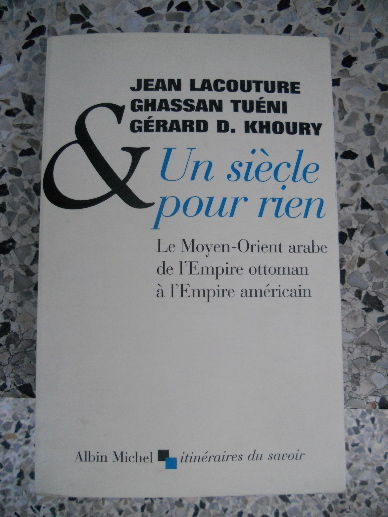
Jean Lacouture / Ghassan Tueni / Gerard D. Khoury
Un siecle pour rien - Le moyen-orient de l'empire ottoman a l'empire americain
Albin Michel, collection "itineraires du savoir", 2003. Format 14x23 cm, broche, 367 pages.Etat neuf.
Referentie van de boekhandelaar : 24941
|
|
|
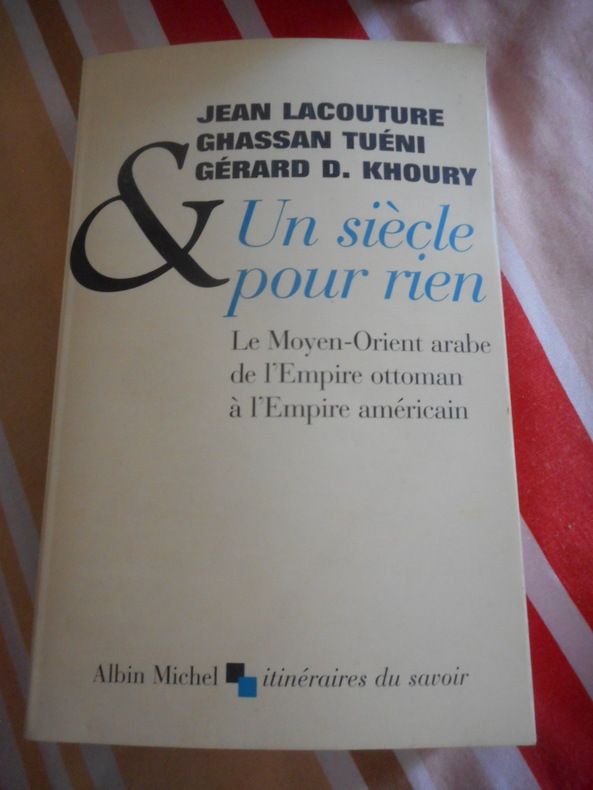
Jean LACOUTURE / Ghassan TUENI / Gerard D. KHOURY
Un siècle pour rien - Le Moyen-Orient arabe de l'Empire ottoman à l'Empire américain
Albin Michel, collection "Itinéraires de savoir", 2003. Format 14x22 cm, 367 pages. Très bon état.
Referentie van de boekhandelaar : 50161
|
|
|
Jean FRELAUT - Eugène FROMENTIN
Un été dans le Sahara
Plon | Paris 1912 | 11.50 x 18.50 cm | relié
Referentie van de boekhandelaar : 61804
|
|
|
JEAN BARON ROUSSEAU.
Seyahatname. Bagdad'dan Haleb'e Arabistan seyahati. Translated by Ali Suad.
As New English Paperback. Pbo. Mint. Demy 8vo. (21 x 14 cm). In Turkish. 100 p. Rousseau's travel memoirs in his travel to Arabia from Baghdad to Aleppo. Turkish translation. Seyahatname. Bagdad'dan Haleb'e Arabistan seyahati. Translated by Ali Suad.
|
|
|
Jeffries, David.
A treatise on diamonds and pearls. In which their importance is considered: and plain rules are exhibited for ascertaining the value of both: and the true method of manufacturing diamonds. London, C. & J. Ackers, for the author, 1750.
8vo. (6), IV, (16), 69, (3) pp. With 30 engraved plates (some depicting cuts of diamonds) and tables. Contemporary mottled calf with gilt dentelle border and corner fleurons (rubbed); modern spine on 5 raised bands. Rare first edition of the "first book in English to describe how diamonds and pearls can be evaluated on the basis of the factors of size (or weight) and style of cut" (Sinkankas). The London jeweller Jeffries is also the first author to provide "a clear statement of the principle that the value of pearls should be calculated to the square of their weight [...] This principle is implicit in the valuation tables given by earlier authors, including Tavernier and others, but Jeffries is the first to state it explicitly. At the back of his book, he provides tables allowing the calculation of the value of individual and batches of pearls of different size or quality. This is effectively a 'chau' book, as used by merchants in the Gulf and India until the mid-20th century, and fulfils exactly the same function" (Carter). - "The text explains the [diamond] cutting procedure, how the evaluation rules were derived, the importance of imperfections and flaws as affecting price, notes on rough diamonds [...] and finally, a somewhat similar procedure for the valuation of pearls, with highest values accorded to pearls of closest approach to spherical perfection, luster, etc. The mathematical rule used for the pearl is known as the 'square of the weight' multiplied by a per-carat base price" (Sinkankas). - Includes a list of subscribers in the preliminaries. Occasional spotting, a few small stains. Small tape repair to title, plates 5 & 6 with short repaired tears (no loss). Professional repairs to corners; modern spine (repairs including the first inch of the covers); modern endpapers. Removed from the Library of the Birmingham Assay Office, one of the four assay offices in the United Kingdom, with their library stamp to the title-page. Sinkankas 3195. Carter, Sea of Pearls, p. 83, 125f., 251 (with illustrations). Goldsmiths' 8500. Hoover 453 (note). Cf. Roller/G. II, 10.
|
|
|
Jeffries, David.
A treatise on diamonds and pearls. In which their importance is considered; and plain rules are exhibited for ascertaining the value of both. The fourth edition, with large improvements. London, E. Lumley, [1871].
8vo. XVI, 116 pp. With 30 plates. Contemporary blue cloth, covers blindstamped and upper cover gilt, title gilt to spine. A 19th century edition of the "first book in English to describe how diamonds and pearls can be evaluated on the basis of the factors of size (or weight) and style of cut" (Sinkankas). The London jeweller Jeffries is also the first author to provide "a clear statement of the principle that the value of pearls should be calculated to the square of their weight [...] This principle is implicit in the valuation tables given by earlier authors, including Tavernier and others, but Jeffries is the first to state it explicitly. At the back of his book, he provides tables allowing the calculation of the value of individual and batches of pearls of different size or quality. This is effectively a 'chau' book, as used by merchants in the Gulf and India until the mid-20th century, and fulfils exactly the same function" (Carter). - "The text explains the [diamond] cutting procedure, how the evaluation rules were derived, the importance of imperfections and flaws as affecting price, notes on rough diamonds [...] and finally, a somewhat similar procedure for the valuation of pearls, with highest values accorded to pearls of closest approach to spherical perfection, luster, etc. The mathematical rule used for the pearl is known as the 'square of the weight' multiplied by a per-carat base price" (Sinkankas). - Insignificant browning. Removed from the Library of the Birmingham Assay Office, one of the four assay offices in the United Kingdom, with their library stamp to the flyleaf. OCLC 31561438. Cf. Sinkankas 3195. Carter, Sea of Pearls, p. 83, 125f., 251. Goldsmiths' 8500. Hoover 453 (note). Roller/G. II, 10.
|
|
|
Jeffries, David.
Traité des diamants et des perles, où l'on considère leur importance, on établit des règles certaines pour en connoître la juste valeur. Paris, Debure & N. Tillard, 1753.
8vo. (8), XXXXV, (1), 104 pp. With engraved dedicatory headpiece and 8 (instead of 10) engraved plates (some depicting cuts of diamonds) and tables. Contemporary smooth calf with gilt cover borders and red spine label. First edition in French of this early book describing "how diamonds and pearls can be evaluated on the basis of the factors of size (or weight) and style of cut" (Sinkankas). The London jeweller Jeffries is the first author to provide "a clear statement of the principle that the value of pearls should be calculated to the square of their weight [...] This principle is implicit in the valuation tables given by earlier authors, including Tavernier and others, but Jeffries is the first to state it explicitly. At the back of his book, he provides tables allowing the calculation of the value of individual and batches of pearls of different size or quality. This is effectively a 'chau' book, as used by merchants in the Gulf and India until the mid-20th century, and fulfils exactly the same function" (Carter). - "The text explains the [diamond] cutting procedure, how the evaluation rules were derived, the importance of imperfections and flaws as affecting price, notes on rough diamonds [...] and finally, a somewhat similar procedure for the valuation of pearls, with highest values accorded to pearls of closest approach to spherical perfection, luster, etc. The mathematical rule used for the pearl is known as the 'square of the weight' multiplied by a per-carat base price" (Sinkankas). - This French edition is much scarcer than the expanded second English edition, on which it is based. It is dedicated by the translator (the Royal librarian Chappotin S. Laurent) to the sixteen-year-old Louis Joseph de Bourbon, prince de Condé, on the occasion of his marriage to Charlotte de Rohan. - Hinges weak, corners and spine-ends bumped and chipped. Lacks the final two plates (showing the cuts of the largest diamonds). Provenance: 20th century handwritten ownership to title-page. Removed from the Library of the Birmingham Assay Office, one of the four assay offices in the United Kingdom, with their library stamp to the flyleaf. Sinkankas 3198. Cf. Carter, Sea of Pearls, p. 83, 125f., 251. Goldsmiths' 8500. Hoover 453. Roller/G. II, 10.
|
|
|
Jeffries, David.
Traité des diamants et des perles, où l'on considère leur importance, on établit des règles certaines pour en connoître la juste valeur. Paris, Debure & N. Tillard, 1753.
8vo. (8), XXXXV, (1), 104 pp. With engraved dedicatory headpiece and 10 engraved plates (some depicting cuts of diamonds) and tables. Contemporary French mottled calf with red giltstamped label to prettily gilt spine. Marbled endpapers. All edges red. First edition in French of this early book describing "how diamonds and pearls can be evaluated on the basis of the factors of size (or weight) and style of cut" (Sinkankas). The London jeweller Jeffries is the first author to provide "a clear statement of the principle that the value of pearls should be calculated to the square of their weight [...] This principle is implicit in the valuation tables given by earlier authors, including Tavernier and others, but Jeffries is the first to state it explicitly. At the back of his book, he provides tables allowing the calculation of the value of individual and batches of pearls of different size or quality. This is effectively a 'chau' book, as used by merchants in the Gulf and India until the mid-20th century, and fulfils exactly the same function" (Carter). - "The text explains the [diamond] cutting procedure, how the evaluation rules were derived, the importance of imperfections and flaws as affecting price, notes on rough diamonds [...] and finally, a somewhat similar procedure for the valuation of pearls, with highest values accorded to pearls of closest approach to spherical perfection, luster, etc. The mathematical rule used for the pearl is known as the 'square of the weight' multiplied by a per-carat base price" (Sinkankas). - This French edition is much scarcer than the expanded second English edition, on which it is based. It is dedicated by the translator (the Royal librarian Chappotin S. Laurent) to the sixteen-year-old Louis Joseph de Bourbon, prince de Condé, on the occasion of his marriage to Charlotte de Rohan. - Professional repairs to hinges and corners; in all a fine copy. Provenance: Handwritten ownership of the Brussels jeweller Emanuel Meyer, dated 1788, to title-page. 19th century engraved bookplate of Thomas Westwood to pastedown. Latterly removed from the Library of the Birmingham Assay Office, one of the four assay offices in the United Kingdom, with their library stamp to the second flyleaf. Sinkankas 3198. Cf. Carter, Sea of Pearls, p. 83, 125f., 251. Goldsmiths' 8500. Hoover 453. Roller/G. II, 10.
|
|
|
JERNAZIAN (Ephraim)
Judgment unto truth. Witnessing the armenian genocide.
New Brunswick, Transaction Publ., 1990. In-8 broché, 163 pp., ill. en noir. (Zoryan Institute Survivors' Memoirs, 4).
Referentie van de boekhandelaar : 556336 ISBN : 88738823
|
|
|
JERPHANION (Guillaume de)
Une nouvelle province de l'art byzantin. Les églises rupestres de Cappadoce. Planches, troisième album.
Paris, Libr. Orientaliste P. Geuthner, 1934. Album grand in-folio (32,5 x 45,5cm), chemise portefeuille d'édition, dos toilé, planches n° 145 à 208, plans, dessins, nombreuses illustrations photographiques, plusieurs en couleurs contrecollées, ces planches sont à rapprocher du texte de la 1ère partie du TII.
Referentie van de boekhandelaar : 540348
|
|
|
JERUSALEM
La P?que des juifs ? J?rusalem. Article (2 pages) dans L'Illustration.
Num?ro complet. 131244
|
|
|
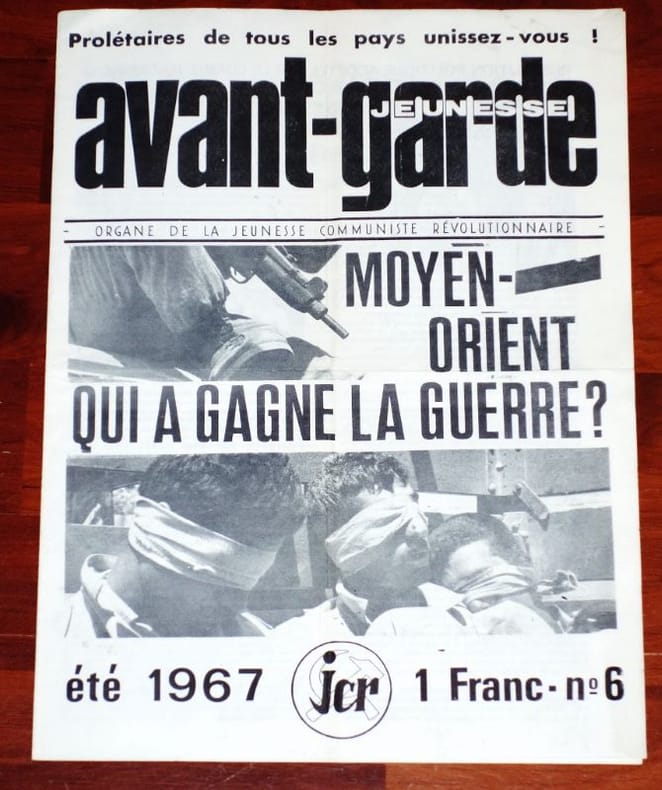
JEUNESSE COMMUNISTE RÉVOLUTIONNAIRE
AVANT-GARDE JEUNESSE, organe de la Jeunesse communiste révolutionnaire, n° 6. Été 1967.
1967 Paris, JCR, 1967. Au sommaire : Moyen-Orient, qui a gagné la guerre ? - Le Monde enchanté des vacances - Regis Debray. Journal de 4 pp., au format 23 x 31 cm. Deux pliures centrales sinon très bon état.
Referentie van de boekhandelaar : 18876
|
|
|
JIDEJIAN (Nina)
Lebanon anthe Greek world. 333 to 64 B.C. - Le Liban et le monde Grec. 333 à 64 av. J.C.
Beirut, Dar el-Machreq, s.d. [1988]. In-4, cart. éd. vert sous jaquette ill. en coul., 144 pp., très nb. reprod. photogr. en n/b. et en coul. de médailles, texte bilingue (anglais-français) sur 2 colonnes , résumé chronologique et tableaux généalogiques in fine.
Referentie van de boekhandelaar : 595390
|
|
|
Jode, Cornelis de.
Secundae Partis Asiae [...]. Antwerp, 1593.
20 x 13 inches. Hand-coloured. Fine example of De Jode's modern map of the Middle East, from his Speculum Orbis Terrae, published in Antwerp in 1578 and engraved by Joannes & Lucas van Deutecum. The complete title reads: "Secundae partis Asiae: typus qua oculis subijciuntur itinera nautarum qui Calecutium Indiae mercandorum aromatum caufa fre quentant, ac eorum quoqz qui terrestri itinere ade unt Suacham, Laccam, in domino Praeto Iani, nec non eorum qui Aden et ormum inuifunt, et Balsaram quoque castrum, supra Euphratem fluuium situm, omnia suis gradibus subiecta, cum longitudinis tum latitudinis / Iacobo Castaldo pedemontano authore; Gerhardus de Iode excudebat". As noted in the title, the map was prepared by Gerard De Jode's and is largely identical to Giacomo Gastaldi's highly influential map of 1559. De Jode's delineation of Arabia is vastly superior to the contemporary maps of Ortelius, showing far more accuracy and detail. Extending from the Nile to Afghanistan and centered on the Arabian Peninsula and the Gulf, the map depicts what was then still among the most important trading centers of the commercial world. The present example is from the first edition of De Jode's work, which can be distinguished from the second edition by the pagination on the verso (VII for the 1578 edition; 9 for the 1593 edition). The map is drawn from the rare first edition of De Jode's Speculum Orbis Terrarum. At least one commentator has opined that as few as 11 known examples of the first edition are known to have survived, making separate maps from this first edition very rare on the market. - Giacomo Gastaldi (fl. 1542-1565) is widely considered to be the most important and influential of all of the Lafreri School mapmakers. Born in Piedmont, Gastaldi worked in Venice, where he become Cosmographer to the Venetian Republic. Karrow described him as "one of the most important cartographers of the sixteenth century. He was certainly the greatest Italian mapmaker of his age..." While his achievement is obvious, it is hard to quantify. A large number of maps were published throughout this period with the geography credited to Gastaldi, but it is often difficult to know what role Gastaldi played in their creation. As a practice, he did not sign himself as publisher, although his name may be found in the title, dedication, or text to the reader. Frequently where there is no imprint one may assume that Gastaldi was the publisher. A further clue may be that many of the maps attributable to Gastaldi as publisher seem to have been engraved by Fabius Licinius. In other cases, where publication is credited to another, it is not always certain whether Gastaldi was commissioned by the publisher to compile the map, whether another less-enterprising publisher merely copied his work and attribution, or simply added Gastaldi's name in the title to add authority to the delineation. His name clearly commanded the same sort of respect that the Sanson name had in the last years of the seventeenth century, and as Guillaume de L'Isle's had in the first half of the eighteenth century. Gastaldi's first published map was of Spain, engraved on four sheets, and issued in 1544. The following year he published a map of Sicily, among the most widely copied of all his maps. In the course of a prolific career, Gastaldi subsequently produced a number of maps of Italy, and individual parts of the peninsula, with his general map of Italy, and the map of Piedmont also being very influential. Among the most important of his maps, however, were of areas outside Italy. Principal among these was his map of the World, published in 1546, a four sheet map of the countries of south-eastern Europe, published in 1559, and his series of three maps of the Middle East, Southern Asia, and South-East Asia with the Far East, issued between 1559 and 1561. In 1562, Gastaldi issued a two-sheet map of the Kingdom of Poland, and in 1564, a magnificent eight-sheet map of Africa. Karrow, Mapmakers of the Sixteenth Century, 30/91.2. Tibbetts, Arabia in Early Maps 38.
|
|

 De zoekresultaten per email ontvangen
 Zoekresultaten downloaden als PDF
 RSS feed
 Permanente link


