|
|
|
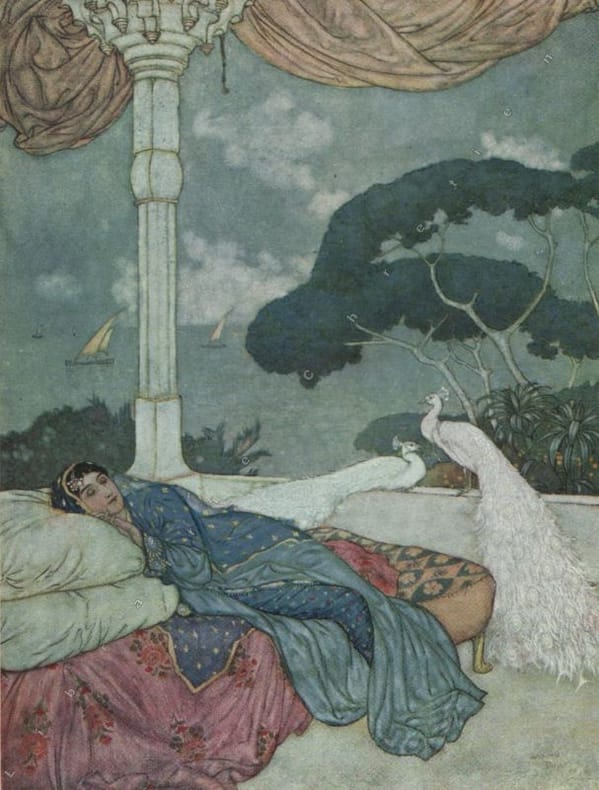
KHAYYAM (Omar). DULAC (Edmund).
Rubaiyat.
Paris OLLENDORF 1910 1 Traduction française de Edmond Dulac, d'après la version de Edward Fittzgerald. Paris, Piazza, (1910), in-4, broché, couverture illustrée décor persan or, 12 planches.
Riferimento per il libraio : 24223
|
|
|
Khayyam, Omar; Whinfield, E. H.
THE QUATRAINS OF OMAR KHAYYAM. Translated into English Verse by E.H. Whinfield. Second Edition, Revised.
124p. Large bookplate of S. M. Boddington. Foxed. A few penciled marks. 8vo. Original full tan cloth binding. Front board decorated and embossed in gold with publisher's device. Binding soiled. Hardbound. Second edition. The first edition of this book was published in 1882, and contained 253 quatrains. Whinfield brought out this edition in 1893 containing the English text of 267 quatrains, based on a collation of eight authorities. Very good. Scarce. ISLAM BOX 1
|
|
|
KHITROWO B. DE
Itineraires Russes en Orient traduits pour la Societe de l'Orient Latin
Cm. 25; pp. 334. 1930 Half leather. Very good copy. (Middle East) 1390/P
|
|
|
Khomeini, Ayatollah Sayyed Ruhollah Mousavi & Borujerdi, J
A Clarification of Questions: An Unabridged Translation of Resaleh Towzih al-Masael
Boulder CO.: Westview Press 1984. Comprehensive scholarly text presents an unabridged translation of Ayatollah Khomeini's "A Clarification of Questions" which provides a unique picture of the belief structure of Shi'ism. A compendium of 3000 "problems" Khomeini's treatise is intended to guide laymen in their religious duties as well as to cover all of life's questions and needs from personal hygiene and ritual purity to organ transplants and modern banking. The Resaleh Towzih al-Masael reveals how the external world is viewed by the Shi'ite faithful. 432 pp. No spine cracks or creases. Scarce. First Edition. Soft Cover. As New. Illus. by . 8vo - over 7¾" - 9¾" tall. Westview Press Paperback
Riferimento per il libraio : MS-22 ISBN : 0865318549 9780865318540

|
|
|
Khoury, H(eneine) B.
Glimpses Behind the Veil. London, Sampson Low, Marston & Co., [1935].
Large 8vo. X, 342 pp. With portrait frontispiece and 62 illustrations on 23 plates. Original red cloth. First edition. - "The travels (c. 1934) of an Arab girl in the Near and Middle East, including a journey with her brother through Lebanon, Iran and the Persian Gulf. The author, a feminist of sorts, visits Tehran, the Caspian region, Esfahan, Persepolis, Shiraz and Bushehr. She views Reza Shah favorably, 'the roads are safe', modernization, industrial plants, etc." (Ghani). Also contains chapters on her sojourn in the "romantic pearl islands of Bahrein" (with an illustration of the author in local Bahraini costume, a gift of the ruler and his wife). - Occasional slight foxing, but well preserved. Ghani 208. OCLC 18175528. Not in Macro, Bibliography of the Arabian Peninsula.

|
|
|
KIAZIM (Omer)
L'aventure kémaliste. Elle est un danger : pour l'Orient, pour l'Europe, pour la paix.
P., L'Edition universelle, 1921. In-12 broché, 104-IX pp., [1] f.
Riferimento per il libraio : 556292
|
|
|
Kiepert, Heinrich.
Specialkarte vom westlichen Kleinasien. Berlin, Dietrich Reimer, 1890.
Folio (365 x 545 mm). 14 (instead of 15) maps (lacking no. 11). Contemporary black half-leather binding over brown cloth. Kiepert's map of the western part of Asia Minor: the personal copy of Paul Gaudin, the archaeologist and engineer in charge of the completion of the Hejaz railway. - In the margins, the numbers of the adjacent maps are written in blue pencil. On maps VIII and IX the route of the railway line as well as the names and numbers of the stations between Alasehir/Philadelphia and Karahissâr/Afiûn were added by Gaudin in red ink. - Binding rubbed. Interior in good general condition despite some minor soiling, tears and pinholes. Also included are maps of Turkey, drawn on tracing paper, showing the route of the Smyrna-Panderma and Smyrna-Afion/Karahissar railway lines. - Provenance: from the library of the archaeologist, collector and railway engineer Paul Gaudin (1858-1921), in charge of the completion of the Hejaz railway in the first decade of the 20th century and later a major donor to the Louvre Museum. OCLC 32646128.
|
|
|
Kimche, Jon.
THE SECOND ARAB AWAKENING.
288p. Illustrated with maps. 8vo. Original full black cloth binding, slightly spotted. Original dust jacket, slightly worn. Hardbound. First edition. Books such as this become increasingly significant with each passing day. Very good. ISLAM BOX 1
|
|
|
Kindleben, Christian Wilhelm.
Galanterieen der Türken. "Frankfurt und Leipzig" [= Altona, J. H. Kaven & Comp.], 1783.
8vo. 2 parts in 1 vol. XVI, 340 pp. (3)-136 pp. With engr. frontispiece by Wentzel (counted in the pagination) and 40 folding costume plates by Endler, in original hand colour. Modern marbled boards retaining original giltstamped red spine label. First edition. - A frequently loose account of oriental conditions and excesses; "based exclusively on earlier travel publications" (cf. Chatzipanagioti-S.). The appendix of pt. 2 has a separate title: "History of a noble Turkish lady who, dressed as a man, found her fortune and death amongst weaponry in Europe". The prologue admits that this appendix "bears no connexion with the preceding matter" - indeed, it has nothing to to with Ottoman history at all, but is a satire on German conditions during the Seven Years' War, replete with allusions which would bear closer study. The author, Christian Wilhelm Kindleben (1748-85), was sometime assistant to Basedow at the Philanthropinum reform school in Dessau. - The engravings show costumes for gentlemen and ladies; "the images of the Sultana combine elements drawn from various illustrations found in Ferriol's 'Recueil'" (cf. Chatzipanagioti-S.). - Evenly browned throughout. German postwar trade records cite a single coloured copy. Chatzipanagioti-S. 481 (= 482; citing merely 39 plates). Frauen reisen 316. Lipperheide 1419 (Lb 3). Colas 1607. Hiler 496. Hayn/Gotendorf III, 559 (and V, 111; VII, 723). Goedeke IV/1, 929, 33.

|
|
|
KING LW L W
Egypt and Western Asia in the Light of Recent Discoveries. Containing One Hundred Plates and Illustrations. ROBERT SINKER'S COPY
SPCK 1907. 8vo. First Edition with frontispiece original tissue guard captioned in red present and numerous plates and illustrations in the text; original red buckram bevelled boards gilt back black endpapers uncut backstrip very lightly sunned else a remarkably bright fresh clean copy. ROBERT SINKER'S COPY WITH HIS SIGNED INSCRIPTION ON FRONT FREE ENDPAPER VERSO. Robert Sinker 1838-1913 was famously Librarian of Trinity College Cambridge and Chaplain of Trinity College Chapel. He compiled several bibliographical works including a scholarly account of the College library and the standard Catalogue of its Fifteenth-Century Printed Books and was active also as a biblical scholar publishing a number of textual studies resulting from the progressive archaeology of the Holy Land. A SPLENDID AND IMPORTANT ASSOCIATION COPY. SPCK, hardcover
Riferimento per il libraio : 21954

|
|
|
KINROSS (Lord)
Within the taurus. a journey in asiatic Turkey.
London, John Murray, 1954. In-8, rel. d’éditeur toile ocre, dos titré, sous jaquette ill., XI-191 pp., carte sur double page, ill. photogr. en noir en planches h.-t. dont le frontispice. Index.
Riferimento per il libraio : 556953
|
|
|
KIRK (George E.).
A Short History of the Middle East, from the Rise of Islam to Modern Times.
New York, Frederick A. Praeger, 1959, in-8°, x-336 pp, 14 cartes, index, reliure pleine toile vermillon de l'éditeur, sans la jaquette, bon état. Texte en anglais
Riferimento per il libraio : 100339
|
|
|
Kirk, John, British administrator in Zanzibar (1832-1922); co-explorer with David Livingstone.
Autograph letter signed ("very sincerely John Kirk"). Zanzibar, 14. VII. 1868.
4to. 6 pp. of 3 ff. With autograph envelope. To the English diplomat and army officer Christopher Palmer Rigby, Consul of Zanzibar from 1858 to 1861. Kirk raises his doubts about Sultan Majid bin Said's desire to end the slave trade, whilst already foreseeing that his successor-to-be Burghash bin Said would be more open to this aim. - Kirk expresses his hopes that in Zanzibar there will "soon be a more rigorous policy for suppression of [the] slave trade", noting that "this year the Arabs have had it all their own", as Britain was engaged in the Abyssinian Wars, and that "my experience of the Arabs is [...] they are all liars, but Suliman bin Ali the real Sultan and only man to go to if you wish anything done is decidedly no exception", discussing the poor health of Majid, Sultan of Zanzibar, and a school of thought that his expected successor, Burghash bin Said ("a very intelligent Liberal man, outspoken and quick"), would be more friendly with the English, expanding on the rivalry between various local factions within Zanzibar. - John Kirk, chief assistant to David Livingstone during his celebrated expedition from 1858 to 1863, was appointed vice-consul of Zanzibar in 1866, and in 1873 "persuaded the sultan of Zanzibar to sign an anti-slavery treaty, closing the island's slave markets, and providing protection for all liberated slaves" (ODNB). An incomplete transcription of this letter is reproduced in Russell, General Rigby, Zanzibar and the Slave Trade, 1935, pp. 301f.
|
|
|
Kirk, John, British administrator in Zanzibar (1832-1922); co-explorer with David Livingstone.
Autograph letter signed. Zanzibar, 3. VIII. 1884.
4to (240:190 mm). 8 pp. on two double-leaf stationery, watermarked "Original Malling Mill Kent". To "my dear Smith": "It is most pleasing to see here the S[lave] T[rade] is driven back [...] In fact Kilwa now seems the saintly place [...] If this scarcity of food and failure of crops extends far inland we shall have the population begging to be sold. Mafia [Island] may take in slaves but it is so near the mainland that no person on earth could prevent it while the institute exists - but is their demand enough on Mafia for any great number of slaves? Boette and coconuts are its chief exports. When you go there visit Kisiwani [...] where corals are washed out of the bank in thousands [...] The Kilwa ruling family fled at one time it is mentioned in the old Kilwa chronicle. Did these old Kilwa kings [grow?] nothing but coffee & do the Bavarians buy up the silver and gold? Native traders are no fools and if gold & silver is ever found I would gladly pay a little over the value of the metal to settle a few permits [...] If you see your way I think a trip south should may be time well spent. I daren't visit the Kilwa people (Indians) [...] I feel sure the end of the land S[lave] T[rade] is further south and the local demand must be very great. I have little faith in estimates made on short experience, so often a man takes the one month or two when slaves are brought down and multiplies it by twelves for the year's estimate. One thing is to find out the caravan men [...]". - Written during the Berlin Conference of 1884/1885 which regulated European colonisation and trade in Africa during the New Imperialism period, and coincided with Germany's sudden emergence as an imperial power, Kirk discusses trade of slaves, as well as gold and silver, the latter mainly in reference to Germans. He suggests that slave trade activity is diminishing near Kilwa due to British abolition efforts, though not as much further south. He then presents theories on estimating the numbers of slaves captured. Also interesting and infrequently documented, he presents concern respecting slavery on Mafia Island. [In the mid-1820s, the town of Kua on Juani Island, the southernmost of the Mafia archipelago, was attacked by Sakalava cannibals arriving from Madagascar with 80 canoes, who ate many of the locals and took the rest into slavery. Under a treaty of 1890, Germany took control of Mafia and constructed the buildings still evident on Chole Island.] - The recipient of the letter, identified as 'Smith', may be Sir Charles Euan-Smith, a Colonel in the British Army who in 1887 he would be appointed Her Majesty's Agent and Consul-General for the Dominions of the Sultan of Zanzibar. [In February 1890 the Sultan died and Euan-Smith took advantage of the situation to persuade the new Sultan, Ali bin Said, that Zanzibar should be a British protectorate. This resulted in the so-called Heligoland-Zanzibar Treaty of July 1890 in which Germany and the United Kingdom agreed on territorial interests in East Africa.]. - By 1868 Omani traders of Zanzibar had long since driven the Portuguese out and Kilwa had been a leading Arab center of the East African slave trade for more than a century. Thriving European plantation economies as close as Mauritius and as far away as Brazil perpetuated the nefarious trade. Kilwa was eventually absorbed into the Sultanate of Zanzibar (1841-1884) which controlled the lion's share of the East African trade. Zanzibar attracted the attention of European imperial and anti-slavery interests which forced the Sultan to close its then-famous slave market in 1873. To this end, the Sultan Bargash signed an edict making slavery illegal and imprisoned the Governor of Kilwa. Even so, the trade for a time remained brisk and a slave was allegedly sold there as late as 1935. Kilwa was part of the colony of German East Africa from 1886 to 1918. - Sir John Kirk (1832-1922) was a Scottish physician, naturalist, explorer, and British administrator in Zanzibar. He accompanied David Livingstone on his second Zambesi expedition from 1858 to 1863. In 1873 Kirk was made the first British Agent and Consul General of Zanzibar, where he eventually convinced the Sultan of Zanzibar to ban the highly lucrative slave trade. He held this post until he returned to England in 1887. He was also a keen botanist, highly regarded by Sir William Hooker, Joseph Dalton Hooker and William Thistleton-Dyer. After the death of Livingston, Kirk pledged to continue Livingston's work to end the East African slave trade. For years he negotiated with the ruler of Zanzibar, Sultan Bargash, gaining his confidence and promising to help enrich the East African domain through legitimate commerce. The Sultan officially banned slave trading in 1873, but it would continue. In 1881 Kirk decided to post a vice-consul, Mr. Jack Haggard to Lamu, Kenya. By 1885, the region was larger and more profitable, his endeavours becoming ever more challenging. Unfortunately, after the Berlin Conference, the British Government forced Kirk as British Consul in Zanzibar to drop the Sultan as part of the "Scramble for Africa". - In 1873, British agent John Kirk by threatening to blockade Zanzibar got Sayyid Barghash ibn Sa'id to sign a treaty banning the slave trade by sea and promising to protect all liberated slaves. On 5 March, the Sultan passed a decree prohibiting the export of slaves from main land and closing of slave market at Zanzibar. Zanzibar slave market was to be closed within 24 hours. In 1875 Sayyid Barghash visited Queen Victoria in England, and in 1876 he proclaimed that conveyance of slaves by land was prohibited nor could slave caravans approach the coast from the interior. Riots broke out in Mombasa against the freed-slave work of the missions, and at Kilwa slave-traders hid 6,000 slaves near the coast. In 1876 the Sultan decreed that no slaves were to be transported overland. Kirk persuaded Barghash to raise an army, and in 1877 Lt. William Lloyd Mathews was appointed to drill the recruits. Slave-trading continued until the Sultan put the Governor of Kilwa in prison. Kirk estimated that during the 1870s about 10,000 slaves a year crossed the Juba River into Somaliland. As the slave trade eventually declined, the export of rubber, cloves, and ivory greatly increased. In 1907 slavery was finally abolished entirely in Zanzibar and Pemba. Kirk died in 1922 at the age of 90.

|
|
|
Kirmani, Mirza Muhammad Karim Khan.
Two treatises on astronomy: Khulasa al-taqwim (Summary of the Calendar) and Risala al-Mizan (A Letter on Balance). Qajar Iran, [July/August 1856 CE =] Dhu'l-Qa'da 1270 H.
8vo (145 x 204 mm). Two treatises bound together: the first in Persian with occasional captions in Arabic, the second in Arabic. Manuscript on polished paper. 45 ff., 18-22 lines. Nastaliq and naskh script in black and red, written space ruled in red and blue, with numerous charts in red, blue, and black and chart headers in blue woodblock print. Folio 10 features moveable slips to complement a chart. 19th century full leather over wooden boards, covers decorated with lacquered gold leaf and illustrated with an astrolabe quadrant; top edge of upper cover recessed at the centre; a flower-shaped inlay to the upper cover is lost. Finely rendered and beautifully bound work on astronomy and timekeeping by Haji Mirza Muhammad Karim Khan-i-Kirmani (1810-73). Karmani was a Shaykhi-Shia scholar, a distant cousin to Fath 'Ali Shah Qajar (1769-1834), and a 19th century polymath with mastery of a whole field of Islamic and philosophical sciences, including alchemy, medicine, optics and music. - The first treatise presented here is "Khulasa al-taqwim", a calendar summary in the form of tables for ikhtiyarat, or selections: it thus guides the reader through the selection of auspicious moments in a given day, the station of the moon and the zodiac in the heavens, and describes the solar and lunar calendars, the hours of the day and night, and knowledge of horoscopes. - The second is "Risala al-Mizan", which focuses on the use and construction of astrolabes. Karmani had a particularly keen interest in the engineering behind the astrolabe, a distinctly Muslim invention which is perhaps the greatest technical triumph of the mediaeval world. Indeed, Karmani went on to invent his own version of the astrolabe. Both calendrical knowledge and astrolabe engineering require keen mathematical and geometric knowledge, the study of which is aided by the numerous and often complex charts made available to the reader throughout. One such chart features two movable slips, still fully intact and functional, which practitioners may slide up and down to match up with the chart and aid their calculations. The binding on this volume is particularly striking, as it is illustrated with diagrams of astrolabe quadrants on a field of glittering copper leaf. - Light wear to covers, slightly delicate binding. A well-preserved and uncommonly early copy of Kirmani's astronomical writings. The only comparable manuscript copy to have appeared on the market is a later specimen in a very similar binding, dating from 1312 H/1895 CE, which sold at Christie's (Art of the Islamic and Indian Worlds Sale, 27 April 2017, lot 16), commanding £21,250.
|
|
|
Kirsten, Peter.
Notae in Evangelium S. Matthaei ex collatione textuum Arabicorum Aegyptiac[orum] Hebrae[orum] Syriacor[um] Graecor[um] Latinor[um] quae non modo studiosis linguarum, sed et cuilibet vero Christiano erunt utilissimae. Breslau, typis Arabicis ac sumptibus authoris in Officina Baumanniana, 1611.
Small folio (204 x 306 mm). (10), 140 pp. Text in Latin and Arabic, with some Hebrew and Greek, woodcut initials and tail-pieces. Tasteful modern sheep-backed marbled boards with giltstamped spine label. First edition of the "notes on the Gospel of Matthew" by the pioneering Arabist and physician Peter Kirsten (1577-1640), who started a private press in Breslau (Wroclaw) in 1607 (cf. Reske 130). His Arabic type, the first to be cut in Germany (by Peter von Selau), shows the influence of the Medicean types. - This is the issue with the letterpress title; another issue has an engraved title. Some copies lack the fifth preliminary leaf (present here): a singleton printed on different paper and in a different typeface, containing a 26-line laudatory poem in Hebrew by Jakob Ebert of Frankfurt, with the Latin translation on the recto. - Kirsten's notes on Matthew's Gospel "are mainly a comparison of the Arabic with the Greek version, and serve to explain the Arabic text. The Coptic and Syriac versions mentioned in the title are no more than marginal readings indicated as such in the Arabic manuscript which he used. These versions, as well as the Hebrew version, are mostly given in Latin translation, but occasionally a slight 12 pt Hebrew type-face is employed" (Smitskamp). - "One of the earliest non-Dutch scholar-typographers in [the] post-Medici tradition was the German Peter Kirsten (1575-1640), a physician of Breslau (Wroclaw), who had travelled and studied in both Italy and Leiden. He created a superior type-face, with some calligraphic qualities" (Roper). - Some very light browning and spotting, but a good copy. OCLC records two copies in the US (New York Public Library and University of Pennsylvania, both apparently with only four preliminary leaves). VD 17, 1:071605E. Smitskamp, PO 113. Fück 58, note 143. Waller 19836. Not in Schnurrer. Cf. Geoffrey Roper, "Early Arabic printing in Europe", in: Middle Eastern Languages and the Print Revolution (Mainz 2002), pp. 129-150, at p. 143.
|
|
|
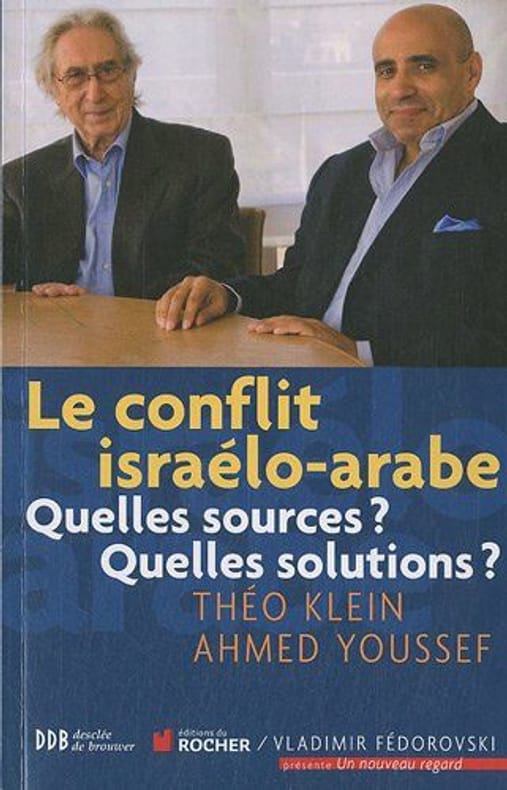
Klein Théo Youssef Ahmed
Le conflit israélo-arabe: Quelles sources ? Quelles solutions
DU ROCHER 2010 192 pages 13 8x1 6x21 8cm. 2010. Broché. 192 pages.
Riferimento per il libraio : 500062705
|
|
|
KNAPP (Grace H.)
The tragedy of Bitlis - We join: CURZON (Robert) ARMENIA: A Year in Erzeroom and on the Frontiers of Russia, Turkey, and Persia.
London, Sterndale Classics, 2002 - IBID, 2003. 2 vol. in-8, paperback, 109pp, B/W illustrations - 154pp, 1854 first edition Reprint.
Riferimento per il libraio : 557385
|
|
|
Knaust (Cnustinus), Heinrich / [Georgijevic (Djurdjevic), Bartolomej].
Mahometische Genealogia Das ist vom Beschreibung, herkommen unnd Absterben Machemetis, darinnen der gantzen Türckey mit ihrem Provintzen, Völckern, Ursprung, Zunemmen, Reisen, Reichthumen, Glauben, Gesatzen, Gewonheiten, Sitten, Regimenten [...]. Berlin, no printer, 1596.
4to (162 x 202 mm). (12), 128 pp. Modern marbled boards. Posthumous edition, under a new title (and with the author's name misspelt "Enustinus" for "Cnustinus"), of Knaust's 1542 pamphlet "Von geringem Herkommen, schentlichem Leben, schmehlichem Ende des Turckischen Abgots Mahomets". The jurist and poet Knaust (ca. 1521-77) published on a wide range of topics; "his popular-scientific works, written mainly for young readers and interested laymen, proved especially successful" (cf. NDB XII, 167). From p. 33 onwards the book contains an updated German version of the oft-reprinted and anthologized "Cronica und Beschreibung der Türckey" (1530) by the former slave Bartolomej Georgijevic from Transsylvania (Georgius de Hungaria). - Variously browned throughout with a few insignificant waterstains in the margins; occasional 18th century pencil annotations. Rare. VD 16, K 1434. Chauvin XI, 502. Göllner 2200. BM-STC German 473. Boecler 169. Draudius 531. Hammer 1305. Kertbeny 1190. Szabó III, 873. Veress 128.
|
|
|
KNIGHTON William (sans mention d'auteur)
La cour d'un roi d'Orient ou les distractions de Nussir-U-Deen souverain de Luknow, traduit de l'anglais par Bénédict-Henri Révoil.
Couverture rigide. Reliure demi-basane quelconque, défraîchie, épidermures. 316 pages. Rousseurs. Une page abimée (difficulté de lecture).
Riferimento per il libraio : 86022
|
|
|
Knorr, Georg Wolfgang.
Deliciae naturae selectae oder auserlesenes Naturalien-Cabinet welches aus den drey Reichen der Natur zeiget, was von curiösen Liebhabern aufbehalten und gesammlet zu werden verdienet [...] fortgesetzt von dessen Erben, beschrieben von Philipp Ludwig Statius Müller und in das Französische übersetzt von Matthäus Verdier de la Blaquiere. Nuremberg, (1754-)1766/67.
Large folio. 2 vols. in one. (26), VIII, 132 pp. (4), XX, 144 pp. With coloured engraved title-page (dated 1754), large engraved vignette by Andreas Hoffer after Gottfried Eichler, and 91 (1 folding) coloured or colour-printed engravings by Knorr, J. A. Eisenmann, A. Hoffer and others. Contemporary calfskin binding gilt. First edition of this monumental work of natural history, one of the most splendid zoological works ever produced in Nuremberg. Begun by Knorr as early as 1751, it was continued by his heirs after his death in 1761. The book describes items from the great contemporary natural history collections, including the magnificent white falcon (with hood) from the collection of the famous physician and botanist Christoph Jakob Trew. The illustrations, occasionally printed in colours but mostly hand-coloured in radiant hues, depict birds, exotic mammals, fishes, corals, butterflies and other insects. - Occasional insignificant waterstaining to the wide blank margins of the text; a few plates show unobtrusive fingerstaining. A beautiful, very wide-margined copy in excellent state of preservation, printed on good, strong paper. Plates show clean, distinct colours and superior contrast. Nissen, ZBI 2227. Horn/Schenkling 12038. Hagen I, 426. Dean I, 696. Graesse IV, 35.
|
|
|
Koenig, Alexander.
Die Vögel am Nil von seiner Mündung bis in das Gebiet seiner Quellflüsse (Weisser Nil) auf Grund eigener Reisen und Beobachtungen in Wort und Bild dargestellt […] Zweiter Band. Die Raubvögel. [Bernburg, Kunze, 1936].
4to. 188 pp. Illustrated with 52 colour plates and 2 black and white plates depicting birds of prey, a plate with 4 photographs of nests, and 2 lithographed illustrations in the text of ancient Egyptian statues of falcons. Rebound in blue half morocco with title label. The very rare only published volume of "Die Vögel am Nil" by Alexander Koenig (1858-1940): a monograph on the birds of prey of the entire Nile region, with many beautiful plates. Koenig traveled to the Nile six times to study the local fauna and concentrated his findings in this second volume, completed near the end of his life. Koenig was a scholar and a man of wealth as well an an avid collector. In 1912 he founded the renowned Museum Koenig in Bonn. In 1964 the 'first' volume was published posthumously in Bonn by the Alexander Koenig Stiftung under the title "Alexander Koenigs Reisen am Nil". Koenig had first published his studies on Egyptian birds of prey in the "Journal für Ornithologie" over the course of many years (1907-32) under the title "Avifauna Aegyptiaca", with some plates. All of these contributions were assembled and expanded, with new plates added, in "Die Vögel am Nil". (The plates already published in the journals are marked "Avif. Aeg."). The birds are divided into three types: vultures, falcons, and owls. The chromolithographed plates of vultures are done by F. Naubaur after E. de Maes (the eggs only by De Maes). Most falcon plates are signed "FR" (A. Frisch) in the plate and executed by Otto Kleinschmidt, printed at the Kunstanstalt Köhler at Gera (Germany), others are by F. Neubaur and E. de Maes. Another plate of eggs (XLIX) is by Paul Preiss. Most of the owls are done by F. Neubaur, with the exception of plate LIV, which is signed "JCK" (Keulmans). The ornithological artist Otto Kleinschmidt was also a collector of bird specimens. His collections of over 10,000 specimens was sold to the Museum Koenig in 1935. - In fine condition. Anker 266. Nissen IVB 524.
|
|
|
KONOW (Sten) [Dir.]
Acta Orientalia ediderunt Societates orientales Batava, Danica, Norvegica. Vol. X.
Lugduni Batavorum, Brill, 1932. In-8 broché, couv. pastiche, étiquette de titre en long au dos, 392 pp., qq. fig. et ill. photogr. en noir in et hors-texte, index.
Riferimento per il libraio : 517220
|
|
|
Konzelmann Gerhard
Dies Land Will Ich Deinen Kindern Geben Die Wurzeln Der Tragodie in Nahen Osten
Mm 160x230 Volume di pp. 416, cartonato rigido, sovraccoperta editoriale, in ottimo stato. SPEDIZIONE IN 24 ORE DALLA CONFERMA DELL'ORDINE.
|
|
|
Koran; Sale, George.
THE KORAN; COMMONLY CALLED THE ALCORAN OF MOHAMMED. Translated into English Immediately from the Original Arabic; by George Sale, Gent. To Which Is Prefixed "The Life Of Mohammed": Or the History of That Doctrine.
pp. 472, 8 [Publisher's catalogue]. Book label of Marshall S. Snow (who was a professor of history in St. Louis; There is a bookplate for Marshall S. Snow ( probably Robert Lincoln's Exeter classmate Ca. 1860, and later a professor and dean at various coleges). Large 12mo. Original embossed publisher's full buckram binding. Loss at head and tail of spine. Hardbound. Interesting Koran published during the American Civil War. Scarce. **PRICE JUST REDUCED! ISLAM BOX 2
|
|
|
Korytko, Stefan.
General orientative map of the world's oil industry / Übersichtskarte der Welt-Naphtha-Industrie / Carte d'orientation de l'industrie de pétrole du monde / Mapa pogladowa swiatowego przemyslu naftowego. Lviv, Stefan Korytko, 1925.
Large folding chromolithographed map (map size 65.5 × 88 cm). Original publisher's printed paper wrappers. Large folding map of the world, completely in colour, showing the areas containing oil and where oil/gas wells are located. Inserted around the margins of the map are several more detailed inset maps of Europe, Poland, California, Kansas, Oklahoma, Texas, Mexico, Venezuela, Trinidad, Apsheron (Azerbeidzjan), Sumatra, Japan, Egypt and Borneo. Also included is a large diagram illustrating the world's oil production, from 1860 to 1924. - Only very slightly worn along a few folds. Paper wrappers slightly damaged, otherwise in very good condition.
|
|
|
Kotzebue, Moritz von.
Voyage en Perse, a la suite de l'Ambassade Russe, en 1817 ... Traduit de l'Allemand par M. Breton. Paris, A. Nepveu, 1819.
8vo. II, 286 pp. Half title. 4 engraved plates, printed in sepia and hand-coloured, each plate depicting 2 images. Contemporary calf-backed pink paper covered boards, flat spine divided by gilt roll tools in six compartments, lettered in the second compartment, the others with a repeat decoration in gilt. First edition in French of a journal of travels in Persia, illustrated with hand coloured plates. In 1817, Moritz Kotzebue, the brother of explorer Otto van Kotzebue, "as a young lieutenant in Russian service, he travelled to Persia in the cortege of a Russian embassy sent to the encampment of Fatha-al-Shah at Soltaniyeh. He kept an informative journal of this embassy, which was afterwards published by his father in Weimar" (Howgego). French, English, Dutch and other editions followed; the present French edition is prized for its hand colored plates, not found in other editions. Provenance: Baron du Puget (period ink stamp on title). Howgego K19. Abbey, Travel 390 (English edition with uncoloured aquatints).

|
|
|
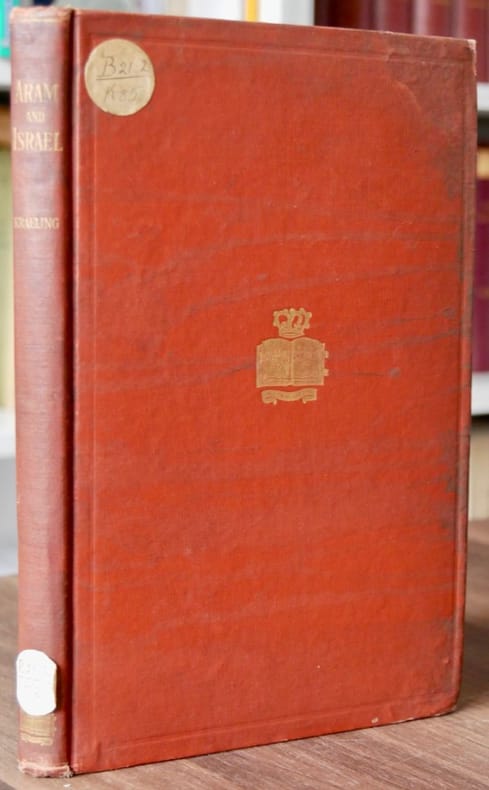
KRAELING (Emil G. H.)
ARAM and ISRAEL or The Amaeans in Syria and Mesopotamia.
New-York, Columbia Univ. Press, 1918. In-8, brown buckram binding, gold gilt on the first cover plate (book with a crown), library label at spine foot, XVI-155pp, 3 maps in frontispiece, first edition. index of the bible passages, index of geographical names, general index.
Riferimento per il libraio : 557341
|
|
|
Krafft, Albrecht, oriental scholar and dilettante painter (1816-1847).
Ansicht des Gesandtschaftspallastes in Constantinopel. Probably Constantinople, c. 1840.
Pencil drawing on paper (168 x 252 mm), mounted on tawny backing with inked border, autogr. caption, and signatures. Matted (390 x 312 mm). A pretty view of the Austrian Embassy Palace in Constantinople (Istanbul). The background shows a mosque and the Bosporus with ships, with a few human figures in the foreground. Signed at the bottom right on the backing paper: "Albrecht Krafft mpr", with the signature of "Joh. von Wörndle mpr" opposite (probably the like-named construction administrator of Vienna's imperial palace, whose sons Edmund and August both were to become important painters trained at the Vienna Academy of Arts). - The Viennese orientalist Krafft was admitted to the famous Oriental Academy at the age of 19; here, he catalogued the library's oriental mss. and studied Armenian and Hebrew. His lasting achievement is considered to be his catalogue of Arabic, Persian, and Turkish mss. at the Academy. However, Albrecht Krafft, son of the Viennese portrait painter Peter Krafft (who had studied with Tischbein and Füger), was also a gifted dilettante painter who had attended the Academy of Arts simultaneously with grammar school, thus obliging his father's wishes before he followed his own inclinations and turned towards oriental scholarship (cf. Wurzbach XIII, 99). "Only the first volume of his projected 10-volume catalogue raisonnée of the Imperial Gallery at the Belvedere Palace was published (in 1837) - an excellent achievement for its time [...] Parthey, in his 'Deutscher Bildersaal', lists three paintings copied by the younger Krafft" (cf. Thieme/B. XXI, 384). - A few edge defects of the backing paper have been professionally restored.

|
|
|
Kriehuber, Jos[eph].
Mahmoud II, Türkischer Kaiser. Vienna, Mathias Artaria (J. Häussle, L. Letronne), 1828.
Lithographic portrait (555 x 380 mm), matted (618 x 499 mm). Portrait of Mahmud II (1785-1839), the 30th Sultan of the Ottoman Empire from 1808 until his death in 1839. A fine likeness by the celebrated Viennese portraitist Joseph Kriehuber. - Some foxing.
|
|
|
Krusinski, Judasz Tadeus / Müteferrika, Ibrahim / Clodius, Johann Christian.
[Tarikh-i Sayyah] hoc est: Chronicon peregrinantis seu historia ultimi belli Persarum cum Aghwanis gesti [...]. Leipzig, Johann Friedrich Gleditsch, 1731.
4to. (20), 108, (12) pp. 19th century blindstamped full calf with blindstamped spine-title. Rare Latin edition of a contemporary history of the Afghan-Persian wars of the Safavid era. This is a Latin retranslation of Müteferrika's 1729 Turkish edition ("Tarih-i seyyah der bayan-i zuhur-i Agvaniyan ve-inhidam-i devlet-i Safeviyan"), which was itself a translation of a work by the Polish Jesuit Judasz Tadeus Krusinski. The present Latin version is the work of the German linguist Johann Christian Clodius. - Krusinski lived in the Safavid Empire from 1707 to 1725/28. He acted as an intermediary between the Papacy and the Iranian court and also functioned as court translator. Proficient in Persian and well acquainted with the nation and its people, he lived in the Safavid royal capital of Isfahan and was a first-hand witness to the sack of the city by the rebellious Afghans in 1722. Krusinksi's accounts make him an important primary source on this particular period of the Safavid era. - Upper hinge professionally repaired. Paper evenly browned and brownstained throughout due to stock. Provenance: from the library of the British Indian civil servant and member of the Royal Asiatic Society, Thomas Newnham, with his ownership to title-page, stricken out, and with his ca. 1840 gift note to flyleaf: "Presented to the Royal Institution by Thomas Newnham Esq.". Faded library stamp to title-page and last page. A 19th century English handwritten genealogy of the Safavid dynasty is loosely inserted. Bibliotheque de Baron Silvestre de Sacy, III, 5310. Ebert 4844. De Backer/S. IV, 1264. Brunet II, 109 (s.v. Clodius). Zenker 930. OCLC 85075897.
|
|
|
Krusinski, Judasz Tadeus, SJ.
Tarikh-i seyyah der bayan-i zuhur-i Agvaniyan ve-inhidam-i devlet-i Safeviyan. Qustantaniyah (Constantinople, Istanbul), Ibrahim Müteferrika, [26 August 1729 CE =] 1 Safar 1142 H.
4to (152 x 220 mm). 2 (instead of 7), 97 ff. (last two leaves mutilated; plus a fragment of the 5th leaf of prelims). Contemporary calf binding; papered spine with typed leather spine label; some loss to lower cover. The third book printed by Ibrahim Müteferrika: a contemporary history of the Afghan-Persian wars of the Safavid era that led to the fall of the Safavid dynasty and the Afghan occupation of Iran. This is the Ottoman Turkish translation of a work by the Polish Jesuit Judasz Tadeus Krusinski, who lived in the royal capital of Isfahan from 1707 to 1725/28, acting as an intermediary between the Papacy and the Iranian court as well as a court translator. Proficient in Persian and well acquainted with the nation and its people, he was a first-hand witness to the sack of the city by the rebellious Afghans in 1722, and his account makes him an important primary source on this particular period of the Safavid era. - Browned, fingerstained and waterstained throughout, several waqf marks; various edge tears and small chips. Lacks the first five leaves of the preliminaries (save for a fragment of the fifth); loss to upper edge of f. 33 (first line) and ff. 96-97 (several lines at the bottom of the page). Zenker 929. Özege 19897. De Backer/Sommervogel IV, 1264. Brunet III, 190. Ebert 4844 (note). Toderini III, p. 34, no. III.
|
|
|
Kumar, Ravinder.
India and the Persian Gulf Region 1858-1907. A Study in British Imperial Policy. Bombay, Asia Publishing House, 1965.
8vo. (10), 259, (1) pp. Publisher's pink cloth with title to spine and printed red dustjacket. Expanded from the author's doctoral dissertation submitted to the Panjab University in 1961. Here, Ravinder Kumar (1933-2001) investigates British interests in the Gulf region during the second half of the 19th century, examining the Gulf within its international settings and seeking to explain the region's politics as being influenced by, and in turn influencing, the wider problems of international diplomacy. - Spine sunned; dustjacket a little chuooed along the edges. 1977 ownership of Sarah Talat to pastedown. OCLC 932291.
|
|
|
Kunos, Ignaz (ed.).
Türkische Volksmärchen aus Stambul. Leiden, Brill, (1905).
8vo. XXXII, 410 pp. Original half cloth with giltstamped spine title. All edges marbled. First edition of this collection of Ottoman fairy tales, translated and with an introduction by the Hungarian linguist, turkologist, and folklorist Ignác Kúnos (1860-1945).- Binding somewhat bumped at extremeties, inner hinges and first flyleaf cracked.
|
|
|
Kuntz, Rudolf.
Abbildungen Königlich Württembergischer Gestütts Pferde von orientalischen Racen. Stuttgart, [Ebner], 1823-1824.
Oblong folio (550 x 635 mm). Issues I and II (of 3). With 12 (out of 18) tinted chalk lithographs by L. Ekeman-Allesson after R. Kuntz. Wants text and table of subscribers. Stored loosely in 2 original wrappers with title label and green original half calf portfolio with gilt-lettered title and borders. Traces of ties. First and only edition. Commissioned by the Board of the Württemberg Stud, the first Arabian stud in Europe, this almost unobtainable series of large format plates shows the Stud's full-blooded Arabian horses with decorative oriental backgrounds. The plates constitute extremely early examples of chalk lithographs (listed individually by Winkler, Frühzeit der dt. Lithographie, 180, 57). Kuntz (1797-1848) was known for his "excellent depictions of horses" (cf. Thieme/B.); throughout his brief career he studied thoroughbreds in England, Hungary, and Paris as well as in Germany. In 1832 he became Painter to the Court of Karlsruhe, Baden; he suffered a stroke in 1846 and died in the newly-founded Illenau mental hospital. - Very slightly stained in places, three plates slightly browned. Of the utmost rarity. This copy removed from the collection of the House of Hanover, dispersed from 2005 (largely through Sotheby's). Includes a publisher's ad (by L. Harrison, Strand) for "A Series of Lithographic Drawings of Celebrated Horses" after James Ward, dedicated to George IV. Nissen 2327. Thieme/B. X, 444 & XXII, 116. Winkler, Die Frühzeit der dt. Lithographie 180.57.
|
|
|
Kuntz, Rudolf.
Abbildungen Königlich Württembergischer Gestütts Pferde von orientalischen Racen. Stuttgart, Ebner, 1823-1824.
Oblong folio. With 18 tinted chalk lithographs by L. Ekeman-Allesson after R. Kuntz. With lith. title, lith. dedication and 3 ff. of letterpress text. Stored in a modern half morocco leather case. First and only edition. Commissioned by the Board of the Württemberg Stud, the first Arabian stud in Europe, this almost unobtainable series of large format plates shows the Stud's full-blooded Arabian horses with decorative oriental backgrounds. The plates constitute extremely early examples of chalk lithographs (listed individually by Winkler, Frühzeit der dt. Lithographie, 180, 57). Kuntz (1797-1848) was known for his "excellent depictions of horses" (cf. Thieme/B.); throughout his brief career he studied thoroughbreds in England, Hungary, and Paris as well as in Germany. In 1832 he became Painter to the Court of Karlsruhe, Baden; he suffered a stroke in 1846 and died in the newly-founded Illenau mental hospital. - Of the utmost rarity, no copy of the complete series with all three issues as present here traceable in auction records. Nissen 2327. Thieme/B. X, 444 & XXII, 116. Winkler, Die Frühzeit der dt. Lithographie 180.57.
|
|
|
Kuntz, Rudolf.
Abbildungen saemmtlicher Pferde-Racen, nach dem Leben gezeichnet, lithographirt und herausgegeben von Rudolph Kuntz mit naturhistorischer Beschreibung von E. d'Alton. 1. bis 4. Lieferung [= all published]. Stuttgart, Georg Ebner'sche Kunsthandlung, [1827-1832].
Oblong royal folio (536 x 445 mm). Engraved title-page, engraved dedication to Ludwig Wilhelm August, Grand Duke of Baden, (4), XX pp. of letterpress text, 25 plates (= 24 lithogr. plates of horse portraits and 1 anatomical plate). Contemporary half calf with handwritten cover label; publisher's original illustrated lithogr. wrappers bound within. First edition, self-published by the author in Karlsruhe, with Ebner's Stuttgart address pasted on the wrapper's upper cover. All that was published of this splendid and rare work about the principal breeds of horses, issued in what must have been a very small press run by Kuntz (1797-1848), Painter to the Court of Karlsruhe, Baden, who is also known for drawing the full-blooded Arabian horses of the Royal Württemberg Stud, the first Arabian stud in Europe. For the present work Kuntz made extensive travels in Hungary, London and Paris to draw his exquisite portraits of Arabian, Persian, Egyptian, Nubian, English and many other thoroughbred horses from life. - Binding professionally repaired at the edges. Interior somewhat foxed and fingerstained. From the officers' library of the Württembergian Uhlan (light cavalry) regiment no. 19. Nissen, ZBI 2328. Thieme/Becker XXII, 116. Wells 4313. Graesse I, 87.
|
|
|
Kurpershoek, Paul Marcel.
Oral poetry and narratives from Central Arabia. 1. The poetry of ad-Dindân a Bedouin Bard in Southern Najd. 2. The Story of a Desert Knight. The Legend of Sçwîh al-'Atâwi & Other 'Utaybah Heroes. 3. Bedouin Poets of the Dawâsir Tribe Between Nomadism & Settlement in Southern Najd. Leiden, New York, Cologne, Brill, 1994-1999.
Large 8vo. 3 volumes. XVII, (5), 368, (4) pp. XIV, (4), 512, (2) pp. XX, 506, (4) pp. With 2 portraits as frontispieces in vols. 1 and 2. 16 pages with illustrations and 2 maps at the end of vols. 2 and 3. Red cloth with title information in gold on front cover and spine of all 3 vols. All 3 vols. have a dust jacket. Outstanding research on the oral traditions of the Bedouins in central Arabia, divided into 3 volumes containing information on the poetry and narratives of various Bedouin tribes and an analysis and translation of various poems and stories. Kurpershoek has recorded, transcribed and translated all poetry and narratives he discusses in this work. - Since its first publication in 1994-99, this trilogy has been expanded with two additional volumes: vol. 4, published in 2002, deals with Saudi tribal history, while vol. 5 (2005) looks back on almost 20 years of research on and involvement with Arabian oral culture. - The Dutch scholar, author and diplomat P. M. Kurpershoek specialises in Arab studies. Kurpershoek studied Arabic language and culture at the Universities of Leiden and Cairo; since 1974 he has worked for the Dutch ministry of foreign affairs, the UN and NATO. As a professor of languages and cultures of the Islamic Middle East at the University of Leiden, he has performed research on the Bedouins of Saudi Arabia. From 2002 until 2013 he served successively as Dutch ambassador to Pakistan, Turkey, and Poland. Subsequently, from August 2013 until December 2014 he served as envoy to Syria. - Spines of the dust jackets of vols. 1 and 2 are slightly discoloured, otherwise in very good condition.
|
|
|
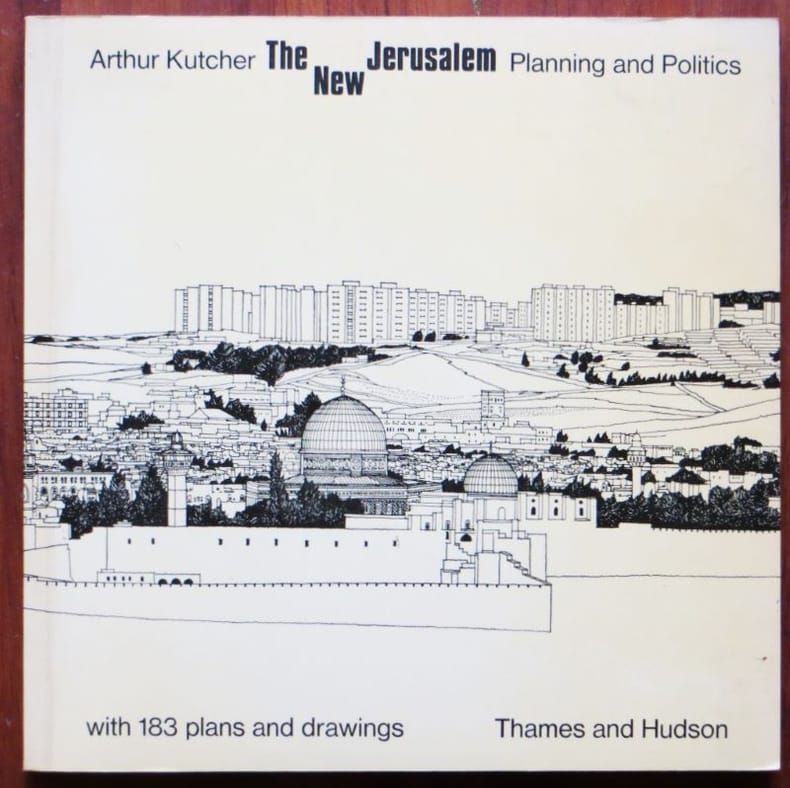
KUTCHER Arthur
THE NEW JERUSALEM. Plannings and Politics. With 183 plans and drawings.
1973 London, Thames and Hudson, 1973. Grand in-8 broché de format carré, 23 x 23 cm., 128 pp. Comprenant 183 plans et dessins de l'auteur. Couverture illustrée. Un léger pli de lecture au dos sinon très bon état. EN ANGLAIS
Riferimento per il libraio : 18665
|
|
|
KÂMRAN INAN, WERNER GUMPEL, HALIT KARA, ANDREW MANGO, EROL MANISALI, OKTAY ORHON et alli.
Turkey's place in the Middle East. Economic, political and cultural dimensions. International Girne Conferences. Edited by Erol Manisali.
Very Good English Paperback. Pbo. Roy. 8vo. (24 x 17 cm). In English. [4], 98, [1] p. Turkey's place in the Middle East. Economic, political and cultural dimensions. International Girne Conferences. Edited by Erol Manisali.
|
|
|
KÜPPER (Hanns Michael)
Bautypus und Genesis der griechischen Dachtranseptkirche.
Wien, ÖAW Verlag, 1996. In-4 broché, 76 pp., 41 ill. phot. en noir et fig. h.-t., 17 cartes et plans dans le texte, bibliogr. (ÖAW - Phil.-hist. Klasse - Denkschriften, 246 ; Veröff. Komm. für die Tabula Imperii Byzantini, 6).
Riferimento per il libraio : 513595
|
|
|
L'HUILLIER (Fernand).
Fondements historiques des problèmes du Moyen-Orient.
Sirey, 1958, in-8°, 122 pp, 3 cartes dont 2 dépliantes hors texte, biblio, broché, état correct
Riferimento per il libraio : 10797
|
|
|
L'Isle, Guillaume de / Buache, Philippe.
Carte de l'Egypte de la Nubie de l'Abissinie &c. Paris, Philippe Buache, 1745.
Hand-coloured engraved map (635 x 505 mm). A fine example of Philippe Buache's edition of Guillaume de l'Isles highly detailed map of the region centered on the Red Sea. The map extends west to include Sicily, the Southeastern Mediterreanean, Barbaria, Nigritie, and a Guinea on the West Coast of Africa. To the east, the map includes the Persian Gulf, Saudi Arabia, the Gulf of Aden and the Kingdom of Ajan and Dadel. De l'Isle's maps provided the first truly scientific mapping of the regions covered, showing the flamboyant Dutch style of illustrations and adopting a highly detailed and decorative approach to the printed map. The result is a combination of spectacular detail and accuracy, not approached by the Dutch or any other 17th Century map makers. The detail in this map reflects this Renaissance of style and accuracy. Tibbetts 199. Cf. Al-Qasimi 268 (1707 ed.).

|
|
|
L'Isle, Guillaume de.
Carte de l'Egypte de la Nubie de l'Abissinie &c. Amsterdam, Jean Covens & Corneille Mortier, (1730).
Hand-coloured engraved map (645 x 540 mm). Guillaume de l'Isle used the three classic divisions in this map, but it also contains other divisions and subdivisions based on geographical and political considerations. - Well preserved. Tibbetts 199. Cf. Al-Qasimi 268 (Paris ed. 1707).

|
|
|
L'Observateur Du Moyen-Orient
L'Observateur Du Moyen-Orient: July 1962 to Dec. 1962
L'Observateur Du Moyen-Orient 1962. First Edition. Hardcover. Good copy in the original title-blocked pictorial cloth. Some suggestion of dust-dulling and wear to the spine bands and panel edges with staining to the boards. Remains well-preserved overall; tight bright clean and strong. Physical description; various pagings of newspaper clippings. Notes; Collected Newspapers of L'Observateur Du Moyen-Orient from July 1962 to December 1962. Subjects; L'Observateur Du Moyen-Orient. French Newspapers. July 1961 to December 1962. Genre; Periodicals. L'Observateur Du Moyen-Orient hardcover
Riferimento per il libraio : 242651
|
|
|
L'ORIENT. . .
L'Orient, proche, extr?me. Num?ro sp?cial de la Nouvelle Revue Fran?aise.
Num?ro complet. 257 pages.
|
|
|
LA BEDOLLIERE (Emile de);
De Paris à Suez.
librairie Georges Barba Paris 1870 1 vol. In-12 broché de VIII 99 pp., couverture imprimée.
Riferimento per il libraio : 15358
|
|
|
La Boullaye-Le-Gouz, François de.
Les voyages et observations du sieur de la Boullaye-le-Gouz gentil-homme Angevin, où sont décrites les religions, gouvernemens, & situations de estats & royaumes d'Italie, Grece, Natolie, Syrie, Palestine, Karamenie, Kaldée, Assyrie, grand Mogol, Bijapour, Indes orientales des Portugais, Arabie, Egypte, Hollande, grande Bretagne, Irlande, Dannemark, Pologne, isles & autres lieux d'Europe, Asie & Affrique, où il a séjourné, le tout enrichy de figures. Paris, François Clousier, 1653.
4to. (16), 540, (10), (2 blank) pp. With a woodcut and an engraved author's portrait, 34 woodcut illustrations in text, including several full-page, and some woodcut initals, head- and tailpieces. Contemporary calf, gold-tooled spine. Rare first edition of a travelogue by the French explorer, merchant and diplomat François de la Boullaye-Le Gouz (ca. 1610-69). The largest part of the book deals with his travels through the Middle East and India, while a smaller parts treats Le Gouz's travels through Europe. In 1643 he travelled the Middle East under the name Ibrahim Beg, visiting Syria, Palestine, Persia, Egypt, Anatolia and Armenia. "Like so many European travellers in the east he adopted oriental clothes and an oriental name ... Unlike most European travellers to the east, however, La Boullaye-Le Gouz continued to wear his Persian clothes in his return to France and was consequently regarded as something of a curio" (Hamilton). A few years later he was sent by the French king with an embassy to the Mogul emperor Shah Jahan, where he met and became great friends with the Jesuit Alexandre de Rhodes (1591-1660). - La Boullaye-Le Gouz describes the routes he takes, the cities he visits and the people he meets along the way, with frequent observations on religion, natural history and commerce. The illustrations show various Indian deities, some city views or buildings, Indian and Eastern costumes, plants and trees. Pages 243-255 deal with plants, fruits and trees in India, including several palm trees, a fig tree, a jack tree and a melon tree. "The work is notable for its information on northern India and its relations to Persia, and for its inclusion of a summary of the Ramayana" (Howgego). - In Europe, Le Gouz travelled Italy, Greece, Poland, England, Ireland, Germany, and the Netherlands. In his later years he travelled again to Persia and died in Isfahan probably in 1669, whereafter the Shah ordered a splendid funeral to be held. Included at the end of the book is a list of names of the people La Boullaye-Le Gouz met, sorted by country; a list of uncommon words, and a table of contents. A second, enlarged edition was published in 1657 at Troyes. - Binding rubbed, restored and front hinge partly cracked. Occasional small (water) stains, otherwise in very good condition internally. Atabey 645. Hage-Chahine 2526. Hamilton, Europe and the Arab world 22. Howgego, to 1800, L4. Slot, The Arabs of the Gulf 1602-1784, p. 410. WorldCat (5 copies). Not in Blackmer.
|
|
|
LA CAMUS, LAbbé E.
Notre voyage aux Pays Bibliques. Haute Palestine, Syrie, Asie Mineure, Grèce
sd A Paris, Chez Sanard et Derangeon, Editeurs - Sans date - Fort in-4, pleine percaline rouge, décor doré et noir sur les plats et le dos, tranches dorées - 528 p. - Très nombreuses illustrations en N&B encadrant le texte de chaque page
Riferimento per il libraio : 109591

|
|
|
La Chappelle, George de.
Recuel [!] de divers portraits des principales dames de la Porte du Grand Turc. Tirée au naturel sur les lieux. Paris, Antoine Estienne / chez le Blond, 1648.
Folio (235 x 335 mm). Engraved title, 3 pp. of dedication, 1 leaf (Privilege du Roy), 12 leaves of text interleaved with 12 engraved plates, woodcut headpieces and initials. The plates, probably by Noel (not Nicolas) Cochin after La Chapelle, show costumes against a scenic background. Contemporary full vellum. First edition, very rare. Georges de la Chappelle, a native of Caen, accompanied the French envoy Le Haye to the Porte and spent several years in the Levant. His work is known to us almost exclusively through these engravings, showing what Thieme/Becker described as "the prettiest ladies in the Imperial Seraglio". In the introductory text included in this first edition, La Chappelle explains that the series was occasioned by a recent French edition of Chalcocondyles, in which (as he complains) the women's costumes were very poorly drawn. La Chappelle clearly had a special interest in female costume: "his own representations are highly detailed, with special attention paid to the fabulous jewels and fine needlework that adorn the garments of Levantine costume. (According to the preface, the accuracy of his drawings could be attested by Le Haye [...], in whose presence the drawings were executed.) To add verisimilitude to the plates, examples of Turkish, Persian, Tartar, Armenian and Greek costume are depicted against topographical backgrounds showing the areas in and around Constantinople in which the models were most likely to reside" (Atabey). Curiously, several of these backgrounds, when placed side by side, form a near-consecutive panorama of Constantinople and its environs. - Occasional light brownstains; wants front flyleaf. Vellum slightly stained and wrinkled; lower cover shows traces of old calculations. An attractive copy in a strictly contemporary binding. Atabey 648. Colas 1697. Thieme/Becker VI, 378f. Cf. Blackmer 935 (2nd edition). Not in Lipperheide or Cohen/de Ricci.
|
|
|

 Ricevere i risultati per e-mail
 Scaricare i risultati in PDF
 RSS feed
 Link
Link


