|
|
|
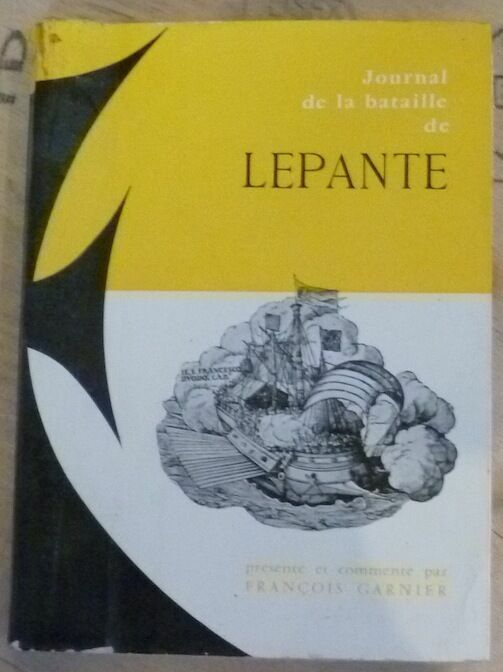
François Garnier
Journal de la bataille de Lépante
1956. Paris Éditions de Paris 1956 - Broché couv. à rabat 14 cm x 19 5 cm 252 pages 112 ills in et hors-texte - Présentation et commentaires de François Garnier bibliographie notes sur les navires et les hommes - Dos restauré état d'usage
Riferimento per il libraio : 14659
|
|
|
FRANÇOIS GEORGEON.
Des Ottomans aux Turcs: Naissance d'une nation.
New English Paperback. Roy. 8vo. (24 x 17 cm). In French. [viii], 488 p. Des Ottomans aux Turcs: Naissance d'une nation.
|
|
|
FRANÇOIS GEORGEON.
Kemalizm ve Islam dünyasi.
Very Good Turkish Paperback. Cr. 8vo. (20 x 14 cm). In Turkish. 200 p. Kemalizm ve Islam dünyasi. Kemalism and the Islamic world.
|
|
|
FRANÇOIS NOGUÈS.
L'Independance de la Turquie et ses traites avec les puissances suivi de la Reforme en Turquie.
New English Original bdg. HC. Roy. 8vo. (24 x 17 cm). In French. [iv], 140 p. Reprint edition of 'Constantinople 1851'. L'Independance de la Turquie et ses traites avec les puissances suivi de la Reforme en Turquie.
|
|
|
FREDERIC C. SHORTER, JOHN F. KOLARS, DANKWART A. RUSTOW, OKTAY YENAL.
Four studies on the economic development of Turkey. Edited by Frederic C. Shorter. (Princeton Studies on the Near East).
Good English Original cloth bdg. Slightly faded. No DJ. Roy. 8vo. (23 x 16 cm). In English. [12], 145 p. Four studies on the economic development of Turkey. Edited by Frederic C. Shorter. (Princeton Studies on the Near East).
|
|
|
FREDERIC HITZEL.
Integration et transformation des savoirs. Itineraire de passeurs dans la societe Ottomane.
New English Paperback. Pbo. Roy. 8vo. (24 x 17 cm). In French. 265 p., b/w ills. Integration et transformation des savoirs. Itineraire de passeurs dans la societe Ottomane. Présentation; Passeurs de techniques : militaires et ingénieurs; Chapitre 1 - « Une voie de pénétration des idées révolutionnaires : les militaires français à Istanbul », dans Varia Turcica, XIX, Mé-langes offerts à Louis Bazin, Paris, L'Harmattan, 1992, p. 87-94. Chapitre 2 - « Les écoles de mathématiques turques et l'aide française (1775-1798) », dans Collection Turcica, vol. VIII, Histoire économique et sociale de l'Empire ottoman et de la Turquie (1326-1960), Louvain-Paris, 1995, p. 813-825. Chapitre 3 - « François Kauffer (1751?-1801), ingénieur-cartographe français au service de Selim III », dans Science in Islamic Civi-lisation, Ekmeleddin Ihsanoglu & Feza Günergun (éd.), Istan-bul, Research Centre for Islamic History, Art and Culture, 2000, p. 233-243. Chapitre 4 - « Ambroise Firmin-Didot, un éditeur parisien témoin des premières imprimeries impériales de Constantinople en 1816 », dans Printing and Publishing in the Middle East, Philip Sad-grove (éd.), dans Journal of Semitic Studies, suppl. 24 (2008), Oxford University Press, p. 101-108. Passeurs de savoirs : interprètes et traducteurs; Chapitre 5 - « L'École des Jeunes de langue de Péra, ou l'art de for-mer les interprètes à l'apprentissage des langues orientales », dans Les langues du commerce en Méditerranée (XVIe-XIXe siècle), Gilbert Buti, Michèle Janin-Thivos & Olivier Raveux, (éd.), Aix-en-Provence, Presses universitaires de Provence, 2013, p. 23-31. Chapitre 6 - « Les interprètes au service de la propagande », dans Varia Turcica, XXXI, Paris, L'Harmattan, 1997, p. 351-363. Chapitre 7 - « L'institution des Jeunes de langue de Constantinople au début du XIXe siècle », dans De Samarcande à Istanbul : éta-pes orientales. Hommages à Pierre Chuvin - II, Véronique Schiltz (éd.), Paris, CNRS éditions, 2015, p. 259-275. Passeurs d'expériences : Prisonniers et diplomates Chapitre 8 - « Osman Aga, captif ottoman dans l'Empire des Habs-bourg », dans Turcica, Revue d'études turques, XXXIII (2001), p. 191-213. Chapitre 9 - « Turcs et turqueries à la cour de Catherine de Médicis », dans Les Musulmans dans l'histoire de l'Europe. I. Une inté-gration invisible, Jocelyne Dakhlia & Bernard Vincent (éd.), Paris, Albin Michel, 2011, p. 33-54. Chapitre 10 - « Sefâretnâme : comptes rendus des ambassadeurs ot-tomans en Europe », dans Turcs et turqueries (XVIe-XVIIIe siè-cles), Paris, Presses de l'Université Paris-Sorbonne, 2009, p. 97-110. Passeurs artistiques : décorateurs et inventeurs Chapitre 11 - « Du musée de Cluny au château d'Écouen : la collec-tion de "faïences persanes" de l'île de Rhodes d'Auguste Salzmann (1824-1872) », dans Iznik. L'aventure d'une collec-tion. Les céramiques ottomanes du musée national de la Re-naissance, Frédéric Hitzel & Mireille Jacotin (éd.), Paris, Ré-union des musées nationaux, 2005, p. 14-29. Chapitre 12 - « De Constantinople à Bourbon-l'Archambault : Léon Parvillée (1830-1885), un artiste inspiré par les arts décoratifs Ottomans », dans Architectures urbaines. Formes et temps. Mélanges offerts à Pierre Pinon, Michèle Lambert-Bresson & Annie Térade (éd.), Paris, Picard, 2004, p. 358-368. Chapitre 13 - « Charles Séchan (1803-1874) : un décorateur français au service du sultan Abdülmecid », version française de : « Charles Séchan (1803-1874) : A French Decorator in the Service of Sultan Abdülmedjid », dans Furniture History, vol. XLVII (2011), p. 151-161. Chapitre 14 - « Osman Hamdi Bey et les débuts de l'archéologie ot-tomane », dans Turcica. Revue des études turques, 42 (2010), p. 167-190. Chapitre 15 - « La protection du patrimoine ottoman à l'épreuve de l'occidentalisation : le cas des collections de céramiques d'Iznik », dans Purs décors d'Islam? Arts de l'islam, regard du XIXe siècle, Rémi Labrusse (éd.), Paris, coédition Les Arts dé-coratifs-musée d
|
|
|
FREDERICK DE JONG.
Sufi orders in Ottoman and Post-Ottoman Egypt and the Middle East.
New English Paperback. Pbo. Roy. 8vo. (24 x 17 cm). In English. 276 p. Sufi orders in Ottoman and Post-Ottoman Egypt and the Middle East.
|
|
|
FREDERIK POHL and C[YRIL] M. KORNBLUTH.
Hukuk gladyatörü. [= Gladiator at law]. Translated into Turkish by Nazli Korkut.
Fine English Paperback. Pbo. Mint. Foolscap 8vo. (18 x 12 cm). In Turkish. 208, [2] p. First Turkish Edition of Kornbluth and Pohl's 'Gladiator at law'. Hukuk gladyatörü. [= Gladiator at law]. Translated into Turkish by Nazli Korkut.
|
|
|
FREDERIK POHL and C[YRIL] M. KORNBLUTH.
Uzay tacirleri. [= Space merchants]. Translated into Turkish by Fatma Taskent.
Fine English Paperback. Pbo. Mint. Foolscap 8vo. (18 x 12 cm). In Turkish. 193, [7] p. First Turkish Edition of 'Space merchants'. Uzay tacirleri. [= Space merchants]. Translated into Turkish by Fatma Taskent.
|
|
|
Freely John
Stamboul Ghosts: A Stroll Through Bohemian Istanbul
8vo, hardcover in dj, In English. 144 p. With the exception of Og?uz, so thin that he was known as The Ghost because he barely cast a shadow, everyone in John Freely's rumbustious memoir, including the author himself, is larger than life. Bohemian Istanbul was a haven for myriad misfits who found their feet in the city. Glamorous, eccentric, cosmopolitan and frequently anarchic, they included the ‘berserker' Peter Pfeiffer, a resourceful exile with three passports, Aliye Berger, the beautiful queen of bohemian Pera, the writer James Baldwin and, fleetingly, the future Pope John XXIII. ‘Would James Baldwin have felt quite so liberated in Istanbul if he had not been a frequent guest at John Freely's parties and experienced that Never Never Land sense of bohemia among the expatriate faculty in an outrageously beautiful campus overlooking the Straits?' – Andrew Finkel ‘The beautiful images that adorn this memoir are by the great Ara Gu?ler. His work as a photojournalist for Magnum took him all over the world, and his archive of 800,000 negatives contains likenesses of Salvador Dali?, Alfred Hitchcock, Willy Brandt, John Berger, Maria Callas, Bertrand Russell, Pablo Picasso and Indira Gandhi, among others. But it is his chronicling of mid-twentieth-century Istanbul for which he is most loved.' – Maureen Freely.
|
|
|
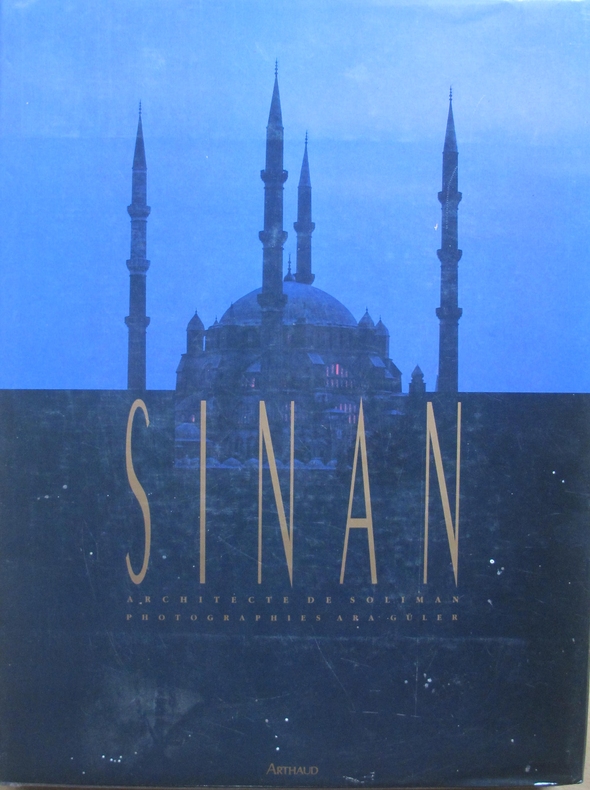
FREELY John - BURELLI Augusto Romano Photographies de Ara Guler.
Sinan, architecte de Soliman le Magnifique.
Couverture rigide. Relié. 144 pages. 31 x 42 cm. Jaquette. Parfait état.
Riferimento per il libraio : 131260
|
|
|
Freely, John
Istanbul : The Imperial City
This is a biography of the city originally known as Byzantium, later renamed Constantinople and now called Istanbul. With a population of 10 million, it's the largest city in Turkey, adorned with splendid monuments of both Ottoman and Byzantium empires. This book gives an account of the city's history from the time of its founding up to the present day along with notes on the monuments that have survived from the successive epochs of its past. It's a biography rather than a political or architectural city with the emphasis on the life of the people and of the city.414p. plates illus, bliography.index 1" chip to DJ.else fine Book
|
|
|
Freely, Maureen
Angry in Piraeus
Paperback. Book Condition: New. 241 x 152 mm. Language: English Brand New Book. Angry in Piraeus is the story of the creation of a translator, as Maureen Freely explores what it was in her childhood that led her to become a traveler across the spaces that exist between countries, languages, and forms. She offers rich descriptions of her itinerant upbringing in America, Turkey, and Greece, vividly evoking what it means to be constantly commuting between worlds - geographical, conceptual, linguistic, and literary - in search of a home, or a self, that is proving elusive. She tells of her transition from novelist to translator - and, specifically, translator of Nobel Prize - winner Orhan Pamuk - and of how eventually she found it necessary to give up translating Pamuk in order to return to her own fictional worlds. As in the entire Cahiers series, the author s words are complemented by beautiful artworks, in this case delicate collages created by Japanese artist Rie Iwatake that journey through their own in - between spaces in a captivating play of analogies and metaphors. The resulting book is an unforgettable meditation on translation, writing, and life itself.
|
|
|
Freeman Edward A.
The Ottoman Power in Europe: It's Nature, It's Growth, and It's Decline , with Three Coloured Maps
. Small 8vo. xxii[ii], 315[1]pp, double-page colour map frontis, two further double-page colour maps. Original blind-stamped red pebble-grained cloth gilt, black eps, uncut. Extremes slightly rubbed; small nick to spine head cloth; spine a little darkened, ow, quite a good copy.
|
|
|
FRESNE-CANAYE Philippe
Le voyage du levant. De Venise à Contantinople, l'emerveillement d'un jeune humaniste ( 1573 )
Toulouse, Editions de Poliphile Toulouse, Editions de Poliphile,1986. In-8 broché de 209 pages. Parfait état
Riferimento per il libraio : 149827

|
|
|
Friedman Isaiah
Germany, Turkey, and Zionism, 1897-1918.
8vo, cloth XIV, 461pp Expansion of the author's thesis, London, 1964. Includes index. Bibliography: p. [429]-451. 22 cm. as new condition. ISBN: 0198225288
|
|
|
FRIEDRICH KARL DORNER.
Nemrud Dagi'nin zirvesinde tanrilarin tahtlari. Kommagene - Dogu Anadolu'da arkeolojinin büyük macerasi. Translated by Vural Ülkü.
Fine Fine English Original bdg. Dust wrapper. Roy. 8vo. (24 x 17 cm). In Turkish. [viii], 255 p., ills., 48 plts. Nemrud Dagi'nin zirvesinde tanrilarin tahtlari. Kommagene - Dogu Anadolu'da arkeolojinin büyük macerasi. Translated by Vural Ülkü. ARCHEOLOGY Anatolian civilizations Excavations Commagen Adiyaman City Nimrod - Nemrud Mt.
|
|
|
FRIEDRICH SARRE.
Küçükasya seyahati. 1895 yazi. Selçuklu sanati ve ülkenin cografyasi üzerine arastirmalar. Translated by Dârâ Çolakoglu.
As New English Paperback. Pbo. Mint. Roy. 8vo. (24 x 17 cm). In Turkish. [xviii], 240 p., Lxxvi b/w plates of architectural works, 16 p. index, 1 folding table and 1 folding huge reprint map of Asia Minor. Küçükasya seyahati. 1895 yazi. Selçuklu sanati ve ülkenin cografyasi üzerine arastirmalar. Translated by Dârâ Çolakoglu.
|
|
|
FRIEDRICH VON KRAELITS-GREIFENHORST, (1887-1932).
Die verfassungsgesetze des Osmanischen Reiches. Mit einer genealgischen Tabelle des kaiserl. Hauses Osman. (Osten und Orient).
Very Good German Paperback. Roy. 8vo. (23 x 16 cm). In German. [viii], 108 p., 1 folded genealogical tree. Die verfassungsgesetze des Osmanischen Reiches. Mit einer genealgischen Tabelle des kaiserl. Hauses Osman. (Osten und Orient).
|
|
|
FRIGYES KÖNIG, (1955-).
Drawings and reconstructions of 16th-17th century Ottoman fortifications in the Carpathian basin.= Rajzok és rekonstrukciok a 16-17. szazadi Oszman-Török Eroditmén.= Karpat Havzasi'ndaki 16-17. yüzyil Osmanli Kaleleri'nin çizim ve rekonstrüksiyonlari. Edited by Kemal Orta.
New English Original bdg. HC. 4to. (27 x 24 cm). In English, Hungarian, and Turkish. 160 p., color ills. Drawings and reconstructions of 16th-17th century Ottoman fortifications in the Carpathian basin.= Rajzok és rekonstrukciok a 16-17. szazadi Oszman-Török Eroditmén.= Karpat Havzasi'ndaki 16-17. yüzyil Osmanli Kaleleri'nin çizim ve rekonstrüksiyonlari. Edited by Kemal Orta.
|
|
|
FRITZ HENKEL (German mineralogist and assistance), HELMUT BÖGEL (German mineralogist and collector), HORST VOIGT (German decorator).
[MIDDLE EAST / MINEALOGY / SCIENTIFIC VOYAGES] Original twenty-three gelatin silver photos documenting the voyage to East Anatolia for collecting minerals from August 25, 1953 to October 20, 1953, of three German mineralogists, collector and decorator with a Turkish scientist.
Very Good Turkish Original twenty-three gelatin silver detachable photos on eight "Leykam" blind-stamped papers. Papers' size: 32,5x25 cm, photos size mostly: 9x14 cm. Punch holes in the left margins. Otherwise a clean collection. A fine photograph collection of a scientific voyage to Central, East, and South Anatolia in 1953, by German and Turkish mineralogists, to collect and research natural materials, including shores of lakes and seas, soils of Anatolian land from Mt. Taurus, Lake Van, Hakkari and Mount Cilo.
|
|
|
FRITZ RIPPMANN.
Johann Rudolf Schmid, Freiherr von Schwarzenhorn, 1590-1667. Ein Lebensbild. Vom Bürger von Stein am Rhein zum Botschafter des Kaisers an der türkischen Pforte.
Fine English Paperback. Pbo. Cr. 8vo. (20 x 14 cm). In German. 45 p., b/w plts. Johann Rudolf Schmid Freiherr von Schwarzenhorn, 1590-1667. Ein Lebensbild. Vom Bürger von Stein am Rhein zum Botschafter des Kaisers an der türkischen Pforte. A biography and collection of Johann Rudolf Schmid, Freiherr von Schwarzenhorn, a German 'kaiserliche Diplomat' in the Ottoman Empire in the 17th century.
|
|
|
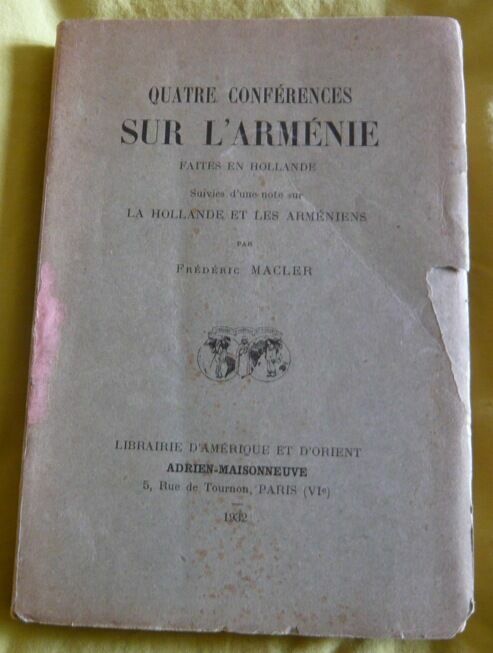
Frédéric Macler
Quatre conférences sur l'Arménie faites en Hollande suivies d'une note sur la Hollande et les Arméniens
1932. Paris Librairie Adrien-Maisonneuve 1932 - Broché 13 cm x 19 cm 293 pages - Texte de Frédéric Macler - Bibliographie - Bien complet du prière d'insérer - Petite tache sur la couv sinon bon état
Riferimento per il libraio : 4766
|
|
|
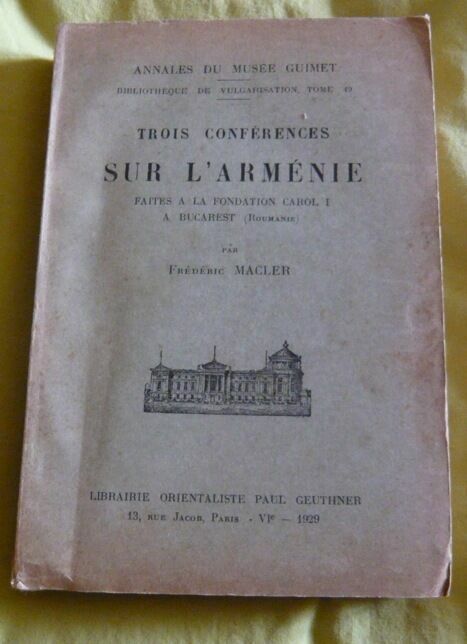
Frédéric Macler
Trois conférences sur l'Arménie faites à la Fondation Carol I à Bucarest (Roumanie)
1929. Paris Librairie orientaliste Paul Geuthner 1929 - Broché 13 cm x 19 cm 290 pages + 10 planches photographiques hors-texte - Texte de Frédéric Macler - Bibliographie - Envoi de l'auteur - Bon état
Riferimento per il libraio : 4767
|
|
|
FUAD [FUAT] ZIYA ÇIYILTEPE, (1870-1942), (Turkish soldier and politician).
[Autograph letter signed Fuad Ziya Çiyiltepe].
Very Good Turkish, Ottoman (1500-1928) Original autograph letter signed Fuat Ziya Çiyiltepe. Dated 1928. 1 p. In Ottoman script. 22x18 cm. Addressed to Commander in Kizan Hani. Includes an assignment report. A military subject about Erzincan, Kizan Hani. "Kizan Hani ve civari bir kol noktasidir. Siz de Kizan Hani'na 9 numero kol noktasi kumandanisiniz..."
|
|
|
FUAD CARIM.
Islenmemis konular. Osmanli tarihinde gizli kalmis olaylar.
Fine English Paperback., Very good., 20 x 14 cm, 95 p. "Islenmemis konular. Ottoman historynde gizli kalmis olaylar, FUAD CARIM, Güncel Yayincilik, Istanbul, 1996"
|
|
|
FUAD CARIM.
Islenmemis konular: Bir Fas heyeti. Istanbul'da yetismis iki Fas imparatoru. 4üncü Henri ve 3üncü Mehmed. Türk musikisi. Kuran'in sahte tercemesi. Abdülmecid ve Papa 9uncu Pie
Very Good English Paperback. Pbo. Cr. 8vo. (20 x 14 cm). In Turkish. 77 p. First Edition. Islenmemis konular: Bir Fas heyeti. Istanbul'da yetismis iki Fas imparatoru. 4üncü Henri ve 3üncü Mehmed. Türk musikisi. Kuran'in sahte tercemesi. Abdülmecid ve Papa 9uncu Pie
|
|
|
FUAD CARIM.
Islenmemis konular: Bir Fas heyeti. Istanbul'da yetismis iki Fas imparatoru. 4üncü Henri ve 3üncü Mehmed. Türk musikisi. Kuran'in sahte tercemesi. Abdülmecid ve Papa 9uncu Pie
Very Good English Paperback. Pbo. Cr. 8vo. (20 x 14 cm). In Turkish. 77 p. Islenmemis konular: Bir Fas heyeti. Istanbul'da yetismis iki Fas imparatoru. 4üncü Henri ve 3üncü Mehmed. Türk musikisi. Kuran'in sahte tercemesi. Abdülmecid ve Papa 9uncu Pie
|
|
|
FUAD CARIM.
Venezuela'li General Miranda'nin Türkiye'ye dair hatirati. Yazar ve seyyah Jean Chardin'in anlattigi kalp para ticareti. Comte de Cesy: Dördüncü Murad tarafindan atanan Fransa elçisi.
Very Good English Paperback. Pbo. Cr. 8vo. (20 x 14 cm). In Turkish. 109 p. Venezuela'li General Miranda'nin Türkiye'ye dair hatirati. Yazar ve seyyah Jean Chardin'in anlattigi kalp para ticareti. Comte de Cesy: Dördüncü Murad tarafindan atanan Fransa elçisi.
|
|
|
FUAD KÖPRÜLÜ.
Edebiyat arastirmalari.
Fine English Paperback., Very good., 23 x 16 cm, [xiv], 472 p. "Edebiyat arastirmalari., FUAD KÖPRÜLÜ, TTK - Türk Tarih Kurumu, Ankara, 1986"
|
|
|
FUAT BALKAN.
Ilk Türk komitacisi Fuat Balkan'in hatiralari. Prep. by Metin Marti.
Very Good Turkish Paperback. Cr. 8vo. (20 x 14 cm). In Turkish. 204 p., ills. Ilk Türk komitacisi Fuat Balkan'in hatiralari. Prep. by Metin Marti.
|
|
|
FUAT BASAR.
Fuat Basar. 35. sanat yili. [Exhibition catalogue].
New English Paperback. Pbo. 4to. (27 x 27 cm). In Turkish. 81, [1] p., color ills. Fuat Basar. 35. sanat yili. [Exhibition catalogue]. TURKISH AND ISLAMIC ARTS Traditional art Ottoman culture Calligraphy Tezhib Illumination Marbling Ebrû Painting.
|
|
|
FUAT BAYRAMOGLU.
Turkish glass art and Beykoz-ware.
Very Good Very Good English Paperback. Dust wrapper. Roy. 8vo. (24 x 17 cm). In English. 116, [3] p., 172 numerous color and b/w plts. and documents. Turkish glass art and Beykoz-ware. First Edition. Contents: Preface.; Introduction: Civilization and glassware.; Glass manufacture in Islamic countries.; Turkish glassware.; Glass manufacture during the Ottoman period.; Successive phases in the development of Ottoman glass manufacture.; Beykozware.; Glass manufacture during the Republican era.; Concluding remarks.; Bibliography and notes.; Index.; Documents and monochrome.; Illustrations.
|
|
|
FUAT BAYRAMOGLU.
Türk cam sanati ve Beykoz isleri.
Fine English Paperback. Pbo. Cr. 8vo. (19 x 13 cm). Color ills. In Turkish. 78 p. Turkish glass art and Beykoz works of glasses. Türk cam sanati ve Beykoz isleri.
|
|
|
FUAT DURMUS.
The contemporary Turkish facsimile of the Gelibolu district Jewish community population register at the Tekfurdagi Governorship Office situated inside Edirne Province.= Edirne Eyaleti dâhiminde kâ'in Tekfurdagi Kaymakamligi idaresinde bulunan Gelibolu kazasinin Millet-i Yahudiyân nüfus defterinin günümüz Türkçesiyle tipkibasimi.
New English Paperback. Folio. (32 x 22 cm). In English and Turkish. 46 p. Edirne Eyaleti dâhiminde Kâ'in Tekfurdagi Kaymakamligi idaresinde bulunan Gelibolu kazasinin Millet-i Yahudiyân nüfus defterinin günümüz Türkçesiyle tipkibasimi. The Contemporary Turkish facsimile of the Gelibolu district Jewish community population register at the Tekfurdagi Governorship office situated inside Edirne Province. Throughout history people have wished to research their past, their family and their family tree. Although being of a verifiable noble genealogy does not change the social status of the person in the modern age, this is the result of the human irrepressible desire for learning. For all groups of people whose roots are based in this geography, the Ottoman Period population registers are the most significant reference guides. The 1845 population register of the Gelibolu Jewish Community -which is published in Turkish and English at same time- includes many details about the members of the community.
|
|
|
FUAT SANCI.
Malatya Türk-Islâm dönemi mimari eserleri.Vol. III.
New English Paperback. Pbo. Roy. 8vo. (24 x 17 cm). In Turkish. 238 p. Turkish and Islamic architectural works in Malatya City. Malatya Türk-Islâm dönemi mimari eserleri.Vol. II.
|
|
|
FUAT SEZGIN.
Piri Reis and the Pre-Columbian discovery of the American continent by Muslim seafarers.
New English Paperback. Pbo. Oblong large 8vo. (22 x 22 cm). In English. Color and b/w ills. 68 p. Piri Reis and the Pre-Columbian discovery of the American continent by Muslim seafarers.
|
|
|
FUAT UÇAR.
Pasha foundations in Bolu during Ottoman period.= Osmanli döneminde Bolu'da pasa vakiflari.
New English Paperback. Roy. 8vo. (24 x 17 cm). In Turkish and small abstract in English. 185, [2] p., b/w ills. and Ottoman documents. Pasha foundations in Bolu during Ottoman period.= Osmanli döneminde Bolu'da pasa vakiflari.
|
|
|
Fugier Laurence
La Folle journée de Nasreddin Hodja
Rue du Monde Papagayo - La petite bibliothèque des contes du monde Cartonné 2012 In-8 (14,5 x 22,6 cm), cartonné, 43 pages, illustrations en couleurs de Véronique Joffre ; excellent état. Livraison a domicile (La Poste) ou en Mondial Relay sur simple demande.
Riferimento per il libraio : fj913

|
|
|
Fulvio (Roiter) ; Freya (Stark)
Turquie
ALTLANTIS 1971 In-4 reliure éditeur pleine toile sous jaquette, 31 cm sur 24,8. 168 pages. Jaquette en état moyen. Bon état d’occasion.
Riferimento per il libraio : 143313
|
|
|
Furet, M.me C.
Récits Tirés De L'histoire Ottomane carnets Du Bosphore Vi
8vo pp. 101, rep. ed. constantinople 1871 livre de lecture à l'usage des écoles et lycées de l'empire ottoman
|
|
|
FUZULI.
Fuzûlî ve Leylâ ve Mecnun (Ingilizce manzum tercümesi). Translated by Sofi Huri.= Leila and Majnun.
Fine English Paperback. Pbo. Roy. 8vo. (24 x 17 cm). In English and Turkish. [6], 133 p. text in Turkish; [x], 236 p. in English translation of poet.
|
|
|
FUZULÎ.
Hadikatü's-süeda. Translated by Seyma Güngör.
Fine English Paperback. Pbo. Roy. 8vo. (24 x 17 cm). In Turkish. [Lxxx], 504 p., color ills. Hadikatü's-süeda. Translated by Seyma Güngör. ISBN: 97500515.
|
|
|
FUZÛLÎ.
Rind ü zahid. Prep. by Kemal Edib Kürkçüoglu.
Very Good English Paperback. Pbo. Roy. 8vo. (24 x 17 cm). In Turkish and facsimile in Persian. 14, [84] p. Rind ü zahid. Prep. by Kemal Edib Kürkçüoglu.
|
|
|
FÂTIH SULTAN MEHMED, (1432-1481).
Dîwân of Sultan Mehmed II with commentary.= Fâtih divâni ve serhi. Prep. by Muhammet Nur Dogan. Translated into English Michael D. Sheridan.
New English Original bdg. HC. Roy. 8vo. (24 x 17 cm). Preface and introduction in English and Turkish; facsimile of original in Ottoman Turkish, with romanized text also translated into modern Turkish and English; commentary in modern Turkish and English. 614, [50] p., includes facsimile of manuscript, no. 305, in Ottoman Turkish preserved in Milli Kütüphane (National Library of Turkey), Istanbul. Dîwân of Sultan Mehmed II with commentary.= Fâtih divâni ve serhi. Prep. by Muhammet Nur Dogan. Translated into English Michael D. Sheridan.
|
|
|
FÜGEN ILTER.
Bir Anadolu kenti: Iskilip.
Fine Turkish Original cloth bdg. 4to. (29 x 20 cm). In Turkish. [xi], 144 p. 218 numerous color and b/w ills., iii numerous b/w maps, vi numerous plts., xx numerous b/w plan, 3 folding maps. Bir Anadolu kenti: Iskilip.
|
|
|
FÜRUZAN KINAL.
Eski Anadolu tarihi.
As New Turkish Paperback. Roy. 8vo. (24 x 17 cm). In Turkish. [xv], 290 p., plates. Eski Anadolu tarihi. History of ancient Anatolia, Asia Minor.
|
|
|
FÜRUZAN KINAL.
Geographie et l'histoire des pays d'Arzava.
Very Good English Paperback. Pbo. Small 4to. (26 x 18 cm). In French. 52 p. Ills. Arzawa in the second half of the 2nd millennium BC (roughly from late 15th century until the beginning of the 12th century) was the name of a region and a political entity (a "kingdom" or a federation of local powers) in Western Anatolia. The core of Arzawa is believed to have been located along the Kestros River (Küçük Menderes), with its capital at Apasa, later known as Ephesus. When the Hittites conquered Arzawa it was divided into three Hittite provinces: a southern province called Mira along the Maeander River, which would later become known as Caria; a northern province called the Seha River Land, along the Gediz River, which would later become known as Lydia; and an eastern province called Hapalla. It was the successor state of the Assuwa league, which also included parts of western Anatolia, but was conquered by the Hittites in c. 1400. Arzawa was the western neighbour and rival of the Middle and New Hittite Kingdoms. On the other hand it was inclose contact with the Ahhiyawa of the Hittite texts, which corresponds to the Achaeans of Mycenaean Greece. Moreover, Achaeans and Arzawa formed a coalition against the Hittites, in various periods.
|
|
|
G DELISLE
Theatrum historicum . Pars orientalis .
1780 P, Dezauche , 1780 , carte 66 x 49 cm Contours des provinces coloriées à l' époque, restauration discrète à la pliure , petits manques de papier dans les coins , quelques taches claires .
Riferimento per il libraio : M5484

|
|
|
G. HAZAI.
A propos d'un changement phonetique dans le Moyen-Osmanli. [Separatum Acta Orient. Hung.].
Very Good English Paperback. Pbo. Roy. 8vo. (24 x 17 cm). In French. [1], 147-154, [1] pp. An ex-library copy.
|
|
|

 Ricevere i risultati per e-mail
 Scaricare i risultati in PDF
 RSS feed
 Link
Link


