Acker, Tim; John Carty; Et AlBiblio.com

811 résultats
2012réf. 103210UWA Publishing. New. Paperback. FREE UPGRADE to Courier/Priority Shipping Upon Request - IN STOCK AND IMMEDIATELY AVAILABLE FOR SHIPMENT - Flawless copy brand new pristine never opened -- 296 pages; over 300 illustrations most in color. -- with a bonus offer-- . 2012. 1742583911 . UWA Publishing paperback
2015réf. 113941University of California Press. New. Hardcover. FREE UPGRADE to Courier/Priority Shipping Upon Request - IN STOCK AND IMMEDIATELY AVAILABLE FOR SHIPMENT - IN STOCK AND IMMEDIATELY AVAILABLE FOR SHIPMENT - Flawless copy brand new pristine never opened - -- with a bonus offer-- . 2015. 0520287185 . University of California Press hardcover
2015réf. 110509Leuven University Press. New. Paperback. FREE UPGRADE to Courier/Priority Shipping Upon Request - IN STOCK AND IMMEDIATELY AVAILABLE FOR SHIPMENT - Flawless copy brand new pristine never opened - -- with a bonus offer-- . 2015. 9058679586 . Leuven University Press paperback
1991réf. SBBI-L-BFQ00227-RAG-20231Flamingo 1991. paperback. Good. Our good condition books are generally good for reading but not for gifting or collecting. They could have imperfections such as creasing fanning inscriptions margin notes yellowing staining on edge or cover or pages bumps scuffs etc etc sometimes multiple of these. It's a wide category that encompasses anything that isn't almost-new down to anything that is slightly better than poor. We would NOT recommend gifting Good books - these should be considered reading copies. Our books are dispatched from a Yorkshire former cotton mill. We list via barcode/ISBN so please note that the images are stock images and may not be the exact copy you receive furthermore the details about edition and year might not be accurate as many publishers reuse the same ISBN for multiple editions and as we simply scan a barcode or enter an ISBN we do not check the validity of the edition data when listing. If you're looking for an exact edition please don't order at least not without checking with us first although we don't always have time to check. We aim to dispatch prompty the service used will depend on order value and book size. We can ship to most countries see our shipping policies. Payment is via Abe only. Flamingo paperback
1975réf. 160809010No place: Self published 1975. First Edition. Paperback. Very Good. A complete set in six parts: "The Case of the Murdered Twerp" "Longing for Better Things" "Stop It Ted I Screamed" "How Love Can Lead Youngsters to Murder" "The Future" and "The Life of Johnny Rocco." Very good on average with wraps showing toning light smudging and general handling. Volume IV has previous owner name inside front cover and light creasing. A postmodern cut-up novel in the vein of William S. Burroughs Brion Gysin and the Situationists. Early works by Acker in complete runs are scarce as they were often issued in parts either handed out to friends or sold by subscription. [Self published] paperback books
réf. 160809010No place: Self published 1975. First Edition. Paperback. Very Good. A complete set in six parts: "The Case of the Murdered Twerp" "Longing for Better Things" "Stop It Ted I Screamed" "How Love Can Lead Youngsters to Murder" "The Future" and "The Life of Johnny Rocco." Very good on average with wraps showing toning light smudging and general handling. Volume IV has previous owner name inside front cover and light creasing. A postmodern cut-up novel in the vein of William S. Burroughs Brion Gysin and the Situationists. Early works by Acker in complete runs are scarce as they were often issued in parts either handed out to friends or sold by subscription. [Self published] paperback
réf. 3040No place Bay Area: Papyrus Press 1972. Very Good. Kathy Acker's first book certainly the rarest and one that already clearly presages the energy & portent of her later writings. Breathless prose. Printed card-covers with thick tape covering staples 8-5/8" x 7-1/8" in Very Good condition but for some water staining to front cover. The present copy is from the library of another great radical literary figure Jill Johnston 1929-2010 cultural critic memoirist lesbian feminist and champion of the avant-garde and it bears her distinctive stamp in blue ink on the title page which reads "Write first. then live." J.J. While the edges of the covers are a tad softened there are no other mentionable flaws to this piece. Papyrus Press unknown
réf. 21226881974. San Francisco: Empty Elevator Shaft Poetry Press / musicmusic Corporation. 1974. Six vols 8vo. Original white and cream wrappers stapled as issued front covers lettered in purple vol. I and black vols III-VI front cover of vol. II blank; housed in a custom-made grey card box; continuous pagination throughout vol. I entirely printed in purple; some light wear to covers slight spotting to top edge of text block in vols V and VI; near fine.First edition a particularly attractive copy of Acker's second published novel issued in six separate parts in limited numbers.A central figure in the New York literary avant-garde of the 1970s Kathy Acker developed a transgressive feminist voice that challenged conventional narrative forms. I Dreamt I Became a Nymphomaniac! loosely based on her own experiences employs her characteristic fragmentary prose to explore the desires and inner life of its first-person narrator.The work was first issued in 1974 in six separate volumes and appeared in a single-volume edition in 1980. Only the first two volumes are explicitly attributed to Acker: the third is credited on the front cover to the composer and experimental musician Peter Gordon whom she married in 1978 while the back cover bears the copyright name ""The Black Tarantula"" one of her pseudonyms. unknown
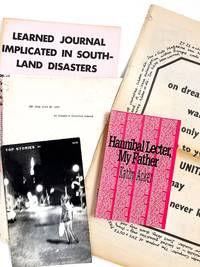
1979réf. 22819New York: Various 1979-1991. Photocopy of typescript with one page original typescript bearing top-copy typed corrections and holograph number that page taped to verso of letterhead. 60pp. printed on recto only stapled at top right corner with neat tape reinforcement over staple on title page. Light wear to title page and final sheet tail edge of two oversized sheets rubbed. Taped revision loose from browned tape mounts. Very good. With four published appearances featuring the story also provided. A pre-publication copy of Ackers own corrected typescript for the story New York City in 1979 which went on to win the 1979 Pushcart Prize making it her first critically acclaimed work. This document gives key insight not only into Ackers writing methods but also raises interesting questions about the intended structure of the finished story and highlights the mutable interpretations regarding the published presentation of her prose writing via four different versions included herein. This copy was sent by Acker in late 1979 to friend and fellow experimental writer Paul Buck. The pages have clearly been xeroxed on several different machines with different paper stock and print qualities evident in different sections and pp. 29 is an original typescript passage with visible typed correctionz and numbered in holograph in Ackers distinctive hand which has been taped onto the verso of a sheet of letterhead for Performing Artservices Inc. 463 West St NY" an organisation that provided management and administrative services to avant-garde artists. Included with this document are four published editions of the story. The first although not always credited thus was in International Times vol. 5 no 5. January/February 1980. Run as New York City 79 over the centerspread this version is closest to the typescript form. There is persuasive indication that the editors of I.T. were working from a similar photocopy and whether instructed thus by Acker or not they took the cut-up style of the piece at face value and ran it as a series of fragments differentiated from one another by the use of typefaces and with no cohesive order. Probably due to space constraints this version is also heavily abridged however the notable omissions of the three statements about lesbians suggests that there was also a degree of selective censorship at work here. The first publication of the complete text followed in July 1980 in the pages of San Diego magazine Crawl Out Your Window Issue 7. Here the sentences which run over multiple pages in the typescript are conventionalised into standard lines. There are also slight textual differences with a couple of additional sentences added. The first stand alone publication came in Top Stories 9 1981 which incorporated photographs by Anne Turyn. These images again mutate the text and raise further questions about Ackers editorial intention; the typescript title-page bears the uncompleted subheading Photographs by but gives no further allusions to this content. The final example is the 1991 Semiotexte collection HANNIBAL LECTOR MT FATHER which shows still further textual edits. In terms of form the most marked difference between the typescript copy and the published editions that followed is the way in which the text is divided into a series of passages or episodes numbered at the head of the page. These can be full paragraphs or single sentences or for example the word syphilis which has an entire page to itself. This deliberate distribution of whitespace surrounding the single word which in later editions is returned to the conventional layout of a sentence adds nuance and valence to the story which is arguably altered in transcription. In the key collection of Acker Papers at Duke University there is a comparable copy described thus in their catalogue: 60-page photocopied typescript corrected in the photocopy with original note on the title page My Copy by Acker. We have not been able to locate an original typescript suggesting that this format with Ackers holograph corrections in the copy is as primary a resource for this text as is currently known. A revealing archive showing both Acker's working methods and intentions while simultaneously demonstrating their editorial undoing across numerous editions. [Various] unknown books
réf. 43804New York: Various 1991. Very good overall. Collection of five different versions of Acker's first critically acclaimed work - including a pre-publication copy of her own corrected typescript. The pre-publication copy gives key insight not only into Acker's writing methods but also raises interesting questions about the intended structure of the finished story and highlights the mutable interpretations regarding the published presentation of her prose writing via four different versions included herein. This copy was sent by Acker in late 1979 to friend and fellow experimental writer Paul Buck. The pages have clearly been xeroxed on several different machines with different paper stock and print qualities evident in different sections and pp. 29 is an original typescript passage with visible typed corrections and numbered in holograph in Acker's distinctive hand which has been taped onto the verso of a sheet of letterhead for "Performing Artservices Inc. 463 West St NY" an organization that provided management and administrative services to avant-garde artists. Included with this document are four published editions of the story. The first although not always credited thus was in International Times vol. 5 no 5. January/February 1980. Run as "New York City '79" over the centerspread this version is closest to the typescript form. There is persuasive evidence that the editors of I.T. were working from a similar photocopy and whether instructed thus by Acker or not they took the cut-up style of the piece at face value and ran it as a series of fragments differentiated from one another by the use of typefaces and with no cohesive order. Probably due to space constraints this version is also heavily abridged however the notable omissions of the three statements about lesbians suggests that there was also a degree of selective censorship at work. The first publication of the complete text followed in July 1980 in the pages of San Diego magazine Crawl Out Your Window Issue 7. Here the sentences - which run over multiple pages in the typescript - are conventionalized into standard lines. There are also slight textual differences with a couple of additional sentences added. The first stand-alone publication came in Top Stories 9 1981 which incorporated photographs by Anne Turyn. These images again mutate the text and raise further questions about Acker's editorial intention; the typescript title-page bears the uncompleted subheading "Photographs by" but gives no further allusions to this content. The final example is the 1991 Semiotexte collection HANNIBAL LECTOR MT FATHER which shows still further textual edits. In terms of form the most marked difference between the typescript copy and the published editions that followed is the way in which the text is divided into a series of passages or episodes numbered at the head of the page. These can be full paragraphs or single sentences or for example the word "syphilis" which has an entire page to itself. This deliberate distribution of white space surrounding the single word which in later editions is returned to the conventional layout of a sentence adds nuance and valence to the story which is arguably altered in transcription. In the key collection of Acker Papers at Duke University there is a comparable copy described thus in their catalogue: "60-page photocopied typescript corrected in the photocopy with original note on the title page My Copy by Acker". We have not been able to locate an original typescript suggesting that this format with Acker's holograph corrections in the copy is as primary a resource for this text as is currently known. A revealing collection about Acker's Pushcart Prize-winning work showing both her working methods and intentions while simultaneously demonstrating their editorial undoing across numerous editions. Photocopy of typescript with one page original typescript bearing top-copy typed corrections and holograph number that page taped to verso of letterhead. 60pp. printed on recto only stapled at top right corner with neat tape reinforcement over staple on title page. Light wear to title page and final sheet tail edge of two oversized sheets rubbed. Taped revision loose from browned tape mounts. With four published appearances featuring the story also provided. [Various] unknown
réf. 146188N.p.: N.p. 1976. Archive of six autograph letters signed and one typed letter signed from Kathy Acker to fellow experimental novelist Rudolph Wurlitzer twenty five pages total undated but written during the first half of 1976 based on dates mentioned in the body of one of the letters. From the collection of Rudolph Wurlitzer with provenance. Acker and Wurlitzer were in a relationship begun while they were both in New York and continuing briefly after he left the city for Nova Scotia where he was a the time of this correspondence. Two of the letters directly address their relationship and correspond to letters written by Wurlitzer as quoted in Chris Kraus' 2017 biography of the late writer "After Kathy Acker." The letters offered here were not available to Kraus something she mentions when discussing the relationship with Wurlitzer and have never been published or previously available for sale. In addition to Acker's frank discussion of her feelings toward Wurlitzer the letters take a broadly confessional tone as Acker discusses her mental and emotional state as well as her conflicted feelings regarding the writing she was doing at the time. She writes candidly about feelings of isolation introversion and exhaustion with life in New York and its attendant social obligations presenting a version of Acker that is at odds with both her own self-mythologizing and her already established persona as a post-punk literary icon and chronicler of the downtown avant garde scene. Acker is similarly candid regarding her own writing mentioning both "The Adult Life of Toulouse-Lautrec" and "Florida" both 1978 as in-progress saying of the former "the hell with Toulouse I wanted to finish it off with hell and this is hell" and of the later that it "is about characters. Have to make characters grow." She goes into some detail regarding her feelings about "The Life of Johnny Rocco" section of "Toulouse" calling it "a horrible book" and noting that she's "scared of this book. Scared to type it up. Something very raw about me in it" but also noting that the "only good thing" about the book is that it was "the first time I created a real character who isn't me." Finally Acker speaks at length about the books and films she is consuming in particular noting the influence of Japanese literature and cinema on her work and often relating them to her own ambitions as a writer. She quotes a long passage from William Faulkner's "Go Down Moses" and compares her work unfavorably to it briefly discusses Akira Kurosawa's "Seven Samurai" mentions reading Yukio Mishima Osamu Dazai and Yasunari Kawabata and in one letter provides a lengthy synopsis of the plot of all three films in Hiroshi Inagaki's "Samurai Trilogy" before briefly relating the themes of the film to her relationship with Wurlitzer. Of the influence of Japanese literature she notes her desire in her own writing for "simple paragraphs each paragraph an image. 1 2 3. The flow absolutely like straight line.like those incredible Japanese novels I've been reading." Autograph letters signed on 7 x 8.25 inch lined notebook paper. 23 pages rectos only. Near Fine with faint horizontal folds. Typed letter signed on 8.5 x 11 paper. Two pages rectos only. Near Fine folded twice for mailing. N.p. unknown