18 134 résultats
1763réf. 6390Cambridge: John Baskerville 1763. Very Good/Printing a grand bible had been Baskerville's cherished ambition but the royal privilege belonged exclusively to Oxford and Cambridge Universities. Consequently Baskerville applied and was elected printer to the University of Cambridge. An innovator a micromanager a workaholic and an exacting perfectionist he threw everything into the bible project. He invented a stiffer blacker ink for it designed the types and the page layout and demanded smoother paper than was generally available. Ultimately he emptied his own bank accounts and borrowed money when the support of subscribers failed. Indeed he was not able to sell the entire edition of 1250 copies and ended up remaindering more than a third of the press run for pence on the guinea to his enormous personal disappointment and financial pain. The book remains a landmark in the history of English printing "one of the most beautiful books printed in the world" according to the bibliographer Frognall Dibdin a sentiment frequently echoed in Great Britain. This copy with the third longest list of subscribers ending with York. . Imperial folio 50 cm; 573 leaves. Text in double columns. In straight-grain blue morocco with gold-tooled border. Rebacked with original gold-tooled spine laid down. All edges gilt. Later reinforcements to joints and hinges. Light foxing on first and last leaves. Old bookplate on pastedown. Extra shipping charges will apply. References: Gaskell "John Baskerville a Bibliography" 26; Rothschild 2640; Darlow & Moule 857. John Baskerville unknown books
1985réf. 6343London: Facsimile Editions 1985. Edition limited to 500 copies. Very Good/Fine facsimile of "Ms Kennicotti" held in the Bodleian Library at Oxford University a finely decorated manuscript of the Hebrew Bible that resembles in some ways the Book of Kells in the use of animal figures and and intricate marginal decorations although the style comes from the Ibero-Islamic tradition rather than the Celtic one. The manuscript was copied out twenty years prior to the expulsion of Jews from Spain in 1492 by Moshe Ibn Zabara and Yosef Ibn Chaim containing the entire Tanak together with the Radak commentary and Sefer HaMichlol. It is known as the "Kennicott Bible" after Benjamin Kennicot 1718-1783 the English clergyman and Hebraist who acquired the manuscript for Oxford University. An exceptionally beautiful facsimile five and a half years in the making it is printed on deluxe paper stock intended to reproduce the appearance of the original vellum. The gold highlights in the facsimile illustrations were applied by hand. The commentary by Bezalel Narkiss and Aliza Cohen-Mushlin provides a scholarly yet approachable historical context and artistic appreciation. A remarkable production!. 34 cm; 2 volumes 444 leaves facsimile; 97 pages commentary. Hebrew and English. Each volume in sturdy blindstamped leather bindings housed in custom velvet-lined blue cloth folding case. Slight surface mark on lower board of facsimile; surface scratch on lower board of commentary folding case a little dusty closure strap somewhat distressed else fine. Extra shipping charges will apply. [Facsimile Editions] hardcover books
1968réf. 6073Zurich: Arta 1968. #70 of 200 copies signed by the artist. Very Good. 34 cm; 70 10 pages last five blank. Text of the Song of Songs in German. Illustrated throughout with original lithographs by Sigg printed from stone by Emil Mathieu. Printed on hand-made paper by Richard de Bas watermarked "Arta". Pages loose in portfolio as issued and preserved in laid paper chemise. Remains of original slipcase present but non-functional. Else fine. Arta unknown books
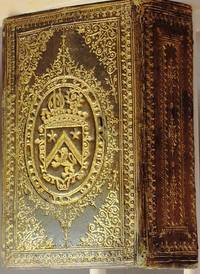
1611réf. 6015Coloniae Allobrogum i.e. Geneva : Pierre de la Rovière 1611. Arias Montano was one of the principal editors of the great polyglot edition of the bible issued by the Plantin Press in 1571. He was denounced to the Inquisition for liberality. This edition of the Greek New Testament with Arias's extensive commentary is enclosed in an elaborate French binding flat back extensively tooled bearing the arms of the Abbé Genesse with his motto "Quae est expectatio mea nonne dominus" Psalm 38:8 What is my hope Is it not the lord. 16mo 13 cm; 2 volumes in one. 342 239 1 leaves. Printer's device on title page. Text in Greek with interlinear Latin translation and commentary. Text and commentary within ruled borders. Elaborately gilt-tooled morocco armorial binding of l'abbé Genesse i.e. of Genoa with arms within a central lozenge enclosed in a motto and filigreed in all corners and within ruled borders on both boards; spine with filigreed central panel. Edges gilt. Pages generally toned with scattered foxing; light water stain on covers and in first 100 leaves. Binding reference: Tausin "Dictionnaire des devises ecclésiastiques" 165. Pierre de la Rovière hardcover books
réf. 5603London: Various publishers Various dates. Leather. Good. Octavo 18 cm; three works in one volume. The Book of Common Prayer: Oxford: for Thomas Guy 1682. 168 of 169 leaves lacks printed title page. Engraved title page torn at upper right with some loss. Worm trails. Collation varies from ESTC copy pi A-U8 X4 lacking pi; engraved title page showing a cathedral nave; armorial tail piece with crest of Charles II. The New Testament of Our Lord and Savior.: London: printed by John Bill Thomas Newcomb and Henry Hills 1679. 192 leaves. Collation varies from ESTC entry and from any of the copies collated in Darlowe and Moule viz: Aa8-Aaa8. The Whole Book of Psalms: Collected into English Metre by Thomas Sternhold John Hopkins and others. London: The Company of Stationers 1684. 2 131 19 pages last blank. Bound in contemporary full calf tooled in blind with floral and geometric motives on both boards. Binding worn. Armorial bookplate of Robert Andrews 1703-1763 on lower pastedown. Armorial bookplate of William Long 1817-1886 on upper pastedown showing the Long crest and motto with handwritten inscription to Elizabeth Hare Long from her aunt Elizabeth Nott "grandaughter sic of Robert Andrews." Manuscript family record of births and deaths on front blanks and on inserted leaf in the hand of Robert Andrews 1703-1763 lawyer and property developer. "No builder or developer played a greater role in making the Grosvenors' Mayfair estate a byword for high-quality Georgian housing" according to DNB. Andrews became the attorney for many of Britain's aristocratic families including that of Frederick Prince of Wales. [Various publishers] hardcover books
1992réf. 49237London: The Olive Tree 1992. First Edition. Octavo. Cloth boards; dustjacket; 120pp. Fine in fine dustwrapper. The entire text reproduced from Lupton's calligraphic manuscript. The Olive Tree unknown books
1968réf. 45523Waltham: Brandeis University Press 1968. First Edition. Quarto 27cm. Beige pebbled cloth boards stamped in gilt; xvii1141pp; 211 items pictured on approximately 100 leaves of plates. Fine unmarked copy no dustwrapper as called for. Publication no. 3 of the Society of Bibliophiles at Brandeis University. Brandeis University Press unknown books
1836réf. 45099Cincinnati: Stereotyped by J.A. James / Corey and Webster 1836. 64mo 8.5cm.; publisher's full sheep gilt-ruled spine; 469pp. Joints starting to crack but holding shallow losses at spine ends spine gilt almost entirely effaced else a Very Good internally sound copy. Not in Darlow & Moule. Stereotyped by J.A. James / Corey and Webster unknown books
réf. 13930Printed by Robert Barker in London: 1611. The Holy Bible Conteyning the Old Testa- ment and the New:/ Newly Translated out of/the Originall Tongues: and with/the former Translations diligently/compared and reuise d by his/Maiesties speciall Com-/mandement./Appointed to be read in Churches./Imprinted/at London by Robert/Barker Printer to the/King's most Excellent/Maiestie./Anno Dom. 1 sheet. Folio size. Covering the verses Psalm 71:3-74:1. First Edition of the King James Bible. Very good condition overall. Pages crisp and clean with minimal foxing. Professional repair to bottom left corner. Large capital letter woodcuts. unknown books
réf. 16769Single Leaf Page from King James bible-page from the book of Luke 13:15-15:1 -the narrow gate - nf. London 1611- printed by Robert Barker printer to the king's excellent majesty in London 1639. First edition fifth and final issue. Leaf Measure 16 1/4 " x 10 3/4 " on heavy weight cotton linen paper. 59 lines of text to the full page. Printed in beautiful old English gothic blackletter type font. the book of luke. Recto contains Luke 13:15 - 14:6 the strait gate & dropsie healed; verso contains Luke 14:7 - 15:1 the great supper & unsavory salt. The King James Bible was the English translation of the Christian Bible for the Church of England commissioned in 1604 and completed as well as published in 1611 under the sponsorship of James VI and I. Noted for its "majesty of style" the King James Version has been described as one of the most important books in English culture and a driving force in the shaping of the English-speaking world. Near fine Herbert # 543. unknown books
réf. 16768Single Leaf Page from Geneva Bible Book of Romans. 1597 Geneva bible leaf from the book of romans 13:11-15:19 page " brotherly love" vgc. London 1597. Over 400 year old Geneva "Breeches" bible leaf printed in London by the deputies of Christopher Barker "printer to the queenes most excellent maieftie anno dom. 1597 " - the book of romans. Recto has romans 13:11 - 14:14 "brotherly love & gentiles called" verso of the leaf has romans 14:15 - 15:19 "the weake brethren & god the judge" Leaf measures 10 3/8" x 7" 262mm x 177mm printed on old cotton linen paper also called rag paper. The Geneva Bible is one of the most historically significant translations of the Bible into English preceding the King James Version by 51 years. It was the primary Bible of 16th-century English Protestantism and was the Bible used by William Shakespeare and Oliver Cromwell. It was one of the Bibles taken to America on the Mayflower. This version of the Bible is significant because for the very first time a mechanically printed mass-produced Bible was made available directly to the general public which came with a variety of scriptural study guides and aids collectively called an apparatus which included verse citations that allow the reader to cross-reference one verse with numerous relevant verses in the rest of the Bible introductions to each book of the Bible that acted to summarize all of the material that each book would cover maps tables woodcut illustrations and indices. The annotations which are an important part of the Geneva Bible were Calvinist and Puritan in character and as such they were disliked by the ruling pro-government Anglicans of the Church of England as well as King James I who commissioned the "Authorized Version" or King James Bible in order to replace it. Surprisingly the Geneva notes were included in a few editions of the King James version even as late as 1715. unknown books
réf. 16767Single Leaf Page from Geneva Breeches Bible. 1597 Geneva Bible - Luke 7:10-8:34 - Christ's Mother & Brothers-London 1597. Over 400 Years Old Geneva Breech Bible Leaf 1 Imprinted at London By The Deputies of Christopher Baker Printer To The Queens Most Excellent Maieftie and Do 1597- The Book of Luke -Recto Has Luke 7:10 Through 48. Verso has Luke 7:49 Through 8:34 Leaf Measures 10 3/8" X 7 1/4 " Printed On Cotton Linen Paper Sometimes Called Rag Paper. The Geneva Bible is one of the most historically significant translations of the Bible into English preceding the King James Version by 51 years. It was the primary Bible of 16th-century English Protestantism and was the Bible used by William Shakespeare and Oliver Cromwell. It was one of the Bibles taken to America on the Mayflower. This version of the Bible is significant because for the very first time a mechanically printed mass-produced Bible was made available directly to the general public which came with a variety of scriptural study guides and aids collectively called an apparatus which included verse citations that allow the reader to cross-reference one verse with numerous relevant verses in the rest of the Bible introductions to each book of the Bible that acted to summarize all of the material that each book would cover maps tables woodcut illustrations and indices. The annotations which are an important part of the Geneva Bible were Calvinist and Puritan in character and as such they were disliked by the ruling pro-government Anglicans of the Church of England as well as King James I who commissioned the "Authorized Version" or King James Bible in order to replace it. Surprisingly the Geneva notes were included in a few editions of the King James version even as late as 1715. unknown books
réf. 16770King James bible book of Matthew. London 1611. This is a First Edition Single Leaf Page from 400 years old leaf printed by Robert Barker printer to the king's excellent majesty in London 1639. First edition fifth and final issue of the measures 16 1/4 " x 10 3/4 " on heavy weight cotton linen paper 59 lines of text to the full page printed in beautiful old english gothic blackletter type font ! Near fine! Herbert # 543 the book of matthew. Recto contains matthew 10:3 - 35 the apostles are sent out. Verso also contains matthew 10:36 - 11:22 to take the cross & of john the baptist. The King James Bible was the English translation of the Christian Bible for the Church of England commissioned in 1604 and completed as well as published in 1611 under the sponsorship of James VI and I. Noted for its "majesty of style" the King James Version has been described as one of the most important books in English culture and a driving force in the shaping of the English-speaking world. unknown books
réf. 16765King James Version Old Testament Bible. London 1613. Old Testament title page for the Song of Solomon. Leaf size Quarto approximately 6 3/4" by 8 3/4". This Leaf contains the Title to The Song the Large engraved 1st Letter T and the verses from Chapter 1:1 through 2:15a. On verso is the end of Ecclesiastes- the last 2 chapters complete. Includes Solomon's conclusion - "Fear God and keep His Commandments" Taken from a King James SHE Bible Published in 1613; Printed just 2 years after the original 1611 King James Version. The Roman font is rare. In good condition. Light trimming to top; some age foxing browning-a small spot or two-slight raveling on inside edge. This leaf was disbound from an incomplete "SHE" King James Bible. dated 1613. This English language version of the Bible was created to encourage ordinary people to discover Jesus Christ. unknown books
réf. 16764Leaf from a First Edition 1611 King James Bible 4th issue 1634 59 line pulpit folio leave The Leaf is an authentic original rag cotton Leaf from the first edition of King James Bible. It is large folio size and measures 11" wide x 16-1/2" tall. There were five separate issues of the 1611 printing in total; 1611 1613 1617 1634 and 1640/39. When King James authorized this large pulpit folio to be printed Richard Barker did so by facilitating 5 separate printing presses working tirelessly for two years. By 1611 the pages of several thousand copies were printed and ready to be bound and issued to the churches of England. It is estimated that in 1611 roughly 300 Authorized Bibles were issued to the churches. The remainder of the printed pages were stored away until the next issue was decreed by the king of England. Over the next two years this Bible was read in the churches and small errors began to be discovered. The most famous of these misprints is Ruth 3:15. In 1611 this verse was printed as "he" went into the city when the correct translation should read "she" went into the city. Thus naming the first edition-first issue of the King James Bible in 1611 as the Great "He" Bible. As these misprints were discovered these specific leaves and only these leaves were re-printed and then bound with the other leaves originally printed in 1611. These were then issued at the next decree of the king. The next issue was in 1613. At this point several of the known misprints were corrected along with Ruth 3:15 being changed to "she" thus the second issue was named the Great "She" Bible in 1613. Over the course of the next 29 years there were five pulpit folios issued to the churches with the majority of the leaves being printed originally in 1611 and with each issue small errors were fixed and these pages were reprinted. In the 4th and 5th issues 1634 and 1640 the text layout stayed exactly the same but with a larger number of small changes made to the marginal notes which suggests a larger reprinting done in the latter years. Finally in 1640 the 5th and last issue was released concluding the legacy of the 1611 printed folios. These misprints corrections and small changes will clearly define the different issue dates of the 1611 King James Bible. unknown books
1582réf. 34482Rheims: John Fogny 1582. 4to. 8 3/4 x 6 1/4 inches. Collation: a-c4 d2 A-5D4 5E2; 28 745 27 pp. With woodcut initials head and tail pieces throughout. Bound in full late 19th century crushed dark blue morocco gilt extra a.e.g.; ex library with a stamp on the title and a few in the text generally a large clean copy. The first Roman Catholic New Testament in English. Very scarce first edition of the important Rheims New Testament the first Roman Catholic version in English translated from the Vulgate. Like the Geneva Bible the Rheims New Testament was "produced by religious refugees who carried their faith and work abroad. Since the English Protestants used their vernacular translations not only as the foundation of their own faith but as siege artillery in the assault on Rome a Catholic translation became more and more necessary in order that the faithful could answer text for text against the 'intolerable ignorance and importunity of the heretics of this time.' The chief translator was Gregory Martinc. 1542-1582 . Technical words were transliterated rather than translated. Thus many new words came to birth. Not only was Martin steeped in the Vulgate he was every day involved in the immortal liturgical Latin of his church. The resulting Latinisms added a majesty to his English prose and many a dignified or felicitous phrase was silently lifted by the editors of the King James's Version and thus passed into the language" Great Books and Book Collectors 108. While Martin was responsible for the translation the controversial textual annotations in defense of Catholic doctrine are attributed to Richard Bristow one of the supervisors of the project; most copies of this edition were purportedly suppressed and destroyed because of these notes some of which were removed from later editions. The New Testament was issued separately and first in the hope that its successful sale would finance prompt production of the Old Testament; the two-volume Old Testament did not however appear until 1609-10 due to insufficient funds. ESTC S102491; STC 2884; Darlow & Moule 134; The Bible 100 Landmarks 66; The Bible in the Lilly Library 39 40; Dore 291-98; Herbert 177 300; Pierpont Morgan Library The Bible 112115. Rumball-Petre 15. Rylands 95 96; Herbert 300; Pforzheimer 68. John Fogny unknown books
1930réf. 33600np 1930. Oblong 16mo original printed and illustrated wrappers 8pp. Near Fine. Stella is presented here engaged in graphically illustrated indiscreet behaviors with her dentist. Tijuana Bibles "were produced by a shadowy criminal underground in the 1930s. Very little hard information is available about how the Bibles were created where they were manufactured and how they were distributed. One certain fact confirmed by numerous anecdotes is that these comic books were for many young men their first peek into the forbidden world of erotic intimacy" Adelman. They were crudely printed and illustrated porn tract-comic books. The skimpy stories featured contemporary movie sports folk political and cartoon characters in absurdly hyperbolic sexual relations. Why they're called Tijuana Bibles is a matter of speculation; 'Tijuana' was typically associated with iniquity and as an outlet for behavior considered impermissible elsewhere. Properly considered the ancestor of America's underground comics Tijuana Bibles declined in popularity in the 1960's as mainstream publications like Playboy would satisfy readers' prurient interests. Adelman Tijuana Bibles. Art and Wit in America's Forbidden Funnies. 1930s-1950s. 1997. unknown books
1930réf. 33601np 1930. Oblong 16mo original illustrated wrappers 8pp. Near Fine. A common theme for these Bibles: respectable married man tells a young woman he wants to "buy a little of your kiester if we could get it over before my wife comes back from the store." The activities progress in graphic detail. Tijuana Bibles "were produced by a shadowy criminal underground in the 1930s. Very little hard information is available about how the Bibles were created where they were manufactured and how they were distributed. One certain fact confirmed by numerous anecdotes is that these comic books were for many young men their first peek into the forbidden world of erotic intimacy" Adelman. They were crudely printed and illustrated porn tract-comic books. The skimpy stories featured contemporary movie sports folk political and cartoon characters in absurdly hyperbolic sexual relations. Why they're called Tijuana Bibles is a matter of speculation; 'Tijuana' was typically associated with iniquity and as an outlet for behavior considered impermissible elsewhere. Properly considered the ancestor of America's underground comics Tijuana Bibles declined in popularity in the 1960's as mainstream publications like Playboy would satisfy readers' prurient interests. Adelman Tijuana Bibles. Art and Wit in America's Forbidden Funnies. 1930s-1950s. 1997. unknown books
1763réf. 32387Germantown PA: Christoph Saur 1763. Thick quarto. 4 992 277 3pp. Printed in two columns. Expert restoration repairing tears with minor losses to OT 2 and A1 and NT A2 and Mm4. Contemporary calf over bevelled wooden boards early marbled endpapers rebacked to style spine with raised bands in six compartments The second Saur bible: the second edition of the first bible in a European language to be published in America. Sauer's text of the Luther translation was largely based on the Halle Bible but with the addition of the appendix to the Apocrypha with books 3 and 4 Esdras and 3 Maccabees supplied from the Berlenburg version. When first published in 1743 Saur's bible was the first bible in a European language to be published in America and just the second Bible printed in America after John Eliot's Indian Bibles of the 1660s. The present edition rumored to have been issued in 2000 copies was printed by Christopher Saur II son of Christoph Saur the elder. Arndt The First Century of German Language Printing in the United States of America 269; Darlow & Moule 4240; Evans 9343; Hildeburn 1877; O'Callaghan p. 25; Sabin 5192; Wright Early Bibles of America pp. 28-50. Christoph Saur unknown books
1717réf. 33327Oxford: John Baskett 1717. 2 volumes folio. 20 3/4 x 13 1/2 inches. Engraved frontispiece in vol. I engraved vignettes on general title and New Testament title engraved head- and tail-piece vignettes and engraved initials. Contemporary black panelled morocco gilt the covers with gilt roll-tooled borders around a series of concentric gilt panels with ornamental leafy sprays and corner-pieces central lozenge gilt composed of similar small tooling spines richly gilt in nine compartments morocco lettering piece in the second compartment gilt dentelles marbled endpapers and gilt edges discreet expert repairs at top and bottom of joints Provenance: Sir John Hynde Cotton armorial bookplate; William Charles Smith armorial bookplate; Maggs Bros. catalogue 1212 Bookbinding in the British Isles item 86 First edition of the monumental splendidly illustrated "Vinegar Bible" -- a "magnificent edition" Darlow & Moule here ruled in red and handsomely bound. Commonly known as the "Vinegar Bible" from the misprint "the parable of the vinegar" for "vineyard" in the headline above Luke Chapter 20. While a contemporary lambasted Baskett for this and other typographical errors in the text calling it a "Baskett-ful of errors" Oxford historian of printing Harry Carter states that "only Baskerville's Bible is its equal among English Bibles for beauty of type impression and paper" The History of the Oxford University Press 1975 I p. 171 In 1709 John Baskett purchased the exclusive royal patent to print Bibles in England control of which his family retained until 1799. This magnificent edition of the Bible is among Baskett's most important works highly regarded for its large elegant type; its 60 striking copper-engraved vignette head- and tailpieces; and its many delicately engraved historiated initials. Two distinct varieties occur. This copy is Darlow & Moule's issue A with additional engraved general title page depicting Moses writing the first words of Genesis here bound as frontispiece; vignette view of Oxford on the general title page; and vignette title page for New Testament depicting the Annunciation dated 1716. The present example is noted for both its lovely contemporary black morocco gilt binding and for being ruled in red throughout. Similar bindings on this edition of the bible are noted in both the Wardington Collection and in Mirjam Foot's Studies in the History of Bookbinding p. 409. Darlow & Moule 735; Herbert 942. John Baskett unknown books
1731réf. LV1890Amsterdam:: R. & J. Westenios & Gul. Smith 1731. 1731. 4to. xii 750 pp. Half title engraved title printer’s device title printed in red and black main body of text printed in double columns separate half-title-page: Davidis Regis et Prophetae Psalmi . . . Z2; Liber Proverbiorum Salomonis Zzz1; upper edge of pp. 242-254 nicked. Some pages misnumbered. Contemporary full calf gilt-stamped spine and red leather spine label 6 raised bands; front cover detached rear cover hanging from 1 cord spine missing pieces – needs rebinding. Theological Institute of Connecticut blind-stamps to title-page and following page. As is. This is the final 1731 work of Leclerc’s commentaries on the Bible that began in 1693 with his Book of Genesis being in particular the sections on Jacob Psalms of David Solomon Proverbs etc. "Founding principally on the position that more recent objects are referred to in the Canon than such as were known in the time of Ezra Leclerc was of opinion that the collection of the Canon is due to the zealous endeavours of pious individuals who had preserved the separate parts of it until the reading of the Prophets along with the Law came into use in the age of the Maccabees which rendered the collecting of the whole necessary" Havernick p. 33. Chetham’s Library and the Cambridge copies both have 3 folding plates but no evidence of plates maps in 15 other copies listed on Copac. No plates are in this copy. REFERENCES: BM compact ed. vol. 3 p. 45; Havernick Heinrich Andreas C. A General Historico-Critical Introduction to the Old Testament Tr. by W.L. Alexander Edinburgh: T. & T. Clark 1852. R. & J. Westenios & Gul. Smith, 1731. hardcover books
1611réf. 108233Single leaf 15 1/2 x 11”. London: Robert Barker 1611. Single leaf 15 1/2 x 11” printed on both recto and verso in two columns with woodcut initials. Foxing to outer margins top-edge has some tears and curling; good. § From either the first or second state of the first edition. Ecclesiasticus: 27:1-30 28: 1-26 29:1-6. Robert Barker unknown books
1743réf. 108185Single leaf 7 x 9 1/2”. Germantown Pennsylvania: Cristoph Haur 1743. Single leaf 7 x 9 1/2” printed in black and red gothic letter. Some damp stains and foxing; good. § Title leaf from the first U.S. printing of Martin Luther’s translation of the Bible completely in German. Cristoph Haur unknown books
réf. 123233Paris: Boudet Desaint et Avignon Merande 1767-1773. 17 vols 4to 33 engraved plates some folding 6 letterpress tables some folding. Contemporary/original mottled calf spines gilt and gilt-lettered. A bit dry and worn but quite sound. § A lovely quarto edition of the Bible in Latin and French also issued in 8vo -- this is much the more preferable version. The plates and maps are outstanding and the physical feat of printing all seventeen volumes in 6 years is astonishing. Complete sets in commerce are surprisingly scarce though widely held by institutions. Brunet I 888: “Ce livre connu sous le nom de Bible de Vence mais qui devrait plutôt porter celui de Rondet son éditeur est fort estimé”. Not in Darlow and Moule under Latin or French. Boudet unknown books
réf. 04639London: Printed for Samuel Bagster 1845. A Very Fine Example of a Mid-Nineteenth Century 'Bagster Velvet' Binding. Complete with the Original Elaborately Decorated 'Bagster' Vellum Case with Original Clasp BIBLE IN ENGLISH. VELVET BINDING. The English Version of the Polyglot Bible; Containing the Old and New Testaments; with a copious and original selection of references to parallel and illustrative passages exhibited in a manner hitherto unattempted. & The New Testament of our Lord and Saviour Jesus Christ. London: Printed for Samuel Bagster ca. 1845. Neat ink inscription at head of title-page "Presented to the Honble Mrs. Baptist Noel 1845." Two volumes bound in one. Small octavo 6 3/8 x 4 inches; 162 x 102 mm. Printed on India Paper. x 586; ii 188 pp. Thirteen folding maps or plans some with colored outlines five folding. Contemporary purple velvet binding ca. 1844 with gilt board edges and clasps stamped "Bagster" upper cover with gilt onlay engraved "Polyglot Bible / English Version". Purple velvet paste-downs with rectangular center panel of ivory watered silk matching end-leaves all edges gilt and gauffered. Housed in the original 'Bagster' ivory watered silk lined full vellum case with single gilt clasp stamped "Bagster". Covers decoratively stamped in gilt with onlays of red green and blue morocco. Spine with similar morocco onlays and red morocco label lettered in gilt. Small 1 38 inch split to top of front hinge vellum a little dusty otherwise near fine. This charming little binding was presented to the wife of The Reverend The Honourable Baptist Wriothesley Noel 1798-1873. On 17 October 1826 Noel married Jane Baillie of Dochfour whose distinguished family was descended from John de Balliol founder of Balliol College Oxford. We have seen several 'Bagster Bibles' in similar purple velvet bindings over the years - if they had a case it was a rather plain purple morocco - BUT - we have never seen a decorated vellum case as shown here. Samuel Bagster 1772-1852 was educated at Northampton under the Rev. John Ryland and after serving an apprenticeship with William Otridge commenced business as a general bookseller on 19 April 1794 in the Strand where he remained until 1816. A few years before he left the rarity and consequent costliness of all 'Polyglot Bibles' gave him the idea of supplying a convenient and inexpensive edition. In 1816 Bagster brought out "The English version of the Polyglot Bible" with a preface by T. Chevalier in foolscap octavo size containing a selection of over 60000 parallel references mainly selected and all verified by himself. The book was extremely successful. London: Printed for Samuel Bagster, 1845 unknown books