20 707 résultats
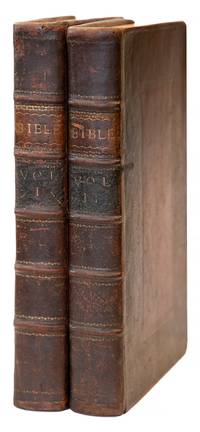
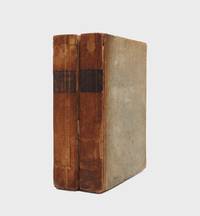
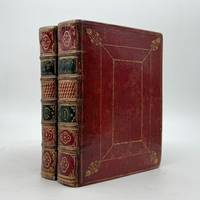
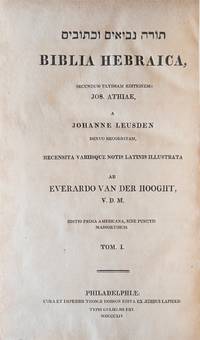
1814réf. 372931Philadelphia: Cura et Impensis Thomae Dobson edita ex aedibus Lapideis. Typis Gulielmi Fry 1814. First American edition. Text in Hebrew with notes in Latin. 6 296; 2 312 leaves. Half titles present in each volume. Uncut. 2 vols. 8vo. Original blue paper boards rebacked with plain paper. Provenance: Hugh Blair Grigsby booklabels. In a blue cloth folding box. First American edition. Text in Hebrew with notes in Latin. 6 296; 2 312 leaves. Half titles present in each volume. Uncut. 2 vols. 8vo. The first complete Hebrew Bible printed in America. Hebrew type was first used in the North American colonies in the Bay Psalm Book printed in 1640 in Cambridge. Over the next ninety-five years Hebrew type appeared in a handful of American imprints usually in brief examples of single words or short sentences. Paucity of appropriate type would continue to be a problem over the years that followed. The first Jewish Psalter was finally published in 1809 followed by this complete Bible five years later. "In 1812 Mr. Horwitz had proposed the publication of this edition of the Hebrew Bible the first proposal of the kind in the United States; early in 1813 be transferred his right and list of subscribers to Mr. Thos. Dobson who published soon afterwards the 1st volume" O'Callaghan. The title page indicates that this work is a reprinting of the second edition of the Joseph Athias Bible edited by Leusden with Latin notes by Everardo Van der Hought and that the Hebrew is printed without vowels. An important piece of American printing and of Jewish Americana. Darlow and Moule 5168a; Goldman 4; Rosenbach 171; Shaw and Shoemaker 30857; Singerman 236; M. Vaxer "The First Hebrew Bible Printed in America" Journal of Jewish Bib. 1940 vol. 2 pp. 20-26 Cura et Impensis Thomae Dobson edita ex aedibus Lapideis. Typis Gulielmi Fry unknown books
1791réf. 373037Worcester: Isaiah Thomas 1791. First Edition. 48 engraved plates complete. 1310 2 89 3pp. Separate OT and NT titles. The family register between the Apocrypha and NT unaccomplished. Royal quarto. Contemporary calf covers ruled in gilt spine gilt with raised bands red morocco lettering piece marbled endpapers joints cracked but cords holding worn at extremities spine a bit abraded with some loss at top. Foxing a few leaves with short tears or small voids. Provenance: Ebenezer Byles signature on verso of the OT title. Housed in a blue cloth clamshell box. First Edition. 48 engraved plates complete. 1310 2 89 3pp. Separate OT and NT titles. The family register between the Apocrypha and NT unaccomplished. Royal quarto. Thomas' quarto bible was published in three distinct issues: with 2 copperplates only i.e. frontispieces to the Old and New Testaments; with two copperplates and John Brown's 89-page concordance in the rear; and the rarest and most deluxe form as here with 48 copperplates and the concordance. Of this last issue according to Thomas's catalogue the work was published "in elegant binding." The explanation for the work being complete with 48 plates rather than the 50 plates of the folio Thomas bible of the same year is easily explained: the frontispieces used for the folio bible plates I and XXXIII were too large for the quarto edition and thus were omitted with plates XXIX and XLVIII used as frontispieces of the quarto bible instead. A very difficult edition to find in a contemporary unsophisticated binding. Evans 23185; Hills 30; ESTC W4496 Isaiah Thomas unknown books
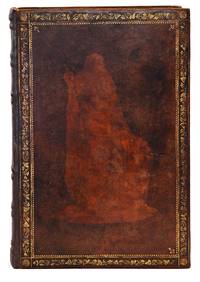
1819réf. 373865Lancaster Penn: Johann Bär 1819. Text in two columns. Engraved frontispieces to the OT and NT. 10 100 12 4 738 26 4 227 1 92pp. Folio. Contemporary calf covers bordered with gilt roll tools and cornerpieces covers with pictorial blocking press and stencil-masked sprinkled motif in relief Moses on the upper cover and Jesus on the lower cover spines with double-raised bands elaborately tooled in gilt with additional stencil-masked motifs in relief red morocco letter piece marbled endpaper gilt edges repair to upper joint and hinge original full calf slipcase. Text in two columns. Engraved frontispieces to the OT and NT. 10 100 12 4 738 26 4 227 1 92pp. Folio. The first German folio Bible printed in America in a very unusual and elaborate American binding and with a very early slipcase. Wright p. 139 Johann Bär unknown books
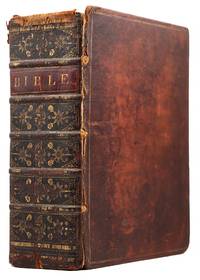
1791réf. 373866Worcester: Isaiah Thomas 1791. First Edition of Isaiah Thomas's Folio Bible. 50 engraved plates. 4 460; 2 461-1012pp. Text in two columns. 2 vols. Folio. Contemporary calf panelled in gilt and blind spine with raised bands in six compartments tooled in gilt on either side of each band red and black morocco labels expert repairs. Moderate to heavy foxing repaired tears to text leaves and plates. First Edition of Isaiah Thomas's Folio Bible. 50 engraved plates. 4 460; 2 461-1012pp. Text in two columns. 2 vols. Folio. "The two Thomas Bibles of 1791 were without doubt far in advance of any other publications of the same kind that had appeared in America in point of typography excellence of paper binding and general execution" Wright. Dubbed "the Baskerville of America" by Benjamin Franklin Isaiah Thomas issued a folio and a quarto Bible almost simultaneously. Published immediately after the ratification of the Bill of Rights the folio edition arguably his magnum opus opens with a note from Thomas situating it as an important accompaniment to this national development: "The civil authority hath set an example of moderation and candor to all Christians by securing equal privileges to all; and it must be their ardent and united wish independently of foreign aid to be supplied with copies of the sacred Scriptures the foundation of their Religion - a religion which furnishes motives to the faithful performance of every patriotic civil and social duty." In preparing the work Thomas compared the language of "not less than eight" significant English Bibles most but not all of which were printings of the King James translation and then had every page of the present edition examined by "the Clergymen of Worcester and . other capable persons." In keeping with his patriotism all the plates are by American engravers an expensive undertaking: the majority by Joseph Seymour with others by John Norman Samuel Hill and Amos Doolittle. It is unusual to find complete copies with all fifty plates. The plate list often lacking is present in this copy. The work was issued either in one volume or in two volumes as here the latter including an additional general title page for the second volume bound in as a cancel. A celebrated American Bible from one of the young country's most important printers. Evans 23186; Hills 29; ESTC W4497; Sabin 5172; Wright Early American Bibles pages 74-88 Isaiah Thomas unknown books
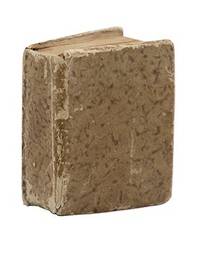
1802réf. 373649Boston: Printed by Thomas Fleet 1802. The tenth American thumb Bible. Separate title pages to each work. With three wood or metal cuts in N.T. 1013-160; vi 107 2 ii-iv iv pp. 1 vols. Miniature 2-1/16 x 3-1/4 inches in 12s. Dappled tan pastepaper over wooden boards. Leaf A1 in OT supplied and remargined. The tenth American thumb Bible. Separate title pages to each work. With three wood or metal cuts in N.T. 1013-160; vi 107 2 ii-iv iv pp. 1 vols. Miniature 2-1/16 x 3-1/4 inches in 12s. A splendid copy of the miniature Bible printed by Thomas Fleet in 1801-2 the tenth American thumb Bible. The text is a paraphrase of the Old and New Testaments by John Taylor 1578-1653 known as the Water Poet; the earliest surviving edition of which was printed in London in 1614. In America five editions were printed in the 1760s and four more between 1786 and 1799. All are rare and survive in just a few copies. After about 1810 the number of thumb Bibles and the variousness of their titles and imprints increased markedly. The Fleet thumb Bible is two volumes bound as one each with a separate dated title page. Following the New Testament are Prayers for Morning and Prayers for Evening. There are four other recorded copies of this book: at the Morgan Library PML81221 lacking all half title and titles and other leaves; at AAS the Welch Stone copy lacking the half title and six pages of the Old Testament; at the Boston Public library rebound; and at the Lilly Library bibliographer Ruth Adomeit's copy in the original binding lacking the first leaf. A gorgeous copy in original binding. Shaw & Shoemaker 1383; Welch 1293.10; Adomeit A10 Printed by Thomas Fleet unknown books
1924réf. 371052London: Nonesuch Press 1924. Deluxe edition one of 75 copies on Arnold unbleached rag paper no. XXXIV. First vol. printed ad hominem for H. Malcom Hubbard with ink note below "Transferred to Ion Buchanan Pritchard F. Meynell. Each volume with an engraved title page head piece and tail piece by Stephen Gooden. 5 vols. Folio. Full brown crushed niger by Best with gilt rule borders and spine relatively unadorned raised bands a.e.g. on the rough. Book ticket of Philip Duschnes. Ex-library with labels from General Theological Seminary Rare Book Room to front paste-downs of each volume. Faintest traces of rubbing to board edges spines of vols. I & 3 slightly darkened from smoke interior fine. GOODEN Stephen. Deluxe edition one of 75 copies on Arnold unbleached rag paper no. XXXIV. First vol. printed ad hominem for H. Malcom Hubbard with ink note below "Transferred to Ion Buchanan Pritchard F. Meynell". Each volume with an engraved title page head piece and tail piece by Stephen Gooden. 5 vols. Folio. One of the great early books of the Nonesuch Press and Stephen Gooden's second book commission after the Nonesuch Anacreon of 1923. The copies on fine paper were offered at 5 guineas bound in full niger or full vellum. The name of the subscriber was printed in the first volume; this copy printed for railway magnate H. Malcolm Hubbard bears a note from Francis Meynell recording the transfer to Ion Buchanan Pritchard another railway executive. Uncommon and attractive. Dreyfus 21 and 20. The Nonesuch Century 21 and 20. Ransom Selective Check Lists pp. 163-164 nos. 20 and 21. Rumball-Petre 125 "a beautiful work of a famous press". Tomkinson p. 136 nos. 19 and 19a Nonesuch Press unknown books
1809réf. 375196Hartford: Hudson and Goodwin 1809. Text in two columns. 816pp. 12mo. Contemporary calf red morocco lettering piece minor staining. Minor foxing early owner's inscription on the endpaper. Text in two columns. 816pp. 12mo. First edition of the first Bible printed in Connecticut. An October 18 1809 advertisement in the Connecticut Courant reads: "Hudson and Goodwin have the satisfaction to announce to the public that they have this day completed their first edition of the School Bible. The type is entirely new imported at heavy expense . and the paper is so good a quality that it is asserted with confidence to be the best of the kind offered for sale in this country." "This is supposed to be the earliest edition of the Bible printed in Connecticut. "It was set up in Nonpareil smaIl 12mo making I believe 68 forms 34 sheets put in chases corrected and shipped from the foundry of Wilson and Sons Glasgow to Hudson and Goodwin at a cost as I have understood of 6000 crowns. The type was sold for old metal about the year 1837" O'Callaghan. Shaw 16998; Hills 168; O'Callaghan 1809.6 Hudson and Goodwin unknown books
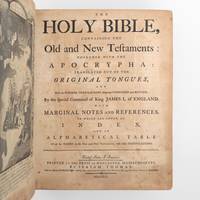
1791réf. 373974Worcester: Isaiah Thomas 1791. First Edition. 2 engraved plates complete. 1310pp. Separate OT and NT titles. The family register between the Apocrypha and NT accomplished by Thomas and Lydia Newton Bond. Royal quarto. Contemporary calf spine with raised bands ruled in gilt on either side of each band. Foxing and toning front endpaper detached. First Edition. 2 engraved plates complete. 1310pp. Separate OT and NT titles. The family register between the Apocrypha and NT accomplished by Thomas and Lydia Newton Bond. Royal quarto. "The two Thomas Bibles of 1791 were without doubt far in advance of any other publications of the same kind that had appeared in America in point of typography excellence of paper binding and general execution" Wright Early American Bibles pages 74-88. Thomas' quarto bible was published in three distinct issues: with 2 copperplates only i.e. frontispieces to the Old and New Testaments as here; with two copperplates and John Brown's 89-page concordance in the rear; and the rarest and most deluxe form with 48 copperplates and the concordance. A very difficult edition to find in a contemporary unsophisticated binding. Evans 23185; Hills 30; ESTC W4496 Isaiah Thomas unknown books
1771réf. 373724Boston: Printed by William M'Alpine for and sold by John Perkins in Union-Street near the market 1771. Title within ornamental border. 159 1pp. Trimmed close with some loss along the fore-edge. 8vo. Contemporary calf rebacked. Expert restoration. Title within ornamental border. 159 1pp. Trimmed close with some loss along the fore-edge. 8vo. ETSC records only two examples of this issue AAS and NYPL. Evans 11987; ESTC W4709; Welch 1072.27 Printed [by William M'Alpine] for and sold by John Perkins, in Union-Street, near the market unknown books
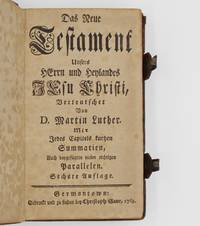
1769réf. 373151Germantown PA: Christoph Saur 1769. 5293pp. 12mo. Contemporary speckled calf covers ruled in blind spine with raised bands brass hinges and clasps minor wear along front joint. Provenance: Abraham de Türck printed book label inserted between the front endpapers. 5293pp. 12mo. German translation of the New Testament printed in Germantown by Christopher Saur the younger. Famous for their quarto bibles in German of 1743 1763 and 1776 the Saur father and son also issued the New Testament separately in smaller format in 1745 1755 1760 1761 1764 1769 and 1775. The present example with a unique added leaf preceding the front blank being a printed bookplate within an elaborate typographic border indicating that the owner Abraham de Türck had received the book from his grandfather Johannes Hoch in 1772. Evans 11181; ESTC W4533; Bötte 366 Christoph Saur unknown books
1512réf. 372103Paris: Philippe Pigouchet for Simon Vostre 1512. Title page printed in red and black with woodcut device of Simon Vostre; full page woodcuts of St. Jerome crucifixion old coloring. Text in gothic type in two columns ornamental initials some colored text ruled in red throughout. 15 340 28 leaves. Terminal black dd6 present. 1 vols. Folio. Modern linen conservation binding. First leaf toned ownership marks struck out early bibliopole's description in ink at bottom of title. Some minor worming at end. Very good. Title page printed in red and black with woodcut device of Simon Vostre; full page woodcuts of St. Jerome crucifixion old coloring. Text in gothic type in two columns ornamental initials some colored text ruled in red throughout. 15 340 28 leaves. Terminal black dd6 present. 1 vols. Folio. Large folio Bible printed for Simon Vostre by Philippe Pigouchet the famous printer of some of the most beautiful Books of Hours. Uncommon in institutions and in the trade. Renouard ICP II 248; Delaveau & Hillard 778 Philippe Pigouchet for Simon Vostre unknown books
1609réf. 371891Geneva: Pierre de la Rouière 1609. In two columns. 28 184 283 1 84 203 1; 8 186 2 134 2pp. Folio 15 x 9-1/2 inches. Contemporary pigskin covers blocked in gilt and blind remnants of paper label on the spine gauffered edges lacks bosses and hinges and clasps worn at extremities and bottom of spine. Provenance: Johann Georg Feuchter of Jura-Weickersroda inscription on pastedown that the bible was purchased at an August 6 1728 auction for 4 florins and 30 groschen; General Theological Seminary blindstamp. In two columns. 28 184 283 1 84 203 1; 8 186 2 134 2pp. Folio 15 x 9-1/2 inches. Edited with introduction by Benito Arias Montanus 1527-1598 Spanish orientalist and editor of the Antwerp Polyglot a reprint of Plantin's similar edition. Darlow & Moole 5113 OT and 4662 NT Pierre de la Rouière unknown books
1607réf. 372868Sanctii Gervasii Saint-Gervais Geneva: Sumptibus Caldorianae Societatis 1607. O.T. and N.T. title pages with printer's device of Fama; each part of O.T. with sectional title parts 2-4 paginated consecutively. 1 vols. Folio. Old calf boards ruled in gilt. Rebacked with morocco spine label. Some paper flaws at end. Portrait of William Lupton 1676-1726 dated 1727 frontispiece to his Sermons on front pastedown. Cloth slipcase and folding box. O.T. and N.T. title pages with printer's device of Fama; each part of O.T. with sectional title parts 2-4 paginated consecutively. 1 vols. Folio. The Junius-Tremellius Bible with Theodore de Beze's translation of the New Testament. This was for many years the standard Latin Bible favored by Protestants. Uncommon OCLC records fewer than 20 locations with interesting English provenance. William Slater or Slatyer 1587-1647 whose Psalmes or songs of Sion: turned into the language of a strange land 1631 "was on 9 July 1631 ordered to be burned. Summoned before the court of high commission on 20 October Slatyer confessed that he had 'added thereunto a scandalous table to the disgrace of religion and to the encouragement of the contemners thereof'; judging from an annotated copy of the work dated 1642 this probably consisted of a list of popular tunes to which the psalms might be sung" ODNB He was also editor of The Psalmes of David in 4 languages 1643 "a high quality edition containing both words and music the latter principally by Thomas Ravenscroft". Not in Darlow & Moule; Bibles imprimées 976 locates a copy with later Genevae imprint. Provenance: William Slater his Latin ownership signature; W.A. Copinger; General Theological Seminary gift of Cornelius Vanderbilt and Dean Augustus Hoffman bookplates and blindstamps Sumptibus Caldorianae Societatis unknown books
1642réf. 371830Paris: Ek basilikēs typographias Imprimerie Royale 1642. Engraved title by by Claude Mellan engraved head and tail pieces and initials. 2 453 3 pp. Extra-illustrated with a later English printed "Abbreviations and Connexions" leaf inserted after the title. Folio 15-1/2 x 10-5/8 inches. Late eighteenth or early nineteenth century red morocco gilt marbled endpapers gilt edges. Neatly rebacked. Cloth slipcase and chemise. Engraved title by by Claude Mellan engraved head and tail pieces and initials. 2 453 3 pp. Extra-illustrated with a later English printed "Abbreviations and Connexions" leaf inserted after the title. Folio 15-1/2 x 10-5/8 inches. Known as the Mazarin edition "since it appeared under the auspices of the great Cardinal" D&M it is the first edition of the Greek New Testament from the Imprimerie Royale founded just two years prior. Inserted before the engraved title page is a partly-printed certificate of the Collegium Mazarinaeum awarding this volume as a prize in Rhetoric to Philippus Matthaeus Guillot dated MDCC in manuscript i.e. 1700 and signed by the college's master P.-J. Le Chapelier Pierre-Jean le Chapelier de Mauron abbé de Ste Marie de Boquen in Brittany with the trace of a seal below. The College Mazarin or College des Quatre-Nations was established by bequest of Cardinal Mazarin 1602-1661 and opened its doors to students in 1688. Darlow & Moule 4687. Provenance: Philippus Matthaeus Guillot certificate his signature at foot of title engraving; Montagu Barton armorial bookplate; John Horatio Nelson gift inscription dated 1841; General Theological Seminary bookplate perforated stamp Ek basilikēs typographias [Imprimerie Royale] unknown books
1509réf. 372247Basel: per Johannem Petri de Langdorff et Johannem Froben de Hammelburg 1509. Printer's device on title hand colored at an early date. Large manuscript initials in red and blue; rubricated throughout. 14 CCCXLVII 28 leaves. Manuscript references and extensive early marginalia in Hebrew in O.T.; citations in Table keyed to N.T. and underlined. Contemporary colored deerskin sectional fore-edge tabs. Folio 13 x 8-1/2 inches. Full burgundy morocco by Zaehnsdorf. Title leaf repaired at gutter and bottom corner; minor staining. Printer's device on title hand colored at an early date. Large manuscript initials in red and blue; rubricated throughout. 14 CCCXLVII 28 leaves. Manuscript references and extensive early marginalia in Hebrew in O.T.; citations in Table keyed to N.T. and underlined. Contemporary colored deerskin sectional fore-edge tabs. Folio 13 x 8-1/2 inches. A scarce Latin bible the first edition of the Vulgate with the printed marginal references to canon law. These 'Concordantiae iuris canonici' according to Masch were compiled by Johannes Niuicellensis an abbot and were printed separately in 1482. This is also the first edition to printed the commendatory hexastich by Matthias Sambucellus on the title page beginning: "Emendata magis scaturit nunc biblia tota." A tall copy with generous margins lovely stylish manuscript initials and full rubrication. VD16 B2584. Delaveau & Hillard 771; cf. Darlow & Moule note after 6092. Provenance: Dr. Charles Clay Manchester 19th century inscription on front endpaper sold Sotheby Wilkinson & Hodge May 18 1883; General Theological Seminary bookplate blindstamps; [per Johannem Petri de Langdorff et Johannem Froben de Hammelburg unknown books
1590réf. 372093Rome: Ex Typographia Apostolica Vaticana 1590. First edition of the Sixtine Vulgate Bible. Engraved illustrated title-page. Title in red and black text in double columns. 8 479 1; 5 482-899; 5 902-1141pp. Lacks the 4ff preface i.e. the papal bull of Sixtus V beginning "Aeternus ille caelestium terrestriumq. rerum omnium conditr ac moderator Deus ." as often. Folio 13-1/2 x 9-1/2 inches. Later red morocco spine darkened corners bumped some repairs at head and tail of spine marbled endpapers gilt edges. Engraved title and title page paper-backed. Red quarter morocco clamshell box. First edition of the Sixtine Vulgate Bible. Engraved illustrated title-page. Title in red and black text in double columns. 8 479 1; 5 482-899; 5 902-1141pp. Lacks the 4ff preface i.e. the papal bull of Sixtus V beginning "Aeternus ille caelestium terrestriumq. rerum omnium conditr ac moderator Deus ." as often. Folio 13-1/2 x 9-1/2 inches. The Sixtine Bible containing the Vulgate text as edited by Pope Sixtus V intended as the first ecclesiastically authorized text to be used throughout Christendom. "In its text it comes closer to R. Stephanus' Bible of 1538-40 than to the Louvain editions" Darlow & Moule who discuss the textual variations. The association with Aldus II suggested by Renouard and lasting long thereafter is spurious. Pope Sixtus V died soon after the book was printed and was followed by three short-lived popes. The Sixtine Bible had "aroused antagonism among both clergy and laity" and was swiftly condemned; the edition was withdrawn by Pope Clement VIII soon after his elevation to the papal throne in 1592 and many copies were destroyed. Preparations began in 1591 for a new edition of the Vulgate printed in 1592 and known as the Clementine Bible which long remained the standard Vulgate text. As often e.g. the Brooker copy this copy without the preface the Bull of Sixtus declaring the text to be immutable and forbidding any reprint without papal permission. Copinger 521; Darlow & Moule 6181; Adams B1098; BM STC Italian 1465-1600 p. 93; EDIT16 CNCE 5805. Provenance: Henry John Farmer Atkinson his sale Sotheby Wilkinson & Hodge March 1896 lot 2752 sold for £18.15s to; Bernard Quaritch; General Theological Seminary bookplate Ex Typographia Apostolica Vaticana unknown books
1810réf. 373845Boston: De l'Imprimerie de J. T. Buckingham 1810. 403; 3261pp. Half-titles errata leaf at back of second volume. Uncut. 2 vols. 8vo. Publisher's paper-backed boards printed paper label one cover detachedsome darkening and spotting chipping and cracking of spines. Spotting and light soiling of text mostly marginal and light. Very good copies in brown cloth open faced case. 403; 3261pp. Half-titles errata leaf at back of second volume. Uncut. 2 vols. 8vo. First American edition of the Bible in French. De Sacy's translation was the most widespread French Bible of the 18th century. O'Callaghan 102; Shaw & Shoemaker 19531; Rumball-Petre "Rare Bibles" 185 De l'Imprimerie de J. T. Buckingham unknown books
1788réf. 375629Worcester: Isaiah Thomas 1788. Numerous woodcut illustrations including full-page frontispiece. 144pp. 12mo. Modern calf red morocco lettering piece. Repair to final leaf affecting the final three lines frontispiece paper-backed with repaired tears and small area of loss in the image a few leaves likely supplied from another copy. Numerous woodcut illustrations including full-page frontispiece. 144pp. 12mo. A cornerstone for any collection of American children's books American illustration or American Bibles this classic children's book is an American reprinting of the edition first published by Hodgson in London in 1783. Containing nearly 500 illustrations it is the first Bible printed in the United States specifically for children. The rebus format of the small volume presents the young reader with famous Bible stories in an amusing format that encourages reading puzzle solving and Bible study. "A touchstone of eighteenth-century American book illustration this 'curious' children's Bible contains nearly five hundred woodcuts made by American artists. The most ambitious woodcut book produced in America up to that time it is one of the sixty-five children's book titles produced by the pioneer publisher of children's literature and preeminent early American printer Isaiah Thomas 1749-1831 who had learned the art of engraving while apprenticed in his youth to the Boston printer Zechariah Fowle" American Treasures of the Library of Congress online exhibition. Complete copies of the first hieroglyphic and children's Bible printed in America are very rare with even Brinley's copy lacking a leaf. This is a book that saw extremely heavy use and given its young audience inevitable if often loving misuse. Welch 510; Rosenbach 128; Evans 20961; O'Callaghan p.33; Hamilton 122; Rumball-Petre 167; Brinley 5805; Sabin 17990. Not in Hills Isaiah Thomas unknown books
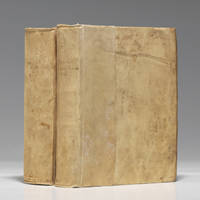
1609réf. 1291221609. First Edition. BIBLE. The Holie Bible Faithfully Translated into English out of the Authentical LatinÉ Douai: Lawrence Kellam 1609-10. Two volumes. Quarto contemporary vellum rebacked in vellum at an early date early traces of ink writing on spines and front boards. Housed together in a custom slipcase and clamshell box. $25000.Scarce first edition of the first Roman Catholic translation of the Old Testament into English from the Latin Vulgate.""The Douai Bible is as it professes to be a literal translation of the Vulgate and in some places more accurately hands down the very words of the biblical writers than any English translation then existing"" Dore 316-17. ""This version of the Old TestamentÉ came from the same hands as the Rheims New Testament of 1582"" Darlow & Moule 129 translated by ""religious refugees who carried their faith and work abroad. Since the English Protestants used their vernacular translations not only as the foundation of their own faith but as siege artillery in the assault on Rome a Catholic translation became more and more necessary in order that the faithful could answer text for text against the 'intolerable ignorance and importunity of the heretics of this time.' The chief translator was Gregory MartinÉ Technical words were transliterated rather than translated. Thus many new words came to birthÉ Not only was Martin steeped in the Vulgate he was every day involved in the immortal liturgical Latin of his church. The resulting Latinisms added a majesty to his English prose and many a dignified or felicitous phrase was silently lifted by the editors of the King James Version and thus passed into the language"" Great Books and Book Collectors 108. Lack of funds and ""our poore estate in banishment"" prevented the publication of this two-volume Old Testament until 1609-1610. With ornamental woodcut title borders woodcut initials and ornamental head- and tail-pieces. The Bible 100 Landmarks 65 66. The Bible in the Lilly Library 39 40. Dore 291-98. Herbert 177 300. Darlow & Moule 231. Pierpont Morgan Library The Bible 112. Rumball-Petre 15. Rylands 95 96. STC 2884. Herbert 300. STC 2207. Pierpont Morgan Library The Bible 115. An early ink annotations to front endpapers of Volume II.Text just occasionally embrowned with infrequent light foxing; last 1-3 letters of bottom 19 lines supplied in an early pencil on page 1079 of the first volume; last 20 leaves of Volume II with expert cleaning later pastedowns with free endpapers restored and preserved. Expected light soiling to contemporary vellum. hardcover books
1790réf. 374001New York: Hugh Gaine 1790. 336pp. Text printed in two columns printer's device on the title. 12mo. Contemporary sheep minor wear. Tear to front endpaper else very good. 336pp. Text printed in two columns printer's device on the title. 12mo. The second NT printed in New York preceded only by the prior edition by Gaine dated 1789 known in but one extant example at NYPL and evidently from the same setting of type as this edition. The complete Bible was not published in New York until 1792. Evans 22359; Hills 27; ESTC W4679 Hugh Gaine unknown books
1638réf. 371697London: Robert Barker Printer to the Kings most Excellent Majestie and by the Assignes of John Bill 1638. A-F8 G4; A-3K8; A-F8 G4. 8vo. Early black morocco tooled in gilt marbled endpapers a.e.g. GTS bookplates at front and rear. Autograph ownership signatures with several additional textual annotations. A few small interior tears with vernacular repairs. 2D2 torn with loss. A-F8 G4; A-3K8; A-F8 G4. 8vo. Includes Robert Barker's 1638 editions of the Book of Common Prayer and the Holy Bible both Old and New Testaments plus Apocrypha along with the 1637 edition of Thomas Sternhold's Whole Book of Psalms printed by G.M. for the Companie of Stationers in London all designated "Cum privilegio." Text in two columns with printed glosses. Three discrete ownership signatures of Richard Jacob are present - two on the versos of the title pages for the Old and New Testaments and one facing the title page for the Whole Book of Psalms - along with several autograph annotations and vernacular repairs. Robert Barker, Printer to the Kings most Excellent Majestie, and by the Assignes of John Bill unknown books
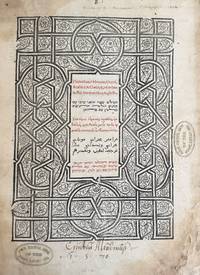
1516réf. 371021Genoa: Petrus Paulus Porrus 1516. Title printed in red and black within woodcut arabesque border printer's device on final leaf. Parallel text in Hebrew Latin Greek Arabic and Chaldaean Aramaic 4 columns to a page 41 lines. 13 woodcut floriated initials. A10 B-Z8 &8 con6; 200 leaves complete. Folio 13-1/8 x 9-3/8 inches. Contemporary blind tooled pigskin over bevelled wooden boards boards with repeated roll of hound hunter and stag spine with floral tools. Clasps perished early repairs with vellum at lower corners; spine darkened with chip at foot joint starting wormholes to the covers. Toning throughout worm holes throughout but heavier to the preliminary and terminal leaves paper loss not affecting text at the lower outer corners of the first 3 leaves minor dampstaining at the lower corners of most leaves and extending from the top inner margin. Scattered early marginalia. Title printed in red and black within woodcut arabesque border printer's device on final leaf. Parallel text in Hebrew Latin Greek Arabic and Chaldaean Aramaic 4 columns to a page 41 lines. 13 woodcut floriated initials. A10 B-Z8 &8 con6; 200 leaves complete. Folio 13-1/8 x 9-3/8 inches. The Genoa Psalter also known as the Octaplum or Quadruplex Psalter was the first polyglot psalter to be published and the first polyglot edition of any part of the Bible. Financed by the Oriental language scholar Bishop Agostino Giustiniani and printed in Genoa in 1516 it presents the psalms laid out in eight columns i.e. four per page on double-page spreads: in Hebrew a Latin paraphrase the Vulgate Latin the Septuagint Greek Arabic Chaldean Aramaic a Latin paraphrase and the editor's notes. "A monument of Renaissance typography this Psalter was linguistically the most ambitious work attempted to date and the first Polyglot work ever published. It provides the Psalms in five languages as well as a marginal scholarship based largely on rabbinic sources. The Arabic text is one of the first two texts and the first biblical text ever printed in this language. The Hebrew types used in this book were apparently never used again" B. Sabin Hill Hebraica from the Valmadonna Trust The Piermont Morgan Library 1989 no. 18. Notably within a lengthy editor's note to Psalm XIX is what is considered the first printed biography of Christopher Columbus along with a very early description of his voyage. A native son of Genoa Giustiniani presents the discovery of the new world as a fulfilment of Biblical prophecy appropriately glossing verse four of Psalm XIX to include his biography of Columbus: "Their sound is gone out through all the earth and their words to the end of the world." The text of the biography of Columbus written a decade after his death includes a brief account of his childhood and continues at length on his discovery of America. Translated from the Latin it begins: "And so their words have reached unto the ends of the earth at least in our own times in which by the marvelous daring of Christopher Columbus of Genoa almost another world was discovered and joined to the community of Christians. And since Columbus often declared that he was chosen by God so that through him this prophecy would be fulfilled I did not consider it unsuitable to include his life here. Therefore Christopher surnamed Columbus a Genoese by birth . lived in our age and through his own efforts explored more lands and seas in a few months than almost all other mortals had done throughout all previous ages . More swiftly than the Portuguese had done he approached new lands and new peoples and at last penetrated regions unknown before now. The news of this matter quickly reached the King who - both out of rivalry with the Portuguese kings and a desire for such new marvels and glory that might accrue to him and his descendants - after long discussions with Columbus finally ordered two ships to be outfitted. With these Columbus set sail from the Fortunate Islands directing his course slightly off the western line . After many days of sailing they had covered great distances. While the others having lost all hope urged a change in course Columbus persisted asserting by reason and conjecture that continuing but a little longer might lead them to discover continents or islands. Nor was he wrong. On the following dawn they sighted land. From this event immense confidence arose in human minds. Later it was learned that these were islands and observations were made of certain peoples there uncultivated and prone to raids on their neighbors even devouring human flesh like wolves. There were violent encounters yet eventually some of these islanders were brought safely to Spain astonishing and delighting all who saw them because they were at first timid unfamiliar with approach easy to persuade and marveling at everything as new." An important and desirable work from a liturgical linguistic and historical perspective. Adams B1370; BM STC Italian p. 97; Darlow & Moule 1411; Sabin 66468; European Americana 516/4; Harrisse BAV 88; JCB 3 I:64; Smitskamp 236; Roper Early Arabic Printing in Europe in Sprachen des Nahen Ostens und die Druckrevolution p. 132; Vinograd Genoa 1. Provenance: Cenobii Alois 1570 inscription below title; Bibliotheca Regia Monacensi pencil inscription on the inside front board identifying it as a duplicate; General Theological Seminary ink and blindstamps and other markings Petrus Paulus Porrus unknown books
1653réf. 371930London: Roger Daniel 1653. Title in red and black. Engraved printer's device on the title state B. Text in two columns. 8 1279 1 pp. 4to 7-3/8 x 5-3/8 inches. Eighteenth century red morocco panelled in gilt spines gilt with black morocco lettering pieces marbled endpapers gilt edges. Provenance: Viscount Palmerston bookplate; General Theological Seminary bookplate. Title in red and black. Engraved printer's device on the title state B. Text in two columns. 8 1279 1 pp. 4to 7-3/8 x 5-3/8 inches. The rare first printing in England of the Septuagint the earliest translation of the Hebrew Old Testament into Greek the scarce printing in quarto format. The text is derived from the Sixtine text and edited by John Biddle 1615-1662 the Unitarian controversialist who was imprisoned by the Parliamentary Commissioners for his religious views. "Roger Daniel's version of the text of the Sixtine edition was prepared for the use of the scholars at Westminster School. This appeared in 1653 and was edited by the Socinian John Biddle. Its publication may have owed something to the interest in the Septuagint generated by Codex Alexandrinus and the frustration produced by the failure of Young's attempts to edit it" S. Mandelbrote "English Scholarship and the Greek Text of the Old Testament" p. 87. A rare issue from the same setting as the octavo edition imposed in quarto without rules separaring the columns. Wing 2nd ed. B2718A; ESTC R12599; Darlow & Moule 4692 Roger Daniel unknown books
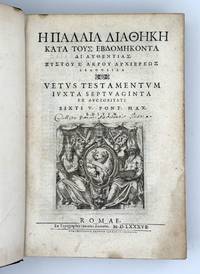
1587réf. 371783Rome: Franciscus Zanetti 1587. Text in Greek with short Latin notes at the end of each verse in two columns. Large engraved vignette on title with figures of Moses and Esdras on either side of the arms of Sixtus V. aâ´ A-3Sⶠ3Tâ¸. 8 783 1pp. Folio. Eighteenth century red morocco arms of the second Duke of Newcastle on the covers marbled endpapers gilt edges minor darkening to spine and wear to joints. Scattered minor dampstaining at lower outer corner of a few leaves. Provenance: Collegii Paris. Societas Jesu.early inscription on title; Douglass Maxwell Moffat booklabel with original invoice purchasing the volume from Davis & Orioli in 1940; General Theological Seminary bookplates. Text in Greek with short Latin notes at the end of each verse in two columns. Large engraved vignette on title with figures of Moses and Esdras on either side of the arms of Sixtus V. aâ´ A-3Sⶠ3Tâ¸. 8 783 1pp. Folio. Commissioned by Pope Sixtus V to assist the revisers who were preparing the Latin Vulgate edition ordered by the Council of Trent the "Sixtine" or "Roman" edition of the Septuagint was edited by Cardinal Antonio Carafa based on the Codex Vaticanus and became the standard for all the later editions of the Septuagint for three centuries after its publication. Darlow & Moule no. 4647; Adams B1246; BM STC Italian 1465-1600 p. 94 Franciscus Zanetti unknown books
1592réf. 371810Rome: Ex Typographia Apostolica Vaticana 1592. First edition of the Clementine Bible. Edition of 500 copies. Engraved title page reading: Biblia sacra vulgatae editionis. Sixti Quinti Pont. Max. iussu recognita atque edita. Letterpress title page printed in red and black. Text in double columns. 12 1131 1 blank 23 1 blank pp. 1 vols. Folio 349 x 250 mm. Full reddish-orange levant morocco spine titled in gilt raised bands highlighted in black boards with single rule in black dated 1957 on turn-in. Fine. Leather-tipped slipcase. First edition of the Clementine Bible. Edition of 500 copies. Engraved title page reading: Biblia sacra vulgatae editionis. Sixti Quinti Pont. Max. iussu recognita atque edita. Letterpress title page printed in red and black. Text in double columns. 12 1131 1 blank 23 1 blank pp. 1 vols. Folio 349 x 250 mm. First edition of the official text of the Catholic Bible issued under sanction of Clement VIII and therefore known as the "Clementine Bible" and superseding the controversial and suppressed edition of Sixtus V of 1590. The text is preceded by Cardinal Bellarmino's preface the Decree of the Council of Trent on the canonical Scriptures and a brief by Clement VIII. "It is generally admitted that on the whole the Clementine text . is critically an improvement upon the Sixtine. . The Clementine Bible of 1592 remains to the present day the standard edition of the Roman Church" Darlow & Moule. Nice wide-margined copy of this notable edition. Brunet I 878; Darlow and Moule 6184; Adams B1101; P.M. Baumgarten Neue Kunde von alten Bibeln pp. 316-322. Provenance: W. A. Copinger bookplate; General Theological Seminary gift of Cornelius Vanderbilt and Dean Augustus Hoffman bookplates Ex Typographia Apostolica Vaticana unknown books