22 799 résultats
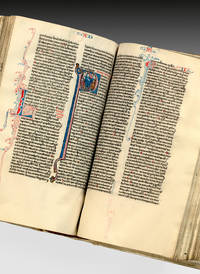
réf. ABAA25-1Northern France probably Paris 1230-1250. 12mo 140 x 93 mm of 1 658 ll.: 1-1524 1620 17-2224 2310 24-2524 2617 without the bl. l. xviii 2726 2828 295 without the bl. l. vi. Thus complete. Double column of 47 lines written in brown ink in a very fine Gothic writing. Justification: 92 x 60 mm. 78 historiated initials. Quires numbered in Roman numerals at the foot of the back of the last ll. and signatures at the bottom corner of the text on each recto of the first half of a quire headings in red initials in red letters of running titles and chapters numbers alternately in red or blue initials of chapters on 2 lines alternately in red or blue with a decor of the opposite color initials of 5 to 7 lines at the beginning of the prologues of the same type but with decoration in two colors opening the prologues 78 historiated initials most decorated with foliage and dragons the extension of 29 of them forming borders decorating the margin painted in blue pink orange-red and yellow a few wormholes in the first l. a few running titles cropped last l. restored in the outer margin. Stiff vellum gilt Greek roll-stamp around the covers flat spine decorated green morocco lettering piece gilt edges from the 19th century. Superb Capetian manuscript from the School of Paris complete and of perfect freshness handwritten on vellum skin and illuminated with exquisite finesse between 1230 and 1250. Text: List of Books of the Bible: recto and verso of the first endpaper; the Vulgate with the preamble: ll. 1-599v; Interpretation of the Hebrew names: ll. 600-658. Superb example of the small vulgate bibles produced in Paris in the 13th century. It was in the 13th century in Paris that the masters of theology of the University established what was to become the standard form of the Latin Bible: the selection of the books their order and their division into chapters established by Stéphane Laugton still universally employed the insertion of the forewords of St Jerome and the interpretation of the Hebrew names. All these characteristics are present in this very elegant Bible on very thin vellum skin. Illuminations: A masterpiece from Pierre de Bar's workshop active in Paris between 1230 and 1250 distinguishes itself by the particularly colored and bright shades of its illuminations; the usual whites pinks and blues are enriched with red orange and even more surprisingly by large areas of yellow. This Bible contains 78 illuminations of great beauty and of amazing freshness. The repertoire of decorative details is peculiar compared to other French illuminations of the time and the foliage contains small clover leaves. Branner attributed the illustration of the manuscript to the Parisian workshop that illustrated the most outstanding illuminated manuscripts of the first half of the 13th century Bar's workshop with reference to Cardinal Pierre de Bar 1252 who gave to the Abbey of Clairvaux a Bible in four volumes issued from this workshop and preserved today under the reference Troyes Bibliothèque municipale ms. 106 108 110 and 111. This manuscript can be dated from 1230-1250. Remarkable for its large and well-formed heads; the bodies are robust and covered with clothes with deep and dark folds R. Branner Manuscript Painting in Paris during the Reign of Saint Louis 1977 pp. 70-71. He dates the activity of Pierre de Bar's workshop between 1230-1250 and explains its specificities by suggesting the development of its style outside Paris. The decoration of the manuscript consists of 78 historiated illuminated initials and a great number of capital letters rubricated in red or blue. This very attractive bible seems to have been made in Paris; it represents an interesting addition to the production of a workshop producing according to Branner some of the most beautiful and refined Parisian illuminations of the first half of the 13th century. We witness from the years 1220-1230 under the reign of Queen Blanche of Castile a concentration of illuminators in Paris at the expense of abbeys and provincial capitular schools. We can indeed attribute several manuscripts to Blanche of Castile who inaugurated the tradition of female patronage in the royal family. But the peak of these famous small Capetian bibles happened during the reign of Saint Louis. The subjects of the historiated initials are the following: l. l St Jerome Prologue; l. 4 The 7 days of Creation Genesis; l. 27 Moses leading his people across the Red Sea Exodus; l. 43 the Jews offering a sacrifice; l. 54 Moses preaching; l. 72 Moses receiving the Tablets of Stone; l. 89 God talking to Joshua; l. 99 Gideon holding his sword; l. 110 Elimelech and Naomi migrating to Moab Ruth; l. 112v Beheading of Eli; l. 128 Beheading of Amalekite before David; l. 141 David's servant bringing Abishag to him; l. 155v Ahaziah falling from a tower; l. 170v the Patriarchs; l. 185 Solomon enthroned; l. 202 The Construction of the Temple; l. 207 Nehemiah presenting the golden cup to Artaxerxes; l. 213v Spraying of the Temple; l. 220v Tobias; l. 225v Judith beheading Holofernes; l. 232 Ahasuerus being merciful to Esther; l. 238v Job on the manure heap; l. 251 David playing the harp; l. 256 anointing of David by Samuel; l. 258v David showing his mouth; l. 261 madman holding the stick and the bread Psalm 52; l. 264 God above David below in the water Psalm 68; l. 268 David ringing the bells Psalm 80; l. 271v Two Singers Psalm 97; l. 275 The Trinity Psalm 109; l. 283v Solomon whipping a young man; l. 294v Solomon teaching to a young man; l. 298 Madonna and Child Enthroned; l. 299v Solomon and a young man carrying a sword; l. 307v Ecclesia; l. 328 Isaiah being sawn in half; l. 353 Stoning; l. 381 Baruch writing; l. 384v Ezekiel in bed with the Tetramorph; l. 412 Daniel in the lions' den; l. 423v Hosea and Gomer; l. 427v Joel preaching to a group of Jews; l. 429v Amos offering the sheep; l. 432v God appearing to Obadiah; l. 433v Jonah in the mouth of the whale; l. 434v the teaching Prophet; l. 437 Nahum lamenting about the fall of Nineveh; l. 438v Habakkuk and the stones; l. 440 the Prophet with his scroll; l. 441v Two Prophets; l. 442v Prophet; l. 447 Two men talking; l. 449 Beheading of the idolatrous Jew; l. 466 the Messenger delivering the letter; l. 478v the Tree of Jesse; l. 494v Saint Mark with the lion; l. 505 Saint Luke with the angel; l. 521v Saint John; l. 535 Saint Paul carrying the cross; l. 541 Saint Paul carrying a sword; l. 546v Saint Paul carrying a sword and a scroll; l. 551 Saint Paul carrying a sword and a book; l. 555 Saint Paul carrying a sword; l. 556v Saint Paul carrying a sword and a book; l. 558 Saint Paul carrying a sword; l. 559 Saint Paul carrying a sword; l. 560 Saint Paul carrying a sword; l. 561v Saint Paul carrying a sword; l. 562v Saint Paul carrying a sword; l. 561v Saint Paul carrying a sword; l. 562v Saint Paul carrying a sword; l. 563v Saint Paul carrying a sword; l. 564 Two men talking; l. 568v. Ascension; l. 585 Jacob holding a book; l. 586v Saint Peter seated holding a book; l. 588 Saint Peter holding a key; l. 589 Saint John writing; l. 590v Saint John; l. 591 Saint John; f. 591 Saint Jude; l. 592 Saint John writing. This complete bible dated from 1230-1250 is a masterpiece of Capetian illumination produced under the reign of Saint Louis. Provenance: - Jean Tornone: doctor from Burgundy: inscription on the verso of the endpaper mentioning his gifting of the book to Stroyff. - Assuerus Stroyff: inscription mentioning his reception of the book by Tornone then his gift to Johan Baron de Bronckhorst. Johan Baron de Bronckhorst and Batenburg de Guelders: inscription dated from 1574 mentioning his receipt of the book. FR Nord de la France probablement Paris 1230-1250. In-12 de 1 658 ff. : 1-1524 1620 17-2224 2310 24-2524 2617 sans le f. blanc xviii 2726 2828 295 sans le f. blanc vi. Ainsi complet. Double colonne de 47 lignes écrites à l'encre brune dans une très fine écriture gothique. Justification : 92 x 60 mm. 78 initiales historiées. Cahiers numérotés en chiffres romains au pied des versos des derniers ff. et signatures au pied du coin inférieur du texte sur chaque recto de la première moitié d'un cahier rubriques en rouge initiales en rouge lettres des titres courants et numéros des chapitres alternativement en rouge ou bleu initiales des chapitres sur 2 lignes alternativement en rouge ou bleu avec un décor de la couleur opposée initiales de 5 à 7 lignes au début des prologues du même type mais avec des décors des deux couleurs ouvrant les prologues 78 initiales historiées la plupart ornées de feuillage et de dragons le prolongement de 29 d'entre elles formant des bordures décorant la marge peintes en bleu rose orange-rouge et jaune qq. trous de vers ds. le premier f. atteinte à qq. titres courants dernier f. restauré ds. la marge extérieure. Vélin rigide du XIXe siècle encadrement d'une roulette grecque dorée autour des plats dos lisse orné pièce de titre de maroquin vert tranches dorées. 140 x 93 mm. Superbe manuscrit capétien de l'école de Paris complet et de parfaite fraicheur calligraphié sur peau de vélin et enluminé avec une exquise finesse entre 1230 et 1250. Texte : Liste des Livres de la Bible : recto et verso de la première garde ; la Vulgate avec le préambule : ff. 1-599v ; Interprétation des noms hébreux : ff. 600-658. Superbe exemple des petites bibles vulgates produites à Paris au XIIIe siècle. C'est au XIIIe siècle à Paris que les maîtres de théologie de l'Université établirent ce qui devait devenir la forme standard de la Bible latine : la sélection des livres et de l'ordre de ceux-ci et leur division en chapitres établies par Stéphane Laugton et encore universellement employée l'insertion des prologues de St Jérôme et l'interprétation des noms hébreux. Toutes ces caractéristiques sont bien présentes dans cette très élégante Bible sur peau de vélin très fine. Enluminures : Chef-d'œuvre de l'atelier de Pierre de Bar actif à Paris entre 1230 et 1250 il se distingue par les teintes de ses enluminures particulièrement colorées et vives ; les habituels blancs roses et bleus sont enrichis de rouge orange et de manière plus surprenante encore par de larges zones de jaune. Cette Bible possède 78 enluminures d'une grande beauté et d'une étonnante fraicheur. Le répertoire de détails décoratifs est particulier en comparaison des autres enluminures françaises de cette époque et le feuillage comporte des petites feuilles de trèfle. Branner a attribué l'illustration du manuscrit à l'atelier parisien qui a illustré les plus remarquables manuscrits enluminés de la première moitié du XIIIe siècle l'atelier de Bar par référence au cardinal Pierre de Bar 1252 qui donna à l'abbaye de Clairvaux une Bible en quatre volumes provenant de cet atelier et conservés aujourd'hui sous les cotes Troyes Bibliothèque municipale ms. 106 108 110 et 111. On peut dater le présent manuscrit de 1230-1250. Remarquable par ses têtes larges et bien formées ; les corps sont robustes et recouverts de draperies aux plis profonds et sombres. R. Branner Manuscript Painting in Paris during the Reign of Saint Louis 1977 pp. 70-71. Il date l'activité de l'atelier de Pierre de Bar entre 1230-1250 et explique ses spécificités en suggérant la formation se son style en dehors de Paris. La décoration du manuscrit comprend 78 initiales historiées enluminées et d'innombrables capitales rubriquées en rouge ou bleu. Cette bible très séduisante semble avoir été réalisée à Paris ; elle représente un ajout intéressant à la production d'un atelier considéré par Branner comme produisant certaines des enluminures parisiennes les plus belles et les plus raffinées de la première moitié du XIIIe siècle. On assiste à partir des années 1220-1230 sous le règne de la reine Blanche de Castille à une concentration des artistes enlumineurs à Paris au détriment des abbayes et des écoles capitulaires de province. On peut en effet imputer plusieurs manuscrits à Blanche de Castille qui inaugura la tradition du mécénat féminin dans la famille royale. Mais l'apogée de ces célèbres petites bibles capétiennes se situe sous le règne de Saint Louis. Les sujets des initiales historiées sont les suivants : f. l St Jerome Prologue ; f. 4 Les 7 jours de la Création Genèse ; f. 27 Moïse conduit son peuple à travers la Mer Rouge Exode ; f. 43 les Juifs offrent un sacrifice ; f. 54 Moïse preche ; f. 72 Moise reçoit les tables de la Loi ; f. 89 Dieu s'adresse à Joshua ; f. 99 Gédéon tient son épée ; f. 110 Elimelech et Naomi migrent à Moab Ruth ; f. 112v Décapitation d'Eli ; f. 128 Décapitation d'Amalekite devant David ; f. 141 le serviteur de David lui amène Abishag ; f. 155v Ahaziah tombe d'une tour ; f. 170v Les trois juifs patriarches ; f. 185 Salomon intronisé ; f. 202 La Construction du Temple ; f. 207 Néhémie présentant la coupe d'or à Artaxerxès ; f. 213v Aspersion du Temple ; f. 220v Tobias ; f. 225v Judith décapitant Holopherne ; f. 232 Assuérus se montre clément envers Esther ; f. 238v Job sur le tas de fumier ; f. f. 251 David joue de la harpe ; f. 256 onction de David par Samuel ; f. 258v David montre sa bouche ; f. f. 261 fou tenant le bâton et le pain psaume 52 ; f. 264 Dieu au-dessus David dans l'eau dessous Psaume 68 ; f. 268 David sonnant les cloches Psaume 80 ; f. 271v Deux chanteurs Psaume 97 ; f. 275 La Trinité Psaume 109 ; f. 283v Salomon fouette un jeune ; f. 294v Salomon enseigne à un jeune ; f. 298 La Vierge et l'Enfant intronisé ; f. 299v Salomon et un jeune portant une épée ; f. 307v Ecclésia ; f. 328 Isaïe est scié en deux ; f. 353 Lapidation ; f. 381 Baruch écrivant ; f. 384v Ezéchiel au lit avec le Tétramorphe ; f. 412 Daniel dans la fosse aux lions ; f. 423v Osée et Gomer ; f. 427v Joel prechant à un groupe de juifs ; f. 429v Amos offre le mouton ; f. 432v Dieu apparait à Obadiah ; f. 433v Jonas dans la bouche de la baleine ; f. 434v le Prophète enseignant ; f. 437 Nahum se lamente sur la chute de Nineveh ; f. 438v Habakuk et les pierres ; f. 440 le Prophète avec son rouleau ; f. 441v Deux Prophètes ; f. 442v Prophète ; f. 447 Deux hommes en discussion ; f. 449 Décapitation du juif idolâtre ; f. 466 le Messager livre la lettre ; f. 478v l'Arbre de Jessé ; f. 494v Saint Marc avec le lion ; f. 505 Saint Luc avec l'ange ; f. 521v Saint Jean ; f. 535 Saint Paul portant la croix ; f. 541 Saint Paul portant une épée ; f. 546v Saint Paul portant une épée et un rouleau ; f. 551 Saint Paul portant une épée et un livre ; f. 555 Saint Paul portant une épée ; f. 556v Saint Paul portant une épée et un livre ; f. 555 Saint Paul portant une épée ; f. 556v Saint Paul portant une apée et un livre ; f. 558 Saint Paul portant une épée ; f. 559 Saint Paul portant une épée ; f. 560 Saint Paul portant une épée ; f. 561v Saint Paul portant une épée ; f. f. 562v Saint Paul portant une épée ; f. 561v Saint Paul portant une épée ; f. 562v Saint Paul portant une épée ; f. 563v Saint Paul portant une épée ; f. 564 Deux hommes en discussion ; f. 568v. Ascension ; f. 585 Jacob tenant un livre ; f. 586v Saint Pierre assis tenant un livre ; f. 588 Saint Pierre tenant une clef ; f. 589 Saint Jean écrivant ; f. 590v Saint Jean ; f. 591 Saint Jean ; f. 591 Saint Jude ; f. 592 Saint Jean écrivant. Cette bible complète datée de 1230-1250 est un chef-d'œuvre de l'enluminure capétienne réalisée sous le règne de Saint Louis. Provenance : - Jean Tornone : docteur bouguignon : inscription au verso de la garde mentionnant son présent du livre à Stroyff. - Assuerus Stroyff : inscription mentionnant sa réception du livre par Tornone puis son présent à Johan Baron de Bronckhorst. - Johan Baron de Bronckhorst et Batenburg de Guelders : inscription datée de 1574 mentionnant sa réception du livre. hardcover
réf. LCS-18358Un chef-d’œuvre de l’enluminure capétienne orné de 78 miniatures d’une finesse exquise réalisé sous le règne de Saint Louis. Bible en latin, avec le Prologue attribué à St Jérôme et l’interprétation des noms hébreux. Nord de la France, probablement Paris, 1230-1250. In-12 de 1 + 658 ff.: 1-1524, 1620, 17-2224, 2310, 24-2524, 2617 (sans le f. blanc xviii), 2726, 2828, 295 (sans le f. blanc vi). Ainsi complet. Double colonne de 47 lignes écrites à l’encre brune dans une très fine écriture gothique. Justification: 92 x 60 mm. 78 initiales historiées. Cahiers numérotés en chiffres romains au pied des versos des derniers ff. et signatures au pied du coin inférieur du texte sur chaque recto de la première moitié d’un cahier, rubriques en rouge, initiales en rouge, lettres des titres courants et numéros des chapitres alternativement en rouge ou bleu, initiales des chapitres sur 2 lignes alternativement en rouge ou bleu avec un décor de la couleur opposée, initiales de 5 à 7 lignes au début des prologues du même type mais avec des décors des deux couleurs ouvrant les prologues, 78 initiales historiées, la plupart ornées de feuillage et de dragons, le prolongement de 29 d’entre elles formant des bordures décorant la marge, peintes en bleu, rose, orange-rouge et jaune (qq. trous de vers ds. le premier f., atteinte à qq. titres courants, dernier f. restauré ds. la marge extérieure). Vélin rigide du XIXe siècle, encadrement d’une roulette grecque dorée autour des plats, dos lisse orné, pièce de titre de maroquin vert, tranches dorées. 140 x 93 mm.
1613réf. 69661London: Imprinted.by Robert Barker 1613. BIBLE IN ENGLISH. Newly translated out of the Originall Tongues: and with the former Translations diligently compared and revised by his Majesties Speciall Commandement. Appointed to be read in Churches. London: Imprinted.by Robert Barker Printer to the Kings most excellent Majestie 1613-1611. Second folio edition of the King James Bible also known as the "Great She Bible." Large folio 14 11/16 x 10 inches; 372 x 253 mm. 752 leaves. Fifty-nine lines. Text in double columns within woodcut rules. Black letter with roman for chapter summaries and roman and italic for marginalia. Calendar and almanac printed in red and black. Woodcut title border McKerrow and Ferguson 231 signed RL and CS. Genealogical tables with woodcut borders and incorporating woodcut illustrations including Adam and Eve Noah's Ark the Tower of Babel and other biblical subjects. Decorative woodcut head- and tail-pieces and decorative and historiated woodcut initials. Facsimile of the 1611 "He" Bible engraved title inserted. Complete with Speed's map map professionally restored. Collation: A-B4 A1r general title A2r dedication to King James I A3v "The Translators to the Reader" A-C6 Speed's Genealogies C6 D4 C1r calendar printed in red and black D1r almanac printed in red black D1v Easter table printed in red and black D2r table and calendar D4v books of the Bible printed in red and black Complete with Ee2 Speed's Map A-Z6 Aa-Zz6 Aaa-Zzz6 Aaaa-Zzzz6 Aaaaa-Ccccc6 Old Testament and Apocrypha; A-2Z6 Aa6 New Testament. In this copy the Genealogies are bound before rather than after the calendar. Late eighteenth-century panelled calf neatly rebacked. Spine ruled in blind and lettered in gilt in compartments. Marbled endpapers. General title restored at margins. Some marginal restoration minor repairs and paper faults touching only a few letters throughout. Generally an exceptionally fresh and clean copy of this monumental work. Housed in a quarter morocco clamshell. "Fry's 'first edition second issue without reprints' of King James' Bible. Others more correctly style it the 'second folio edition 1613 11' inasmuch as it deserves to be reckoned a distinct edition. The general title is usually dated 1613 though the NT title bears the date 1611" Herbert. Commonly known as the "Great She Bible" for the more correct reading "she went into the citie" in Ruth III. 15 and also for the remarkable error in Matthew XXVI. 36 leaf where "Judas" appears for "Jesus." Sometimes a correction slip is pasted over the mistake but in the present copy it is corrected in an early hand. "The King James Bible or the Authorized Version as it is now commonly but not strictly accurately known was the outcome of the conference summoned at Hampton Court by the King in January 1604 in an attempt to settle the quarrels in the Church of England arising from the Puritan zeal of some of its members. It was the leader of the Puritan party John Reynolds the President of Corpus Christi College Oxford who first suggested the idea of a new translation.It has been described as 'the only literary masterpiece ever to have been produced by a committee' and was the work of nearly fifty translators organized in six groups.Being based on a wider range of classical and oriental scholarship than its predecessors the Authorized Version was a more learned text.No new English translation was produced until the Revised Version of 1881 and the influence of the Authorized Version may best be described in the words of G.M. Trevelyan. 'For every Englishman who had read Sidney or Spenser or had seen Shakespeare acted at the Glove there were hundreds who had read or heard the Bible with close attention as the words of God. The effect of the continual domestic study of the book upon the national character imagination and intelligence for nearly three centuries to come was greater than that of any literary movement in our annals or any religious movement since the coming of St Augustine'" Printing and the Mind of Man 114 describing the 1611 first edition. "The translators were directed to take the rendering of the Bishops' Bible as their basis and were advised also to consult the following versions: Tyndale's Matthew's Coverdale's Whitchurch's i.e. the Great Bible and the Geneva" Herbert 309 describing the 1611 first edition. John Speed was granted a patent in 1610 for ten years to issue and insert his "Genealogies" and double-page general map engraved by Elstrack in every edition of this Bible. Darlow & Moule 246. Herbert 319. Pforzheimer 63. STC 2224. W.E. Smith "A Study of the Great She Bible" The Library 2 1890: 1-11 96-102 141ff. HBS 69661. $175000. Imprinted...by Robert Barker unknown
1613réf. 69661London: Imprinted.by Robert Barker 1613. BIBLE IN ENGLISH. Newly translated out of the Originall Tongues: and with the former Translations diligently compared and revised by his Majesties Speciall Commandement. Appointed to be read in Churches. London: Imprinted.by Robert Barker Printer to the Kings most excellent Majestie 1613-1611. Second folio edition of the King James Bible also known as the "Great She Bible." Large folio 14 11/16 x 10 inches; 372 x 253 mm. 752 leaves. Fifty-nine lines. Text in double columns within woodcut rules. Black letter with roman for chapter summaries and roman and italic for marginalia. Calendar and almanac printed in red and black. Woodcut title border McKerrow and Ferguson 231 signed RL and CS. Genealogical tables with woodcut borders and incorporating woodcut illustrations including Adam and Eve Noah's Ark the Tower of Babel and other biblical subjects. Decorative woodcut head- and tail-pieces and decorative and historiated woodcut initials. Facsimile of the 1611 "He" Bible engraved title inserted. Complete with Speed's map map professionally restored. Collation: A-B4 A1r general title A2r dedication to King James I A3v "The Translators to the Reader" A-C6 Speed's Genealogies C6 D4 C1r calendar printed in red and black D1r almanac printed in red black D1v Easter table printed in red and black D2r table and calendar D4v books of the Bible printed in red and black Complete with Ee2 Speed's Map A-Z6 Aa-Zz6 Aaa-Zzz6 Aaaa-Zzzz6 Aaaaa-Ccccc6 Old Testament and Apocrypha; A-2Z6 Aa6 New Testament. In this copy the Genealogies are bound before rather than after the calendar. Late eighteenth-century panelled calf neatly rebacked. Spine ruled in blind and lettered in gilt in compartments. Marbled endpapers. General title restored at margins. Some marginal restoration minor repairs and paper faults touching only a few letters throughout. Generally an exceptionally fresh and clean copy of this monumental work. Housed in a quarter morocco clamshell. "Fry's 'first edition second issue without reprints' of King James' Bible. Others more correctly style it the 'second folio edition 1613 11' inasmuch as it deserves to be reckoned a distinct edition. The general title is usually dated 1613 though the NT title bears the date 1611" Herbert. Commonly known as the "Great She Bible" for the more correct reading "she went into the citie" in Ruth III. 15 and also for the remarkable error in Matthew XXVI. 36 leaf where "Judas" appears for "Jesus." Sometimes a correction slip is pasted over the mistake but in the present copy it is corrected in an early hand. "The King James Bible or the Authorized Version as it is now commonly but not strictly accurately known was the outcome of the conference summoned at Hampton Court by the King in January 1604 in an attempt to settle the quarrels in the Church of England arising from the Puritan zeal of some of its members. It was the leader of the Puritan party John Reynolds the President of Corpus Christi College Oxford who first suggested the idea of a new translation.It has been described as 'the only literary masterpiece ever to have been produced by a committee' and was the work of nearly fifty translators organized in six groups.Being based on a wider range of classical and oriental scholarship than its predecessors the Authorized Version was a more learned text.No new English translation was produced until the Revised Version of 1881 and the influence of the Authorized Version may best be described in the words of G.M. Trevelyan. 'For every Englishman who had read Sidney or Spenser or had seen Shakespeare acted at the Glove there were hundreds who had read or heard the Bible with close attention as the words of God. The effect of the continual domestic study of the book upon the national character imagination and intelligence for nearly three centuries to come was greater than that of any literary movement in our annals or any religious movement since the coming of St Augustine'" Printing and the Mind of Man 114 describing the 1611 first edition. "The translators were directed to take the rendering of the Bishops' Bible as their basis and were advised also to consult the following versions: Tyndale's Matthew's Coverdale's Whitchurch's i.e. the Great Bible and the Geneva" Herbert 309 describing the 1611 first edition. John Speed was granted a patent in 1610 for ten years to issue and insert his "Genealogies" and double-page general map engraved by Elstrack in every edition of this Bible. Darlow & Moule 246. Herbert 319. Pforzheimer 63. STC 2224. W.E. Smith "A Study of the Great She Bible" The Library 2 1890: 1-11 96-102 141ff. HBS 69661. $175000. Imprinted...by Robert Barker unknown books
1477réf. 25127Nuremberg: Anton Koberger 30 July 1477. Very Early Printing of the Bible and only the second Latin Bible printed by Koberger 51 lines and headline double column canon marginalia in the Gospels. With manuscript headlines in red a beautiful opening initial of 10 lines with elaborate flourishes that flow from the very top to very bottom of the page in red blue and green numerous 6 line initials in red and blue some with much longer extensions or flourishes a profusion of 3 line initials in red or blue red paragraph marks and additional rubricating throughout primarily in red. Royal folio 375 x 265mm approx in contemporary German blind-stamped pigskin over thick wood boards probably a Nuremberg binding the boards center-paneled and decorated in blind with a central tool within multiple borders remnants of brass catches on the fore-edge. Manuscript lettering to the spine with wide tall bands. 468 leaves complete. An unusually fine copy especially well preserved and very handsome indeed. An important copy with full contemporary binding intact and in great likelihood coming directly from Koberger’s workshop. A RARE AND EXTREMELY HANDSOME COPY ESPECIALLY WELL PRESERVED. THIS BOOK REPRESENTS ONLY THE SECOND TIME THAT KOBERGER PRINTED THE LATIN BIBLE. This printing was issued in the second year after the first printing of 1475. Anton Koberger was for a number of years the leading publisher/printer of his time. The total list of his printings for the forty years from 1473 to 1513 when he died comprises no less than two-hundred and thirty-six separate works including fifteen impressions of the Biblia Latina eight of which presented material differences of notes and commentaries which entitled them to be considered as distinct editions. "In the actual number of separate works issued Koberger was possibly equaled by one or more of his contemporaries but in respect to literary importance and costliness and in the beauty and excellence of the typography the Koberger publications were not equaled by any books of the time excepting the issues of Aldus in Venice" Putnam II p. 150. This printing of Koberger’s Latin Bible was printed again in 1478 and is largely based on the Fust and Schoeffer edition of 1462. The tractate of Menardus is included which is a summary of the books of the Bible with a guide on how to best study them. It was first printed not after 1474. A beautiful example of the magnificent productions during the first generation of printed Bibles the state of preservation and the impressive German binding making it all the more so. Anton Koberger hardcover
1613réf. 145500London: Robert Barker Printer to the Kings Most Excellent Majestie 1613. Rare 1613 folio edition of the great King James "She" Bible" "the true 1613 folio edition of King James' Bible; easily distinguishable from the other large folio editions by its smaller type. The preliminary leaves are set up as in the other large folio editions but the text is printed in smaller type with 72 instead of 59 lines to the full column" Herbert; Darlow & Moule. From the library of famed collector Alfred Sutro and decorated with a large fore-edge painting by John T. Beer. Folio bound in full 19th century paneled calf rebacked with older spine labels preserved gilt tiles and ruling to the spine in seven compartments within raised banes gilt ruling to the front and rear panels inner dentelles elaborately stamped in blind marbled endpapers text in two columns 72 lines black letter titles within elaborate historiated woodcut borders featuring the twelve tribes woodcut initials & headpieces with the opening calendar printed in red and black the genealogies and apocrypha engraved double-page map of the Holy Land by More & Speed extra-illustrated with 43 engravings by Beilby & Bewick from Ostervald's Bible Newcastle 1782 bound at the appropriate chapter and verse. A4 B4 C6 D4 2A-4M6 4N4 plus A-C6 Speed's Genealogies inserted before OT. Decorated with a large disappearing fore-edge painting by John T. Beer depicting two scenes: "Caleb's daughter pleading for a watered land" and "Christ at the Well of Sychar." With the erroneous phrase found in the first issue “and he went into the citie” in Ruth 3:15 corrected to “…she went…” Provenance: John T. Beer 1826-1903 fore-edge painting and his sale Nov 12 1903 lot 249 sold to William Ridler bookseller; Alfred Sutro 1869-1945 bookplate; sold to another private collection 1976. Exhibition: Museum and Gallery Bob Jones University Greenville SC 2016-2023. Noted collector and early President of the Book Club of California Alfred Sutro commissioned a pamphlet from the Grabhorn Press in 1938 to celebrate this volume. Darlow & Moule 249; Herbert 322; Weber Beer 29. In very good condition with corner repairs to first 15 and final 4 leaves incl. loss of 2 letters on A2v corner creasing and a small ink stain to OT title map laid down and with losses along edges and of lower corners final leaf trimmed laid down and with loss of a few letters front free endpaper started gift inscription. An exceptionally rare complete and unique example of perhaps the most influential text in the English language. "From about the middle of the seventeenth century until the appearance of the Revised Bible of 1881-5 the King James version reigned without rival" Herbert 319. One of the most influential texts in the English language Thomas Macaulay anointed it "a book which if everything else in our language should perish would alone suffice to show the whole extent of its beauty and power" PMM 114. The official work of translation was undertaken by nearly 50 scholars over the span of 1604 to 1611 but it can be seen as the culmination of nearly a century of work beginning with William Tyndale's New Testament translations and including the bibles of Coverdale and Whitchurch the Bishops' Bible the Geneva Bible and the Rheims New Testament. "Appointed to be read in Churches" the Great "He" Bible was exposed to public usage on lecterns and almost all surviving copies have suffered some manner of damage or loss. Robert Barker, Printer to the Kings Most Excellent Majestie unknown
1480réf. 4261Ulm: Johann Zainer 29 January 1480. FIRST BIBLE PRINTED AT ULM. Hardcover. Fine. An excellent copy with noble provenance of this magnificent Bible. A very large impressive copy with broad margins preserving numerous deckled edges. The quires are numbered in a contemporary hand in red ink at the foot of leaves. The stub for the canceled blank leaf ll3 the conjugate of leaf ll9 is visible with instructions to the binder. With numerous blue fabric tabs each marking an individual book of the Bible. Rubricated throughout with a few larger red brushwork initials and red and blue Lombard capitals red paragraph marks and capital strokes. The book is adorned with Zainer's distinctive large woodcut initials a larger decorative marginal decoration and a woodcut of Saint Jerome in his study working on the Vulgate. on first text leaf a few corners torn away one affecting the woodcut decoration in the margin; damp-staining in gutter and lower margin some light dust-soiling at ends. Occ. natural paper flaws in the blank margins of the paper ex. Leaf l8 p3 oo8 not affecting the text. Bound in contemporary Moravian binding of blindstamped tanned pigskin over wooden boards nicely rebacked in the mid 19th c. with gilt spine lacking clasps and catches. The leather of the boards is worn with small losses to the leather exposing the wooden boards in two places. The richly-tooled binding features tools associated with a workshop that produced bindings for the monastery see below. Provenance: 1. With an inscription of the Carthusian monastery of the Holy Trinity Brno Moravia dissolved in 1782. 2. Library of the Princes of Liechtenstein bookplate sold in 1949 by Prince Franz Joseph II 1906-1989 to H.P. Kraus. 3. Elaine and Alexandre Rosenberg acquired from H.P. Kraus New York 20 November 1957. The only Bible printed at Ulm in the 15th century by Ulm's first printer in a contemporary binding. This Bible is illustrated with numerous large intricate and unusual woodcut initials. Zainer was likely the brother of Gunther Zainer first printer at Augsburg. Both men were innovators in printed book illustration. With the Canon of Hebrew names printed annotations in the margins of the New Testament and printed summaries at the beginning of each book. An inscription on the recto of the first blank leaf indicates that this Bible was the property of the Carthusian monastery of the Church of the Holy Trinity in Brno Moravia in the 15th c. According to Jiøí Glonek "KnihvazaÄská dílna královopolských kartuziánů" the binding was produced in a workshop in Brno located in a building used by the Carthusians close to St. Jacob's church. The bindery existed from the 1460s until 1516 and produced bindings for the monastery as well as St. Jacob's. Despite the fact that the bindery was located outside of the monastery unlike the bindery at the Carthusian monastery of Olomouc Glonek who has made an in-depth study of the extant bindings concludes that the bindery was operated by the Carthusians. At its height the bindery used over 61 different tools. Among the tools used on the binding of the Ulm Bible are: EBDB s020741 scroll EBDB s020731 dog EBDB s020720 Fabelwesen Glonek 30 palmette. The Carthusian monastery at Brno was founded by the Margrave of Moravia Jan Jindøich younger brother of the Czech King Emperor Charles IV. Jindøich invited the first member of the Carthusian order Gottfried of Enns from the Austrian Charterhouse in Gaming to Brno as early as 1369 and six years later issued the founding charter of the monastery with the consent of his wife Elizabeth and his sons. The foundation charter is dated August 13 1375. The charterhouse was not incorporated into the order until the following year. "It is understood that the Carthusian library was founded together with the monastery; as of 1387 there is a mention that Jan Czapfel a chaplain at the Church of St. Jacob in Brno dedicated his library to the Královo Pole Carthusians. According to this mention the manuscripts in the collection were donated by Jan Czapfel to the Carthusians even earlier. From the end of the fourteenth century there was a bookbinding workshop for the monastery the peak of which dates back to the second half of the fifteenth century. "As part of the religious reforms undertaken by Joseph II the monastery was dissolved by decree on 12 January 1782 along with other monasteries that did not establish a school or a hospital and the brethren of which did not hold a preaching or a priesthood position. The dissolution committee arrived in Moravia six days later. The library at the time possessed fewer than 3000 volumes including manuscripts and incunabula. A total of 145 volumes including manuscripts and incunabula were sent to the Imperial Royal Court Library in Vienna after 10 March 1784. "Books that were not selected for the Court Library in Vienna went to auction which took place from 7 September 1786 to the end of 1790. We do not know exactly which of the auctions the Carthusian books were sold at but they probably went to sale at the first September and October auctions in Brno together with collections from other Brno monastery libraries.Jindr Pavelková The Library Collection of the Brno Charterhouse in the Rajhrad Monastery Library in "Monastic Libraries in East Central and Eastern Europe between the Middle Ages and the Enlightenment"Monastica Historia Volume 5. Johann Zainer, 29 January hardcover
1480réf. 4261Ulm: Johann Zainer 29 January 1480. FIRST BIBLE PRINTED AT ULM. Hardcover. Fine. An excellent copy with noble provenance of this magnificent Bible. A very large impressive copy with broad margins preserving numerous deckled edges. The quires are numbered in a contemporary hand in red ink at the foot of leaves. The stub for the canceled blank leaf ll3 the conjugate of leaf ll9 is visible with instructions to the binder. With numerous blue fabric tabs each marking an individual book of the Bible. Rubricated throughout with a few larger red brushwork initials and red and blue Lombard capitals red paragraph marks and capital strokes. The book is adorned with Zainer's distinctive large woodcut initials a larger decorative marginal decoration and a woodcut of Saint Jerome in his study working on the Vulgate. on first text leaf a few corners torn away one affecting the woodcut decoration in the margin; damp-staining in gutter and lower margin some light dust-soiling at ends. Occ. natural paper flaws in the blank margins of the paper ex. Leaf l8 p3 oo8 not affecting the text. Bound in contemporary Moravian binding of blindstamped tanned pigskin over wooden boards nicely rebacked in the mid 19th c. with gilt spine lacking clasps and catches. The leather of the boards is worn with small losses to the leather exposing the wooden boards in two places. The richly-tooled binding features tools associated with a workshop that produced bindings for the monastery see below. Provenance: 1. With an inscription of the Carthusian monastery of the Holy Trinity Brno Moravia dissolved in 1782. 2. Library of the Princes of Liechtenstein bookplate sold in 1949 by Prince Franz Joseph II 1906-1989 to H.P. Kraus. 3. Elaine and Alexandre Rosenberg acquired from H.P. Kraus New York 20 November 1957. The only Bible printed at Ulm in the 15th century by Ulm's first printer in a contemporary binding. This Bible is illustrated with numerous large intricate and unusual woodcut initials. Zainer was likely the brother of Gunther Zainer first printer at Augsburg. Both men were innovators in printed book illustration. With the Canon of Hebrew names printed annotations in the margins of the New Testament and printed summaries at the beginning of each book. An inscription on the recto of the first blank leaf indicates that this Bible was the property of the Carthusian monastery of the Church of the Holy Trinity in Brno Moravia in the 15th c. According to Jiøí Glonek "KnihvazaÄská dílna královopolských kartuziánů" the binding was produced in a workshop in Brno located in a building used by the Carthusians close to St. Jacob's church. The bindery existed from the 1460s until 1516 and produced bindings for the monastery as well as St. Jacob's. Despite the fact that the bindery was located outside of the monastery unlike the bindery at the Carthusian monastery of Olomouc Glonek who has made an in-depth study of the extant bindings concludes that the bindery was operated by the Carthusians. At its height the bindery used over 61 different tools. Among the tools used on the binding of the Ulm Bible are: EBDB s020741 scroll EBDB s020731 dog EBDB s020720 Fabelwesen Glonek 30 palmette. The Carthusian monastery at Brno was founded by the Margrave of Moravia Jan Jindøich younger brother of the Czech King Emperor Charles IV. Jindøich invited the first member of the Carthusian order Gottfried of Enns from the Austrian Charterhouse in Gaming to Brno as early as 1369 and six years later issued the founding charter of the monastery with the consent of his wife Elizabeth and his sons. The foundation charter is dated August 13 1375. The charterhouse was not incorporated into the order until the following year. "It is understood that the Carthusian library was founded together with the monastery; as of 1387 there is a mention that Jan Czapfel a chaplain at the Church of St. Jacob in Brno dedicated his library to the Královo Pole Carthusians. According to this mention the manuscripts in the collection were donated by Jan Czapfel to the Carthusians even earlier. From the end of the fourteenth century there was a bookbinding workshop for the monastery the peak of which dates back to the second half of the fifteenth century. "As part of the religious reforms undertaken by Joseph II the monastery was dissolved by decree on 12 January 1782 along with other monasteries that did not establish a school or a hospital and the brethren of which did not hold a preaching or a priesthood position. The dissolution committee arrived in Moravia six days later. The library at the time possessed fewer than 3000 volumes including manuscripts and incunabula. A total of 145 volumes including manuscripts and incunabula were sent to the Imperial Royal Court Library in Vienna after 10 March 1784. "Books that were not selected for the Court Library in Vienna went to auction which took place from 7 September 1786 to the end of 1790. We do not know exactly which of the auctions the Carthusian books were sold at but they probably went to sale at the first September and October auctions in Brno together with collections from other Brno monastery libraries.Jindr Pavelková The Library Collection of the Brno Charterhouse in the Rajhrad Monastery Library in "Monastic Libraries in East Central and Eastern Europe between the Middle Ages and the Enlightenment"Monastica Historia Volume 5. Johann Zainer, 29 January hardcover books
1611réf. 16409London: Robert Barker 1611. A3 bound backwards. Title page the 2 leaves of the engraved map and the final 2 leaves in excellent facsimile. Additional title page from a later edition bound in behind the facsimile. Gothic and Roman types text double column with 59 lines per column and printed within woodcut rule-border calendar and almanac printed in red and black. General title-page within engraved border by Christian Boel and section title for the New Testament dated 1611 within woodcut border. Full-sheet engraved map of the Holy Land by John Speed after Dr John More 17 leaves of genealogical tables incorporating woodcut illustrations of Adam and Eve Noah’s Ark the Tower of Babel and other Biblical subjects numerous woodcut head- and tail-pieces historiated and ornamental initials. Contemporary calf boards rebacked spine labels; some staining a few leaves with small holes or edges torn away but generally a very good copy. With a notation on the paste-down that the book was “received of William Biggs for the sum of 5 shillings . by me John Lang. Ford Warminster” dated 1747 and with a small but elaborate bookplate of William Thomas Smedley 1858-1920 the noted collector of Elizabethaniana and Bacon; his library was sold in 1924 to Henry Clay Folger and the Folger library collection today includes nearly 1500 volumes formerly owned by Smedley. First edition second issue/state called the “she” Bible because of the reading of Ruth III 15: “she went into the citie”. In addition because of the small hole in C6 Matthew 26:36 it is impossible to tell whether the word Judas or Jesus is printed. The King James version of the Holy Bible is arguably the most important book ever published in English. Preparation of the Royal Version took more than 5 years and was laboriously attended to by over 50 translators and researchers. The final translations were then exchanged and reviewed reaching a final committee of six. Supervision of the printing was carried out by Miles Smith and Thomas Bilson. Although the Royal Version appropriates much from the Tyndale Coverdale Geneva and Bishops’ Bibles it is unquestionably regarded as the greatest literary translation of the Bible ever produced. Herbert 309; Pforzheimer 62; PMM 114; STC 2217. Robert Barker unknown
1611réf. 16409London: Robert Barker 1611. A3 bound backwards. Title page the 2 leaves of the engraved map and the final 2 leaves in excellent facsimile. Additional title page from a later edition bound in behind the facsimile. Gothic and Roman types text double column with 59 lines per column and printed within woodcut rule-border calendar and almanac printed in red and black. General title-page within engraved border by Christian Boel and section title for the New Testament dated 1611 within woodcut border. Full-sheet engraved map of the Holy Land by John Speed after Dr John More 17 leaves of genealogical tables incorporating woodcut illustrations of Adam and Eve Noah’s Ark the Tower of Babel and other Biblical subjects numerous woodcut head- and tail-pieces historiated and ornamental initials. Contemporary calf boards rebacked spine labels; some staining a few leaves with small holes or edges torn away but generally a very good copy. With a notation on the paste-down that the book was “received of William Biggs for the sum of 5 shillings . by me John Lang. Ford Warminster” dated 1747 and with a small but elaborate bookplate of William Thomas Smedley 1858-1920 the noted collector of Elizabethaniana and Bacon; his library was sold in 1924 to Henry Clay Folger and the Folger library collection today includes nearly 1500 volumes formerly owned by Smedley. First edition second issue/state called the “she” Bible because of the reading of Ruth III 15: “she went into the citie”. In addition because of the small hole in C6 Matthew 26:36 it is impossible to tell whether the word Judas or Jesus is printed. The King James version of the Holy Bible is arguably the most important book ever published in English. Preparation of the Royal Version took more than 5 years and was laboriously attended to by over 50 translators and researchers. The final translations were then exchanged and reviewed reaching a final committee of six. Supervision of the printing was carried out by Miles Smith and Thomas Bilson. Although the Royal Version appropriates much from the Tyndale Coverdale Geneva and Bishops’ Bibles it is unquestionably regarded as the greatest literary translation of the Bible ever produced. Herbert 309; Pforzheimer 62; PMM 114; STC 2217. Robert Barker unknown books
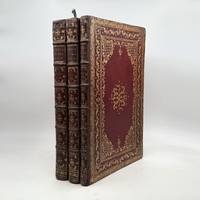
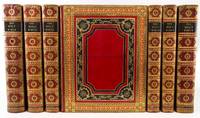
1590réf. 371036Rome: Ex Typographia Apostolica Vaticana 1590. First edition of the Sixtine Vulgate Bible large paper copy. Engraved illustrated title-page. Title in red and black text in double columns. 3 vols. Folio. Italian full red morocco binding of the seventeenth or early eighteenth century elaborately gilt with triple floral scrollwork borders stars in cornerpieces about a central motif stencilled paste paper endsheets a.e.g. Boxed. First edition of the Sixtine Vulgate Bible large paper copy. Engraved illustrated title-page. Title in red and black text in double columns. 3 vols. Folio. The engraved title reads: Biblia sacra vulgatae editionis ad concilii Tridentini praescriptum emendata et a Sixto V.P.M. recognata et approbata. With the preliminary document the Bull of Sixtus V beginning 'Aeternus ille caelestium terrestriumq. rerum omnium conditr ac moderator Deus .". This is often lacking. An extraordinary copy of the Sixtine Bible containing the Vulgate text as edited by Pope Sixtus V intended as the first ecclesiastically authorized text to be used throughout Christendom. "In its text it comes closer to R. Stephanus' Bible of 1538-40 than to the Louvain editions" Darlow & Moule who discuss the textual variations. This copy includes examples of the printed overslips required to correct hurried printing. The association with Aldus II suggested by Renouard and lasting long thereafter is spurious. Pope Sixtus V died soon after the book was printed and was followed by three short-lived popes. The Sixtine Bible had "aroused antagonism among both clergy and laity" and was swiftly condemned; the edition was withdrawn by Pope Clement VIII soon after his elevation to the papal throne in 1592 and many copies were destroyed. Preparations began in 1591 for a new edition of the Vulgate printed in 1592 and known as the Clementine Bible which long remained the standard Vulgate text. The ordinary issue of this printing measures 13-3/8 inches tall as in the Brooker copy sold 2024; the present copy measures 15-3/4. AN OUTSTANDING LARGE PAPER COPY OF A NOTABLE EDITION. Copinger 521; Darlow & Moule 6181; Adams B1098; BM STC Italian 1465-1600 p. 93; EDIT 16 CNCE 5805. Provenance: Vincenzo Maria Carafa 1739-1814 Prince of Roccella and Duke of Bruzzano engraved bookplates MS shelfmark :H 5; Douglas Maxwell Moffat bought of Quaritch in Dec. 1939; General Theological Seminary Ex Typographia Apostolica Vaticana unknown
1590réf. 371036Rome: Ex Typographia Apostolica Vaticana 1590. First edition of the Sixtine Vulgate Bible large paper copy. Engraved illustrated title-page. Title in red and black text in double columns. 3 vols. Folio. Italian full red morocco binding of the seventeenth or early eighteenth century elaborately gilt with triple floral scrollwork borders stars in cornerpieces about a central motif stencilled paste paper endsheets a.e.g. Boxed. First edition of the Sixtine Vulgate Bible large paper copy. Engraved illustrated title-page. Title in red and black text in double columns. 3 vols. Folio. The engraved title reads: Biblia sacra vulgatae editionis ad concilii Tridentini praescriptum emendata et a Sixto V.P.M. recognata et approbata. With the preliminary document the Bull of Sixtus V beginning 'Aeternus ille caelestium terrestriumq. rerum omnium conditr ac moderator Deus .". This is often lacking. An extraordinary copy of the Sixtine Bible containing the Vulgate text as edited by Pope Sixtus V intended as the first ecclesiastically authorized text to be used throughout Christendom. "In its text it comes closer to R. Stephanus' Bible of 1538-40 than to the Louvain editions" Darlow & Moule who discuss the textual variations. This copy includes examples of the printed overslips required to correct hurried printing. The association with Aldus II suggested by Renouard and lasting long thereafter is spurious. Pope Sixtus V died soon after the book was printed and was followed by three short-lived popes. The Sixtine Bible had "aroused antagonism among both clergy and laity" and was swiftly condemned; the edition was withdrawn by Pope Clement VIII soon after his elevation to the papal throne in 1592 and many copies were destroyed. Preparations began in 1591 for a new edition of the Vulgate printed in 1592 and known as the Clementine Bible which long remained the standard Vulgate text. The ordinary issue of this printing measures 13-3/8 inches tall as in the Brooker copy sold 2024; the present copy measures 15-3/4. AN OUTSTANDING LARGE PAPER COPY OF A NOTABLE EDITION. Copinger 521; Darlow & Moule 6181; Adams B1098; BM STC Italian 1465-1600 p. 93; EDIT 16 CNCE 5805. Provenance: Vincenzo Maria Carafa 1739-1814 Prince of Roccella and Duke of Bruzzano engraved bookplates MS shelfmark :H 5; Douglas Maxwell Moffat bought of Quaritch in Dec. 1939; General Theological Seminary Ex Typographia Apostolica Vaticana unknown books
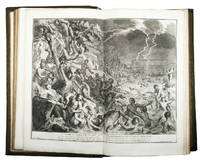
1663réf. 2167Leiden: widow and heirs of Johannes Elzevier 1663. Richly gold-tooled black goatskin morocco ca. 1725 over bevelled wooden boards sewn on 6 double cords each board with a double frame cornerpieces and large lozenge centrepiece all built up from hundreds of impressions of about 40 tools including a birds-in-vines roll for the inner frame with large built-up cornerpieces inside and smaller ones outside the centrepiece with a quartered square central field each quarter with a courant running stag and with a small 6-pointed sun with a face in the centre each of the 7 spine compartments with a double frame of double fillets with small fleurs-de-lis as cornerpieces the 2nd and 3rd with the title and volume number and each of the others with a centrepiece 4 cornerpieces and 2 small fleurs-de-lis; richly gold-tooled turn-ins gilt edges headbands in yellow and reddish-gold the so-called STAG BINDERY Rotterdam. From the collection of Hendrik Adriaan or Hendricus Hadrianus vander Marck ca. 1667-1726. Large folio 44.5 x 28 cm. The Elzevier Bible with an engraved allegorical frontispiece 3 letterpress title pages the general title page in red and black the others for the New Testament and Apocrypha each with the same Elzevier woodcut tree device Rahir M. 9. Picart's wholly engraved print-Bible with an allegorical frontispiece a half-title and 209 finely engraved Bible scenes 29 double-page by Gerard Hoet Bernard Picart etc. Further with a series of 6 double-page engraved plates namely 5 maps plus a plan of Jerusalem all by Nicolaas I Visscher. Below the privilege from the city of Leiden the city secretarys clerk Jacob vander Werve has authenticated the book by stamping the Leiden coat of arms and signing his name below it. 3 volumes bound as 2 with the prints and maps bound in. The famous and magnificent 1663 Elsevier edition of the 1637 authorized Dutch States translation of the Bible Old and New Testament plus the Apocrypha the only early edition of the Dutch States translation with the text in roman type instead of the traditional textura gothic. With Picart's folio print-Bible Figures de la Bible 1720 the most sumptuous pictorial bible published in the Netherlands here in the rare first edition published by the artist himself and the series of 6 maps and plans by Nicolaas I Visscher 1618-1679. The prints and maps are inserted in the relevant places in the Old Testament New Testament and Apocrypha with the New Testament and Apocrypha bound together to make the second volume. The whole is most luxuriously and splendidly produced and bound by the so-called "stag bindery" active in Rotterdam at least 1693-1743 the most important eighteenth-century bindery in Rotterdam and . one of the most distinguished Dutch workshops in the first half of that century Storm van Leeuwen IIA p. 432. A truly unique piece combining the best of all aspects of Dutch book production Elzevier's printing excellent presswork Picart's engravings and a binding by a Rotterdam workshop undoubtedly the equal of Magnus.Storm van Leeuwen notes that the book comes from the library of the great Dutch book collector Hendrik Adriaan vander Marck ca. 1667-1726 though we do not find it in the 1727 auction catalogue of his library. It descended to the Tjeenk Willink collection. In very good condition with some of the inserted prints and maps slightly browned and an occasional minor marginal defect. The bindings with a few minor scratches a few scuffs on the board edges and the spines slightly worn but still very good most of the tooling fine. Magnificent set complete with the two integral blank leaves.l Biblia sacra 1663.B.dut.JElwidandheirs.a; Bijbel-tentoonstelling 1914 no. 653; Darlow & Moule 3321; Poortman Bijbel en prent I p. 154; Rahir 885; STCN 840822693; Willems 884; for the print-Bible: Poortman II pp. 140-145; STCN 274059983 4 copies; for the maps: Poortman & Augusteijn chapter 27 maps 118-123; for the binding: Jan Storm van Leeuwen Dutch decorated bookbinding L805 & vol. IIA p. 433 438 ill. fig. 178. widow and heirs of Johannes Elzevier, hardcover
réf. 124387London Imprinted at London in povvles Churchyarde by Richarde Iugge printer to the Queenes Maiestie 1568. . First edition five parts in 1 vol.; large folio 40.5 x 29 cm; black letters text in double columns in 57 lines calendar printed in red and black general title with xylographic word panel in woodcut architectural border and an engraved medallion portrait of Queen Elizabeth the royal arms and allegorical figures 2 further engraved portraits comprising: Robert Dudley Earl of Leicester to the divisional title of Part 2 and Sir William Cecil to the recto of A2 in Part 3 all attributed to Franciscus Hogenberg woodcut New Testament Title the text further illustrated with 131 narrative woodcuts of 133 missing those on E2-3 in Part 1 which are lacking in this copy after Virgil Solis 5 woodcut maps and numerous diagrams woodcut printers device to verso of final f. contemporary annotations in pen including note dated '1590' to recto of Q8 in Part 2 with 19th-century transcription on blue paper tipped-in at fore-edge further note in same hand to foot of X3 recto also in Part 2 general title trimmed and mounted in the 18th-century with calligraphic dated ownership inscription in pen to verso some early underlining and marginalia in pen throughout tear to head of E6-7 in Part 1 repaired with glue with resultant residue to head of E7 pen marginalia to Part 1 K6 smoke damage to lower corner of N4-5 of same part paper brittle with tear repaired in archival tape small hole with loss of text to O6 also in Part 1 dampstaining to final 2ff causing minor loss to text both ff with early paper repairs at gutter margin as mentioned lacking ff E2-3 in Part 1 numbered XXXXIV-V comprising final chapter of Genesis and opening chapter of Exodus lacking final blank f. otherwise complete with some ff possibly supplied form other copies; 20th-century gilt-panelled calf the centre of the covers with jewelled cross formed of red green and purple morocco onlays modern endpapers minor wear very good; collation: A-Q8-E2-3 A-Y8 Z10 A-E8 F6 G-Z8 2A8 2B12 A-O8 P6 A-T8 V5. First edition of the Bishop's Bible the second authorised English translation. The editio princeps of the Bishop's Bible the second authorised English translation. A rare near complete example of the 'most sumptuous' and lavishly illustrated English pulpit Bible of the sixteenth century with over 130 narrative woodcuts and maps and three engraved portraits. The Bishop's Bible so-named for the numerous bishops and Biblical scholars involved in its production was the brainchild of the Archbishop of Canterbury Matthew Parker 1504-1575. The translation was intended to counter the Calvinist influence of the Geneva Bible which had come to prominence following the accession of Elizabeth I in 1558 and the return shortly thereafter of the Marian exile community into England and supersede the earlier Great Bible as the official authorised version of the scriptures in the Church of England. The text mainly follows that of the 1539 Great Bible but both Hebrew and Greek originals were consulted as well as the Geneva version. At least eleven bishops were involved in the revision with Parker himself contributing the lion's share of the work and the whole was completed by September 1568. 'In April 1571 the Convocation of the Province of Canterbury ordered that copies of this edition should be placed in every cathedral and as far as possible in every church; and enjoined every ecclesiastical dignitary to exhibit a copy in a prominent place in his house for the use of his servants and guests' Darlow & Moule. When Whitgift became Archbishop in 1583 he attempted unsuccessfully to enforce the sole use of the Bishop's Bible in churches and chapels across England. 'The Bishops' Bible was a success in that it replaced the Great Bible last reprinted in 1569 in churches to the exclusion of the Geneva version. But the latter continued to be read in Protestant homes and became the foundation of the Authorized Version' ODNB. The woodcut illustrations were mostly copied from designs by the Nuremberg artist Virgil Solis 1514-1562 for a picture series Biblische Figuren des Alten and Neuen Testaments that was first published in Frankfurt in 1560. The three engraved portraits depict Queen Elizabeth her favourite Robert Dudley Earl of Leicester and the Secretary of State Sir William Cecil and are attributed to Flemish artist Franciscus Hogenberg 1535-1590. 'While title-page portraits of the monarch were an established feature of English Bibles contemporary portraits within the text were a startling departure. The engravings of Dudley and Cecil prominently placed at the beginning of Parts 2 and 3 respectively flatter by association with the immediately following books. Dudley portrayed in armor mirrors the warrior-hero Joshua. Cecil is position as a new David at the head of Psalms with an open book in one hand other other grasping the large initials B of the psalm's opening line "Blessed is the man that walketh not in the counsell of the ungodly"' Luborsky & Ingram. This edition is also sometimes known as the 'Treacle Bible' for the rendering of 'balm' as 'triacle' in Jeremiah 8:22. A lovely example with early annotations including a note in pen to the foot of the first book of Chronicles dated '1590' with a 19th-century transcription on tipped-in blue paper: 'As thou shalt understand oute of this testamente the tru godlynes and the salvasion of ouer soules both by hearing of it and laying up as a storehouse in the harte. With a true and sinsear loue and so take up the crose of Christe Jesus and folowe hime that is to suffer afflictiones and fornes and scurges as Crist did when he suffered afflicksiones for ouer sines. 1590'. With a further note in the same hand to the second book of Esdras. ESTC S122070; STC 2099; Herbert 125; DM 89; Luborsky & Ingram B:2099. London, Imprinted at London in povvles Churchyarde by Richarde Iugge, printer to the Queenes Maiestie, [1568]. unknown
1862réf. 49952Glasgow Edinburgh and London: William Mackenzie 1862. Deluxe Edition. Two volumes folio 450 x 330 mm published between 1862 and 1863. 16 1344pp. 57 unnumbered leaves of albumin prints 230 x 160mm mounted on card stock. Crimson morocco over wooden boards elaborately tooled in gilt and blind; edges mounted in brass double brass clasps with thistle motif; covers with a broad blind-stamped border around a recessed central panel with the crowned cipher of Queen Victoria in gilt; gilt tooled spine with 5 raised bands; a.e.g. marbled endleaves with gilt dentelles. Covers with some mild traces of use; single crease in each marbled endleaf partially detached in second volume; occasional light to moderate foxing mostly confined to the plate mounts; albumin prints in fine condition often with foxing extending about 5mm from the edges into the mount. Overall a very good set with a fine series of photographs notable for their technical achievment. Deluxe edition one of 170 copies complete with all 57 albumen prints. Produced for the 1862 International Exhibition and dedicated to Queen Victoria then recently in mourning for the death of Prince Albert this work appeared at a time when photography though still a laborious and expensive process was just beginning to become a popular activity. Victoria herself was an amateur photographer and "the royal couple had been enthusiastic supporters of photography in England from the beginning; in 1853 they became founding patrons of the Photographic Society Club" K. Fiedorek. Francis Frith 1822-1898 the devout Quaker whose photographic images grace the present work was one of the best-known photographers to work in the Near East and the most commercially successful photographer of the nineteenth century. Finding his elementary studies tedious Frith left school at the age of ten apprenticed with a grocer and eventually started his own business. He later went into printing sold the grocery business to a competitor at a substantial profit and went on to devote himself to photography. "The growing Victorian interest in the East and its exotic and historic attractions caught the attention of this astute businessman" Perez. Between 1856 and 1860 Frith made three photographic expeditions to Egypt Ethiopia Sinai and the Levant accompanied by the engineer Francis Herbert Wenham who provided technical assistance in mechanics and optics. While Perez notes that Frith's "approach was always a strictly commercial one and his concern was to make truthful and accurate views of the area" he readily concedes that "the technical quality of Frith's photographs is superior." Frith employed the new wet collodion process in which glass plate negatives were sensitized exposed and developed while still wet. While technically demanding the process yielded rich detail and broad tones. "Frith's were the first original wet-plate photographs of Jerusalem and the Holy Land to reach a wide English-speaking audience and his pictures of the small Palestinian towns were most likely the first published anywhere" Nir p.66. Perhaps the most novel aspect of this celebrated edition of the Bible and certainly a harbinger of things to come was the way in which the photographer "presented the radical possibility of seeing photographs of the biblical sites alongside related verses of scripture. he sought to defend and promote his faith by conscripting the veracity of science and materialism to his cause and considered photography to be the most effective medium for his campaign" Foster et al. This vision is manifest even in such details as the re-captioning of prints previously offered for sale so that the new descriptions would more clearly reference the King James text. It should be noted that while the printing was still done by hand this was one of the earliest books for which machinery was used for composing. Original publisher's price = 50 guineas. Another version of this work was published at London in 1860-1862 by Eyre & Spottiswoode; sometimes confused with the present work it was issued in 20 parts each containing a single photographic print by Frith. K. Fiedorek A Photographic Bible Fit for a Queen NYPL Blog 2014. Foster Heiting and Stuhlman Imagining Paradise pp. 68-69. Gernsheim Incunabula of British Photographic Literature 1839-1875 p.36 no.184. Herbert The English Bible 1940 1217. Y. Nir The Bible and the Image The History of Photography in the Holy Land 1939-1899 esp. chap. 3: "Early Traveling Landscape Photographers". N. Perez Focus East: Early Photography in the Near East 1838-1885 pp.163-165. William Mackenzie unknown
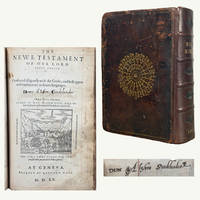
1560réf. V15The Bible and Holy Scriptures Conteyned in The Olde and Newe Testament. Translated According to the Ebrew and Greke and conferred with the best Translations in divers Languages. With Moste Profitable Annotations… Summary The first edition of the Geneva Bible. Unrivaled for three generations the Geneva translation produced by Marian exiles showed a distinct advance on its predecessors: Roman type portable size verse divisions marginal study notes and explanatory woodcuts. Its phrases find an echo in Scripture quotations from Shakespeare to Bunyan. Description General title page 1560 and prelims in facsimile. Text in two column Roman type ruled in red throughout. Two double-page maps are present 'The description of the holie land and other places mencioned in the foure Evangelistes'; 'The description of the countreis and places mencioned in the Actes of the Apostles' with the other three maps in facsimile. The font and woodcuts are both larger than the editions later printed in England. Apocrypha present as issued. New Testament title page 1560 with the woodcut of the crossing of the Red Sea. Concludes with the Two Tables and The Order of the Yeres. Bound with the first edition of the newly authorized 1650 Scottish Metrical Psalter: The Psalmes of David in Meeter printed by Evan Tyler in Edinburgh with title page 1650. First chapter woodcut initials throughout. Collation 4-1-4 general title and prelims in facsimile a-z4 A-Z4 Aa-Zz4 &6 Aaa-Zzz4 Aaaa-Zzzz4 Aaaaa-Bbbbb4 Aa-Zz4 -Tt1 Romans 8:1-9:33 in facsimile Aaa-Lll4. Binding Attractive brown calf featuring an 18th-century Scottish wheel design. Covers bordered with gilt fillets and centered with a large circular gilt wheel composed of radiating floral and foliate tools around a central rosette. Rebacked in matching calf with four raised bands blind tooling to compartments and the words "Holy Bible" and "1560" lettered in gilt. Endpapers renewed. Corners slightly bumped. Condition First three leaves of Genesis strengthened to edges with loss to a few sidenotes of last two leaves; trimmed with headlines occasionally cropped; occasional soiling and staining; Ddd-Lll some repairs to lower corner infrequently costing a few letters of sidenotes. NT title page lightly stained to fore-edge; upper corner repair to final few leaves of Tables. Provenance Contemporary ownership inscriptions "Deme Alesone Sandelandes" repeated on the New Testament title-page and verso of the double-page map in John 20. This Bible's first owner is likely Dame Alison Sandilands d. 1584 Lady Ormiston a member of the prominent Sandilands family of Calder and wife of John Cockburn of Ormiston one of the early supporters of the Scottish Reformation. The Ormiston household stood close to the circle of John Knox: Knox served as tutor to Alison's son Alexander Cockburn while the Protestant martyr George Wishart was sheltered at Ormiston shortly before his arrest in 1546. Alison herself participated in the circulation and preservation of Reformation writings and Henry Balnaves's Confession of Faith was dedicated to her when published in 1584. Later 17th-century family records to verso of The Order of the Yeres include births in 1672 and 1676 the ownership inscription of Mary Hill and a record of the death of her father Charles Hill on 22 October 1691." Note First edition of the Geneva Bible the most important and widely read English Bible for more than a century. Produced by English Protestant exiles who had fled Marian persecution for Geneva it was the first complete English Bible translated directly from the original biblical languages and the first English Bible printed in roman type and with verse divisions. Designed as a portable and readable Bible for everyday devotion and study its title page departed from the elaborate woodcut designs of earlier English Bibles such as the Coverdale Matthew's and Great Bibles instead featuring a modest image of the Israelites trapped at the Red Sea. Hemmed in by the sea mountains and the pursuing Egyptian army the Israelites turn to God for deliverance a scene that invites readers to see a parallel between Israel's bondage and the plight of the persecuted English church in exile awaiting God's deliverance and the opportunity to return home. The Geneva Bible quickly became the Bible of the English Protestant household and retained its popular preeminence until its gradual suppression and displacement following the introduction of the King James Version in 1611. Bound with the first edition of the newly translated metrical Psalter authorized by the General Assembly of the Church of Scotland containing the enduring Scottish version of Psalm 23 beginning "The Lord's my shepherd I'll not want." References Herbert 107; USTC 450496; Luborsky 2108; PMM 83 Bible; ESTC R39597 Psalter. Rouland Hall hardcover
1862réf. 49952Glasgow Edinburgh and London: William Mackenzie 1862. Deluxe Edition. Two volumes folio 450 x 330 mm published between 1862 and 1863. 16 1344pp. 57 unnumbered leaves of albumin prints 230 x 160mm mounted on card stock. Crimson morocco over wooden boards elaborately tooled in gilt and blind; edges mounted in brass double brass clasps with thistle motif; covers with a broad blind-stamped border around a recessed central panel with the crowned cipher of Queen Victoria in gilt; gilt tooled spine with 5 raised bands; a.e.g. marbled endleaves with gilt dentelles. Covers with some mild traces of use; single crease in each marbled endleaf partially detached in second volume; occasional light to moderate foxing mostly confined to the plate mounts; albumin prints in fine condition often with foxing extending about 5mm from the edges into the mount. Overall a very good set with a fine series of photographs notable for their technical achievment. Deluxe edition one of 170 copies complete with all 57 albumen prints. Produced for the 1862 International Exhibition and dedicated to Queen Victoria then recently in mourning for the death of Prince Albert this work appeared at a time when photography though still a laborious and expensive process was just beginning to become a popular activity. Victoria herself was an amateur photographer and "the royal couple had been enthusiastic supporters of photography in England from the beginning; in 1853 they became founding patrons of the Photographic Society Club" K. Fiedorek. Francis Frith 1822-1898 the devout Quaker whose photographic images grace the present work was one of the best-known photographers to work in the Near East and the most commercially successful photographer of the nineteenth century. Finding his elementary studies tedious Frith left school at the age of ten apprenticed with a grocer and eventually started his own business. He later went into printing sold the grocery business to a competitor at a substantial profit and went on to devote himself to photography. "The growing Victorian interest in the East and its exotic and historic attractions caught the attention of this astute businessman" Perez. Between 1856 and 1860 Frith made three photographic expeditions to Egypt Ethiopia Sinai and the Levant accompanied by the engineer Francis Herbert Wenham who provided technical assistance in mechanics and optics. While Perez notes that Frith's "approach was always a strictly commercial one and his concern was to make truthful and accurate views of the area" he readily concedes that "the technical quality of Frith's photographs is superior." Frith employed the new wet collodion process in which glass plate negatives were sensitized exposed and developed while still wet. While technically demanding the process yielded rich detail and broad tones. "Frith's were the first original wet-plate photographs of Jerusalem and the Holy Land to reach a wide English-speaking audience and his pictures of the small Palestinian towns were most likely the first published anywhere" Nir p.66. Perhaps the most novel aspect of this celebrated edition of the Bible and certainly a harbinger of things to come was the way in which the photographer "presented the radical possibility of seeing photographs of the biblical sites alongside related verses of scripture. he sought to defend and promote his faith by conscripting the veracity of science and materialism to his cause and considered photography to be the most effective medium for his campaign" Foster et al. This vision is manifest even in such details as the re-captioning of prints previously offered for sale so that the new descriptions would more clearly reference the King James text. It should be noted that while the printing was still done by hand this was one of the earliest books for which machinery was used for composing. Original publisher's price = 50 guineas. Another version of this work was published at London in 1860-1862 by Eyre & Spottiswoode; sometimes confused with the present work it was issued in 20 parts each containing a single photographic print by Frith. K. Fiedorek A Photographic Bible Fit for a Queen NYPL Blog 2014. Foster Heiting and Stuhlman Imagining Paradise pp. 68-69. Gernsheim Incunabula of British Photographic Literature 1839-1875 p.36 no.184. Herbert The English Bible 1940 1217. Y. Nir The Bible and the Image The History of Photography in the Holy Land 1939-1899 esp. chap. 3: "Early Traveling Landscape Photographers". N. Perez Focus East: Early Photography in the Near East 1838-1885 pp.163-165. William Mackenzie unknown books
1560réf. V15The Bible and Holy Scriptures Conteyned in The Olde and Newe Testament. Translated According to the Ebrew and Greke and conferred with the best Translations in divers Languages. With Moste Profitable Annotations… Summary The first edition of the Geneva Bible. Unrivaled for three generations the Geneva translation produced by Marian exiles showed a distinct advance on its predecessors: Roman type portable size verse divisions marginal study notes and explanatory woodcuts. Its phrases find an echo in Scripture quotations from Shakespeare to Bunyan. Description General title page 1560 and prelims in facsimile. Text in two column Roman type ruled in red throughout. Two double-page maps are present 'The description of the holie land and other places mencioned in the foure Evangelistes'; 'The description of the countreis and places mencioned in the Actes of the Apostles' with the other three maps in facsimile. The font and woodcuts are both larger than the editions later printed in England. Apocrypha present as issued. New Testament title page 1560 with the woodcut of the crossing of the Red Sea. Concludes with the Two Tables and The Order of the Yeres. Bound with the first edition of the newly authorized 1650 Scottish Metrical Psalter: The Psalmes of David in Meeter printed by Evan Tyler in Edinburgh with title page 1650. First chapter woodcut initials throughout. Collation 4-1-4 general title and prelims in facsimile a-z4 A-Z4 Aa-Zz4 &6 Aaa-Zzz4 Aaaa-Zzzz4 Aaaaa-Bbbbb4 Aa-Zz4 -Tt1 Romans 8:1-9:33 in facsimile Aaa-Lll4. Binding Attractive brown calf featuring an 18th-century Scottish wheel design. Covers bordered with gilt fillets and centered with a large circular gilt wheel composed of radiating floral and foliate tools around a central rosette. Rebacked in matching calf with four raised bands blind tooling to compartments and the words "Holy Bible" and "1560" lettered in gilt. Endpapers renewed. Corners slightly bumped. Condition First three leaves of Genesis strengthened to edges with loss to a few sidenotes of last two leaves; trimmed with headlines occasionally cropped; occasional soiling and staining; Ddd-Lll some repairs to lower corner infrequently costing a few letters of sidenotes. NT title page lightly stained to fore-edge; upper corner repair to final few leaves of Tables. Provenance Contemporary ownership inscriptions "Deme Alesone Sandelandes" repeated on the New Testament title-page and verso of the double-page map in John 20. This Bible's first owner is likely Dame Alison Sandilands d. 1584 Lady Ormiston a member of the prominent Sandilands family of Calder and wife of John Cockburn of Ormiston one of the early supporters of the Scottish Reformation. The Ormiston household stood close to the circle of John Knox: Knox served as tutor to Alison's son Alexander Cockburn while the Protestant martyr George Wishart was sheltered at Ormiston shortly before his arrest in 1546. Alison herself participated in the circulation and preservation of Reformation writings and Henry Balnaves's Confession of Faith was dedicated to her when published in 1584. Later 17th-century family records to verso of The Order of the Yeres include births in 1672 and 1676 the ownership inscription of Mary Hill and a record of the death of her father Charles Hill on 22 October 1691." Note First edition of the Geneva Bible the most important and widely read English Bible for more than a century. Produced by English Protestant exiles who had fled Marian persecution for Geneva it was the first complete English Bible translated directly from the original biblical languages and the first English Bible printed in roman type and with verse divisions. Designed as a portable and readable Bible for everyday devotion and study its title page departed from the elaborate woodcut designs of earlier English Bibles such as the Coverdale Matthew's and Great Bibles instead featuring a modest image of the Israelites trapped at the Red Sea. Hemmed in by the sea mountains and the pursuing Egyptian army the Israelites turn to God for deliverance a scene that invites readers to see a parallel between Israel's bondage and the plight of the persecuted English church in exile awaiting God's deliverance and the opportunity to return home. The Geneva Bible quickly became the Bible of the English Protestant household and retained its popular preeminence until its gradual suppression and displacement following the introduction of the King James Version in 1611. Bound with the first edition of the newly translated metrical Psalter authorized by the General Assembly of the Church of Scotland containing the enduring Scottish version of Psalm 23 beginning "The Lord's my shepherd I'll not want." References Herbert 107; USTC 450496; Luborsky 2108; PMM 83 Bible; ESTC R39597 Psalter. Rouland Hall hardcover books
1660réf. 3641Amsterdam: widow of Paulus Aertsz. van Ravesteyn 1660. 18th-century black so-called sharkskin over bevelled wooden boards ca. 1770 sewn on 8 double supports with 8 large silver corner-pieces and 2 large silver clasps with catchplates and anchorplates all with matching stamped relief decoration scallop shells/fans scrollwork and fields of suares with crosses at the intersections or diamonds with 's at the intersections gilt and gauffered edges. The silver furnishings bear Amsterdam city hallmarks with year letter C crown above XXX above C and master's mark DF. Rebacked with most of the original backstrip mounted on the spine. Large folio 47.5 x 32 cm. With an integral engraved general title page architectural portico with a book above illuminated by the sun the crowned arms of the States General below and a large biblical scene at the foot: Elijah and the ravens alluding to Van Ravesteyn's name 2 letterpress title pages for the New Testament and Apocrypha each with Van Ravesteyn's woodcut device Elijah and the ravens a divisional title for the Prophets 6 double-page engraved maps by Nicolaas Visscher I including a world map and a plan of Jerusalem and 336 Bible-illustrations 6.5 x 10 cm by Claes Jansz. Visscher after Matthäus Merian on 42 numbered single-page plates plate size 35 x 24 cm with 8 illustrations per plate. Further with 9 woodcut tailpieces one at the end with a different Van Ravesteyn device inserted in the middle plus dozens of repeats about 50 woodcut decorated initials at least 8 series the 36 mm series opening most books of the Bible having 2 different blocks for at least some letters plus more than a hundred repeats. Set in textura types with incidental roman. The maps and illustrations coloured by an early hand with extensive use of gold. 3 parts in 1 volume. Extra-illustrated large folio edition of the Dutch Statenbijbel States Bible with 6 maps and 336 illustrations hand-coloured the translation officially authorized by the Dutch Reformed Church and published with a privilege from the States General of the Dutch Republic. The 1619 Synod of Dordrecht established a committee to prepare the new translation and leading Dutch scholars worked on it for nearly twenty years before Paulus Aertsz. van Ravesteyn ca. 1586-1655 published the first edition in 1637. The 6 maps and the engraved illustrations were produced to be inserted into Van Ravesteyn's folio editions. The series of 336 illustrations by Claes Jansz. Visscher with eight to one leaf are engraved by Cornelis Danckerts. With some browning but still generally in good condition and with large margins. The binding has been rebacked as noted and the "sharkskin" on the boards has some cracks and wear but the silver furnishings and gauffered edges are well-preserved. A stunning large States Bible with 6 maps and 336 illustrations coloured by an early hand with extensive gold.l Poortman Bijbel en prent I p. 233 cf. pp. 147 151; STCN 094500975 9 copies; cf. Darlow & Moule 3315 1657 ed.; for the maps: Poortman & Augusteijn 27.1-6 all in first states; the prints not in Hollstein; Poortman Bijbel en prent; for the zilver furnishings: Voet Amst. zilversmeden 448-449. widow of Paulus Aertsz. van Ravesteyn, hardcover
1790réf. ST19326Amsterdam: H. Keyzer H. Gartman en W. Vermandel 1790. 555 x 345 mm. 21 7/8 x 13 3/4". 2 p.l. 62 folding plates. Attractive late 19th or early 20th century retrospective polished brown calf by L. Guétant stamp-signed in gilt on tail of spine double gilt-ruled border floral cornerpieces raised bands spine panels with scrolling floral borders and central flower ornament gilt titling. With title vignette and 62 ENGRAVED FOLDING PLATES ALL WITH BEAUTIFUL HAND COLORING AND HIGHLIGHTED WITH GOLD depicting Bible scenes from the Old and New Testament 61 of which are by Jan Luyken. A Large Paper Copy. For earlier editions: Graesse IV p. 308; Brunet III 1245-46; Klaversma & Hannema 159-164. Light rubbing to joints and edges boards just a little marked trivial foxing and faint spots here and there but A REMARKABLY FINE COPY the binding lustrous and showing little wear the paper extremely bright and fresh the margins immense and the paint and gold unusually vibrant. The marvelous illustrations of Dutch engraver and poet Jan Luyken comprise this collection of "remarkable stories" from the Bible each depicted with panoramic grandeur and enhanced with a wide range of finely applied colors and gold. Luyken 1649-1712 had written and illustrated erotic poetry as a young man but later became a devout Pietist after reading the works of German mystic Jakob Böhme. He became a member of the Baptist Church in 1673 and thereafter devoted his talents to producing religious works. The vast scenes here are notable in their scale detail and animation. There are a number of battle scenes from the Old Testament as well as dramatic depictions of the plagues and a fascinating episode from the histories of Josephus depicting Herod's soldiers being lowered down the side of a cliff in large boxes suspended from chains in order to attack the thieves hiding in caverns on the cliffside. There is a majestic portrayal of the Queen of Sheba arriving at the court of Solomon a peaceful scene of Adam naming the beasts in the Garden of Eden and a festive celebration of the Feast of Tabernacles. New Testament scenes include a terrifying final judgment a blinding conversion of St. Paul and scenes from that Apostle's travels. The engravings have one common trait: they are heavily populated whether by men or beasts and one of Luyken's special gifts is to render every person in the crowd as an individual with his own concerns and reactions to the events at hand. The engravings while already greatly pleasing in black and white are even more stirring and memorable when seen in the full color and gold used here. Expansive tableaus are given greater definition and clarity and events such as Noah’s flood and the destruction of Sodom and Gomorrah are rendered even more successful in expressing the awesome powers of the Almighty. The illustrations are quite definitely Protestant in point of view: there are no depictions of the Virgin Mary not even a Nativity scene. Except for engravings of the Annunciation to the Shepherds and the Massacre of the Holy Innocents the illustrations focus on Jesus as an adult and on the work of his Apostles spreading the gospel. There were earlier editions containing Luyken's 62 large plates which originally appeared without text as here in 1708 and they appeared again with a text in Dutch in 1729 and in French in 1732. Copies of these editions appear with some regularity in the marketplace but are usually not colored and are often found incomplete or with other major condition issues. We can trace no record in RBH or OCLC of a copy of our 1790 edition and we can find nothing that compares with the quality of coloring and grand height attained by the monumental margins seen here. H. Keyzer, H. Gartman en W. Vermandel unknown
1790réf. ST19326Amsterdam: H. Keyzer H. Gartman en W. Vermandel 1790. 555 x 345 mm. 21 7/8 x 13 3/4". 2 p.l. 62 folding plates. Attractive late 19th or early 20th century retrospective polished brown calf by L. Guétant stamp-signed in gilt on tail of spine double gilt-ruled border floral cornerpieces raised bands spine panels with scrolling floral borders and central flower ornament gilt titling. With title vignette and 62 ENGRAVED FOLDING PLATES ALL WITH BEAUTIFUL HAND COLORING AND HIGHLIGHTED WITH GOLD depicting Bible scenes from the Old and New Testament 61 of which are by Jan Luyken. A Large Paper Copy. For earlier editions: Graesse IV p. 308; Brunet III 1245-46; Klaversma & Hannema 159-164. Light rubbing to joints and edges boards just a little marked trivial foxing and faint spots here and there but A REMARKABLY FINE COPY the binding lustrous and showing little wear the paper extremely bright and fresh the margins immense and the paint and gold unusually vibrant. The marvelous illustrations of Dutch engraver and poet Jan Luyken comprise this collection of "remarkable stories" from the Bible each depicted with panoramic grandeur and enhanced with a wide range of finely applied colors and gold. Luyken 1649-1712 had written and illustrated erotic poetry as a young man but later became a devout Pietist after reading the works of German mystic Jakob Böhme. He became a member of the Baptist Church in 1673 and thereafter devoted his talents to producing religious works. The vast scenes here are notable in their scale detail and animation. There are a number of battle scenes from the Old Testament as well as dramatic depictions of the plagues and a fascinating episode from the histories of Josephus depicting Herod's soldiers being lowered down the side of a cliff in large boxes suspended from chains in order to attack the thieves hiding in caverns on the cliffside. There is a majestic portrayal of the Queen of Sheba arriving at the court of Solomon a peaceful scene of Adam naming the beasts in the Garden of Eden and a festive celebration of the Feast of Tabernacles. New Testament scenes include a terrifying final judgment a blinding conversion of St. Paul and scenes from that Apostle's travels. The engravings have one common trait: they are heavily populated whether by men or beasts and one of Luyken's special gifts is to render every person in the crowd as an individual with his own concerns and reactions to the events at hand. The engravings while already greatly pleasing in black and white are even more stirring and memorable when seen in the full color and gold used here. Expansive tableaus are given greater definition and clarity and events such as Noah’s flood and the destruction of Sodom and Gomorrah are rendered even more successful in expressing the awesome powers of the Almighty. The illustrations are quite definitely Protestant in point of view: there are no depictions of the Virgin Mary not even a Nativity scene. Except for engravings of the Annunciation to the Shepherds and the Massacre of the Holy Innocents the illustrations focus on Jesus as an adult and on the work of his Apostles spreading the gospel. There were earlier editions containing Luyken's 62 large plates which originally appeared without text as here in 1708 and they appeared again with a text in Dutch in 1729 and in French in 1732. Copies of these editions appear with some regularity in the marketplace but are usually not colored and are often found incomplete or with other major condition issues. We can trace no record in RBH or OCLC of a copy of our 1790 edition and we can find nothing that compares with the quality of coloring and grand height attained by the monumental margins seen here. H. Keyzer, H. Gartman en W. Vermandel unknown books
1549réf. U91The newe Testament of the last translacion. By Wylliam Tyndall with the prologes and annotacions in the mergent declaryng many harde places conteyned in the texte also in the later ende foloweth the Epistles of the olde Testament. Description Title page printed in red and black 1549 with an architectural design with two supporting figures and below under an arch a recumbent figure writing. The title page is contemporary and perhaps supplied from another copy. The prelims include an Almanak Calendar and Tyndale's address to the reader. Text in single column black letter with 35 lines to the full column. The text closely follows the 1534 edition of William Tyndale. References subject headings and notes in the margins. Woodcut initials before each chapter. Tyndale's prologues before Matthew and each of the Epistles including his long introduction to Romans. Ends on dated colophon 1548. Collation unsigned4 -unsigned1-3 with authentic title page A6-A6 B-Z8-B-C6 lacking all text before Matthew 15 Aa-Nn8. 271 of 292 leaves. Prelims and all missing text supplied in color facsimile. Binding Rebound in period-style black calf. Covers with a diaper framework design within a rectangular frame. Spine with four raised bands and elaborate blind tooling to compartments. Endpapers renewed. Condition Lacking prelims and all text up to Matthew 15 except title page; Rr7 repaired to upper corner with a few missing words replaced in facsimile; Cc7 lower corner repaired; minor spotting and staining with slight damp-staining at the rear; a few small wormholes; a clean text with some early marginalia in places far better than typically seen of Tyndale New Testaments from the period. Provenance Bookplate of Bristol Baptist College Library to front pastedown with their shelf mark x.9.1 and identification 89b on front free endpaper. An inserted letter in a nineteenth century hand from Francis Fry attempting to identify the edition and inquiring of available copies at the library that match his description; accompanied by Christopher Anderson's response that no such copies exist. Anderson is the author of Annals of the English Bible. On a blank endpaper facing the title page an early inscription claims "Coverdale's Testament" yet this is corrected below in Fry's hand. "A Gifford" of the Baptist College Bristol Particular Baptist minister antiquarian book collector and librarian at the British Museum to headline of D1. Scarcity ESTC records only six institutional copies with only one in North America. RBH records only one copy at auction Ryrie sale also lacking many leaves. Note A rare and early Tyndale New Testament. Most of the copies from the forty editions of Tyndale's New Testament are from the final three printed editions. Heavily suppressed by Mary and produced from much smaller print runs. A true rare and collectible gem. References Herbert 77; ESTC S90918; Fry's No. 18. William Tylle hardcover
1549réf. U91The newe Testament of the last translacion. By Wylliam Tyndall with the prologes and annotacions in the mergent declaryng many harde places conteyned in the texte also in the later ende foloweth the Epistles of the olde Testament. Description Title page printed in red and black 1549 with an architectural design with two supporting figures and below under an arch a recumbent figure writing. The title page is contemporary and perhaps supplied from another copy. The prelims include an Almanak Calendar and Tyndale's address to the reader. Text in single column black letter with 35 lines to the full column. The text closely follows the 1534 edition of William Tyndale. References subject headings and notes in the margins. Woodcut initials before each chapter. Tyndale's prologues before Matthew and each of the Epistles including his long introduction to Romans. Ends on dated colophon 1548. Collation unsigned4 -unsigned1-3 with authentic title page A6-A6 B-Z8-B-C6 lacking all text before Matthew 15 Aa-Nn8. 271 of 292 leaves. Prelims and all missing text supplied in color facsimile. Binding Rebound in period-style black calf. Covers with a diaper framework design within a rectangular frame. Spine with four raised bands and elaborate blind tooling to compartments. Endpapers renewed. Condition Lacking prelims and all text up to Matthew 15 except title page; Rr7 repaired to upper corner with a few missing words replaced in facsimile; Cc7 lower corner repaired; minor spotting and staining with slight damp-staining at the rear; a few small wormholes; a clean text with some early marginalia in places far better than typically seen of Tyndale New Testaments from the period. Provenance Bookplate of Bristol Baptist College Library to front pastedown with their shelf mark x.9.1 and identification 89b on front free endpaper. An inserted letter in a nineteenth century hand from Francis Fry attempting to identify the edition and inquiring of available copies at the library that match his description; accompanied by Christopher Anderson's response that no such copies exist. Anderson is the author of Annals of the English Bible. On a blank endpaper facing the title page an early inscription claims "Coverdale's Testament" yet this is corrected below in Fry's hand. "A Gifford" of the Baptist College Bristol Particular Baptist minister antiquarian book collector and librarian at the British Museum to headline of D1. Scarcity ESTC records only six institutional copies with only one in North America. RBH records only one copy at auction Ryrie sale also lacking many leaves. Note A rare and early Tyndale New Testament. Most of the copies from the forty editions of Tyndale's New Testament are from the final three printed editions. Heavily suppressed by Mary and produced from much smaller print runs. A true rare and collectible gem. References Herbert 77; ESTC S90918; Fry's No. 18. William Tylle hardcover books
1800réf. ST20221aLondon: T. Bensley for T. Macklin final volume Bensley for T. Cadell & W. Davies 1800 for the six volumes of the Bible 1816 for the Apocrypha. First Printing of this Edition. 480 x 385 mm. 19 x 15 1/8". One leaf in the Apocrypha 3P2 comprising two prologues of Ecclesiasticus invisibly inserted from another copy. Seven volumes comprising the regular Bible in six volumes and the Apocrypha usually not included as a seventh volume. ABSOLUTELY MAGNIFICENT CONTEMPORARY RED NEOCLASSICAL-STYLE STRAIGHT-GRAIN MOROCCO SUMPTUOUSLY GILT AND ONLAID WITH BLUE BY GEORG FRIEDRICH KRAUSS done for Prince Albert Casimir Duke of Saxe-Teschen with repeated "AST" monogram covers with very elaborate frames incorporating 11 plain and decorative gilt rules four onlaid borders of blue morocco and very elegant swirling foliate ornamentation around the central scalloped panel six pairs of raised bands each pair flanking a recessed gilt and blue metope and pentaglyph rule very handsome spine compartments with blue fan-shaped cornerpieces and central gilt-decorated blue medallions within sunburst gilt collars turn-ins with Greek key pattern in gilt striking endleaves of turquoise and green watered silk the Apochrypha endleaves slightly different. With more than 100 allegorical headpieces and tailpieces and some 70 SPLENDID LARGE-FOLIO-SIZE COPPER PLATES after Fuseli Reynolds West and others most plates printed before letters. Tissue guards perhaps later. Herbert 1442 and 1651. First volume with about 30 leaves noticeably foxed the majority of plates offset onto previous and following pages consistent inoffensive offsetting of text on facing pages other trivial imperfections but still a very impressive copy internally with the luxurious paper used for the text both fresh and clean and the engravings richly impressed and with very little foxing. Some unimportant scuffing and rubbing to the leather but all defects minor THE MAGNIFICENT BINDINGS REMARKABLY WELL PRESERVED the heavy volumes completely solid with only insignificant signs of use and THE MOROCCO AND LAVISHLY GILT DECORATION EXTREMELY BRIGHT. AN ALTOGETHER MEMORABLE COPY. The most prodigious form of Scripture in English ever published the Macklin Bible was often put into ornate bindings especially by London binders like Staggemeier and his contemporaries. But however much other sets may glisten the present magnificent example surely stands at or near the front of the line as one of the most lavishly decorated and arresting copies in existence. Its decorative extravagance also testifies to the fact that Macklin's publication was sufficiently admired outside of England to warrant the finest workmanship and the expenditure of great sums of money on artistic resources. The very large and bold type the fine Whatman paper and the series of engravings by some of the most celebrated artists of the period make this an item that is already very desirable. Like the Boydell "Shakespeare Gallery" also printed by Bensley our Macklin Bible is a vast picture book with illustrations that are grand both in size and emotional impact. But it is of course the bindings here that matter the most. Francesco Piranesi is generally given credit for inventing the Neoclassical style when he designed volumes presented to Gustavus III of Sweden during this monarch's visit to Rome in 1783-84. Quickly popular the Neoclassical style was imitated and developed by Staggemeier & Welcher in London by F. W. Standlander in Stockholm and by Georg Friedrich Krauss in Vienna. Krauss was the most prominent Continental binder working in this style of the day and Saxe-Teschen was perhaps his most important client. Products of the Krauss bindery have passed through some of the most distinguished collections over the years particularly those of Fürstenberg and Schäfer; and his bindings have consistently brought remarkable sums of money at auction. It is sufficient to say that the present group of bindings represents the most impressive collection of decorative volumes we have ever offered for sale. The collector for whom these bindings were originally executed Duke Albert of Saxe-Teschen 1738-1822 was the son of Friedrich August II of Saxony and the son-in-law of the empress Maria Theresa. After providing important military and civil service to the Habsburg empire he retired to Vienna in 1795 and afterward devoted himself to the fine arts. He founded the Albertina which now houses the greatest collection of prints in the world and he put together a great library distinguished by the highest taste and most exacting standards. The present copy has the additional distinction of containing what amounts to an extra volume: the Macklin Bible however it is bound most often appears in the marketplace without the Apocrypha appearing here as Volume VII which was not issued until 16 years after the others. It is also of some interest that the bindings of our seven volumes were decorated in an entirely uniform fashion as a close inspection shows something not typical of a set with volumes published so many years apart. The non-uniform endleaves in the final volume here may have resulted from the fact that given the physical size of the books the binder simply ran out of the cloth he had used for lining the first six volumes. The present set was offered though unsold at Sotheby's in 2003 with an estimate of £40-50000 approximately $64000-80000 and in 2005 for £30-40000 approximately $54000-72000. T. Bensley for T. Macklin [final volume Bensley for T. Cadell & W. Davies] unknown
1800réf. ST20221aLondon: T. Bensley for T. Macklin final volume Bensley for T. Cadell & W. Davies 1800 for the six volumes of the Bible 1816 for the Apocrypha. First Printing of this Edition. 480 x 385 mm. 19 x 15 1/8". One leaf in the Apocrypha 3P2 comprising two prologues of Ecclesiasticus invisibly inserted from another copy. Seven volumes comprising the regular Bible in six volumes and the Apocrypha usually not included as a seventh volume. ABSOLUTELY MAGNIFICENT CONTEMPORARY RED NEOCLASSICAL-STYLE STRAIGHT-GRAIN MOROCCO SUMPTUOUSLY GILT AND ONLAID WITH BLUE BY GEORG FRIEDRICH KRAUSS done for Prince Albert Casimir Duke of Saxe-Teschen with repeated "AST" monogram covers with very elaborate frames incorporating 11 plain and decorative gilt rules four onlaid borders of blue morocco and very elegant swirling foliate ornamentation around the central scalloped panel six pairs of raised bands each pair flanking a recessed gilt and blue metope and pentaglyph rule very handsome spine compartments with blue fan-shaped cornerpieces and central gilt-decorated blue medallions within sunburst gilt collars turn-ins with Greek key pattern in gilt striking endleaves of turquoise and green watered silk the Apochrypha endleaves slightly different. With more than 100 allegorical headpieces and tailpieces and some 70 SPLENDID LARGE-FOLIO-SIZE COPPER PLATES after Fuseli Reynolds West and others most plates printed before letters. Tissue guards perhaps later. Herbert 1442 and 1651. First volume with about 30 leaves noticeably foxed the majority of plates offset onto previous and following pages consistent inoffensive offsetting of text on facing pages other trivial imperfections but still a very impressive copy internally with the luxurious paper used for the text both fresh and clean and the engravings richly impressed and with very little foxing. Some unimportant scuffing and rubbing to the leather but all defects minor THE MAGNIFICENT BINDINGS REMARKABLY WELL PRESERVED the heavy volumes completely solid with only insignificant signs of use and THE MOROCCO AND LAVISHLY GILT DECORATION EXTREMELY BRIGHT. AN ALTOGETHER MEMORABLE COPY. The most prodigious form of Scripture in English ever published the Macklin Bible was often put into ornate bindings especially by London binders like Staggemeier and his contemporaries. But however much other sets may glisten the present magnificent example surely stands at or near the front of the line as one of the most lavishly decorated and arresting copies in existence. Its decorative extravagance also testifies to the fact that Macklin's publication was sufficiently admired outside of England to warrant the finest workmanship and the expenditure of great sums of money on artistic resources. The very large and bold type the fine Whatman paper and the series of engravings by some of the most celebrated artists of the period make this an item that is already very desirable. Like the Boydell "Shakespeare Gallery" also printed by Bensley our Macklin Bible is a vast picture book with illustrations that are grand both in size and emotional impact. But it is of course the bindings here that matter the most. Francesco Piranesi is generally given credit for inventing the Neoclassical style when he designed volumes presented to Gustavus III of Sweden during this monarch's visit to Rome in 1783-84. Quickly popular the Neoclassical style was imitated and developed by Staggemeier & Welcher in London by F. W. Standlander in Stockholm and by Georg Friedrich Krauss in Vienna. Krauss was the most prominent Continental binder working in this style of the day and Saxe-Teschen was perhaps his most important client. Products of the Krauss bindery have passed through some of the most distinguished collections over the years particularly those of Fürstenberg and Schäfer; and his bindings have consistently brought remarkable sums of money at auction. It is sufficient to say that the present group of bindings represents the most impressive collection of decorative volumes we have ever offered for sale. The collector for whom these bindings were originally executed Duke Albert of Saxe-Teschen 1738-1822 was the son of Friedrich August II of Saxony and the son-in-law of the empress Maria Theresa. After providing important military and civil service to the Habsburg empire he retired to Vienna in 1795 and afterward devoted himself to the fine arts. He founded the Albertina which now houses the greatest collection of prints in the world and he put together a great library distinguished by the highest taste and most exacting standards. The present copy has the additional distinction of containing what amounts to an extra volume: the Macklin Bible however it is bound most often appears in the marketplace without the Apocrypha appearing here as Volume VII which was not issued until 16 years after the others. It is also of some interest that the bindings of our seven volumes were decorated in an entirely uniform fashion as a close inspection shows something not typical of a set with volumes published so many years apart. The non-uniform endleaves in the final volume here may have resulted from the fact that given the physical size of the books the binder simply ran out of the cloth he had used for lining the first six volumes. The present set was offered though unsold at Sotheby's in 2003 with an estimate of £40-50000 approximately $64000-80000 and in 2005 for £30-40000 approximately $54000-72000. T. Bensley for T. Macklin [final volume Bensley for T. Cadell & W. Davies] unknown books