24 885 résultats
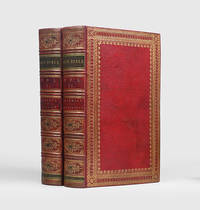
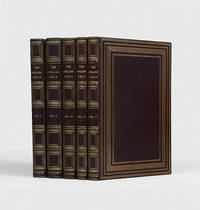
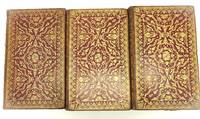
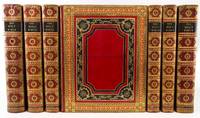
1800réf. ST20221aLondon: T. Bensley for T. Macklin final volume Bensley for T. Cadell & W. Davies 1800 for the six volumes of the Bible 1816 for the Apocrypha. First Printing of this Edition. 480 x 385 mm. 19 x 15 1/8". One leaf in the Apocrypha 3P2 comprising two prologues of Ecclesiasticus invisibly inserted from another copy. Seven volumes comprising the regular Bible in six volumes and the Apocrypha usually not included as a seventh volume. ABSOLUTELY MAGNIFICENT CONTEMPORARY RED NEOCLASSICAL-STYLE STRAIGHT-GRAIN MOROCCO SUMPTUOUSLY GILT AND ONLAID WITH BLUE BY GEORG FRIEDRICH KRAUSS done for Prince Albert Casimir Duke of Saxe-Teschen with repeated "AST" monogram covers with very elaborate frames incorporating 11 plain and decorative gilt rules four onlaid borders of blue morocco and very elegant swirling foliate ornamentation around the central scalloped panel six pairs of raised bands each pair flanking a recessed gilt and blue metope and pentaglyph rule very handsome spine compartments with blue fan-shaped cornerpieces and central gilt-decorated blue medallions within sunburst gilt collars turn-ins with Greek key pattern in gilt striking endleaves of turquoise and green watered silk the Apochrypha endleaves slightly different. With more than 100 allegorical headpieces and tailpieces and some 70 SPLENDID LARGE-FOLIO-SIZE COPPER PLATES after Fuseli Reynolds West and others most plates printed before letters. Tissue guards perhaps later. Herbert 1442 and 1651. First volume with about 30 leaves noticeably foxed the majority of plates offset onto previous and following pages consistent inoffensive offsetting of text on facing pages other trivial imperfections but still a very impressive copy internally with the luxurious paper used for the text both fresh and clean and the engravings richly impressed and with very little foxing. Some unimportant scuffing and rubbing to the leather but all defects minor THE MAGNIFICENT BINDINGS REMARKABLY WELL PRESERVED the heavy volumes completely solid with only insignificant signs of use and THE MOROCCO AND LAVISHLY GILT DECORATION EXTREMELY BRIGHT. AN ALTOGETHER MEMORABLE COPY. The most prodigious form of Scripture in English ever published the Macklin Bible was often put into ornate bindings especially by London binders like Staggemeier and his contemporaries. But however much other sets may glisten the present magnificent example surely stands at or near the front of the line as one of the most lavishly decorated and arresting copies in existence. Its decorative extravagance also testifies to the fact that Macklin's publication was sufficiently admired outside of England to warrant the finest workmanship and the expenditure of great sums of money on artistic resources. The very large and bold type the fine Whatman paper and the series of engravings by some of the most celebrated artists of the period make this an item that is already very desirable. Like the Boydell "Shakespeare Gallery" also printed by Bensley our Macklin Bible is a vast picture book with illustrations that are grand both in size and emotional impact. But it is of course the bindings here that matter the most. Francesco Piranesi is generally given credit for inventing the Neoclassical style when he designed volumes presented to Gustavus III of Sweden during this monarch's visit to Rome in 1783-84. Quickly popular the Neoclassical style was imitated and developed by Staggemeier & Welcher in London by F. W. Standlander in Stockholm and by Georg Friedrich Krauss in Vienna. Krauss was the most prominent Continental binder working in this style of the day and Saxe-Teschen was perhaps his most important client. Products of the Krauss bindery have passed through some of the most distinguished collections over the years particularly those of Fürstenberg and Schäfer; and his bindings have consistently brought remarkable sums of money at auction. It is sufficient to say that the present group of bindings represents the most impressive collection of decorative volumes we have ever offered for sale. The collector for whom these bindings were originally executed Duke Albert of Saxe-Teschen 1738-1822 was the son of Friedrich August II of Saxony and the son-in-law of the empress Maria Theresa. After providing important military and civil service to the Habsburg empire he retired to Vienna in 1795 and afterward devoted himself to the fine arts. He founded the Albertina which now houses the greatest collection of prints in the world and he put together a great library distinguished by the highest taste and most exacting standards. The present copy has the additional distinction of containing what amounts to an extra volume: the Macklin Bible however it is bound most often appears in the marketplace without the Apocrypha appearing here as Volume VII which was not issued until 16 years after the others. It is also of some interest that the bindings of our seven volumes were decorated in an entirely uniform fashion as a close inspection shows something not typical of a set with volumes published so many years apart. The non-uniform endleaves in the final volume here may have resulted from the fact that given the physical size of the books the binder simply ran out of the cloth he had used for lining the first six volumes. The present set was offered though unsold at Sotheby's in 2003 with an estimate of £40-50000 approximately $64000-80000 and in 2005 for £30-40000 approximately $54000-72000. T. Bensley for T. Macklin [final volume Bensley for T. Cadell & W. Davies] unknown books
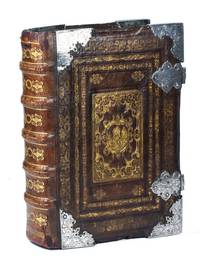
1590réf. A27E2B01U79ODelft: Bruyn Harmansz. Schinckel colophon: printed by Aelbrecht Heyndricksz. 1590. Contemporary gold panel-stamped and gold-tooled calf over wooden boards sewn on 5 supports with spectacular finely engraved silver furnishings: 8 corner pieces 2 clasps 2 catch plates and 2 anchor plates the catch and anchor plates with four female virtues: Justice/Justitia with sword and scales Faith/Fides praying toward the light of the sun Charity or Love/Caritas with 2 children and Hope/Spes holding a cross and treading on a snake; the corner pieces engraved with winged heads that appear to represent the four compass winds Boreas Notus Euros Zephyrus each of the 8 different also with engraved decoration on their edges; and each clasp with an oval martyrdom scene flanked by birds with the feet toward the foot of the book: 2 men tied to a tree and being stoned in the upper clasp and a women being accosted by 2 men in the lower all 14 pieces of silverwork with floral and other decoration and with their edges cut to decorative shapes. Each board has the same central rectangular panel-stamp 98 x 61 mm with an oval scene of Charity or Love/Caritas with 3 children and with castle towers in the background on either side that on the viewers right on a mountain with strapwork decoration around the oval containing the makers initials B and H and inside the rectangle the two decorations linked at the sides; with 2 gold-tooled double fleurs-de-lis above the panel-stamp and 2 below the whole enclosed by three gold-tooled frames each made with a different decorated roll separated by blind-tooled multiple fillets; gilt and elaborately gauffered edges. Rebacked in gold-tooled calf each compartment with a decorated oval with a decoration on either side but with the original endpapers. 4to 23.5 x 17.5 cm. With a general title page and three part-titles each with the same woodcut device oval Biblical emblem with a quotation from Matthew 13:44 a mirror image copy of that in the 1562 first edition in a separate elaborately decorated cartouche signed AvL the combination: Dutch printers devices 0671 p. 970; 3 engraved folding maps plate size 23.5 x 17 & 29.5 x 17 cm drawn by Petrus Plancius and executed by Baptista van Doetecum for the present Bible and the folio edition of the same year showing Eden the route of the Exodus and the Holy Land; ca. 20 woodcut illustrations in the text mostly about 4 x 5 cm but the largest 10 x 6 cm a woodcut arabesque tailpiece about 21 woodcut decorated initials 3 series plus more than 50 repeats. Printed mostly in 2 columns with shoulder notes set in textura gothic types with incidental roman and with diamond-head musical notes for the metrical Psalms and a small 3.2 mm vine-leaf ornament preceding many chapter headings not in Vervliet but similar to Vervliet 112 & 133. 4 parts in 1 volume. An unrecorded issue 1 of at least 7 of a rare and important 1590 Bible edition the corrected "deux aes" Bible based on the first edition of 1562 New Testament 1559 which remained the standard Dutch Reformed Bible until the official Dutch States translation published in 1637. It was translated from Luther's German by Godfried van Wingen the New Testament by Johannes Dyrkinus after comparison with several other versions and includes many notes some also taken from Luther and some by Augustin Marlorat as well as Petrus Danthenus's metric psalms with music notes. The Amsterdam bookseller Laurens Jacobsz. initiated the publication of the present corrected text of the "deus aes" Bible and the maps to accompany it publishing the folio edition with maps himself but sharing the quarto edition with four other publishers. Although Jacobsz.'s name does not appear in the present issue he was originally trained as a binder operated his shop at the sign of the gold-tooled Bible and Fontaine Verwey gives evidence to link him with the panel stamp on the present binding. He may therefore have bound copies or had them bound for the other publishers. Bibliasacra Typ. Batava and the STCN together record only 8 copies of all issues combined at least half of those lack leaves and some of the copies with all leaves have defective leaves or lack the maps so that they record at most 2 other complete copies with maps.With a few leaves slightly browned a water stain in the second half and the first preliminary quire of part 1 faint outside a few quires small tears in the maps and a few worm holes or other defects in the paper mostly in the margins of the last few leaves but still in good condition. The binding has been skilfully re-backed probably in the early 19th-century and is slightly rubbed with a crack along the edge of the panel-stamp on the front board and a few minor cuts and scrapes but also still in good condition and only slightly trimmed. A very rare complete copy of an important Dutch Reformed Bible in an unrecorded issue and in a stunning contemporary gold panel-stamped and gold-tooled binding with engraved silver furnishings.l www.bibliasacra.nl 1590.B.dut.BHS.c parts 1-3: 2 copies incl. 1 incomplete & AHa b & c parts 2-4: 3 incompl. copies; Höweler & Matter 1590b parts 2-4: 2 copies plus 1 copy of the psalms alone & cf. 1590c d f other issues of part 1; Le Long p. 748 parts 2-4 with other issue of part 1; Netherlandish books 3856 parts 1-3 citing TB & 3855 3857 3858 parts 2-4 citing TB; Poortman Bijbel en prent I pp. 112-119 184-187 & 215 parts 2-4 with other issues of part 1; Scheurleer supp. 3950 parts 2-4 with other issue of part 1; STCN 336510985 parts 1-3: 1 incomplete copy & 054873002 334453534 parts 2-4: 2 incomplete copies; Typ. Batava 602 parts 1-3: same 2 copies as bibliasacra & 601 605 606 parts 2-4: same 3 copies as bibliasacra; USTC 429308 parts 1-3 citing NB & 422871 422886 429309 parts 2-4 citing NB; cf. Darlow & Moule 3293 1562 ed. of deux aes Bible; Moes & Burger IV pp. 399-400 & nos. 459 1590 fol. ed. & 721 ; for the maps: New Hollstein Van Doetecum family IV 867-869; Poortman & Augusteijn chapter 18 maps 2 3 & 5; for the panel-stamp: H. de la Fontaine Verwey Amsterdamse uitgeversbanden van Cornelis Claes en Laurens Jacobsz in: Uit de wereld van het boek II pp. 33-48 at pp. 41-43. Bruyn Harmansz. Schinckel (colophon: printed by Aelbrecht Heyndricksz.), hardcover
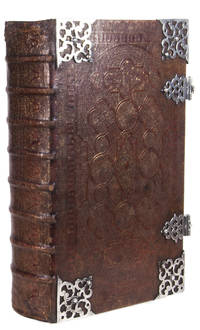
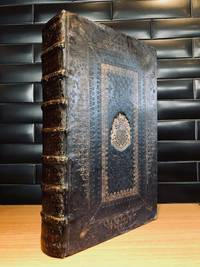
1663réf. ABC_48446Leiden 1663. Large folio 44.5 x 28 cm. widow and heirs of Johannes Elzevier Contemporary elaborately gold-tooled red morocco over bevelled wooden boards sewn on 8 supports with corresponding raised bands on the spine with grand silver fittings with the hallmarks of an unknown silversmith dated on the inside of one of the clasps "1665" gold-tooled board edges and turn-ins. Further with gilt painted and elaborately gauffered and decorated edges; the fore edge shows the coat-of-arms of Jeremias de Bont with some floral decorations these floral decorations can also be found on the top and bottom edges. The boards show a very intricate gold-tooled symmetric design of ribbons with small geometric stamps and with ornamental curling stamps - better known as "petit fers" - within the different parts of the bigger pattern. The binding contains 4 ornamental corner pieces on each board and two catch plates front board and two hinge plates back board connected by two decorated massive silver clasps engraved on the inside "Ieremias de Bont top and "1665" bottom. With 3 letterpress title-pages the first in red and black and each with the same Elzevier woodcut tree device with non solus a complete series of 6 double-page engraved maps the Nicolaes Visscher maps 5 published ca. 1657 and including the world map added ca. 1663 without the engraved title-page as usual. Further with numerous woodcut initials and tailpieces. 3 parts in 1 volume. 22 "368" = 370; 13 "167" = 168; 2 77 ll. The first Dutch "States Bible" to be printed in roman type printed by the famous Leiden printers publishers and booksellers Elzevier. The present copy in the splendid binding was made for a high official within the Dutch Republic Jeremias de Bont. His family's coat-of-arms can be found on the gauffered painted and gilt fore edge and Jeremias' name is engraved in the inside of the top silver clasp the bottom one shows a date "Anno 1665". The "States Bible" is the first officially authorized translation of the Bible into Dutch the Statenvertaling commissioned during the Synod of Dordrecht 1618-1619. The States General of the United Provinces of the Netherlands were asked to pay for it hence its name. The translation was completed in 1635 and approved authorized and published in 1637 in Leiden. For the present 1663 edition the Elzeviers followed the text of the 1657 revised and corrected edition. In a sense it could be seen as a revolutionary publication even though it still is an authorised version of the Bible; the present copy contains the live signature of a Leiden city clerk - as usual - to indicate its authorization. The decision to set the main text in roman type rather than the conventional gothic textura was unprecedented in such publications and not only contributed to the spread of roman type in Dutch-language printed matter generally works in Latin were often set in roman more than a century earlier but also contributed to the prolonged popularity of the authorised translation itself and of the present edition.The present copy is illustrated with 6 double-page maps published by Nicolaes Visscher; this series includes 5 maps of Jerusalem and the Holy Land published ca. 1657 and 1 world map published ca. 1663 as usual all in their first state.Jeremias de Bont -1687 was 17th-century politician in the Dutch Republic. He was a member of the "Vroedschap van Gorinchem" in/since 1674 city council of Gorinchem in the present-day province of South Holland burgomaster in Gorinchem in 1679 and 1681-1683 and member of the Dutch "Raad van State" Council of State of Holland on behalf of the city of Gorinchem.We thank dr. J. Storm van Leeuwen for his in-depth analysis of the present binding. Through his findings we know that the present binding is contemporary to the work 1663 and judging by the style of the decorations possibly produced by a German binder in the Netherlands Amsterdam or The Hague. In his research Storm van Leeuwen came across 3 other bindings in the same style and all produced around the 1660s. These bindings cannot be ascribed to a hitherto known 17th-century Dutch bindery thus - for ease of reference - Storm van Leeuwen named the bindery after the present binding: "De-Bont Binderij".With the signature of J. van der Werve a city clerk below the coat of arms of the city of Leiden on the verso of the first title-page below the privileges. The binding shows slight signs of wear browned and foxed throughout the edges are slightly dust-soiled but still showing the highly detailed decorations. Without the engraved title-page as usual. Otherwise in good condition a splendidly bound copy for Jeremias de Bont of the famous Elzevier Dutch States Bible.l Bijbel tentoonstelling statenvertaling Amsterdam 1937 105; Darlow & Moule II 3321; Delaveau & Hillard Bibles imprimées 1200; Le Long Boekzaal der Nederduytsche Bybel p. 821; STCN 840822693; Willems 884; for the maps: Poortman & Augusteijn Kaarten in Bijbels 27-pp. 179-185; for Jeremias de Bont and his positions within Gorinchem: C. van Zomeren Beschryvinge der stadt van Gorinchem en landen van Arkel Gorinchem Teunis Horneer 1755; for the De Bont family: De Nederlandsche Leeuw 40 1992 cols 121-122 "Bondt de". hardcover
1660réf. J6OH1B1XFXOGAmsterdam: widow of Paulus Aertsz. van Ravesteyn 1660. Later ca. 1800 blind-tooled calf sewn on 7 supports 3 cut flush with the bookblock each board with a small central flower in a double frame with corner diagonals made with 2 rolls and another flower inside each corner of the inner frame 2 pair of brass fastenings. Modern ca. 1900 endpapers. Large folio 45 x 30 cm. With an integral engraved general title-page architectural portico with a book above illuminated by the sun the crowned arms of the States General below and a large biblical scene at the foot: Elijah and the ravens alluding to Van Ravesteyn's name 2 letterpress title-pages for the New Testament and Apocrypha each with Van Ravesteyns woodcut device Elijah and the ravens a divisional title for the Prophets 6 double-page engraved maps by Nicolaas Visscher I including a world map and a plan of Jerusalem and 96 Bible illustrations 7 x 8.5 cm: 64 for the Old Testament and 32 for the New Testament published by Frederick de Wit engraved by Cornelis Danckerts after Matthäus Merian on 6 double-page plates plate size 28.5 x 38 cm with 16 illustrations per plate. Further with 9 woodcut tailpieces one at the end with a different Van Ravesteyn device inserted in the middle plus dozens of repeats about 50 woodcut decorated initials at least 8 series the 36 mm series opening most books of the Bible having 2 different blocks for at least some letters plus more than a hundred repeats. Set in textura types with incidental roman. The engraved title-page devices on the letterpress title-pages maps illustrations and many of the woodcut decorations and initials including all those on the back of the maps coloured by a contemporary hand with extensive use of gold. 3 parts in 1 volume. Extra-illustrated and hand-coloured large folio edition of the Dutch Statenbijbel States Bible the translation officially authorized by the Dutch Reformed Church and published with a privilege from the States General of the Dutch Republic. The 1619 Synod of Dordrecht established a committee to prepare the new translation and leading Dutch scholars worked on it for nearly twenty years before Paulus Aertsz. van Ravesteyn ca. 1586-1655 published the first edition in 1637. The 6 maps and the 96 engraved illustrations were produced for insertion in folio editions of the States Bible but in Van Ravesteyn's 1657 edition maps 2-6 by Nicolaas Visser I were originally accompanied by an older world map by his father Claes Jansz. Visser. The younger Visser's present new world map replaced it ca. 1663. De Wit's series of illustrations seems to be quite rare.With owners inscriptions. The tattered margins of the half-title and title-page were reinforced and extended with slips of paper at an early date there are tears repaired into two maps and one text leaf and other leaves have marginal defects some repaired. The paper shows some browning and foxing. Still generally in good condition and with large margins. The binding is scuffed but structurally sound and most of the tooling remains clear. A stunning large States Bible with 6 maps 96 illustrations and many decorations and initials coloured by a contemporary hand with extensive gold.l Poortman Bijbel en prent I p. 233 cf. pp. 147 151; cf. Darlow & Moule 3315; for the maps: Poortman & Augusteijn 27.1-6; for the prints: Poortman Bijbel en prent 30.A.3. widow of Paulus Aertsz. van Ravesteyn, unknown
1763réf. 184488Cambridge: printed by John Baskerville 1763. An outstanding synthesis of fine printing illustration and binding First Baskerville edition: a spectacular copy of one of the greatest English Bibles and a crowning achievement of English printing in a magnificent Staggemeier and Welcher binding and abundantly extra-illustrated with 287 Old Master engravings. The copy adorned two of the greatest book collections of the last two centuries: the library of the Dukes of Marlborough at Blenheim Palace and of Estelle Doheny in California. Friedrich Leberecht Staggemeier 1759-1827 was esteemed for his elaborately decorated neoclassical bindings. He partnered with Samuel Welcher from 1799 to 1810 and the pair catered to the highest echelons of the market. Extra-illustration was a distinguishing feature of this market: here 171 of the illustrations are from Bernard Picart and Gerard Hoet's Figures de la Bible The Hague 1728 and 58 are from Pierre Mortier's Bible Amsterdam and Antwerp 1700 while others are from Jan Luyken's Icones Biblica Veteris et N. Testamenti Amsterdam 1729 and other sources. The extravagant binding and extra-illustration were commissioned by the first owner the collector and scholar Jacob Bryant. In 1804 he bequeathed the Bible to his patron George Spencer 4th Duke of Marlborough. It remained in the duke's collection at Blenheim Palace until 1881 when it passed to Fanny Octavia Louisa daughter of the 7th duke. Her descendants sold the book and it passed via Dawson's Book Shop to Estelle Doheny one of the greatest collectors of the 20th century where it joined her Gutenberg Bible and other landmarks of printing history. She bequeathed it to St. John's Seminary which sold it and the rest of Doheny's collection in 1988 where it realized $11000. Bound in 2 vols large folio 518 x 343 mm pp. 1146. Extra-illustrated with 287 Old Master engravings of which 198 are single page and 84 double each mounted mostly within a black ink and pale yellow wash frame. Late 18th- or early 19th-century red straight-grain morocco by L. Staggemeier & Welcher of London binder's ticket green morocco labels richly gilt in compartments wide gilt borders to covers gilt Greek-key turn-ins green watered-silk linings with gilt grapevine borders all edges gilt. Joints and extremities restored scattered light offsetting from plates and foxing else contents fresh very minor worming to front endpapers of first volume: a beautiful copy. ESTC T93106; Gaskell 26; Herbert 1146. unknown
1660réf. 4440Cambridge: Printed by John Field Printer to the Universitie 1660 1660. First Ogilby edition 2 works; 2 vols; large folio 51 x 34.5 cm; 110 double-page engraved plates including a large double-folding plan of Jerusalem captions in Latin some masked at time of printing engraved general title New Testament title dated 1659 ruled in red throughout wide margined on thick paper armorial bookplate to front pastedown of each vol. ownership inscription in pencil to front free endpaper a few tears mostly affecting margins 4N2 verso stained minor colour-run from fore-edge throughout some minor offsetting and ink smudges prelims a little spotted otherwise internally very clean; near-contemporary straight-grained red morocco armorial device supralibros to upper boards obscured by later blue morocco panel set within gilt meander border gilt spine in 8 compartments alternating lettering and cross-hatch design all edges gilt over earlier fore-edge painting of meandering vines joints and corners expertly restored; 140 16 806; 2 807-1103 1 258 4 338pp. Herbert 668; ESTC R17044; Wing B2258; Lowndes 1367; Griffiths 8. An exceptional well-margined copy of John Ogilby's imaginative reissue of the Field large folio bible published for the Restoration of King Charles II on 29th May 1660. Magnificently illustrated with 110 double-page engraved plates of biblical scenes after paintings by Rubens Tintoretto de Vos de Bruyn and other old masters including Wenceslaus Hollar's impressive double-folding-page view of Jerusalem his Chorographica Terra Sanctae of the Holy Lands and the engraved general title by Lombart after Diepenbeeck depicting Solomon enthroned. The work was originally illustrated with just 8 plates by Lombart and Hollar which had been intended for the London Polyglot bible published in 1657 but Ogilby soon offered the option of embellishing the work with a choice of engravings from the Amsterdam publisher Nicolaes Visscher. The number of plates is known to vary but ESTC calls for a total of 102 only. The text was first published the previous year by John Field printer to the University of Cambridge who had been commissioned to supply a lectern bible for use in churches and libraries. The work was well-received with the former university Vice-Chancellor John Worthington noting that 'For a fair large letter large paper with fair margin &c. there was never such a Bible in being'. In the event however most of the edition was bought-up by Ogilby for his own project. Variously called 'Ogilby's Bible' or 'The Restoration Bible' the result was a truly luxurious production with well-margined copies such as this costing upwards of £25 in sheets alone. The finished work was presented to Charles II to whom the work is dedicated when the restored monarch first visited the Royal Chapel in Whitehall. An 'unrivalled specimen of the press of the time' the finest edition of the Holy Bible then extant Lowndes. Provenance: Sir William Halsey Gaddesden Library bookplate and ownership inscription. Cambridge: Printed by John Field, Printer to the Universitie 1660 hardcover
1627réf. 18927Frankfurt: Matthaeus Merian 1627. First edition. Hardcover. Very good. Matthaeus Merian. Oblong folio leaves: 20.6 by 31.2 cm; plates: 10 to 11.5 by 14.5 to 15.5 cm. Engraved titlepage borders without letterpress; 231 of 233 engraved plates printed on the rectos with no printed text depicting biblical scenes from the Old and New Testaments lacks Gen. XIX: Lot and his daughters after the destruction of Sodom and Gomorrah; Exod. VIII & IX: The plague of frogs. Recent marbled calf lightly rubbed at extremities bordered in blind; gilt-tooled spine with raised bands gilt lettering pieces. Occasional light stains and smudges especially at the outermost leaves and almost entirely restricted to the blank margins; old mostly marginal repairs and reinforcement of tears to about 30 leaves Matt. IV plate with loss of about 10 words of manuscript text. Protected by wide margins the plates are clean fresh and bright with relatively few minor blemishes. Housed and protected in a custom luxurious modern leather clamshell box. Rare suite of biblical illustrations printed before letter perhaps as proofs comprising 231 of 233 engraved plates from the Icones Biblicae of Matthaeus Merian the elder 1593-1650. The engravings are printed on large paper and lack any printed text. They are preceded by a leaf of the engraved title borders to the first part in which the central cartouche which would have contained a letterpress title and imprint is here blank. Neat manuscript annotations appear throughout: atop each engraving is a brief title along with a notation of the biblical book and chapters; beneath each engraving are six-lines of rhyming verse in German; at the top corners are leaf numbers in Arabic numerals. All are penned in black ink in the same old cursive German hand. The engraved title leaf is not included in the manuscript foliation. The first three leaf numbers and several others among the first 23 leaves are obscured by wear or later marginal repairs. The foliation ends at leaf 233 and is discontinuous where one would expect to find numbers 15 and 38 corresponding to the missing plates noted above. As noted by Wütrich only four of the 233 plates are signed by Merian all in the New Testament series. Each of these signed plates appears in our suite: Matthaei I. - page 7; Johannis VIII. - page 65; Matthaei XXVII. - page 101; Apocalyps. IX. - page 145 header titles and page numbers from the first edition. The first editions were published at Frankfurt in four parts between 1625 and 1627. The Pentateuch series was published in 1625. The second part illustrating the Old Testament books from Joshua to Kings appeared in 1626. These first two series were published under the name of Merian's father-in-law the printer and bookseller Johann Theodor de Bry 1561-1623 whose heirs retained title to the business. The third part illustrates the remainder of the Old Testament and Apocrypha; the fourth the New Testament. These last two parts were published in 1627 under the engravers's own name. Verses in Latin German and French accompany each plate in the three Old Testament series the French verses being omitted in the 1627 New Testament series. While the eminent Swiss draughtsman and engraver Matthaeus Merian is best known for his topographical depictions of the German speaking lands which appeared in the Theatrum Europaeum his novel selection of biblical stories and innovative stylistic approach revealed in the present series of plates proved highly influential ushering in a new age of copperplate engraving in Bible illustration. Merian broke with the century-long tradition of woodcuts which had accompanied countless editions of Luther's German Bible. Even as he drew on the Bible illustrations of Jost Amman Hans Holbein Virgil Solis and Tobias Stimmer Merian greatly expanded the traditional iconographic and compositional repertoire. The Old Testament alone contains 23 prints depicting stories that had never before been the subject of an engraver. While earlier New Testament woodcuts focused on the Book of Revelation Merian now provided a rich series of plates to illustrate the Gospels and Acts of the Apostles as well. Merian had an obvious preference for crowd scenes and battles along with some of the novelistic features of the Old Testament such as Jacob's lentil dish Solomon and Shulamit in the Song of Songs or the apocryphal story of the Dragon in Babylon. Merian sometimes provides local color from his home town of Basel as in his depiction of Solomon's Temple Consecration in which despite the baroque redesign the Basel Cathedral with the old choir is easily recognizable. The costumes and gestures of Merian's biblical characters display a baroque fantasy of the ancient Near East as reflected in the theater of his day; in depicting cities and buildings however Merian generally prefers to follow contemporary models. In individual cases such as Bathsheba's Bath he succumbed to the temptation as an engraver and artist to show off his skills in a magnificent fashionable palace and garden complex. All-in-all Merian's engravings initiated a development in Bible illustration "that led further and further away from the didactic Reformation purpose of Bible pictures to purely artistic-representational purposes and finally ended in the well-known pathos of the German Romantic Nazarenes" Schmidt. In the first few decades after their appearance these Bible plates were widely copied throughout Europe especially in the Netherlands and France Poortman. The first folio Bible to use Merian's copper plates to illustrate the text was published by the heirs of Lazarus Zetzner at Strasbourg in 1630. Subsequent editions of the "Merian Bible" were published at Frankfurt where Merian had taken over his father-in-law Johann de Bry's business. For over a century as Merian's heirs continued to publish new editions this would become "the most widespread German illustrated Bible in southern Germany Basel and Alsace primarily in wealthy households" Schmidt. After the demise of the Merian publishing house in 1727 the bookseller Philip Heinrich Hütter acquired the copper plates which he used to illustrate a Catholic Bible edition published at Frankfurt in 1740 Poortman. A very notable instance of transposing Merian's biblical engravings into another context occurs in the famous and oft-reprinted Amsterdam Haggadah the ritual for the Jewish Passover meal first published in 1695. The engravings were made by Abraham ben Jacob a former Protestant preacher who converted to Judaism. Introducing skills he had earlier acquired when working outside the Jewish community Abraham ben Jacob "widened the scope of Jewish book illustration" Rosenau and introduced new elements into the traditional iconography of the Haggadah. "He chose many of the same incidental scenes as had appeared in the Venice Haggadot 1599-1604 but he drew them afresh basing his work on the biblical pictures in the Icones Biblicae by Matthew Merian" EJ. Among them was the image of the Temple of Solomon in Jerusalem. As Merian used a wide variety of prototypes Rosenau suggests that the two free-standing columns Jachin and Boaz depicted at the front porch of the Temple in Merian's engraving and Abraham ben Jacob's adaptation may have ultimately been derived from the woodcuts which accompany Estienne's Bible Paris 1540 based upon the scholarship of Franciscus Vatablus. In Das druckgraphische Werk von Matthaeus Merian d. Ae. 1993 L. H. Wüthrich describes a "Spezialausgabe ohne Drucktext" complete with 233 biblical engravings located in Darmstadt at the Hessische Landesbibliothek 31/643. This "separate edition without text or a series of proofs" which he describes has three notable features: 1 an undated first edition title page of the second part Pars II of the Old Testament which has been "corrected. by crossing out or shaving" to read "Pars I"; 2 the first edition title page of the New Testament series dated 1627; 3 an engraving of the The Fall of Man probably after Johann Theodor de Bry which later appears in Gottfried's Chronicle part 1 1629/1630 but which differs from that found in most copies of the first edition Wütrich 1a. The copies containing this plate after de Bry Wütrich 1aa. were likely printed in 1626. Further research perhaps locates only one other suite of Merian plates without text at the Herzog August Bibliothek Wolfenbüttel catalogued under two call numbers: the Old Testament series dated 1626-1627 comprising 157 leaves including an engraved title A: 30.1 Geom. 2 "Ausg. ohne Text von Ps. 1 und 2." = VD17 23:289608V and the New Testament series dated 1627 comprising 78 leaves including an engraved title A: 30.1 Geom. 3 "Ausg. ohne Text" = VD17 23:655618H. The catalogue entry for the Old Testament series references Wütrich's "Spezialausgabe ohne Drucktext." Surprisingly the key images provided for this entry illustrate the same three notable features of the "Spezialiausgabe" which Wütrich located at Darmstadt !. Our suite of plates is provided with a single blank engraved title leaf the one used for the first series of the Old Testament plates which lacks any letterpress. The third plate which depicts the Fall of Man is here in Merian's style and is the image more commonly found in the first printings Wütrich 1a. In the first edition of the Icones Biblicae the title page notes "Mit Versen und Reymen in dreien Sprachen geziert und erkläret Durch Johann Ludwig Gottfried" decorated and described with verses and rhymes in three languages by Johann Ludwig Gottfried. In the first three parts of Icones Biblicae Gottfried's German verses are in four lines with a rhyme scheme of ABBA. In the fourth part the New Testament the German verses are modified to six lines with a rhyme scheme of AABCCB. The manuscript verses in German which accompany each of the 231 plates in our suite differ from both of these formats being composed in six lines of iambic hexameter with a rhyme scheme of ABABCC. To give a sense of how these versions differ the four lines of the German printed verses which accompany the first plate The Creation may be compared with the following transcript of the written verses which describe this scene in our set. in the first edition of Merian's Bilderbibel Im Anfang Gott Erschuff den Himmel und die Erden Die Wasser und das Meer das Liecht der Sternenschein Die Vögel Fisch Gewürm alle Thier groß und klein Warauß sein Gütigkeit und Kraft erkant mag werden. the hand of anonymous versifier Im Anfang schuff der Herr den Himmel und die Erden Das Licht die Sonn den Mond die Sternen und das Meer Gras Bäume Laub und Kraut und was genannt mag werden Von Thieren Vögel Fisch in ihrem grosen Heer Nur durch ein einig Wort: Ich kan hieraus erkennen O Gott! dein ew'ge Krafft und dich den Schöpffer nennen. Watermark: flambeau surrounded by garland Provenance: laid-in typed description on a half-sheet bearing the early twentieth-century letterhead of Harry A. Levinson Rare Books: "There appears to be no record of another such copy of proofs before letter." References: L. H. Wüthrich Das druckgraphische Werk von Mattaeus Merian d. Ae. Basel: Bärenreiter 1993 vol. 3 p.16: "Spezialausgabe ohne Drucktext;" Enc. Jud. 2nd ed. 8:215; W. C. Poortman Bijbel en Prent 's-Gravenhage 1986 2:56-59; H. Rosenau Vision of the Temple London: Oresko 1979 pp. 135; 146f. Ph. Schmidt Die Illustration der Lutherbibel Birsfelden/Basel 1977 pp. 304-329; VD17 23:289608V and 23:655618H. [Matthaeus Merian] hardcover
1627réf. 18927Frankfurt: Matthaeus Merian 1627. First edition. Hardcover. Very good. Matthaeus Merian. Oblong folio leaves: 20.6 by 31.2 cm; plates: 10 to 11.5 by 14.5 to 15.5 cm. Engraved titlepage borders without letterpress; 231 of 233 engraved plates printed on the rectos with no printed text depicting biblical scenes from the Old and New Testaments lacks Gen. XIX: Lot and his daughters after the destruction of Sodom and Gomorrah; Exod. VIII & IX: The plague of frogs. Recent marbled calf lightly rubbed at extremities bordered in blind; gilt-tooled spine with raised bands gilt lettering pieces. Occasional light stains and smudges especially at the outermost leaves and almost entirely restricted to the blank margins; old mostly marginal repairs and reinforcement of tears to about 30 leaves Matt. IV plate with loss of about 10 words of manuscript text. Protected by wide margins the plates are clean fresh and bright with relatively few minor blemishes. Housed and protected in a custom luxurious modern leather clamshell box. Rare suite of biblical illustrations printed before letter perhaps as proofs comprising 231 of 233 engraved plates from the Icones Biblicae of Matthaeus Merian the elder 1593-1650. The engravings are printed on large paper and lack any printed text. They are preceded by a leaf of the engraved title borders to the first part in which the central cartouche which would have contained a letterpress title and imprint is here blank. Neat manuscript annotations appear throughout: atop each engraving is a brief title along with a notation of the biblical book and chapters; beneath each engraving are six-lines of rhyming verse in German; at the top corners are leaf numbers in Arabic numerals. All are penned in black ink in the same old cursive German hand. The engraved title leaf is not included in the manuscript foliation. The first three leaf numbers and several others among the first 23 leaves are obscured by wear or later marginal repairs. The foliation ends at leaf 233 and is discontinuous where one would expect to find numbers 15 and 38 corresponding to the missing plates noted above. As noted by Wütrich only four of the 233 plates are signed by Merian all in the New Testament series. Each of these signed plates appears in our suite: Matthaei I. - page 7; Johannis VIII. - page 65; Matthaei XXVII. - page 101; Apocalyps. IX. - page 145 header titles and page numbers from the first edition. The first editions were published at Frankfurt in four parts between 1625 and 1627. The Pentateuch series was published in 1625. The second part illustrating the Old Testament books from Joshua to Kings appeared in 1626. These first two series were published under the name of Merian's father-in-law the printer and bookseller Johann Theodor de Bry 1561-1623 whose heirs retained title to the business. The third part illustrates the remainder of the Old Testament and Apocrypha; the fourth the New Testament. These last two parts were published in 1627 under the engravers's own name. Verses in Latin German and French accompany each plate in the three Old Testament series the French verses being omitted in the 1627 New Testament series. While the eminent Swiss draughtsman and engraver Matthaeus Merian is best known for his topographical depictions of the German speaking lands which appeared in the Theatrum Europaeum his novel selection of biblical stories and innovative stylistic approach revealed in the present series of plates proved highly influential ushering in a new age of copperplate engraving in Bible illustration. Merian broke with the century-long tradition of woodcuts which had accompanied countless editions of Luther's German Bible. Even as he drew on the Bible illustrations of Jost Amman Hans Holbein Virgil Solis and Tobias Stimmer Merian greatly expanded the traditional iconographic and compositional repertoire. The Old Testament alone contains 23 prints depicting stories that had never before been the subject of an engraver. While earlier New Testament woodcuts focused on the Book of Revelation Merian now provided a rich series of plates to illustrate the Gospels and Acts of the Apostles as well. Merian had an obvious preference for crowd scenes and battles along with some of the novelistic features of the Old Testament such as Jacob's lentil dish Solomon and Shulamit in the Song of Songs or the apocryphal story of the Dragon in Babylon. Merian sometimes provides local color from his home town of Basel as in his depiction of Solomon's Temple Consecration in which despite the baroque redesign the Basel Cathedral with the old choir is easily recognizable. The costumes and gestures of Merian's biblical characters display a baroque fantasy of the ancient Near East as reflected in the theater of his day; in depicting cities and buildings however Merian generally prefers to follow contemporary models. In individual cases such as Bathsheba's Bath he succumbed to the temptation as an engraver and artist to show off his skills in a magnificent fashionable palace and garden complex. All-in-all Merian's engravings initiated a development in Bible illustration "that led further and further away from the didactic Reformation purpose of Bible pictures to purely artistic-representational purposes and finally ended in the well-known pathos of the German Romantic Nazarenes" Schmidt. In the first few decades after their appearance these Bible plates were widely copied throughout Europe especially in the Netherlands and France Poortman. The first folio Bible to use Merian's copper plates to illustrate the text was published by the heirs of Lazarus Zetzner at Strasbourg in 1630. Subsequent editions of the "Merian Bible" were published at Frankfurt where Merian had taken over his father-in-law Johann de Bry's business. For over a century as Merian's heirs continued to publish new editions this would become "the most widespread German illustrated Bible in southern Germany Basel and Alsace primarily in wealthy households" Schmidt. After the demise of the Merian publishing house in 1727 the bookseller Philip Heinrich Hütter acquired the copper plates which he used to illustrate a Catholic Bible edition published at Frankfurt in 1740 Poortman. A very notable instance of transposing Merian's biblical engravings into another context occurs in the famous and oft-reprinted Amsterdam Haggadah the ritual for the Jewish Passover meal first published in 1695. The engravings were made by Abraham ben Jacob a former Protestant preacher who converted to Judaism. Introducing skills he had earlier acquired when working outside the Jewish community Abraham ben Jacob "widened the scope of Jewish book illustration" Rosenau and introduced new elements into the traditional iconography of the Haggadah. "He chose many of the same incidental scenes as had appeared in the Venice Haggadot 1599-1604 but he drew them afresh basing his work on the biblical pictures in the Icones Biblicae by Matthew Merian" EJ. Among them was the image of the Temple of Solomon in Jerusalem. As Merian used a wide variety of prototypes Rosenau suggests that the two free-standing columns Jachin and Boaz depicted at the front porch of the Temple in Merian's engraving and Abraham ben Jacob's adaptation may have ultimately been derived from the woodcuts which accompany Estienne's Bible Paris 1540 based upon the scholarship of Franciscus Vatablus. In Das druckgraphische Werk von Matthaeus Merian d. Ae. 1993 L. H. Wüthrich describes a "Spezialausgabe ohne Drucktext" complete with 233 biblical engravings located in Darmstadt at the Hessische Landesbibliothek 31/643. This "separate edition without text or a series of proofs" which he describes has three notable features: 1 an undated first edition title page of the second part Pars II of the Old Testament which has been "corrected. by crossing out or shaving" to read "Pars I"; 2 the first edition title page of the New Testament series dated 1627; 3 an engraving of the The Fall of Man probably after Johann Theodor de Bry which later appears in Gottfried's Chronicle part 1 1629/1630 but which differs from that found in most copies of the first edition Wütrich 1a. The copies containing this plate after de Bry Wütrich 1aa. were likely printed in 1626. Further research perhaps locates only one other suite of Merian plates without text at the Herzog August Bibliothek Wolfenbüttel catalogued under two call numbers: the Old Testament series dated 1626-1627 comprising 157 leaves including an engraved title A: 30.1 Geom. 2 "Ausg. ohne Text von Ps. 1 und 2." = VD17 23:289608V and the New Testament series dated 1627 comprising 78 leaves including an engraved title A: 30.1 Geom. 3 "Ausg. ohne Text" = VD17 23:655618H. The catalogue entry for the Old Testament series references Wütrich's "Spezialausgabe ohne Drucktext." Surprisingly the key images provided for this entry illustrate the same three notable features of the "Spezialiausgabe" which Wütrich located at Darmstadt !. Our suite of plates is provided with a single blank engraved title leaf the one used for the first series of the Old Testament plates which lacks any letterpress. The third plate which depicts the Fall of Man is here in Merian's style and is the image more commonly found in the first printings Wütrich 1a. In the first edition of the Icones Biblicae the title page notes "Mit Versen und Reymen in dreien Sprachen geziert und erkläret Durch Johann Ludwig Gottfried" decorated and described with verses and rhymes in three languages by Johann Ludwig Gottfried. In the first three parts of Icones Biblicae Gottfried's German verses are in four lines with a rhyme scheme of ABBA. In the fourth part the New Testament the German verses are modified to six lines with a rhyme scheme of AABCCB. The manuscript verses in German which accompany each of the 231 plates in our suite differ from both of these formats being composed in six lines of iambic hexameter with a rhyme scheme of ABABCC. To give a sense of how these versions differ the four lines of the German printed verses which accompany the first plate The Creation may be compared with the following transcript of the written verses which describe this scene in our set. in the first edition of Merian's Bilderbibel Im Anfang Gott Erschuff den Himmel und die Erden Die Wasser und das Meer das Liecht der Sternenschein Die Vögel Fisch Gewürm alle Thier groß und klein Warauß sein Gütigkeit und Kraft erkant mag werden. the hand of anonymous versifier Im Anfang schuff der Herr den Himmel und die Erden Das Licht die Sonn den Mond die Sternen und das Meer Gras Bäume Laub und Kraut und was genannt mag werden Von Thieren Vögel Fisch in ihrem grosen Heer Nur durch ein einig Wort: Ich kan hieraus erkennen O Gott! dein ew'ge Krafft und dich den Schöpffer nennen. Watermark: flambeau surrounded by garland Provenance: laid-in typed description on a half-sheet bearing the early twentieth-century letterhead of Harry A. Levinson Rare Books: "There appears to be no record of another such copy of proofs before letter." References: L. H. Wüthrich Das druckgraphische Werk von Mattaeus Merian d. Ae. Basel: Bärenreiter 1993 vol. 3 p.16: "Spezialausgabe ohne Drucktext;" Enc. Jud. 2nd ed. 8:215; W. C. Poortman Bijbel en Prent 's-Gravenhage 1986 2:56-59; H. Rosenau Vision of the Temple London: Oresko 1979 pp. 135; 146f. Ph. Schmidt Die Illustration der Lutherbibel Birsfelden/Basel 1977 pp. 304-329; VD17 23:289608V and 23:655618H. [Matthaeus Merian] hardcover books
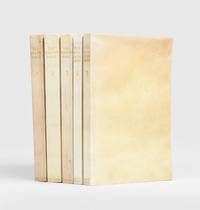
1903réf. 193657Hammersmith: The Doves Press 1903-05. With provenance tied to Citizen Kane The Doves Bible the finest output of the press and among the finest achievements of typography one of 500 sets on handmade paper. This is the copy of Hearst Cartle the residence satirized as Xanadu in Citizen Kane 1941. Its owner the newspaper magnate William Randolph Hearst provided Orson Welles with the model for Charles Foster Kane. Situated in San Simeon California the castle was constructed from 1919 to 1947 in collaboration between Hearst 1863-1951 and the architect Julia Morgan. Welles's unflattering portrayal of Hearst provoked attempts to sabotage the film explored in the documentary The Battle Over Citizen Kane 1996. This set appeared in the sale of Hearst's library through Parke Benet in 1938. The shelf labels of Hearst Castle appear on the rear free endpapers recto. In contrast to Hearst's opulence this binding presents a restrained aesthetic entirely appropriate for the Doves Bible reserving more ornate decoration for the doublures. The binder Henry Stikeman trained under the renowned American bookbinder William Matthews and soon himself rose to pre-eminence in the last decades of the 19th century. Much of the Stikeman bindery's production was for high-end publisher's sets and in later years he established his trade bindery in New York. "The Doves Bible and the Kelmscott Chaucer stand side by side upon the highest peak of typographical accomplishment utterly dissimilar yet with the same element of greatness incontestable. The great red initial 'I' that dominates and yet fits exactly the opening page of Genesis in the Doves Bible is a pattern for all time of complexity reduced to the minimum of simplicity. When it is said that they approach dangerously near to absolute perfection everything has been said" Ransom. Tidcombe notes that foxing appears on the sheets of early volumes of the Bible "although fortunately not the opening page". Cobden-Sanderson was asked about this condition issue in 1920 and noted that it was "due to a misadventure in the drying of the sheets long ago when the Bible was being printed" cited in Tidcombe p. 45. 5 vols quarto 331 x 228 mm. Doves type printed in black with red initials by Edward Johnston on handmade paper. Bound without publisher's 6 blank leaves at front of vols 3-4 and end of vol. 5. Near-contemporary dark red morocco by Stikeman & Co. New York spines lettered in gilt raised bands with gilt dotted roll and foliate finials concentric gilt frames thickly bordering compartments and covers gilt rule to board edges gilt rules and floral roll to turn-ins dark blue morocco doublures with fillet and floral panels incorporating onlaid petals in red and green red silk moiré free endpapers top edges gilt others trimmed. Bindings bright couple of gentle surface scratches to covers a few marks to fore edges foxing to initial leaves of vol. 1 as usual see note occasional light foxing elsewhere mostly marginal. A near-fine set. Ransom p. 56; Tidcombe DP6. hardcover
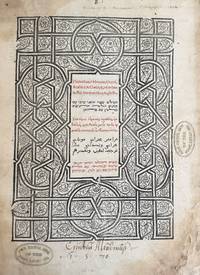
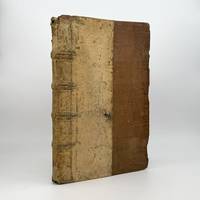
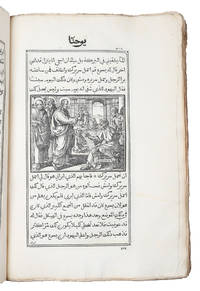
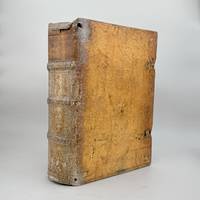
1516réf. 371021Genoa: Petrus Paulus Porrus 1516. Title printed in red and black within woodcut arabesque border printer's device on final leaf. Parallel text in Hebrew Latin Greek Arabic and Chaldaean Aramaic 4 columns to a page 41 lines. 13 woodcut floriated initials. A10 B-Z8 &8 con6; 200 leaves complete. Folio 13-1/8 x 9-3/8 inches. Contemporary blind tooled pigskin over bevelled wooden boards boards with repeated roll of hound hunter and stag spine with floral tools. Clasps perished early repairs with vellum at lower corners; spine darkened with chip at foot joint starting wormholes to the covers. Toning throughout worm holes throughout but heavier to the preliminary and terminal leaves paper loss not affecting text at the lower outer corners of the first 3 leaves minor dampstaining at the lower corners of most leaves and extending from the top inner margin. Scattered early marginalia. Title printed in red and black within woodcut arabesque border printer's device on final leaf. Parallel text in Hebrew Latin Greek Arabic and Chaldaean Aramaic 4 columns to a page 41 lines. 13 woodcut floriated initials. A10 B-Z8 &8 con6; 200 leaves complete. Folio 13-1/8 x 9-3/8 inches. The Genoa Psalter also known as the Octaplum or Quadruplex Psalter was the first polyglot psalter to be published and the first polyglot edition of any part of the Bible. Financed by the Oriental language scholar Bishop Agostino Giustiniani and printed in Genoa in 1516 it presents the psalms laid out in eight columns i.e. four per page on double-page spreads: in Hebrew a Latin paraphrase the Vulgate Latin the Septuagint Greek Arabic Chaldean Aramaic a Latin paraphrase and the editor's notes. "A monument of Renaissance typography this Psalter was linguistically the most ambitious work attempted to date and the first Polyglot work ever published. It provides the Psalms in five languages as well as a marginal scholarship based largely on rabbinic sources. The Arabic text is one of the first two texts and the first biblical text ever printed in this language. The Hebrew types used in this book were apparently never used again" B. Sabin Hill Hebraica from the Valmadonna Trust The Piermont Morgan Library 1989 no. 18. Notably within a lengthy editor's note to Psalm XIX is what is considered the first printed biography of Christopher Columbus along with a very early description of his voyage. A native son of Genoa Giustiniani presents the discovery of the new world as a fulfilment of Biblical prophecy appropriately glossing verse four of Psalm XIX to include his biography of Columbus: "Their sound is gone out through all the earth and their words to the end of the world." The text of the biography of Columbus written a decade after his death includes a brief account of his childhood and continues at length on his discovery of America. Translated from the Latin it begins: "And so their words have reached unto the ends of the earth at least in our own times in which by the marvelous daring of Christopher Columbus of Genoa almost another world was discovered and joined to the community of Christians. And since Columbus often declared that he was chosen by God so that through him this prophecy would be fulfilled I did not consider it unsuitable to include his life here. Therefore Christopher surnamed Columbus a Genoese by birth . lived in our age and through his own efforts explored more lands and seas in a few months than almost all other mortals had done throughout all previous ages . More swiftly than the Portuguese had done he approached new lands and new peoples and at last penetrated regions unknown before now. The news of this matter quickly reached the King who - both out of rivalry with the Portuguese kings and a desire for such new marvels and glory that might accrue to him and his descendants - after long discussions with Columbus finally ordered two ships to be outfitted. With these Columbus set sail from the Fortunate Islands directing his course slightly off the western line . After many days of sailing they had covered great distances. While the others having lost all hope urged a change in course Columbus persisted asserting by reason and conjecture that continuing but a little longer might lead them to discover continents or islands. Nor was he wrong. On the following dawn they sighted land. From this event immense confidence arose in human minds. Later it was learned that these were islands and observations were made of certain peoples there uncultivated and prone to raids on their neighbors even devouring human flesh like wolves. There were violent encounters yet eventually some of these islanders were brought safely to Spain astonishing and delighting all who saw them because they were at first timid unfamiliar with approach easy to persuade and marveling at everything as new." An important and desirable work from a liturgical linguistic and historical perspective. Adams B1370; BM STC Italian p. 97; Darlow & Moule 1411; Sabin 66468; European Americana 516/4; Harrisse BAV 88; JCB 3 I:64; Smitskamp 236; Roper Early Arabic Printing in Europe in Sprachen des Nahen Ostens und die Druckrevolution p. 132; Vinograd Genoa 1. Provenance: Cenobii Alois 1570 inscription below title; Bibliotheca Regia Monacensi pencil inscription on the inside front board identifying it as a duplicate; General Theological Seminary ink and blindstamps and other markings Petrus Paulus Porrus unknown
1516réf. 371021Genoa: Petrus Paulus Porrus 1516. Title printed in red and black within woodcut arabesque border printer's device on final leaf. Parallel text in Hebrew Latin Greek Arabic and Chaldaean Aramaic 4 columns to a page 41 lines. 13 woodcut floriated initials. A10 B-Z8 &8 con6; 200 leaves complete. Folio 13-1/8 x 9-3/8 inches. Contemporary blind tooled pigskin over bevelled wooden boards boards with repeated roll of hound hunter and stag spine with floral tools. Clasps perished early repairs with vellum at lower corners; spine darkened with chip at foot joint starting wormholes to the covers. Toning throughout worm holes throughout but heavier to the preliminary and terminal leaves paper loss not affecting text at the lower outer corners of the first 3 leaves minor dampstaining at the lower corners of most leaves and extending from the top inner margin. Scattered early marginalia. Title printed in red and black within woodcut arabesque border printer's device on final leaf. Parallel text in Hebrew Latin Greek Arabic and Chaldaean Aramaic 4 columns to a page 41 lines. 13 woodcut floriated initials. A10 B-Z8 &8 con6; 200 leaves complete. Folio 13-1/8 x 9-3/8 inches. The Genoa Psalter also known as the Octaplum or Quadruplex Psalter was the first polyglot psalter to be published and the first polyglot edition of any part of the Bible. Financed by the Oriental language scholar Bishop Agostino Giustiniani and printed in Genoa in 1516 it presents the psalms laid out in eight columns i.e. four per page on double-page spreads: in Hebrew a Latin paraphrase the Vulgate Latin the Septuagint Greek Arabic Chaldean Aramaic a Latin paraphrase and the editor's notes. "A monument of Renaissance typography this Psalter was linguistically the most ambitious work attempted to date and the first Polyglot work ever published. It provides the Psalms in five languages as well as a marginal scholarship based largely on rabbinic sources. The Arabic text is one of the first two texts and the first biblical text ever printed in this language. The Hebrew types used in this book were apparently never used again" B. Sabin Hill Hebraica from the Valmadonna Trust The Piermont Morgan Library 1989 no. 18. Notably within a lengthy editor's note to Psalm XIX is what is considered the first printed biography of Christopher Columbus along with a very early description of his voyage. A native son of Genoa Giustiniani presents the discovery of the new world as a fulfilment of Biblical prophecy appropriately glossing verse four of Psalm XIX to include his biography of Columbus: "Their sound is gone out through all the earth and their words to the end of the world." The text of the biography of Columbus written a decade after his death includes a brief account of his childhood and continues at length on his discovery of America. Translated from the Latin it begins: "And so their words have reached unto the ends of the earth at least in our own times in which by the marvelous daring of Christopher Columbus of Genoa almost another world was discovered and joined to the community of Christians. And since Columbus often declared that he was chosen by God so that through him this prophecy would be fulfilled I did not consider it unsuitable to include his life here. Therefore Christopher surnamed Columbus a Genoese by birth . lived in our age and through his own efforts explored more lands and seas in a few months than almost all other mortals had done throughout all previous ages . More swiftly than the Portuguese had done he approached new lands and new peoples and at last penetrated regions unknown before now. The news of this matter quickly reached the King who - both out of rivalry with the Portuguese kings and a desire for such new marvels and glory that might accrue to him and his descendants - after long discussions with Columbus finally ordered two ships to be outfitted. With these Columbus set sail from the Fortunate Islands directing his course slightly off the western line . After many days of sailing they had covered great distances. While the others having lost all hope urged a change in course Columbus persisted asserting by reason and conjecture that continuing but a little longer might lead them to discover continents or islands. Nor was he wrong. On the following dawn they sighted land. From this event immense confidence arose in human minds. Later it was learned that these were islands and observations were made of certain peoples there uncultivated and prone to raids on their neighbors even devouring human flesh like wolves. There were violent encounters yet eventually some of these islanders were brought safely to Spain astonishing and delighting all who saw them because they were at first timid unfamiliar with approach easy to persuade and marveling at everything as new." An important and desirable work from a liturgical linguistic and historical perspective. Adams B1370; BM STC Italian p. 97; Darlow & Moule 1411; Sabin 66468; European Americana 516/4; Harrisse BAV 88; JCB 3 I:64; Smitskamp 236; Roper Early Arabic Printing in Europe in Sprachen des Nahen Ostens und die Druckrevolution p. 132; Vinograd Genoa 1. Provenance: Cenobii Alois 1570 inscription below title; Bibliotheca Regia Monacensi pencil inscription on the inside front board identifying it as a duplicate; General Theological Seminary ink and blindstamps and other markings Petrus Paulus Porrus unknown books
1480réf. 254000Ulm: Johann Zainer 1480. 293 of 296 leaves; lacking first 2 leaves of the Calendar and final blank. •6 ••8 a-x8 y12 z8 A-L8 M3. 1 vols. 8vo; 111 x 90 mm. Bound in 18th-century paper boards with remnant of morocco spine label edges stained red. Spine defective and covers rubbed but binding is sound; several leaves bear stubs at outer edge from former index tabs; first leaf of Psalter extended at inner margin; final two leaves slightly waterstained; some browning and occasional stains; text block seriously trimmed but never into text. Notes on front endpapers and a presentation inscription in 1826 from a member of the German Methodist Episcopal Church U.S. In a custom half-morocco slipcase and chemise. 293 of 296 leaves; lacking first 2 leaves of the Calendar and final blank. •6 ••8 a-x8 y12 z8 A-L8 M3. 1 vols. 8vo; 111 x 90 mm. Johann Zainer the Elder fl. 1472-93 established the first printing press at Ulm where his first book is dated 1473. This pocket psalter by Zainer is undated; the colophon gives only the printer's name and the city in which it was printed. ISTC gives a conjectural date of around 1480. The book's handy but fragile format a thick octavo that would have been easily portable for late fifteenth-century users doubtless guaranteed a low survival rate. Indeed the few copies which have survived are often incomplete fragments or in poor condition. ISTC gives the following locations: France: Strasbourg BNU imperfect wanting Commune sanctorum; Germany: Bamberg SB; Berlin SB; Fulda HLB; Leipzig DB/Buch fragment missing; München BSB 2 imperfect; Stuttgart WLB 3; U.S.A: Washington DC Washington Cathedral Library this copy The present copy - the only copy in America - is complete save for the first two leaves of the Calendar and the blank leaf at the end. Goff Suppl. P1041a; H 13475; C 4927; GW M36206; ISTC No.: ip01041500 Johann Zainer unknown
1480réf. 254000Ulm: Johann Zainer 1480. 293 of 296 leaves; lacking first 2 leaves of the Calendar and final blank. •6 ••8 a-x8 y12 z8 A-L8 M3. 1 vols. 8vo; 111 x 90 mm. Bound in 18th-century paper boards with remnant of morocco spine label edges stained red. Spine defective and covers rubbed but binding is sound; several leaves bear stubs at outer edge from former index tabs; first leaf of Psalter extended at inner margin; final two leaves slightly waterstained; some browning and occasional stains; text block seriously trimmed but never into text. Notes on front endpapers and a presentation inscription in 1826 from a member of the German Methodist Episcopal Church U.S. In a custom half-morocco slipcase and chemise. 293 of 296 leaves; lacking first 2 leaves of the Calendar and final blank. •6 ••8 a-x8 y12 z8 A-L8 M3. 1 vols. 8vo; 111 x 90 mm. Johann Zainer the Elder fl. 1472-93 established the first printing press at Ulm where his first book is dated 1473. This pocket psalter by Zainer is undated; the colophon gives only the printer's name and the city in which it was printed. ISTC gives a conjectural date of around 1480. The book's handy but fragile format a thick octavo that would have been easily portable for late fifteenth-century users doubtless guaranteed a low survival rate. Indeed the few copies which have survived are often incomplete fragments or in poor condition. ISTC gives the following locations: France: Strasbourg BNU imperfect wanting Commune sanctorum; Germany: Bamberg SB; Berlin SB; Fulda HLB; Leipzig DB/Buch fragment missing; München BSB 2 imperfect; Stuttgart WLB 3; U.S.A: Washington DC Washington Cathedral Library this copy The present copy - the only copy in America - is complete save for the first two leaves of the Calendar and the blank leaf at the end. Goff Suppl. P1041a; H 13475; C 4927; GW M36206; ISTC No.: ip01041500 Johann Zainer unknown books
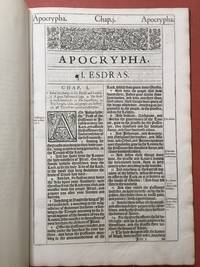
1611réf. H2543London: Robert Barker 1611. First printing. Hardcover. Fine. First edition taken from the 'He' version of the entire APOCRYPHA Authorized Version known as the King James Bible 1611. Folio finely bound in full morocco gilt with printed title page and preface by the New York bookseller Charles Hamilton probably early 1960s where he attests that the text is from the 'He' version taken from an error in Ruth III.15 corrected to 'she' shortly after and thus much more desirable. Fine. 104 leaves 208 pp. from the most famous book in the English language. The 1611 King James Apocrypha contained the following books: 1 Esdras 2 Esdras Tobit Judith Additions to Esther Wisdom of Solomon Ecclesiasticus Baruch Letter of Jeremiah Prayer of Azariah Susanna Bel and the Dragon Prayer of Manasseh 1 Maccabees and 2 Maccabees. In 2016 a copy of the complete Bible sold at Sotheby's for $320000 plus the hammer: nearly $400000. Robert Barker hardcover
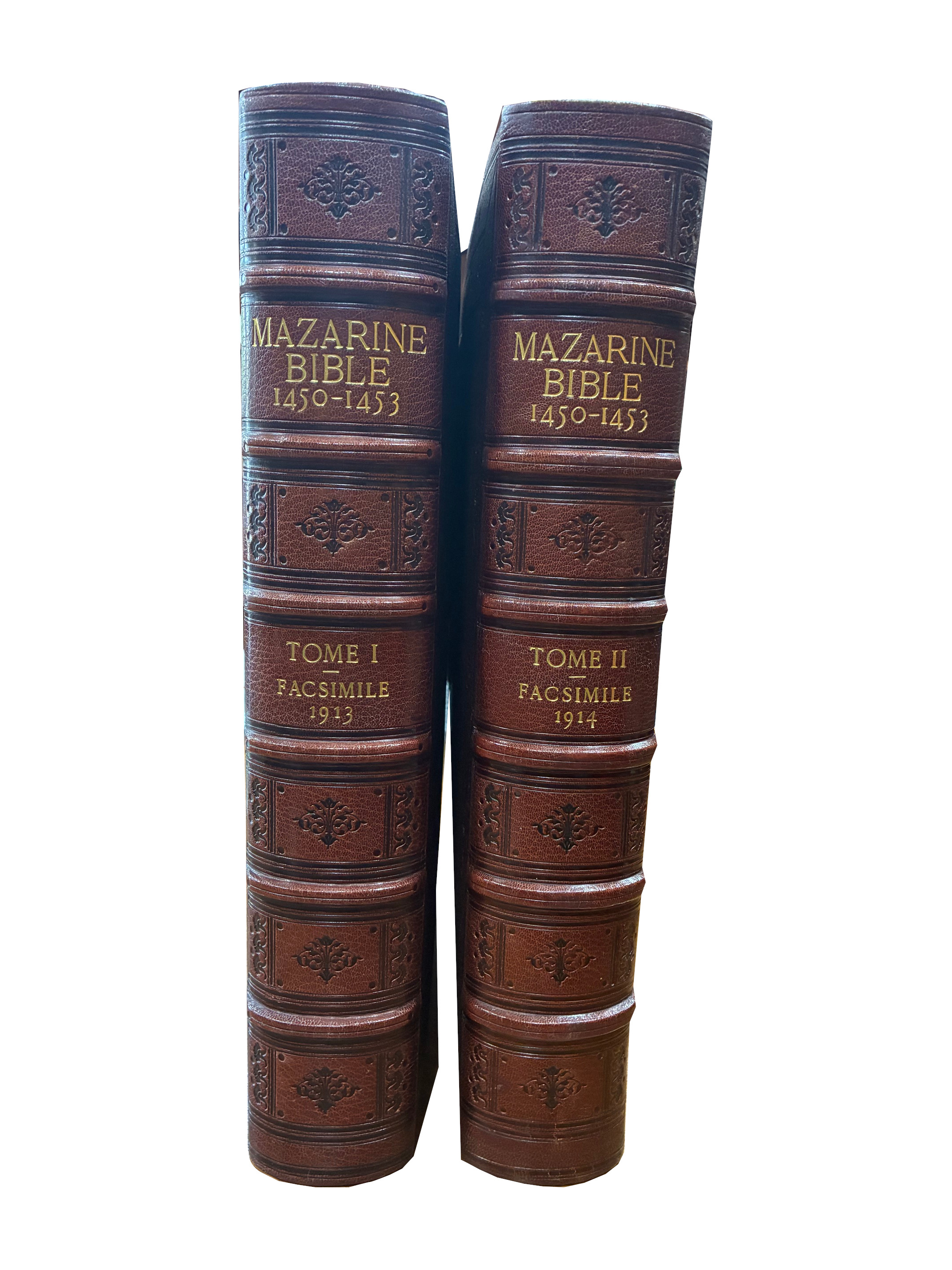
1913réf. 001619Leipzig: Insel Verlag 1913. Two volumes complete 1913-1914 - Volume I - 648p; Volume II - 632p. Publisher's blind stamped morocco by Riviere & Son raised bands spines in seven panels title in gilt to second volume number and date in gilt to fourth remaining panels with central floral spray and volute tools to side in blind. Covers with outer double panel joined by mitred corners with occasional flower heads and elongated volutes to margins again in blind title and original publisher to head and foot in gilt central panel with blind roll presumably showing Gutenberg's head with a central arabesque inner edges with blind roll combed and curled marbled endpapers a.e.g. Bright and clean. The first complete facsimile of the Gutenberg Bible reproduced from the richly illuminated copies in the Koniglichen Bibliothek Berlin and the Standischen Landesbibliothek Fulda and attractively produced and bound. First Thus. Hardback. Very Good. Elephant Folio. Facsimile. Insel Verlag hardcover
1903réf. 189656Hammersmith: The Doves Press 1903-05. Among the greatest achievements of book design The Doves Bible the finest output of the press and among the finest achievements of typography one of 500 sets on handmade paper. "All copies of the Bible were sold before printing was finished and the fourth Doves Press List published in June 1905 states that the Bible like all other Doves Press books was now out of print" Tidcombe. "The Doves Bible and the Kelmscott Chaucer stand side by side upon the highest peak of typographical accomplishment utterly dissimilar yet with the same element of greatness incontestable. The great red initial 'I' that dominates and yet fits exactly the opening page of Genesis in the Doves Bible is a pattern for all time of complexity reduced to the minimum of simplicity. When it is said that they approach dangerously near to absolute perfection everything has been said" Ransom. Tidcombe notes that foxing appears on the sheets of early volumes of the Bible "although fortunately not the opening page". Cobden-Sanderson was asked about this condition issue in 1920 and noted that it was "due to a misadventure in the drying of the sheets long ago when the Bible was being printed" cited in Tidcombe p. 45. In this copy the foxing is very limited. On the head of each pastedown is the thin bookplate of Benjamin Fairfax Hall 1904-1982 founder of the Stourton Press in 1930. The press was known for its appealing productions many of which used the Aries font designed specially for Fairfax Hall by Eric Gill. 5 vols large quarto. Doves type printed in black with red initial letters by Edward Johnston on handmade paper. Original limp vellum by the Doves Bindery with their stamp on rear pastedowns spines lettered in gilt. Spines a little creased natural colour variance remarkably little foxing. A near-fine set. Ransom p. 56; Tidcombe DP6. hardcover
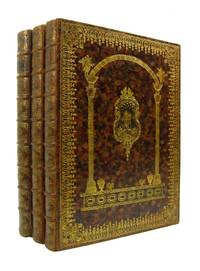
1712réf. 12639Dordrecht Pieter Keur and Jacob Keur/Luyken: Johannes Covens and Cornelis Mortier/Weigel: Nürnberg Christoph Weigel 1729/1729/1712. Biblia dat is De gantsche H. Schrifture vervattende alle de Canonijcke Boecken des Ouden en des Nieuwen Testaments. Door Last der Hoogh- Mog. Heeren Staten Generael vande Vereenighde Nederlanden en volgens het Besluyt vande Synode Nationael gehouden tot Dordrecht inde Jaren 1618 ende 1619. Uyt de Oorspronckelicke talen in onse Nederlandtsche tale getrouwelick over geset. Met nieuwe bygevoeghde Verklaringen op de duystere plaetsen aenteeckeningen vande gelyck-Luydende Texten ende nieuwe Registers over beyde de Testamenten. Ende door gemeene ordre der Nederlandsche Kercken verbetert van Druckfouten en Misstellingen die in den Eersten Druck gevonde worden. WITH: Icones Biblicae Veteris et N. Testamenti. / Figures du Vieux et du Nouveau Testament. Inventées et Gravées par Jan Luyken. / Print-Verbeeldingen der Historien des Ouden en Nieuwen Testaments. WITH: Historiae Celebriores Veteris -Novi Testamenti Iconibus Repraesentatae et Selectis Epigrammatibus exornatae in lucem olim datae a Christophoro Weigelio Noribergae. Unieke set. 3 werken in 3 banden gegraveerde titelpagina 19 144 1 145-302 2 134 12 164 2 66 folia. Luyken: 62 folia. Weigel: titelprent 151 titelprent 108 folia. Origineel Leer met ribben rijkelijk met goud bestempeld goud op snede en geciseleerde boekblokken gebonden door de Tweede Stadhouderlijke Binderij in Den Haag Folio H. 445 x L. 28 x B. 7-85 cm. Ruggen aan de onder- en bovenkant vakkundig gerestaureerd. Zeer fraaie uitgave van de Nederlandse Bijbel in de Statenvertaling in drie banden bestaande uit het Oude en Nieuwe Testament gevolgd door de Apocriefen. Doorschoten met de 6 dubbel paginagrote kaarten van Pieter en Jacob Keur 61 genummerde en dubbel paginagrote gravures alle van Jan Luyken uit zijn Icones Biblicae. Daarbij het gehele werk van Christoph Weigel genaamd Historiae Celebriores bestaande uit 2 titelprenten en 257 gravures. Deze prentenserie is fraai en gedetailleerd gegraveerd. Onder de gravures staat de bijbehorende tekstverwijzing met een vierregelig gedicht in het Latijn en Duits. De gravures zijn voornamelijk gegraveerd door Jan en Casper Luyken en enkele door François Antoinne Meloni en Paul Decker. Het geheel is ingebonden door de Tweede Stadhouderlijke Binderij in drie zeer fraaie stempelbanden. De Tweede Stadhouderlijke Binderij was actief gedurende de jaren 1752-1782 in de stad Den Haag. De binderij heeft zijn naam te danken aan het feit dat zij veel banden inbonden voor de stadhouderlijke familie voor dit doeleinde bezaten zij enkele stempels die exclusief hiervoor werden gebruikt waaronder de kroontjes op deze set. Kenmerkend voor de banden is het rijkelijk met goud bestempelde patroon de stempels zijn te herleiden naar de binderij met behulp van het standaard werk van Storm van Leeuwen. De stempels die gebruikt zijn voor deze banden zijn divers op elk van de platten zijn 8 kronen weergegeven omringd door een levendig patroon van overwegend bloemmotieven en bladmotieven. De ruggen van de banden zijn tussen en op de ribben met goud bestempeld met een decoratief bloemenmotief waarbij een vak is opengelaten voor de titel en de deelaanduiding. De boekblokken zijn met goud op snede en langs de randen geciseleerd met een een motief van bladeren. 3 works in 3 bindings engraved frontispiece 19 144 1 145-302 2 134 12 164 2 66 folia. Luyken: 61 folia. Weigel: frontispiece 151 frontispiece 108 folia. Contemporary blind-stamped Leather with 7 raised bands richly decorated with gilt gilt-edged and gauffred text blocks bound by the Second Stadholder's Bindery in The Hague Folio H. 445 x L. 28 x W. 7-85 cm. The spines are very slightly faded and the spine-ends are skillfully restored. A superb copy of a Dutch States Bible Statenbijbel in three volumes containing the Old and New Testament followed by the Apocrypha. Interleaved with the 6 double-page maps by Pieter and Jacob Keur 61 numbered double-page prints and the title print all by Jan Luyken from his ""Icones Biblicae"" and the entire work of Christoph Weigel named Historiae Celebriores containing 2 frontispieces and 257 engravings. This print series is beautifully and precisely engraved. Under the engravings is listed the reference to the accompanying Bible text and a 4-line long poem both in Latin and in German. The engravings are mostly by Jan and Casper Luyken and some by François Antoine Meloni and Paul Decker. The Second Stadholder's Bindery binds the work in three magnificent blind-stamped bindings. The Second Stadholder's Bindery was active in the years 1752-1782 in the city of The Hague. The bindery is so-called because it made many bindings for members of the Stadholder's family; they owned special stamps for this purpose among which were the crowns on this set. Typical for the bindings is the richly decorated pattern with gold tooling; the stamps can be traced back to the bindery with the help of the standard work of Storm van Leeuwen. The gilding used on the bindings is very diverse; on each board 8 crowns are displayed surrounded by a vivid pattern of mostly flowers and leaves. The spines are decorated with floral gilding between and on the raised bands leaving some space for the title and volume indication. The text blocks are gilt-edged and near the edges gauffered with a design of leaves. Literature: Eeghen P. van & Kellen J.P. van der 1905. Het Werk van Jan en Casper Luyken Deel II p. 641-658 & 658-666 / Poortman W.C. 1986. Bijbel en Prent. Deel II: Boekzaal van de Nederlandse Prentbijbels p. 131 & 134 / Poortman W.C. 1995. Kaarten in Bijbels p. 193-203 / Klaversma N. & Hannema K. 1999. Jan en Casper Luyken te boek gesteld p. 76 & 350 / Storm van Leeuwen J. 1976. De achttiende-eeuwse Haagse boekband in de Koninklijke Bibliotheek en het Rijksmuseum Meermanno-Westreenianum 298-311 & 453-456 / Storm van Leeuwen J. 2006. Dutch Decorated Bookbinding in the Eighteenth Century Volume IIA p. 164-173 & Volume III p. 629-811. / Uit de Schaduw 2011Provenance: Twintig jaar Nederlands Genootschap van Bibliofielen p. 328-331 private collection M. Roos IJmuiden. Dordrecht, Pieter Keur, and Jacob Keur/Luyken: Johannes Covens, and Cornelis Mortier/Weigel: Nürnberg, Christoph Weigel hardcover
1728réf. 12691s-Graavenhaage Pieter de Hondt 1728. Taferelen der Voornaamste Geschiedenissen van het Oude en Nieuwe Testament en andere boeken bij de Heilige Schrift gevoegt door de vermaarde Kunstenaars Hoet Houbraken en Picart Getekent en van de beste meesters in koper gesneden en met beschrijvingen uitgebreid. 3 delen titelprent 2 gegraveerde opdracht 148 72 2 2 149-280 14 71 titelprent 2 gegraveerde opdracht 160 70 p. Origineel Leer met ribben rijkelijk met goud bestempeld en goud op snede gebonden door de Van Damme Binderij in Amsterdam Folio H. 45 x L. 33 x B. 45-5 cm. Prentbijbel van Pieter de Hondt bestaande uit 212 gravures door Gerard Hoet Arnold Houbraken en Bernard Picart met bijgevoegde tekst van Jacques Saurin. 19 van de gravures zijn avant-la-lettre gedrukt dat wil zeggen dat het om de eerste proefdrukken gaat van de kopere platen op de rugschilden staat dan ook 'eerste drukken' boven de deelaanduiding. De randen om deze 19 prenten zijn op maat gemaakt voor het werk. Het geheel is gedrukt op super royaal papier en is ingebonden door de Van Damme Binderij in drie zeer fraaie stempelbanden. De Van Damme Binderij was werkzaam tussen 1750 en 1786 in de stad Amsterdam. De binderij heeft zijn naam te danken aan het feit dat zij werkzaam waren voor de bekende boekhandelaar Pieter van Damme. De banden die afkomstig zijn uit deze binderij behoren tot het beste dat in Amsterdam in de achttiende eeuw werd gemaakt. De stempels die gebruikt zijn voor deze banden zijn divers op het midden van de platten een zwart schild met een afbeelding van een engel gekroond met twee zegenende handen. Dit wordt omringd door een triomfboog met op de bovenste hoeken twee engelen die in spiegelbeeld van elkaar zijn gestempeld dit alles wordt omlijst door een brede decoratieve rand. De ruggen van de banden zijn bestempeld met op elk van de vlakken een engel omringd door een motief van ranken waarbij een vak is opengelaten voor de titel en de deelaanduiding. De Van Damme binderij stond er om bekend kleine en soms verborgen verwijzingen aan te brengen in de bestempeling die verwijzen naar de inhoud van het boek. De stempels die voor deze set zijn gebruikt zijn hier een voorbeeld van. Zo verwijzen de engelen en de zegenende handen naar de geestelijke inhoud van dit werk. De onder- en bovenkanten van de ruggen zijn plaatselijk wat ingescheurd. Zeer fraaie set van een zeldzame editie. 3 volumes frontispiece 2 engraved dedication 148 72 2 2 149-280 14 71 frontispiece 2 engraved dedication 160 70 p. Contemporary blind-stamped Leather with 8 raised bands richly decorated with gilt and gilt-edged text blocks bound by the Van Damme Bindery in Amsterdam Folio H. 45 x L. 33 x W. 45-5 cm. Print Bible of Pieter de Hondt containing 212 engravings by Gerard Hoet Arnold Houbraken and Bernard Picart with accompanying text by Jacques Saurin. 19 of the engravings are printed avant la lettre which means that they are the first test pressure of the copper plates; above the volume indication on the spine is gilded 'eerste drukken' which means first prints in English. The borders of these 19 engravings are custom-made to match the size of the other pages. The entire work is printed on extra-large paper and is bound by the Van Damme Bindery in three very beautiful blind-stamped bindings. The Van Damme Bindery was active from 1750 to 1786 in the city of Amsterdam. The bindery is so called because they worked for the well-known bookseller Pieter van Damme. The bindings made in this bindery belong to the best that was made in Amsterdam during the eighteenth century. The gilding used on the bindings is very diverse. In the middle of the covers a black central shield with the image of an angel crowned by blessing hands. Surrounded by a triumphal arch with a pair of angels stamped in each other's mirror image on top of it altogether framed by a broad ornamental border. The spines are decorated with an angel surrounded by tendrils between each raised band leaving some space for the title and volume indication. The Van Damme Bindery was known to place minor and sometimes almost hidden references in the gilding that point to the content of the book. The tooling used for this set is an example of this. The angels and the blessing hands refer to the religious content of this work. The spine ends are slightly split at some places. An excellent set of this rare edition. Literature: Poortman W.C. 1986. Bijbel en Prent. Deel II: Boekzaal van de Nederlandse Prentbijbels p. 137-145 / Storm van Leeuwen J. 1977. Enige ontwikkelingen in de stijl van platbestempeling bij Nederlandse boekbanden uit de achttiende eeuw. In Documentatieblad werkgroep Achttiende eeuw. Jaargang 1977 p. 16-19 / Storm van Leeuwen J. 2006. Dutch Decorated Bookbinding in the Eighteenth Century Volume I p. 460-496 s-Graavenhaage, Pieter de Hondt hardcover
1510réf. 371469Leipzig: Wolfgang Stockel 1510. Title in red and black. A-DⶠEâ´ F-JⶠKâ´ L-Mâ¶. 68 leaves. Extensive annotations throughout in Latin in a contemporary Germanic cursive comprising both interlinear notes and marginal gloss. 1 vols. Folio 12x8-1/2 inches. Early pigskin and oaken boards a remboitage from a thicker volume worn front hinge split between A2 and A3. Housed in a blue cloth slipcase. Provenance: Duplum Bibliothecae Regiae Monacensis pencil annotation; John Pintard inscription presenting the book to; General Theological Seminary bookplate and inked stamps. Title in red and black. A-DⶠEâ´ F-JⶠKâ´ L-Mâ¶. 68 leaves. Extensive annotations throughout in Latin in a contemporary Germanic cursive comprising both interlinear notes and marginal gloss. 1 vols. Folio 12x8-1/2 inches. Edited by Johann Kusthuert this printing of the Epistles of Paul was intended for the student market with the introduction addressed to studiosis sacarum litterarum tyronibus. In addition the colophon reads: Impressum ad altissimi Dei laudem ac studiosorum Sacre Scripture tyronum perfectum in officina libraria prouidi viri Vuolffgangi Stockel ciuis Liptzensis anno Domini 1510 quarto kalendis Septembris. The annotations and marginal gloss are impressive and very similar though in a different hand to the copy described by Rosenthal now at the Beinecke suggesting they are by a student at the same institution: "The present copy comes with a vast manuscript apparatus in Latin covering the entire text from St. Jerome's general preface to the last sentence of the last epistle. The annotation . is uniformly intense throughout. The script is a very small at times microscopic Germanic cursive and there is evidence of careful layout especially in the marginal gloss." Estimating the annotations to be approximately 80000 words Rosenthal describes the interlinear notes as "frequently far more than simole reading aids." He continues: "The marginal gloss includes an argumentum for each chapter and its subdivisions . There are also occasional citations from authorities such as St. Thomas and Ambrose." It is a handsomely printed volume with the title in large red letters above an 11-line subtitle in black. The verso of the title comprises a table of contents of the Pauline epistles and is followed by an introduction by Kusthuert. On the duplicates sold by the Munich royal library including the present volume see: Wagner Bettina. "'Duplum Bibliothecae Regiae Monacensis': The Munich Court Library and Its Book Auctions in the Nineteenth Century." The Papers of the Bibliographical Society of America vol. 111 no. 3 2017 pp. 345-77. Pintard 1759-1844 was a prominent New Yorker of Huguenot origin patron of education and one of the earliest and staunchest advocates for the preservation and study of the history of New York and the United States. Pintard began to work towards the establishment of a historical society in the city in early 1804 and he was the leader in the organization of the New-York Historical Society in November 1804. He was also a patron of the old French Huguenot Church of St. Esprit and the General Theological Seminary to whom he donated this volume in 1826. Scarce. OCLC locates three copies in Germany the aforementioned copy at Yale described by Rosenthal and the present example. Rosenthal B.M. Printed books with manuscript annotations 105 for a similarly annotated copy of the same edition; Panzer vii p. 169; VD16 B 4980. Not in BM STC Germany Adams or Darlow & Moule [Wolfgang Stockel] unknown
1510réf. 371469Leipzig: Wolfgang Stockel 1510. Title in red and black. A-DⶠEâ´ F-JⶠKâ´ L-Mâ¶. 68 leaves. Extensive annotations throughout in Latin in a contemporary Germanic cursive comprising both interlinear notes and marginal gloss. 1 vols. Folio 12x8-1/2 inches. Early pigskin and oaken boards a remboitage from a thicker volume worn front hinge split between A2 and A3. Housed in a blue cloth slipcase. Provenance: Duplum Bibliothecae Regiae Monacensis pencil annotation; John Pintard inscription presenting the book to; General Theological Seminary bookplate and inked stamps. Title in red and black. A-DⶠEâ´ F-JⶠKâ´ L-Mâ¶. 68 leaves. Extensive annotations throughout in Latin in a contemporary Germanic cursive comprising both interlinear notes and marginal gloss. 1 vols. Folio 12x8-1/2 inches. Edited by Johann Kusthuert this printing of the Epistles of Paul was intended for the student market with the introduction addressed to studiosis sacarum litterarum tyronibus. In addition the colophon reads: Impressum ad altissimi Dei laudem ac studiosorum Sacre Scripture tyronum perfectum in officina libraria prouidi viri Vuolffgangi Stockel ciuis Liptzensis anno Domini 1510 quarto kalendis Septembris. The annotations and marginal gloss are impressive and very similar though in a different hand to the copy described by Rosenthal now at the Beinecke suggesting they are by a student at the same institution: "The present copy comes with a vast manuscript apparatus in Latin covering the entire text from St. Jerome's general preface to the last sentence of the last epistle. The annotation . is uniformly intense throughout. The script is a very small at times microscopic Germanic cursive and there is evidence of careful layout especially in the marginal gloss." Estimating the annotations to be approximately 80000 words Rosenthal describes the interlinear notes as "frequently far more than simole reading aids." He continues: "The marginal gloss includes an argumentum for each chapter and its subdivisions . There are also occasional citations from authorities such as St. Thomas and Ambrose." It is a handsomely printed volume with the title in large red letters above an 11-line subtitle in black. The verso of the title comprises a table of contents of the Pauline epistles and is followed by an introduction by Kusthuert. On the duplicates sold by the Munich royal library including the present volume see: Wagner Bettina. "'Duplum Bibliothecae Regiae Monacensis': The Munich Court Library and Its Book Auctions in the Nineteenth Century." The Papers of the Bibliographical Society of America vol. 111 no. 3 2017 pp. 345-77. Pintard 1759-1844 was a prominent New Yorker of Huguenot origin patron of education and one of the earliest and staunchest advocates for the preservation and study of the history of New York and the United States. Pintard began to work towards the establishment of a historical society in the city in early 1804 and he was the leader in the organization of the New-York Historical Society in November 1804. He was also a patron of the old French Huguenot Church of St. Esprit and the General Theological Seminary to whom he donated this volume in 1826. Scarce. OCLC locates three copies in Germany the aforementioned copy at Yale described by Rosenthal and the present example. Rosenthal B.M. Printed books with manuscript annotations 105 for a similarly annotated copy of the same edition; Panzer vii p. 169; VD16 B 4980. Not in BM STC Germany Adams or Darlow & Moule [Wolfgang Stockel] unknown books
1717réf. 7186Oxford: John Baskett 1717. First Edition Thus. Royal binding in full morocco. Very Good. John Sturt. Two volumes in one. Large stout folio. Double column with columns separated by double rule. Text ruled in red and title pages printed in red and black. Engraved vignette title pages for Old and New Testaments the latter dated 1716. With the engraved additional general title page by cartographer and renowned illustrator John Sturt 1658-1730. With striking copper-engraved vignette head- and tail-pieces and many engraved historiated initials. Complete with Apocrypha. Marbled endpapers. All edges gilt. Bound in contemporary full black morocco rebacked with original elaborate gilt-tooled spine neatly laid-down gilt-tooled arms of King George II featuring the motto "Most Noble Order of the Garter" as centerpieces and his monogram in spine compartments raised bands and gilt-decorated borders. Only moderate wear to the splendidly complete royal binding. First edition of the monumental illustrated "Vinegar Bible" with additional title page engraved by John Sturt including the vignette of a church interior featuring the figures of Moses Aaron et al. per Darlow and Moule. According to the DNB Sturt "specialized in miniature work and it was said that he could engrave the creed on a silver penny but could also work on a large scale and in 1692 he produced a notable engraving of Britannia the royal first capital ship of England printed on four sheets". Presented in a handsome King George II armorial binding. Carter notes that " . Bibles with the royal arms may have come from one of the Royal Chapels - but they may equally have come from any loyal parish church" ABC p. 157. That said a limited print run coupled with the high cost of Baskett's elaborate opus would suggest the former. In 1709 printer John Baskett secured the exclusive royal patent to print Bibles in England. Of those he and his family published this is the most magnificent being a triumph of legible elegant type that contributes to an easy readability accessible today. Alas a typographical error in the running head of Luke XX among other typos rendered the parable of the vineyard as the "parable of the vinegar" overshadowing Baskett's magnificent achievement. A scarce and stately copy of a high spot in 18th-century printing. DARLOW & MOULE 736-B "the engravings differ considerably from those in A". John Baskett unknown
1590réf. 62507Rome, Typographia Medicea, 1590 (-1591). Folio. Completely uncut in the original blank interim wrappers (with slight offsetting to verso of front wrapper). Newer paper backstrip matching the paper of the wrappers. Some leaves browned. Occasional brownspotting. An overall excellent copy. Housed in a old vellum chemise with ties and handwritten title (EVANGELIUM) to spine. Old, amorial, vague red stamp to title-page, colophon, and p. 97, from the Bibliotheque Impériale (now Bibliotheque Nationale), with a small deaccession-stamp to title-page. Magnificently illustrated with 149 large woodcut engravings in the text. 368 pp. Arabic text within double-frame border througout. Beautifully printed on very heavy paper.
1590réf. 62507Rome Typographia Medicea 1590 -1591. Folio. Completely uncut in the original blank interim wrappers with slight offsetting to verso of front wrapper. Newer paper backstrip matching the paper of the wrappers. Some leaves browned. Occasional brownspotting. An overall excellent copy. Housed in a old vellum chemise with ties and handwritten title EVANGELIUM to spine. Old amorial vague red stamp to title-page colophon and p. 97 from the Bibliotheque Impériale now Bibliotheque Nationale with a small deaccession-stamp to title-page. Magnificently illustrated with 149 large woodcut engravings in the text. 368 pp. Arabic text within double-frame border througout. Beautifully printed on very heavy paper. The scarce editio princeps of the Arabic translation of the New Testament magnificently printed in Granjon's famous font considered the first satisfactory Arabic printing type appearing here for the first time and beautifully illustrated with 149 woodcut illustrations in the text. This work constitutes the very first printing by the Typographia Medicea-press a printing-house set up by Pope Gregor XIII and Cardinal Ferdinando de Medici in order to promote and distribute Christian scriptures to the East. This splendid work is considered the first successful printing of Arabic. Apart from the Latin part of the title-page and the colophon the book is in Arabic throughout. Two issues of the work were printed almost simultaneously the Arabic-only text which has the year 1590 on the title-page and 1591 on the colophon and the interlenear Arabic-Latin edition which has 1591 on the title-page. The Arab-only edition with 1590 on the title-page is generally considered the first. "Its first great Arabic publication was this edition of the Gospels bearing the date 1590 on the title page and 1591 at the end. Two versions appeared one solely in Arabic and one with an interlinear Latin translation." Library of Congress.The work was edited by Giovanni Battista Raimondi 1536-1614 a renowned Orientalist and professor of mathematics at the College of the Sapienza in Rome. Raimondi had travelled extensively in the Middle East and had thorough knowledge of Arabic Armenian Syrian and Hebrew. He is however most famous for being the editor at the Typographia Medicea-press; together with French engraver Robert Granjon who also created the Arabic typography of the present work "bettered all previous attempts to print in Arabic in Europe and would remain unsurpassed long after the press had closed. Boogert "Medici Oriental Press Rome 1584-1614"."Antonio Tempesta the engraver cutter: Leonardo Parasole had studied under Santi di Tito and Joannes Stradanus at the Accademia del Disegno in Florence later working with Stradanus and Vasari on the interior decoration of the Palazzo Vecchio in Florence before travelling to Rome where he executed various commissions including frescos for Pope Gregory XIII in the Vatican and decorations for the Villa Farnese. Simultaneously with his frescos and panel paintings he executed a large number of engravings. The illustrations for the present work are remarkable examples of Tempesta's work noteworthy for their clear composition and narrative of the episodes depicted. Despite the extremely high quality of the prints the press never became an economic success and it went bankrupt in 1610. Scholars have noticed that presenting a work with beautiful scriptural illustrations as the present to Arabic-speaking Muslims when Islam forbids religious illustration showed little understanding of the culture and almost certainly hindered Pope Gregory XIII's missionary efforts."The press was not only an intellectual enterprise; it was also a commercial one. Raimondi clearly hoped to sell his books in the East rather than the West because the selection of the works he produced showed little consideration with the type of material European scholars in this period needed. While the works failed to sell in the Ottoman Empire however they did significantly stimulate the study of the Middle East in Europe.Ferdinando de' Medici had ordered Raimondi to print 'all available Arabic books on permissible human sciences which had no religious content in order to introduce the art of printing to the Mohamedan community.' Only more than a century after the Medici Press in Rome had closed did it finally have the envisaged impact in the Levant; Ibrahim Müteferrika the first Muslim printer referring to it in his plea to the sultan to allow him to open his own printing house at Istanbul which happened in 1729." Boogert "Medici Oriental Press Rome 1584-1614".The copy was previously in the Bibliothèque Nationale in Paris at the time when it was entitled "Bibliothèque Imperiale" which was its name inbetween from 1849 to 1871. Thus the book entered the library in Napoleonic times and was later deaccessioned. Brunet II 1122-23Schnurrer 318Adams: B:1822 hardcover
1483réf. 372104Venice: Johannes Herbort de Seligenstadt 1483. Text in two columns 56 lines per page. Initials mostly executed in red Psalms and a few other chapter headings with large color initial others empty. N.T. with printed marginal glosses. 398 leaves. 1 vols. Folio. Contemporary pigskin stamped in blind lower pastedown with manuscript waste re-inforcement. Binding worn and soiled spine darkened. Front pastedown with abundant annotations; flyleaf with tabulations of books of the Bible; occasional marginal annotations a bit more frequent in N.T. Pious abecedary poem in 23 lines in manuscript on blank verso of last leaf. Text in two columns 56 lines per page. Initials mostly executed in red Psalms and a few other chapter headings with large color initial others empty. N.T. with printed marginal glosses. 398 leaves. 1 vols. Folio. With additions by Franciscus Moneliensis and Quintius Aemilianus. This is grouped with the Fontibus ex Graecis editions of the corrected Latin text though this edition does not include the Latin verses. Leaf a1v prints a letter by Franciscus Moneliensis in which he praises the printer Johannes Herbort who got his start in Padua in the mid-1470s where he printed Avicenna's Canon medicinae. He came to Venice and worked with Jenson and others; he printed an edition of the Bible with Postilla of Nicolaus de Lyra in 1481; a quarto Bible was issued in 1484. Herbort produced some 50 works during his career. ISTC ib00579000; GW 4254; Goff B579; cf. Darlow & Moule 2:911 note. Provenance: W. A. Copinger bookplate; General Theological Seminary gift of Cornelius Vanderbilt and Dean Augustus Hoffman bookplates and blindstamps Johannes Herbort, de Seligenstadt unknown
1483réf. 372104Venice: Johannes Herbort de Seligenstadt 1483. Text in two columns 56 lines per page. Initials mostly executed in red Psalms and a few other chapter headings with large color initial others empty. N.T. with printed marginal glosses. 398 leaves. 1 vols. Folio. Contemporary pigskin stamped in blind lower pastedown with manuscript waste re-inforcement. Binding worn and soiled spine darkened. Front pastedown with abundant annotations; flyleaf with tabulations of books of the Bible; occasional marginal annotations a bit more frequent in N.T. Pious abecedary poem in 23 lines in manuscript on blank verso of last leaf. Text in two columns 56 lines per page. Initials mostly executed in red Psalms and a few other chapter headings with large color initial others empty. N.T. with printed marginal glosses. 398 leaves. 1 vols. Folio. With additions by Franciscus Moneliensis and Quintius Aemilianus. This is grouped with the Fontibus ex Graecis editions of the corrected Latin text though this edition does not include the Latin verses. Leaf a1v prints a letter by Franciscus Moneliensis in which he praises the printer Johannes Herbort who got his start in Padua in the mid-1470s where he printed Avicenna's Canon medicinae. He came to Venice and worked with Jenson and others; he printed an edition of the Bible with Postilla of Nicolaus de Lyra in 1481; a quarto Bible was issued in 1484. Herbort produced some 50 works during his career. ISTC ib00579000; GW 4254; Goff B579; cf. Darlow & Moule 2:911 note. Provenance: W. A. Copinger bookplate; General Theological Seminary gift of Cornelius Vanderbilt and Dean Augustus Hoffman bookplates and blindstamps Johannes Herbort, de Seligenstadt unknown books