2,127 results
1952ref. 63021Paris: Imprimeurs L.I.E.S.A. 174 Quae de Jemmapes 1952. Oblong 4to. 9.25 x 7.75 in. 2 24 pp. colour-lithograph illustrations throughout 10 leaves unnumbered. consisting of 4 colour lithograph boards to cut out alphabet letters for playing 2 black & white lithograph letter pages for colouring cutting out themselves and playing word games 1 thick instruction leaf 3 printed leaves on blue- salmon- and green-tinted thin paper instruction sheets. Flexible boards colour-lithographed front cover rear board with model figures on verso to be cut out to create paper-engineered toys spiral metal comb binding as issued minor edgewear age toning still a VG and complete copy. First edition of this wonderfully illustrated and charming alphabet game/book featuring anthropomorphic letters in the “Kingdom of the Alphabet” set against the adventures of a Medieval/Renaissance Country of Vowels and the Isle of Consonants uniting over a banquet ball to form an alphabet. Marquet 1892-1984 and Desnoyer 1901-1988 were illustrators and miniaturists noted for their inventive games and illustrations who had originally designed this game/book in 1939. They were married to the well known painters Albert Marquet and Francois Denoyer respectively. Desnoyer a Russian-Ukrainian emigre from Kiev had originally landed in Bohemia by 1906 where she learned the Western alphabet and later settled in France. This particular copy not only features the four colour lithograph boards for children to cut out and play the suggested alphabet game but also the 2 additional boards for an adult word game and back board to create toys which are typically missing as are often the colour-tinted instruction sheets. Worldcat locates 4 copies U of WA & Princeton Incomplete Bibliotheque Nationale FR & Bibliotheque des Chiroux BE -- complete; See: Robert Bolick Books on Books Collection -- Souza Desnoyer and Marcelle Marquet Il etait une fois un alphabet 1951-2009 Dec. 22 2022. Imprimeurs L.I.E.S.A., 174, Quae de Jemmapes, hardcover
2012ref. 32906San Francisco: Deeply Game Publications 2012. Hardcover. Fine. Hardcover. Number 45 of 55 copies. Signed by the author and book artists. Book artist Sara Press collaborated with Andrew Rottner to create this exquisite tribute to printing's golden age. "The story by Christina Lauritsen mis-remembers H.C. Andersen's classic tale of the same name transforming it into a story of revelation and madness. The visual progression of the book mirrors the plot pitting the beauty of the decorative arts against the intense and unpredictable messiness of human experience. This book confronts the inevitability of loss and bows to intellectual freedom and its attendant risks." artists' statement. The book is printed in Garamond and Bembo types on Moab Entrada paper. It features two 26 inch wide foldouts with illustrations by Rottner. The striking cover is done from a cut-marbled-paper and brocade. The book measures 7 x 9 inches. It is unpaginated. Deeply Game Productions creates and distributes the art works of Sara Press and her collaborators. Sara L. Press is a photographer printmaker and book artist based in the San Francisco Bay Area. Many of her projects examine peculiar areas of overlap between nature and culture for example: dog fighting feral children and our co-evolution with snakes. Sara has also wrestled with the relationship between creativity and the scientific method. Recently Sara has turned to constructions of masculinity and femininity in our culture such as human bloodsports and altered fairy-tales. Her work can be seen in public collections around the country and are also in many library and private collections. A lovely book in fine condition. PRI/021919. Deeply Game Publications hardcover
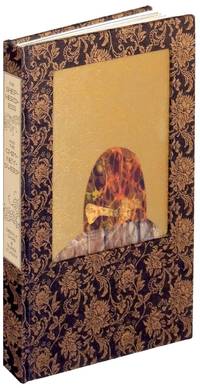
2012ref. 32906San Francisco: Deeply Game Publications 2012. Hardcover. Fine. Hardcover. Number 45 of 55 copies. Signed by the author and book artists. Book artist Sara Press collaborated with Andrew Rottner to create this exquisite tribute to printing's golden age. "The story by Christina Lauritsen mis-remembers H.C. Andersen's classic tale of the same name transforming it into a story of revelation and madness. The visual progression of the book mirrors the plot pitting the beauty of the decorative arts against the intense and unpredictable messiness of human experience. This book confronts the inevitability of loss and bows to intellectual freedom and its attendant risks." artists' statement. The book is printed in Garamond and Bembo types on Moab Entrada paper. It features two 26 inch wide foldouts with illustrations by Rottner. The striking cover is done from a cut-marbled-paper and brocade. The book measures 7 x 9 inches. It is unpaginated. Deeply Game Productions creates and distributes the art works of Sara Press and her collaborators. Sara L. Press is a photographer printmaker and book artist based in the San Francisco Bay Area. Many of her projects examine peculiar areas of overlap between nature and culture for example: dog fighting feral children and our co-evolution with snakes. Sara has also wrestled with the relationship between creativity and the scientific method. Recently Sara has turned to constructions of masculinity and femininity in our culture such as human bloodsports and altered fairy-tales. Her work can be seen in public collections around the country and are also in many library and private collections. A lovely book in fine condition. PRI/021919. Deeply Game Publications hardcover books
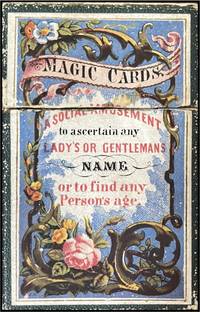
1850ref. 19999England 1850. 18 cards 89 x 54 mm 9 printed on pink cardstock and 9 on yellow. Housed in original slipcover made of pebbled green paper over boards with chromolithographed label affixed to the front open at top and bottom. Light wear to edges of slipcover otherwise in excellent condition. A charming and unusual magic card game based on mathematical principles that purports to reveal anyone’s name and age. Using the pink cards for women and yellow for men the questioner holds onto the instruction and key cards and gives the player the rest of them which have lists of names and numbers and the letters A E I O U W and Y at the top. The player tells the questioner the letters corresponding to which cards have their name on them and using the key the questioner adds their corresponding numbers to get the player’s name provided it is one of the 127 names listed. The game is played the same way to determine players’ ages. The game actually works! unknown
1850ref. 19999England 1850. 18 cards 89 x 54 mm 9 printed on pink cardstock and 9 on yellow. Housed in original slipcover made of pebbled green paper over boards with chromolithographed label affixed to the front open at top and bottom. Light wear to edges of slipcover otherwise in excellent condition. A charming and unusual magic card game based on mathematical principles that purports to reveal anyone’s name and age. Using the pink cards for women and yellow for men the questioner holds onto the instruction and key cards and gives the player the rest of them which have lists of names and numbers and the letters A E I O U W and Y at the top. The player tells the questioner the letters corresponding to which cards have their name on them and using the key the questioner adds their corresponding numbers to get the player’s name provided it is one of the 127 names listed. The game is played the same way to determine players’ ages. The game actually works! unknown books
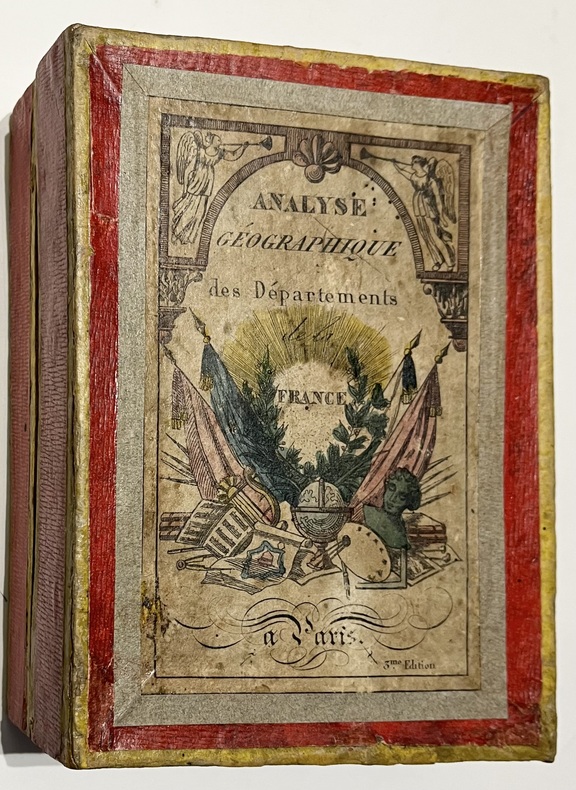
1836ref. 5579Paris, Bourrut Lemerie, [circa 1836]. 1836 Jeu de 90 cartes (132 x 82 mm). (quelques rousseurs) 1 boite d'origine (160 x 120 mm) en carton recouverte de papier rouge, titre imprimé en couleur sur le couvercle. (défauts d'usage)
ref. 118195Berlin Simon Schropp c. 1790. Engr. broadsheet. Large folio 400x505 mm. Uncut with wide margins 465x635 mm folded. Small tears in foldings and in the outer margins. Stain in upper part. Rare version of this board game with the main title and the individual ones in four languages; French German English and Polish. cf V & A Museum MISC.124-1989.Based on the English version published in 1790 as ”The New Game of Human Life” by John Wallis and Newbury the Berlin publisher Simon Schropp published one version with French text only and this one in four languages. They all go back to Crépy’s ”Le Nouveau Jeu de la Vie Humaine” from ca. 1775.The aim of the game is to reach immortality and the end space nr 84 of the game is the Immortal Man. This version contains no printed rules but the game is so similar to that published by John Wallis that it will be played the same way:The game is played with two dice. Each tile on the playing field has instructions to follow. For instance: ”The Studious Boy at 7 shall receive a Stake and shall proceed to 42 the place of the Orator”. ”The Negliant boy at 11 shall pay a Stake and shall remain two rounds without spinning”. ”The Married Man at 34 shall receive two Stakes for his Wife’s Portion and go to be a Good Father at 56”. ”The Romance Writer at 40 shall pay two Stakes and go back to the Mischievous Boy at 5”. Etc.”The Immortal Man who has existed 84 years seems worthy by his Talents and Merit to be a Model for the Close of Life which can end only be Eternity. When we arrive at the No. 84 we shall have gained all we can by this Game but if we exceed this number we must go back as many points as we have proceeded beyond it. The Age of Man is divided in seven periods of twelve years viz. Infance to Youth Manhood Prime of Life Sedate Middle-age Old age Decreptitude and Dotage”. Some famous people are depicted. As philosoper nr 62 is Voltaire the poet nr 41 is Alexander Pope and the geographer nr 47 is Captain Cook pointing at a map. The final end space Immortality in the Berlin version shows a monument to Leopold of Brunswick Prince of Brunswick-Wolfenbüttel 1752-85. His charity as a general towards his soldiers made him famous and he drowned while trying to save his soldiers lives in the great flood of the River Oder. unknown
1957ref. 186938Japan: Koide Nobuhirosha c. 1957. A charming set of playing cards based on the film Nankyoku Tairiku "The South Pole" recounting the story of the 1956-57 Japanese Antarctic Research Expedition. The cards show scenes of penguins the research ship Soya and the expedition members. In 1955 the Japanese government announced plans to send a research group to Antarctica in the following year. A team of 53 scientists led by Professor Nagata Takeshi set off on 8 November 1956 the first time Japan had explored the south pole since the early 1900s. They set up the Syowa Station on East Ongul Island before being emergency airlifted out of a storm. A documentary film focusing on the expedition was released in June 1957 directed by Hayashida Shigeo and titled Nihon nankyoku chiiki kansokutai no kiroku: Nankyoku Tairiku. This game was released to complement the film. Karuta is a traditional Japanese matching game where each pictorial card is assigned a letter of the Japanese alphabet and must be paired with an associated poem sentence or proverb. The player who can make the most matches wins. 90 playing cards 61 x 81 mm landscape or portrait 45 with colour photographic illustrations on one side 45 lettered in black on one side. Housed in original pictorial box 170 x 132 x 35 mm lettered in red and black. Lacking instructional booklet. Cards a little toned and bowed; box scuffed with minor loss in places bottom with some damp-staining remains of plastic wrap on lid verso old repairs in places: a very good example. Galbraith p. 133. unknown
1929ref. 63842London: H.F. & G. Witherby 1929. Tall 8vo. 223 pp. plus 1 pp. publisher’s ads. Photo frontisp. numerous photo plates throughout by W. Woodhouse. Red embossed publisher’s cloth gilt lettering & ruling on spine minor bumping to couple corners edgewear to lower fore-edges dustsoiling to upper fore-edge minor sunning head of spine w/ d.j. wraparound cover art image of hunter shooting at a man-eater lion w/ brushfire in the background chipping & tear to head of spine w/ about 1.75 in. of loss to lettering chipping & edgewear to foot of spine some minor creasing still a VG/G- copy w/ mimeographed private library slip laid-in for M.R. Steele and bookseller’s label on rear pastedown. First edition stated of this work describing the author’s hunting adventures while leading an American hunting party through the African bush tracking down man-eating lions and rogue elephants. Chadwick 1882 had first emigrated to South Africa in the 1920’s and became a transport rider and member of the Bechuanaland Protectorate Police while working as a professional hunter earning a living selling ivory and lion skins from his trophies. The original dustjacket is exceedingly scarce with Ellen Herring of Trophy Room Books noting that they had only seen this one copy. H.F. & G. Witherby, hardcover
1874ref. 246686London: Chapman and Hall 1874. First edition secondary binding. vi 337. 1 vols. 8vo. Green cloth spine titled in gilt. Very good minor rubbing. First edition secondary binding. vi 337. 1 vols. 8vo. Tiger hunting in Central India with notes on leopard. The author "also relates numerous stories from other sportsmen focusing on hunting bear rogue elephant and the like" Czech. Czech Asia p. 2 Chapman and Hall unknown
1874ref. 246686London: Chapman and Hall 1874. First edition secondary binding. vi 337. 1 vols. 8vo. Green cloth spine titled in gilt. Very good minor rubbing. First edition secondary binding. vi 337. 1 vols. 8vo. Tiger hunting in Central India with notes on leopard. The author "also relates numerous stories from other sportsmen focusing on hunting bear rogue elephant and the like" Czech. Czech Asia p. 2 Chapman and Hall unknown books
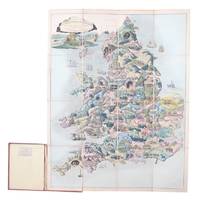
ref. AQ30350London: Published by Edward Wallis 42 Skinner Street s.d. c. 1840 Elaborately lithographed aquatint folding sheet dissected into 16 and mounted on linen bound within original publisher's gilt-lettered blind-tooled cloth folding case. The case a trifle marked lacking ties with some cracking to hinges internally; very occasional marking to map-sheet itself. Without the rare instruction book or draw cards. A well-preserved example of an obscure early nineteenth-century educational map game - issued by Edward Wallis 42 Skinner Street - wherein the player is instructed through play and vignette illustrations in the notable towns and principal economic outputs of the different English and Welsh counties. Dorset for example features images of coopers i.e. making barrels and dairy maids; whilst the topography of Cornwall is dominated by an illustration of copper mining. Other counties feature cathedrals Such as Winchester and factories. The aim of the race was to progress through the counties which are numbered with Essex as 1 and Kent as 150 the moves determined by drawing cards; the answering of questions related to the county of landing would also allow players to progress more rapidly. Edward Wallis was one of two of the sons of John Wallis d. 1818 the prolific London board game book map and print seller to follow him into the publishing business. He operated on his own account from 42 Skinner Street between 1818 and 1847. . Dimensions 520 x 660mm unfolded 140x180mm folded. Published by Edward Wallis, 42 Skinner Street, [s.d., c. 1840] hardcover
1966ref. 12447Paris - Bièvres, Pierre de Tartas, 1966 ; in-folio en feuilles sous couverture beige muette, coffret d'éditeur de tissu marron, titre lavande, intérieur de suédine grise ; (106) pp., (2) ff. blancs, 18 lithographies originales en couleurs, dont 7 à doubles pages et 3 en marge du livre par Jean Commère.
1892Folio, First Edition, with portrait frontispiece (of Bewick; original guard present), 16 fine coloured plates (all original guards present), 18 plates in autotype (all original guards present) and 30 wood-engraved illustrations (by the author and George Lodge) in the text, neat contemporary signature on front paste-down; original red straight-grained half morocco, red coarse-grain cloth sides blocked and lettered in gilt, gilt back, gilt top, blue-grey endpapers, uncut, joints and corners very faintly rubbed else a near fine, crisp copy. Lovely copy of Millais' well-known monograph on the four primary species: Capercaillie, Blackgame, Grouse and Ptarmigan. A number of the text-illustrations are by George Lodge. Freeman 2583; Jackson p.25; Mullens & Swann, p.405; Tate p.247.
1906ref. BIGGAMEH002055Privately printed by Marchant Singer & Co London. 1906. First edition. Royal octavo. pp xvi 415. 112 illustrations mostly from photographs by Mrs McMillan but also a number of full-page reproductions of drawings by the author. Large folding colour map in pocket at rear. Original red cloth gilt. Accounts of four hunting trips by Mr and Mrs McMillan in which the author participated. The McMillans originally from St Louis Missouri had relocated to London and also owned a farm in Kenya.Gift inscription from 1923 on front free endpaper. Front inner hinge starting to split. Endpapers a bit tanned and spotted. Very good indeed. Scarce. Privately printed by Marchant Singer & Co, London. hardcover
1890ref. 20151France 1890. 48 playing cards on thick stock. 86 x 56 mm. Wood engraved designed with stencil color versos alike with wood engraved grid fields. Excellent condition. A fine deck of cards for the game of Aluette a trick-taking game commonly played in France. Made up of four suits—batons coins swords and cups—the deck is dealt to players clockwise and played in “tricks”; the highest card wins and the player who threw it take the rest of the pile. Although it is a French game Aluette uses Spanish suits indicating that the game may be older than the creation of French playing cards. It is also called “La Vache” in some circles because one of the cups cards features a cow. B.P. Grimaud was the primary producer of Aluette decks but not that offered here. However the basic imagery on the cards closely follows Grimaud’s of the mid-late 19th century. unknown
1890ref. 20151France 1890. 48 playing cards on thick stock. 86 x 56 mm. Wood engraved designed with stencil color versos alike with wood engraved grid fields. Excellent condition. A fine deck of cards for the game of Aluette a trick-taking game commonly played in France. Made up of four suits—batons coins swords and cups—the deck is dealt to players clockwise and played in “tricks”; the highest card wins and the player who threw it take the rest of the pile. Although it is a French game Aluette uses Spanish suits indicating that the game may be older than the creation of French playing cards. It is also called “La Vache” in some circles because one of the cups cards features a cow. B.P. Grimaud was the primary producer of Aluette decks but not that offered here. However the basic imagery on the cards closely follows Grimaud’s of the mid-late 19th century. unknown books
1884ref. 6396Cambrai: Renaut, 1884. 1884 1 vol in-8° (210 x 140 mm) de : 139 pp. (dont faux titre, titre) ; nombreux schémas et tableaux dans le texte ; cachet de libraire et signature manuscrite de l'auteur et concepteur du jeu au dos de la page de titre. Demi-basane verte d'époque, dos lisse orné et titré, plats recouverts de papier marbré, tranches marbrées. (Reliure frottée).
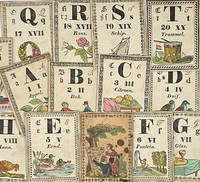
1820ref. 103149No place no date but Leiden P.J. Trap c. 1820. Size: c. 6 x 8 cm. 27 cards the first one with two children reading and the other 26 contain the alphabet in various lettering types and the Roman and Arabic numbers. Each card also shows a word beginning with the letter on it and a handcoloured picture of the word. Each card with a decorative typographical border various types. card with publisher's name not present; the first card with browning and staining but all in all a lovely clean set held in a homemade green open box. Rare Dutch alphabet cards. The first card was used for the cover of 'Kinderen lazen kinderen lezen'. c.f. Van Veen Kinderen lazen kinderen lezen #17; Buijnsters Papertoys p. 142/143. P.J. Trap
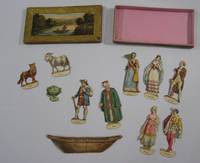
1825ref. 18320French: n.p. 1825. Very good. 11 engraved cut-out figures or objects including ferryman three couples wolf goat cabbage and boat to be slotted into boat original box with engraved pictorial label colored by hand A rare children's game possibly printed by the Parisian publisher Nepveau. Contained in the box measuring 14cm x 7cm x 1cm is a complete set of figures for the two river crossing puzzles known as the 'Jealous Husbands Problem' and 'Goat Wolf and Cabbage'. The earliest account of these puzzles is in the 9th century manuscript "Propositionnes ad Acuendos Juvenes" Problems to Sharpen the Young attributed to Alcuin. In both puzzles there are only two places in the boat. In the Jealous Husbands Problem no woman can be with another man unless also accompanied by her husband. In Goat Wolf and Cabbage the wolf will eat the goat and the goat will eat the cabbage unless they are guarded by the boatman. Originally accompanied by counters and an instruction sheet now lost. The box is lightly worn else in very good condition; the figures are in fine condition except the boat which has been repaired and the cabbage which lacks the lower part of its insertion tab and one female figure lacks a hand. Rare. n.p. unknown
1825ref. 18320French: n.p. 1825. Very good. 11 engraved cut-out figures or objects including ferryman three couples wolf goat cabbage and boat to be slotted into boat original box with engraved pictorial label colored by hand A rare children's game possibly printed by the Parisian publisher Nepveau. Contained in the box measuring 14cm x 7cm x 1cm is a complete set of figures for the two river crossing puzzles known as the 'Jealous Husbands Problem' and 'Goat Wolf and Cabbage'. The earliest account of these puzzles is in the 9th century manuscript "Propositionnes ad Acuendos Juvenes" Problems to Sharpen the Young attributed to Alcuin. In both puzzles there are only two places in the boat. In the Jealous Husbands Problem no woman can be with another man unless also accompanied by her husband. In Goat Wolf and Cabbage the wolf will eat the goat and the goat will eat the cabbage unless they are guarded by the boatman. Originally accompanied by counters and an instruction sheet now lost. The box is lightly worn else in very good condition; the figures are in fine condition except the boat which has been repaired and the cabbage which lacks the lower part of its insertion tab and one female figure lacks a hand. Rare. n.p. unknown books
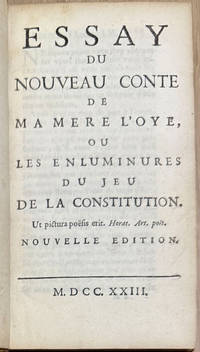
1723ref. Debonnaire1723GAME OF THE GOOSE Essay du nouveau conte de ma Mère l'Oye ou les enluminures du jeu de la Constitution by Louis Debonnaire. No imprint 1723. 8vo xiii xviii 176pp; early leather boards with original spine laid down. Despite the claim that this is a new edition it is nonetheless an UNCOMMON IMITATION of the traditional "Game of the Goose" a rhymed pastiche as if spoken by Mother Goose written by a Jansenist priest Abbot wherein one must win the formation of a new Council here referred to as a Constitution. It introduced what became a familiar catchphrase "LIBERTY EQUALITY FRATERNITY" condemned in 1725 as anti-Rome. Barber III 880 No imprint hardcover
1723ref. Debonnaire1723GAME OF THE GOOSE Essay du nouveau conte de ma Mère l'Oye ou les enluminures du jeu de la Constitution by Louis Debonnaire. No imprint 1723. 8vo xiii xviii 176pp; early leather boards with original spine laid down. Despite the claim that this is a new edition it is nonetheless an UNCOMMON IMITATION of the traditional "Game of the Goose" a rhymed pastiche as if spoken by Mother Goose written by a Jansenist priest Abbot wherein one must win the formation of a new Council here referred to as a Constitution. It introduced what became a familiar catchphrase "LIBERTY EQUALITY FRATERNITY" condemned in 1725 as anti-Rome. Barber III 880 No imprint hardcover books
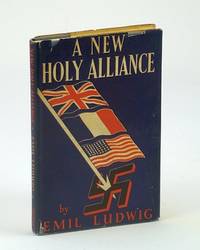
1938ref. 734G4576London: Robert Hale Limited 1938. Book. Good. Hardcover. First English Edition. 8vo - over 7¾" - 9¾" tall. 123 pages. Black and white photographic frontisplate of author. First published in German in the same year. Noteworthy for its call for a resurrection of the same two-front military alliance which was marshalled against Germany in the Great War. The following year 'Foreign Affairs Quarterly' published a review of this book endorsing this policy. - Mike King. "In July 1914 Dr. Ludwig expounded the causes and misunderstandings which led up to the Great War. The purpose of the present work is to provide a remedy for the present perilous impasse before it is too late to avert disaster." - from dust jacket. In preparing this work Ludwig confidentially sent the first 83 pages of his manuscript to Edward VIII for his corrections which were later provided by letter. Source available upon request. Bold dust jacket art depicts British/French/US spear piercing a Nazi swastika. Unmarked. Binding tight. Moderate wear to book. Somewhat above-average wear to dust jacket which is now preserved in mylar. Moderate age-toning near endpapers. Moderate foxing to edges and back half of dust jacket. A sound copy of this significant work. Robert Hale Limited Hardcover
2009ref. DADAX1934857319Catalyst Game Labs 2009-08-19. Anniversary. hardcover. New. 8.63x1.00x11.13. Buy with confidence. Excellent Customer Service & Return policy. Catalyst Game Labs hardcover