RONALD WARTOW, BRADY GAME,Biblio.com

3,388 results
1996ref. USD_9781566865746Brady 1996. 1st. Paperback. Used - Like New/Used - Like New. _ Brady paperback
1929ref. 302295Los Angeles 1929. 100 pp of typed documents and an additional 50 album leaves mounted with approximately 50 photographs various sizes and processes and various documents. Folio. Limp leatherette with title and recipient name stamped in gilt to upper cover. Large black quarter morocco clamshell box gilt. 100 pp of typed documents and an additional 50 album leaves mounted with approximately 50 photographs various sizes and processes and various documents. Folio. "It is proposed that a COMPLETE ZOOLOGICAL GARDENS be opened to the public on a fifty cent admission basis which is to be properly laid out as an attractive Zoological and Botanical Garden with the finest and largest private collection of animals birds and reptiles to be seen anywhere on the continent." The advent of the motion picture industry in California had many wide-ranging ramifications on the business world and one was that it created a new market for firms who traditionally supplied animals to circuses and zoos both public and private owned by the likes of William Randolph Hearst. This archive is a report by the Investment Auditors of California for the Horne Corporation that was looking to expand by establishing a zoological garden in the environs of Los Angeles. The Horne Corporation was the largest and most successful of its type at the time apparently the only company in the US that could completely outfit a circus with both animals and show equipment. They were to purchase the Los Angeles Zoological Garden and Jungle Studio for $250000 and thereby sought to provide a similarly complete service to the film studios with both animals and suitable locations for film sets. The head of the company I.S. Horne for whom this report was compiled commenced trading in animals from Kansas City MO around 1914. The range of animals at the their disposal included big game birds reptiles and many of the documents concern the prospect of importing reindeer from Alaska. The material is held in a presentation album and includes the certificate of incorporation in Wilmington Delaware May 13 1929 as well as the by-laws of the corporation minutes of the first meeting the proposal for Los Angeles Zoological Garden and Jungle Studio and a balance sheet. At this stage the company had total assets of $57700 & liabilities of $625388.46; an enumeration of the various animals in inventory including wildebeest sables leopard lynx Rhodesian baboons bushbaby and a large aardvark. Of real interest are the plans for the park including artist's impressions which would be furnished with circus attractions "Monkey Island" jungle setting for motion pictures and an acknowledgment that "before the introduction of the motion picture industry the art of showmanship was not quite so highly developed as it is today." In fact one of the first pictures they supplied animals for was - appropriately enough - Trader Horn which was nominated for the 1931 Academy Award for Best Picture. On a more practical level there is a "Descriptive Classification of Principal Commercial Wild Animals" which lists 340 different animals in some details. There is also an account of hunting wild animals in East Africa as well as a section on animals that have been trained to hunt by man. Furthermore there is also much correspondence which provides much insight into the game industry its clients and the prospects for its future. Horne's venture subsequently became known as the World Jungle Compound in Thousand Oaks California eventually being acquired by 20th Century Fox studios. This archive is a record of a new phase of the entertainment industry. unknown
1968ref. 80676Toledo OH: Leister Game Company 1968. First Edition; First Printing. Softcover. Very Good in wrappers.; 8vo 8" - 9" tall. Leister Game Company unknown
1874ref. 246686London: Chapman and Hall 1874. First edition secondary binding. vi 337. 1 vols. 8vo. Green cloth spine titled in gilt. Very good minor rubbing. First edition secondary binding. vi 337. 1 vols. 8vo. Tiger hunting in Central India with notes on leopard. The author "also relates numerous stories from other sportsmen focusing on hunting bear rogue elephant and the like" Czech. Czech Asia p. 2 Chapman and Hall unknown
1772ref. 28703Paris: Chez Debure l'aîne 1772. 1 vols. 8vo. Contemporary stained calf citron morocco label spine gilt. Some rubbing surface worming on lower cover else very good. 1 vols. 8vo. Commentary on the environmental and game laws. Chez Debure l'aîne unknown
1875ref. 37921Paris: M.J. & Cie 1875. 10 1/4 x 10 1/4 x 5 inches. Some minor wear. 10 1/4 x 10 1/4 x 5 inches. M.J. & Cie unknown
2025ref. __368950158XSplitter Verlag 2025. Hardcover. New. 112 pages. German language. 12.64x0.67x9.06 inches. Splitter Verlag hardcover
2026ref. __3689501180Splitter Verlag 2026. Hardcover. New. 528 pages. German language. 9.13x1.89x12.72 inches. Splitter Verlag hardcover
ref. 68269462-75SAGE Publications Limited. Used - Very Good. Pages intact with possible writing/highlighting. Binding strong with minor wear. Dust jackets/supplements may not be included. Stock photo provided. Product includes identifying sticker. Better World Books: Buy Books. Do Good. SAGE Publications, Limited unknown
ref. A9781506739601Hardback. New. hardcover
ref. B9781506739601Hardback. New. hardcover
ref. 1638610703.GGood. Access codes and supplements are not guaranteed with used items. May be an ex-library book. unknown
ref. 1638611386.Ghardcover. Good. Access codes and supplements are not guaranteed with used items. May be an ex-library book. hardcover
ref. 697029247WestBow Press . Hardback. New. pp. 184 WestBow Press hardcover
1978ref. 62356Surrey England: Spur Publications Saiga 1978. English Language Edition. Hardcover. Nr Fine/Very Good Clean Price Clipped Paper Price Label. Octavo. Two Pages in Full Colour Of Indian And Cornish Game Together With 41 Illustrations Of Prize Winning Birds And Equipment. 8.75 5.75 0.8 From the Poultry FAnciers’ Library Edited by Dr. and Mrs. J. Batty A Crisp Copy Spur Publications, Saiga hardcover
2004ref. I-478-535Productions Guy Delcourt 2004. Hardcover. Very Good. Volume 1. Ammareal gives back up to 15% of this item's net price to charity organizations. Productions Guy Delcourt hardcover
2004ref. I-478-537Productions Guy Delcourt 2004. Very Good. Volume 3. Ammareal gives back up to 15% of this item's net price to charity organizations. Productions Guy Delcourt unknown
2001ref. I-478-538Delcourt 2001. Very Good. Volume 4. Ammareal gives back up to 15% of this item's net price to charity organizations. Delcourt unknown
ref. D16OS-00436Game Designer's Workshop. Used - Very Good. Very Good condition. 1977. Revised edition. Gaming Role-playing A copy that may have a few cosmetic defects. May also contain light spine creasing or a few markings such as an owner’s name short gifter’s inscription or light stamp. Game Designer's Workshop unknown
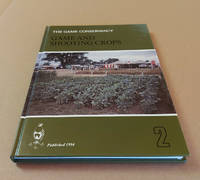
1994ref. 13290Scarce hardcover viii 97pp 4 pages of glossy colour plates numerous b&w photos in text NOT ex-library. Book is clean and bright throughout untanned with unmarked text free of inscriptions and stamps firmly bound. Issued without a dust jacket. -- This is a practical field guide to the selection establishment and management of crops grown to provide cover and feed for gamebirds produced by the advisory arm of the Game Conservancy - a body whose research into farmland ecology and game management has shaped best practice across the British countryside for decades. This second volume in the Game Advisory Guides series draws directly on that research heritage and on the hands-on experience of the Conservancy's advisory officers working with shoots and farms throughout the UK. -- This guide explains how to design establish and manage game and shooting crops on working lowland shoots. It links agronomy ecology and shoot layout showing how cover and feed crops can be built into existing rotations rather than bolted on as an afterthought. Early sections discuss how to choose and position strips and blocks in relation to drives topography and prevailing winds and how soil type drainage and previous cropping influence the choice of mixes and cultivation methods. The core of the book is a series of crop profiles that compare annual and biennial species and mixtures used to provide both shelter and seed through the shooting season and winter. Examples include tall brassicas such as kale and Texel greens and seed rich combinations based on quinoa buckwheat millet canary grass and fodder radish. For each the guide discusses sowing dates and rates fertiliser needs susceptibility to pests and disease and likely longevity alongside their value to pheasants partridges and a wide range of farmland birds. Later sections place game and shooting crops in a wider conservation and policy context. They look at how winter bird crops function as habitat for declining seed eating species how game covers can be aligned with agri-environment and stewardship schemes and how to balance sporting aims with wider biodiversity objectives. The manual continues to be cited in ecological research and is recommended reading on gamekeeping countryside management and wildlife feeding courses reflecting its ongoing relevance wherever shoots and conservation need to be planned together. Game Conservancy hardcover
2010ref. DADAX1166778517Kessinger Publishing 2010-09-10. paperback. New. 6.00x0.82x9.00. Buy with confidence. Excellent Customer Service & Return policy. Kessinger Publishing paperback
ref. DADAX1947335375Catalyst Game Labs 0000-00-00. First Edition. Paperback. New. 11.02x7.87x0.04. Buy with confidence. Excellent Customer Service & Return policy. Catalyst Game Labs paperback
ref. ria9780415706704_inpPaperback / softback. New. New Book; Fast Shipping from UK; Not signed; Not First Edition; This is the only book out there that deals with the technical details of sound for social casual mobile and cloud gaming markets. Including Unity iOS Android HTML5 and more. paperback
ref. 05401France: 1900. Les Trois Chats" A Delightfully Grotesque French Belle Époque Passé-Boules Carnival Game PASSÉ-BOULES GAME. Les Trois Chats. French hand-painted polychrome papier-mâché ball-toss carnival game. France ca. 1900. A remarkable surviving French passé-boules fairground game modeled as three wonderfully expressive cats arranged side by side each with a wide-open mouth forming the target through which the player was required to throw a ball. Hand-modelled and painted in polychrome papier-mâché over a wooden-supported structure measuring approximately 24 1/2 inches high × 23 5/8 inches wide × 5 7/8 inches deep 630 × 600 × 150 mm. The three feline heads are individually characterized with wonderfully exaggerated green eyes whiskers and large open mouths each approximately 2 1/2 inches 63 mm. across. The particularly splendid central gray cat wears a jaunty orange-and-blue striped hat prominently lettered "TOTO." The cats rest above three projecting differently colored receptacles - blue orange and yellow - with the respective scores "30" "50" and "20" painted beneath them. The higher-scoring central target is therefore appropriately occupied by the magnificently hatted Toto. The whole is reinforced by a simple wooden structure including boards at the base and upper portion while the projecting lower section forms the ball-catching receptacle. The reverse revealing the utilitarian construction of what was intended as a working fairground amusement survives substantially intact. The photographs also reveal the wonderfully irregular hand-modeled surfaces and surviving original polychrome decoration that give the three cats their extraordinary personalities. A remarkable survival of a French passé-boules carnival game from the Belle Époque. Passé-boules - literally games in which a ball was passed or thrown through an opening - were a familiar feature of French fêtes foraines and popular entertainments during the nineteenth and early twentieth centuries. Targets frequently took the form of grotesque or comic human and animal heads their exaggerated open mouths providing the aperture through which the player attempted to propel a small ball. Points were awarded according to the successful target as demonstrated here by the painted scores beneath the three cats. The present example is particularly appealing for its three anthropomorphic feline characters. Their exaggerated expressions brilliant green eyes and distinctly individual personalities inevitably recall the celebrated comic cats of Louis Wain 1860-1939. No attribution to Wain is intended but the comparison places the game delightfully within the wider late-Victorian and Edwardian fascination with humorous humanized cats. Unlike printed or manufactured toys intended for domestic use fairground games were working objects subjected to repeated handling impact transportation and exposure. Consequently early papier-mâché examples surviving substantially complete are inherently scarce. The survival here of the three original sculptural targets their painted decoration numbered scoring system and integral ball receptacle makes Les Trois Chats an unusually evocative piece of French popular entertainment. Its appeal lies equally as a folk-art sculpture fairground artifact and piece of feline whimsy: three gloriously eccentric cats who have apparently spent more than a century waiting for someone to throw a ball into their mouths. Provenance: Acquired in Paris directly from the family of the former owner by whom it was said to have descended from a grandparent who acquired the game around the turn of the twentieth century. France: , 1900 unknown
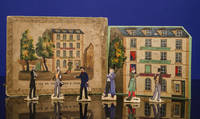
ref. 04338Paris: H. Duru 1840. A Remarkable Survival H. Duru's Apparently Unrecorded Le Jeu du Portier Complete with All Six Hand-Colored Standing Figures and the Original Pictorial Box FRENCH GAME. DURU H. publisher. Le Jeu du Portier. The Doorman's Game. Paris: H. Duru ca. 1840. An exceptionally rare early French hand-colored lithographed game complete with the original architectural playing board all six numbered standing figures and the original pictorial card box. Original hand-colored lithographed board depicting the façade of a Parisian multi-story house 8 3/4 x 6 3/4 inches; 222 x 172 mm. the upper right corner beveled as issued. Six original hand-colored lithographed cut-out figures each mounted on its original base average size 3 1/8 x 1 1/4 inches; 80 x 32 mm. Complete in the original card box the lid bearing a hand-colored lithograph depicting the same multi-story house and titled beneath "LE JEU DU PORTIER PAR H. DURU." The board and figures in near fine condition; the box somewhat soiled with the corners strengthened with cloth tape. A remarkable survival in substantially complete original condition. The architectural board represents a vertically organized Parisian apartment house its occupants and businesses identified floor by floor. It is lettered from top to bottom: "No. 6"; "No. 5 / Locart Fnt Lunetier au 3me"; "No. 4 / F. Sonnet M.de Dentelles"; "No. 3 / Clagmann et Cie. Banquiers"; "No. 2"; and "No. 1 / Loge du Portier." The six accompanying figures correspond to the numbered hierarchy of the building and are identified as: 1. Le Portier the doorman or concierge; 2. Propriétaire proprietor or landlord; 3. Banquier banker; 4. Marchand merchant; 5. Fabricant manufacturer; and 6. Ouvrier worker. The original printed numbers and occupational designations remain visible on the bases of the figures. The figures form a delightful miniature gallery of French social types: the prosperous Propriétaire in his vividly patterned blue coat; the top-hatted Banquier; the fashionably dressed Marchand carrying his hat; the Fabricant; the plainly dressed Ouvrier; and the Portier the indispensable guardian of the building. Their original hand-coloring remains remarkably fresh. More than simply a children's amusement Le Jeu du Portier presents in miniature a fascinating picture of nineteenth-century Parisian urban life and social hierarchy. Proprietor banker merchant manufacturer workman and concierge are transformed into movable characters associated with a single apartment house. The game belongs to the particularly appealing nineteenth-century tradition in which children's toys simultaneously entertained and introduced their young players to occupations social distinctions and the organization of contemporary life. The choice of the portier as the central character is especially evocative. Occupying the loge at street level the Parisian concierge stood literally at the entrance to the social world represented by the building controlling access and observing the comings and goings of its occupants. The numbered inhabitants ascending through the building consequently provide an engaging physical representation of the social structure of nineteenth-century Paris. H. Duru was a Parisian publisher active in the production of illustrated educational works children's books puzzles and games during the middle decades of the nineteenth century. Among Duru's publications were Nouvelle méthode de lecture progressive ou Lecture apprise en quarante jours Syllabaire universel en action Les homonymes illustrés Grammaire illustrée and Alphabet chantant. Duru's activity as a publisher of games is independently confirmed by another lithographed production Le Jeu du Touriste preserved in the collection of the Musée des Civilisations de l'Europe et de la Méditerranée Mucem. The survival of the six separate standing figures together with their architectural board and original pictorial box is exceptional. The standing figures are of particularly delicate construction consisting of thin lithographed card cut-outs mounted upright on their original bases - ephemeral playthings never intended to survive nearly two centuries of use. We have been unable to locate another example of Le Jeu du Portier in OCLC or in the institutional collections and published references consulted. Apparently unrecorded and possibly unique in this complete state. A remarkable and highly evocative survival of an early French children's game combining hand-colored lithography three-dimensional play and a wonderfully detailed representation of nineteenth-century Parisian social life. Paris: H. Duru, 1840 unknown