4.361 Ergebnisse
Large 8vo. XVII, (3), 113, (3), 407, (1) pp. With 3 lithogr. plates. Contemporary red cloth with giltstamped spine title; original blue wrappers bound within. First modern edition of the original Arabic text of "Al Hidayah ila Faraid al-Qulub" ("Guide to the Duties of the Heart"), written in 1080 by the Jewish philosopher Bahya ibn Paquda, who lived at Zaragoza, in Muslim Spain. The work offers the first Jewish system of ethics and was translated into Hebrew by Judah ibn Tibbon in 1161-80 ("Chovot ha-Levavot"). It is based on numerous non-Jewish sources, including writings of Islamic mysticism and Arabic neo-Platonism. Yahuda's edition uses mss. in the libraries of Oxford, Paris, and St Petersburg. - In excellent condition. Herlitz IV/2, 1521. OCLC 3117215.
4o. 294, (1) pp., final blank page. With a full-page map of Palestine not included in pagination, 2 full-page plans of Jerusalem included in pagination, and several small print illustrations in the text. Contemporary half calf over marbled boards with giltstamped spine and spine-title. Marbled endpapers. Fourth edition of this description of a journey through Palestine by the French painter and writer Bazelaire (1857-1926), first published in 1889. In April 1888 she boarded a ship with a group of pilgrims, which, after a stop in Civitavecchia, from where she visited Rome, dropped anchor in Haifa. Accompanied by her brother Maurice (1840-1909) and her sister Isabelle (1847-89) she departed on horseback to tour the country for a month. Her emotional account describes the places they visited, including Mount Carmel, Nazareth, Tibériade, Jerusalem ("Am I really in Jerusalem, or is it but a dream about to fade away?", p. 129), Mount Olivet, Jericho, the Dead Sea, Bethlehem, Hebron, and the Valley of Josaphat. Among other adventures, a night spent locked in the Church of the Holy Sepulchre near Jesus's empty tomb inspired a particular sense of awe: "It is a night as long as a century, and as short as all joys in the world! [...] All those who have seen Jerusalem know and understand these things, I invoke all pilgrims!" (pp. 253f.). - The initials and illustrations accompanying the text were created by Bazelaire herself. The plans show the old and new towns of Jerusalem. - Extremities insignificantly rubbed; small flaw to spine. Paper somewhat browned and brownstained throughout. A pressed palm leaf is inserted between pp. 124 and 125. Hage Chahine, Guide du livre orientaliste 359. OCLC 1083265900. Cf. Ueckmann, Frauen und Orientalismus 359 (1899 ed.). Kuhn, Orientalische Bibliographie VI, 4225 (1892 ed.). Not in Weber, Cox, Graesse.
8vo. (6), X, 166 pp. Contemporary full calf with giltstamped spine and giltstamped spine-label. All edges marbled. Marbled endpapers. First edition. French translation of the "Vasiyetname", the Turkish catechism by the Hanafi Maturidi scholar and moralist Imam Birgivi (1522-73), who lived during the height of the Ottoman Empire. Edited by the French orientalist Garcin de Tassy (1794-1878). Invoking honesty, devotion, unity and fraternity, the "Vasiyetname" was directed at the common people, and was therefore written in Kaba Türkçe, a simpler, vulgar version of Ottoman Turkish used by unskilled workers and farmers. - Apart from the Muslim catechism, the present volume includes a translation of the "Pend-Namèh" by Saadi Shiraazi by the same editor, and a translation of the poem "Al-Burda" by Antoine-Isaac Silvestre de Sacy (1758-1838), as well as two fairy tales from the "Anwari Soheili", the famous collection of folk tales by Bidpai ("The Falconer" and "The Bear and the Gardener"). - Binding somewhat rubbed; lightly bumped at extremities; hinges starting. A few pencil underlinings. Small portion of lower right corner of title-page torn off; tiny marginal tear to p. 33f. Traces of two removed paperclips and some ink dashes to half-title. Decorative contemporary bookplate in Arabic to front pastedown. Shelfmark stamped to half-title. Two red square stamps to title-page, another to first page of the preface and first page of the "Exposition". OCLC 165361693.
Hand-coloured engraved map (365 x 260 mm). Detailed map of Saudi Arabia, the Red Sea, Persian Gulf, etc. Rigobert Bonne was the Official Hydrographer to the French Depot De La Marine. - In good condition. Not in Tibbetts, Al Ankary and Al-Qasimi.
8vo. (8), VIII, 400 pp. Modern half calf with giltstamped title to spine. First English edition. Book 1 contains a description of Arabia, as well as of Mecca and Medina; books 2 and 3 contain Mohamed's genealogy and biography. The historian Henri de Boulainvilliers (1658-1722), translator of Spinoza's "Ethics", wrote on topics so diverse as astrology, physics, philosophy and theology, though many of his writings were not printed until after his death. For his neutral reasoning, his works were cited by subsequent writers who would prove influential in the development of Western political thought and historical research. - Short tear to title page repaired; some browning and brownstaining throughout. From the library of the British philosopher of religion, David Arthur Pailin (b. 1936), with his bookplate and copious notes laid in. Chauvin XI, p. 149, no. 477. BMC 3:1075.635. Cf. Aboussouan 153 (Amsterdam, 1731). NYPL Arabia coll. 164.
18384to. 3 vols. With 3 engraved title-pages, 2 engr. maps, and 113 (instead of 117) plates. (4), 80 pp. 76 pp. 100, (4) pp. Contemporary cloth. First edition. The attractive views of Alexandria, Antioch, Beirut, Damascus, Jaffa, Jerusalem, Rhodes, Tripoli etc. are engraved from drawings by W. H. Bartlett, W. Purser and others. - Slightly rubbed and bumped, spine faded and with small tears. Blackmer 291. Aboussouan 187. Weber I, 1125. Cf. Howgego II, E4 (p. 194). Tobler 167.
8vo. (2), 78, (6) pp. With an engraved folding map of the Arabian Peninsula, 3 engraved folding plates, and an engraved title-vignette. Later full cloth. Rare first Dutch edition of the travelogue of a 16th-century sea voyage around the Arabian Peninsula. Castro's voyage took him from Socotra up the Red Sea. He landed on both the African and the Arabian coast before reaching Suez; his account includes descriptions of the various ports he encountered en route as well as observations on the naming of the Red Sea. - Dom João de Castro (1500-48) was a naval officer and later Viceroy of Portuguese India. In 1538 he embarked on his first voyage to India, arriving at Goa and immediately proceeding to the defense of Diu. Castro was responsible for the overthrow of Mahmud, King of Gujarat, whose interests threatened Portuguese control of the Goan coast. Castro died in Goa in 1548 and was initially buried there, but his remains were later exhumed and transferred to Portugal. - Traces of glue near the gutter of the title-page, but a good copy in a modern binding. Only three copies traceable in auction records. BMC V, 168:149. OCLC 224637211. Cf. Scholberg, Bibliography of Goa & the Portuguese in India, DC7. Avila Perez 1562. Welsh 4780 (other eds.).
8vo. IX, (5), 333, (1) pp. With 8 plates. Yellow cloth with title information in blue on front cover and spine, with a dust jacket designed by Paul Wenck, map of Ethiopia and Arabia on the endpapers. First edition of Coon's account of his experiences in Ethiopia and Arabia. From 1933 to 1934 Coon travelled through Ethiopia to conduct physical anthropological research, but after conflicts with the authorities he had to escape to Arabia. He states in his foreword that the purpose of the present work is a memoir, since it was not meant to "impress the public with our scientific findings, for, interesting as these results may or may not be, they are reserved for more formal publication", but simply to tell what he and two others did during the expedition. C. S. Coon (1904-81) was an American anthropologist and professor of anthropology at Harvard University and the University of Pennsylvania. He spoke ten languages and made notable contributions to the fields of cultural and physical anthropology and archaeology. He was the author of multiple works, including highly controversial works on race, such as "The Origin of Races" (1962), which were widely disputed during his lifetime and are considered pseudoscientific by modern anthropology. - Dust jacket somewhat damaged, covered with clear protective plastic, edges foxed. Otherwise in very good condition. Macro 747. Shapero, The Islamic World (2003), 178. Sotheby's, Burrell sale, lot 889.
8vo. 2 parts in 1 volume. VI, 202 pp. VI, 114 pp. Modern orange cloth. Second German edition (the original French edition appeared in 1851); an English translation was published in 1863. The book is divided into two parts and includes extensive information on the principles of Arabian cavalry, military costumes of horsemen, celebrated Arabian horse breeds (Haymour, Bou-ghareb, Meizique), how to choose and acquire your horse, nutrition, hygiene, the meaning of the variously coloured horse attires, rigging, veterinarian medicine and illnesses, crippledness, castration, various kinds of military attacks in the deserts and how to execute them, tribal wars, as well as ostrich, gazelle, and falcon hunting. The book concludes with general remarks on the Sahara desert and a letter from the Algerian Sufi saint and military and religious leader Abd-el-Kader (1808-83), the Emir of Mascara who founded the Algerian state and led the Algerians in their struggle against French domination and in 1847 was imprisoned with his family by the French government in the fortress of Lamalgue in Toulon (France). The Emir wrote the letter while Daumas served as French consul in Mascara. In this letter the Emir, calling himself Daumas' friend, answers some questions Daumas previously asked him while preparing this book. - The French cavalry general Melchior Joseph Eugène Daumas (1803-71) was "directeur des affaires d'Algerie" and also served as Minister of War. "De 1837 à 1839, il avait rempli, auprès d'Abd-el-Kader, à Mascara, les fonctions de consul, et en 1847 il fut chargé d'une mission spéciale auprès de l'Emir, alors détenu au fort Lamalgue, à Toulon. Ces relations amicales expliquent la part prise par Abd-el-Kader à certains ouvrages du Général Daumas" (Mennessier de la L.). - Some annotations in coloured pencil. Old handwritten ownership "Berkovich" to title and preface. Title-page and table of contents professionally repaired. Cf. Mennessier de la Lance I, 348. Huth 178. Not in Fromm.
Oblong 4to (244 x 232 mm). XVI, 152 pp. Illustrated throughout. Original pebbled brown cloth, titled in gilt on front cover. A rare Zionist publication on anti-Israeli propaganda, in English and Hebrew throughout, issued in the wake of the first two tumultuous years of statehood. Prolifically illustrated with facsimiles of contemporary photographs, posters, and cartoons and quoting extensively from Arab newspapers translated into Hebrew and English, the author presents a snapshot the political climate and high tensions of 1950 through a curated collection of contemporary sources, most from Arab media outlets in Egypt, Syria, and Lebanon. - Light wear, binding delicate. Interior bright and clean. OCLC 19160797.
2 vols. 8vo. (4), XI, (1), XXV, (26)-264, (2) pp. (4), 259, (1) pp. With 2 engr. frontispieces and 6 engr. plates, all in contemp. colour. Contemp. marbled half calf with double giltstamped spine labels. Marbled endpapers. Third edition. - Drouville was a cavalry officer who went to Persia in the service of the Tsar and spent three years there. His vivid account of Persian manners, customs, and military organisation contains charming costume plates in contemporary colour. - Occasional minor brownstaining; professional repairs to spine-ends. Hage Chahine 1413. Wilson 62. Graesse II, 435. Cf. Howgego II, G2 (1st and 2nd ed.). Henze II, 97. Lipperheide Lc 9. Colas 901. Hiler 249 (all for the 1825 second ed. 1825 only). Schwab 144. Diba Collection p. 180 (first ed.).
Varnished wood. 335 x 35 mm. Maps printed on both sides, with calendar for 1894 in gold on black on both sides of the finial. "This desk accessory, designed for use as a map page turner or letter opener/paper knife, was a promotional item for The Eastern Telegraph Company Limited and The Eastern Extension Telegraph Company Limited. Based in London, these companies were part of a network creating communication routes around the UK and across the Atlantic in the late 1800s ... The blade of this wooden object is decorated with varnished sections of a world map, including Australia, with red lines indicating international land and sea telegraph lines" (Description of a similar example in the Queensland Museum, Registration no. H47766). - In very good condition.
17704to. (6), 374, (174) pp. With engr. publisher's device on t. p. Contemp. half calf with giltstamped red label to gilt spine. All edges red. Re-issue of the 1733 4th edition (first published in 1620). "An important addition is Schultens' 'Clavis dialectorum', in which he discusses the lexicological relation between Hebrew and Arabic. Another new feature is the anthology of proverbs entitled 'Al-Nawabig' [...] The indexes are this time predominant, for Arabic alone 142 pages" (Smitskamp). Erpenius (1584-1624), professor of oriental languages at Leiden, is regarded as "one of the men whom the study of oriental languages owes its resurrection" (cf. ADB). His own private printing shop, equipped with Hebrew, Arabic, Syrian, Ethiopian, and Turkish type, produced its first specimens as early as 1615. - Some slight browning and brownstaining throughout due to paper. Contemporary bibliographical note to front flyleaf; ms. ownership "Fuchs" to pastedown. Smitskamp, PO 76. Schnurrer 108. Gay 3400. Brunet II, 1050. Graesse II, 499. Ebert 6914.
8vo. XIV,188 pp. With portrait frontispiece and plates. Original pictorial cloth, gilt. First edition. - Some foxing, rubbed.
8vo. 40 pp. With woodcut vignette at the end. Boards. First edition of Hammer's German translation of this Persian verse epic. A good copy showing very little browning. Graesse III, 206. Goedeke VII, 766, 84. OCLC 29890924.
8vo. (2), 15, (5) pp. With 12 plates. Original printed wrappers. Study of Mediaeval Arabic hunting methods, by the curator of the Museum of Arab art, Cairo, and published by the Egyptian Ministry of Education. Well-preserved copy. OCLC 67900862.
Folio (254 x 400 mm). (1) f., 14 cols., (1) p. (= 5 ff. in all). Modern blue-grey paper covers. First Dutch edition. Edward Heynes' account of the first successful attempt of the British (the third altogether) at establishing trading privileges with Mocha and a commercial presence there, previously published in English within the first volume of Samuel Purchas' collection "Hakluytus Posthumus, or Purchas his Pilgrimes" (1625). - The ship "Anne Royall", captained by Andrew Shilling, sailed in April 1618 up the Red Sea and visited Mocha from April 11 till August 20. Heynes, secretary to Sir Thomas Roe, gives an extensive account of the reception by the governor of Mocha, customs of the population, and prospects of commerce. "[The] British delegation lands, and presents the governor with six yards of broadcloth stammell, six yards of green material, a shotgun and mirror. It is striking that the British respond to their hosts' food gifts with gifts of technology. This form of reciprocity sends a message of power, for not only does it reflect the greater sophistication of their economy, it also implies that the Yemenites are no match militarily" (Malkiel, p. 10). Includes a short account of a trip made by Heynes' fellow-merchant Joseph Salbank to Sinan. - Published as part 18 of the series "Wijd-beroemde Voyagien na Oost- en West-Indiën, gedaan door de Engelschen", with a detailed index. Slight foxing throughout, but on the whole well preserved. Tiele 8. Cf. David Malkiel, Strangers in Yemen (Berlin/Boston 2021), p. 9-11. Not in Henze, Howgego, Cox etc.
Large 8vo. 2 parts in 3 vols. XX, 299, (135) pp. XII, 467, (1) pp. XII, 668, (8) pp. With 4 folding tables and 1 folding lithographed map of the Military Frontier. Contemporary giltstamped full calf with charmingly giltstamped spine; leading edges gilt. All edges gilt. Marbled pastedowns. First edition. - Elaborate study of the "Militärgrenze" (Military Frontier), a borderland of Imperial Austria set up for national defence against the Ottoman Empire, by Hietzinger (1786-1864), a civil servant in the Court Council of War. "Of lasting historical value" (cf. Wurzbach). The map shows the area of the Military Frontier as well as the positions of the infantry and cavalry regiments stationed there. The folding tables provide details on the size and population density of the area, various 18th century organisational reforms, as well as temperature and minerals of the Baths of Mehadia (Baths of Hercules) in modern Romania. The first part was published with a dedication to Archduke Ludwig Joseph of Austria, a younger brother of Emperor Franz Joseph I. The index of subscribers in volume I, sometimes bound after the XX pp. of preliminaries, is bound at the end of the present copy. Author's initials and shelfmarks to the flyleaves of all three volumes. - A few paper flaws to the index of volume I, not touching text. A very well preserved, appealingly bound copy. From the library of the Viennese collector Werner Habel, with his stamped and signed ownership to flyleaves, dated 1977. Kayser III, 142. Wurzbach IX, 8f. (misquoting the title).
Small 8vo. 8, 328 pp. With 64 colour lithographed plates of maps and diagrams. Original light brown cloth bearing elaborate Ottoman Art Nouveau designs. This edition of Hilmi's "Pocket Atlas" captures the Ottoman Empire during the twilight of the Hamidian Era, when it still controlled territories on three continents, extending from Albania to Yemen. With 64 highly attractive colour lithographic plates, the atlas features an especially extensive collation of thematic maps and diagrams, more that we have encountered in other issues, including detailed maps of the empire's various vilayets. Notably, the book's coverage of the Arabian Peninsula is excellent, with a double-page map of the entire peninsula; a custom map of the route of the Hejaz Railway (due to be extended as far south as Medina in 1908); a map of the Basra Vilayet (with southern Iraq, Kuwait, Bahrain and Qatar, as well as parts of today's Saudi Arabia); as well as separate maps of Yemen and Asir. - Ibrahim Hilmi Cigiracan (1876-1963) was one of the most important publishers and cartographers of the late Ottoman Empire. Born in Tulcea (now in Romania), he founded his first printing shop in Istanbul in 1896, under the name "Kitaphane-i Islami" (Islamic Library), largely producing religious books. Subsequently, Hilmi became interested in military affairs, geography and history, and changed the name of his press to "Kitaphane-i Islam ve Askeri" (Islamic and Military Library). He published about 200 military books, and his atlases (especially his "Pocket Atlas") were among the most popular cartographic items throughout the empire. During WWI, Hilmi gained the affection of the public for his charitable programme of sending free books to poor children in Anatolia. - Hilmi's enterprise thrived until Atatürk's Republican regime nationalized the publishing of law and school books in the 1920s, undercutting the most lucrative part of his business. However, Hilmi left an enduring legacy, having published over a thousand books on a wide variety of topics over three decades. - Binding worn with a few chips of minor loss, especially along hinges, but holding firm; old repairs to lower margin of upper cover. Internally light, even toning to text pages and some marginal chips to few leaves and plates, not affecting printed area. Maps generally clean and bright, just some offsetting to 4 maps. A fine edition. OCLC 1014526531.
Colour lithographed postcard, 130 x 90 mm. This very rare Ottoman postcard features a map of the Northern Arabian Gulf, including what is today Qatar, Bahrain, the Saudi Arabian Gulf Coast (including Dhahran), Kuwait, Southern Iraq (including Basra), as well as south-western Iran. Interestingly, it shows the Arab Gulf States as being part of the Ottoman Empire, when in reality they were already British Protectorates. The card was part of a series made by Ibrahim Hilmi, one of the premier Istanbul cartographers of the era. - Ibrahim Hilmi Cigiracan (1876-1963) was one of the most important publishers and cartographers of the late Ottoman Empire. Born in Tulcea (now in Romania), he founded his first printing shop in Istanbul in 1896, under the name "Kitaphane-i Islami" (Islamic Library), largely producing religious books. Subsequently, Hilmi became interested in military affairs, geography and history, and changed the name of his press to "Kitaphane-i Islam ve Askeri" (Islamic and Military Library). He published about 200 military books, and his atlases (especially his "Pocket Atlas") were among the most popular cartographic items throughout the empire. During WWI, Hilmi gained the affection of the public for his charitable programme of sending free books to poor children in Anatolia. - Hilmi's enterprise thrived until Atatürk's Republican regime nationalized the publishing of law and school books in the 1920s, undercutting the most lucrative part of his business. However, Hilmi left an enduring legacy, having published over a thousand books on a wide variety of topics over three decades. - Very good, overall clean and crisp, just some very light even toning to verso.
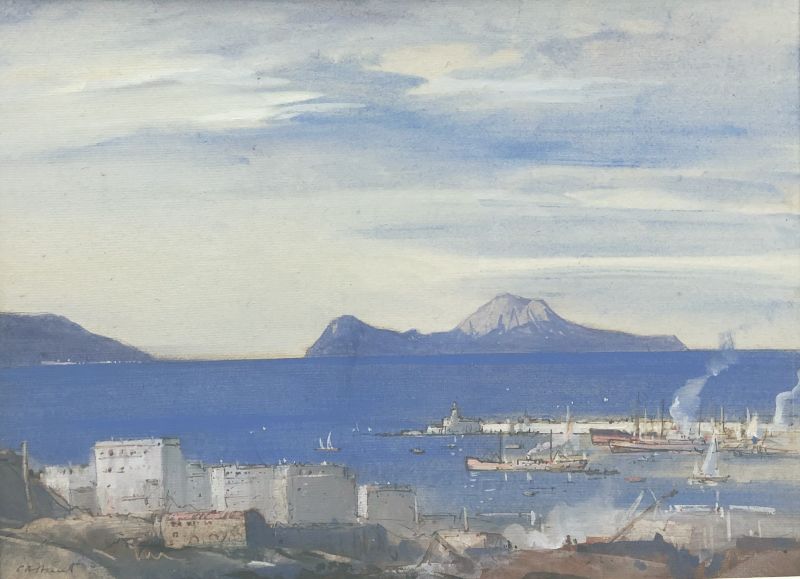
Best.-Nr. 2201701. Hälfte 20. Jh. Signiert "CA Hunt", verso eigenh. bezeichnet "`Capri`: Bay of Naples". 29,3 x 39 cm
17394to. (2), 56, (2) pp. With engr. printer's device on t. p. Disbound. University oration on the Arabic language, its age, beauty, and usefulness, held by the noted Arabic scholar Thomas Hunt (1696-1774). Hunt studied at Christ Church, Oxford, and was chaplain to Thomas Parker, 1st Earl of Macclesfield. In 1738, he became the fourth Laudian Professor of Arabic, additionally becoming Lord Almoner's Professor of Arabic in 1740 (the year in which he was elected a Fellow of the Royal Society) and Regius Professor of Hebrew in 1747. - Many type specimens in Arabic, as well as some in Greek, Hebrew, and Syriac. Trimmed rather closely. Some foxing near beginning and end; t. p. shows punched library ownership ("Philadelphia Divinity School") and shelfmarks. Schnurrer 12. OCLC 27855095.
4to. 2 vols. 32 pp. 30 pp. Illustrated throughout with photo illustrations and sketch maps. Original pictorial wrappers, second volume ring-bound. Issued in tandem with the Basrah Petroleum Co. Ltd. and the Mosul Iraq Petroleum Co. Ltd., these volumes, which seem to have appeared yearly from 1951, offer information on the development of the industry over the year. Both volumes contain a Foreword by the Managing Director H. S. Gibson, followed by illustrations and information concerning the oil produced. The books are nicely produced, and in very good condition.
1935Folio (280 x 360 mm). 2 parts in 2 vols. (4), XVI, 262 pp. (2), 263-555, (1) pp. With large colour map, 169 plates (15 in colour, including 13 large portolan facsimiles) and 95 text illustrations. Contemporary half cloth with original printed covers and spines. Important study of Near-Eastern travel routes, also including Mecca and oriental cartography. Only vol. 2 (out of 3, published 1929-52), published as no. 16 in the series "Mémoires de la Société Royale de Géographie d'Égypte". Inscribed and signed on the title page by the author to the French psychiatrist Pierre Janet (1859-1947): "A Monsieur le Dr. Pierre Janet membre de l'Institut en témoinage de haute estime et d'admiration [...]" (Paris, 7 Nov. 1937); Janet's autograph ownership on front flyleaf. Janet, a great bibliophile, was a member of the Institut de France since 1913; he is credited with coining the words ‘dissociation’ and ‘subconscious’ and was an important forerunner of Sigmund Freud. - Spine of the first volume beginning to split; covers show slight staining (more pronounced in second volume), with occasional browning to margins. Macro, Bibliography of the Arabian Peninsula, 1339. Henze II, 315 (s. v. Estevâo da Gama). OCLC 2891592.
1840Pencil drawing on paper (168 x 252 mm), mounted on tawny backing with inked border, autogr. caption, and signatures. Matted (390 x 312 mm). A pretty view of the Austrian Embassy Palace in Constantinople (Istanbul). The background shows a mosque and the Bosporus with ships, with a few human figures in the foreground. Signed at the bottom right on the backing paper: "Albrecht Krafft mpr", with the signature of "Joh. von Wörndle mpr" opposite (probably the like-named construction administrator of Vienna's imperial palace, whose sons Edmund and August both were to become important painters trained at the Vienna Academy of Arts). - The Viennese orientalist Krafft was admitted to the famous Oriental Academy at the age of 19; here, he catalogued the library's oriental mss. and studied Armenian and Hebrew. His lasting achievement is considered to be his catalogue of Arabic, Persian, and Turkish mss. at the Academy. However, Albrecht Krafft, son of the Viennese portrait painter Peter Krafft (who had studied with Tischbein and Füger), was also a gifted dilettante painter who had attended the Academy of Arts simultaneously with grammar school, thus obliging his father's wishes before he followed his own inclinations and turned towards oriental scholarship (cf. Wurzbach XIII, 99). "Only the first volume of his projected 10-volume catalogue raisonnée of the Imperial Gallery at the Belvedere Palace was published (in 1837) - an excellent achievement for its time [...] Parthey, in his 'Deutscher Bildersaal', lists three paintings copied by the younger Krafft" (cf. Thieme/B. XXI, 384). - A few edge defects of the backing paper have been professionally restored.