Hammer-Purgstall, Joseph von.MareMagnum

4497 risultati
8vo. 40 pp. With woodcut vignette at the end. Boards. First edition of Hammer's German translation of this Persian verse epic. A good copy showing very little browning. Graesse III, 206. Goedeke VII, 766, 84. OCLC 29890924.
8vo. (2), 15, (5) pp. With 12 plates. Original printed wrappers. Study of Mediaeval Arabic hunting methods, by the curator of the Museum of Arab art, Cairo, and published by the Egyptian Ministry of Education. Well-preserved copy. OCLC 67900862.
Folio (254 x 400 mm). (1) f., 14 cols., (1) p. (= 5 ff. in all). Modern blue-grey paper covers. First Dutch edition. Edward Heynes' account of the first successful attempt of the British (the third altogether) at establishing trading privileges with Mocha and a commercial presence there, previously published in English within the first volume of Samuel Purchas' collection "Hakluytus Posthumus, or Purchas his Pilgrimes" (1625). - The ship "Anne Royall", captained by Andrew Shilling, sailed in April 1618 up the Red Sea and visited Mocha from April 11 till August 20. Heynes, secretary to Sir Thomas Roe, gives an extensive account of the reception by the governor of Mocha, customs of the population, and prospects of commerce. "[The] British delegation lands, and presents the governor with six yards of broadcloth stammell, six yards of green material, a shotgun and mirror. It is striking that the British respond to their hosts' food gifts with gifts of technology. This form of reciprocity sends a message of power, for not only does it reflect the greater sophistication of their economy, it also implies that the Yemenites are no match militarily" (Malkiel, p. 10). Includes a short account of a trip made by Heynes' fellow-merchant Joseph Salbank to Sinan. - Published as part 18 of the series "Wijd-beroemde Voyagien na Oost- en West-Indiën, gedaan door de Engelschen", with a detailed index. Slight foxing throughout, but on the whole well preserved. Tiele 8. Cf. David Malkiel, Strangers in Yemen (Berlin/Boston 2021), p. 9-11. Not in Henze, Howgego, Cox etc.
Large 8vo. 2 parts in 3 vols. XX, 299, (135) pp. XII, 467, (1) pp. XII, 668, (8) pp. With 4 folding tables and 1 folding lithographed map of the Military Frontier. Contemporary giltstamped full calf with charmingly giltstamped spine; leading edges gilt. All edges gilt. Marbled pastedowns. First edition. - Elaborate study of the "Militärgrenze" (Military Frontier), a borderland of Imperial Austria set up for national defence against the Ottoman Empire, by Hietzinger (1786-1864), a civil servant in the Court Council of War. "Of lasting historical value" (cf. Wurzbach). The map shows the area of the Military Frontier as well as the positions of the infantry and cavalry regiments stationed there. The folding tables provide details on the size and population density of the area, various 18th century organisational reforms, as well as temperature and minerals of the Baths of Mehadia (Baths of Hercules) in modern Romania. The first part was published with a dedication to Archduke Ludwig Joseph of Austria, a younger brother of Emperor Franz Joseph I. The index of subscribers in volume I, sometimes bound after the XX pp. of preliminaries, is bound at the end of the present copy. Author's initials and shelfmarks to the flyleaves of all three volumes. - A few paper flaws to the index of volume I, not touching text. A very well preserved, appealingly bound copy. From the library of the Viennese collector Werner Habel, with his stamped and signed ownership to flyleaves, dated 1977. Kayser III, 142. Wurzbach IX, 8f. (misquoting the title).
Small 8vo. 8, 328 pp. With 64 colour lithographed plates of maps and diagrams. Original light brown cloth bearing elaborate Ottoman Art Nouveau designs. This edition of Hilmi's "Pocket Atlas" captures the Ottoman Empire during the twilight of the Hamidian Era, when it still controlled territories on three continents, extending from Albania to Yemen. With 64 highly attractive colour lithographic plates, the atlas features an especially extensive collation of thematic maps and diagrams, more that we have encountered in other issues, including detailed maps of the empire's various vilayets. Notably, the book's coverage of the Arabian Peninsula is excellent, with a double-page map of the entire peninsula; a custom map of the route of the Hejaz Railway (due to be extended as far south as Medina in 1908); a map of the Basra Vilayet (with southern Iraq, Kuwait, Bahrain and Qatar, as well as parts of today's Saudi Arabia); as well as separate maps of Yemen and Asir. - Ibrahim Hilmi Cigiracan (1876-1963) was one of the most important publishers and cartographers of the late Ottoman Empire. Born in Tulcea (now in Romania), he founded his first printing shop in Istanbul in 1896, under the name "Kitaphane-i Islami" (Islamic Library), largely producing religious books. Subsequently, Hilmi became interested in military affairs, geography and history, and changed the name of his press to "Kitaphane-i Islam ve Askeri" (Islamic and Military Library). He published about 200 military books, and his atlases (especially his "Pocket Atlas") were among the most popular cartographic items throughout the empire. During WWI, Hilmi gained the affection of the public for his charitable programme of sending free books to poor children in Anatolia. - Hilmi's enterprise thrived until Atatürk's Republican regime nationalized the publishing of law and school books in the 1920s, undercutting the most lucrative part of his business. However, Hilmi left an enduring legacy, having published over a thousand books on a wide variety of topics over three decades. - Binding worn with a few chips of minor loss, especially along hinges, but holding firm; old repairs to lower margin of upper cover. Internally light, even toning to text pages and some marginal chips to few leaves and plates, not affecting printed area. Maps generally clean and bright, just some offsetting to 4 maps. A fine edition. OCLC 1014526531.
Colour lithographed postcard, 130 x 90 mm. This very rare Ottoman postcard features a map of the Northern Arabian Gulf, including what is today Qatar, Bahrain, the Saudi Arabian Gulf Coast (including Dhahran), Kuwait, Southern Iraq (including Basra), as well as south-western Iran. Interestingly, it shows the Arab Gulf States as being part of the Ottoman Empire, when in reality they were already British Protectorates. The card was part of a series made by Ibrahim Hilmi, one of the premier Istanbul cartographers of the era. - Ibrahim Hilmi Cigiracan (1876-1963) was one of the most important publishers and cartographers of the late Ottoman Empire. Born in Tulcea (now in Romania), he founded his first printing shop in Istanbul in 1896, under the name "Kitaphane-i Islami" (Islamic Library), largely producing religious books. Subsequently, Hilmi became interested in military affairs, geography and history, and changed the name of his press to "Kitaphane-i Islam ve Askeri" (Islamic and Military Library). He published about 200 military books, and his atlases (especially his "Pocket Atlas") were among the most popular cartographic items throughout the empire. During WWI, Hilmi gained the affection of the public for his charitable programme of sending free books to poor children in Anatolia. - Hilmi's enterprise thrived until Atatürk's Republican regime nationalized the publishing of law and school books in the 1920s, undercutting the most lucrative part of his business. However, Hilmi left an enduring legacy, having published over a thousand books on a wide variety of topics over three decades. - Very good, overall clean and crisp, just some very light even toning to verso.
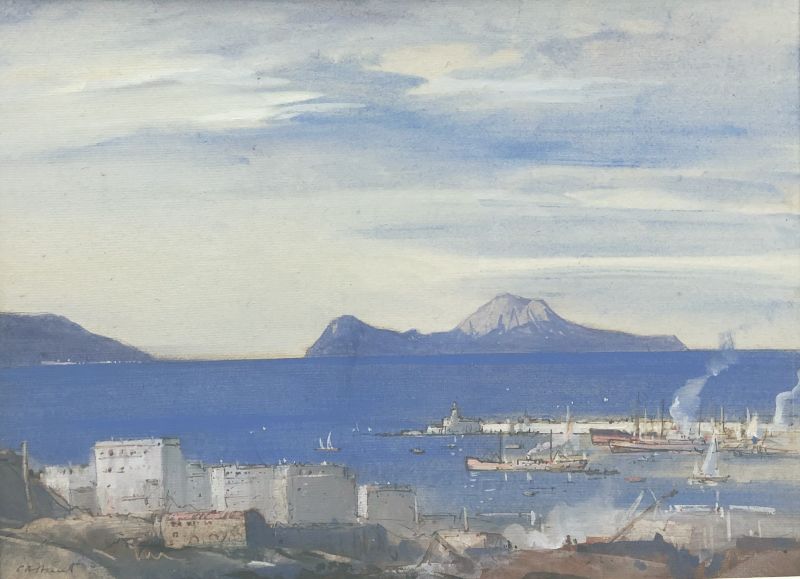
rif. 2201701. Hälfte 20. Jh. Signiert "CA Hunt", verso eigenh. bezeichnet "`Capri`: Bay of Naples". 29,3 x 39 cm
17394to. (2), 56, (2) pp. With engr. printer's device on t. p. Disbound. University oration on the Arabic language, its age, beauty, and usefulness, held by the noted Arabic scholar Thomas Hunt (1696-1774). Hunt studied at Christ Church, Oxford, and was chaplain to Thomas Parker, 1st Earl of Macclesfield. In 1738, he became the fourth Laudian Professor of Arabic, additionally becoming Lord Almoner's Professor of Arabic in 1740 (the year in which he was elected a Fellow of the Royal Society) and Regius Professor of Hebrew in 1747. - Many type specimens in Arabic, as well as some in Greek, Hebrew, and Syriac. Trimmed rather closely. Some foxing near beginning and end; t. p. shows punched library ownership ("Philadelphia Divinity School") and shelfmarks. Schnurrer 12. OCLC 27855095.
4to. 2 vols. 32 pp. 30 pp. Illustrated throughout with photo illustrations and sketch maps. Original pictorial wrappers, second volume ring-bound. Issued in tandem with the Basrah Petroleum Co. Ltd. and the Mosul Iraq Petroleum Co. Ltd., these volumes, which seem to have appeared yearly from 1951, offer information on the development of the industry over the year. Both volumes contain a Foreword by the Managing Director H. S. Gibson, followed by illustrations and information concerning the oil produced. The books are nicely produced, and in very good condition.
1935Folio (280 x 360 mm). 2 parts in 2 vols. (4), XVI, 262 pp. (2), 263-555, (1) pp. With large colour map, 169 plates (15 in colour, including 13 large portolan facsimiles) and 95 text illustrations. Contemporary half cloth with original printed covers and spines. Important study of Near-Eastern travel routes, also including Mecca and oriental cartography. Only vol. 2 (out of 3, published 1929-52), published as no. 16 in the series "Mémoires de la Société Royale de Géographie d'Égypte". Inscribed and signed on the title page by the author to the French psychiatrist Pierre Janet (1859-1947): "A Monsieur le Dr. Pierre Janet membre de l'Institut en témoinage de haute estime et d'admiration [...]" (Paris, 7 Nov. 1937); Janet's autograph ownership on front flyleaf. Janet, a great bibliophile, was a member of the Institut de France since 1913; he is credited with coining the words ‘dissociation’ and ‘subconscious’ and was an important forerunner of Sigmund Freud. - Spine of the first volume beginning to split; covers show slight staining (more pronounced in second volume), with occasional browning to margins. Macro, Bibliography of the Arabian Peninsula, 1339. Henze II, 315 (s. v. Estevâo da Gama). OCLC 2891592.
1840Pencil drawing on paper (168 x 252 mm), mounted on tawny backing with inked border, autogr. caption, and signatures. Matted (390 x 312 mm). A pretty view of the Austrian Embassy Palace in Constantinople (Istanbul). The background shows a mosque and the Bosporus with ships, with a few human figures in the foreground. Signed at the bottom right on the backing paper: "Albrecht Krafft mpr", with the signature of "Joh. von Wörndle mpr" opposite (probably the like-named construction administrator of Vienna's imperial palace, whose sons Edmund and August both were to become important painters trained at the Vienna Academy of Arts). - The Viennese orientalist Krafft was admitted to the famous Oriental Academy at the age of 19; here, he catalogued the library's oriental mss. and studied Armenian and Hebrew. His lasting achievement is considered to be his catalogue of Arabic, Persian, and Turkish mss. at the Academy. However, Albrecht Krafft, son of the Viennese portrait painter Peter Krafft (who had studied with Tischbein and Füger), was also a gifted dilettante painter who had attended the Academy of Arts simultaneously with grammar school, thus obliging his father's wishes before he followed his own inclinations and turned towards oriental scholarship (cf. Wurzbach XIII, 99). "Only the first volume of his projected 10-volume catalogue raisonnée of the Imperial Gallery at the Belvedere Palace was published (in 1837) - an excellent achievement for its time [...] Parthey, in his 'Deutscher Bildersaal', lists three paintings copied by the younger Krafft" (cf. Thieme/B. XXI, 384). - A few edge defects of the backing paper have been professionally restored.
Large 8vo. 3 volumes. XVII, (5), 368, (4) pp. XIV, (4), 512, (2) pp. XX, 506, (4) pp. With 2 portraits as frontispieces in vols. 1 and 2. 16 pages with illustrations and 2 maps at the end of vols. 2 and 3. Red cloth with title information in gold on front cover and spine of all 3 vols. All 3 vols. have a dust jacket. Outstanding research on the oral traditions of the Bedouins in central Arabia, divided into 3 volumes containing information on the poetry and narratives of various Bedouin tribes and an analysis and translation of various poems and stories. Kurpershoek has recorded, transcribed and translated all poetry and narratives he discusses in this work. - Since its first publication in 1994-99, this trilogy has been expanded with two additional volumes: vol. 4, published in 2002, deals with Saudi tribal history, while vol. 5 (2005) looks back on almost 20 years of research on and involvement with Arabian oral culture. - The Dutch scholar, author and diplomat P. M. Kurpershoek specialises in Arab studies. Kurpershoek studied Arabic language and culture at the Universities of Leiden and Cairo; since 1974 he has worked for the Dutch ministry of foreign affairs, the UN and NATO. As a professor of languages and cultures of the Islamic Middle East at the University of Leiden, he has performed research on the Bedouins of Saudi Arabia. From 2002 until 2013 he served successively as Dutch ambassador to Pakistan, Turkey, and Poland. Subsequently, from August 2013 until December 2014 he served as envoy to Syria. - Spines of the dust jackets of vols. 1 and 2 are slightly discoloured, otherwise in very good condition.
Large 4to (210 x 263 mm). 23, (1) pp. Contemporary unsophisticated wrappers. Early edition of the text of Lokman's Fables, never released in the regular book trade. Edited by Caussin de Perceval père (1759-1835), professor of Arabic at the Collège de France sice 1784. Includes four additional Fables not previously edited. "Ce livre n'a pas été mis dans le commerce. Il y a des exemplaires en grand papier. Caussin utilise le manuscrit de Paris et, aux 37 fables connues, ajoute le texte des quatre nouvelles, qui Marcel avait traduites en 1803" (Chauvin). - Wrappers frayed; wrinkled and browned with edge flaws throughout. Stamps of the Paris Jesuit Seminary. Chauvin III, 13. OCLC 978526580.
8vo. XXI, (1), 38 pp., 1 blank f., (2), 45, (1) pp. With a portrait frontispiece. Contemporary half calf with marbled covers and giltstamped red spine label. All edges red. Edition of the Turkish text (with the first German translation) of the "Asafname", a mirror for ministers written by the Albanian-born Ottoman statesman Lütfi Pasa (1488-1564), grand vizier of the Ottoman Empire under Suleiman the Magnificent. The translation, forming the dissertation of Rudolf Tschudi, was issued as vol. 12 of the "Türkische Bibliothek" edited by Georg Jacob, Professor at Erlangen. - An attractively bound copy with the bookplate of the collector Franz Pollack von Parnau (1903-81), who assembled a famous library in the Viennese palais of his father, the textile magnate Bruno Pollack von Parnau.
Small 4to. 8 pp. Study on the training of horses, submitted and presented to the Agricultural Society of Allier, by Marien de Mareschal, Mayor of Deux-Chaises (France). The author tries to demonstrate the benefits of horse breeding. - Small defects to edges; slight dust-soiling.
Small folio (230 x 286 mm). XVI, 280, (2) pp. Contemporary boards with printed spine label. First edition of the History of the Ghasnevids by the Persian historian Mir Khwand (ca. 1434-98), part of the author's famous "Rawzat al-Safa". Persian text followed by a Latin translation by Friedrich Wilken, professor at Heidelberg. The Turkoman dynasty of the Ghasnevids ruled in Afghanistan and northern India between 975 and 1186 CE, when they were conquered by the Persian Ghurids. - Fairly strong foxing throughout; some buckling to lower spine-end. Untrimmed, wide-margined copy from the collection of the Protestant bishop of Bavaria, Friedrich Veit (1861-1948), with his ownership stamp to the front flyleaf. Old stamps of the Strasbourg National and University Library (deaccessioned as a duplicate). Rare; no other copy in auction records. Zenker I, 877. Schwab 387. Strout 206. OCLC 6906577.
1912Telephone Talk was the glossy bimonthly publication of the British Columbia Telephone Company. It was written by employees for employees to present information of interest to those engaged in the plant, traffic, commercial, operating, accounting and other departments of the service. Each issue is replete with black and white photos and information on topics such as: company, industry and technological news, traffic levels, expansion plans, personnel announcements, publicity and social events, deaths, weddings, lists of exchanges, and more. As such, these issues serve as a vital preserve of rare and fascinating British Columbia history. This volume covers topics including: Photo of new office in Victoria; Advances in rates; Increased Rates in Manitoba; Telephoning across the Atlantic; Exchanges ranked in order of per cent good toll calls, November 1911; Statement of development - number of phones operating in each exchange as of 1 December 1911; Cover photo of Grand Forks Switchboard; Photo montage of underground work at Victoria; Birth of the Telephone - 3 page article; Mr. F.J. MacGougan; Photo of types of protected terminals; Vancouver Switchboard photos from 1908 and 1898; Great 2-page photo of the huge 'A' switchboard at Seymour; Load Curve Graph of Seymour Office; Cut-over of Victoria Plant - new epoch in phone history of B.C.'s capital; Vancouver Island Toll Rates; Special Victoria Issue - photo montage of city and district officials; Photo of New B.C. Office; Table showing # of phones in Victoria since 1880; Photos of underground work in Victoria; May 1880 list of Victoria subscribers; 1890 list of subscribers; cable-laying scenes from last September; Nanaimo and Sidny facilities; New Gulf Cable Ordered by William Farrell in England; Miss Mina Kerr; Record work at Highland; New Plant Department Building; How a Directory is Produced; Jolly moonlight excursion to Nanaimo aboard the steamer Princess Patricia; Great photo of 5 new auto wagons of the construction department in front of the Seymour Office (horses having been recently displaced); Some Victoria cable troubles; Photo montage of the Royal visitors, the Duke of Connaught, the Duchess of Connaught, and Princess Patricia; Training school for operators; interior and exterior views of the Royal trolley coach; 3-page Kamloops feature with photos; Functionalization of Plant - reorganization of the department; laying North Vancouver Cable; Photos of large buildings under construction in the Fairmont exchange - the Lee Building, the hospital buildintgs, Steel plant in G.N.R. yards; Fairmont feature - 4 pages with photos; Instructions for Operators; North Vancouver Cable Ready; Importance of Transmission; and more. Half-leather binding. Hinges tender but intact. Backstrip very rough. Ink stamp of company executive E.P. LaBelle upon top edge. Mr. LaBelle's signature upon front free endpaper and his initials are penned to top edge. He is mentioned on page 8 of the July issue as being the new Plant Engineer. Binding intact. Please note: small article clipped from page 18 of the December issue. Book
4to. (2), 12 pp. Contemporary bronze-varnished boards. Rare dissertation on early Hebrew and Arabic poetry, with a few specimens. A second part was published separately. - Boards rubbed. Printed dedication to Eric Waller. From the library of the Swedish bishop and writer Eric Waller (1732-1811) with his bookplate on front pastedown. OCLC 839100044.
8vo. XVII, (1 blank), 255, (27), VIII pp. Contemporary blindstamped full calf. Sixth and final edition of this manual of English hunting law, first published in 1727, deemed "still more useful and satisfactory" (p. 3 of the preface) than its predecessors. Opening with an introduction describing the history of English game law from the time Britain was under Saxon rule, when there "was such plenty of game, that there was no occasion for restraining laws to preserve them" (p. IX), until the reissue of the 1217 "Charter of the Forest" in 1225, the treatise explains key terms of hunting law in alphabetical order, describes exemplary law cases, and discusses when, where and by whom which animals can be chased, and in what manner offenders are proceeded against. The present copy includes the 8-page appendix, giving two acts relating to doves and fish that were passed shortly after the book was printed, which is lacking in some copies of this edition. - Extremities slightly rubbed; hinges cracked. Paper evenly browned throughout. Contemporary ownership of J. Kilsby, dated 1775, to title-page; later in the collection of Charles Henry Stanley Garton (b. 1920), his ownership, dated Kingswood, May 1946, to front pastedown. This edition not seen at auction since 1962. Westwood/Satchell 155. Cf. Schwerdt II, 40 (1732 ed.). ESTC T82611. OCLC 837605604. Not in Souhart, Harting.
Colour-printed map (30 x 44 cm). Map showing Philby’s route. Inset of Central Arabia. Not in Ankary; Al-Qasimi.
8vo. 65 pp. With woodcut vignettes by Jost Amman. A modern reissue of the "Traitte fort curieux de la venerie et de la fauconnerie" (Lyon 1671). Text in German and French. One of 500 copies. Harting 132.
12mo. (4), 292 pp. With woodcut vignette on title page, 13 plates and a folding map. Original printed wrappers. First edition of this account of a journey made from Port Said, down the Red Sea to Mascate, and then along the Arabian Gulf ending in Baghdad. - Some foxing. OCLC 254176761.
8vo. XIX, (1), 197, (3) pp. Contemporary blindstamped green cloth. First published edition. "A translation of Persian narratives from the posthumous papers of his half-brother, Friedrich Rosen, including a glossary and grammar of modern Farsi" (NDB). - The doctoral dissertation of the Prussian oriental scholar and diplomat G. Rosen (Ballhorn, 1820-91), who studied in Berlin and Leipzig. In 1844 he was a dragoman at the Prussian embassy in Constantinople before becoming Prussian consul in Jerusalem in 1853. From 1867 he served as German Consul General in Belgrade. - Some browning and brownstaining throughout due to paper stock. Binding a little rubbed with traces of a library label to spine. NDB XXII, 52.
Folio. 1 page. On uncut wove paper, bearing the Schoellers-Parole blind embossed seal, margins uncut. The original autograph contribution of Dr Rouchdy Bey to the Committee of the World League for Peace (Ligue Mondiale pour la Paix), a remarkable organization formed in 1925 with close ties to the League of Nations. The Committee itself was composed of such notaries as Queen Elizabeth of Belgium, King Carol II of Romania, John D Rockefeller, Marie Curie, and Albert Einstein, who personally gathered the present manuscripts over the course of seven years (1925-32). Among the public figures who contributed to the project were dignitaries from the newly-created League of Nations' member states. "I cannot conceive of any offensive war whose advantages could equal the benefits of peace for a nation which is independent and which has the possibility of developing itself in freedom. [Signed] Dr Rouchdy". Pax Mundi. Livre d'or de la paix. Enquete universelle de la Ligue mondiale pour la paix sous le haut patronage de son comite d'honneur avec l'approbation de la Societe des nations, du Bureau international du travail et de la Cour permanente de justice internationale. Geneve, Societe paxunis, 1932.
4to. 937-959, (1) pp. Original printed wrappers. Stapled. Exceedingly rare paper on international agreements in the oil industry by Fuad Rouhani (1907-2004), the first Secretary General of OPEC. First presented in early 1962 at the United Nations petrol conference in New York, it discusses legal issues of the oil industry, especially adressing the problem of the uneven distribution of profits between oil companies and the countries in possession of the reservoirs: "On sait toutefois que ces dernières années les gouvernements des pays qui ont accordé des concessions ont acquis la conviction qu'il existe un écart trop grand entre les bénéfices que les compagnies retirent de l'indutrie qu'elles financent et les rentrées du pays qui possède les gisements" (p. 949). - Right edge slightly warped, otherwise very well preserved. Offprint from "Revue de l'Institut Français du Pétrole et Annales des combustibles liquides", vol. XVIII, no. 6. An English version is held at Pepperdine University Library in Malibu, California; no other copy traceable in libraries internationally.