[ARABIAN GULF; KUWAIT].Biblio.com
4.080 Ergebnisse
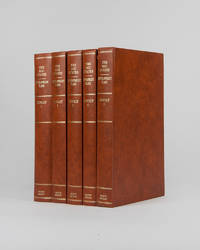
Best.-Nr. 121996London Archive Editions 1994. . 5 vols 8vo 25.5 x 16.5 cm; numerous charts maps plans graphs and tables; publisher's original orange-brown cloth gilt lettering to spines top edges gilt a fine set. The full development plan for Kuwait of 196/7-1971/2 as well as master plan for the city studies for the National Physical Plan and of urban development the statistics and figures for the years 1963-1988 and the statistical abstract for 1990-91. With numerous maps graphs and charts illustrating the reports as well as the full first five year plan reproduced in Arabic. London, Archive Editions, 1994. hardcover
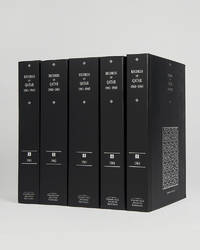
Best.-Nr. 121951Cambridge Cambridge Archive Editions 2021. . 5 vols 25.5 x 16.5 cm; publisher's original black cloth silver gilt lettering a fine set. A very important collection of documents charting the the history of Qatar during the years 1961 to 1965 including the rise of the National Unity Front the growth of the Qatar Petroleum Company and the decline of British-Qatari relations. Chapters divide the documents into sections: the Royal Court Council of Ministers communications economy foreign affairs internal affairs judiciary labour and oil among others. Cambridge, Cambridge Archive Editions, 2021. hardcover
4to (20.5 x 15.5 cm). [20], 211, [1] pp. With the title in red and black in an ornamental, architectural woodcut frame with a palm tree at the head, and woodcut palm tree device above the colophon (both acquired from Erpenius), a decorated woodcut initial, a woodcut factotum and factotums and decorative bands built up from cast fleurons. Set in serto Syriac, meruba Hebrew, Greek and roman types, with incidental estrangela Syriac and italic. Contemporary or near contemporary vellum, sewn on 4 velum tapes laced through the joints, with a hollow back, red edges. The first edition of any early text of the Book of Revelations in the ancient Syriac language, a book that had been lacking in the manuscripts followed by the earlier Syriac New Testaments. It is also the first book the Elzeviers printed with Syriac or any other "oriental" type, their earlier forays into printing with non-Latin types having been limited to Greek and Hebrew. The main text is set in two columns, with the Syriac text set in Syriac type on the outside and the Syriac text set in Hebrew type on the inside, an aid to scholars less familiar with the Syriac script. Two columns in smaller type at the foot provide the original Greek text and a literal Latin translation of the Syriac. The whole is well printed and laid out, showing why the Elzeviers were quickly gaining a reputation as the leading scholarly printers and publishers. Thomas Erpenius made Leiden University the leading centre for the study of oriental languages when appointed professor of oriental languages in 1613. He set up his own printing office, acquiring or commissioning types for Arabic, Syriac, Samaritan and Ethiopic, and inaugurating it with his edition of Lockman's fables in Arabic (1615). His death from the plague at age forty cut his work short in 1624. Ludovicus de Dieu (1590-1642), Regent of the Walloon College associated with the University, had studied under Erpenius and his successor in Arabic studies Jacob Golius, but for Syriac he became Erpenius's spiritual successor. The present book was nearly his first publication. Although Syriac New Testaments had been published earlier, no source had been found for the Syriac text of the Book of Revelation, which was lacking in the standard "Peshitta" Bible, a Syriac Old and New Testament whose text was probably established in the 4th century. In his 1599 Polyglot, Elias Hutter therefore filled the gap with his own new translation, but De Dieu published the present text based on a manuscript from the library of the great orientalist Joseph Scaliger, apparently a copy made in Rome ca. 1580 of an ancient manuscript of the Syriac text established by the Persian Philoxenus, Bishop of Mabbug, in Mesopotamia in 508 and corrected by the Palestinian monk Thomas of Harkel near Alexandria in 616. For that reason, Darlow & Moule, Smitskamp and others call the present book the "editio princeps". Erpenius's widow briefly continued her husband's printing office, completing the Syriac psalter that he had begun, but it was published jointly by the Elzeviers and Johannes Maire, and on 9 October 1625 the Elzeviers bought her printing office and took over most of its materials and workmen. At the same time they began to acquire and commission new printing materials, greatly expanding the printing office they had added to their publishing house in 1617. This made the period 1625 to 1640 the press's golden age. Erpenius had commissioned the woodcut of the present title-page for his Arabic Historia Josephi in 1517 and most of the types and fleurons came from him as well. Plantin commissioned the serto and estrangela Syriac types from Robert Granjon for volume 5 (1571) of his Polyglot Bible (Erpenius added and revised a few characters in the serto) and Daniel Bomberg commissioned the Hebrew type for his press in Venice, where he used it in 1517. The lovely arabesque initial V with a face in the centre, however, belongs to a series cut exclusively for the Elzeviers and used here nearly for the first time. The book also shows them beginning to supplement their 16th-century French types (Garamont romans and Granjon italics) with 17th-century types cut in the Dutch Republic. The New Testament was originally written in Greek, the language of the Christian Church and Christian scholars in the first centuries of the Christian era, and a lingua franca among the diverse groups living in the Middle East at that time. But it relates stories that would have first been told (and in some cases probably also written down) in Aramaic, the vernacular language of Palestine in Jesus's time. It also presents Jesus's words in Greek translation, while he would have spoken them in Aramaic. While no early New Testament survives in Palestinian Aramaic, the Greek was translated into Syriac, probably already in the second century, and surviving manuscripts may date back to the fifth century. Syriac, another dialect of Aramaic, served as the vernacular language of much of the Middle East (it has nothing to do with today's Syria, where the native language is Arabic). The Syriac text therefore provides valuable clues to the Aramaic sources of the New Testament. The Peshitta Bible remains the standard text among some Christian groups. Debates continue as to how much of the "original" Aramaic can be found in the surviving Syriac versions. - The watermark in the endpapers (a simple bend) does not closely match any found in the literature, but the nearest is Heawood 129, used in Amsterdam in 1646. In fine condition, with only an occasional minor spot and at the edge of the last few leaves some tiny (0.2 mm!) worm holes, and with large margins (the leaves are a couple millimetres taller than those noted by Berghman and Rahir). The binding is very slightly rubbed but still very good. A fine copy of an important work of biblical scholarship and a showpiece of the Elzevier's press at the beginning of its golden age. Berghman, Cat. Raisonné 48; Copinger 1310; Darlow & Moule 8962; Rahir 230; Smitskamp, Phil. orientalia 303; STCN (9 copies); Willems 269; www.bibliasacra.nl, 1627.Rev.poly.BE.a.; for the types: J.F. Coakley, Typography of Syriac W3B & S3.
12mo. 4 vols. (12), 320 pp. 314, (2) pp. 301, (3) pp. 312 pp. Contemporary full mottled calf, spine, covers and leading edges gilt. A rare, early English edition based on Galland's liberal but highly influential French translation. Adapted to Parisian tastes, it had been first published in 12 volumes between 1704 and 1717. "Even before the last of Galland's volumes had been published in France, some of his stories had been translated into English and were circulating as cheap chap-books on the popular market" (R. Irwin, The Arabian Nights: A Companion, p. 19). "Galland's translation [...] was quickly translated into English and German. It enjoyed a most remarkable success throughout Europe, perceptible even in children's literature, and contributed significantly to the new image which enlightened Europeans entertained of the Islamic East: after Galland, this was no longer the home of the Antichrist and of accursed heresy, but rather the ever-constant Orient beneath an eternally fair sky, boasting splendid colours and unheard-of wealth, Caliphs, Viziers, and Kadis, harems, fairy-tale princes, fairies and genies, sorcerers and sages, a world of fantastic adventure and outrageous incidents" (cf. Fück, p. 101). - Hinges and spines professionally repaired in places. Light browning and reading marks; old auction lot ticket on vol. 2; clean cuts into the side of three leaves of vol. 4 (no loss to text). A well-preserved set with the blocks intact, all the same edition and uniformly bound. Only three copies listed via COPAC (British Library; Trinity College, Connecticut; Bryn Mawr, Pennsylvania). ESTC N15877. OCLC 504545353. Cf. Chauvin IV, 185 D (1713: 4th ed.), 185 G (1769); 185 L (1778: 14th ed.).
Oblong small folio (258 x 355 mm). Photo album with 56 original silver gelatin prints, 10 picture postcards in colour, and 2 folding greeting cards. 4 photos captioned in Arabic, the remainder in English. Contemporary full calf. Private photo album of a Western engineer involved in bridge construction near Jeddah. The collection includes images of the workers' camp, construction machines, Saudi workers and supervisors, the rising bridge piers, and inspection rounds, as well as pictures of the engineer chatting with Saudi friends or repairing his SC truck. In addition, the set comprises views of Mecca, pilgrim buses and tents, as well as souvenir cards and postcards, suggesting a friend of the collector participated in the Hajj. - One postcard, showing a street view of Mecca, is dated Jeddah, 3 July 1964 (addressed to Silvia Pirani in Bologna). - The 4 photographs with Arabic captions, dated 1375/1955, show a family, including a small boy in formal uniform, before a mosque. - A very well-preserved album documenting the advance of infrastructure in the Saudi Arabian desert.
8 jigsaw puzzles, 302 x 228 mm each: lithographs in original hand colour, laid down to wood panels. Relief shown by hachures. Stored in decorative box (320 x 250 x 55 mm). Charming hand-coloured geographical puzzle set, manufactured by Logerot in Paris, rarely encountered complete and with eight maps: World, North America, South America, Europe, Asia, Africa, Oceania, and France. Puzzles of this type were first produced in London by John Spilsbury in the 1760s, but the style passed to the continent and became a popular educational tool in France and Germany in the early to mid 19th century. Logerot issued his puzzles from the 1850s onwards; the European borders of this set point to a production date between 1878 and 1880. The puzzle maps are stored in the box fully assembled, each resting on a paper mat with cloth tabs for easy retrieval. - In excellent condition. Cf. OCLC 56131950. Tooley III, p. 148 ("99 jugsaw puzzles, c. 1850").
C. 258 x 325 mm (cardboard); image dimensions c. 222 x 284 mm. Albumen prints (vintage) on cardboard. By Bonfils, from Bethlehem: "Tombeau de Rachel" (no. 336); "Puits des Mages" (889); "Entrée des pèlerins à Bethléem, le jour de Noël" (892, illustrated in Wieczorek/Sui, "Ins Heilige Land", p. 106); "Vue générale de Bethléem, du puits de David" (1225) and interior of the Church of the Nativity (uncaptioned); from Jaffa: "Place du marché vue générale" (238, ill. with alternative caption in W./S., p. 67); from Jerusalem: "Porte de Jaffa" (244, ill. with alternative caption in W./S., p. 73); "Mur des Juifs en vendredi" (245); "Façade du St-Sépulcre" (246); "Prison de St. Pierre" (250); "Arc de l'Ecce Homo" (252); "Ruelle allant au palais d'Hérode" (259); "Coupoles du St.-Sépulcre" (274); "Vue générale de la mosquée d'Omar" (278); interior of the Dome of the Rock ([279], illustrated with caption but trimmed in W./S., p. 85); "Porte donnant accès au-dessous du rocher" (280); "Vue générale de l'emplacement du temple de Salomon" (285); "Porte de Damas" (287); "Jardin de Gethsemané, vue générale" (303, ill. trimmed in W./S., p. 76); "Vallée de Josaphat" (310); "Intérieur du St-Sépulcre avec ornements" (850); "Grotte de Sainte-Hélène, intérieur" (855 bis); "Entrée de Jérusalem près de la porte de Jaffa" (1037) and "Rue de la Porte de Jaffa" (1038). - By Lorent: "Tombeau de David sur le Mont Sion" (288). This is apparently a print of the 1864 image illustrated in Wieczorek/Sui (p. 88), made by Bonfils and supplied with a caption. Curiously, that image is trimmed by several centimeters on the left, as compared to our print. - By the Zangakis: "Jerusalem", "Eglise du Pater couloir" (1018). - Anonymous: "Juive, costume riche" (1). - 4 photographs show slight edge defects. Occasional staining to cardboard edges, but mainly clean and well-preserved, with German ms. pencil captions.
Coloured R.A.F. aeronautical chart. 738 by 573 mm. Scale 1:1,000,000. An excellent official British aeronautical chart of the Strait of Hormuz, covering part of Oman, a large section of the coastline of the United Arab Emirates (including Abu Dhabi, Dubai, Sharjah and Ras al Khaimah) and Hormuz Island. It was issued by the Geographical Section, General Staff (GSGS) as part of their 4695 series of 1:1,000,000 scale maps. The GSGS supplied maps to the British Armed Forces (in this case the R.A.F.), collected data on foreign survey networks and prepared survey data for Expeditionary Force mobilisation. - Light weakening and edge flaws to folds, but generally well preserved.
6 maps, colour printed. Scales: 1:100,000; 1:250,000; 1:2,500,000. All in their original printed orange and green envelopes, all but one with accompanying booklets. Six maps from the USGS's premier Geologic and Geoscience series (English and Arabic text), focusing on the west of the Arabian Peninsula. Originally compiled from field mapping carried out at the 1:100,000 scale, though scales here vary. Maps include keys and cross-sections, and sometimes an accompanying booklet of detailed explanatory notes. Comprises individually: - 1) GM-22 (IR 182; Vranas p. 17): Geology of the Jabal Ibrahim Quadrangle, Sheet 20 / 41C, by W. R. Greenwood, with a Section on Economic Geology, by R. G. Worl and W. R. Greenwood, 82 x 74 cm, 1:100,000, 1975 (1976). Based on mapping done Dec. 1970-Jan. 1971. With 18 pp. staple-bound illustrated notes as called for. - 2) GM-28: Geology of the Nuqrah Quadrangle, sheet 25E, by J. Delfour, 106 x 62 cm, 1:250,000, 1977. Includes 18 pp. staple-bound illustrated notes by J. Delfour. This area lies a little to the north of Medina. Original mapping is credited to the Bureau de Recherches Geologiques et des Minieres. - 3) GM-66 - Plate 2: Mineral locality maps of Saudi Arabia, by Hans van Daalhoff, 71 x 96 cm, 1:2,500,000, 1982. This map is a reduction of the Anglo-American / USGS Map I-270-B2 (1963) and includes a large stretch of the Red Sea coast including the Holy Sites, part of Qatar, and the major oil producing locations on the Arabian Gulf. - 4) GM-78A (IR 383; Vranas p. 33): Geologic map of the Najran quadrangle, Sheet 17G (with Landsat base), by Edward G. Sable, 109 x 64 cm, 1:250,000, 1985. Includes 18 pp. staple-bound illustrated "Explanatory Notes" by Sable as called for (though Vranas confusingly indicates this should also include an additional geographic map, and the booklet be 35 pp.). - 5) GM-122: Industrial mineral resources map of Jiddah, by C. H. Spencer, Alain Cartier, and Pierre Louis Vincent, in two sheets, 1988. 1:100,000. 2 sheets (Jiddah East; Jiddah West), each 102 x 76 cm. Includes 15 pp. staple-bound illustrated notes by Spencer, Cartier and Vincent. - 6) GM-132: Geologic map of the Cenozoic Lava field of Harrat Kishb, by M. John Roobol and Victor E. Camp, 86 x 76 cm, 1:250,000, 1991. Includes 34 pp. staple-bound illustrated notes by Roobol and Camp. - Very well preserved in general. G. J. Vranas, List of Interagency Reports submitted by the US Geological Survey Saudi Arabian Mission to the Saudi Arabian Directorate General of Mineral Resources from 1965 to the beginning of 1992 (Open File Report USGS-OF-92-2. Interagency Report 844 (Jiddah: Ministry of Petroleum and Mineral Resources Directorate General of Mineral Resources, 1412 AH/1992 AD), pp. 17, 33.
4to. (30 [instead of 44]), 480 pp. Contemporary limp vellum with handwritten spine title (wants ties). First - and likely only - edition. The first large-scale Syriac grammar, the third ever written (following those of Caninius, 1554, and Widmanstetter, 1555). Composed by the Maronite priest Jiris Ibn Mikha'il ibn 'Amira, it was printed by the Maronite scholar Ya'qub ibn Hilal (Giacomo Luna), who worked at the Medicean Press under Raimondi and was responsible for the Arabic and Syriac publications issued between 1590 and 1594. In 1595 he started printing on his own, and possibly took over some of the types of the Vatican Press. The work is listed as a Propaganda Press imprint ("olim typis nostris impressi") in Amadatius's 1773 "Catalogus", which shows the continuity that was felt to exist between the Medicean Press, the intermediate stage of Luna and Stephanus Paulinus, and the Propaganda Press. In the preface Raimondi is mentioned as the instigator of the work. - The 24 pt Syriac "serto" types were cut in 1590 by Jean Cavaillon for the Medicean Press. In the beginning a Syriac alphabet is presented, in three different scripts: "estrangelo" (this word possibly here used for the first time), "serto", and a Nestorian script possibly in type. This Nestorian script, a cursive form of estrangelo, is introduced here for the first time. In 1633 a slightly different typeface was used for Bellarmino's Catechism. - Preliminaries wanting 7 leaves but containing 4 additional interleaved blanks, two of which bearing Syriac annotations in a large, contemporary hand. Occasional light browning, a few leaves misbound. - Provenance: Handwritten ownership of the Discalced Carmelites of St. Joseph in Paris on the title-page and lower pastedown. - Quite rare. A second edition, supposedly produced in 1645 (cf. Nasrallah, p. 10), is not attested in libraries. Edit 16, CNCE 1541. Adams A 965. BM-STC Italian 356 (s. v. "Jiris"). IA 104.783. Zenker, p. 132, no. 1534. Smitskamp, PO 184. Vater/Jülg 388. Nestle 13. Duverdier, Impressions, 198. OCLC 7238840. Ebert 513 ("Selten"). Brunet I, 231 ("Ouvrage estimé").
8vo. (4), XLIV, 525, (1) pp. Contemporary half calf with giltstamped spine title. With the folio atlas: 6 engr. maps and plans and 4 lithogr. views. Contemporary half calf over marbled boards, with original printed wrapper cover on upper cover. First edition, text and atlas together. Descended from a family of canal builders, Antoine François Conte Andreossi (1761-1828) served at the French embassy in Constantinople from 1811 to 1814, when he was recalled to France by Louis XVIII, much to the dismay of the local French community. Some of the plates show his beloved waterways and fountains; they also include a view of the Hippodrome and Mosque of Sultan Ahmed. - Slight worming to hinges of atlas; old stamp to first engraved plates. Bookplate of Dr. Th. Weber (no. 518). Atabey 22. Blackmer 33. Weber I, 154f. Brunet I, 276. Graesse I, 122. Not in Aboussouan.
8vo. 411, (1) pp. (With:) Borgia, Stefano. Irsad li-ajl al-i'tiraf wa-tanawul al-qurban (...) [Instructions for confession and communion]. 109, (3) pp. Contemporary grey wrappers. Third Arabic edition of the complete text of Bellarmino's immensely popular catechism, translated into Arabic for the use of Catholic missionaries. Includes the rare first and only edition of Stefano Borgia's Arabic instructions for confession and communion. Borgia (1731-1804) was appointed secretary of the Propaganda Fide in 1770, the year they published the present third Arabic edition of the catechism. He added the instructions, apparently intending them to be bound with the catechism. - Text entirely in Arabic except for title-page and colophon. Old Bourges library stamp "Ex bibliotheca Majoris Seminarii Bituricensis". Wrappers slightly stained; interior very well preserved. A major product of the Propaganda Fide's efforts to convert Arabic-speaking people in the 18th century, including the rare instructions for confession and communion. De Backer/Sommervogel I, 1190 (& note). Schnurrer 303 (& note).
8vo. (16), 184, (56) pp. With woodcut printer's device on t. p. Modern half vellum with marbled covers. Rare first edition. "The work opens with the well known 'Consilium de studio arabico feliciter instituendo' here published for the first time. At the end is given a 'Catalogus librorum arabicorum', compiled by Erpenius and Coddaeus, and listing most of the work concerned with Arabic published so far. It is one of the sources for the alleged Koran printed in Venice ca. 1520" (Smitskamp). Remarkably, the author printed his introduction in the Arabic style, from right to left. Erpenius (1584-1624), professor of oriental languages at Leiden, "is one of the men whom the study of oriental languages owes its resurrection [...] He set up his own printing shop with Hebrew, Arabic, Syrian, Ethiopian, and Turkish type" (cf. ADB). Until well into the 19th century his works, published in numerous editions, remained the foundation of Arabic language teaching in the west. - A few underlinings and marginalia in Latin and Arabic. Some waterstaining. From the library of the Danzig Lutheran Nathanael Dilger (1604-79) with his marginalia and autograph note of acquisition, dated November 1625, on title page. Graesse II, 499. Hoefer XVI, 309. Schnurrer 55. Smitskamp 88. ADB VI, 329 ("1628" in error). Cf. Ebert 6914. Gay 3400 (later ed.). Brunet 1050 (later ed.).
8vo (149 x 94 mm). Illuminated Arabic ms. on paper, 211 ff., 20 lines, Naskh script. Double-page 'unwan on first two pages shows elaborate gilt and coloured ornamentation. Framed by strings of three gold and black lines. Gold discs between verses, sura headings written in gold. Original lacquer binding decorated with flowers. Traces of use, otherwise in good condition. Binding restored.
8vo. 95, (1) pp. - (Bound with) II: Delaporte, Jean Honorat. Principes de l'idiome Arabe en usage a Alger suivis d'un conte Arabe avec la pronunciation et le mot-à-mot interlinéaires. Algiers & Paris, Bastide & Charles Hingray, 1845. (8), 163, (1) pp. With 5 folding letterpress tables. Contemporary navy blue half leather with giltstamped spine. First French edition, with the translation (by Silvestre de Sacy) and the Arabic text printed in parallel, entitled "The race with the lightning and the clouds above: on the success of the messenger pigeon". The Syrian linguist Michel Sabbagh (1784-1816) served as interpreter to the Imperial Army during Napoléon's Egyptian Campaign. He emigrated to France when the army left Egypt and attached himself to Silvestre de Sacy and the Imperial Library and print shop. His original work on carrier pigeons remains a classic. - Bound with this is the third and final edition of a work on Algerian Arabic, first published in 1836 by the Frenchman Jean-Honorat Delaporte (1812-71), who worked as interpreter for the Ministry of the Interior in Algiers. His work begins with the alphabet, vowels, letter forms, orthography, all set out in folding tables, followed by chapters on grammar, syntax, numbers, etc. Included at the end, as an exercise, is the Arabic story known as "La ruse des femmes" (from the Sindbad cycle of Alf layla wa-layla), with a word for word translation into French. - Extremeties a little rubbed; occasional light brownstaining, but a good copy. I: GAL II, 479. OCLC 11618486. Schnurrer BA 426. - II: Chauvin VI, p. 173, no. 331.2. H. Fiori, Bibliographie des ouvrages imprimés à Alger de 1830 à 1850, 50. Playfair, Bibliography of Algeria 1124.
Engraved map (51 x 84 cm), hand-coloured in outline. Large map of the Turkish Empire in original colour stretching from the Gulf of Oman to Morocco. Al-Qasimi 78; Tibbetts 154.
4to. (14), 264 pp. With engraved illustrated title-page and 12 engraved plates; one line of musical notes showing the melody of the muezzin's call "la 'ilaha 'illa -llahu" (There is no deity but Allah). 19th century marbled half leather with giltstamped red spine label. Marbled endpapers. All edges sprinkled red. Second edition of Wallich's account of Islam, written in 1659 following his mission to the Porte. "The first part is a description of Turkish religion and customs [...] together with seven of the plates. The second part is a life of Mohammed, and the third part is a comparison of Pope Alexander VII with Mehmed IV (the two antichrists, oriental and occidental)" (Blackmer). The biography of the Prophet includes a genealogy and an engraving showing Ali with the Zulfiqar presenting the written Qur'an to the faithful. - Johann Ulrich von Wallich (1624-73), a Thuringian jurist in Swedish services, participated in several diplomatic missions, including the Swedish embassy to Constantinople in 1657/58, where he got to know the Muslim religion. - Binding very insignificantly rubbed along the hinges, corners a little bumped. A fine copy bound for the Ottoman-Greek diplomat Stephanos Carathéodory (1834-1908), who served as secretary to the Ottoman delegation at the 1878 Congress of Berlin and as Ottoman ambassador to Brussels, with his printed bookplate and motto ("Meden agan" - "nothing in excess") to front pastedown and spine. VD 17, 39:134505B. Chauvin XI, p. 197, no. 720. Cf. Atabey 1761; Blackmer 1309.
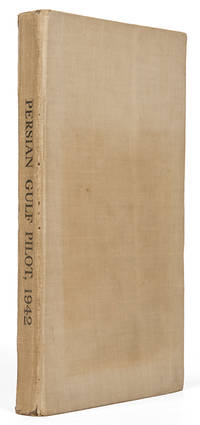
Best.-Nr. 119766London Hydrographic Department Admiralty 1942. . Ninth edition with the fourth supplement dated 1948; 8vo 24.5 x 16 cm; supplement tipped to front pastedown 2 maps acting as an index for admiralty charts folding meteorological chart 21 plates showing numerous coastal views with additional view of Abu Dhabi fort tipped in from supplement further in-text weather diagrams notice of supplement tipped in to face title numerous annotations making good the corrections from the supplement; publisher's tan cloth lettered in black touch of rubbing to spine very good copy; xxvi 286 pp. A scarce pilot guide of the Persian gulf describing Bahrain Kuwait Qatar Dubai and Abu Dhabi and numerous other villages and towns along the Arabian coast. Includes coastal views of Ras Al Hadd Sur Qalhat As Suwaiq Sohar Fujairah Khasab the Tunb Islands Abu Musa the Doha Fort Bahrain Harbour and Tarut Island amongst others. The guide was published to give accurate sailing directions to the ports towns and safe anchorages along the Arabian coast from Ras al Hadd on the eastern peninsular of Oman to Shatt al Arab in the North and back along the coast of Iran to Bandar Abbas and beyond. With much early information on the principal settlements of the United Arab Emirates Qatar Bahrain Kuwait and Oman and an interesting glossary of Arabic-English key terms. Dubai is described as well as Daira: 'Daira is a large suburb consisting of mat huts amongst which stand a number of well-built houses.' 'Dibai Dubai contains the residence of the Shaikh. There are several tall towers in Dibai; the fort is a conspicuous square building with a round tower. from which the Shaikh's flag is displayed.' Abu Dhabi is similarly described: 'This town consists for the most part of huts and extends along the coast for nearly two miles. In the town there is a small fort partially surrounded by trees with five towers close together. The coast in the vicinity of Abu Dhabi is very low and the beach is of white sand'. There are two views of Qasr Al Hosn one of which appears here with the 1948 supplement for the first time. The great pearl bank is also given attention: 'this extensive bank. fills the great bight in the southern part of the Persian Gulf.' 'Many islands both close to the coast and far offshore lie on the bank. With the exception of Dalma none has permanent inhabitants though they are frequented by the pearl boats during the summer and by fisherman from Abu Dhabi in the winter.' 'The best pilots for the coast are to be obtained at Abu Dhabi.' Much of the information of Qatar and Doha is amended by the supplement and appropriately altered by the annotations showing its quickly changing nature. Bahrain is also described and there is also note of the health of the region: 'Manama. is more liable to epidemics than the smaller ports; since 1920 however there have been no more epidemics in Bahrain than in any other of the larger Gulf ports.' Kuwait is described 'The Shaikh's palace. has a small roof which is the highest point of any building in the town.' 'The principal export is pearls; the chief imports are rice sugar tea flour piece goods matches hardware wheat and barley.' London, Hydrographic Department, Admiralty, 1942. hardcover
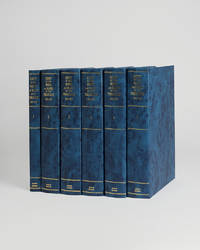
Best.-Nr. 121956London Archive editions 1990. . 5 vols 8vo; 1 vol. text with index map & 4 vols map portfolios containing 55 maps charts and views; original blue cloth gilt a fine set. The first systematic examination of the coastal topography of the Arabian Gulf. A remarkable collection of sea charts harbour plans coastal views and topographical descriptions produced during the survey of the shores and islands of the Persian Gulf carried out between 1820 and 1829 by officers of the Bombay Marine on the orders of the Bombay government. London, Archive editions, 1990. hardcover
Folio (ca. 27 x 36 cm). [255] ll. With 13 illustrations, mostly showing different soil profiles relating to the fossils, including 10 drawn by hand. In a pink cardboard portfolio entitled "Fossils Mesozoic-Age (secondary)", including another portfolio with blue paper wrappers. Extensive correspondence addressed to George Stanfield Blake, mainly from Leslie Reginald Cox, discussing fossil specimens. Blake's additional correspondents were, among others, the deputy director of the "laboratoire de paleontologie" of the French national museum of natural history J. Coltreau and the director of the British museum of natural history C. Tate Regan. - Blake (1876-1940) was a British mineral and mining geologist and was from 1922 to 1939 the geological advisor to the Mandatory Government of Palestine, in which capacity he wrote and received the letters collected in the present portfolio. His work was essential, according to Israeli geologist Picard and others, for the expansion of geological knowledge of Palestine and Transjordan and their natural assets. Cox (1897-1965) was a British palaeontologist and malacologist (a specialist in molluscs), who was attached to the British museum of natural history and was elected a fellow of the Royal Society in 1950. - Most of the letters are typed copies of letters with autograph signatures, except for a few autograph letters. The collection also includes a few illustrations of soil profiles and even some notes of thanks from the trustees of the British museum of natural history addressed to Blake, thanking him for his donations of information on fossils and the specimens themselves. - Paper wrappers show signs of wear, wrappers and documents inside are very slightly discoloured, most leaves are slightly frayed around the edges. Most leaves are numbered in blue pencil and the numbers correspond with the overview of the contents typed on a separate leaf, pasted on the inside of the front pink wrapper.
8vo. 2 parts in 1 vol. (4), 318 pp. (4), 441, (1) pp. Modern red half morocco with giltstamped spine title; original blue printed wrappers bound within. First edition in book form ("Extrait du Journal Asiatique, 9. sér., v. 3-7, 1894-96"). The French scholar Henri Sauvaire (1849-96), a leading photographer and numismatic collector, served as a Consul in Damascus and Casablanca. He spent the last years of his life writing on Arab culture. In 1864 he embarked on translating into French the "Description of Damascus" by Abd al-Basit al-Amawi, who lived in Damascus in the mid-16th century (d. 1573/4). - Rare and well-preserved. OCLC 23427282.
8vo. 55, (1) pp. With woodcut printer's device on title page (Christ sending the Apostles forth to spread the Gospel). Unbound as issued. Very scarce catalogue of oriental books printed by the Propaganda Fide press. Pages 10-12 list no fewer than 28 publications in Arabic, many of which (such as Scialac's and Sionita's 1613 version of the "Doctrica Christiana") are still considered milestones of Arabic typography. Prints in other languages such as Chaldaean, Persian, Syriac, and Ottoman Turkish bear further witness to the unrivalled excellence of the Propaganda Press in the field of Middle Eastern typography. A first such catalogue had appeared in 1765; of this second, expanded edition OCLC lists no more than two copies (Tübingen and Copenhagen). - Well-preserved throughout. OCLC 465974789. Not in Besterman.
Oblong 4to. 5 cloth-bound volumes with stamped titles, containing 253 original photographs mounted on cardboard with accompanying text. Extensive photo documentation of Polish Arabian horses, recording year of birth, ancestors, racing results, descendants, etc. - No copy in any library recorded in WorldCat or KVK. A fine, clean copy.
8vo. (8), 83, (1) pp. (8), 57, (1) pp. (8), 74 pp. (8), 52 pp. (4), 26 pp., final blank f. (4), 26 pp. 38 pp. (index). Publisher's printed green cloth. A manual of "geographical, economic, historical, social, religious and political" information compiled for the British delegates to the Peace Conference that took place in Versailles in 1919, here issued "for public use" for the first time. The extensive section on the Arabian coastal regions includes not only detailed statistics (giving the population of Abu Dhabi, Dubai, and Sharjah at 6,000, 20,000, and 15,000 inhabitants, respectively), but also, in a separate appendix, the full text of the treaties signed between the United Kingdom and the Sheikhs and rulers of the "Trucial Coast" in 1820 and 1853, including the names of all signatories: Sh. Hassan bin Rahmah for Ras al-Khaimah, Sh. Shakbout for Abu Dhabi, Sh. Zayed bin Syf for Dubai, Sh. Sultan bin Suggur for Sharjah, Sh. Rashid bin Hamid for Ajman, Sh. Abdullah bin Rashid for Umm al-Quwayn, etc. - Issued as vol. XIII of the "Peace Handbooks" by the Historical Section of the Foreign Office. Comprises in all: nos. 76 (Persian Gulf), 77 (French India), 78 (French Indo-China), 79 (Portuguese India), 80 (Portuguese Timor), and 81 (Macao). - Binding slightly stained. Withdrawn from the University Library of Manchester (their ownership, bookplate, and deaccession stamp to endpapers). - Rare. OCLC 28122772.
480 x 680 mm. Fine handwritten, calligraphic description of a perfect horse's anatomy, explaining its ideal proportions. Located in the centre is a printed horse study taken from Bourgelat's "Treatise on the choice and care of horses they require" ("Traité du choix des chevaux et des soins qu'ils exigent", 1769). - The founder of veterinary colleges at Lyon in 1761, Claude Bourgelat, was as an oft-consulted authority on horse management. - Small defects to edges; some dust-staining on reverse.