4 577 résultats
4to. XII, 23, (5) pp. Arabic letterpress text within red ornamental borders. Contemporary papered spine. Only edition; exceedingly rare. - At first glance, the editio princeps of an ancient Arabic encomium based on two manuscript sources, accompanied by copious notes on the text as well as by German and Latin versions, and published on the occasion of the 50th teaching anniversary of Christian Woltersdorf, the director of the Salzwedel grammar school, by Friedrich Wilhelm Gliemann (1792-1864), teacher at the school. The few holding libraries unanimously cite the author as "Abu-’l Harr al-Mumallih", a poet entirely unknown to oriental literary history. Contemporary reviewers were quick to point out that the publication is, in fact, an elaborate hoax as scholarly as it is witty: "Indeed, the poem constitutes a cento assembled by Mr. Gliemann, in the main based on several poems of the Hamasah genre and on the encomium of Safieddin, edited by Bernstein [in 1816]. Yet the feat of properly conjoining these various pieces to form a whole, in a single, pure and correct metre, reveals no mean knowledge of Arabic. Several of the verses are of Mr. Gliemann's own invention. And so it is evident that the purported editor is none other than Abu’l Charr himself (the 'father of the embers', a pun on the name, 'Glühmann'), and that the variant readings of the second MS are nothing but different readings of the various passages of the original" (cf. Ergänzungsblätter zur A.L.Z. [1829], col. 263f.). - Printed on fine, crisp writing paper with tree watermark. Slight corner flaws to Latin and Arabic title-pages, otherwise a clean and wide-margined copy. Only four copies known in institutional possession (Halle, Leipzig, Göttingen, Greifswald). A rare and highly original piece of Arabic scholarship. OCLC 257626548.
Folio (250 x 310 mm). (28), 586, (2) pp. Contemporary blindstamped full calf; spine rebacked. Second Henricpetri edition of this elaborate system of astrology, edited by Antonius Stupa. Abul Hasan Ali ibn abi Rijal (also known as Haly or Hali, and by the Latinized versions of his name, Haly Albohazen and Haly Abenragel), probably born in Cordoba, flourished in Tunis from ca 1020 to 1040, where he served as court astrologer to Prince Al-Muizz Ibn Badis. His "Distinguished Book on Horoscopes from the Constellations" enjoyed a great reputation, and he was celebrated as "Ptolemaeus Alter" and "summus astrologus". The work was translated from Arabic into Castilian by Judah ben Moses, upon orders of King Alfonso X of Spain, and - in 1485 - from the Castilian into Latin, by Aegidius de Tebaldis and Petrus de Regio. A manuscript copy containing five of the eight books of a translation into Old Castilian by Yehuda ben Moshe Cohen survives in the National Library of Spain. "De Judiciis Astrorum", a Latin translation of the Old Castilian manuscript, was first published in Venice in 1485 and became an important source in Renaissance Europe for the understanding of medieval astrology. - Spine and binding repaired; some duststaining to the first pages. Entirely complete: VD 16 cites 20 ff. of prelims in error; all digitized copies entirely agree with the present specimen. Removed from the Ampleforth Abbey library in North Yorkshire with their bookplate to pastedown. A good copy. VD 16, A 1884. Cf. BM-STC German (1551 ed.). M. H. Fikri, Treasures fron the Arab Scientific Legacy in Europe, Bibliography, no. 26 (1551 ed.). Honeyman I, 54 (editio princeps). Not in Adams.
8vo (140 x 222 mm). (10), XIV, (5)-342 pp. With 3 folding lithographed plates. Contemporary half calf over marbled covers with florally gilt spine. Marbled endpapers. First and only edition of this important French translation of the surgical section of the author's "Al-Tasrif", "the first rational, complete and illustrated treatise on surgery and surgical instruments" (Garrison/M.). Abu-l-Qasim Khalaf al-Zahrawi, a 10th-century physician from Cordoba, was the author of a voluminous medico-surgical encyclopedia gathered in a set of thirty treatises under the title of "Kitab at-tasrif liman agiza 'an it-ta'alif", but his fame rests on the section on surgery, which forms the 30th and final treatise in the book. "During the Middle Ages it was the leading textbook on surgery until superseded by Saliceto" (ibid.). The illustrations of the instruments, numbering between 150 and 200 in the various the manuscripts, contributed to the success of the work. - Al-Zahrawi designed several devices used during surgery, for purposes such as inspection of the interior of the urethra, applying and removing foreign bodies from the throat, inspection of the ear, etc. He described how to ligature blood vessels almost 600 years before Ambroise Paré and was also the first to describe a surgical procedure for ligating the temporal artery for migraine, also almost 600 years before Pare recorded that he had ligated his own temporal artery for headache that conforms to current descriptions of migraine. His use of catgut for internal stitching is still practised in modern surgery. - Leclerc based his version on the Oxford edition of the text, improved by comparison with the Paris manuscript. "The French translation by Lucien Leclerc, with a useful introduction, was very influential in making al-Zahrawi's surgery better known to modern historians of science" (DSB). - Spine a little rubbed, occasional browning, but still an appealing copy. Campbell, Arabian Medicine 90. GAL I, 239 (276), 24, no. 1. DSB XIV, 585. M. H. Fikri, Treasures from the Arab Scientific Legacy in Europe, p. 25. OCLC 876228425. Cf. Garrison/M. 5550.
2005Signed, without inscription, by author upon title page. 325 pages. Index. Black and white reproductions of archival photos in text. Includes chapters on Akerman and Gyves family genealogy, plus the author's native ancestry. "Bob's incredible memory of the stories he heard from his family while he was growing up gives an excellent glimpse into what life was like for the early residents of Salt Spring Island. The stories he tells remind us of the importance of family, community and history: they remind us of our place as individuals and as part of the greater whole." - from Introduction. Prior owner's tiny address label inside front cover, otherwise clean and unmarked with moderate wear. A sound copy of this engaging and informative work. Book
8vo. 3 vols. Contemporary giltstamped calf with double giltstamped black spine labels; spines gilt; giltstamped borders to covers. First edition of this encompassing study by the Rev. Robert Adam (1770-1825), long a standard work on the world's religions. - A prettily bound set from the library of the British philosopher of religion, David Arthur Pailin (b. 1936), with his bookplate. OCLC 1615651. Cf. Chauvin XII, 53 (later edition 1823).
Landscape folio (30 x 42 cm). 16 hand-coloured lithographed plates, all with captions and decorative borders (lacks title-page). A fine example of Adam's expertise in lithography. The plates depict a variety of unusual equestrian racing scenes including female chariot racing and monkeys riding horseback. Victor Adam (1801-67) was originally employed as painter for the Museum at Versailles. However, in the 1840s he decided to concentrate on the art of lithography, and this scarce album is typical of his work. - 10 plates show some spotting, mainly marginal; one plate with tear in margin (ca. 1 cm, not affecting the plate). Paper on front pastedown wrinkled, bookseller's label, bound in original blue gilt decorated cloth. Overall an attractive copy. Not in Schwerdt, Lipperheide or Colas.
2002réf. pq2415Editions du Rocher Album souple 2002 In-8 (18,4 x 22,3 cm), album souple, 208 pages, Académie de Golf PGA National ; comme neuf, sous blister. Livraison a domicile (La Poste) ou en Mondial Relay sur simple demande.
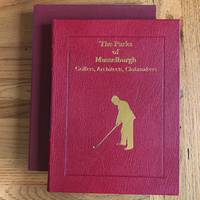
1991réf. 3554907191371991. Hard Cover. Signed by Author. Droitwich Worcestershire: Grant Books 1991. AUTHOR'S PRESENTATION EDITION SIGNED BY THE AUTHOR JOHN ADAMS AND LIMITED TO 125 COPIES THIS BEING # 69. Publisher's full red morocco with gilt lettering to the front board and spine with vignette of a golfer in gold to the front board. Four raised bands to the spine. All edges gilt. Title to the spine in gilt on black leather label. Marbled end-papers. A very fine copy in like publisher's slip-case. Hand-written letter from the publisher dated 6.4.91 laid in about the forthcoming publication of this book. A stunning production. Note: This limited edition of 125 copies should not be confused with the separate limited edition of 750 copies which is signed by Shirley Grant the publisher which was NOT published with a slip-case. Photographs/scans available upon request. hardcover
8vo. (24), 216 (misnumbered as 226), (8) pp. (pagination skips from pp. 80 to pp. 91 due to a printers' error, with no missing text). 18th century full leather ruled in blind and gilt, titled in gilt on red morocco spine label. Early English account of Muslim North Africa. An early example of notoriously difficult Arabic typesetting appears in the index of 'Moorish Words' at the rear, where Arabic terms are listed in both romanized and Arabic alphabets. - The Reverend Lancelot Addison (1632-1703), father of the essayist Joseph Addison, lived and worked as a chaplain in Tangier in northwest Morocco for seven years, which provided the basis for his historical accounts and gave him some knowledge of Arabic. Here he discusses, with some editorialising, the marital dramas of Moroccan dynastic struggles as well as the local traditions of cattle farming, and explains the camel to his European audience. - Leather rubbed and scuffed; spine, binding, and corners repaired; some offsetting to endpapers and half-title; light toning and foxing. Contemporary handwritten ownerships "Tho. Willughby" to front free endpaper and "T. Willughby" to title-page, probably belonging to the influential Tory politician Thomas Willoughby, 1st Baron Middleton (1672-1729), second son of the Warwickshire naturalist Francis Willughby (1635-72).
Large 4to. (8), 206, (4) pp. With 8 engraved plates. Contemp. full calf with giltstamped cover borders and giltstamped red label to gilt spine. Only edition. - The theologian J. G. Ch. Adler (1756-1834) had spent a long time in Rome and visited Europe's great libraries. During his scholarly journeys he had immersed himself in Greek and oriental manuscripts, studying especially the Syrian documents with a view to Biblical textual criticism. One of the scientific results of his labours is the present study: "notes regarding the manuscript Syriac translations so important for New Testament criticism" (cf. ADB). The plates show specimens from the Syrian manuscripts. - Evenly browned throughout with occasional insignificant staining. Appealingly bound. Hamberger/Meusel I, 29. ADB I, 86. Silvestre de Sacy 704. Darlow/Moule 8975 (note.). OCLC 5987315.
réf. DADAX0199330646New unknown
Large 4to. 1 p. "La santé est le seul et unique principe de vie pour le corps humain: pour un peuple c'est l'union avec l'accord et non la guerre qui le fera vivre [...]". - Mounted on cardboard.
8vo. VII, (1), 168 pp. Original printed yellow wrappers (spine repaired). First edition of an important study of the "six poets", as some of the earliest known writers of Arabic poetry are collectively known, probably simply because they were the earliest for whom compilers were able to assemble complete Divans: Ennabiga, Antara, Tharafa, Zuhair, Alqama, and Imruulqais. - Ahlwardt (1828-1909) was engaged as cataloguer of Arabian manuscripts at the Berlin Royal Library. For most of his working life he classified, collated, described and excerpted some 12,000 works in ca. 6000 volumes, including current accessions. - Inside edge of upper wrapper cover reinforced. Removed from the "Institut für Geschichte und Kultur des Nahen Orients an der Universität München" with their stamp on the title-page. An untrimmed copy. GAL I, p. 22. OCLC 18208722.
4to. 10+1 volumes. With 12 photographic halftone plates of 62 manuscript specimens in vol. X. - Added: separate atlas issue of the 12 plates. Altogether 11 vols. in publisher's light blue printed boards. A complete set of the scarce original edition, published as volumes 7-9 and 16-22 of the giant general catalogue of the Berlin manuscript collections ("Die Handschriften-Verzeichnisse der Königlichen Bibliothek zu Berlin"). Ahlwardt (1828-1909) was engaged in 1863 as cataloguer of the Arabian manuscripts. Until 1887 he classified, collated, described and excerpted some 12,000 works in ca 6000 volumes, including current accessions. The important collection was based on the precious library bequeathed by Heinrich Friedrich von Diez. It was gradually enlarged by the manuscript treasures purchased from leading German scholars such as Glaser, Landberg, Minutoli and Brugsch, Petermann, Sachau, Sprenger and Wetzstein. Ahlwardt's monumental catalogue is renowned for an unprecedented wealth of details both in physical and textual respect. It formed a pattern for a complete history of Arabic literature - theological, juridical, philosophical, scientific, linguistic, historical and poetical. Ahlwardt expanded on the customary manuscript catalogue entries by providing an exact outline of contents for each work catalogued. "When all ten volumes had been printed in 1899, Ahlwardt had created a work which by virtue of its scope and precision would remain of lasting value to the history of Arabic literature" (cf. Fück, Die Arabischen Studien in Europa, 1955, p. 192). - Bindings a little bumped, dust-soiled and faded in places, some edges foxed. A clean and very good set. NYPL (Arabia and the Arabs) p. 7.
4to (165 x 125 mm). (6), 129 ff. Early 19th century half calf with floral moirée paper covers. Yellow paper pastedowns. The sixth book printed by Ibrahim Müteferrika: an important eyewitness account of the life of Tamerlane (Timur), the successful and barbaric 14th-century Turkish conqueror. Translated into in Ottoman Turkish by Nazemi Zadeh from the original Arabic manuscript completed in 1437/38 by the Syrian author Ahmad lbn 'Arabshah (1392-1450), secretary to Sultan Ahmad of Baghdad. - Binding a little rubbed at extremeties. Occasional browning, depending on paper stock, but mostly a very good, clean copy on crisp paper. Özege 19929. GAL S II, p. 25. Ebert 292 (note). Brunet I, 117 (note). Toderini III, p. 75, no. V.
Folio. 1 page. On uncut wove paper, bearing the Schoellers-Parole blind embossed seal, margins uncut. The original autograph contribution of Ahmed Ali Khan to the Committee of the World League for Peace (Ligue Mondiale pour la Paix), a remarkable organization formed in 1925 with close ties to the League of Nations. The Committee itself was composed of such notaries as Queen Elizabeth of Belgium, King Carol II of Romania, John D Rockefeller, Marie Curie, and Albert Einstein, who personally gathered the present manuscripts over the course of seven years (1925-32). Among the public figures who contributed to the project were dignitaries from the newly-created League of Nations' member states. "The finest ideal for humanity is a peace based on justice and the integral independence of all nations. [Signed] Ahmed Ali". Pax Mundi. Livre d'or de la paix. Enquete universelle de la Ligue mondiale pour la paix sous le haut patronage de son comite d'honneur avec l'approbation de la Societe des nations, du Bureau international du travail et de la Cour permanente de justice internationale. Geneve, Societe paxunis, 1932.
8vo. VIII, 174, 8, (2) pp. With mounted photoportrait frontispiece. Original elaborately giltstamped forest green cloth. All edges red. First and only edition; inscribed copy. The author worked in the service of the Nawab (sovereign) of Tonk, in Hindustan. A Muslim, the Nawab in January 1870 received permission to make the pilgrimage to Mecca. Ahmed Hassan accompanied him, and his account includes details of the crossing from Bombay to Jeddah, of the visits to Mecca and Medina, and of the continuation of his journey to England. The account is uncommon. - Occasional minute foxing to interior, otherwise a very fine copy in well-preserved original binding. Inscribed by the author on t. p.: "With the author's compliments". OCLC 4384569. Not in Macro, Bibliography of the Arabian Peninsula.
8vo. (2), 307, (1) pp. Contemporary marbled half calf with giltstamped red label to prettily gilt spine. All edges red. First German translation of the "Layiha" of Ahmet Resmî bin Ibrahim Giridî (1700-83), a Greek-Ottoman statesman and diplomat and Turkey's first ambassador to Berlin. A political memoir on the Ottoman-Russian war of 1768-74, one of the few existing accounts from the Turkish perspective. Between 1772 and 1773 the Ottomans undertook ultimately abortive negotiations with the Russians during which Ahmed Resmi pressed for peace, arguing that the Russians were badly overextended and that both sides should recognize their military and territorial limitations. Such thinking was still novel in Ottoman administration and represents the good understanding of the balance of power diplomacy which the author had gained at the courts of Vienna and Berlin. - The oriental scholar H. F. Diez (1751-1817) had trained as a jurist but, bored by his administrative occupation, soon left the Prussian civil service and in 1784 went to Constantinople as Frederick the Great's chargé d'affaires at the Sublime Porte. He was ennobled after only two years of successful diplomatic service. Recalled in 1790 on the eve of the Russo-Turkish War, the self-confessed Turkophile soon retired to the life of an independent scholar and book collector in Berlin. His orientalist publications captured the attention of the learned world, and he moved in the circles of Goethe, Gleim, and Alexander von Humboldt, though largely outside the contemporary tradition of academic oriental studies. "Even if many aspects of his scholarly life are almost forgotten, his merits, especially for the development of Turkish studies, are noteworthy [...] His works, almost completely printed at his own expense, reflect his interest in the origins of Asian cultures, literatures, and politics, as well as everyday issues and ethics" (J. Gonnella et al. [ed.], The Diez Albums [Leiden, 2017], p. 58, 76). - Corners slightly bumped, otherwise very good. Bookplate of the "Brigade-Schule zu Potsdam"; several 19th century stamps of Prussian military academies on title-page; old shelfmark label to spine. Katalog der k. k. Kriegs-Bibliothek (1853), p. 266.
réf. 30595622-nnew. unknown
réf. 30595622like new. unknown
réf. DADAX1786604825Rowman & Littlefield Publishers 2018-04-30. hardcover. New. 6.30x1.09x9.27. Buy with confidence. Excellent Customer Service & Return policy. Rowman & Littlefield Publishers hardcover
Folio (239 x 320 mm). 2 parts in one volume. 394 pp. 383, (1) pp. Contemporary giltstamped brown full calf with fore-edge flap. Early Arabic-Turkish dictionary completed in 1545 in Kütahya, Turkey, and first published in Constantinople in 1826. - Binding rubbed, giltstamping largely oxydized; interior a little browned due to paper. A good copy. OCLC 22445320. Not in Zaunmüller or Vater/Jülg.
réf. 12130Clinton era Air Force One golf ball circa 1993-2001 is a piece of presidential commemorative material bearing the visual identity of the executive office and presidential air transport during Bill Clinton's administration. Air Force One serves as the call sign for a U.S. Air Force aircraft while the president is aboard and the two VC-25A aircraft used for presidential transport became among the most recognizable symbols of the modern presidency. The golf ball consequently belongs to the material culture surrounding presidential travel executive symbolism and the informal commemorative objects associated with the White House and Air Force One. Dunlop Air Force One commemorative golf ball. Clinton era circa 1993-2001. White golf ball manufactured by Dunlop and printed in full color with the Presidential Seal. Surrounding the seal is the inscription "Seal of the President of the United States / Air Force One." The design combines two immediately recognizable symbols of presidential authority: the official seal and the name associated with presidential air transport. No additional inscriptions presentation case or provenance information are noted in the supplied description. During Clinton's presidency presidential air transportation centered on two specially configured Boeing 747-200B aircraft designated VC-25A which served both practical and symbolic roles in the public presentation of the presidency. As an object rather than a document of a specific flight or event the golf ball is most useful for the study of presidential memorabilia executive branding and the informal material culture associated with Air Force One. No specific defects are noted in the supplied description. Near fine. A compact Clinton-era presidential souvenir combining the iconography of the Presidency with one of its most recognizable instruments of official travel. unknown
réf. 12130Clinton era Air Force One golf ball circa 1993-2001 is a piece of presidential commemorative material bearing the visual identity of the executive office and presidential air transport during Bill Clinton's administration. Air Force One serves as the call sign for a U.S. Air Force aircraft while the president is aboard and the two VC-25A aircraft used for presidential transport became among the most recognizable symbols of the modern presidency. The golf ball consequently belongs to the material culture surrounding presidential travel executive symbolism and the informal commemorative objects associated with the White House and Air Force One. Dunlop Air Force One commemorative golf ball. Clinton era circa 1993-2001. White golf ball manufactured by Dunlop and printed in full color with the Presidential Seal. Surrounding the seal is the inscription "Seal of the President of the United States / Air Force One." The design combines two immediately recognizable symbols of presidential authority: the official seal and the name associated with presidential air transport. No additional inscriptions presentation case or provenance information are noted in the supplied description. During Clinton's presidency presidential air transportation centered on two specially configured Boeing 747-200B aircraft designated VC-25A which served both practical and symbolic roles in the public presentation of the presidency. As an object rather than a document of a specific flight or event the golf ball is most useful for the study of presidential memorabilia executive branding and the informal material culture associated with Air Force One. No specific defects are noted in the supplied description. Near fine. A compact Clinton-era presidential souvenir combining the iconography of the Presidency with one of its most recognizable instruments of official travel. unknown books
1902réf. e9632Edinburgh: Printed for Private Circulation by Morrison & Gibb Ltd. Cover rubbed. Original cloth rebacked. New fep affixed to half title page. Hinges along an initial and end leaf with tape repairs along gutter. Part of prelims misbound. Light scattered browning. Teg. 1902. First Edition. Blue hardback cloth cover. 260mm x 190mm 10" x 7". xl 126pp. Photographic frontispiece and vignette of old clubhouse. . Printed for Private Circulation by Morrison & Gibb Ltd hardcover