4 355 résultats
19961st edition. Fine in green cloth with white lettering.8894. eng
réf. SONG1557501319Used: Good unknown
réf. 83543Seconde période - Tome cent troisième - XLIIIe année - 15 janvier 1873 - 2e livraison - Paris. Bureau de La Revue des Deux Mondes - grand in-8 broché - 240 pages
réf. 386161 vol in-8 broché - 162 pages - N° 33 de janvier - mars 1992
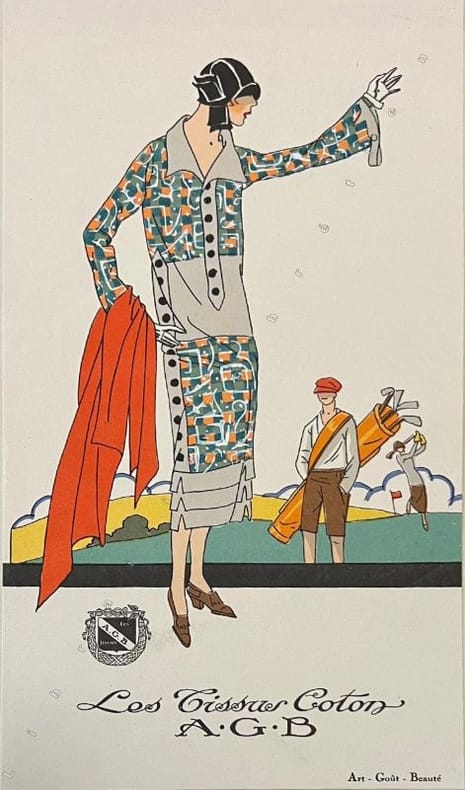
1922réf. 24714paris 1922 1 in 4 Estampe rehaussée au pochoir, titrée, rehaussée sur la page de Garde. Paris, Successeurs d'Albert Godde, Beddin et Cie, (1922),
(Large) 4to. Altogether 8¾ pp. on 3 bifolia. Three letters to the Prelate in Austro-Hungary, Jacob Mislin (1807-78), signed, containing reports of the position of the Lebanese Christians, especially about Youssef Bey Karam (1823-89), a Maronite freedom fighter in Mount Lebanon: "Le Cheik Joseph Caram, sur l'avis qu'il avait reçu de votre Grandeur s'était préparé à faire une brillante réception à leur Altesse Royale le Duc de Brabant et son auguste épouse, il avait mis à contribution tout ce que son pays pouvait lui fournir de ressources matérielles, pour donner à leur Altesse un témoignage éclatant de la vénération qui lui et tout son pays professent pour elles. Après de nombreux préparatifs, ayant appris que leur Altesse n'avait pu exécuter leur voyage au cèdres, sa douleur a été à son comble. Vous connaissez ses instincts pour les devoirs de l'hospitalité; En cette occasion ils s'étaient déployés au delà de tout ce qu'on peut dire. Pendant les dix ou douze jours de son attente, il avait mis plusieurs villages à contributions, pour réparer les chemins trop raboteux et qui pouvaient offrir quelques dangers, il avait aussi envoyé au haut des montagnes ôter la neige tout le long de la route depuis les cèdes jusqu'à l'autre côté du Liban; il avait entretenu pendant plusieurs jours une cinquantaine de cavaliers dans sa maison; il avait acheté et distribué huit quintaux de poudre à tous ses gens armés aux quels il donnait quelque teinture de la manœuvre militaire pour que leurs salves fussent exécutées avec ordre; il avait fait de grands achat de tentures pour tapisser tout l'intérieur de sa maison et ses avenues &c.&c.&c., le tout à ses frais, malgré la maudicité de ses ressources. Son cœur généreux et on ne peut plus désintéressé serait certes loin d'espérer quelque compensation à toutes ces dépenses, il se tiendrait même grièvement offensé sur le point d'honneur, s'il savait que je vous au fait connaître ces détails; c'est donc à son inçu et sur le conseil de quelques uns de ses nombreux amis que je me donne la liberté de vous en entretenir, afin que si vous le jugez convenable, vous portiez ces faits à la connaissance de leur Altesse Royale; votre ami se croirait déjà trop flatté de savoir que sa bonne volonté leur est connue. Le Prince de Jouinville dans son voyage en Syrie l'avait pris tellement en affection qu'il voulait l'emmener à la cour, si l'Auguste sœur de ce digne Prince voulait lui continuer le même intérêt, nous la prierions de vouloir bien obtenir de la porte Ottomane, pour le Cheik Joseph Caram, le titre serait le prix de son parfait dévouement, non seulement pour le servir de leur Altesse Royale, mais encore pour celui de tous les européens qui voyagent dans ces pays et cela depuis un bon nombre d'années, suivant en cela les traces de son illustre Père. Mille pardons, Monseigneur, de la liberté que je prends moi pauvre missionnaire; c'est peut-être un excès de tendresse de ma part" (10 May 1855). - "Le scheik Joseph Caram gouverneur d'Eden, Sgorta, […] vient de scavoir l'honorable et précieux souvenir de son Altesse Royale le Duc de Brabant. Cette marque distinguée de la munificence du Prince a été reçue avec de grands transports d'enthousiasme et une pompe vraiment triomphale. On est allé à rencontre de la précieuse epingle, avec le même élan et la même solemnité que si c'eut été son Altesse en personne qui venait honorer ces contrées de sa personne. Le Scheik Joseph ne fait rien à moitié: il a voulu que la foule nombreuse qui faisait cortège au Cadeau Royal, depuis Tripoli, avec chants, musique, salves, tournois, comprit la signification qu'il voulait donner à cette fête. […] publiant avec une grande conviction, en face de tous, que tout honneur vient de Dieu et doit retourner à Dieu, que ce n'est qu'en vue de glorifier sa souveraine Majesté qu'on doit accepter la gloire mondaine; que le glorieux Prince qui veut bien condescendre à honorer la personne n'a d'autre dessein dans ses largesses que d'étendre le royaume de celui de la libéralité du quel il tient le sceptre et la couronne […]" (1 Feb. 1856). - "Le fanatisme des Musulmans se réveille. Un de ces jours le tribunal de Tripoli a condamné à (3) mort un Maronite pour avoir maudit Jésus Christ. Ce n'est pas, comme vous le pensez bien, par respect pour la religion chrétienne et son divin instituteur, mais pour avoir raison de condamner à la même peine de mort quiconque blasphémerait le nom de Mahomet : car disent-ils la loi du Coran est encore dans toute sa vigueur et le Hati-Scherif n'a pas voulu toucher la question de la liberté de conscience […]" (21 June 1856).
2021ill., br. Con il titolo "Golf. Un gioco di testa" l'autore ha voluto mettere in evidenza l'ovvia importanza che la psicologia del golfista esercita sulla buona riuscita del gesto atletico e della performance. Il risultato è un libro da utilizzare come un manuale da portarsi sui campi di prova, a disposizione di chi abbia la volontà di introdursi come golfista alle tecniche funzionali a far scoprire come il proprio gioco possa ancora cambiare e migliorare. Lo scopo di questo libro è anche quello di riuscire a ridurre, non purtroppo a eliminare completamente, quella porzione di scontentezza che alligna nell'animo di ogni golfista, coltivando nel contempo quelle abilità che, unite parallelamente ad una buona condizione fisica e tecnica, possono condurre il giocatore alla realizzazione della peak performance, intesa come propria prestazione ottimale. Numerosi i suggerimenti utili per gestire al meglio le dinamiche interiori, insieme ad esercizi ed azioni pratiche che potranno far evolvere considerevolmente il potenziale personale, l'umore e non ultime, le scelte tattico-strategiche che sarà possibile fare sul percorso.
2017ill., br. "Una sfida che accomuna tutti noi professionisti sia giocatori sia maestri è rendere, per quanto possibile, la tecnica del golf più comprensibile ed accessibile a tutti. In questo contesto si inserisce perfettamente il libro di Stefano, ricco di aiuti e "drill" atti a colmare quella distanza che a volte si crea tra la tecnica pura e la sua applicazione pratica. La lettura del suo libro risulterà pertanto molto utile a tutti noi giocatori, poiché se la perfezione nel golf non esiste e non deve essere ricercata, è altrettanto vero che una pratica mirata, più efficace e ricca di feedback porta sicuramente a risultati migliori." (Matteo Delpodio)
1986réf. 118195P., Unesco, 1986, gr. in-8°, 336 pp, 43 photos et cartes, index, reliure toile éditeur, jaquette illustrée, bon état. Texte en anglais
Folio (218 x 340 mm). Two parts: 1) Confidential. Survey by Major E.T. Rich, R.E., of routes between Bandar-Abbas and Kerman. General Staff, India. Simla: Government Branch Press, 1917. 9, 13, (1), 7, 16 = 46 pp. With six maps and plans (two folding), a proof plate with 2 photo views, and 13 leaves of original manuscript, typewritten and printed telegrams related to the report. Both original publisher’s wrappers bound in. - 2) Confidential. Report by Major E. T. Rich, R.E., on the Construction of Motor Roads in South Persia between Bandar Abbas and Kerman. 1917. General Staff, India. 2 vols. Delhi: Superintendent Government Printing, India, 1918. Vol. 1: (2), IV, 38 pp. With 12 leaves of plates (including one proof plate) and 8 maps and plans (3 folding). Vol. 2: 39-54 pp. With 3 folding maps. Occasional red ink notes by Rich in text and on the maps/plans; original publisher’s wrappers bound in. Occasional red ink notes by Rich in text and on the maps/plans; both original publisher’s wrappers bound in. Custom-made hardcover binding with the first publisher’s wrapper of the original report pasted to the front board. With a large folding linen backed map of Persia in the pocket at rear. Addenda (see below). Special custom-bound, historically important archive, compiled by E. T. Rich and containing confidential printed reports, 18 maps and plans, as well as original documents related to the survey of potential routes for a motor road between Bandar Abbas and Kerman in southern Persia. The survey was carried out by Rich as a part of the Persian campaign during the First World War on the special orders of the Chief of General Staff in India. As a part of WWI military operations, Bandar Abbas was occupied by British forces under command of Sir Percy Sykes in March 1916, and the survey was apparently undertaken in order to establish additional supply routes to the war’s Persian front. Rich was ordered "to report as soon as possible on the best route for a road to take motor lorry traffic from Bandar Abbas to Kerman and to frame estimates from the same and proposals as to the best way of carrying out the work." The survey was done between December 1916 and June 1917; a year later Rich was promoted a Companion of the Order of the Indian Empire (C.I.E.) for his work. Nevertheless, the road never was constructed, probably because of the cardinal changes on the Persian front after the collapse of the Russian front line as a result of the revolution in February 1917. - The volume contains: confidential reports by Rich; printed "Working notes" on the survey; maps and plans of Bandar Abbas, Kerman, and the area in between; telegrams sent to him from the Chief of General Staff (Delhi & Simla), Surveyor General’s Office in Calcutta, British Consul in Bandar Abbas; tables with distances and estimates of construction, printed views of the area et al. Several leaves slightly age-toned, but overall a very good custom-made copy. - Supplemented with Rich’s copy of a typewritten dispatch from the British Vice-Consul in Bandar Abbas to the Chief of Roodbar (South Persia) Zarghan-us-Saltaneh, dated Bandar Abbas, 2 Dec. 1916. In the dispatch the consul asks for the assistance to Rich who is going to visit the area under the chief’s control during the course of his road survey. The copy is signed by the consul and has his manuscript note "Original sent by special messenger direct to Zarghan-us-Saltaneh." - There are also two autograph signed letters by Rich, addressed to his aunt in London and written while on field service in Southern Persia. The letters are dated 10 & 25 Dec. 1916, housed in the original envelope with a postal stamp of Bandar Abbas, and contain interesting notes about Rich’s work and his observations on the native life. [Near Kerman:] "It is Xmas evening & as I have no one to talk to, the nearest white man being over 100 miles away, I am writing instead. Being high up over 5000 feet in the mountains, it is bitterly cold & proper Xmas weather, but personally I’d prefer it a bit warmer as I can’t keep warm no how at night which means continuously waking up [...] The food of the villagers about here is most strange, being dates & bread about 2 lbs of each per diem & nothing else. They feed the horses & cows on dates & even the dogs. I eat them once a day for lunch which consists of porridge, bread & cheese & dates. I often envy the meals my servants get at home when I am out on these expeditions." - E. T. Rich (1874-1937) was a British military engineer and surveyor, Fellow of the Royal Geographical Society. He graduated from Sandhurst with the Pollock Medal and was gazetted as 2nd Lieutenant in the Royal Engineers. In 1895 he went out to India and was posted to railway survey work in Burma. In 1905-1909 Rich worked as survey officer on the Indian North-West Frontier, and took part in the Bazar Valley and Mohmand Campaigns of 1908 (as a divisional and a chief survey officer respectively). During the latter he was slightly wounded and for his services was promoted brevet-major. In 1911 Rich was appointed the head of the survey office on the Burma frontier post at Myitkyina, where he carried out the survey of the border with Tibet and Yunnan. In 1916/17 he was in charge of the survey party looking for the alternative routes between Bandar Abbas and Kerman in South Persia; in 1918 he was in charge of the North West Persia Survey Detachment which accompanied British intervention in the Caspian under command of General Dunsterville. Rich carried out important surveys in Baku, Batum and Tiflis. After WWI Rich returned to Burma where he became the head of the Burma Circle of the Survey of India. In 1920-22 while surveying the unadministered territory between Burma and Assam he encountered slavery and human sacrifices still practiced there; in 1925 he took part in the Sir Harcourt Butler’s Mission to the Hukawng Valley to suppress slavery. Rich retired with the rank of Colonel and C.I.E. in 1929. "Colonel Rich was a great linguist, and besides his knowledge of Urdu, Pushtu, and Persian, he was able to converse in Yunnanese and several dialects of Burma - Kachin, Maru, and Lisaw [...] He was a keen explorer throughout his career and did much to encourage a spirit of adventure in younger officers who served under him” (Obituary, The Geographical Journal 91.1 [1938], p. 96).
Folio (275 x 407 mm). 2 vols. (4), XLVIII, (16) pp. 2144 (but: 2136: skipping 441-448) cols. (4) pp., XX cols., (6) pp., 2286 cols. 19th century English calf. First edition of the first Persian-Arabic-English dictionary, edited by the orientalist Sir John Richardson (1740/41-1795). The first volume includes a dissertation on the languages, literature and manners of Eastern nations. ''An excellent work. As the first vol. or Persian, Arabic and English part was published separately, many more copies were sold than of the second or English, Persian, and Arabic. A few broken sets of the first volume being left, the booksellers were led to reprint several deficient sheets, and so with the copies left on hand of the second vol. they made up some perfect sets. But these are easily known from the original'' (Clarke), as they are printed in London in 1800. - "On 12 November 1767 [Richardson] was proposed for the Society of Antiquaries of London as of Furnival's Inn. In London he pursued both the law and the study of Arabic and Persian. In his oriental interests Richardson was much influenced by another young man, William Jones, who was already coming to be regarded as a prodigy of learning in Asian languages. With the growth of British territorial power in India the potential market for a Persian dictionary had aroused the interest of London publishers and by 1770 Jones and Richardson were working on a new version of Franciscus Meninski's 'Thesaurus linguarum orientalium', first published in 1680-87. Progress was very slow, and Jones withdrew to concentrate on his legal career, leaving the field to Richardson. Thanks to his 'ingenuity and perseverance' (memorial of A. Hamilton and G. Nicol to East India Company, 6 Feb 1776, BL OIOC, E/1/60, no. 26), an abridged version of the original project eventually appeared in two volumes in 1777 and 1780 as A Dictionary, Persian, Arabic and English. Fundamentally revised by others, notably by Charles Wilkins in 1806 and 1810, the dictionary was to have a long life, but although the company took 150 sets, there were few other subscribers and Richardson got little reward for the huge effort he had expended on it" (Marshall). - Bindings rubbed and worn, inner hinges partly split, endpapers renewed. Some staining and marginal repairs to interior; larger tears to 5 leaves, staining to both titles, ownership inscriptions partly inked out; both titles showing central repaired clipping as well as marginal strenghtening and collector's stamp. A large part of both volumes shows worming to gutter; a few leaves with repairs. Zaunmüller 189. Vater/Jülg 25. Graesse VI, 113. Cf. Brunet IV, 1285 (later ed. only, 1806-1810). Clarke, John. (1806). The Bibliographical Miscellany - Supplement, vol. 1 (London, 1806) pp. 273-274; for Richardson: Marshall, "Richardson, John [styled Sir John Richardson, ninth baronet] (1740/41-1795), orientalist", in: ODNB (online ed.).
2010réf. B3A210320016Hazeltine National Golf Club. 50th Anniversary Committee 2012-01-01. Hardcover. Very Good. A nice copy. Text in mint/unmarked condition. Cover has minor wear. Binding is tight. Your Satisfaction Guaranteed. We ship daily. Hazeltine National Golf Club. 50th Anniversary Committee, hardcover
1997réf. 7080784Zürich: Museum Rietberg 1997. 319 Seiten. Mit zahlreichen farbigen Abbildungen. 4° (30,5 - 25 cm). Farbig illustrierter Orig.-Pappband. [Hardcover / fest gebunden].
Small 4to (140 x 187 mm). 68 ff. (but title is fragmentary, preserving the letterpress only, laid down to old paper). Near-contemporary full leather binding, spine rebacked. All edges red. Rare edition of this famous and scare refutation of the Qur'an. The Dominican Ricoldus (ca. 1243-1320) was sent to the orient as a missionary in 1288. He visited the Holy Land and travelled to Baghdad via Cilicia, Erzurum, and Tabriz. During his stay in Baghdad, Ricoldus studied the Qur'an and other works of Islamic theology, for controversial purposes, arguing with Nestorian Christians. He is said even to have begun a translation of the Qur'an about 1290, but it is not known whether this work was completed. - Ricoldus returned to his native Florence around the year 1300 to compose or edit several works about the Middle East. While many of his writings praise the Muslims' social behaviour, hospitality and sense of honour, his best-known work, the "Contra legem Sarracenorum", is a notorious refutation of the Islamic doctrines. Largely a compilation from William of Tripolis, Marcus of Toledo and the "Contrarietas alpholica", and probably an early effort written in preparation of Ricoldus's mission, it contends that the Qur'an's self-contradictory passages, confused arrangement and want of miracles prove that Islam cannot be a true revealed religion. Despite Ricoldo's hostility towards Islam his work shows specific knowledge of the Qur'an and overcomes one important prejudicial error common to other medieval criticisms of Islam: the perception that Muhammad introduced a christological heresy. The work was widely received; a Greek translation was prepared as early as 1385 by Demetrius Kydones, which was re-translated into Latin by Bartolomeo Piceno as "Improbatio" or "Confutatio Alcorani". A Spanish version appeared at Toledo in 1502, and Luther translated parts into German in 1530 (his "Verlegung des Alcoran" appeared in 1542). It influenced Pope Pius II, John of Segovia and Nicolaus Cusanus (cf. LMA VII, 808). - Binding worn but professionally repaired; spine rebacked. Some fingerstaining and browning with occasional slight worming to gutter. Trimmed rather closely with printed marginalia cropped in places, title fragment torn out and mounted, preserving some old handwritten annotations. Provenance: Mehmed V (1844-1918), Sultan of the Ottoman Empire from 1909, with his his Arabic bookplate on the pastedown. VD 16, R 2328. BNHCat R 296. This edition not in Panzer.
8 engravings, 255 x 180 mm each. Attractive series of horses (and mules) used in Arabia, Germany, England, Spain, Tartary, Turkey, and Hungary. - Captions and four-line descriptions in German and French.
Engraving. 285 x 357 mm. Matted. An Arabian horse led by a bedouin, engraved by the young Martin Elias Ridinger after a drawing by his famous father.
Oblong folio (450 x 336 mm). Letterpress title page (with extensive description on the reverse) and 4 engraved plates. Contemporary blank wrappers, stored in custom-made cardboard portfolio with giltstamped cover label. First edition. A fine series of four elaborately decorated Turkish horses, based on drawings prepared in Constantinople and sent to Ridinger by Baron Gudenus. As stated in the letter from Constantinople, dated 7 March 1741 and printed on the reverse of the title page, the Ottoman dignitaries could be distinguished by the various kinds of luxurious cloths, jewels, and finery they applied to their stables. The officials would vie with each other for the most splendid equestrian adornments, often showering their animals with gold and silver, diamonds, silk, and delicate embroideries. At a state reception in 1740, the Sultan was reported to have shown a parade of 30 horses, each covered in a different kind of precious stone. Such a horse laden with ornament, led into the seraglio by a Janissary, is pictured in plate I: four ostrich feathers adorn the head (a distinction afforded only to the Sultan's personal stable), while the chest bears a splendid rosette belt. Plate II shows a rising "Divani", such as is ridden by the Grand Vizier when dressed in state, with silver chains jingling from its halter and an embroidered blanket under the saddle. Plate III shows another Divani (titled "du coté gauche", but a rare variant imprint from front right), with different bridle and blanket; an elaborately tooled gilt thong is strapped across the chest. The final plate IV shows the "cheval de main d'un Pacha" besides a large kiosk, with a long blanket, rich silver and gemstone decoration and two leopard skins. - Some fingerstaining in the margins, but well preserved. Thienemann 594-597.
Folio (302 x 402 mm). (6), 56 pp. With 60 chromolithographed plates. Contemporary half cloth. Second edition of this plate set first published in 1876-78, including several much-sought depictions of falcons. "As these birds of prey are rendered with the utmost attention to detail, the description of their exterior may be confined to that which is not evident from the images or whatever is of particular noteworthiness" (cf. preface). - Binding rubbed and stained; lower hinge beginning to split. Nissen, IVB 782. OCLC 302340448. Cf. Harting 127.
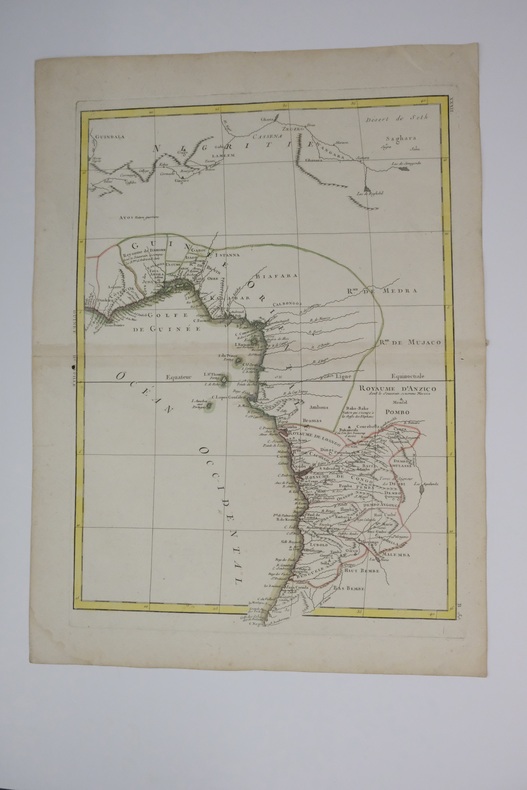
1770réf. carte180b12Français : Un bel exemple de la carte décorative de l'Afrique de l'Ouest de Rigobert Bonne datant de 1770. Couvre de la Gold Coast (Ghana moderne), au sud autour du golfe du Bénin (Biafara) jusqu'au Gabon, au Congo et à l'Angola. Comprend les pays modernes du Ghana, du Togo, du Bénin, du Nigeria, du Cameroun, de la Guinée équatoriale, du Gabon, du Congo et de l'Angola. Comme la plupart des cartes de l’Afrique, cette carte montre d’excellents détails le long de la côte et uniquement des spéculations à l’intérieur. Donner la preuve d’importantes activités cartographiques belges à travers le Congo. Nomme de nombreux royaumes africains, dont Anzico, Mujaco, Bembe, Lubolo, Pemba, Dembi, Calbongo, Bake-Bake, Bénin et d'autres. Tentatives de cartographier le fleuve Niger quant à ses écoulements dans le désert de Seth ou Saghara, mais la plupart de cette cartographie est au mieux spéculative. Dessiné par R. Bonne en 1770 pour émission sous la planche no. B 30 dans le numéro de 1776 de Jean Lattre de l'Atlas Moderne English: A beautiful example of Rigobert Bonne's 1770 decorative map of West Africa. Covers from the Gold Coast (modern day Ghana), south around the Bight of Benin (Biafara) to Gabon, Congo and Angola. Includes the modern day countries of Ghana, Togo, Benin, Nigeria, Cameroon, Equatorial Guinea, Gabon, Congo and Angola. As with most maps of Africa, this map shows excellent detail along the coast and only speculation in the interior. Give evidence of significant Belgian mapping activities throughout the Congo. Names numerous African Kingdoms including Anzico, Mujaco, Bembe, Lubolo, Pemba, Dembi, Calbongo, Bake-Bake, Benin and others. Attempts to map the Niger River as to flows into the Desert de Seth or Saghara, but most of this cartography is speculative at best. Drawn by R. Bonne in 1770 for issue as plate no. B 30 in Jean Lattre's 1776 issue of the Atlas Moderne .
8vo (125 x 182 mm). (8), 80 pp. Contemporary full red morocco with gilt dentelle borders along both covers. Ottoman Turkish treatise on equestrian anatomy: a translation of the "Traité des articulations du Cheval" (Paris 1827) by the French veterinary surgeon Félix Rigot (1803-47), translated by Muhammad 'Abd al-Fattahh al-Misri and edited by Mustafa Hasan Kassab. - Old ticket inscribed in French "Arabe - Chirurgie" pasted to inside of lower cover. A very good, clean copy. OCLC 56713283.
8vo. X, (2), 364 pp. With a pictorial map as frontispiece, 31 photographic plates and a full-page map in text. Original publisher's black cloth, with title in gold on spine. First edition, British issue, of a travelogue by the distinguished Lebanese Arab-American writer Ameen Rihani (1876-1940). Divided into five parts, it describes his time with King Husein in the Hijaz, the Idrisi in Asir, Aal Sabah, the sheiks of Kuwait, Aal Kalifah, the sheiks of Bahrein, and Aden and the protectorates. It is one of the most important sources for the historical background of the Idrisid Emirate of Asir. - Rihani, who moved to New York when he was twelve, is considered the founding father of Arab-American literature. His early English writings mark the beginning of a school of literature that is Arab in its concern, culture and characteristic, English in language, and American in spirit and platform. - A few occasional spots, but otherwise in very good condition.
8vo. XII, 400 pp. Contemporary full blue calf, the spine elaborately gilt, blue silk page-marker, all edges gilt. Neat contemporary ownership inscription to front free-endpaper. Second edition. "The author, a Christian Arab from Lebanon, gives a very interesting account of life among the native Christian population. The work consists of a mixture of autobiographical anecdotes, travels and information on Syria and Lebanon. There is also an amusing chapter on how a young Syrian sees England, plus a very interesting account of silk-worn culture" (Blackmer, 1427). - Minor wear to extremities of spine, corners slightly bumped, otherwise very good. Cf. Blackmer 1427 (first edition).
réf. DADAX0367280620New unknown
Imperial folio (405 x 474 mm). 2 vols. (10), 12, (2) pp. With 10 colour illustrations in the the text and 100 full-page coloured illustrations mounted on plates. Sumptuous dark brown contemporary full calf, gilt, covers lined in silk, with silk endpapers. First edition of this monumental publication on Islamic pottery, no. 107 of 200 copies printed. All ceramics pictured within the two volumes are described in detail with place and date of origin as well as the current owner (mostly French noble or institutional collections). Includes a bibliography on the subject and list of plates. - Union Club bookplate. Contemporary bindings somewhat rubbed; hinges professionally repaired, otherwise a fine copy, clean throughout. Rare. Not in Arntzen/Rainwater.