[General Staff, India].MareMagnum
[Garnmann-Horodisch, Alice:]Antiquariat.de
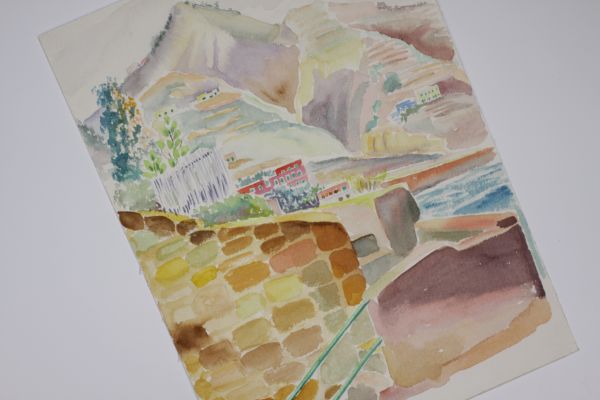
Lenno - [Aquarell]. -
1963Best.-Nr. 900318AG1963. Blattmaß: 24 x 31 (quer),

Antiquariat Tautenhahn · Deutschland160,00 €
4.355 Ergebnisse
Folio (210 x 330 mm). (2), 65, (1) pp. Original printed boards, spine reinforced with cloth. Annotated tables of the tribes making up "Al-Muntafiq", a large Arab tribal league in southern and central Iraq then in struggle against British occupation. Edited from the Basrah Arab Bureau's confidential British government handbook "The Muntafik" published that same year. - Corners chipped; erased stamps; stamp and handwritten ownership of "Harry J. Almond, Arabian Mission" (American Mission School). Extremely rare; no copies in OCLC or the British Library.
12mo. 134, (6) pp. Contemporary red morocco, triple gilt filet on covers, central royal coat of arms, gilt edges. First edition. The priest Gaudereau (1663-1743) had gone to Persia in 1689 in the company of Bégnine Vachet, a director of the Seminary of Foreign Missions. Having arrived at Isfahan in late 1690, they joined François Sanson, another member of the Society of Foreign Missions sent by Louis XIV to the court of Shah Suleiman. After Sanson's departure in 1692, Gaudereau continued negotiations with Suleiman, after 1694 with Husayn. Having negotiated a military and commercial alliance between Persia and the French East India Company, he returned to Isfahan, which he quit for Europe in 1703. It was during this journey from Constantinople and Trabzon that in September 1704 he contracted the illness he describes in his book, which he based on his own experience, having miraculously survived. - Fine copy, bound for Philippe d'Orléans. From the library of Hyacinthe Théodore Baron (18th century engraved book plate). Blake 169. OCLC 495355672. Not in Waller or Wellcome.
Engraved map of the Indian Ocean, Indian subcontinent and most of the Gulf region (28 x 39 cm; margins extended to 50 x 66.5 cm), at a scale of about 1:13,500,000 with north at the foot, with the equator reticulated with longitudes based on a prime meridian through Cape Verde, reticulated scales of latitude in the left and right borders, the Tropic of Cancer not reticulated; 3 sea monsters, a spouting whale and 3 ships in the ocean; and on the land elephants, lions and 2 people on horseback carrying spears. Rare very early engraved map showing the Indian subcontinent, the Strait of Hormuz, the eastern half of the Gulf, and the Indian Ocean, including the islands of Ceylon (Sri Lanka), the Maldives, Seychelles, the western tip of Sumatra and what must be the eastern tip of Somalia. The island Diego Garcia (7° S), labelled "Isole de Don Garzia", touches the southern edge of the map image. The map's own scales indicate that it covers 35°N to 9°S and 60 to 120°E (labelled 85 to 145°E following the Cape Verde prime meridian), but in fact it covers about 60 to 96°E. It is double trapezoidal projection, but tapers only slightly from its widest point at the equator. Many topographic names appear in forms used in early Portuguese accounts of voyages, but most can be identified. In India and Ceylon we find Goa, Mangalor (Mangalore), Cochin (Kochi), Calinapata (Calcutta?), Besinagar (Bangalore), Colmucho (Colombo) and many others; in the Gulf region Cor. Dulfar (Dhofar), the island Macira (Masirah), C. Resalgate (Ras el Had?), Galatia (the ancient site Qalhat), Mazcate (Muscat), the island Quexumo (Qeshm) and Ormus (Hormuz). There is even an unlabelled city close to present-day Abu Dhabi. Two of the ships are labelled with their destinations: Calicut (Kozhikode) on the Malabar Coast and Molucche (the Moluccas) in the East Indies. - Gastaldi first published a similar map as one of a set of three woodcut maps in the first volume of the second edition of Giovanni Battista Ramusio,Navagationi et viaggi, Venice, 1554: the "Prima tavola" shows Africa, the "Seconda tavola" shows the regions in the present map and the "Terza tavola" shows Southeast Asia and the East Indies. These were a great advance on earlier maps, including even Gastaldi's own, taking account of new information from Portuguese explorers. - The woodblocks and whatever copies of the printed edition had not yet been sold were destroyed by a fire in 1557, so for the 1563 edition the publisher had the three maps engraved on copperplates by Niccolo Nelli. Bertelli published the three maps without Ramusio's text, and his maps are usually supposed to have been printed from the 1563 plates, but Karrow describes them as close copies, with his name and the date 1565 added in each map, and Bertelli was an engraver as well as a publisher. Although the first map also has a longer note referring to all three maps, they were probably issued separately as well. Although printed from a single copper plate, the present map image is divided into two parts, with a 7 mm gap between the right and left halves, so that nothing would be lost if the map were bound as a double-page plate. No later state is noted in the literature, so there may have been multiple printings with the unrevised plate. - The present copy is printed on a whole sheet of paper, watermarked: coat of arms (77 x 44 mm) bearing a tree on the central and highest of three hills = --, with about 38.5 mm between chainlines except that the mark is centred on a chainline only 25 mm from the adjacent ones. The tree clearly matches the style of the oak tree in the arms of the family Delle Rovère, including the Popes Sixtus IV and Julius II (who served 1471-1484 and 1503-1513), but their arms does not include the hills. The present mark is very close to Briquet 969 (Lucca 1573-1582) and Zonghi 1737 (Fabriano 1571). Likhachev 3636 (an Italian manuscript f ca. 1570) is not as close. All similar marks noted in the literature date from the period 1569 to 1582, so the present map seems unlikely to have been printed in 1565, but very likely to have been printed ca. 1570 (Bertelli remained active to ca. 1580 or perhaps even later). Bifolco & Ronca lists copies of the 1563 (84a) and the present 1565 (84b) state or edition together, but their separate lists of references suggest the present 1565 version is much rarer. - The margins have been cut down close to the plate edge and in places to the outer edge of the border, and the margins then greatly extended (10-14 cm) with blank paper, but this paper is also contemporary, watermarked: coat of arms bearing a ladder and topped with a 6-point star (90 x 27 mm) = --, similar to Likachev 3524 (Loreto 1564). The map is very slightly browned at the edges (where the pieces of paper used to extend the margins were pasted together) and in the gap between the right and left halves (where the old fold has been reinforced on the back), but the map is otherwise in fine condition. A milestone in the cartography of India and the Gulf States, remarkably well preserved. Bifolco & Ronca, Cartografia topografia Italiana, 84b. Gole, Early printed maps of India, 2. Karrow 30/74.2.
1963Best.-Nr. 900318AG1963. Blattmaß: 24 x 31 (quer),
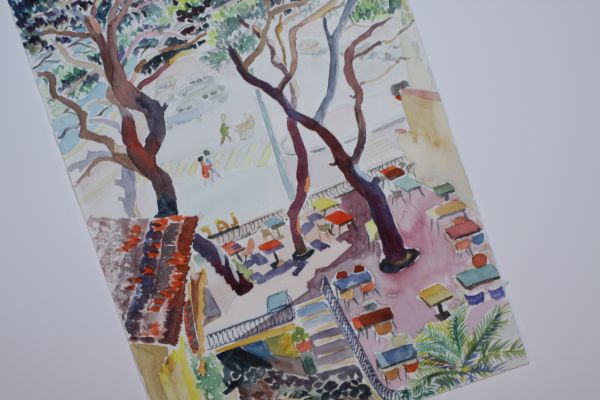
1963Best.-Nr. 900320AG1963. Blattmaß: 31 x 24 cm,
1964Best.-Nr. 900321AG1964. Blattmaß: 31 x 24 cm,
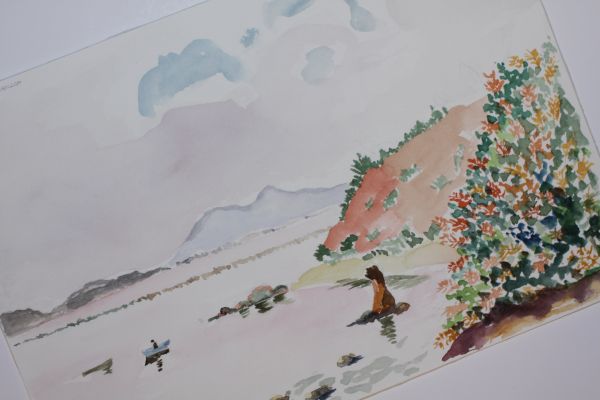
1967Best.-Nr. 900306AG1967. Blattmaß: 16,5 x 24 cm,
1967Best.-Nr. 900304AG1967. Aquarell, Blattmaß: 16,5 x 24 cm (quer),
8vo. 188 pp., 2 final blank leaves. Original printed wrappers. First edition. - Collection of laws and regulations for Lebanon (Zone Ouest) passed by the French under their mandate for Syria and the Lebanon from October 1918 until the end of August 1920, two days prior to the declaration of independence of Greater Lebanon. A compact primary source on French administration in the Middle East, this rare manual contains decrees for administrative issues such as the division of Lebanon into three zones, sanitary measures against the plague, but also detailed regulations concerning everything from travel permits and the organisation and surveillance of prisons to the application of the metric system, the trade in carrier pigeons, the prices for ice (2 piastres for 400 grams wholesale, 3 piastres retail), alcoholic drinks (16 piastres for a litre of table wine) and tramway fares, and the circulation of vehicles. - A few marginal flaws to the wrappers, occasional minor edge flaws. A good, clean copy with provenance stamp "Le Chef de Cabinet" on the upper cover.
22 typewritten sheets (4to) in carbon duplicates, revised by hand, with two smaller hand-drawn coloured maps of the Arabian Gulf, showing Bahrain and Qatar with the "Pirate Coast". A closely typed report on Bahrain, written in the autumn of 1936, outlining the country's history, situation, population, government, economy, foreign relationships and influences. This is accompanied by two detailed coloured sketch maps of the Gulf, showing Bahrain off the coast of Qatar and the entire Gulf from Kuwait to Oman, with the British and American spheres of interest and the international air routes marked. - During the two years that followed the end of the Great War, the British held control of most of Ottoman Mesopotamia (now Iraq) and the southern part of Ottoman Syria (Palestine and Transjordan), while the French controlled the rest of Syria, Lebanon, and other portions of southeastern Turkey. In the early 1920s, British and French control of these territories became formalized by the League of Nations' mandate system, and in 1923 France was assigned the League of Nations mandate of Syria. It would last until 1943, when Syria and Lebanon emerged as independent countries. - Occasional insignificant edge flaws; rust stains from old paperclips. Holes punched along left edge. A rare survival.
4to. English manuscript on paper. (4), 306 pp. With mounted engraved frontispiece in original hand colour and 21 mounted engraved plates, 13 of which in original hand colour. Contemporary half calf over patterned boards with giltstamped spine and spine-title. Marbled endpapers. All edges red. Intriguing manuscript comprising five Arabian tales allegedly recounted by officers at a Spahi camp in Algeria in the context of an imminent raid against the Haschemu tribe loyal to Emir Abdelkader in 1842, commanded by the French general Louis Juchault de Lamoricière (1806-65). The compiler, who gives his initals as "E. H. S. de R." on the title-page, states that he transcribed the tales from another book, but gives no clear indication whether or not the account is purely fictitious. He does, however, criticize the "cruel system of warfare which the French have hitherto employed in Africa" (p. 1). - Prefaced to the tales is an introduction describing the events leading up to the frame narrative, involving the rescue of a Douair chieftain by a member of the Spahi regiment, and the officers spending the evening together at the campfire. Five of them are prompted to tell stories, some autobiographical, which the editor has titled "The Unfortunate", "The Dervish of Anatolia", "The Renegade", "The Arab's Faith", "Love and Hate", and "The Fugitive of Armenya". The last tale is followed by an account of the fate of the two Douair and Spahi officers, who became close friends after the latter saved the life of the former. - The hand-coloured engravings which illustrate the volume depict characters and scenes from the tales; the frontispiece shows a lavishly decorated room in a palace with an Arab leader smoking a long pipe, surrounded by servants and followers. Continuously paginated, but with additional pagination for each tale. The additional heading "First series" on the title-page suggests that the present manuscript was conceived as part of a larger set. - Extremities slightly rubbed; interior very clean. A very well preserved volume providing an unusual look at French rule in Algeria during its early years.
4to. 2 vols. bound as one. With 6 engraved illustration plates (I-VI, including 1 oblong folio folding). XVIII, 198; [4], 228 pp. Early 19th century half calf. Important scholarly edition, the first (and only?) one to contain the extensive commentaries by Johann Gottlob Schneider (1750-1822). One of the most important mediaeval works on hawking, "still one of the best" (Harting), and an important ornithological and zoological work in general, written by the Holy Roman Emperor Frederick (Friedrich) II (1194-1250). Frederick developed an enthusiasm for falconry in Italy and brought experts back from the Middle East when he returned from the crusades in 1239. His treatise discusses the capture, care and feeding, training and use of hawks, as well as the equipment, and was largely responsible for the spread of Middle and Near Eastern falconry through Europe. Frederick's text was first printed in 1596, but the present edition is “preferable à cause des excellentes motes de Schneider” (Thiébaud). The six plates show anatomical drawings of birds of prey, including a skull and skeletons. “By far the greatest contribution to zoology was due, mirabile dictu, to the Emperor Frederick II. His treatise on falconry, De arte venandi cum avibus, was completed by 1248 […] It is an astounding work, taking into account the Greek and Arabic literature on the subject, but essentially based upon the author’s own observations and experiments, and upon the information elicited by himself from his Muslim advisers. It set forth a number of new anatomical facts […] and discussed bird migrations and the mechanical conditions of flight. Frederick even instituted experiments to determine how vultures were attracted to their prey […] I said that Frederick’s knowledge was partly derived from Muslim writings. Indeed an Arabic treatise was translated for him by his astrologer and secretary, Theodore of Antioch, and another in Persian was also known to him” (Sarton). It is followed (vol. I, pp. 175-198) by another celebrated 13th century treatise on falconry: Albertus Magnus’s "De falconibus asturibus et accipitribus". It was originally part of his "De animalibus", where it comprised more than half of the text. "De animalibus" was first printed in 1478 and this part was included in the 1596 first edition of "De arte venandi cum avibus". Volume II contains Schneider’s commentaries, with a six-page Latin-German glossary of technical terms, a 20-page review of the literature, and an index. - With a modern armorial bookplate of the Verne d’Orcet family (barry of 7, sable and argent) at Château du Veuillin in Apremontsur-Allier (Nivernais), whose great library on the subject of hunting was begun ca. 1900. Volume I and the second half of vol. II slightly browned with occasional foxing or spots, but otherwise in good condition. The binding is slightly scuffed, the hinges worn with some cracks, and the foot of the spine damaged, but the book block is structurally sound and the tooling on the spine is well preserved. The greatest early work on hawking and falconry, in its most thoroughly annotated edition. Ceresoli, Bibliografia caccia, 243. Harting 308, pp. 168f. Lindner 11.0643.02. Nissen, IVB 333. Sarton, Introduction to the history of science II, 516. Schwerdt I, 188. Sotheby’s (Marcel Jeanson coll.) 28 February-1 March 1987, lot 241. Souhart, cols. 197f. Thiébaud, col. 432. VD18, 80448100 & 80448119 = 12775835.
Folio. 11, (1) pp. Sewn. Contains an extensive discussion of the de jure and de facto status of navigation in the Arabian Gulf: legally, the "western and southern coasts are partially owned and partially claimed by Turkey, or are in the occupation of Arab tribes, who have entered into Treaty relationships of varying character, constituting a sort of veiled Protectorate with Great Britain. The islands in the Gulf are owned either by Persia or by Arab Chiefs (in the case of Bahrein under British protection) [...] The de facto position upon the waters and on the shores of the [...] Gulf refelcts a more positive British predominance than the preceding paragraph might indicate. In the early years of the [19th] century the Slave Trade was rapant in the Gulf [...] This conflict [...] resulted in the establishment of Treaty relations with the great majority of the Arab Chiefs, under which they bound themselves to observe perpetual peace, and to refer all disputes to the British Resident at Bushire [...]". - Slight duststaining to cover, but well preserved.
8vo (206 x 162 mm). XVIII, 30 pp. Original printed paper wrappers. Housed in a full black morocco case with cloth chemise. Second edition of FitzGerald's translation, substantially expanded and revised. Omar Khayyám was a Persian mathematician, astronomer, philosopher, and poet, famous in his own country and time chiefly for his scientific achievements. He is known to English-speaking readers mostly due to FitzGerald's translations, which were quite free and liberal in their paraphrasing and would prove to be the "most popular verse translation into English ever made" (Decker, p. xiv). - Five hundred copies of the second edition were printed, with Quaritch selling each at a price of 1s. 6d.; when a copy re-appeared in their catalogue in 1929, it had already reached a price of £52 10s. (Potter, p. 12). Fitzgerald substantially revised the text of the Rubáiyát four times, with none of these five versions seen as truly definitive. The first edition had 75 quatrains, while the present second edition, which has 110 quatrains, is the longest of the five. - Some light foxing throughout. Some soiling and creasing to wrappers; contemporary ownership inscription, dated 1869, to upper cover. Potter 129.
Best.-Nr. 59227N.p.; photographer unknown ca 1990. Three large-format black-and-white photographic prints 11" x 14"; very mild creasing at edges still Near Fine. Three anonymous but excellent images of a Gulf War-era demonstration probably in Manhattan ca. 1990. The photographer is unidentified but the prints are of professional quality and capture close-up scenes of crowds carrying banners and placards opposing military involvement in the Middle East and directly attacking President George H.W. Bush. One placard calls for Bush's impeachment accusing him of ".creating the Gulf War to Cover Up His High Crimes and Misdemeanors;" another appears to read "Liar Liar We Will Set Your Ass on Fire." Several images suggest a New York likely Manhattan locale: one poster connects the marcher to SUNY Old Westbury on Long Island; several placards bear the imprint of the National Coalition to Stop U.S. Intervention in the Middle East including a New York City phone number. Though the precise date is obviously uncertain the event captured here is plausibly the October 20 1990 nationwide protest against Operation Desert Storm; rallies took place in several cities simultaneously but New York's was by far the largest as some 15000 protesters gathered at Columbus Circle and marched to Times Square. In general opposition to the first Gulf War was rather muted but significant demostrations did take place in October 1990 and January 1991 as well as a less well-attended counter-protest on the day of the Desert Storm victory parade June 8th 1991. unknown books
Best.-Nr. 59227N.p.; photographer unknown ca 1990. Three large-format black-and-white photographic prints 11" x 14"; very mild creasing at edges still Near Fine. Three anonymous but excellent images of a Gulf War-era demonstration probably in Manhattan ca. 1990. The photographer is unidentified but the prints are of professional quality and capture close-up scenes of crowds carrying banners and placards opposing military involvement in the Middle East and directly attacking President George H.W. Bush. One placard calls for Bush's impeachment accusing him of ".creating the Gulf War to Cover Up His High Crimes and Misdemeanors;" another appears to read "Liar Liar We Will Set Your Ass on Fire." Several images suggest a New York likely Manhattan locale: one poster connects the marcher to SUNY Old Westbury on Long Island; several placards bear the imprint of the National Coalition to Stop U.S. Intervention in the Middle East including a New York City phone number. Though the precise date is obviously uncertain the event captured here is plausibly the October 20 1990 nationwide protest against Operation Desert Storm; rallies took place in several cities simultaneously but New York's was by far the largest as some 15000 protesters gathered at Columbus Circle and marched to Times Square. In general opposition to the first Gulf War was rather muted but significant demostrations did take place in October 1990 and January 1991 as well as a less well-attended counter-protest on the day of the Desert Storm victory parade June 8th 1991. unknown
Tall 8vo (150 x 246 mm). Persian manuscript on sturdy cream paper. 254 (instead of 264) ff., 15 lines per extensum, paginated by later hands (lacking pp. 35-42 and 45-46; pp. 43-44 transposed after p. 30). Cursive nasta'liq calligraphy in black ink, catchwords in red. Illustrated with 56 (instead of 77) coloured horse drawings in the text (numbered in pencil by a later hand). Later illustrated binding with black leather spine and lacquered wooden boards with coloured floral designs. A late 18th century Indian manuscript copy of a celebrated treatise on horsemanship, the "Farasnama" ("The Coloured Book of Horses"). Constituting a Persian translation of the Sanskrit "Salihotra", its topics include horse-breeding, grazing, dressage, veterinary advice and horseracing. - The "Salihotra" is attributed to Durgarasi, son of Surgarasi, who is believed to have composed it for Mahmud Ghaznavi (d. 1030). A note on p. 2 of the present manuscript indicates that the text was translated from Sanskrit into Persian during the reign of Shah Jahan (d. 1666); other traditions give credit to 'Abdullah bin Safi, who was active under the earlier reign of Bahmanid ruler Ahmad Shah Wali (d. 1436). The present manuscript contains numerous coloured drawings of thoroughbred horses, along with observations on their salient traits, the illnesses to which they are prone, and prescriptions for their treatment. Their execution is an interesting illustration of the iconoclastic tendencies characterising painting under the later Mughal emperors. - Occasional slight traces of worming; some waterstaining to margins; some leaves remargined by an early owner. In spite of the loss of five leaves that would have contained an additional 21 horse illustrations, a fine manuscript in an attractive illustrated lacquer binding.
Hand-coloured steel engraving. 158 x 96 mm. Matted. Plate from "The Naturalist’s Library Vol. IX Part I. Birds of Prey" by William Jardine published in 1838.
Hand-coloured steel engraving. 250 x 147 mm. Plate from "A History of the Birds of Europe, Not Observed in the British Isles" by Charles Robert Bree, published by George Bell and Sons in 1875.
Hand-coloured steel engraving. 247 x 150 mm. Plate from "A History of the Birds of Europe, Not Observed in the British Isles" by Charles Robert Bree, published by George Bell and Sons in 1875.
Various sizes, c. 14 x 22 cm to c. 20 x 25 cm. Mounted on folio backing paper. Stored in custom-made sand coloured half morocco solander case. Ten finely executed pen-and-ink drawings of different falcons in various poses, all captioned and vividly watercoloured by a mid-19th-century artist. Includes the Saker Falcon, Iceland Falcon, Greenland Falcon, Merlin, Lanner Falcon, Norway Falcon etc. - Well preserved.
Painting and embroidery on silk, 650 x 935 mm. Near-life-size embroidery of a lady falconer in green dress, her hat highlighted with gold sequins. A charming and skillfully executed work in the Viennese neo-classical style, obviously commissioned for the decoration of a so-called Hunter's Salon in an Austrian nobleman's castle.
A single folio on card, ca. 385 x 280 mm. Ink and gouache on paper. Matted, framed and glazed. Fine painting with Mughal influences, showing a golden-coloured domestic falcon, loosely tied to an elegant and decorated outdoor stand. Framed within multiple gilt decorated borders adorned with different floral motifs; borders painted with geometric octagonal shapes, each displaying an array of birds including from the heron and pigeon families, all heightened in gilt. - Attractively preserved.
6 cards, 110:70 mm each. A complete set of six so-called "Liebigbilder" issued by the German producer of beef extracts, the Liebig Extract of Meat Co., showing falconry practises throughout the world and history: by Kublai Khan in the 13th century, in mediaeval Flanders, in 16th century Belgium, in 19th century Persia and 17th century Japan. - Very well preserved.
8vo (150 x 240 mm). Persian manuscript on paper. (4), 62 (misnumbered: 63, omitting fol. 19), 64 (misnumbered: 58, leaping back to 24 after 23 but lacking fols. 38-39) ff.; 64 (instead of 70) ff. (lacking fols. 25-30). 15 lines of black and occasional red ink script. Rebound in full red morocco using the original covers. A collective manuscript on falconry, including the famous "Baz-nama" of Khushal Khan, the Afghan national poet, copied in the area of Afghanistan within a year after the passing of the author. - This fine and early manuscript contains two separate treatises on falconry, the latter one being the "Book of Falconry" of Kushal Khan Katak, the father of Pashto literature, written in verse. The first English translation, prepared by Sami ur Rahman and dedicated to Sheikh Mohammed bin Rashid Al Maktoum, Ruler of Dubai, appeared in Islamabad as recently as 2014: "What makes Khushal's 'Baaz Nama' unique is its poetical form. Perhaps there is no other work in world literature that treats the subject matter in verse on the one hand and keeps its systematic exposition and professionalism intact on the other [...] Khushal's manual is pretty concise and cogent. There are no long-drawn and tedious accounts. The style and diction are extremely down-to-earth" (translator's note, p. xiv). - The present manuscript contains a colophon at the end stating that it was copied by Muhammad Khan in 1101 AH, within a year of the death of its author on 5 Jumada I, 1100 AH, and it may thus command a high degree of textual authority. A renowned Pakistani warrior, Khushal Khan Khatak (1613-89) long served the Mughal Empire, but when he was expelled from his tribal chiefdom, he turned against his Mughal lords, promoted Pashtun nationalism, and encouraged revolt against the Mughal Empire. His works, mostly written in Pashto, are considered the foundation of modern Afghan literature. - A few occasional stains and ink smudges; lacks six leaves according to foliation and catchword. The first treatise in this volume, by an unidentified author, is in two parts with an index after the first but apparently not complete, lacking the end of the second half, as well as two leaves. First leaf extensively remargined but without loss to text; a few old waqf stamps and occasional marginalia.