4to (178 x 240 mm). Arabic manuscript on paper. (136) pp. Calligraphic text with cursive writing in red ink, black and gold in a frame of double red rules, 15-23 lines, frontispiece on double page, 4 banners. Contemporary blindstamped red morocco binding with fore-edge flap. Arabic manuscript on the virtue of prayer upon the Prophet Muhammad. The very neat cursive calligraphy is finely executed in three inks: black, red and gold (the latter having taken on an olive green hue). The manuscript begins with the last three suras of the Qur'an, followed by the Asma ul-Husna, an introduction, and a prayer. A superb frontispiece on a double page (pp. 5-6) is executed in black ink on a red background within polychrome frames. The one on the right-hand side, decorated with five outward-facing arches in the margins, gives the names of Allah, of the Prophet, and of his four caliphs; the panel on the left indicates the name of the manuscript and its author, "Abi Abdallah Hashim ibn Abdulaziz al-Mohammadi al-Shafei". The titles of each of the six chapters are written in red ink or gold, followed by the "Bismillah" in larger calligraphy. The first colophon, at the end of the first chapter, is calligraphed in red ink in a banner; the other three colophons, arranged within triangular tiers, announce the end of each chapter and repeat the name of the author. The text ends with the "Qasida" to the glory of the Prophet. The analysis of the document and the use of the term "Shafei" suggest that its author was an imam trained in the Shafiist school of jurisprudence, one of four schools (madhhab) of jurisprudence within Sunni Islam, based on the teaching of Imam Al-Shafi'i (767-820) and his followers. This "madhhab" is widespread in Yemen and around the Horn of Africa (Djibouti, Eritrea, Ethiopia, and Somalia), as well as in Kurdistan and Egypt. Binding and paper suggest a date in the second half of the 18th century.
1997rif. 29902Haren, ASTA-Wohnbau (Hg), 1997. 8°, 41 S., mit zahlreichen farbigen Abb. und Zeichnungen, Bezahlung per PayPal möglich, we accept PayPal, min. Gebr.sp., kartoniert
Folio (262 x 358 mm). 35, (1) pp. With 9 plates. Original wrappers printed in red, stored loosely within original dedicatory giltstamped cloth portfolio with white moirée endpapers. Handsome facsimile publication produced on the occasion of the centenary of the University of Turin (27 October 1906), under the editorship of the professor of philosophy Ettore Stampini (1855-1930) for the Academic Council. Dedication copy for Sultan Abdülhamid II (1842-1918), the 99th caliph of Islam and the 34th sultan of the Ottoman Empire. The Sultan was to be deposed in 1909; but two years later, Italy and the Ottoman Empire would go to war over Libya. - Rather strongly browned throughout, as usual; still a good copy with fine provenance. OCLC 16164614.
4to. (11) pp., final blank page. Sewn. Scarce Portuguese account of the Third Battle of the Dardanelles in the Sixth Ottoman-Venetian War, the heaviest defeat the Ottomans had suffered since the Battle of Lepanto. Since 1645, Venice and the Ottoman Empire had been at war over the possession of the island of Crete. Ottoman forces had captured most of the island in the early years of the war, but were unable to seize its capital, the heavily fortified city of Candia (modern Iraklio). The Venetians had endeavoured to cut off the Ottoman army's supplies and reinforcements, and attempted several times to blockade the Straits of the Dardanelles, through which the Ottoman fleet had to sail to reach the Aegean from its base around Constantinople. In the morning of 26 June 1656 the wind was from the north, and the Ottomans made good progress, the Venetian galleys being unable to assist their sailing ships. Then the wind backed, trapping the Ottomans against the Asian side of the strait just below the Narrows, and a mêlée ensued. Kenan Pasha got back past the Narrows with 14 galleys but the rest were either captured, sunk or burned. - Numbered "17" in ink on first page. Small rust spot on first page, otherwise very well preserved. BGUC Misc. 3, 58. OCLC 1045393175.
8vo. 104 pp. With several black and white photographic illustrations in the text. Original printed wrappers. First edition. - The first 1947 issue of the "Field Sports" magazine, including essays on hawking, salmon fishing, hunting, rabbiting, and the study of footprints. Stunning wildlife photography shows eagles, mallards, seagulls, badgers, hounds, and salmons. The essay on falconry was prepared by the British author and broadcaster James Wentworth Day (1899-1983), who gives an atmospheric description of the tradition of hawking in England: "To see a party of falconers, some mounted and some on foot, hawks on fist [...] silhouetted against the sky-line of a Wilshire down, with all the green and noble emptiness of stubble, chalk down and misty hollow falling away at their feet in seemingly limitless immensity, is to see a page of English history reborn, to recapture something of the romance and colour of an earlier England [...]" (p. 33f.). - Advertisement on pastedowns. Extremities lightly bumped.
1978rif. 172055Perhaps Kuwait: United Nations Environment Programme 1978. First and sole edition untraced in Middle Eastern libraries of this plan enshrining environmental protection as a priority for future development along the Arabian coast. The regional conference highlighted the dangers posed by oil spills and committed to pollution-control measures for future projects. Participants included delegates from Bahrain Iran Iraq Kuwait Oman Qatar Saudi Arabia and the UAE. Attendees also agreed on a regional trust fund funded in different proportions by eight governments including the UAE and Saudi Arabia to finance initiatives. In the United Kingdom copies can be found at the universities of Oxford Durham and Southampton. We have also located three each in the US and Canada two in Germany two in Switzerland and one each in Austria and Sweden. Octavo. Original pale blue wrappers wire-stitched as issued front cover lettered in black. Light peripheral toning to covers small rust mark at top corner of front cover back cover slightly creased: a very good copy. unknown
565 x 780 mm. Scale 1:250,000. Showing the future border, then the dividing line through the Saudi-Kuwaiti Neutral Zone, a 5,770 km² area between Saudi Arabia and Kuwait that was left undefined when the border was established by in 1922. Partitioning negotiations finally commenced when the rulers of both countries met and decided, in October 1960, that the Neutral Zone should be divided. On 7 July 1965, the two governments signed an agreement, which took effect on 25 July 1966, to partition the Zone adjoining their respective territories. Ratification followed on 18 January 1970. "This map has been prepared from the results of the survey according to the agreement between Kuwait and Saudi Arabia for the Neutral Zone Division on 7/4/1386 corresponding to 25/7/1966". The Gulf is labelled "Arabian Gulf". - An indistinct stamp on verso. A tear to one fold; lower edge irregular. Rare; not in OCLC.
2003rif. 219641Gräfelfing: Albrecht Golf, 2003. IX + 294 S., 20 cm. Opp., gebundene Ausgabe, SU.
542 x 772 mm. Ottoman Turkish manuscript with large Tughra of Sultan Abdülmecid I (reigned 1839-61). 1 page. Diwani calligraphy in black ink, powdered with gold, on a single sheet of sturdy, polished laid paper. Two watermarks: a crescent moon with a human face, and an eagle with outstretched wings and mark GFA. An important document of Ottoman-French and Franco-Egyption relations: a firman (official letter) from Sultan Abdülmecid to the Kadi of Egypt concerning the appointment of Joseph Vattier de Bourville (1812-54) as the new French consul in Cairo. Sultan Abdulmejid informs the Kadi that, as requested by the French Ambassador to the Porte, Admiral Albin Roussin (1781-1854), Vattier de Bourville has been appointed to fill the place of Ferdinand de Lesseps as consul in Cairo and gives instructions that these orders are strictly to be obeyed and that nobody else is to be approved in the office of consul. The firman refers to the "Ahidname" (treaty) between France and the Ottoman Empire. Interestingly, the King of France, Louis Philippe I, is referred to as "Padishah (Sultan) of France", while the resident French ambassador in Istanbul is addressed as the "Commander of the Messianic Nation". - Three horizontal and vertical folds; some creases. Very light foxing with a small hole and trace of worming. Full transcription available upon request.
Altogether 4 ½ pp. on 6 ff. Various 8vo formats. Three on letterheads of the Cabinet du Directeur Général des Archives de l'Empire Paris. Three addressed to "Monsieur", one to "Monsieur et cher Collègue", and one to "mon cher Monsieur". I: Apologising for "la nullité de ce volume. Le temps, mon zèle et surtout vos encouragements m'aideront à accomplir ma tâche" (29 April 1839, 8 lines). - II: "Je voudrais avoir le temps, monsieur, de faire des articles pour la revue du centre, mais au milieu des richesses, dont on m'a confié la garde, je souffre le supplice de Tantale en me consacrant uniquement à faciliter les travaux des autres". Sends a message to be passed on to "Mr D'auvergne"' (23 February 1858, 15 lines). - III: Concerning "la correspondence relative à la vente du cabinet de Mr de Julienne" (25 May 1861, 8 lines). - IV: He is too busy to undertake any enterprise "en dehors de mes travaux commencés, mais je viendrai à la fin de l'année réclamer la place que vous m'offrez dans votre journal" (1 September 1865, 8 lines). - V: Thanks the recipient for the information relating to letters by Napoleon Bonaparte in the British Museum. Asks him to continue his work "dans la même forme et me le renvoyer pour que je puisse, pendant votre séjour a Londres, vous signaler ce qui est à transcrire" (undated, 18 lines). Asks whether the volume the recipient refers to is the same as that described by Panizzi. - All very good, on lightly aged paper.
4to (245 x 190 mm). 32, CXXVI, (2), 219, (1) pp. Complete but irregular pagination. With full-page engraved map of part of Yemen, drawn by Niebuhr and engraved by Peter Haas. 19th century half calf over green marbled boards. All edges marbled, title in gilt on spine. First edition of a "pioneer work by the great botanist Forskål which substantially increased the knowledge about the vegetation in the areas he visited. The author proposed 50 new genera, half of which are still valid" (Hünersdorf). The Swedish botanist Peter Forsskål (1732-1763), a brilliant pupil of Linnaeus, was part of the famously doomed Royal Danish expedition to Arabia 1761-1767. Despite his success in studying Arabic and collecting and recording numerous botanical and zoological specimens, all but one of Forsskål's party perished; Forsskål himself contracted malaria and died in Yemen at only thirty-one. The sole survivor was the group's cartographer, Carsten Niebuhr (1733-1815), who returned to Sweden and published Forsskål's meticulous notes, preserved in this volume, which describe a staggering number of Arabian plants for the first time in modern scientific terms. Forsskål was also known for using local Arabic terms for plants and animals in assigning them Latin names. Many Arabic terms are listed alongside botanical descriptions in this volume as well, appearing in both Latin and Arabic scripts. Among these are coffee and the drug plant qat (Catha edulis). Indeed, Forsskål and Niebuhr were the first Europeans to taste the qat. In a note added to his description, Forsskål describes the cultivation and uses of the drug, observing how the Arabs chewed the green leaves to stay awake all night (p. 64). The volume closes with one of Niebuhr's maps, showing the Western side of the Arabian Peninsula, today Saudi Arabia, as it was in the 1760s. - Light external wear, otherwise well-preserved. Pritzel 2969. Hünersdorf, Coffee, pp. 517-518. Stafleu & Cowan 1819. Cf. I. Friis, "Coffee and qat on the Royal Danish expedition to Arabia", in: Archives of Natural History, vol. 42, No. 1 (April 2015), pp. 101-112..
1930rif. 21570Jena: Verlag von Gustav Fischer, 1930. 332 Seiten , 24 cm Pappeinband
8vo. (2), CLXVI ff. With several botanical woodcut initials. Contemporary dark goatskin, blind-tooled in a panel design. First edition of this important capsule edition of Ibn Sina's comprehensive Canon of Medicine (Kitab al-Qanun fi al-tibb). Designed with the Western medical student and practicioner in mind, Michael de Capella's abridgement of the greatest and most influential work in mediaeval and early modern medical history is here pared down to a nutshell manual of 166 leaves. "The preface … refers to the importance in medicine of aphoristic works that can readily be committed to memory and to the example of Hippocratic writings. The task of abbreviation was undertaken with such enthusiasm that Avicenna's chapter on the elements (Canon 1:1:2) [...] was compressed from about 550 words in the full Gerard of Cremona version into 53 in the 'Flores'. This compendium was twice reissued, in 1514 and again in 1528" (Siraisi). - Provenance: 1) Title-page shows handwritten ownership of the Augustinian monastery of Zaragoza, Spain, dated 1743. 2) 20th century bookplate of Karl and Thilde Wagner to front pastedown. - Binding somewhat worn, spine-ends and extremeties chipped. Some browning throughout, inkstains on title-page and a couple of minor stains in text. A good copy. Adams A 2319. Durling 411. USTC 143378. N. G. Siraisi, "The Changing Fortunes of a Traditional Text", in The Medical Renaissance of the Sixteenth Century (1985), p. 21. Cf. BM-STC French 234 (1514 ed. only). Cf. Wellcome I, 577 (1528 ed. only).
rif. 8306Göttingen: W. Fischer Verlag, unbekannt. o.A. 142 Seiten , 21 cm, Pappeinband
Vintage lithographed poster backed on linen. 1060 x 680 mm. Tiger-themed poster by the British Overseas Airways Corporation (BOAC) in association with Qantas Empire Airways, South African Airways, and Tasman Empire Airways. An early document of modern aviation in Pakistan, which had gained independence only in 1947, after the Partition of the British Indian Empire, which awarded separate statehood to its Muslim-majority regions. Affiches Air-France-2006, p. 149.
Vintage lithographed poster backed on linen. 1060 x 762 mm. Rare travel poster showing the Nefertiti Bust, designed by Assem Ismail for the United Arab Airlines (formerly Misr Airlines and MisrAir, now Egypt Air). Affiches Air-France-2006, p. 149.
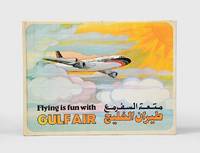
1974rif. 168084Bahrain: Gulf Public Relations 1974. First edition first printing of this pop-up book published by Gulf Air Public Relations in around 1970 with dual Arabic-English text by Ib Penick and illustrations by Gloria Nixon. The narrative revolves around Ahmed a boy who is flying from Manama to London with his parents. Quarto. 8 double-page full-colour illustrations by Gloria Nixon each one with a pop up all except the last with moving parts. Original coloured pictorial boards spine lettered in gold covers illustrated in colour and lettered in black and gold. Boards lightly toned spine lettering faded covers slightly soiled contents bright all moving parts in working order. A very good copy. hardcover
Oblong 4to. Pop-up book containing 8 pop-ups with moveable parts. (8) pp. Text in English and Arabic. Printed boards. Colourful pop-up book for travelling children, published in the 1970s by Gulf Air's Public Relations department in Bahrain and illustrated by Gloria Nixon. - One moveable part missing, some creasing, otherwise in good condition.
2008xvii + 280 pages, illustrated. eng
1991rif. 50561Kensington West Productions, 1991. Fifth Edition.
Small 8vo (175 x 135 mm). [4], 326 (pp. 272f. printed on a single page, pp. 274-279 printed as three folding tables), [1] pp. With large folding map and additional separately printed index in pocket at front. Original green cloth, printed title to spine and upper flap. Ownership inscription of H. W. Leatham, Lieut., RAMC, dated April, 1918. First edition of a field guide to Mesopotamia (Iraq), published on behalf of the General Staff in India for the use of officers serving in the Mesopotamian campaign during the First World War, stating on the binding and title-page "for official use only". The guide is divided into eight chapters, dealing with Iraq's history, geography, population, resources, military strength, maritime power, administration and communication respectively. The fifth and sixth chapter also contain valuable information on the Turkish military and maritime strength. Added to the present guide is many newly acquired information not present in the 1915 guide. For example, the "list of routes" in the present guide contains 36 routes from one city to another, compared to 14 routes in the 1915 guide. The routes are shown on the folding map. With the owner's inscription of H. W. Leatham, Lieutenant in the British Royal Army Medical Corps, on the first flyleaf. A few small spots or stains. Binding only very slightly rubbed. Overall in very good condition.
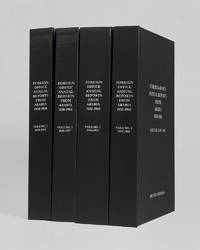
rif. 122004Minneapolis East View 2026. . 4 vols 8vo 25.5 x 16.5; publisher's black cloth lettered in white to boards and spines a fine copy. A comprehensive collection of annual reports produced by the British Foreign Office concerning the major regions of Arabia often intended as internal circulars and never for direct publication. Minneapolis, East View, 2026. hardcover
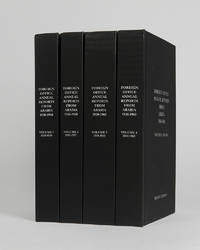
rif. 122002Minneapolis East View 2026. . 4 vols 8vo 25.5 x 16.5; publisher's black cloth lettered white to boards and spines a fine copy. A comprehensive collection of annual reports produced by the British Foreign Office concerning the major regions of Arabia often intended as internal circulars and never for direct publication. Minneapolis, East View, 2026. hardcover
With original dustjacket in excellent condition. First edition, first printing. Violet was the wife of H. R. P. Dickson, author of 'The Arab of the Desert' and 'Kuwait and her Neighbours'.
1930anni '30 circa (riproduzioni posteriori) gruppo di quattordici in marron e nove in nero, tutte circa cm. 25/28 x 21.