Raymond, Alexandre.MareMagnum

4 213 résultats
1924Imperial folio (360 x 490 mm). In the two original, matching decorative portfolios. Half cloth, boards with illustrated lithogr. title, inside covers and flaps with ornamental decoration printed in gold, green and blue. Green ties. I: 12 pp. 36 lithogr. plates in colour (of which 4 are double-page). II: 12 pp. 54 plates in colour (of which 2 are printed in gold on blue paper and 8 double-page sized). First edition of both parts, complete and not listed thus in library catalogues or auction records of the last decades. The first part was considered lost; indeed, its very existence was doubted ("apparently the first part was never published", Atabey Sale, Sotheby's 29 May 2002, lot 990, the second part alone fetching £22,000). Contains a finely chromolithographed selection of plates illustrating Islamic architecture and architectural details drawn from various mosques and numerous examples of ornamental decoration taken from Islamic fayences. - Some staining to upper covers of both portfolios; outer cloth of spines restored; mild foxing to margins of a few plates in part II; otherwise, plates clean and in good condition. Atabey 1015 (part 2 only). Not in Blackmer.
1995réf. 111047Comité des travaux historiques et scientifiques - CTHS, coll. « Colloques du CTHS », n° 12 1995 In-8 broché 24 cm sur 16. 426 pages. Couverture légèrement passée et poussiéreuse, plis de lecture au dos, coin inférieur du premier plat plié, néanmoins, intérieur propre. Bon état d’occasion.
4to. 409, (1 blank), (16), 427-442, (3), (1 blank) pp. With numerous illustrations. Paperback. First edition. - Meticulous work by the French historian Brégeon, whose research focuses mostly on the French Revolution and the Napoleonic era, especially on the campaign in Egypt. The 1911 article "Les Graffiti de l'Expédition" by the Egyptologist Georges Legrain, who contributed to the first volume of Jacques de Morgan's "Catalogue des Monuments et Inscriptions de l’Egypte" (1894) by discussing graffiti in the area of Aswan, comprises the 16 unnumbered pages; pagination continues at 427. - Signs of use, but a very good, firm copy.
8vo. 80 pp. 18th-century blind-ruled brown calf, blindstamped arms of William Stirling Maxwell on the upper cover and his blind cipher on the lower cover. Spine and vertical title label gilt; turn-ins gilt. Marbled flyleaves. All edges red. Green silk marker. First edition in a Western language of the celebrated autobiographical lament of the poet, royal secretary, and soldier Al-Tughra'i, who rose to Vizier only to be beheaded. His elegy, "Lamiyyat al-'Adjam", is probably the first major work of Arabic poetry published in the west. The other significant early Arabic work here contains an offering of proverbs selected from the "Exalted Aphorisms" of the fourth Caliph Ali ibn Abi Talib (601-661), the only person born in Mecca's sacred Kaaba sanctuary, cousin and son-in-law of the prophet Muhammad. - The editor and Royal Interpreter for Arabic, Pierre Vattier (1623-47), translated these pieces into French for their stylistic elegance and textual importance. He held the Chair of Arabic at the Collège de France from 1658 until his death and contributed an extended opening essay on Arabic prosody, here in its only edition. - Front joint cracked, extremeties slightly bumped; title remargined at lower edge. Altogether a fine copy. - Provenance: from the collection of the proverb bibliographer P. A. Gratet-Duplessis (1792-1853), recording on the final flyleaf the date of his acquisition (Lyon, 1828) and the price paid. In the sale of his library in 1856, the volume was described as a "joli exemplaire de ce curieux et rare petit volume" (p. 156, no. 969). A slightly later owner has quoted from Duplessis' bibliography on the second front flyleaf. Later bookplates of William Stirling Maxwell, Keir House, and Lt. Col. V. S. M. de Guinzbourg on pastedowns and flyleaf. Schnurrer 196. Zenker, BO 403. Cioranescu 65583. Gratet-Duplessis, Bibliographie parémiologique, 70. Moll, Sprichwörterbibliographie, 7624 ("1640" in error).
2019brossura "L'emozione del golf" di Donatella Carriera (giornalista) e Riccardo Valeri (maestro di golf) è un'opera dedicata al mondo del golf e a coloro che intendono avvicinarsi a questo gioco che tuttavia è anche uno sport olimpico. È un opera che non spiega le tecniche del gioco del golf, come fare lo swing o quale sia il bastone da usare in ogni fattispecie di gioco, di cui gli scaffali delle librerie ne sono già pieni. Si tratta invece di un piccolo libretto che consente a coloro che desiderano avvicinarsi al gioco del golf di comprenderne i reali benefici partendo proprio dagli odori del campo. Un libro emozionale (non psicologico) che tende a trasferire al lettore la giusta motivazione per la pratica di questo gioco che soprattutto all'inizio non può essere sviluppata in autonomia ma affidandosi a un bravo maestro. Il mondo del golf in Italia è ancora molto sconosciuto (o conosciuto male) e continua a essere "di nicchia". Gli autori con questa opera desiderano divulgare sempre più la filosofia che permea dal gioco del golf e che educa al rispetto della natura e delle persone, auspicandone una maggiore crescita dei giocatori tesserati nei prossimi anni, anche in funzione della Ryder Cup 2022 che si terrà a Roma nel 2022.
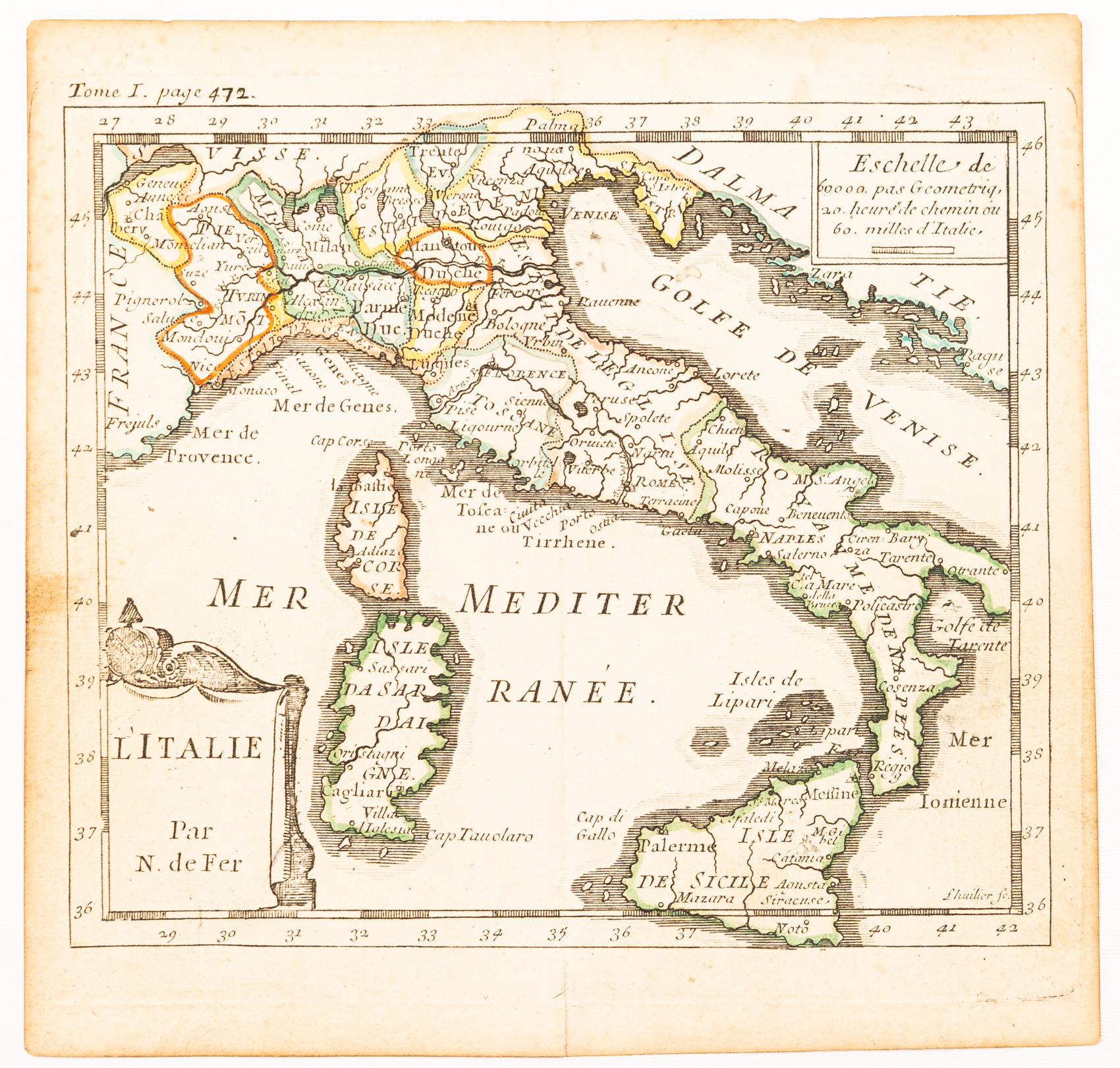
1767240 x 355 mm. Engraved map, coloured by hand. Showing the Arabian Peninsula in great detail. First published in 1747. Cf. Tibbetts 276. Not in the Al-Quasimi collection.
Landscape folio (30 x 42 cm). 16 hand-coloured lithographed plates, all with captions and decorative borders (lacks title-page). A fine example of Adam's expertise in lithography. The plates depict a variety of unusual equestrian racing scenes including female chariot racing and monkeys riding horseback. Victor Adam (1801-67) was originally employed as painter for the Museum at Versailles. However, in the 1840s he decided to concentrate on the art of lithography, and this scarce album is typical of his work. - 10 plates show some spotting, mainly marginal; one plate with tear in margin (ca. 1 cm, not affecting the plate). Paper on front pastedown wrinkled, bookseller's label, bound in original blue gilt decorated cloth. Overall an attractive copy. Not in Schwerdt, Lipperheide or Colas.
Folio (250 x 360 mm). 4 parts in 1 vol. (16), 1015, (29) pp. 289 cols., (3) pp. 4 pp., cols. 5-128 (+ 2 ff.), (2) pp. 65 ff., 66-114, (4) pp. (several mispaginations). With engr. t. p., 2 engr. plates, and numerous engravings in the text. Contemp. calf. All edges red. Chronicle of the early history of the Ottoman empire; one of several editions printed in the same year. First published in its French translation in 1577, this work by the Byzantine historian Chalkokondyles (c. 1423-90) was republished frequently throughout the 17th century, always including the account of Ottoman costumes and an interpretation of the seventeen enigmatic illustrations of Byzantine prophecies foretelling the downfall of the Ottoman Empire. The folding plate depicts a bird’s-eye view of Constantinople with its prominent buildings. The chronicle itself is illustrated by numerous portraits of rulers. The costume plates were originally designed for the travel account of Nicolas de Nicolay (1517-83), first published in 1567 (cf. Lipperheide Lb 2), who had visited the Ottoman court as a diplomat in the services of King Henry II. - Hinges and extremeties professionally repaired. Engraved title closely trimmed at top; slight loss to edge of plate showing the Turkish army as well as one costume plate. Occasional brownstaining and edge defects throughout. From the Ottoman collection of the Swiss industrialist Herry W. Schaefer. Cf. Atabey 214. Navari (Greek) 138. Hage Chahine 860-862. Navari (Greek) 138. Hamilton 23. Not in Blackmer.
2007Pr?face - Introduction 2 21x21 cm., legatura editoriale cartonata lucida, 2 volumi in una custodia aperta e chiusa con nastri, pp.96; 96, prima edizione francese, numerose illustrazioni, come nuovo
4to. (8), 9-44, 332 pp. - (Bound with) II: Ibn 'Arabshah, Ahmad ibn Muhammad / Vattier, Pierre (transl.). L'histoire du grand Tamerlan divisée en sept livres. Ibid., 1658. (24), 248, (4) pp. - (And) III: The same. Portrait du grand Tamerlan, avec la suite de son histoire iusques à l'establissement de l'Empire du Mogol. Paris, Vattier, Augustin Courbé & Jean Huart, 1658. (8), 146, (2). Contemporary vellum. All edges sprinkled in red. A milestone of French Arabist scholarship in the 17th century. I: First French edition of the "General History of the World" ("Kitab al-Magmu' al-mubarak") by Girgis al-Makin ibn al-'Amid, known in the Latin tradition as Georgius Elmacinus. Born in Cairo in 602 AH (1205 AD) to a Coptic civil servant in the War Ministry, he later served in a similar function in Syria. His chronicle had previously been translated into Latin (by Erpenius) and English (by Purchas); the work "for the first time provided wider circles in the west with an overview of Islamic history from its beginnings to the Crusades and acquainted them with the prime of the Baghdad Califate, previously almost unreceived, through an account ultimately based on Tabari" (cf. Fück). - II/III: First French translation (issued in two parts) of this important critical, at times even satirical eyewitness account of the life of Tamerlane (Timur Lenk), the great Turkish conqueror of the 14th century. "A frequently malicious account, in spite of the panegyrical form in which it is couched" (cf. GAL). Based on the original Arabic text written in 1437-38 by the Syrian author Ahmad lbn 'Arabshah who was secretary to Sultan Ahmad of Baghdad. In the late 16th century Timur was made famous in Europe through Christopher Marlowe's play "Tamburlaine" (published in 1590). The 17th century Western translations of Ibn Arabshah's work "for the first time acquainted the occident with a model of Arabic rhyming prose which also had the power to captivate the reader by its subject, as well as with the elaborate rhetorical style so characteristic of the literary taste of the Orient" (cf. Fück). Pierre Vattier (1623-67), physician to the Duke of Orleans, was the author of several treatises and translations on various aspects of Middle Eastern or Muslim culture. - Some browning and occasional inkstaining throughout. Top spine-end repaired. A good copy. The Macclesfield copy commanded £3,400 at Sotheby's in 2008. I: GAL I, 348. Schnurrer, p. 115, no. 155. Gay 3568. Fück 73. Aboussouan 449 ("1558" in error). OCLC 1811219. - II/III: GAL II, 29. Schnurrer, p. 137, no. 167. Fück 82. OCLC 29069177/29069426.
1948réf. qs669Librairie Marcel Rivière et Cie Broché 1948 In-8 (16 x 22 cm), broché, 148 pages, 4 graphiques, une carte, 16 illustrations hors texte en simili gravure ; papier jauni, pliures en queue du quatrième plat, bel état général. Livraison a domicile (La Poste) ou en Mondial Relay sur simple demande.
1925The French news weekly. 14 February 1925. With four page in colour. Sections of advertisements at beginning and end. Paginated 134-156. Foxing down edge of spine.. Corners creased and slightly dog-eared.
1933réf. ABE-2727860194EN COUVERTURE LE DIRIGEABLE AMERICAIN AKRON AU DESSUS DES FLOTS-PUBLICITE PLEINE PAGE BANANIA/"LA BECQUEE"-SPLENDEURS ET MISERES D'UN PATRIMOINE FRANCAIS/ABBAYE D'ARDENNE/CALVADOS-L'ATONIE INTERNATIONALE DE LA FRANCE PAR ANDRE TARDIEU-LA CATASTROPHE DE L'AKRON-PHOTOGRAPHIES DU SIECLE DERNIER/AVENUE DE L'OPERA/GEORGES SAND/LISZT-LA FIN D'UN HEROS/LE CAPITAINE HENRI DE BOURNAZEL/PHOTO-LE GOLF PAR GABRIEL HANOT/AQUARELLES DE RENE VINCENT/4P/7 ILLUSTRATIONS COULEURS-EN MARGE DES "TROIS MOUSQUETAIRES"/ELISABETH DE PORTAU/BRAGELONGUE-LA CEREMONIIE DU NAM GIAO A HUE/4 PHOTOS-CHATEAUX EN ESPAGNE DE SACHA GUITRY/PHOTOS-AUX "ISLES" D'AMERIQUE/1P/4 ILLUSTRATIONS/SUCRERIE SAINT JAMES-DON QUICHOTTE AU CINEMA/CHALIAPINE/PHOTO
1934réf. ABE-7164436383EN COUVERTURE "FETE NATIONALE: LA STATUE DE JEANNE D'ARC (PLACE DES PYRAMIDES) FLEURIE ET ILLUMINEE"-EN COUVERTURE INTERIEURE "LE 505 E ANNIVERSAIRE DE LA DELIVRANCE D'ORLEANS PAR JEANNE D'ARC MGR COURCOUX EVEQUE D'ORLEANS BENISSANT LA FOULE DEVANT LA CATHEDRALE"-LES FETES DE JEANNE D'ARC/2P-L'AEROPORT SUR LE TOIT/PROJET SUR 2 PAGES-LES "GUEULES NOIRES" CHANTENT POUR LES "GUEULES CASSEES"/PHOTO-LA REFORME DE L'ETAT/LE PROBLEME DES OFFICES/PHOTO-JARDINS DE LA COTE D'AZUR/DE LA CORNICHE D'OR AU GOLFE JUAN/PAR PAUL EMILE CADILHAC/4P-VOIES ROMAINES ET VOIES MODERNES-LES PRINCIPES ET LES REALISATIONS DES FRERES BAT'A/ARTICLE D'EMILE SCHREIBER SUR 6 PAGES/15 PHOTOS/1 CARTE-UN GRAND SEIGNEUR SPORTIF/DECES DU BARON DE ZUYLEN-CINEMA/LA REINE CHRISTINE/GRETA GARBO-NOMBREUSES PUBLICITES-DEGRAFE
4to (150 x 190 mm). (40), 128 pp. With large engraved view on title-page, 3 full-page engr. plates in text, 9 half-page engr. plates in text, and 1 folding engr. plate bound at rear. Bound in contemporary stiff vellum with remains of manuscript title on spine. Extremely rare sole edition of this guide to fortification, written by a French sapper who had served in the Venetian navy during the Ottoman Siege of Candia (1648-69), in Crete. In his 40-page preface "au lecteur", Poullet writes at length about his experiences as a military engineer during the siege (illustrated in two half-page plates in text), and even includes 'attestations' in Italian of his military service under Marcantonio Giustiniani, dated from Zante (Greece), 1st March 1670. - Writing shortly before the Siege of Vienna in 1683, Poullet expresses the hope that his manual incorporates some of the lessons learned from the 21-year battle for Candia - seen as an impressive feat of resistance, despite ending in defeat for the Venetian forces. His illustrated examples of fortifications constantly refer to the best methods for fighting 'les Turqs' and the mistakes made in Crete. - With a handful of early manuscript corrections in text; plate 11 printed upside-down; head of spine with some loss, crudely repaired; internally one or two discreet wormholes, otherwise a very good copy. - A rare survival: OCLC shows just 5 copies worldwide (none in the US or UK); KVK adds one further, at the Austrian National Library. The copy at the Czech National Library is lacking one leaf of prelims. Mayer, Wiens Buchdrucker-Geschichte I, 1849.
Square 4to (250 × 260 mm). With the frontispiece in three states: a lithographed plate, a hand-coloured miniature painting on vellum, highlighted with gold, and an engraved plate; and with the half-title printed in blue and several words in the text printed in green and blue. Original green cloth. One of six copies (numbered 4) of a sumptuous publication of poems on Islam by the French poet, writer and publisher Maurice Heine (1884-1940). The entire edition consists of 77 copies, of which only the first six (numbered 1-6) were printed on dyed Japanese paper and included the frontispiece in three states, of which one painted and highlighted with gold on parchment. The frontispiece, an Arabic text surrounded by flowers, was designed and drawn by the Algerian miniature painter Mohammed Racim (1896-1975), founder of the Algerian school of miniature painting that still exists. The included poems are: La demeure harmonieuse; Dans la maison moresque; Palais d'Islam; Le voyage en faience; Le cyprès; Alger-aux-barbares; and La mort d'Alger. The work opens with a half-title printed in blue, followed by a blank leaf, a leaf with the privilege, another half-title, three frontispieces, the title-page, and a dedication, followed by the prologue and the seven poems. It closes with a colophon, mentioning the different copies of the book. Below the colophon is the print number: "Exemplaire no. 4. Imprimé pour le docteur Pierre Astruc". - With a presentation inscription to Pierre Astruc: "à Pierre Astruc, avec toute l'affection de ton ami dévoué, Maurice Heine". In very good condition. C. Tailliart, L'Algérie dans la littérature française 123. WorldCat (3 copies).
8vo. (4), VI, 299, (1) pp. With one folding map. Publisher's yellow printed wrappers. First edition of Bonet-Maury's study of Abrahamic religions in Africa, supporting both Christianity and Islam as superior alternatives to local beliefs. A protestant clergyman and academic, Gaston Bonet-Maury (1842-1919) wrote extensively on monotheistic faiths and their unity, proposing them as a significant factor in the development of Western civilisation. - Slight marginal toning, a few light marks, otherwise a very good copy. From the library of Vittorio Emanuele III, King of Italy, with manuscript pencil poem to final blank and shelfmark label of the royal library to spine.
1700réf. 910875CG[Um 1700]. Alt-grenzkolorierter Kupferstich 13 x 16 cm, Blattgröße 16 x 16,5 cm.
8vo. (4), II, 140 pp. With 3 engr. plates by Horace Vernet. Contemporary straight-grained red morocco, elaborately gilt on covers and spine; leading edges and inner dentelle gilt. Blue endpapers. All edges gilt. First edition of this manual of riding instruction for ladies. The fine engravings by the young Horace Vernet (1789-1863), later the 19th century's foremost master of equestrian illustration, include the earliest depiction of a lady sitting astride the horse. A second edition was published in 1817. The author, Louis Henri II, marquis de Pons d'Hostun (1750-1820?), was inspired by the works of Newcastle and La Guérinière. Exceedingly rare; a sumptuously bound copy. Schrader 1452. Mennessier de la Lance 336. Huth 75.
4to. (4), IV, 470, (2) pp. With 20 coloured wood-engraved plates. Contemp. marbled half cloth with giltstamped spine title. Only edition of this military and political history of Egypt in the early 19th century, illustrated with coloured plates after drawings by J.-A. Beaucé. - Some foxing throughout; plates rather severely browned due to paper. Formerly in the Ottoman collection of the Swiss industrialist Herry W. Schaefer. Ibrahim-Hilmy I, 271. Gay 2043. Sander 306.
12mo. 6 vols. With 84 engraved plates, mostly aquatints, in contemporary hand colour, several folding. Contemp. red grained morocco, blindstamped and giltstamped, spine gilt, leading edges and inner dentelle gilt. All edges gilt. First edition, the rare coloured issue in contemporary French master bindings. - Contains a large number of very pretty views and charming genre scenes, also showing costumes, arms, tools, etc. Accompanied by notes by Jean Joseph Marcel (1776-1854), director of the French imperial printshop at Cairo. Immaculate, sumptuously bound copy from the library of Mary Lecomte du Noüy with her gilt morocco bookplate on all pastedowns. Uncommonly well preserved; most copies in the great travel collections were incomparably the worse for wear: the Atabey copy was described as "rubbed, upper joint of vol. VI wormed" and was uncoloured, as were most of the press run and all recent copies showing up in trade or at auction. Atabey 148. Blackmer 200. Ibrahim-Hilmy I, 87. Röhricht 1631. Lipperheide Ma 10. Colas 438. Hiler 113.
8vo (170 x 253 mm). 38, (2), 112 pp. With a wood-engraved portrait of Abou Naddara and numerous illustrations. Modern marbled half calf with gilt-stamped spine. Silk divider. Inscribed to Paul Leclerc, "ami de l'Égypte, hommage respectueux du Cheikh Abou Naddara", also signed in Arabic. - "Abou Naddara" was the first Arabic magazine to feature cartoons (with captions in French and Arabic), as well as the first work to use in the press a form of colloquial Arabic, radically different from the literary form. - The Egyptian journalist James Sanua ("Ya'qub Rufa'il Sanu'" in Arabic, but usually known simply by his pseudonym, Abou Naddara, "father of spectacles") was born into a family of Sephardic Jews in Cairo. He played an important role in the development of the Arabic theatre in the 1870s, but it was as a satirical journalist that he became best known, targeting the Khedive as well as the British interlopers. He founded the satirical magazine "Abou Naddara" in 1877, which immediately enjoyed a broad appeal and was quickly suppressed; of the 15 issues that appeared between March and April 1877, no copies are known. Sanua went into exile in 1878, but his celebrated journal, reproduced lithographically from manuscript in Arabic and French, continued to appear, printed in Paris at a shop aptly located in the Passage du Caire in the 2e arrondissement. Within Egypt, where the magazine's smaller format allowed it to be smuggled inside other larger newspapers, its circulation was considerable, with possibly over 3000 copies of each issue printed. There is evidence of its presence in the highest echelons of Egyptian society, and its content focused on the political and financial turmoil in Egypt, as Sanua was undoubtedly privy to information from friends and informants well-placed inside administrative circles. - Extremely rare. Loosely inserted is a folded original issue of the "Journal Oriental" ("Directeur & Rédacteur en chef: J. Sanua Abou Naddara"), no. 8, dated 25 September 1886 (entirely lithographed in Arabic). OCLC 25737746.
Small 8vo. 2 vols. in one. (8), 252 pp. (14), 9-240, (4) pp. Contemporary French brown morocco with gilt spine (spine-ends repaired). A mixed copy of the 1784 first and the 1788 edition. A Jesuit perspective on the Muslim faith, including many observations on Islamic customs and culture; "contenant les choses les plus curieuses qui regardent Mahomet & l'établissement de sa secte, qui n'ont pas encore été imprimées. Avec des conferences sur la religion chrétienne, & sur l'Alcoran" (subtitle). Indeed, the Tours-born Jesuit Michel Nau (1631-83) had first-hand knowledge of the Middle East: he had undertaken a long voyage to the Holy Land during which he visited Galilee in 1665 and the remainder of Palestine in 1674. He published an account of his journey, "Voyage nouveau de la Terre-Sainte". - From the library of the Abbé de la Paluelle with his ownership to title page and his etched armorial bookplate to pastedown. Chauvin XII, p. 283f., no. 1187 & 1190. Luzac, Bibl. orientalis IX, 26, no. 493. OCLC 54746487. De Backer/Sommervogel V, 1595, no. 3. Cf. Hurter IV, 428.
1974réf. 100149873L'ermitage 1974 in8. 1974. Broché. Ouvrage de Michel de Galzain illustré par les photographies de Jos Le Doaré consacré au golfe du Morbihan en Bretagne. Il s'agit d'une réédition numérique d'un livre paru initialement en 1957 décrivant ce site naturel remarquable
Paris, Typographie Philippe Renouard, [c. 1918], in-8, br. edit., pp. [4], 13, [5]. Con ill. Invio autografo dell'autore.