Multiple ContributorsMareMagnum

4.589 Ergebnisse
1955Features: Great colour Sweet Caps (Caporal) ad inside front cover; Editorial - how Gulf Oil vetoed Ottawa's pipeline plans; Gorgeous colour-photo two-page ad for General Motors four-door hard tops, Oldsmobile Ninety-Eight De Luxe Holiday Sedan and Buick Special 4-door Riviera; The Unknown Man who bought the Globe and Mail - who's R. Howard Webster? - sparked by Howard's financial wizardry, the five Webster brothers mushroomed the fur and fuel empire their father, Lorne Webster, left into a private trust that virtually blankets North America in the fields of Fuel, Stevedoring, Tankers, Hardware, The Imperial Trust, and more; Why I'm out of TV - Choir leader Dr. Leslie Bell bowed out when the singers became dancers and he was made to act; The Race to sell new cars - the market has been turned topsy-turvy by the hottest competition since the horseless carriage replaced the buggy - great black and white photos!; The blonde who leaps from the clouds - RCAF Para-nurse F/O Marion Macdonald; How they'll blow up Ripple Rock - for decades this underwater monster in the Strait of Georgia has been wrecking ships and drowning sailors; When a Canadian Ruled Oregon - Towering John McLoughlin from Riviere du Loup was king of Columbia - the Oregon and Washington of today; The doctors in overalls who've changed your life - the research done by Ontario Veterinary College; That Yellow Prairie Sky - Robert Kroetsch; Is there Really an Abominable Snowman?, by Willy Ley; Nostalgic full-page colour photo ad for Toro (fortieth anniversary) mowers; Colour Visking Weiners ad; nice colour full-page ad for the all-new 1955 Plymouth; Nice colour full-page ad for the Oldsmobile 88-98. Average wear. Binding sound. Address label on front. A quality copy. Book
1983Features: China - a showcase of consumer emancipation; Essay - Pondering the B.C. Condition - Hard Times in Canada's Lotus Land; Peter C. Newman on B.C.'s high-flying acquisitors - Nelson Skalbania, Jack Poole, Neil B. Cook, Herb Doman, Bob Carter, Peter Thomas, The Doumet Brothers, Jimmy Pattison, Peter Brown, Joe Segal, The Belzbergs, Edgar Kaiser Jr.; Bob Lee; Conservative M.P. Bill Kempling; Teaching hate in Alberta schools? - Jim Keegstra of Eckville, Alberta; Socialism in a tailspin in France; The Politics behind Soviet Spy Charges in France; Kampuchea - Vietnam's latest offensive; Nice multi-panel colour photo B.C. tourism promotional centerfold; Persian Gulf Oil Slick in the War Zone; Security Express robbed in London; James Kay and Dylex; Peter Pocklington's empire unravels; Canada takes on the curling world - LaRocque and Werenich; A close call - a happy end - Space Shuttle Challenger completes its maiden mission; Le Devoir joins the newspaper war; Worst flooding in 25 years in New Orleans - colour photos and article; Krugerrand ad; Canadian foresters and computer firefighting. Average wear. Book
196348 pages. Features: The Mafia in Canada - article with many mugshots of famous mobsters; McKenzie Porter looks at Golf; How Alvin Hamilton Keep the Prairies in his Pocket; Portrait of a Doctor whose specialty is people - Dr. Dave Lander of Turner Valley, Alberta; Armament and Disarmament in Central America - special report from the explosive half of our hemisphere; How to work your children's way through college; Michael Wade describes his visits with the women of the Seven Seas; Sculptors Gerald Gladstone, Walter Yarwood, Armand Vaillancourt, Yosef Drenters, Eli Bornstein; Vintage black and white Honda motorcycle ad - a row of motorcycles serve as a badminton net at a campsite. Small contest clipping from bottom corner of page 41. Unmarked. Somewhat above-average wear. A sound vintage copy. Magazine
1965Features: George Knudson on cover; The People who don't want equality - why Alberta's law-abiding Hutterites are bitterly fighting the law; The High Priest of Pop Culture - how Marshall McLuhan suddenly became our hottest intellectual fad; Golf ace George Knudsen sizes up the tough $100k Canadian Open at Mississauga Golf & Country Club; Is there life on Mars? - we may soon know as Mariner IV scans the mysterious Red Planet; Wife Killer or Fall Guy? - Wayne Lonergan wins his freedom after 21 years; Holiday Trails of Canada - the Bruce Trail, a 500-mile footpath through Ontario wilds; Do Canadian wines really rate with competitive imports?. Water staining. Average wear and soiling. Book
193876 pages. Please note: Covers not included. Contents: nice ad for International Harvester Industrial Power Equipment; Leg of Gold, by James Francis Dwyer; The Barr Colony, by Captain C. Tweedale; Jury Rig, by Jay Wilson; Who'll Succeed Chamberlain?; The Splendid Prodigal, by Margaret Nyren Hoffman; Let Go of those (Golf) Clubs - Dink Carroll writes about the new 14 club rule; Our Future Population - C.M. Campbell's interesting examination of the population B.C. and Alberta are capable of supporting; Old Ugly Face, Talbot Mundy; An American's Letter to Beverley Baxter, by Archibald Douglas Turnbull; Wonderful colour full-page photo ad for Sweet Caporal cigarettes features two women walking their dog; Plymouth car ad; Ad for Westinghouse appliances, including their 10-tube all-wave Superheterodyne radio; Nice ad for Chrysler cars; Frigidaire refrigerator ad; Great full-page black and white ad for Sisman's Scampers shoes - with patented cork insulators; Nice Dodge truck ad with photos emphasizes they are made of Better Steel; Gifts go Electric - practical suggestions for pleasing a June bride. Above-average wear. Unmarked. Covers not included. Book
1945Features: Nice Ford ad inside front cover features colour illustration of an old-time barn raising; Man From Missouri - A vivid close-up of Harry S. Truman, the onetime plowboy who was pitchforked into the White House; Here's a Fine Stymie! - humorous article about golf and the impact upon it by WWII; To Chuck - With Love (short story); "They're Full of Love and Mozart" - Maclean's War Correspondent L.S.B. Shapiro tours Eisenhower's Germany; Sissy Fish? No Sir! - Charley Hartman and his Ontario Government Trout Rearing Station (fish hatchery) at Cold Water Creek take care of almost 3 million trout (with photos); 25,000 Miles to Battle - Lieut. Stuart Keate, an officer of Canada's new cruiser, the H.M.C.S. Uganda, describes why war in the Pacific is different than War in the Atlantic; Well, Good Night (short story); Charles H. Scott, Director of the Vancouver School of Art, chastises Vancouver's art patrons of not supporting Canadian artists; Stage set for an election in England; Ottawa political report; On the Corner in the Sun (short story); What About Russia? - Will the men of the Kremlin enter the family of nations or erect a Russian Great Wall?; Music By Adaskins, Canada's most musical family - Murray, Naomi, Yanova, Frances Marr, John, Frances James and Harry; Three-Way X-Ray - LeRoy J. Leishman, a Los Angeles inventor, solves the problem of bringing depth perception to the fluoroscope with his stereofluoroscope; Nice colour half-page Orange Crush ad shows girl with dog; Additional ads for Canada Dry, Kotex, Palmolive soap, Castoria, Lysol, Absorbine Jr., Vaseline hair tonic, and many more; One-page ad for the Wartime Prices and Trade Board encourages readers to use sugar sparingly; Back cover Coke ad features colour painting of a happy scene in Brussels where Canadian troops imbibe with friendly locals. 50 pages. Unmarked with average wear. Faint discoloration to back cover. Please note: missing first page. Last page loose but present. A worthy copy of this vintage issue from the tail end of WWII, printed mere days before Truman, featured in this issue, authorized atomic bombs to fall upon Japan. Book
Engraved map (51 x 84 cm), hand-coloured in outline. Large map of the Turkish Empire in original colour stretching from the Gulf of Oman to Morocco. Al-Qasimi 78; Tibbetts 154.
4to. 2 vols. bound in one. 14 pp. (index), 210 pp., (1 blank), 7 pp. (index), 190 pp. Original full calf with later paper label; later marbled paper on the spine. An important first-hand account of relations between the Porte and central Europe as well as the wider political events during the second half of the 18th century. Written by the Baghdad-born diplomat Ahmed Vasif Effendi and also known as "Vasif Tarihi" ("Vasif's History"), it forms one of the most important works of Ottoman political history for the period between 1754 and 1774, when the author actively participated in the world of diplomacy in the Ottoman Empire, on the Balkans, in Russia and in Vienna. Vasif was known for his quick temper and was later described by the German orientalist Franz Babinger as "vain, stingy, jealous, and excessively vicious" (cf. p. 336). His text was left unfinished after a dispute with the Istanbul-based press of Rasid Efendi, which Vasif himself had helped establish, and it was completed by Sadullah Enveri (d. 1794), who himself had participated in the military events described. - At the time one of the few available printed historico-political accounts of contemporary Middle Eastern relations with the West during the age of Enlightenment, the book proved extremely popular throughout Europe and is today found in many European libraries. This is the third and last edition, the second printed at Bulaq, by the first official and governmental printing press in Egypt, after first being published in Istanbul in 1219 (1803/04). - Bulaqor Al-Amiriya Press, the first official and governmental printing press established in Egypt, was founded in 1820 by the viceroy of Egypt, Muhammad Ali. As early as in 1815 the first delegation was sent from Egypt to Milan to learn printing. After the building for the press was finished in the autumn of 1820, it took another two years to transport the machines and train the employees, and the first book, an Arabic-Italian dictionary, was published in 1822. Viceroy Muhammad Ali started several reform programmes with a view to create a modern Egyptian society after the European model, and the press was part of this modernisation. He is remembered for establishing modern Egypt as an independent country. - Printed on thick paper. Interior clean with sporadic old staining; old pencil and ink annotations to endpapers. Binding shows larger scratches and loss of material, but still in the original Bulaq covers. Provenance: 19th century bookseller's label of Benjamin Duprat, Paris, on front pastedown; later owned by the Iraqi architect Mohamed Makiya (2015). Özege V, 22519. OCLC 949617481, 777193206, 320228577, 780208235, 165361809, 26779362 and 600848792 (some examples on microfilm). Ethan L. Menchinger, The First of the Modern Ottomans: The Intellectual History of Ahmed Vasif (2017). Franz Babinger, Die Geschichtsschreiber der Osmanen und ihre Werke (1927), pp. 335-337.
Oblong 4to (240 x 168 mm). Photo album with 9 original black-and-white silver gelatin prints, mostly 125 x 180 mm. With English captions mounted on verso of the photographs as well as on the opposite pages. 8 blank ff. Contemporary half cloth over cardboard with title label mounted to front cover. Notable collection of historic images of the Mahd Al Thahab gold mine in the province of Al-Madinah, in the Hejaz region of Saudi Arabia. Photographs show the mining complex including the crushing plants, mills and storage tanks, as well as the camp with warehouses, shops, schools, hospital buildings, a mosque, and the living quarters of the Emir of Mahad. The last picture depicts the staff and office buildings at Jeddah. - Mining activities in the area date back to 961 BC, and the Mahd adh Dhahab deposit was rediscovered in 1932 by K. S. Twitchell. The Saudi Arabian Mining Syndicate (SAMS), a joint venture between the Government of Saudi Arabia and the American Smelting and Refining Company, started production in 1939, treating at first mainly the ancient tailings. SAMS produced 22 tonnes of gold and 28 tonnes of silver up to 1954. - Extremities slightly rubbed.
Lithographic portrait (555 x 380 mm), matted (618 x 499 mm). Portrait of Mahmud II (1785-1839), the 30th Sultan of the Ottoman Empire from 1808 until his death in 1839. A fine likeness by the celebrated Viennese portraitist Joseph Kriehuber. - Some foxing.
4to. VI, 32 pp. With 2 lithogr. plates and 28 ff. of Arabic letterpress with lithogr. borders, toned in various colours. Modern boards with the original wrappers bound within. First edition. - Without any doubt Hammer’s finest work in imitation of an oriental manuscript: the Persian text of the famous Sufi manual ‘Golshan-e Râz’ is printed in seven four-leaf quires of varying colours, each framed by a lithographed sequence of interlaced flowers and animals (pheasants, deer, antilopes, panthers, jackals). The German translation, the unsophisticated typography of which provides a striking contrast to the luxurious Persian text, is illustrated by two plates of topographical interest. The binding preserves the original blue paper wrappers with a large emblematic lithograph of a shell hidden among a bouquet of roses, drawn by Pauline von Koudelka-Schmerling. - Occasional slight foxing. Untrimmed. Goedeke VII, 767, 100. Rabenlechner I, 122. Cf. Brunet III, 34 (Vienna, 1838 ed.).
Collection of 48 stereoscopic views (double prints on cardboard) (ca. 86 x 178 mm each). Includes original contemporary stereo viewer with collapsible handle, sliding focus tray, and padded viewing chamber with lenses. An American-manufactured mahogany stereoscope (Perfecscope, Underwood & Underwood, New York) with 48 photographs showing scenes of town and country, architecture, figures, and war. Well preserved, rare with the turn-of-the-century stereoscope in perfect working order.
Engraving (230 x 160 mm), matted (360 x 280 mm). Portrait of Sultan Mehmet IV (1642-93), the second longest reigning sultan in Ottoman history, pictured on horseback. From Peeters's series "Korte Beschryvinghe, Ende Aen-Wysinghe der Plaetsen in dessn Boeck, met hunnen teghenwoordigen Standt, pertinentelijck uytghebeldt, in Oostenryck" (1686).
4to (162 x 202 mm). (12), 128 pp. Modern marbled boards. Posthumous edition, under a new title (and with the author's name misspelt "Enustinus" for "Cnustinus"), of Knaust's 1542 pamphlet "Von geringem Herkommen, schentlichem Leben, schmehlichem Ende des Turckischen Abgots Mahomets". The jurist and poet Knaust (ca. 1521-77) published on a wide range of topics; "his popular-scientific works, written mainly for young readers and interested laymen, proved especially successful" (cf. NDB XII, 167). From p. 33 onwards the book contains an updated German version of the oft-reprinted and anthologized "Cronica und Beschreibung der Türckey" (1530) by the former slave Bartolomej Georgijevic from Transsylvania (Georgius de Hungaria). - Variously browned throughout with a few insignificant waterstains in the margins; occasional 18th century pencil annotations. Rare. VD 16, K 1434. Chauvin XI, 502. Göllner 2200. BM-STC German 473. Boecler 169. Draudius 531. Hammer 1305. Kertbeny 1190. Szabó III, 873. Veress 128.
8vo. (10), 547, (1) pp. With additional engraved title page and 6 engraved plates. Contemporary vellum with handwritten spine title. Uncommon Dutch edition of du Ryer's version, in a translation by J. H. Glasemaker (previously published in 1658), with a Life of the Prophet and numerous engravings by Caspar Luyken (1672-1708). Du Ryer's 1647 French version served as the basis for further translations of the Qur'an (including English, German, and Russian), and was instrumental in introducing Europeans to the tenets of the Muslim faith. - Block somewhat loosened, but still a good copy. Chauvin X, p. 129 (phi). Cf. Schnurrer 428.
8vo. 2 vols. 88, 47 ff. Original Japanese fukuro-toji bindings. First Japanese edition: the first Japanese book on the life of the prophet Muhammad, drawn from Prideaux's "The True Nature of Imposture Fully Display'd in the Life of Mahomet" (1697) and translated into Japanese by Hayashi Tadasu, later to become Japan's Minister for Foreign Affairs. Rare as a complete two-volume set. - Bindings very slightly stained, otherwise fine. Cf. Chauvin XI, 185f., 656ff. (other editions).
Best.-Nr. 5h3029Gulf Craft United Arab Emirates 2017. 143 S. mit zahlreichen Abbildungen Pappband quart. - gutes Exemplar / good condition / Text englisch - unknown
Folio (422 x 528 cm). Lithogr. t. p. and 60 lithogr. plates, all in original hand colour, captions often raised in gilt. With 10 leaves of letterpress text. 10 instalments in the original printed wrappers as issued. Stored in contemporary green half calf with giltstamped spine and cover label. Ties. - (Includes): Die Uebergangsländer von Asien und Afrika, begreifend: Arabien nebst Mesopotamien und Syrien und das Nilgebiet. Munich, C. Wenng, 1845. Engraved map with contemporary border colour. 640 x 544 mm. Scale 1:7,000,000. Only edition of the rare variant with all the plates and in their splendid original colour: the personal copy of Duke Maximilian in Bavaria. "Published in ten parts. The plates show costume of the period and also that of earlier times, taken from paintings" (Hiler). The picturesque views, which include Cairo, Alexandria, Jerusalem, La Valletta, Luxor, and Thebes, genre scenes and landscapes, are all framed within a decorative border and arranged as a small painting. The Nuremberg artist Mayr, especially well-known for his depictions of battles scenes and horses, was personal painter to Duke Maximilian, whom he accompanied on his 1838 journey of the Orient. The group had departed from Munich on January 20 with a small entourage, travelling via Venice, Korfu, Patras, Athens, Alexandria, and Cairo to the Holy Land. They returned to Munich after eight months on 17 September 1838; the following year, Maximilian was made honorary member of the Bavarian Academy of Sciences. - Some foxing to letterpress explanatory text, plates beautifully preserved with only the backing paper showing occasional duststaining. From the library of Duke Maximilian at Tegernsee Castle, retaining the original shelfmark label on the spine. - Includes the extremely rare map of the Arabian Peninsula and the Middle East which was published only in 1845, at the instigation of the naturalist Gotthilf Heinrich von Schubert (1780-1860) and the geologist Joseph von Russegger (1802-63), to satisfy this frequently noted lack in Mayr's production (some foxing, but also finely preserved). Ibrahim-Hilmy II, 26. Gay 90 (only 36 plates). Lipperheide Ma 22 (= 1589). Hiler 578. Tobler 161. Graesse IV, 457. Engelmann 124. Kainbacher 265 ("a rarity"). Thieme/Becker XXIV, 477. Nagler VIII, 498f. ("highly memorable drawings"). ADB XXI, 139ff. Not in Blackmer or Abbey (Travel). Not in Colas.
Folio (422 x 528 cm). Lithographed title-page and 60 lithographed plates, all in original hand colour, captions often raised in gilt. With 10 leaves of letterpress text. Half calf with giltstamped spine. (Includes): Die Uebergangsländer von Asien und Afrika, begreifend: Arabien nebst Mesopotamien und Syrien und das Nilgebiet. Munich, C. Wenng, 1845. Engraved map with contemporary border colour. 640 x 544 mm. Scale 1:7,000,000. Only edition of the rare variant with all the plates and in their splendid original colour: "Published in ten parts. The plates show costume of the period and also that of earlier times, taken from paintings" (Hiler). The picturesque views, which include Cairo, Alexandria, Jerusalem, La Valletta, Luxor, and Thebes, genre scenes and landscapes, are all framed within a decorative border and arranged as a small painting. The Nuremberg artist Mayr, known especially for his depictions of battle scenes and horses, was personal painter to Duke Maximilian, whom he accompanied on his 1838 journey of the Orient. The group had departed from Munich on January 20 with a small entourage, travelling via Venice, Korfu, Patras, Athens, Alexandria, and Cairo to the Holy Land. They returned to Munich after eight months on 17 September 1838; the following year, Maximilian was made honorary member of the Bavarian Academy of Sciences. - Some foxing, otherwise splendidly preserved. Includes the extremely rare map of the Arabian Peninsula and the Middle East which was published only in 1845, at the instigation of the naturalist Gotthilf Heinrich von Schubert (1780-1860) and the geologist Joseph von Russegger (1802-63), to satisfy this frequently noted lack in Mayr's production (some foxing, but also finely preserved). Ibrahim-Hilmy II, 26. Gay 90 (only 36 plates). Lipperheide Ma 22 (= 1589). Hiler 578. Tobler 161. Graesse IV, 457. Engelmann 124. Kainbacher 265 ("a rarity"). Thieme/Becker XXIV, 477. Nagler VIII, 498f. ("highly memorable drawings"). ADB XXI, 139ff. Not in Blackmer or Abbey (Travel). Not in Colas.
815 x 1140 mm (on 2 separate sheets). The first distance-time route map of the Ottoman Empire, one of the great masterpieces of Ottoman thematic cartography. Devised by the General Staff of the Ottoman Army and depicting the entire realm of the Sublime Porte from Albania to Yemen, it gives travel times between hundreds of locations, including various routes of the Hajj. - The map captures the scene during the middle of the rule of Sultan Abdul Hamid II (reigned 1876-1909), during which the empire still controlled vast territories in Europe, Asia and Africa, extending from the Balkans to the Arabian Peninsula. It is centred upon Anatolia but includes all the core regions of the Empire, extending from Bosnia in the northwest to the head of the Arabian Gulf in the southwest, and from Crimea and Baku in the north and east to Lower Egypt in the southwest. In the lower right corner is an inset capturing the western Gulf, including Kuwait, Bahrain, and Qatar; an inset above details the Red Sea, including Hejaz, Asir and Yemen; a larger inset in the lower left depicts Ottoman Libya as well as parts of French Tunisia and Algeria. Annotated in Ottoman Turkish throughout, the map is traversed by hundreds of lines that connect every city and town of importance, representing the main land travel routes between these centres; each segment states the estimated travel times between the points. The map also features a chart comparing distances between the principal centres: on average, the chart shows, it took 18 hours to travel from the Red Sea port of Jeddah to the holy city of Mecca. - This is the first map ever to display the distances between all significant travel points in the Ottoman Empire and would have been vitally useful to soldiers, merchants, and government bureaucrats planning their itineraries. It was also one of the only maps to give an approximately accurate notion of the times and distance along several of the most important Hajj routes, including the famous Syrian Hajj Road from Damascus to Mecca, now considered by UNESCO for World Heritage Status. - Transportation had always been one of the great challenges confronting the Ottoman Empire, an astoundingly vast realm spanning three continents and traversing some of the world's most rugged terrain. Yet the Hamidian Era marked a period of rapid modernization, including the creation of macadamized highways, railways and modern ports, and saw the rise of sophisticated cartography. The General Staff was able to draw on exhaustive highway surveys and recent itinerary records. The present map also depicts the rapidly expanding Ottoman railway system, after a wave of development had revolutionized travel in the empire's European domains, but just before an unprecedented boom in railway construction would do the same for Ottoman Asia. The Balkans are traversed by several railways: most notably as of 1888 the great port of Salonika was connected to the rest of Europe by rail, while Istanbul was linked to the European system for the first time that same year, providing the direct route for the famed Orient Express, which commenced in 1889. One will also notice the first great leg of the Anatolian Railway that connected Istanbul to Ankara on 31 December 1892, completed only a matter of weeks before the present map was issued. - Although Ottoman cartographers were producing topographic and thematic maps of the highest sophistication and diversity, every bit as impressive as those of the best German and French and British mapmakers, these works tend to be very rare today and are not nearly as well known as they deserve to be: they were almost invariably issued in small print runs, and maps intended for practical use in the field, such as the present work, tended to perish easily. Also, Turkey's switch to the Latin alphabet, in 1928, ensured that many of the surviving earlier maps were discarded, making this specimen a rare survival of an historic cartographical achievement. - Brownstains and waterstains.
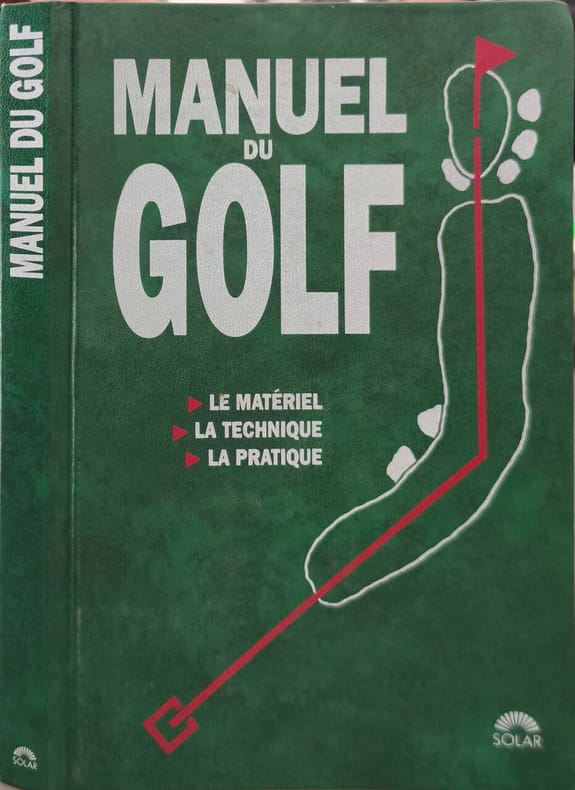
1992Best.-Nr. 17936Solar 1992 223 pages in8. 1992. Broché. 223 pages. LE MATÉRIEL LA TECHNIQUE LA PRATIQUE
Best.-Nr. 6465SOLAR Broché au format 13x19cm , couverture illustrée souple de l'éditeur , 223 pages nombreux croquis explicitant les positions , quelques photographies en couleurs ,très bon état , 224 pages .
1999Best.-Nr. LFA-126743730Un ouvrage de 224 pages, format 140 x 210 mm, illustré, broché couverture couleurs, publié en 1999, Editions Solar, bon état
1992Best.-Nr. 8165Solar 1992 223 pages in8. 1992. Reliure editeur cartonnée. 223 pages. Ce manuel pratique de Vivien Saunders est un guide complet pour apprendre et progresser au golf. Il couvre tous les aspects du jeu : le choix et l'utilisation du matériel (des drivers aux putters) la maîtrise des techniques de base (stance grip swing) l'entraînement la stratégie en compétition et l'interprétation des règles. L'approche est adaptée au niveau du joueur plutôt qu'à la performance des champions
8vo. 3 parts in one volume. (72), 184, (4), 71, (1), (14), 278 pp. With 12 engravings in the text, 3 folding plates and several woodcuts. 19th century mottled boards, spine ruled in gilt, titled in gilt on black leather spine label. All edges speckled. First edition of this important work dedicated to oriental games from Arabia and Persia as well as from India and China, including backgammon, draughts and dice. Includes the first scholarly account devoted to the history of chess, as well as Asian board games from Arabia, Persia, India, and China, including backgammon, draughts, and dice. Two folding plates illustrate chessboards; further in-text illustrations show the various types of game pieces in Caxton-era England, Turkey, and India. The second and third parts explain the history of dice and many other Chinese games. - Contains numerous texts in Hebrew, Chinese, Arabic, Greek, and other languages. "Ouvrage curieux. Les exemplaires n'en sont pas communs" (Brunet). Hyde was an orientalist and later became Bodleian Librarian. - Binding lightly rubbed at extremities, outer front hinge splitting, small paper library label on lower spine. Paper repair to top right edge of front free endpaper and to reverse of largest folding plate. Interior gently toned, edges of folding plates lightly rubbed, a few inked and penciled notes on front endpapers. Graesse III, 403. Von der Linde I, 88-90. Cordier (Sinica) 3142. Wing H3875 & H3877. ESTC R1348.