Eisenberg, [Friedrich Wilhelm] von.MareMagnum

4 361 résultats
Oblong folio (390 x 257 mm). 2 vols. in one. 56 ff., 63, (1) pp. With engr. title page and 59 engr. plates by B. Picart. Contemp. calf with gilt spine. Marbled pastedowns. Rare first German edition of Eisenberg's famous riding school, which boasts beautiful illustrations of horses and horsemen (repeated from the 1727 French original edition). Arabian horses in particular are lauded as "the finest produced by the Orient. They are exceptionally fine animals, especially those from the hills of Mokha [...] Arabian horses are full of fire and vigour in general and are possessed of a great natural agility [...] Their start is like lightning, and so they are incomparable for racing and tournaments, for they are skillful as well as swift". - Binding rather chafed in places; hinges beginning to crack. Some edge damage to plate IV; some browning or brownstaining to margins. From the collection of the Leipzig jurist and later senior alderman of the Leipzig council, Christian Gottlob Bose (1726-88), with his autogr. ownership "C. G. Bose. 1748" on the printed title. The Boses, a wealthy Leipzig family of merchants and aldermen, were close friends of the family of the composer Johann Sebastian Bach. While it was known that the twelve-year-old Christian Gottlob had taken violin lessons with the theologian J. C. Weiß, the young law student's passion for horses - an expensive hobby, but well within the means of any son of the gold and silver manufacturer Georg Heinrich Bose (1682-1731) - was hitherto unknown. Lipperheide Tc 42. Jöcher/Adelung II, 854. Cf. Mennessier de la Lance I, 438. Huth 1727 & 1747. Cohen/R. 345. Hoefer XV, 774. OCLC 248061472.
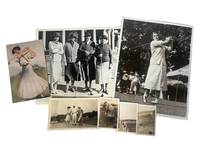
1910réf. 200811910. Women's competitive golf archive 1910s to 1930s documents women golfers in practice tournament and club settings during the formative decades of organized women's golf in the United States. The group provides visual evidence of women's athletic participation in a sport long associated with country-club respectability social access and gendered expectations about dress leisure and competition. The U.S. Women's Amateur Championship began in 1895 as one of the USGA's first three championships and the USGA identifies it as marking the beginning of women's competitive golf in the United States; these photographs and postcard show how that competitive culture appeared in everyday and press imagery in the decades that followed. The archive consists of seven items dated between the 1910s and 1930s: six silver gelatin photographs and one brightly illustrated postcard measuring from approximately 1.75 x 2.75 inches to 7.25 x 9 inches. The photographs include a 1934 press image of golfer Barbara Stoddard in a swing position; a 1935 lineup from the Annual Women's St. Valentine Golf Tournament identifying Helen Waring Sarah Fownes Wadsworth Myrom W. Marr and W.C. Fownes Jr.; three small circa 1928 photographs of women positioned with clubs on a golf range; and an early 1930s image of two women posed with a man at a country club the women holding several clubs with one woman wearing trousers. The illustrated postcard from the early twentieth century shows a woman swinging a club in an athletic outfit still shaped by long-skirted fashion rather than later sportswear. Across the group recurring details include golf clubs held as markers of athletic identity posed swings tournament lineup conventions country-club settings and changing women's clothing from long skirts to less restrictive dress. The archive records women's golf as both competitive sport and social performance making visible the relationship between athletic skill class-coded club culture and evolving public ideas about women's physical capability. Its strongest research value lies in the mix of press photographs vernacular practice images tournament documentation and illustrated popular culture allowing comparison between women as actual competitors and women as stylized sporting subjects. Light handling wear minor edge wear and typical surface wear to photographs and postcard; images remain clear and identifiable; overall very good. Cohesive women's sports archive documenting early twentieth-century women golfers as competitors club participants and subjects of changing athletic representation. unknown
1910réf. 200811910. Women's competitive golf archive 1910s to 1930s documents women golfers in practice tournament and club settings during the formative decades of organized women's golf in the United States. The group provides visual evidence of women's athletic participation in a sport long associated with country-club respectability social access and gendered expectations about dress leisure and competition. The U.S. Women's Amateur Championship began in 1895 as one of the USGA's first three championships and the USGA identifies it as marking the beginning of women's competitive golf in the United States; these photographs and postcard show how that competitive culture appeared in everyday and press imagery in the decades that followed. The archive consists of seven items dated between the 1910s and 1930s: six silver gelatin photographs and one brightly illustrated postcard measuring from approximately 1.75 x 2.75 inches to 7.25 x 9 inches. The photographs include a 1934 press image of golfer Barbara Stoddard in a swing position; a 1935 lineup from the Annual Women's St. Valentine Golf Tournament identifying Helen Waring Sarah Fownes Wadsworth Myrom W. Marr and W.C. Fownes Jr.; three small circa 1928 photographs of women positioned with clubs on a golf range; and an early 1930s image of two women posed with a man at a country club the women holding several clubs with one woman wearing trousers. The illustrated postcard from the early twentieth century shows a woman swinging a club in an athletic outfit still shaped by long-skirted fashion rather than later sportswear. Across the group recurring details include golf clubs held as markers of athletic identity posed swings tournament lineup conventions country-club settings and changing women's clothing from long skirts to less restrictive dress. The archive records women's golf as both competitive sport and social performance making visible the relationship between athletic skill class-coded club culture and evolving public ideas about women's physical capability. Its strongest research value lies in the mix of press photographs vernacular practice images tournament documentation and illustrated popular culture allowing comparison between women as actual competitors and women as stylized sporting subjects. Light handling wear minor edge wear and typical surface wear to photographs and postcard; images remain clear and identifiable; overall very good. Cohesive women's sports archive documenting early twentieth-century women golfers as competitors club participants and subjects of changing athletic representation. unknown books
Varnished wood. 335 x 35 mm. Maps printed on both sides, with calendar for 1894 in gold on black on both sides of the finial. "This desk accessory, designed for use as a map page turner or letter opener/paper knife, was a promotional item for The Eastern Telegraph Company Limited and The Eastern Extension Telegraph Company Limited. Based in London, these companies were part of a network creating communication routes around the UK and across the Atlantic in the late 1800s ... The blade of this wooden object is decorated with varnished sections of a world map, including Australia, with red lines indicating international land and sea telegraph lines" (Description of a similar example in the Queensland Museum, Registration no. H47766). - In very good condition.
réf. DADAX1786608057Rowman & Littlefield Publishers 2019-05-17. 1. paperback. New. 5.99x0.46x8.74. Buy with confidence. Excellent Customer Service & Return policy. Rowman & Littlefield Publishers paperback
1990réf. 2090502113701264Not Available 1990. Soft Cover. Fine. The book is in fine condition. Not Available paperback
1980No marks or inscriptions. A very clean very tight copy with bright unmarked navy cloth boards and very minor bumping to lower front edge and upper front corner. Dust jacket price clipped but not marked or torn with minor creasing to upper and lower edges. 256pp. What happened in the sport of golf in 1979. Illustrated.
Colour printed map, 1015 x 710 mm. Rare map of oil concessions in the Middle East. With an inset map of the Southern Arabian Peninsula. - Rich in detail, the chart depicts the concessions of various oil companies active in the Arabian Peninsula, the largest by far being that held by Aramco since the 1933 royal concession. However, the map also shows smaller concessions, including those held by Sirip (Société Irano-Italienne des Pétroles), Kuwait Oil, and Japan Petroleum. In addition, it shows oil fields, oil and gas pipelines, pump stations, and refineries, as well as important towns and international borders. - Published as a supplement to the international outlook issue of World Oil. - Slightly duststained, otherwise very well preserved. OCLC 137384087.
réf. 0265807301.Ghardcover. Good. Access codes and supplements are not guaranteed with used items. May be an ex-library book. hardcover
Educational material on Saudi Arabia, comprising 1 book, 1 Arabian flag, 2 Arabian coins, 2 Arabian stamps, 1 string of worry beads, 24 study posters (17" x 22") and 1 study guide in a cardboard container (33 x 27 x 4.5 cms). Book: Theodore O. Phillips. Getting to Know Saudi Arabia. Illustrated by Haris Petie. NY, Coward, McCann & Geoghegan, Inc., 1963, 8th impression, revised 1972. 8vo. 64 pp. Original illustrated wrappers. - Further includes: Documentary still film, 41 frames, colour, 35 mm, stored in waterproof plastic can labelled "You Discover Saudi Arabia Filmstrip". 1971. Remarkable educational kit issued by Aramco to teachers throughout the U.S. from late 1969 into the early 1970s. In the words of a contemporary Aramco advertisement, "The multi-media 'You Discover Saudi Arabia Kit' is designed to allow teachers to introduce into the classroom by sight and touch, as well as the printed word, many facets of Aramco's operations in Saudi Arabia and some of the economic-sociologial aspects of life in that country". The kit includes a miniature flag of Saudi Arabia, sample coins, stamps, and worry beads, as well as an introductory booklet on Saudi Arabia and extensive information on the country, its geography, history, and culture, spread out on 24 folding instructional posters. While the book is directed at juvenile audiences, the posters and the study guide that accompanies them appear designed to be used in junior and senior college classes. Containing a wealth of information for expats, the set was also made available to university graduates considering a career in the oil industry. - A slightly later example with the book revised in 1972, this set is remarkable for including the separately issued 1971 documentary film to go with the kit. Comprising two titles and 39 captioned stills, it provides a brief overview of the people, history, topography, culture, economic development, and future of Saudi Arabia. - In the original cardboard box with shipping label addressed to the Meade Public Library, Kansas. Box a little grease-stained, otherwise in excellent state throughout. OCLC 2959261, 2723896.
Educational material on Saudi Arabia, comprising 1 book, 1 Arabian flag, 2 Arabian coins, 2 Arabian stamps, 1 string of worry beads, 24 study posters (17" x 22") and 1 study guide in a cardboard container (33 x 27 x 4.5 cms). Book: Theodore O. Phillips. Getting to Know Saudi Arabia. Illustrated by Haris Petie. NY, Coward-McCann, 1963, 5th impression, revised 1969. 8vo. 64 pp. Original illustrated wrappers. Remarkable educational kit issued by Aramco to teachers throughout the U.S. from late 1969 into the early 1970s. In the words of a contemporary Aramco advertisement, "The multi-media 'You Discover Saudi Arabia Kit' is designed to allow teachers to introduce into the classroom by sight and touch, as well as the printed word, many facets of Aramco's operations in Saudi Arabia and some of the economic-sociologial aspects of life in that country". The kit includes a miniature flag of Saudi Arabia, sample coins, stamps, and worry beads, as well as an introductory booklet on Saudi Arabia and extensive information on the country, its geography, history, and culture, spread out on 24 folding instructional posters. While the book is directed at juvenile audiences, the posters and the study guide that accompanies them appear designed to be used in junior and senior college classes. Containing a wealth of information for expats, the set was also made available to university graduates considering a career in the oil industry. This specimen, in its original box shipped in December 1969 with a label stating, "This Comes to You Through The Instructor", is addressed to Thomas J. Paccillo (1946-2000) of New Brunswick, New Jersey, a '69 Monmouth graduate. - A very finely preserved example. OCLC 2959261.
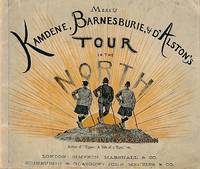
1890réf. 3061London: Day & Son; Simpkin Marshall Hamilton Kent & Co Ltd. G : in Good condition. Cover rubbed. Slight foxing. 1890. First Edition. Maroon hardback cloth cover. 190mm x 250mm 7" x 10". 27pp 25pp ads. According to the Badminton Library. . Day & Son; Simpkin, Marshall, Hamilton, Kent & Co Ltd hardcover
4to (170 x 266 mm). Persian and Chagatay Turkish manuscript on polished laid paper. 158 ff. 14 lines of black Naskhi script, set in two columns within gilt borders and black, blue, and red rules; chapter headings in red ink. Prettily illustrated throughout with 28 coloured gouaches (of which 11 are half- to full-page-sized). Margins decorated with gilt scrollwork. Near-contemporary full brown binding with blind-tooled borders and medallion stamps to both covers. Highly rare, charmingly illustrated 18th century manuscript of the story of Yusuf and Zulaikha, which forms the medieval Islamic version of the narrative of the prophet Yusuf and Potiphar's wife. In the Muslim world for centuries, it is found in many languages such as Arabic, Persian, Bengali, Turkish and Urdu, but was given its best-known expression in Persian, by Jami, in the 15th century. - Edges brittle with some tears and chipping, quite extensive remarginings (no loss to text, but obscuring some of the gilt scrollwork borders), occasional light waterstaining. Ownership seals and stamps of Ya Cabbar and Habib Allah.
1997352 pages including index. Part memoir, part entertainment, part commentary on a life lived as art, Toller Cranston tells tales as only he can, including: The only skating show in Haiti; The Broadway triumph that failed; The pachinko wizard; Upstaging Joan Collins; The decimation of John Curry; Sex in Holiday on Ice; Golf among the Mambas; and other stories too strange not to be true! Clean, bright and unmarked with only the very faintest trace of handling. Splendid copy. Book
8vo. 125 pp. With frontispiece, 15 plates and several text illustrations (including a map of the Gulf coast and the first page of a Quran). Original illustrated cloth. First edition of this account of travel through the Arabian desert. - S. M. Zwemer (1867-1952), the "Apostle to Islam", was a missionary at Basra, Bahrain, and at other locations in Arabia from 1891 to 1905. He was a member of the Arabian Mission (1890-1913) and served in Egypt from 1913 to 1929. He also travelled widely in Asia Minor and was elected a fellow of the Royal Geographical Society of London. - A good, clean copy without the front flyleaf. Macro, Bibliography of the Arabian Peninsula, 2379. OCLC 5163501.
8vo. 6, (2) pp. Contemporary blue printed wrappers. A speech given by the British politician Samuel, appointed High Commissioner of Palestine in 1920, at a meeting led by the English Zionist Federation, celebrating the second anniversary of the Balfour declaration, "which stated that the Government favoured the establishment of a Jewish National Home in Palestine". - Minor flaws to the edges, not touching text. OCLC 504623804.
8vo. 27, (1) pp. Contemporary blue printed wrappers. A speech by Weizmann, director of the British ammunition laboratory until 1919, who became president of the World Zionist Organization in 1921, given at a Zionist conference in London. Weizmann was elected the first president of the newly founded state of Israel in 1949. - Wrappers a little brownstained, paper slightly foxed in places. OCLC 12959743.
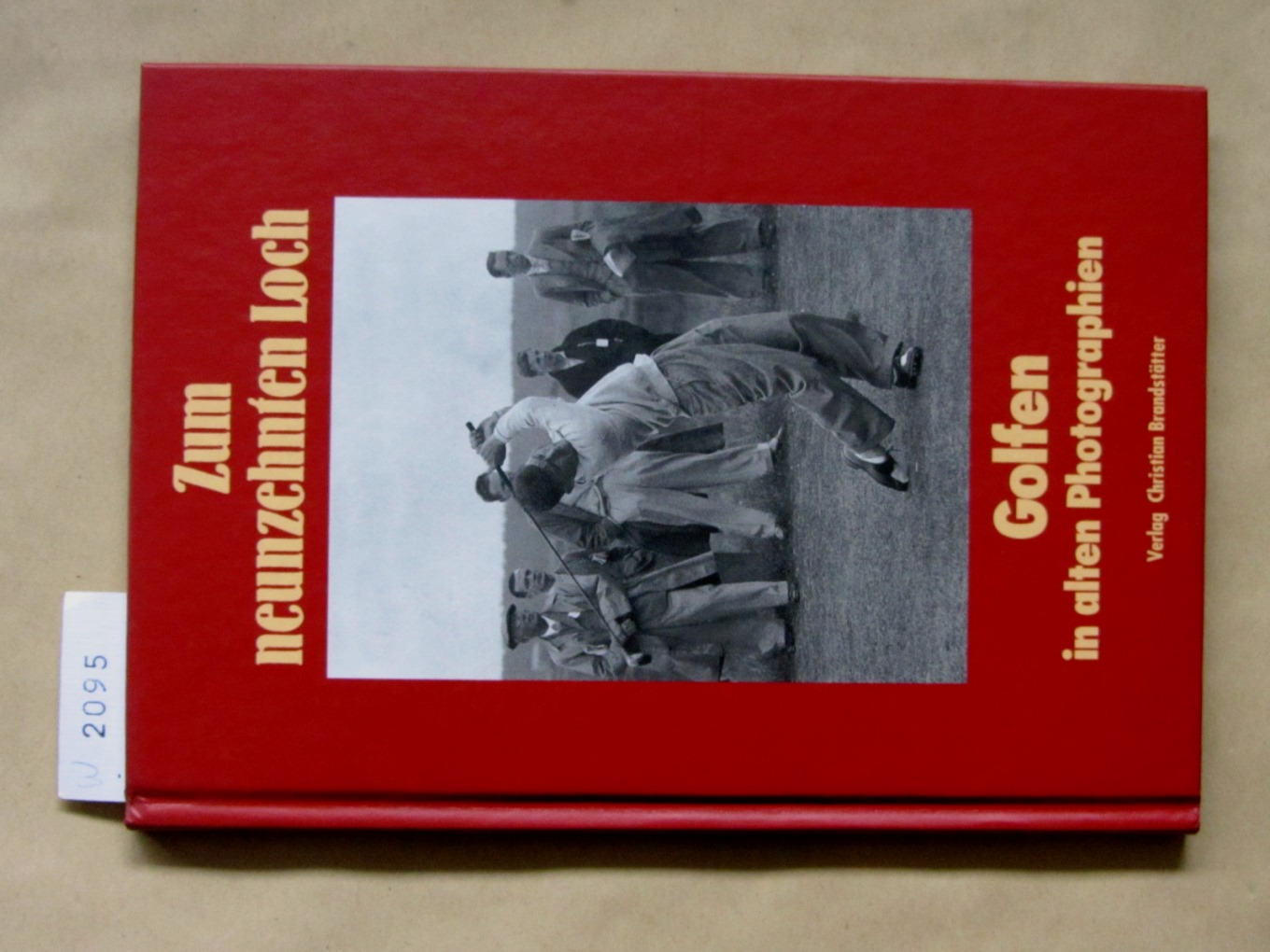
1995réf. 2095Wien: Brandstätter 1995. 1. Auflage. Mit 60 Abbildungen in duotone, 63 S., 8°, photoill. OPb.
4to. (2), "31" (= 29), (1) pp. With engraved frontispiece (an allegory of the 1683 Ottoman defeat) and headpieces. Side-stitched in modern wrappers, green edges. Rare pamphlet describing two dreams supposedly predicting the fall of the Ottoman Empire. It was written by the German composer and novelist Daniel Speer (1636-1707) under the pseudonym "Designante Somniatore" and opens with some remarks on prophetic dreams with reference to the Old Testament. Speer's pamphlet, written immediately after the 1683 Battle of Vienna, expresses a deep-seated fear of the Ottoman Empire, which, thrusting into the heart of Europe, seemed a serious threat to Christianity. With manuscript annotation on the back of the frontispiece by "Joannes Jacobus Hausmohr", 1685, and contemporary ownership of the Salzburg Theological Seminary ("Ex libris Seminarij Salisb.") on title page. In good condition. VD 17, 3:310364C. Not in Atabey or Blackmer.
Original watercolour drawing over ink. 267 x 196 mm. On thick oriental wove paper. Original ink drawing of the armillary sphere (Zâtü'l-Kürsü, "instrument on pedestal") published in 1732 in the famous universal Islamic geography "Kitab-i Cihânnümâ" of Katib Chelebi (1609-57). The present watercolour by Ahmed Al-Qirimi, who also contributed the maps to Ibrahim Müteferrika's famous publication of Katip's atlas, probably served as the direct model for the engraved plate. Müteferrika, a Hungarian convert to Islam, completed Katip's unfinished work, which had hitherto circulated in manuscripts only. He had the maps specially drawn and cut for it, and printed it at his own press, the first printshop in Turkey. - While extremely close in design and size to the present drawing, the published plate differs from it in several respects, lacking numerous details as well as - most conspicuously - the four additional instruments which here decorate the corners; on the other hand, the print shows the pedestal placed upon an additional short plinth not seen in the sketch. - Evenly browned and with a few small edge flaws, but well preserved.
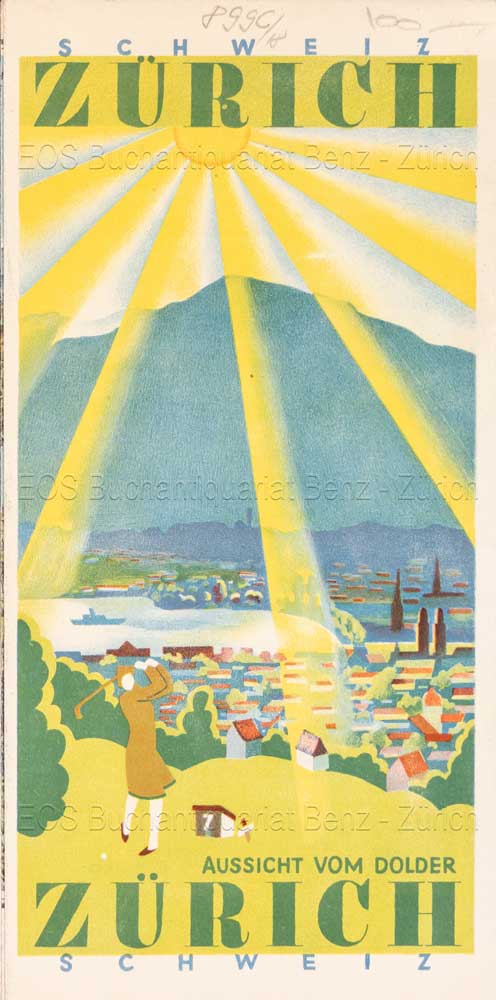
1929réf. 899CG(1929) Farbige Lithograhpie 17,5 x 29 cm (farb. Panorama).
1929réf. 899CG(1929). Farbige Lithograhpie 17,5 x 29 cm (farb. Panorama). + Wichtig: Für unsere Kunden in der EU erfolgt der Versand alle 14 Tage verzollt ab Deutschland / Postbank-Konto in Deutschland vorhanden +, Abb.
4to. 8, (2) pp. With additional panegyrical matter: 2 ff., 2 single sheets. All with woodcut initials and headpieces. A set of French (and Latin) eulogies addressed to "Dominique Ottoman", or Osman, the son of Sultan Ibrahim I, who was captured with his mother by the Maltese fleet in 1644 and educated by the Knights of Malta to become a Dominican friar. As an adolescent he was baptized and adopted the name Dominique de Saint-Thomas on 23 February 1656. He studied in Naples and Rome and went to Paris in 1664, where he spent two years. In 1667 he travelled to Candia on Crete, a Venetian-ruled city besieged by Ottoman forces since 1648, on an unsuccessful mission to convince the latter to make peace. Appointed vicar general on Malta around 1669, he returned to the island, where he spent his final years. - Louis de Puch's formal address of 8 pages is followed by a 12-line madrigal on a separate leaf. This same madrigal is present as a broadside on another single sheet, as well as on the first of two conjoined additional leaves, the second of which contains a Latin elogy in praise of St. Dominicus (signed P[uch] L[odovicus]). Finally, a large quarto leaf (showing traces of folds) contains an unsigned French sonnet "Au serenissime prince Dominique Ottoman fils aisné du Sultan Ibrahim, religieux de l'Ordre de S. Dominique". - Occasional slight foxing and creasing. A rare ensemble. OCLC records Puch's encomium only at the French National Library, the University of Tübingen, and the University of Pennsylvania. OCLC 458209721.
60 photographs on albumen paper, measuring 28 x 22 cm each, signed and captioned in the plate, numbered 1 through 68. Contemporary green half calf with gilt spine and title "Égypte & Nubie", initialed "B.C.D." on first plate. Large and beautiful photographs by Bechard: excellent vintage prints, mostly in superior condition. They represent the popular Egyptian and Nubian types, frequently in close-ups. Nissan N. Perez states that this part of the work of a photographer specializing in views of sites and monuments "has escaped general attention" (cf. Focus East, p. 123, reproducing the photograph of water carriers resting). Includes: a scribe; a sheikh reading the Qur'an, merchants and grocers, a group of ulemas (religious scholars) reading the Qur'an, an Arab drawing water, whirling dervishes, Arab peasants (a fellah carrying water), a sheikh going to the mosque, a game of Mangala, water carriers, mat manufacturers, Sheikh Sadad, a descendant of Mohammed, a falconer, washerwomen, an Arabic singer, a young fellah, a Darabouka player, labourers, a public fountain, a beggar, Arabs at prayer, Arabic coffee, etc. - Béchard was active between 1869 and ca. 1890. "His work is distinguished by the superb quality of his prints and the generally spectacular presentation of even the most common sites, such as the pyramids. His studies of people and costumes are even more interesting and point to a very personal involvement of the photographer in the life and customs of the country. His cityscapes and urban scenes were mostly taken from unusual angles in an attempt to cope with the narrow and confined spaces" (Nissan N. Perez). - Binding repaired in places.
Folio (447 × 315 mm). 125 mounted original salt prints, letterpress captions to mounting leaves and tissue-guards, 3 small engravings to the introductory text, double-page engraved plan of Karnak, single-page plans of Medinet-Habu and the island of Philae. Recent half brown cloth, marbled boards, original spine, brown hard-grained morocco laid down, title gilt direct, low flat bands with dotted roll gilt, double fillet panels to the compartments, new endpapers, original marbled free endpapers retained. Extremely rare first edition, complete, illustrated with 125 salt prints from wet paper negatives (Blanquart-Evrard process) mounted one to a page. Maxime Du Camp’s monumental survey, "Égypte, Nubie, Palestine et Syrie", was the first of its kind, the first travel album to be completely illustrated with photographs of archaeological monuments. - A young man of independent means, Du Camp learnt the craft of photography from Le Gray in 1849 in preparation for his second journey to North Africa. By the time he came to Abu Simbel in March 1850 to explore the rock-cut temples built by Ramesses II (reigned 1292-1225 BC), Du Camp was thoroughly at ease with the medium. With official backing from the French Government, and travelling in the company of the novelist Gustave Flaubert, Du Camp returned with over 200 paper negatives of the antiquities of Egypt and the Near East, of which 125 were published in the present work. The illustrations were produced at the photographic printing works of Louis-Désiré Blanquard-Évrard at Lille and their distinctive cool neutral tones are due to the prints being chemically developed rather than merely printed-out in sunlight. - Distinguished as it was, Du Camp’s photographic career was short-lived. After the completion of his magisterial survey of the antiquities of the Near East, he abandoned photography entirely in favour of literary pursuits. - Soundly bound, presenting well on the shelf. Front hinge slightly cracked towards the head at the first blank, some very light foxing throughout, but altogether an excellent copy. Parr/Badger, The Photobook, I, 73. QNL Inaugural Exhibition (2018), 153.