4.493 Ergebnisse
1931Best.-Nr. 31607Paris Albin Michel 1931 In-12 envoi signé de l'auteur à René Gast - 253 pp + 1 ff Tables des matières - Carte indiquant le voyage de l'auteur aux pêcheries de perles de la Mer Rouge, du Golfe d'Aden et du Golfe Persique (comprise dans la pagination) - Planches non comprises dans la pagination - plat séparé et dos partiellement manquant
1894Large 8vo. 109 (instead of 129), (2) pp. With 16 (instead of 19) plates. Marbled half calf with giltstamped title to spine. Includes 4 photographic views of Mecca, 3 of Medina and 3 of Jeddah (after Sadiq Bey and others), wants only the ten-leaf appendix, 2 portraits and the plate showing the departure of the Mahmal in Cairo. - Salih Subhi, an Egyptian public health official, was commissioned by his government to undertake the Hajj in 1888 and 1894. Here he describes the eight-month journey in great detail. Muhammed Sadiq Bey was a major pioneer in the history of Arabian photography and the first person ever to photograph the Holy Cities of Mecca and Medina. - Browned throughout due to paper. Our copy without the ten-leaf appendix before the author's epilogue and portrait. - Rare, the last copy on the market fetched £27,500 (Christie's, April 13 2010, lot 276, with author's dedication), the Burrell copy fetched £8,000 in 1999 (complete, but in modern cloth). Macro, Bibliography of the Arabian Peninsula, 2096. Auboyneau/Fevret 20. OCLC 7055812.
8vo (127 x 192 mm). 107, (5) pp. Original printed green wrappers. Only edition of this rare account of the "North African War Pilgrimage", the Hajj of the year 1940 - the last before the Second World War brought an effective hiatus on the Meccan pilgrimage for two years. Together with the French journalist and ethnographer Robert Boutet, the Moroccan and Tunisian radio journalist and theatre critic Noureddine ben Mahmoud (1914-1990) published the account of his pilgrimage to Mecca, performed between 19 February and 2 March 1940. The book describes the special travel conditions imposed by the war and the struggle for influence by the European powers, who feared that the pilgrimage would serve as a platform for North African separatists under the leadership of King Abdulaziz Ibn Saud. - Ben Mahmoud also published on the Saudi press, in particular about the periodical "Um El Qurra", whose editorial staff he visited while in Arabia. Later based in Paris, he became one of the heads of the Mosquée de Paris and the Institut de Paris in 1961. - Covers a little foxed, otherwise fine. Uncut and untrimmed as issued. OCLC 5544875.
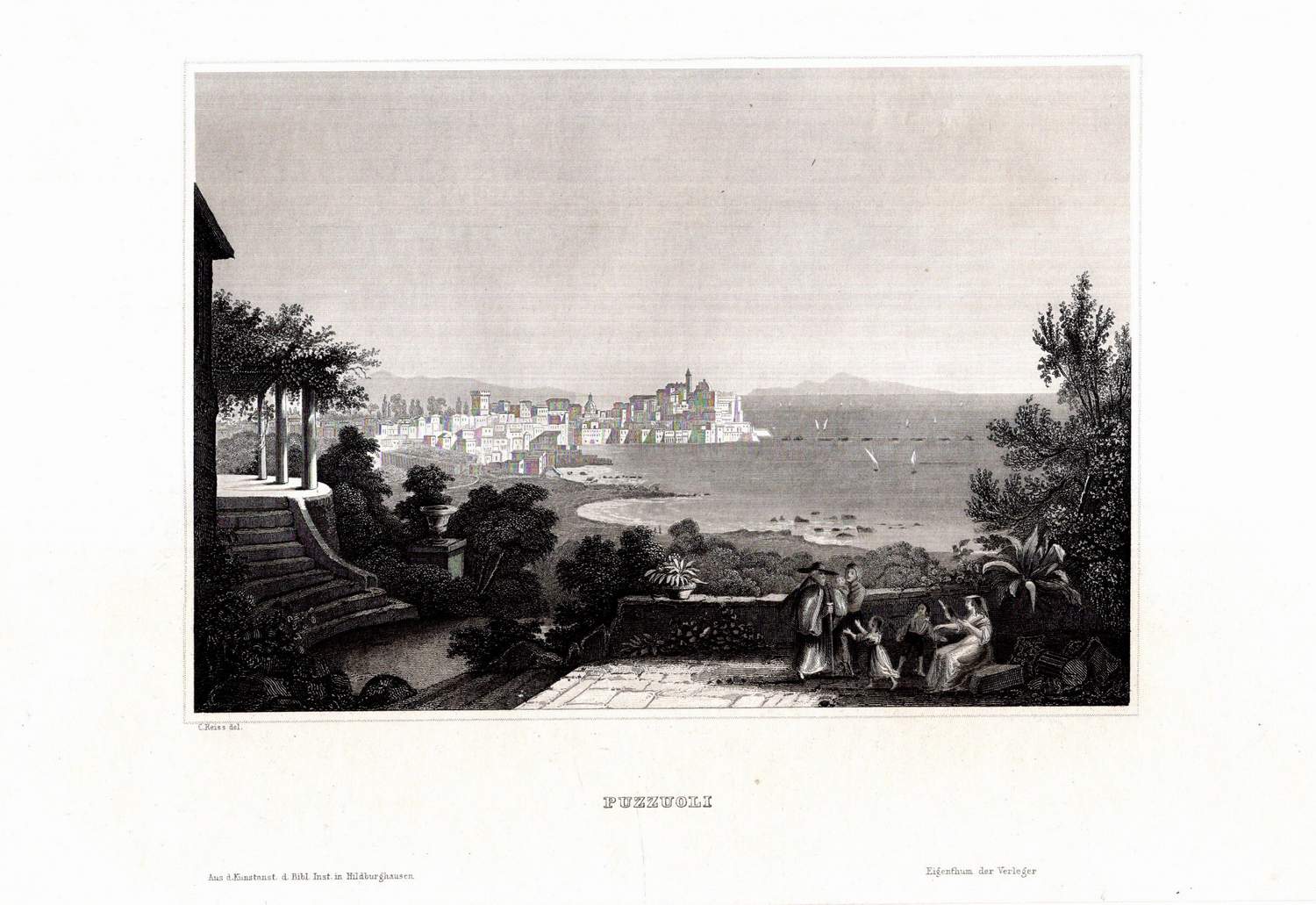
1850Best.-Nr. 50528Hildburghausen, Bibliographisches Institut, um 1850. Darstellung ca. 10 x 14,5 cm, Blatt ca. 14,5 x 23 cm. 1 Blatt, verso weiß.
1992Quarto, 160 pages, illustrated, index. eng
1987Best.-Nr. 07648Hamburg, Jahr, 1987. PP, OU, 160S, gutes Exemplar
8vo. (2), 34, II pp. Contemporary blue printed wrappers. First edition of this exceedingly rare Russian account of a 1719/20 pilgrimage to Jerusalem, the only known work by the Russian merchant Matviei Gavrilov Nechaev (d. 1752). His descriptions of the settlements of Greek merchants in Russia suggest that he was involved in trading with them, an unusual practice at the time. In addition, his travelogue discusses the Turkish tax system, the plague epidemic in Constantinople of 1721, and the Arab revolts in Jerusalem, as well as the Maltese fleet and Russian slaves in Turkey. - A tiny tear to the upper margin of the title-page. Rare; only three copies library catalogues internationally (New York Public Library; Stanford Univ. Library; Dumbarton Oaks); no copy in auction records. OCLC 38678524. Not in Röhricht.
Best.-Nr. EB7-100Blaboratoire freyssinge 0 laboratoire freyssinge. En Feuilles. sd années 50 - in4 en feuilles dans sa pochette à rabat illustrée - illustré à pleine page sur chaque planche par FORE. Publicité pharmaceutique au verso imprimée en vert.
Best.-Nr. 2g8571Gulf Coast Research Laboratory Museum Ocean Springs 1972. 328 S. Halbleinen Name auf Titel. - Text englisch - unknown
Best.-Nr. 0970365004.Gpaperback. Good. Access codes and supplements are not guaranteed with used items. May be an ex-library book. paperback
1988Best.-Nr. LFA-126730850Un ouvrage de 176 pages, format 195 x 215 mm, illustré, relié cartonnage couleurs, publié en 1988, Editions Robert Laffont, collection "Sports pour Tous", bon état
1989In 8°, cartonato editoriale illustrato, pp. 173, illustrato, buon esemplare. LIB PE5B LIB PE5B
Folio (binding 250 x 335 mm, inner book 236 x 327 mm). 200 leaves, complete. Title printed in red and black within woodcut arabesque border, printer's device on final leaf. With parallel text in Hebrew, Latin, Greek, Arabic and Chaldaean (in their respective types), 4 columns to a page, 41 lines. 13 woodcut floriated initials (5 Latin, 4 Hebrew, 2 Greek and 2 Arabic). Rebound in near contemporary brown calf, carefully restored, edges and corners repaired, spine fully rebacked in seven compartments with modern gilt title and date. First edition. - The first polyglot edition of any part of the Bible, and also the first polyglot work ever published. It is of the utmost importance in several further respects, constituting the second book printed in Arabic from movable type (following Gregorio de Gregorii's "Kitab salat as-sawa'i", a Horologion for the Lebanese Melchites, printed in 1514), as well as the earliest Arabic printing of any portion of the Bible. It also contains the first edition of the Aramaic text of the Psalter and offers for the first time Kabbalistic texts from the Zohar. Furthermore, Giustiniani’s commentary provides the first substantial biographical reference to Columbus, and is thus noted as an Americanum. - The learned Dominican Agostino Giustiniani (1470-1536) was Bishop of Nebbio in Corsica from 1514 and later became the first Professor of Arabic and Hebrew at Paris. On his death he bequeathed his extensive library to the state of Genoa. He edited, supervised and financed the present edition and also wrote the commentary. - His book is the first multilingual edition of any part of the Bible. Aldus Manutius had planned a Psalter in three languages as early as the late 15th century, but his project was not realised. Printed in eight parallel columns on double pages, Giustiniani’s work comprises the text in Hebrew, a literal Latin translation thereof, the Latin Vulgate, the Greek Septuagint, Arabic, Aramaic (Chaldee), a literal Latin translation from the Aramaic, and scholia in the same languages. While Giustiniani aimed to edit the entire Bibel in this form, no further sections were published. He described his difficulties in selling the edition in his History of Genoa (1537), recording an edition size of 2,000 paper copies and 50 copies on vellum. - Giustiniani’s extensive commentary includes a long note to Ps. 19:4 ("et in fines orbis omnia verba eorum"; C7r-D1r), about the Genoese Christopher Columbus, who had died in 1506, containing previously unpublished information on his second voyage: "In this interesting sketch of the life and voyages of his fellow-townsman, Bishop Giustiniani gives an interesting account of the discovery of the new world, and states some facts not mentioned elsewhere" (Sabin). - This edition is also the only book printed at Genoa in the 16th century. The Milanese printer Pietro Paulo Porro maintained a press at Turin with his brother Galeazzo. Giustiniani summoned Porro to Genoa especially for the production of this edition, and had set up a press in the house of his brother Nicolo Giustiniani Paulo. The types were designed and cut for this edition under Porro’s direction. - Mild browning throughout, with some occasional waterstaining (more pronounced near beginning). Adams B 1370. Darlow/Moule 1411, 1634 & 2401. Smitskamp, PO, 236. Alden-Landis 516/4. Harrisse, BAV no. 88 (pp. 154-158). Sabin 66468. Sander 5957. G. Roper, Early Arabic Printing in Europe, in: Middle Eastern Languages and the Print Revolution. A Cross-Cultural Encounter (Westhofen 2002), pp. 129-150, at p. 132, with colour ill. IV. StCB 25. Vinograd Genoa 1.
800 x 755 mm. 20 parts mounted on linen. A monumental and highly detailed 1751 map of India, Persia, and Arabia by the French cartographer Jean Baptiste Bourguignon d'Anville. Centered on Persia, this map covers from Istanbul to eastern India and Tibet, and from the Black Sea to the Maldives. It offers excellent coverage of the central Asian portions of the Silk Road naming the centers of Samarkand, Bukhara, Lop Nor, and others. At the bottom center there is a large decorative title cartouche including stylized Christian, Muslim Zoroastrian, and Buddhist elements. - Some worming, slightly browned.
8vo. Half-title and title, (4), 123, (1) pp. With 4 lithographed plates. Contemporary red morocco-backed cloth. One of 150 copies, rare. "A neat summary of nearly all that is necessary to be known in order to tame, train, and fly a hawk successfully" (Harting). - Cloth rubbed, a very good copy. Harting 217. Schwerdt II, 168.
18278vo. 27, (1) pp. With 5 engraved plates by F. Berthout, Caen, and woodcut vignette of the Académie de Caen on reverse of t. p. Original printed wrappers. Second edition (first printed in 1820), with several illustrations published here for the first time. No. 237 of 300 copies. Rare treatise by John Spencer Smith (1769-1845), an "extrait du procès-verbal de la séance du 14 avril 1820", about the famous Chasuble of Saint-Regnobert preserved at the Cathedral of Bayeux, and about the Cufic-inscribed ivory chest, supposedly part of the Saracen spoils taken by Charles Martel, in which it is stored. The engravings show the chasuble as well as the chest and many details of the inscriptions. The original edition, published by Le Roy in 1820, contained merely a frontispiece and a single text illustration. - Wrapper torn at upper spine end. Binding loosened; significant browning to final quires. With the errata slip bound at the end. OCLC 27973008.
580 x 420 mm. Colour lithograph, signed "Ibrahim K." Mounted on styrofoam board. Bilingual safety poster in Arabic and English. - Traces of folds, some brownstaining to lower right corner.
570 x 430 mm. Colour lithograph, signed "Ibrahim K.". Mounted on styrofoam board. Bilingual safety poster in Arabic and English. - Traces of folds, some brownstaining to lower right corner.
560 x 430 mm. Colour lithograph, signed "Ibrahim K.". Mounted on styrofoam board. Bilingual safety poster in Arabic and English. - Traces of folds.
Best.-Nr. 5c4699Volkswagen Wolfsburg 1979. 21 Seiten kartoniert Stempel auf Vorsatz. - Beiliegt eine Preisliste Stand 01.05.1979. - unknown
8vo. 51 ff. (without final blank). Printer's woodcut device on title page. Attractive modern boards. Second edition thus (previously published in 1544) of this collection of smaller treatises on Europe and the Orient. Göllner calls this "a chronicle of contemporary history, spanning the years 1480 through 1532, fuelled by a calculated optimism". Contains the "Prognosticon" by the Ferrarese physician A. Arcoato (ff. 2-10), about the Turkish threat to Europe; A. & C. Cella's "Europae descriptio" (ff. 11-22r); F. Titelmans' "De fide ... Aethiopum" (ff. 22v-28r); D. a Gois, "Legatio Magni Indorum Imperatoris presbyteri Ioannis ... 1513" (ff. 28v-45r), and two treatises on the Ottoman Empire. - Some loss to final leaf (though not to text) professionally remargined. BM-STC Dutch 199. Adams 811. Göllner III, 341.
4to. 44, (4) pp., interleaved throughout. Contemporary marbled half cloth with giltstamped spine label. Dissertation of Eugen Mittwoch (1876-1942), the groundbreaking German scholar who is considered one of the founders of modern Islamic Studies, about the chronicles of the Arabic wars. This constitutes the author's first academic foray into Arabic studies. - Old ink library shelfmark on verso of title page, otherwise fine. NDB XVII, 591. NYPL Arabia coll. 32. Cf. GAL S I, 162.
Folio (141 x 42,5 cm). Five folio leaves, printed in French and Arabic in two columns and pasted together vertically to form a single broadside. A massive broadside intended for wall-mounting, by which the newly appointed commander-in-chief introduced his government (and himself) to the people of Egypt in Arabic and French: "Habitans de l'Egypte, écoutez ce qu j'ai à vous dire au nom de la République Francaise. Vous étiez malheureux; l'armée francaise est venue en Egypte pouir vous porter le bonheur [...]". - Menou, who succeeded Kleber at the head of Egypt as general-in-chief, following Kleber's assassination in June, converted to Islam and took the name of Abdallah. Unlike most announcements published by his predecessor at the same press, the present proclamation is not headed with the motto of the French Republic, but rather with the Shahada ("There is no deity but God, Muhammad is the messenger of God") in both languages. Menou continues to set out his principles for a good government for Egypt, emphasizing his firm stand against abuse and corruption in the local administration of taxation, justice and the police, and finally threatens any attempt at rebellion with severe retaliation. - An important document from the first printing press in Arab world, of the utmost rarity due to its sheer size and ephemeral nature, according to OCLC recorded in four copies only: "The expedition of Napoleon Bonaparte to Egypt from 1798 until 1801 was a prelude to modernity. It was to change permanently the traditional Arab world [...] The French brought Arabic typography to Egypt, where it was practised under the supervision [...] of Jean Joseph Marcel [...]. Only a few days after the French troops landed [...] they set up the Imprimerie Orientale et Française there. It was an extraordinarily important turning point. For, leaving aside the Hebrew printing presses in Egypt of the 16th to the 18th centuries, until this date announcements and news adressed to Arabs there, as well as in other parts of the Arab-Islamic world, had been spread only in hand-writing or orally, by criers, preachers or storytellers" (Glass/Roper). - Traces of folding, but uncut with temoins. A surprisingly fresh survival. Cf. D. Glass/G. Roper, The Printing of Arabic Books in the Arab World, in: Middle Eastern Languages and the Print Revolution (Gutenberg Museum Mainz 2002), p. 177-225, at 182.
1986209 pages including black and white photos of selected participants. The concept of the People's Enquiry was to gather information on the implications of CFMETR by inviting a number of experts in various fields to give papers on selected topics. The idea of having an open meeting was to provide the public with the answers which were denied them when the government turned down requests to hold a public meeting. Major-General Leonard Johnson (retired), one of the three distinguished panelists, said of the Enquiry, it was "an attempt to obtain facts, to inform the public, and to influence the activities that bear on the security of the people of Canada... Defence agreements can lead with changes in strategy and technology to unforseen and unintended consequences inimical to the security of Canadians. Because they are made and implemented in secret, beyond public security, such agreements are not subject to democratic control by an informed electorate, as all agreements affecting the lives of people should be. This is especially serious where nuclear weapons are involved." Moderate wear. Unmarked. Binding sound. Nice copy. Book