4.589 Ergebnisse
4to. XII, 127, (8) pp., final blank page. Front flyleaf included in the pagination. Original printed wrappers. With dust jacket. Only edition, very scarce. - Noted essay on the physique of the Anglo-Arabian horse, challenging the theory of its over-lightness and insufficiency - the "gravest and most unjust" criticism levelled against the breed. Prepared by the vice-president of the prominent Toulouse stables "Écurie coopérative du Midi", Claude Marty. Of the utmost rarity: a single library copy traceable internationally (French National Library). - The main part of this work is made up of highly informative tables, displaying the distribution of the various breeds in the French, Algerian, Spanish, and Prussian cavalry forces, specifying their origins, as well as weights and body measures, and occasionally even stating their given names. Several other tables show the use of the Anglo-Arabian for public transportation in Toulouse. The work concludes with remarks on the Anglo-Arabian's high bone density and their physical ability to set vehicles in motion. - Ownership stamp of the Bibliothèque de Trélissac to half-title. Dust jacket somewhat worn, minor tears. A few pages loosened. A good copy of this important work rarely seen in the trade. OCLC 457358123.
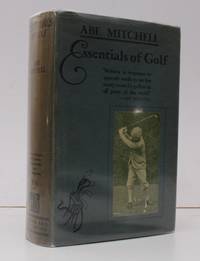
19368vo., Fifteenth Edition, with portrait frontispiece and plates, some very light and scattered spotting; olive cloth, upper board and backstrip framed and lettered in green, uncut, a very good, bright, clean copy in unclipped dustwrapper. Mitchell's golfing classic was first published in 1927. SCARCE IN THIS CONDITION.
1936Best.-Nr. 38688Hodder & Stoughton 1936. 8vo. Fifteenth Edition with portrait frontispiece and plates some very light and scattered spotting; olive cloth upper board and backstrip framed and lettered in green uncut a very good bright clean copy in unclipped dustwrapper. Mitchell's golfing classic was first published in 1927. SCARCE IN THIS CONDITION. Hodder & Stoughton, hardcover
8vo. X, 485 pp. Harting 79.
Tables only: 11 genealogical tables on 15 folding sheets. Contemporary red half morocco; marbled covers and endpapers. Slightly foxed throughout. From the library of Richard C. Hodges (his etched bookplate on front flyleaf); later in the library of Sidney Edward Bouverie-Pusey (1839-1911), only son of the agriculturist Philip Pusey (cf. DNB XLVII, 64), with his bookplate on front pastedown.
4to. (4), VI, 7-100 pp. With lithographed frontispiece and 3 lithographed plates. Original printed wrappers. Third edition. Rare treatise on equine appearance by a prominent figure of the French cavalry. Unlike the first edition, which included only two illustrations, the present third edition features 4 lithographed plates, including an Arabian horse and the horse's skeleton. Frequently cited by later works on hippology, Morris's essay discusses all aspects of the horse's physique, including proportions and the angular structure of the skeleton, which "can rather be applied to the Arabian horse than to European breeds" (de la Lance). - Wrappers slightly browned near margins. A fine, uncut copy of an equestrian classic. Mennessier de La Lance II, 227. Not in Boyd/P.
1942Best.-Nr. b24975New York 1942. First Edition . Soft cover. Near Fine. Near fine in original wrappers. paperback
1949Best.-Nr. 001622New York: Esquire Inc David A Smart 1949. A superb item for the golf collector 12 page guide plus numerous adverts covering the whole golfing scene incs at double page size a pullout colored print of " The Golfers " playing at St Andrews by Charles Lees Wonderful condition you won't be disappointed! 167pp. Not Inscribed or Signed. This is the First Edition. Paper Magazine . Fine/No Jacket Issued. Illus. by Various Including a Coloured Print of the Famous Golfer Picture " the Golfers " By Charles Lees in Superb Condition . Folio - over 12" - 15" tall. Magazine . Esquire Inc David A Smart unknown
1991N° spécial, issu de l'exceptionnelle association des 2 revues, présentant un important dossier sur les "Paysages apres la bataille", celle de la Guerre du golfe Persique (1990-1991), pour "déminer autant que possible" le thème de "la guerre des cultures", s'interroger sur la politique arabe de la France, la politique étrangère des Etats-Unis, l'avenir politique du Proche-Orient, sur l'Islam, etc; introduit par "La Guerre", poème de Mohammed KHAÏR-EDDINE. Français
1991Best.-Nr. 13475Paris, Esprit / Les Cahiers de l'Orient, 1991 1 volume 15 x 24cm Broché. 354p., 3 feuillets. Très bon état.
1986Best.-Nr. 129921München : Mosaik-Verlag, 1986. 159 Seiten mit Abb. Gr.-8°, Leinen mit OU
(2), 11, (1) SS., l. w. Bl. Marmorbroschur der Zeit. 8vo. Aufsätze: "Das Auslaut- und Betonungsgesetz des Neupersischen"; "Über das Lautgesetz: altbaktr. sh = alteran. rt."; "dahân". "Aus dem Decemberhefte des Jahrganges 1870 der Sitzungsberichte der phil.-histor. Cl. der kais. Akademie der Wissenschaften [LXVI. Bd., S. 361] besonders abgedruckt." Im Rand etwas angestaubt. Mit Bibliotheksstempel des Indogermanischen Instituts der Karl-Marx-Universität Leipzig am Titelblatt sowie Ausscheidestempel.
Colour-printed map. Ca. 65 x 52 cm. Scale 1:800,000. German military map of eastern Anatolia in the Ottoman Empire, produced by the Prussian Ordnance Survey near the end of the First World War and marked as "for operational use only". - Folded. Formerly in the collections of the Geographical Institute of the University of Berlin with 1940s stamp and shelfmark. OCLC 246429024.
1995In 4°, pag. 192 con moltissime illustrazioni a colori. Tela editoriale con sovr. illustrata. Presentazione di Nick Price. Ottimo e fresco esemplare.
Large 4to. 36 pp. With a folding lithographed plate. Original wrappers with handwritten label on upper cover. Treatise on a papyrus document concerning the sale of land, found in an Egyptian grave and dated 104 BC. - August Boeckh (1785-1867), who did important work on ancient poetry, particularly Pindar, is regarded as the founder of modern Epigraphy. - Slightly brownstained. Covers worn. From the library of Joseph Baron Lassberg (1770-1855), his autogr. ownership "Villae Eppos ad Bibliothecam Laßbergii" on inside of front cover; stamp of the Fürstenberg Court Library at Donaueschingen on title page. Ibrahim-Hilmy I, 78. Not in Kainbacher.
Chromolithograph map, 852 x 520 mm. Scale 1:500,000. A map depicting the Jewish settlements related to Keren Hayesod agricultural work from 1921-1946. Keren Hayesod was, during the pre-state period, a single-issue Zionist funding body and played a large role in the settlement of Palestine by Jewish colonists prior to 1948; many of these settlements were agricultural in nature. The map lists over one hundred settlements and distinguishes those established by from those aided by Keren Hayesod. Also identified are settlement types: communal, smallholders, village, urban, town, training farms, and ex-servicemen villages. A colourful and thorough overview of Keren Hayesod's work in the region. - A hint of wear along creases, otherwise well preserved. OCLC 827860593.
635 x 910 mm (image); 680 x 990 mm (sheet). Colour-printed poster mounted on cloth with wooden rods for hanging. German teaching material on Saudi Arabia, stereotyping the symbiotic simultaneity of modern oil exploration and the traditional bedouin lifestyle. Prepared for introducing students to the economic value of desert landscapes for oil exploration, this large poster depicts an utterly idyllic scence with a resting caravan watering their camels near a pipeline and three oil rigs. Another caravan on the move, as well as two bedouin tents and an oasis are displayed in the background. - Chart number 7 from the series "Dr. te Neues Geographische Bilder" after a work by the German painter Michael Mathias Kiefer (1902-80), bearing his reproduced signature. - Vertical tear near upper margin (measuring ca. 9 cm); margins occasionally slightly waterstained, not affecting image.
4to. XI, (1), 418 pp. With folding lithographed frontispiece and a lithographed plate, both in original hand colour. Ca. 1940s giltstamped full blue morocco with spine-title. Leading edges gilt. Marbled endpapers. All edges gilt. First edition of this classic of Middle Eastern travel literature, published anonymously. The first literary venture by the English travel writer and historian Kingslake, in which he described a journey he made about ten years earlier in Syria, Palestine and Egypt, together with his Eton contemporary Lord Pollington. According to the Irish traveller and novelist Elliot Warburton, the book evoked "the East itself in vital actual reality", and it was instantly successful. - Packed with intimate details of a traveller's life and emotions, the narrative includes vivid accounts of Kinglake's encounter with Lady Hester Stanhope (1776-1839), one of the most famous travellers of her age, at her home near Sidon in Lebanon, as well as of a severe outbreak of the plague during his 15-day sojourn in Cairo: "When I first arrived, it was said that the daily number of 'accidents' by the plague, out of a population of about 200,000, did not exceed four or five hundred, but before I went away, the deaths were reckoned at twelve hundred a day [...] When first I arrived at Cairo, the funerals that daily passed under my windows were many, but still there were frequent, and long intervals without a single howl. Every day, however [...] these intervals became less frequent, and shorter, and at last, the passing of the howlers from morn to noon was almost incessant. I believe that about one half of the whole people was carried off by this visitation [...]" (p. 283ff.). - The frontispiece shows a group of travellers on horseback passing the skeletons of impaled robbers in the Balkans, captioned "Eastern Travel". The plate shows a baggage raft and some swimmers crossing the River Jordan. - Upper hinges slightly rubbed. Frontispiece worn in the folds; occasional very slight foxing. Provenance: pastedown has bookplate of Frank Goldsmith, possibly the Kentish-born photographer of that name (1902-82) who survived the sinking of the Titanic as a nine-year-old and relocated to the USA after WWII. A fine copy in an sumptuous blue morocco binding produced by the Bayntun-Riviere bindery in Bath, England. Blackmer 911. OCLC 1191005987. Cf. Weber 369 (1845 2nd edition). Atabey 635 (1847 French edition). Not in Aboussouan.
8vo. 3 vols. 35, (1), 293, (9) folded maps, (7), 212, (1) pp. Original printed wrappers. First edition. - Three-volume set of this military geographic work on Iran, published by the General Staff of the German Army, collecting valuable information concerning physical aspects, resources, and artificial features of the terrain necessary for planning and operations. This set is complete with its 9 large folded maps and its 212 b/w photographic reproductions. - Moderate age-toning or foxing on wrappers. Text in German. Wrappers in overall good, interior in very good condition.
Royal folio (540 x 410 mm). 5 volumes in 1. With engraved title-page, engr. dedication, 5 engr. half-titles and 86 engr. plates (3 folded, 1 map). Contemporary full calf with giltstamped red morocco label to richly gilt spine. All edges red. First edition of this splendid work, which was reprinted five times until 1742 (including an English edition). The first three volumes deal with historical and legendary monuments (among them the seven wonders of the ancient world as well as monuments of the "Arabs and the Turks"). The fourth volume is dedicated to buildings of Fischer von Erlach himself; the fifth volume shows vases and sarcophagi. - Binding slightly rubbed, some dampstaining near end, otherwise a fine, wide-margined and complete copy. Nebehay/Wagner 176. Ornamentstichslg. Berlin 2105. Fowler 121. Schlosser 438. Thieme/B. XII, 48. Millard III, 31. Kruft 205/687. Museum of Islamic Art, Hajj - The journey through art, p. 48f. (illustration).
1986192 pages, illustrated, statistics, glossary, index. eng
1967Best.-Nr. 83900San Diego CA: Gulf General Atomic Incorporated c1967. Presumed First Edition First printing thus. Wraps. Good. 4 pages plus covers. Illustrated front cover. Illustration inside front cover. Other illustrations. Rear cover has designation SP8017 0206906. Rare surviving item of corporate ephemera from the brief period when the potential for the Peaceful Uses of Nuclear Explosives were actively considered and investigated. This document is undated but has content indicating that it was produced no earlier than 1962. Because it is a product of Gulf General Atomic it was produced between 1967 and 1973 based on when this name was officially used. Based on context this document is probably from the earlier part of this period. This is a marketing brochure for Gulf General Atomic's field services and highlights some of its expertise developed in support of nuclear-effects computer code development high-explosive experimental verification and analytical and experimental participation in underground nuclear explosive testing. Also highlighted is their experience with chemical explosives. General Atomics is an American energy and defense corporation headquartered in San Diego California specializing in research and technology development. This includes physics research in support of nuclear fission and nuclear fusion energy. The company also provides research and manufacturing services for remotely operated surveillance aircraft including the Predator drones airborne sensors and advanced electric electronic wireless and laser technologies. General Atomic GA was founded on July 18 1955 in San Diego California by Frederic de Hoffmann with assistance from notable physicists Edward Teller and Freeman Dyson. Originally the company was part of the General Atomic division of General Dynamics "for harnessing the power of nuclear technologies for the benefit of mankind". In 1956 San Diego voters approved the transfer of land to GA for permanent facilities in Torrey Pines and the John Jay Hopkins Laboratory for Pure and Applied Science was formally dedicated there on June 25 1959. The Torrey Pines facility continues to serve as the company's headquarters. General Atomic's initial projects were the TRIGA nuclear research reactor which was designed so that it was guaranteed to be safe by the laws of nature and Project Orion. GA helped develop and run the San Diego Supercomputer Center. A brief history of the company: 1967: Sold to Gulf Oil and renamed Gulf General Atomic. 1973: Renamed "General Atomic Company" when Royal Dutch Shell Group's Scallop Nuclear Inc. became a 50-50 partner. 1979: Harold Agnew appointed president and CEO 1982: Renamed "GA Technologies Inc" when Gulf bought out its partner. Gulf General Atomic Incorporated paperback
1992in 4°, pp. 336, leg. edit. con sovracop. ill. Tutto sul golf, le regole del gioco, le attrezzature, le architetture, le mappe dettagliate dei maggiori campi del mondo, carriere dei più grandi campioni mondiali, con centinaia di foto a colori. Come nuovo. 255/37