Freytag, Carl.MareMagnum
Watson, TomAntiquariat.de
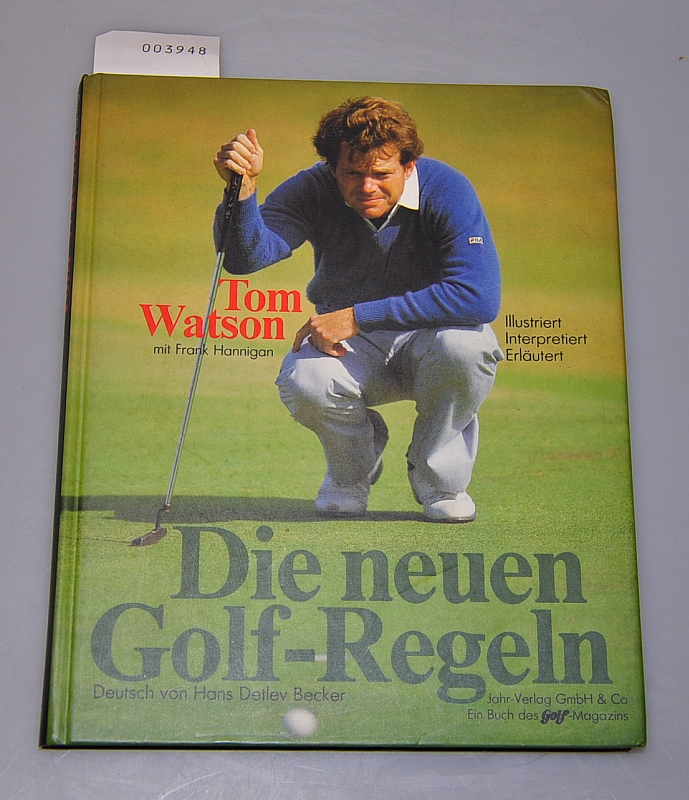
Die neuen Golf-Regeln
1985rif. 03948Hamburg, Jahr, 1985. PP, 185S, gutes Exemplar
Folio (260 x 330 mm). 156 pp. With 40 lithographed plates by H. Schenck. Original giltstamped green cloth. Marbled endpapers. Extensive, fully illustrated study of the horse breeds of the Orient and southern Europe. Separate chapters are dedicated to the Barb and the Arabian horse, praising the latter as "the noblest and most beautiful, possibly also the cleverest of all animals of its species". - Some foxing throughout; hinges repaired. OCLC 245766508. Cf. Huth 280 (series "Die Haustierracen"). Not in Boyd/P.
8vo. 2 parts in 1 volume. VI, 202 pp. VI, 114 pp. Modern orange cloth. Second German edition (the original French edition appeared in 1851); an English translation was published in 1863. The book is divided into two parts and includes extensive information on the principles of Arabian cavalry, military costumes of horsemen, celebrated Arabian horse breeds (Haymour, Bou-ghareb, Meizique), how to choose and acquire your horse, nutrition, hygiene, the meaning of the variously coloured horse attires, rigging, veterinarian medicine and illnesses, crippledness, castration, various kinds of military attacks in the deserts and how to execute them, tribal wars, as well as ostrich, gazelle, and falcon hunting. The book concludes with general remarks on the Sahara desert and a letter from the Algerian Sufi saint and military and religious leader Abd-el-Kader (1808-83), the Emir of Mascara who founded the Algerian state and led the Algerians in their struggle against French domination and in 1847 was imprisoned with his family by the French government in the fortress of Lamalgue in Toulon (France). The Emir wrote the letter while Daumas served as French consul in Mascara. In this letter the Emir, calling himself Daumas' friend, answers some questions Daumas previously asked him while preparing this book. - The French cavalry general Melchior Joseph Eugène Daumas (1803-71) was "directeur des affaires d'Algerie" and also served as Minister of War. "De 1837 à 1839, il avait rempli, auprès d'Abd-el-Kader, à Mascara, les fonctions de consul, et en 1847 il fut chargé d'une mission spéciale auprès de l'Emir, alors détenu au fort Lamalgue, à Toulon. Ces relations amicales expliquent la part prise par Abd-el-Kader à certains ouvrages du Général Daumas" (Mennessier de la L.). - Some annotations in coloured pencil. Old handwritten ownership "Berkovich" to title and preface. Title-page and table of contents professionally repaired. Cf. Mennessier de la Lance I, 348. Huth 178. Not in Fromm.
XI, (1), 143, (1) SS. Bedr. Originalbroschur. 8vo. Der erste von insgesamt acht Bänden des Katalogs der orientalischen Handschriften der Herzoglichen Bibliothek Gotha und der einzige Band, der die persischen Werke verzeichnet. Den Katalog, der zwischen 1859 und 1893 erschien, verfasste der Bibliothekar und Orientalist Pertsch (1832-99), Beamter und ab 1879 Oberbibliothekar zu Gotha. Auf den Katalog der persischen Handschriften folgte jener der türkischen in einem Band, der arabischen in fünf Bänden und abschließend ein Band der übrigen orientalischen Handschriften. - Gering stockfleckig. Unbeschnittenes, unaufgeschnittenes Exemplar. Nicht bei Besterman.
1985rif. 03948Hamburg, Jahr, 1985. PP, 185S, gutes Exemplar
1985rif. 08253Hamburg, Jahr, 1985. PP, 185S, gutes Exemplar
Folio. (1), 286 pp. With 26 folding plates. Original cloth. First edition, based on the unpublished 1942 proofs. The noted numismatist Eduard von Zambaur (1866-1947) was a specialist for the coinage of the Muslim peoples; in 1927 he published his "Manuel de Généalogie et de Chronolgie pour l'Histoire de l'Islam" (1927). - A perfect copy. OCLC 6321389.
Oblong folio (297 x 216 mm). 12 ff. 10 silver gelatin photographs mounted in photo corners, each 175 x 115 mm. Contemporary patterned cloth with saddle-stitched binding. Rare original photographs of bridge construction in Amara, taken shortly before the 1958 Iraqi revolution the following year. Sequential photographs show materials and cranes gathering on the banks, the cranes at work lifting steel girders, wooden pylons being sunk, the busy construction zones on each bank, and workers inspecting their materials. The album's title is handwritten in German on the first leaf. - Between 1950 and 1960 two steel-deck-type plate-girder highway bridges were designed in Britain for the Iraq government, the first of which was the New Amara Bridge, a twin-box girder bridge with pier foundations featuring large bored piles, likely the project pictured here. - Quite well preserved.
8vo. (16) pp. Modern marbled wrappers. Extremely rare German slavery account by the Prussian clockmaker F. G. Albertus. Born in Potsdam in 1770, he visited Amsterdam in 1797, was press-ganged into joining an East India Company ship bound for Batavia, but fell into the hands of Tunisian pirates off the coast of Gibraltar. He details the horrors of his eight-year slavery in North Africa and mentions several of his fellow sufferers by name, including a Spanish Countess named Carolina who was captured at age 16 and was finally ransomed after nine years of slavery. Ultimately, Albertus is ransomed by a Dutch jeweller named Birkenthal and returns to Germany, physically broken but full of praise for the workings of God. - Trimmed rather closely (slight loss to text). Title page bears contemporary censorship stamp of the Delitzsch police. Of the utmost rarity: a single other copy is known (bound within sammelband A/31581:9 in the State and University Library of Hamburg). OCLC 837821535 (SUB Hamburg).
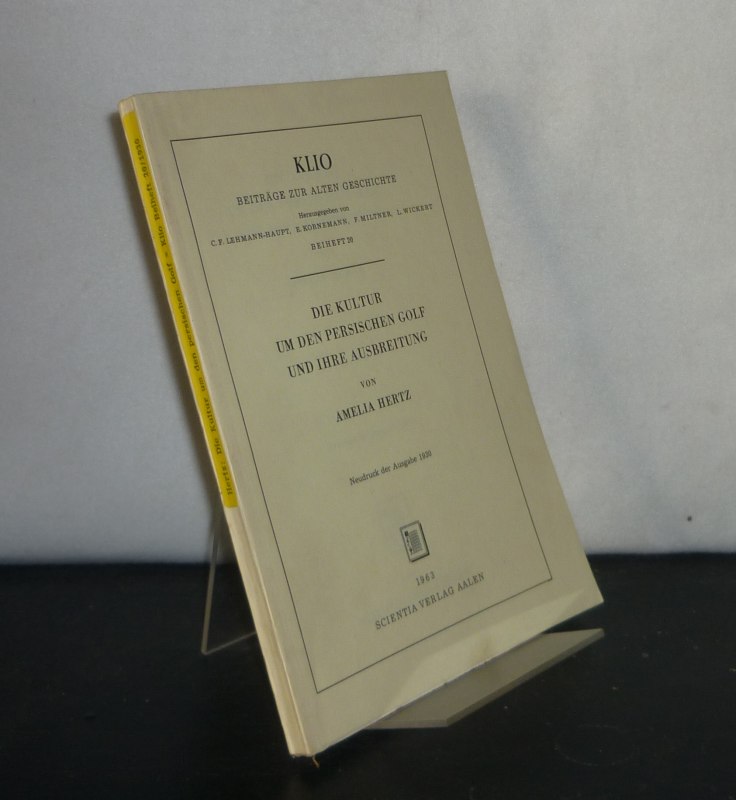
1963rif. 3123191Aalen: Scientia-Verlag 1963. (4), 152 Seiten. Mit 15 Abbildungen auf 8 Tafeln. Gr. 8° (22,5-25 cm). Orig.-Broschur. [Softcover / Paperback].
8vo. VI, (2), 164 pp. Original printed wrappers. Scholarly work on Abu 'Ubaid's collection of proverbs (matal) known as "Kitab al-Amtal", assembled in the 8th/9th century A.D., and other, similar anthologies of Arabic adages. - A very good copy.
8vo. VIII, 120 pp. Contemporary green full cloth with giltstamped spine title. The first essay about the Oriental Academy founded by Maria Theresa in 1753/54, "producing detailed information about this important institution" (cf. Wurzbach), with specimens in Turkish, Arabic and Persian types. Weiß (1818-86), who studied at the Academy himself, "deserves our gratitude, as he tells of several famous Austrian orientalists and statesmen who emerged from this institution" (ibid.). The appendix includes the essays "Denkschrift des türkischen Gesandten Ebubekr Ratib Efendi, vom Jahre 1792", "Gedichte bei der Feier des fünfzigsten Jahrestages von der Errichtung der k. k. Akademie der morgenländischen Sprachen [...]", "Reden bei Gelegenheit der Allerhöchsten Vermählung weil. Sr. k. k. apostolischen Majestät Franz des Ersten mit Ihrer königlichen Hoheit Maria Ludovica Beatrix Erzherzoginn von Oesterreich", "Denkschrift des persischen Gesandten Mirsa Abdul Hussein Chan vom Jahre 1819", and "Bedingungen der Aufnahme in die k. k. orientalische Akademie". - Bookplate of the Albertina collection and later bookplate of the Viennese journalist and writer Vinzenz Chiavacci (1847-1916) to front pastedown. Gugitz 4363. Slg. Mayer IV, 3506. Wurzbach LIV, 144. Not in Slg. Eckl.
8vo. 64 pp. Original printed wrappers. Caesar Vimercati describes his experiences on board of "La Guerriera" during the year 1840 and provides descriptions of Constantinople, Alexandria, Beirut, Saida, Acre, etc. Austrian warships had their first military encounters during the Oriental Crisis of 1840 as a part of a British-led fleet which ousted the Viceroy of Egypt, Muhammad Ali, from Ottoman Syria. Archduke Friedrich took part in the campaign personally and was awarded the Military Order of Maria Theresa for his exceptional leadership: "Es ist allgemein bekannt, daß um diese Zeit, und zwar genau am 15. Juli zu London eine Uebereinkunft zwischen den Repräsentanten der vier Großmächte England, Rußland, Preußen und Oesterreich geschlossen worden war, welche die Bezwingung der maßlosen Eroberungssucht Mehemed Ali's zum Zwecke hatte […] ". - Wrappers slightly dust-soiled, brownstaining to paper throughout, otherwise a good copy. OCLC 797734900. Not in Kalemkiar or in Kat. der k. k. Kriegsbibliothek.
8vo. VIII, 341, (3) pp. Contemporary half calf with gilt spine and labels in red and black; covers and edges marbled. First edition. - The first extensive history of the medieval Muslim sect of the Assassins, a radical group from whose name the English term for a political or religious killer is derived. A fanatical branch of the Ismaili Muslims who viewed themselves as martyrs, the Assassins specialised in political murder (usually carried out with a dagger), often conducted in broad daylight and in full view of the public, so as to instill terror in their foes. Contemporaries found it incomprehensible that they entirely accepted the fact of their own death as a consequence, as they made no attempt to escape and exposed themselves to the revenge of the victim's followers. Acting from a strong ideological conviction, the Assassins aimed to re-establish a theocracy, the basic Islamic order bequeathed by the Prophet, as they felt their contemporary world order to be usurped by tyrants. Most of their victims were Sunni Muslims, especially the Seljuk rulers of the 12th and 13 centuries. - For this history, Hammer-Purgstall draws from a wide variety of mainly oriental sources (Ibn Khaldun, Jihannuma, Abulfeda, Persian and Turkish chronicles, with a small number of western studies included), all of which he lists at the beginning, and ultimately compares the mediaeval sect to the modern fanatics of his own day, particularly the Jacobin party of the French Revolution. Among the goals which he wishes to have achieved with his book, he writes, is to have "given a vivid account of the pernicious influence of secret societies under weak governments, and of the hideous abuse of religion for purposes of committing atrocities of unscrupulous ambition and unfettered despotism". - Slight browning, but a good, finely bound copy. Provenance: from the Thun-Hohenstein library in Decín (Tetschen) with their armorial stamp "Tetschner Bibliothek" on the reverse of the title page. When the castle was requisitioned by the Czechoslovakian army in 1933, the library was transferred to Prague and dispersed to the trade. Goedeke VII, 762, 47. Wurzbach VII, 274, I B 1. FRA 70 (1940), p. 572. Cf. Atabey 556; Blackmer 787 (English ed.).
6 text volumes and 1 atlas. 35,5 x 26 cm; atlas 54 x 36,5 cm. 29; 62; 53; 29; 32; 89; 80 pp. With a total of 185 plates in the text volumes, 22 plates in the atlas volume, mostly in black and white, some in colour, and numerous illustrations in text. Uniform decorated brown cloth. Reprint of a work on archeology in China, published in the years 1922-1933, written by the German orientalist and archaeologist Albert von Le Coq (1860-1930). From 1902 to 1914, Le Coq led three of the four German expeditions to the Turfan (or Turpan) area, in Xingjian, China. The expeditions were initiated by the German archaeologist Albert Grünwedel. "The principal spoils of these expeditions were literary. Vast numbers of Chinese manuscripts were obtained from every center, both secular and religious. … Besides securing manuscripts, these expeditions examined caves decorated with stucco figures and with frescoes…" (Couling). The text gives a brief history of the expeditions, the different sites they excavated, including grottoes and temples, which are also shown on some of the smaller illustrations, followed by descriptions of the objects shown on the plates. "The civilization thus revealed is a mixture of Persian, Indian, Chinese, Hellenic etc." (Couling). Both Grünwedel and Le Coq went back to Berlin with thousands of artefacts, of which many are shown in the plates. The second volume, titled Die Manichaeischen Miniaturen, deals with fragments of illuminated manuscripts, the other volumes deal mainly with either sculpture, mural paintings or frescoes and their techniques. The fourth expedition ended early due to the outbreak of the First World War, but compared to the earlier expeditions they collected the most artefacts during this short stay. - All volumes in very good condition. Cf. Couling, pp. 32, 578.
4to. 5 parts in 4 volumes. IX, (1) 1, (1), 387, (2) pp. XVI, 447 pp. XV, 495 pp. XIV,154, 155, (3) pp. With frontispiece to vols. 1, 2 and 4, 32 plates with photograph reproductions, several folding tables and maps in texts, and a total of 6 folding maps, some in end-pocket. Uniform green cloth. First edition of an elaborate work on Bedouin tribes in the Arabian Peninsula, written by the German orientalist and archeologist Max von Oppenheim (1860-1946) in collaboration with Erich Bräunlich and Werner Caskel. Von Oppenheim made various travels to the Middle East in the early 20th century, where he observed and analyzed the lives and cultures of various Bedouin tribes. "Fascination with a society seemingly still free of the constraints of 'civilization' and still governed by a shared traditional code of behaviour underlies the admiration for the Bedouins that Max von Oppenheim shared with many of his predecessors and contemporaries" (Gossman). He gathered his information during nearly forty years, and the first volume of his ethnographic study appeared in 1939, dealing with Bedouin tribes in Mesopotamia and Syria. In 1943 the second volume was published, which dealt with the tribes in Palestine, Hejaz, Transjordan and the Sinai Peninsula. The last two volumes were posthumously published and edited by Caskel (1896-1970), comprising the tribes in Iraq, Iran and north and middle Arabia. Most of the tables show family trees, and tribe members are shown on the plates, along with their names and the year the photo was taken. "Perhaps the most comprehensive work on the locations, genealogies, and interconnections of the Arab Bedouin" (Sweet). - In very good condition, only very slightly browned. Macro 1720. Henze III, 650. L. Gossman, The passion of Max Von Oppenheim: archaeology and intrigue in the Middle East from Wilhelm II to Hitler (2013), p. 18; L. E. Sweet, The central Middle East: a handbook of anthropology and published research on the Nile Valley, the Arab Levant, southern Mesopotamia, the Arabian Peninsula, and Israel (1971), p. 157.
2 vols. Elephant folio. 112 pp. 224 text illus. (some in colour), 204 plates (numbered 1-205, nos. 204-205 forming one double-page plate; 7 double-page; 2 coloured), showing photographs, measured drawings, ground plans, etc. Loose as issued in original board portfolio. First edition; rare. An important survey of the architecture of Constantinople, concentrating mainly on religious buildings. The extensive scope covers the major mosques of the Ottomans, as well as Topkapi Palace, the Hagia Sophia, Hagios Theodoros and the Byzantine land walls. The plates depict interior and exterior views, architectural details, street scenes, plans, and elevations. A panoramic and comprehensive overview of many centuries of architectural evolution in Istanbul. - Very scare, and virtually impossible to obtain: the last copy at Sotheby's sold for £13,150 in 2002. The only other copy available in the trade has library stamps on every plate. - Some plates evenly browned (as usual); a few plates a bit frayed. Spines repaired with tape. Atabey 545. The Ottoman World II, Cat. Sotheby's, 28 May 2002, lot 537. Not in Blackmer.
1983rif. 003782Bonn, Europa Union Verlag, 1983. -- Broschiert -- 8°
8vo. VIII, 136; 22 pp. (appendix in a nashk Arabic type). Publisher's original printed wrappers (spine repaired). First and only early edition, in German, of an extraordinarily thorough documentation of scholarly academies in the early Islamic world, containing a biographical dictionary of early Arabic scholars and lists of their writings. This is one of the earliest and most important publications of the Göttingen orientalist Ferdinand Wüstenfeld, who based much of it on the ancient biographical dictionaries compiled by Abu-Bakr Ibn Qadi Shuhba and Ibn Khallikan. It covers the 5th to the 9th centuries AH (11th to 15th centuries CE), with accounts of 37 academies in Bagdad, Nishabur, Damascus, Jerusalem, and Cairo, and brief biographies of 254 scholars, 187 listed under the academies where they taught and 67 in a separate section at the end. For most he includes a list of their writings. The German text ends with a 2-page extract, in German translation, from the works of Ibn Khallikan. A 22-page appendix gives the original Arabic text of an extract from Ibn Shuhba, "Tabaqat al-shafi 'iyya", published here for the first time, with an Arabic title-page. - Ibn Qadi Shuhba (1377-1448 CE) was a leading jurist and chief Qadi in his native Damascus, best known for his biographical dictionary, completed ca. 1407. Ibn Khallikan (1211-82 CE), born in what is now Iraq, studied in Aleppo, Damascus, and Mosul before settling in Cairo, where he became a leading jurist in the Shafi'i school of Sunni Islamic law. He is best known for his biographical dictionary, completed ca. 1274. - The German orientalist and historian of Arabic literature H. F. Wüstenfeld (1808-99) studied theology and oriental languages at Göttingen and Berlin. He settled in Göttingen, taking a post at the University Library the year after the present publication, and taught at the University there from 1842, becoming professor of oriental languages in 1856. From 1835 to his death almost 65 years later, he published many important contributions to the study of early Arabic texts, covering the fields of medicine, language, topography and geography, often including the original Arabic texts of important works not previously published. - The Arabic type used for the excerpt from Ibn Qadi Shuhba is smaller than that of the Nies foundry, often used in Germany around this time, and quite different stylistically. It may have been produced for Wüstenfeld's works. - Minor browning, but altogether in very good condition, only slightly tattered at the edges. Original publisher's wrappers a little damaged along spine (professionally repaired; modern spine). Untrimmed copy, removed from the "Institut für Geschichte und Kultur des Nahen Orients an der Universität München" with their stamp on the title-page. Neue Jahrbücher für Philologie und Paedagogik VIII (1838), pp. 355f. Not in Blackmer or Gay.
1994rif. 13561München Heyne, 1994. 190 S. 18 cm, Taschenbuch,Softcover
rif. 86624aafFribourg, Office du Livre & München, Mosaik Verlag, 1987, in-4to, 224 S., illustr. mit zahlreichen farbigen Fotogr., Original-Pappband mit orig. illustr. Umschlag und orig. illustr. Schuber.
rif. 87300aafMünchen, Mosaik Verlag, 1987, in-4to, 224 S., illustr. mit zahlreichen farbigen Fotogr., Verlags-Archiv Exemplar mit Stempel ‘Exemplaire d’Archive’, Original-Leinenband, OU, ill. Schuber. Neues Exemplar.
Large 4to. 2 vols. VII, (1), 461, (1) pp. (4), 435, (1) pp. Near-contemporary sprinkled gold-tooled tanned sheepskin, sewn on 4 recessed cords, gold-tooled board edges, shell-marbled endpapers and matching marbled edges. First edition, edited by Caussin de Percival. One of the first complete French-Arabic dictionaries. The Copt Ellious Bocthor (1784-1821) held a chair for Vulgar Arabic at the École des Langues Orientales in Paris. - Some foxing throughout, otherwise an excellent copy. From the library of the Ducs de Luynes at the Château de Dampierre: their bookplate reproducing the arms of Charles Marie d'Albert de Luynes (1783-1839), 7th Duc de Luynes, on pastedown in both vols. Fück 151. Vater/Jülg 457. OCLC 493558888. Cf. Gay 384 (1864 third ed.).
Large 4to (198 x 260 mm). (4), XV, (1), 227, (1) pp. Contemporary French half calf over papered boards with giltstamped red spine label. Only edition. The first dictionary of Arabic published in France: a unidirectional wordbook of more than 6,000 French terms translated into Arabic (in Arabic typeface), printed in large type and generously spaced, for the use of French merchants in the orient. - In the preface, the author anticipates the concept of linguistic relativity when he observes that Arabic lacks equivalent terms for a multitude of French words, especially such as relate to everyday life, culture, and the mechanical arts, and states that it would be impossible to translate the works of Newton, Montesquieu, or Lavoisier into Arabic, for "l'ignorance d'une chose entraîne nécessairement l'ignorance du mot qui sert à la désigner" (p. ix). With the practical needs of commercial travellers and secretaries in mind, he has thus aimed to pare down the vocabulary of his dictionary to the bare essentials, so as to offer to those who would wish to use Arabic nothing but the most widely used words (p. xiii). - Ruphy, a native of Greece born Iacovos Rouvis, emigrated to France as a young man and participated in Napoleon's Egyptian Campaign before becoming secretary of the Conseil des arts et du commerce du département de la Seine in 1801. - Binding rubbed; extremeties bumped. A fairly large waterstain throughout the lower third of the book. Rare in the trade; a single copy at auction in the past 40 years. Ersch/Gruber V, 53. OCLC 27402218. Spirgatis, Kat. 32: Grammatiken und Wörterbücher (Leipzig 1895), no. 309. Not in Zaunmüller or Vater/Jülg.
Royal 4to (31 x 27 cm). 2 vols. 439; 46, (2 blank) pp. (vol. II, pp. 1-2 blank). With 2 title-pages printed in red and black, each with the author's wood-engraved decorated GAV monogram and motto; vol. 1 with 2 folding lithographed maps (1 printed in black, brown and blue, with the route coloured by hand in red, of the Sinai Peninsula; the other in black and white, of the city of Petra); 40 mounted albumen prints after paintings by Emile Pierre Metzmacher (mainly 11.5 x 16 cm), individually mounted with letterpress captions on the mount; and 2 engraved plates; vol. 2 with 6 numbered engraved plates of molluscs and insects. Set in roman and italic types, with incidental Arabic, and sans-serif Greek and Latin capitals to render ancient inscriptions. The Diario in the original publisher's maroon cloth with the author's crowned monogram gold-blocked on the front board and spine, and blind-blocked on the back board, with the title in gold on the spine. The Atlante in the original publisher's blue cloth, with the author's crowned monogram and the title gold-blocked on the front board, and the monogram in a larger size blind-blocked on back board. Both volumes with gilt edges, orange endpapers and with tissue guard leaves tipped in, protecting the albumen prints and engraved plates. Rare first and only edition of an Italian account of an 1865 expedition through "Arabia Petrea", meaning the Sinai Peninsula and adjoining parts of what are now Israel and Jordan, including the ancient city of Petra, now in Jordan, where parts of "Raiders of the Lost Arc" were filmed (the spectacular ancient buildings are carved into the solid rock walls of the cliffs and probably date from the 5th century BC to the 2nd century AD). - The photographically reproduced paintings show the author on camelback, numerous Bedouins, Arabs, Egyptians and Ethiopians as well as archaeological sites, monuments and topographic views. The plates in the second volume depict molluscs and insects, reflecting the author’s own research interests in the field of natural history, in addition to archaeology. The typography has been designed to suit the antiquarian subject, with Louis Perrin's Augustaux roman capitals on the title-pages, the main text set in what would then have been considered an "antique" style (types influenced by pre-1800 models) and sans-serif capitals used to represent the ancient Greek and Latin inscriptions. The author quite literally put his stamp on the work, with his crowned monogram not only on the title-page and binding, but also embossed in the paper, where it serves as a sort of watermark. - The book does not indicate the size of the edition, but since most of the illustrations are original albumen prints, there cannot have been many copies produced. The present copy may be a more deluxe binding than the Blackmer copy, also inscribed by the author to a woman, for it was in green cloth with only Visconti's single initial "V" on the front board. The volume with the Diario is a presentation copy with the author’s presentation inscription to a woman named Josephine. - Bindings slightly worn, the blue cloth a little stained. First and last leaves of both volumes browned, some foxing, some fly-leaves with a tear (not affecting the plates), the map of Petra stained due to oxidation, with some browning caused by the albumen prints on the facing leaves, but overall in good condition. Blackmer 1742. Gay 3650 bis. Macro 2254 (not noting plates): Not in Howgego, Ibrahim-Hilmy, or Weber.
1845pp. v, (5)-217. Foxed. Wide margins. XLib bookplate and manuscript ownership of the Abington Friends Meeting Jenkintown, PA. 8vo. 205 mm. Original full cloth binding, decorated in blind. Front board decorated with flowers in gold gilt. Corners worn with slight loss. Slight loss at head of spine. First Edition. Hardbound. Very good. Interesting essay on the climates and seasons around the globe. NW48 FarRt