CESURA Guido - SPALDING A. -MareMagnum

4 114 résultats
1939Milano, Sperling, 1939, 8vo br. (mancanza al dorso) cop. ill. pp. 147 con num. tav. f.t.
1945Opera con segni d'uso. Ultima pagina quasi completamente staccata. Stato discreto
1939Milano, Sperling & Kupfer, 1945. 8vo br. pp. 156 con fig. n.t. e tav. f.t.
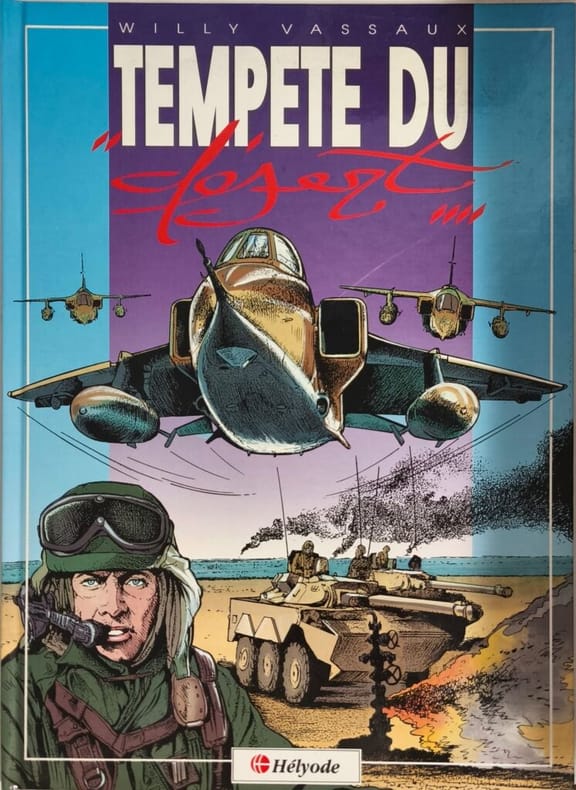
1991réf. 5566Helyode 1991 47 pages IN4. 1991. Cartonnage editeur. 47 pages. Cette bande dessinée documentaire relate l'invasion du Koweït par l'Irak de Saddam Hussein le 2 août 1990 événement déclencheur de la guerre du Golfe qui a bouleversé la géopolitique du Moyen-Orient
92 x 126 cm. Scale: 1:1,000. Whiteprint on thick paper. Title, scale and compass executed in manuscript in blue pen. Impressive plan of the excavation site of Tell Halaf (now on the Syrian-Turkish border), the location of the great ancient Aramaean town of Guzana, and one of the most important archaeological revelations of the modern era. Then in the Ottoman Empire, it was discovered in 1899 by the German diplomat Max von Oppenheim (1860-1946) while travelling through northern Mesopotamia on behalf of Deutsche Bank, working on establishing a route for the Bagdad Railway. - This is a working copy of the official, authoritative plan of the site produced during the 1911-13 excavation led by Oppenheim, printed at Tell Halaf for the use of the senior archaeological team. Signed in the upper right-hand corner by Theodor Dombart (1884-1969), a professional architect and one of Oppenheim’s principal associates, later an esteemed professor of ancient Middle Eastern architecture and an authority on Munich history. - A little worn, slight toning along old folds, else very good.
8vo. XIV, 673, (1) pp. With wood-engraved title vignette, folding map of the Middle East, 3 maps, 4 wood-engraved plates, 1 steel-engraved portrait, and numerous wood-engraved text illustrations. Contemporary half calf with giltstamped spine title. Marbled edges and endpapers. Fascinating account of the work on the submarine telegraph lines from British India to Turkish Arabia, the so-called "Persian Gulf Cable" laid in the 1860s. An extensive section is devoted to the laying of cables in the Arabian Gulf south of Persia, with a separate diagram of the diversion of the "Persian Gulf Cable" from Elphinstone Island off the northern tip of Arabia to Henjam and Jask. The telegraph lines ultimately reached from London via Munich, Vienna, Constantinople, Diarbekr, and Baghdad to Basrah, then continued by the Indian Government to Bushehr, Henjam, Gwdar and Karachi as well as to Tehran. Other cables connected Cairo with Aden and thence with Bombay. - Some brownstaining and edge flaws, otherwise an excellent copy. Inscribed "Thomas Kirk Johnson Dec. 1876 From R. B. Hull". Howgego III, G31. OCLC 1283945.
1996réf. 2240ABAachen, Meyer & Meyer Verlag, 1996. 21 cm, 128 Seiten, mit zahlreichen Illustrationen und graphischen Darstellungen, kartoniert. Einband minimal berieben, Rücken leicht gebräunt, Kanten und Ecken berieben.
1860réf. 6126AGEdingburgh, London, Blackie, 1860 (ca.). handkolorierter Stahlstich von Willmore nach Brockedon nach Mott, Darst. (excl. Text) 22,7 x 15,3, Bll. 29,3 x 20,8. Auf Wunsch Digitalaufnahme in jpg-Format erhältlich- photo in jpg-format available. Je nach Versandart können die Portokosten bis zu 2 ? weniger als angegeben betragen.
1999No marks or inscriptions. No creasing to covers or to spine. A lovely clean crisp very tight copy with bright boards and no bumping to corners. 112pp. The funny things that happen on a golf course, with lots of colour photographs of golfing stars - plus the stars who just play golf.
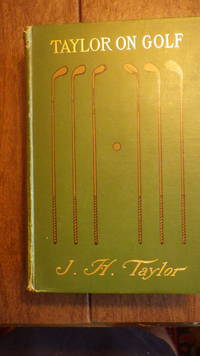
19118vo., First Edition, endpapers lightly browned, neat inscription on front free endpaper; original decorative cloth, covers very lightly age-worn at extremities else a very good, firm copy. First appearance in book form of a series of newspaper articles written under the pseudonym 'Tee Shots'. Scarce
1995Laboratoire Ciba-Geigy, 1995. In-8 broché de 173 pages avec photos. Très bon état
1995réf. yd609Ciba-Geigy Broché 1995 In-8 (16,5 x 23 cm), broché, 175 pages, illustrations en noir et blanc et en vert ; très bon état général. Livraison a domicile (La Poste) ou en Mondial Relay sur simple demande.
8vo. 84 pp. 5 folding maps. Contemporary loose cardstock wrapper, stapled. Slightly altered version published in 1947 as "Historical Memoranda" or "Historical Survey". A rare Zionist booklet issued in Hebrew by the General Council of the Jewish Community of Palestine to the Anglo-American Committee of Inquiry. This publication was part of a series of three such pamphlets issued in 1946-47, each presenting a history of Jewish populations in Palestine and diasporic movement. Of the three, this pamphlet deals the most with the history of ancient Palestine. The folding maps illustrate waves of Jewish immigration from 640-1882 CE and identify sites of Jewish settlements in Roman, early Muslim, Crusade, Mamluk, and Ottoman periods. - Somewhat toned; maps are bright and clear. OCLC 244129609.
8vo. Ottoman Turkish manuscript, with medical terminology mostly in Arabic. 50 pp. Black (and occasional red) ink on polished paper. 19th century marbled wrappers. A traditional pharmacological essay or pharmacopoeia, as well as a description of several ailments and medical conditions (including earache, infection of the larynx, uvular edema, malaria, jaundice, and yellow fever), with their treatment indications. Interestingly, there is a specific reference to opium ("afyon" in Turkish). The anonymous scribe was very probably a physician or medical practitioner with an imperfect knowledge of Arabic, most likely a Turk. No colophon, but likely written in the early 18th century in an Arabic-speaking Eastern province of the Ottoman Empire. - Occasional stains and smudging; some corner and edge flaws throughout with chipping to wrappers.
1902réf. 997D. Appleton NY 1902. HB NODJ 1902 1st edition 1st printing with #1 on last page of Text as Required Green decorated Cloth with minor Rub Wear Tiny Chip Tears Extremities Interior Nice & Tight with light Fox Wear & few loose protruding pages reattached with small tape at Inner Hinge & Vox NF/NF AS-IS NODJ 328 pages page with pencil underlining. Signed by Illustrator. First Edition. Hard Cover. D. Appleton NY hardcover
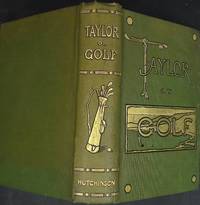
1903réf. r5802bLondon: Hutchinson & Co. VG : in very good condition. Cover rubbed. Spine faded. Slight foxing. 1903. 4th Edition. Green/gilt hardback cloth cover with motif. 200mm x 130mm 8" x 5". viii 338pp plates. 48 b/w plates. The author was open champion in 1894 1895 1900 and 1909. . Hutchinson & Co hardcover
8vo (130 x 218 mm). Arabic manuscript on paper. (375) pp., 19 lines per extensum. Written in neat black naskh, emphases picked out in red; catchwords. With numerous tables and diagrams, one in red and black. Contemporary brown leather binding with stamped ornaments. A 16th century commentary (sharh), profusely illustrated with diagrams, on Naziraddin al-Tusi's "at-Tadhkira an-Nasiriya", a general outline of astronomy, originally written in Persian. Composed by the Persian Sunni scholar Nizamaddin ibn Muhamad an-Nisapuri (d. 1328/29), who was known as a mathematician, astronomer, jurist, Qur'an exegete, and poet. His teacher Qutb al-Din al-Shirazi had himself been a student of al-Tusi's. An-Nisapuri wrote the present commentary in 711 H (1311 CE). - Binding rather rubbed. Marginal notes throughout; colophon with partial date "14 Jumada II". Scattered minor wormholes, but overall in good condition. GAL I, 511, VI, 40 b.
Small 8vo. 15 vols., uniformly bound in near-contemporary half calf with gilt spine and red spine labels. First printing of this German edition, based on a complete translation prepared by Antoine Galland (1646-1715). The so-called "Galland ms." which he had bought in 1701 is the oldest Arabic text extant (dating from 1450 or later). Maximilian Habicht (1775-1839) lived in Paris for a decade as a member of the Prussian delegation. He knew vernacular Arabic well and separately published an edition of the Arabic text of the "Nights" (cf. Fück). - Slightly browned; bookplates of the Viennese collector Rudolf Jelinek on pastedowns; collector's stamps to titles. Chauvin IV, 248. Hayn/Gotendorf V, 276. Cf. Fück 157.
Small 8vo. 6 vols., uniformly bound in contemporary brown half cloth with giltstamped spine titles. Still early printing of this revised edition of Habicht's German translation, based on a complete French translation prepared by Antoine Galland (1646-1715) and expanded by Gauttier. The manuscript which Galland had bought in 1701 is the oldest Arabic text extant (dating from 1450 or later). The German editor Maximilian Habicht (1775-1839) lived in Paris for a decade as a member of the Prussian delegation. He knew vernacular Arabic well and separately published an edition of the Arabic text of the "Nights" (cf. Fück). - Slight browning. Volumes 1 and 2 have old colour vignettes applied to the half-titles; pencil ownership of Marianne Alschech to second volume, otherwise fine. Hayn/Gotendorf V, 276. Chauvin IV, 249 (note). Cf. Fück 157.
8vo (160 x 252 mm). Arabic manuscript on polished oriental paper. 12 pp. on 7 ff., ca. 18 lines, per extensum. Black ink with red emphases. With numerous red and black ink diagrams in the text. Contemporary blindstamped full calf, restored and spine rebacked. The "Tashrih al-aflak", known as "general outline of astronomy" or "anatomy of the celestial spheres", is a summary of theoretical astronomy. The philosopher, architect, mathematician, astronomer and poet Baha' al-Din (953-1030 H / 1547-1621), a native of Baalbek, relocated to Iran with his father. Having completed his studies, he is said to have travelled for 30 years before settling in Isfahan, where he was highly respected as Sheikh al-Islam at the court of Shah Abbas. In the present treatise he affirmed a view in support of the positional rotation of the Earth. Baha' al-Din was one of the first Islamic astronomers to advocate the feasibility of the Earth's rotation in the 16th century, independent of Western influences. - Noticeable duststaining throughout; edges remargined. The restored binding uses the stamped original cover material. GAL II, 415, 6.
4to (146 x 211 mm). Ottoman Turkish manuscript. 284 ff. of polished laid paper. Black naskh with occasional red; 19 lines within red rules; gilt and illuminated sarlowh on first text page. Signed by the scribe Darwish 'Ali. Early 19th century English binding with blind-tooled spine and fore-edge flap in the oriental style. A complete 18th century manuscript of what is famously the first Ottoman history of America. Composed by an unidentified Turkish author in the 1580s, the work is also known as "Tarikh-i Hind-i gharbi" ("History of the West Indies") and "Hadis-i nev". It enjoyed great popularity throughout the 16th and 17th centuries and was printed by Ibrahim Müteferrika in 1730, making it the earliest book about the New World published in the Ottoman Empire. This text appears to be the principal source of information about the Americas circulating in the Ottoman Empire from the 16th to the 18th century. - Binding somewhat rubbed at extremeties; interior well preserved with wide margins. Provenance: from the library of Frederick North, Earl of Guilford (1766-1827), first British Governor of Ceylon, Philhellene and founder of the first university in modern Greece (his engraved bookplate on the front pastedown); annotated on the flyleaf: "A history of the new world, or America & the W. Indies, written in 1184 A.H.". Old French catalogue entry, clipped and mounted on lower pastedown. The son of Lord North, Prime Minister under George III, Frederick North had travelled widely throughout the Mediterranean, visiting not only Greece and Italy, but also Constantinople and the Ottoman Empire, including Syria, Palestine, and Egypt. He gifted his large personal collection of printed books and manuscripts to the Library of the university he created in Corfu. Counter to his wishes, after his death the books were transferred to his heir, George Holroyd, 2nd Earl of Sheffield (1802-76), who had the collection auctioned in London in seven sales held between 1828 and 1835; a substantial part was acquired by the British Museum and still rests in the British Library. - An important text, in a copy with important provenance. Cf. T. D. Goodrich, The Ottoman Turks and the New World (Wiesbaden 1990). The same, "Tarihi-i Hind-i Garbi: An Ottoman Book on the New World," in: Journal of the American Oriental Society 107.2 (April-June 1987), p. 317.
4to (165 x 125 mm). (6), 129 ff. Early 19th century half calf with floral moirée paper covers. Yellow paper pastedowns. The sixth book printed by Ibrahim Müteferrika: an important eyewitness account of the life of Tamerlane (Timur), the successful and barbaric 14th-century Turkish conqueror. Translated into in Ottoman Turkish by Nazemi Zadeh from the original Arabic manuscript completed in 1437/38 by the Syrian author Ahmad lbn 'Arabshah (1392-1450), secretary to Sultan Ahmad of Baghdad. - Binding a little rubbed at extremeties. Occasional browning, depending on paper stock, but mostly a very good, clean copy on crisp paper. Özege 19929. GAL S II, p. 25. Ebert 292 (note). Brunet I, 117 (note). Toderini III, p. 75, no. V.
4to (152 x 220 mm). 2 (instead of 7), 97 ff. (last two leaves mutilated; plus a fragment of the 5th leaf of prelims). Contemporary calf binding; papered spine with typed leather spine label; some loss to lower cover. The third book printed by Ibrahim Müteferrika: a contemporary history of the Afghan-Persian wars of the Safavid era that led to the fall of the Safavid dynasty and the Afghan occupation of Iran. This is the Ottoman Turkish translation of a work by the Polish Jesuit Judasz Tadeus Krusinski, who lived in the royal capital of Isfahan from 1707 to 1725/28, acting as an intermediary between the Papacy and the Iranian court as well as a court translator. Proficient in Persian and well acquainted with the nation and its people, he was a first-hand witness to the sack of the city by the rebellious Afghans in 1722, and his account makes him an important primary source on this particular period of the Safavid era. - Browned, fingerstained and waterstained throughout, several waqf marks; various edge tears and small chips. Lacks the first five leaves of the preliminaries (save for a fragment of the fifth); loss to upper edge of f. 33 (first line) and ff. 96-97 (several lines at the bottom of the page). Zenker 929. Özege 19897. De Backer/Sommervogel IV, 1264. Brunet III, 190. Ebert 4844 (note). Toderini III, p. 34, no. III.
4to (170 x 214 mm). (4), 65, 51 ff. Early 19th century half calf with marbled covers and fore-edge flap. Pink paper pastedowns. The seventh book printed by Ibrahim Müteferrika: a history of Egypt from antiquity to early modern times, prepared by the Turkish scholar Ahmed Süheylî (1562?-1632). The modern section (bound first, as usual) is in fact an Ottoman Turkish translation of the chronicle of the Ottoman-Mamluk war of 1516/17, "Fath Misr" (Tarikh as-sultan Selim al-Utmani ma'a as-sultan Qansuh al-Ghawri) by Ibn Zunbul (d. 1574/75). - Handwritten ownership of the French diplomat Louis Lagarde (dated 1923 CE) to front flyleaf. Occasional light browning and fingerstains, but mostly an excellent copy on good, crisp paper. Özege 19868-19869. GAL S II, p. 409. Toderini III, p. 85, no. VI.