Shurreef, Jaffur (Ja'far Sharif).MareMagnum

4.355 resultados
Large 8vo. XXVIII, 436, CXXVIII pp. With lithogr. frontispiece and 18 lithogr. plates. Half calf with red morocco label to spine. Marbled endpapers. First edition of this very rare study of Indian Muslim customs, manners, social habits and religious rites. At the request of the British-Indian surgeon Gerhard Andreas Herklots (1790-1834), the work was composed in his native Dakhini by the "liberal-minded" Ja'far Sharif and then translated by the editor. Subsequently published under title "Islam in India, or, The Qanun-i-Islam; the customs of the Musalmans of India". - Extremities very slightly rubbed and bumped. Occasional brownstaining, otherwise in good condition. Provenance: engr. bookplate of George R. Elliot on front pastedown; later in the library of the Indian-born surgeon Charles Marsh Beadnell (1872-1947; his ownership on flyleaf). OCLC 5152176.
Folio. 1 page. On uncut wove paper, bearing the Schoellers-Parole blind embossed seal, margins uncut. The original autograph contribution of Sidi Ahmed Pasha to the Committee of the World League for Peace (Ligue Mondiale pour la Paix), a remarkable organization formed in 1925 with close ties to the League of Nations. The Committee itself was composed of such notaries as Queen Elizabeth of Belgium, King Carol II of Romania, John D Rockefeller, Marie Curie, and Albert Einstein, who personally gathered the present manuscripts over the course of seven years (1925-32). Among the public figures who contributed to the project were dignitaries from the newly-created League of Nations' member states. "Praise be to God! Be friends and love one another, for you are all brothers who worship God. Peace is the best policy and God leads the righteous to that which is in the best interest of nations and peoples [Signed] Sidi Ahmed Pasha". Sidi Ahmed Pasha, better know as Ahmed II Bey, ruled Tunisia from 1929 until his death in 1942 as a member of the Husseinite dynasty. Pax Mundi. Livre d'or de la paix. Enquete universelle de la Ligue mondiale pour la paix sous le haut patronage de son comite d'honneur avec l'approbation de la Societe des nations, du Bureau international du travail et de la Cour permanente de justice internationale. Geneve, Societe paxunis, 1932.
8vo. 2 vols. XI, (1), 324 pp. XI, (1), 291, (1) pp. With 2 engr. frontispieces (portrait and view of the Lake of Tiberias). Contemporary calf with triple giltstamped cover fillets and blindstamped ornamental borders, leading edges gilt, inner dentelle gilt, spines rebacked to style with giltstamped label. Marbled endpapers; all edges marbled. First edition. - An account of a journey made in 1833 through Egypt, the Holy Land, Syria, Mesopotamia (Baghdad, Babylon and Basrah), Persia, down the Arabian Gulf (stopping at Muscat, "the hottest place on earth") and thence to India. - Corners bumped; frontispieces foxed. Attractively bound copy; armorial bookplates ("Gadsden", motto "decrevi") to pastedowns; contemporary ownership "C. J. Wilton" to flyleaf. Blackmer 1547. Ibrahim-Hilmy II, 237. Röhricht 1808. OCLC 4255403. Cf. Atabey 1142 (1837 second ed.).
8vo. 2 vols. XXIV, 453, (3) pp. XXXVIII, 534, (2) pp. With 13 folding engr. plates and 2 folding tables. Contemp. marbled boards with giltstamped spine labels. First German edition of this account of travels in Upper and Lower Egypt, translated from the French original of the naturalist Charles Sonnini de Manoncourt (1751-1812), who had visited Egypt, Turkey, and Greece in 1777-78. The plates show landscapes, plants, fish, and antiquities. - Binding slightly bumped at extremeties; slight browning throughout. Titles stamped ("Institut für Grenz- und Auslandstudien"). Fromm 24495. Ibrahim-Hilmy II, 245. Kainbacher 398. Cox I, 395. Graesse VI/1, 439. Cf. Gay 2250 (1799 French ed.).
4to. (6), 74 pp. With woodcut title vignette. modern boards. Extensively annotated catalogue of 115 Arabic, Persian and Turkish works, mostly manuscripts which Sparvenveldt had acquired in Egypt, Syria, and Tunisia in 1691. Edited with the help of Erik Benzelius and Olof Celsius. The titles are rendered in the original languages in Kirsten's fine Arabic types, brought with him to Sweden from Breslau in 1636. - Insignificant edge staining to title page; reverse shows old library stamp of Upsala College, East Orange, NJ, dissolved in 1995. Untrimmed copy. Smitskamp, PO 113d. Schnurrer 17 & 25. Besterman 152. Warmholtz 9270.
8vo. 40 pp. Modern marbled wrappers. Third edition, following two editions published in Edinburgh in 1781 and 1782. The pamphlet purports to give "a minute account of his parentage, rise and progress, his miraculous journey to Jerusalem, and from thence, through the seven Heavens. Their distance one from another. His access to the Divine Presence; and what marvellous things he saw and heard. His robberies and wars. His wives and concubines; with a particular account of his death and burial. Also, an account of the principal tenets of religions taught by that impostor and his followers, etc." - Browned throughout; final leaf remargined. Rare in all editions. OCLC 316386491. ESTC T167642. Not in Chauvin or Gay.
8vo. VIII, 263, (1), 40 pp. Contemporary marbled boards with giltstamped red spine label. All edges red. Only edition. - The principal work of the Göttingen oriental scholar T. C. Tychsen (1758-1834), a grammar of Arabic that replaced that of Michaelis, including a 40-page "Anthologia Coranica" in Arabic which contains suras 1, 68, 91-96 and long excerpts from suras 2, 23, 47, and 5. The instructional text (though not the Qur'anic appendix) of the present copy has been closely studied, corrected and extensively annotated in German, Arabic, and Latin on more than 70 pages by an unidentified contemporary scholar or student of oriental languages, in a manner often consistent with preparatory notes for a revised edition. Sources cited include Scheidius, Reiske's Abulfeda, De Sacy, Rosenmüller, and Gesenius; the latest is the third volume of Freytag's Lexicon Arabico-Latinum, published in 1835. - Binding rubbed, extremeties bumped. Evenly browned throughout due to paper. Formerly in the library of the Gießen-based Arabist Wilfried B. C. Schaum (b. 1943) with his 1970s stamp to the title-page. Kayser V, 484. OCLC 614537916.
1987Ballpoint, heightened with white. 378 x 278 mm. A sheet of annotated preliminary sketches for Upton's watercolour portrait of the three Arab mares Gold Roseifa, Russallka, and Roxiralot. - Matted.
1562230:325 mm. Engraved map. An early Ptolemaic map, showing "the mountains as lightly shaded slopes. The map includes details on towns and watercourses. The Arabian Gulf is distorted and the size of the watercourses is exaggerated" (Al Ankary). Al Ankary 147.Tibbetts 30. Not in the Al-Quasimi collection.
17408vo. (16), 344 pp. Modern marbled calf with gilt title to spine. First German edition. "Il La Croze era bibliotecario del re di Prussia. Il primo libro di quest' istoria narra le origini e il progresso del monofisismo, il secondo contiene la relazione di Etiopia del patriarca Bermudez, il terzo racconta il progresso e la decadenza della influenza portoghese in Etiopia" (Fumagalli). - Some brownstaining throughout. Fromm 26499. Mulsow, Drei Ringe, p. 150. Cf. Cioranescu 35510. Fumagalli 2268. Gay 2691 (1739 first French ed.). Not in Kainbacher or Paulitschke.
8vo. 64 pp. Original printed wrappers. Caesar Vimercati describes his experiences on board of "La Guerriera" during the year 1840 and provides descriptions of Constantinople, Alexandria, Beirut, Saida, Acre, etc. Austrian warships had their first military encounters during the Oriental Crisis of 1840 as a part of a British-led fleet which ousted the Viceroy of Egypt, Muhammad Ali, from Ottoman Syria. Archduke Friedrich took part in the campaign personally and was awarded the Military Order of Maria Theresa for his exceptional leadership: "Es ist allgemein bekannt, daß um diese Zeit, und zwar genau am 15. Juli zu London eine Uebereinkunft zwischen den Repräsentanten der vier Großmächte England, Rußland, Preußen und Oesterreich geschlossen worden war, welche die Bezwingung der maßlosen Eroberungssucht Mehemed Ali's zum Zwecke hatte […] ". - Wrappers slightly dust-soiled, brownstaining to paper throughout, otherwise a good copy. OCLC 797734900. Not in Kalemkiar or in Kat. der k. k. Kriegsbibliothek.
8vo. 264 pp. With 3 folding engr. plates. Contemp. calf with giltstamped red label to gilt spine. Marbled endpapers. All edges red. Second, enlarged edition, published a year after the first and now including "diverses observations sur les grandes actions qui se sont passées dans la dernière guerre d’Hongrie, et dans la présente en Moldavie". This is the first work of the Swiss-born De Warnery (1720-86), published in a German translation as early as 1766 (purportedly against his own wishes): according to the author, never one to eschew self-aggrandizement, he was the first to "unmask the Turks" and show that they did not warrant the fear with which they were usually viewed (cf. ADB XLI, 176). The plates show suggestions for battle arrays. - Unobtrusive repairs to lower cover of the appealing binding. Variously browned and brownstained due to paper. Rare. Formerly in the Ottoman collection of the Swiss industrialist Herry W. Schaefer. Barbier IV, 257. Cf. Atabey 1321 (first ed. 1770). Not in Blackmer.
Six engraved maps, all in four segments on orange cloth with title labels. All ca. 68 x 54 cm. Stored in a contemporary marbled slipcase. A fine set of six maps, comprising all the Near East and Middle East maps from Weiland's great "Allgemeiner Hand-Atlas" (general hand atlas) published by the Geographical Institute in Weimar. - Includes: Turkey and Levant ("Das osmanische Asien", 1829); the Arabian Peninsula ("Arabien", 1834); Persia ("Iran, Afghanistan und Beludschistan", 1828); Africa (1831); Northern Africa ("Das nordwestliche Africa oder die Staaten Fez und Marokko, Algier, Tunis und Tripoli, nebst der Wüste Sahara", 1827); and the Nile Valley with the south-western coast of Arabia ("Das nordöstliche Africa oder Aegypten, Nubien, Habesch, Kordofan und Darfur", 1829). - All with engraved labels of the Paris map dealer and publisher Charles Simonneau with titles inscribed in French. Some mild foxing throughout, but altogether fine. Slipcase worn but professionally repaired. Cf. Espenhorst p. 24; Le Gear 6107 (1848 ed.); Al-Qasimi (2nd ed.), p. 281 (Weiland's map of Arabia, 1839 edition).
8vo. 27, (1) pp. Contemporary blue printed wrappers. A speech by Weizmann, director of the British ammunition laboratory until 1919, who became president of the World Zionist Organization in 1921, given at a Zionist conference in London. Weizmann was elected the first president of the newly founded state of Israel in 1949. - Wrappers a little brownstained, paper slightly foxed in places. OCLC 12959743.
4to. 24 pp., including two black-and-white plates. Text in English and Polish. Bound in printed card covers as issued. Sole edition of this extremely rare publication, printed for private circulation, describing with great excitement the Polish programme of Arabian horse-breeding in the 1930s. On the eve of WWII, Dr George White visited the Polish State Stud and provides an invaluable record of the horses kept there, listing the stallions and mares he saw by name, as well as the names of those recently deceased. In 1939-40, many of Poland's prized Arabians were confiscated by the Russian and German armies, virtually demolishing the breeding programme in that country. - White had travelled the world comparing Arabian horses, having visited Egypt already in 1929 for that purpose, but was awestruck by what he discovered in Poland: "I had seen Arabian horses on four of the five continents of the world, but never before had such an Arabian horse display been exhibited before me ... The Polish Arab is superior in all material respects to the Egyptian". The plate at the end depicts "the author's conception of the world's two greatest living Arabian stallions - Kaszimir and Ofir", belonging to Prince Witold Czartoryski and to the Polish State Stud respectively, and White offers the prediction that "the day is not far distant when the countries of the world will be looking toward Poland for suitable foundation stock in the form of mares and stallions to either start or improve their Arabian horse breeding projects". - George Ransom White (b. 1874) was a friend and advisor to General Jacob M. Dickinson (1890-1963), the owner of Travellers Rest Stud in Nashville, TN. Dickinson began to import Polish Arabians in 1938 following Dr White's advice. - Rare: OCLC shows two copies worldwide, at the National Library of Poland and the British Library.
Folio. 272 pp. With 136 text illustrations. Modern half cloth with gilststamped spine title. Study of mediaeval Arabic clock-making techniques, based on published works and unpublished Arabic manuscripts. - Perfectly preserved in a modern private library binding. OCLC 4703118. Nova Acta: Abh. der Kaiserl. Leop.-Carol. Deutschen Akademie der Naturforscher, Bd. C Nr. 5.
Engraved map (19 x 25 cm), contemporary hand-coloured. Seventeenth century map of Arabia, engraved by de Winter after Sanson.
4to. (10), XVIII, 294 pp. Contemporary unsophisticated wrappers. Uncommon dictionary of Syriac compiled by Antonio Zanolini, professor of oriental languages at the seminary of Padua seminary. - Spine browned; slight waterstain to upper cover, not affecting interior. A wide-margined, untrimmed copy with several Greek, Hebrew and Syriac notes in a contemporary scholar's hand laid in. Vater/Jülg 387. Zaunmüller 372. OCLC 3667168.
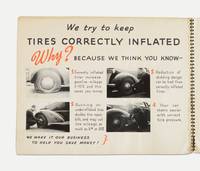
1930ref. ALB-1091930. Photo album; Silver prints 25. A boldly designed promotional album for John Schmook's Gulf Service Station in Lancaster Pennsylvania. The album produced by Gulf and distributed to franchised gas stations displays printed slogans and handwritten captions consistent with the album's roadside aesthetic as well as prescribed placeholders for predetermined photographs to accompany the customer-service driven catchphrases and service descriptions. The images primarily depict station attendants performing basic services such as oil changes radiator checks and tire replacements all while adhering to the "Gulf Guide of Gulflex Service" alongside interior and exterior shots of Schmook's station. Come and get "That Good Gulf Gasoline." Images 2 1/4 x 3 1/4 to 8 x 10 inches mounted to 10 x 13 inch pages with graphically printed captions and slogans. unknown
8vo. (38), 97-144, (8) pp. Title-page printed in red and black. With engraved frontispiece and folding letterpress table. - Bound after this is a 10-page German manuscript by a contemporary hand in red and black ink, entitled "Continuatio curiosorum experimentorum collocatio". Modern half vellum with marbled covers and spine title. Edges sprinkled in red. Later edition of this oft-reprinted but rare manual of geomancy, a divination system with Arabian origins. The term is derived from the ancient Greek "geômanteía", a translation of the Arabic "'ilm al-raml" - the "science of the sand", or the art of foretelling from dots or lines randomly marked upon the ground or on paper. The method, probably developed in the Near and Middle East, arrived in mediaeval Europe via North Africa. In the European context it was seen as an ancillary science to astrology and was attributed to Hermes Trismegistus. It was especially Robert Fludd's "Utriusque cosmi maioris scilicet et minoris metaphysica, physica atque technica historia" (1618) that made geomancy popular in the late Renaissance. "Pointing, or geomancy, was among the most popular of the divinatory entertainments of the 17th and 18th century" (cf. Daxelmüller, Zauberpraktiken, p. 200, with fig. 35). Purportedly translated from Arabic, this manual cites Cornelius Agrippa, Henry de Pisis, Trithemius, and Fludd as its authorities. - The manuscript bound at the end of the volume treats of "Onomantia", or the so-called science of divining a person's future from their names - a method explicitly said to work not only with Christian names given at baptism, but also with any name bestowed by a similar process upon a Jew or Muslim. - Slightly browned, but well preserved. 1744 handwritten and stamped ownership of the Lieutenant Christoph Carl König on title page, with his initials and date at the head of the instructions to the reader. Graesse (Bibl. Mag. et Pneum.) 105. Not in Ackermann, Caillet, Dorbon-Aine, Rosenthal, etc.
Small folio (30 × 23.5 cm). With many reproductions of photographs, ground plans, maps, and cross-sections. Later cardboard binder. Extract from the periodical "The Petroleum Times", containing an extensive article on oil in the Middle East. It opens with a list of Middle East oil companies and their concessions, accompanied by a map showing their oil fields, followed by a section on the future of Middle East oil. Individual chapters are devoted to the oil industry in Iran, Iraq, Bahrein, Saudi Arabia, Haifa (Israel) and Kuwait, describing the area's geology, oil fields, reservoirs, and more, illustrated with photographs and cross-sections of the soil. The first 25 and last 16 pages consist of advertisements. - Lacking the first 4 leaves of the preliminaries (probably advertisements), but the article itself complete, some leaves slightly creased, otherwise in very good condition.
(32), 545, (44) pp. With engraved title-page by Wingendorp. Contemporary sheepskin parchment. One of the two first editions published simultaneously of a historical work written by the German historian Georgius Hornius (1620-70). "In the dusk of his life, he moved to universal history, an endeavor that culminated with his Arca Noae, which comprised the chronicles of Europe, alongside descriptions of the cultures of China, Egypt, Assyria, ancient Greece, Rome, and pre-Columbian America, and surveys of their religion, art and literature" (Kowner). Entitled "Noah's Ark", it contains the history of the world starting at its creation up to the 17th century. It successively deals with all the great empires and kingdoms and their important founders and rulers. It contains narratives about the founding of Damascus, the founding of Arab kingdoms by Ishmael and Isaac, the caliphates, and the Turks. Beside sections dealing with the Middle East, the book deals with Chinese and American history as well, struggling with sources that predated the biblical sources. Hornius identified biblical figures with characters mentioned in early Chinese annals, suggesting that Cain's offspring had settled in China. Nevertheless, he rejected the possibility that some Chinese sources predated the flood for which Noah built his ark. - Born in Germany, Hornius later became a professor of history at Leiden University, the Netherlands. He mainly dealt with the topic of chronology, discussing how (world) history was to be divided into periods. Among others the compared the difference in biblical, classical and oriental chronologies, and wrote many works on history, theology, geography, and chronology. - With old shelfmark on spine and library stamp on flyleaf. Browned with some small spots throughout, engraved title-page slightly thumbed, a waterstain on leaf *2 and a small tear in leaf *3, and frequent wormholes, slightly affecting the text near the end of the book. Book block only loosely attached to binding. Otherwise a good copy. Sabin 33013. European Americana 666/75. R. Kowner, From white to yellow (2014), 9.
8vo. (2), 76 pp. , final blank leaf. Cloth-backed boards with paper title labels on front cover and spine. Privately published collection of letters from wartime Persia in 1918, inscribed by the author on the front free endpaper: "To Maddalene and Murray Franklin with love from Kate Jackson". - Kate Jackson wrote a series of letters to her sister in the United States while she and her husband were travelling "to Persia as members of the American-Persian Relief Commission": while "quite personal in character, they present a picture of experiences under somewhat unusual conditions and during a very memorable period" (from the prefatory note by A. V. Williams Jackson). Few copies were printed, not for publication, but intended simply to be given to friends. - In the letters themselves, Jackson discusses studying Persian, her voyage via Japan and Bombay, being the only woman on a troopship up the Tigris, meeting Syrian and Armenian refugees on the way out of Baghdad, and the reports she has heard on the Armenian genocide, and describes the celebration of the Armistice in Tehran. - Covers somewhat worn, otherwise an inscribed copy in good condition. OCLC 10350636. Not in Wilson.
Small 8vo. 2 vols. in one. (8), 252 pp. (14), 9-240, (4) pp. Contemporary French brown morocco with gilt spine (spine-ends repaired). A mixed copy of the 1784 first and the 1788 edition. A Jesuit perspective on the Muslim faith, including many observations on Islamic customs and culture; "contenant les choses les plus curieuses qui regardent Mahomet & l'établissement de sa secte, qui n'ont pas encore été imprimées. Avec des conferences sur la religion chrétienne, & sur l'Alcoran" (subtitle). Indeed, the Tours-born Jesuit Michel Nau (1631-83) had first-hand knowledge of the Middle East: he had undertaken a long voyage to the Holy Land during which he visited Galilee in 1665 and the remainder of Palestine in 1674. He published an account of his journey, "Voyage nouveau de la Terre-Sainte". - From the library of the Abbé de la Paluelle with his ownership to title page and his etched armorial bookplate to pastedown. Chauvin XII, p. 283f., no. 1187 & 1190. Luzac, Bibl. orientalis IX, 26, no. 493. OCLC 54746487. De Backer/Sommervogel V, 1595, no. 3. Cf. Hurter IV, 428.
Hand-coloured engraved map (775 x 554 mm). Stunning large format map of Saudi Arabia, the Persian Gulf, Red Sea and vicinity. The map is dominated by the Great Desert and Province of Neged. Marvelous detail of the mountains, rivers etc. Highly detailed regional map, one of the best regional maps of the area to appear in an English Atlas during the period. Pinkerton's now rare elephant folio atlas is one of the best engraved works of the period. While lesser known than the more common atlases by Cary & Thomson, it is a superior work, especially in the detail of the maps. Not in Tibbets, Al-Qasimi and Al Ankary.