Valgrisi, Vicenzo.MareMagnum

4.409 resultados
1562230:325 mm. Engraved map. An early Ptolemaic map, showing "the mountains as lightly shaded slopes. The map includes details on towns and watercourses. The Arabian Gulf is distorted and the size of the watercourses is exaggerated" (Al Ankary). Al Ankary 147.Tibbetts 30. Not in the Al-Quasimi collection.
2 text vols. (8vo) and 2 plate vols. (large folio). (2), 491, (1), (4) pp. 788, (6) pp. text. With engraved portrait of Segato as frontispiece in the first text volume and the plate volumes with 160 engraved and aquatint plates (7 double-page), including 51 tinted and/or coloured by a contemporary hand; many plates contain multiple illustrations, making 309 illustrations in total. Contemporary green (text vols.) and brown (plates vols.) half morocco, sewn on 3 recessed cords (text vols.) and 4 tapes (plates vols.), "agate" chemical marbled sides. First edition of a beautiful series of illustrations of Egypt and classical Egyptian monuments, with the accompanying text volumes giving detailed information on each illustration. The illustrations show maps, costumes and views of both ancient and modern Egypt. The scientist and Egyptologist Girolamo Segato (1792-1836) began working on a new description and depiction of Egypt, selecting illustrations from the works of Denon, Grau and Rosellini, and also including his own original drawings. After his premature death his collaborator Domenico Valeriani finished the work and provided the accompanying texts. - Segato is best known for his technique similar to mummification, this technique of petrification remains mysterious, despite numerous studies and attempts to imitate, as he destroyed all his documentation before his death. - The text and plates volumes with marginal foxing throughout, minor except in the preliminary leaves. Otherwise in good condition. The binding slightly rubbed along the extremities, damage to the upper right corner of the first plates volume, resulting in a stain on the front endpapers, and the upper half of the sides on the second plate volume faded, otherwise good and structurally sound. Blackmer 1521 (plate volumes only, erroneously noting 159 plates). Blackmer sales cat. 984 (160 plates). Ibrahim-Hilmy II, 301. ICCU 0154707. For Segato: Almagia, "Segato, Girolamo" in: Treccani Enciclopedia Italiana (online ed.).
2007Valentini Giovanni Valentini Giovanni, La magia del golf, Sperling and Kupfer, 2007 - I. Milano, Sperling and Kupfer 2007 - I italiano, in sedicesimo pp.150 38421 Valentini Giovanni, La magia del golf, Sperling and Kupfer, 2007 - I ed, in 16, Cartonato con sovraccoperta, pp. 150, Molto buono.
8vo. 12 vols. With 72 engr. maps. Contemp. French full calf with giltstamped labels and gilt spines. All edges red; marbled endpapers. A fine copy of the twelve-volume octavo edition of the most detailed and accurate geography of its day (published simultaneously in four quarto volumes). All the maps are taken from the "Atlas Portatif" (1748-49) of Robert de Vaugondy. The fine map of the Arabian Peninsula is derived, via Vaugondy, from Delisle; "it includes the three classic divisions of the Arabian Peninsula and the following regional subdivisions: Tahama in the south west, Bahrain, which extends along the east coast and includes the town of Cathema, Yemen in the south which includes Oman, the States of the Cherif of Mecca which includes Hagiaz and parts of the centre of the Arabian Peninsula. Although the width of the Red Sea is exaggerated, the Sinai peninsula's shape is very close to reality. The topographical features and watercourses are not very different to how they are shown on other maps of the same period. A town named Naged is shown to the north west of the town of Janama" (Al Ankary). - Some bindings slightly bumped at extremeties. Contemporary ms. ownership "Leon. van Berg" to pastedowns; titles bear stamp of the La Valsainte Charterhouse, Switzerland (dissolved in 1825). Slightly browned. Formerly in the collection of the Swiss industrialist Herry W. Schaefer. Streit 17, p. 252, n. 6198. Brunet VI, 19613. OCLC 34221488. For the map of Arabia cf. Tibbetts 278. Sultan Bin Muhammad Al-Qasimi, The Gulf in Historic Maps, S. 162. Al Ankary Collection 338 (all referencing Vaugondy's map).
4to. (6), 112 pp. (but: 108 pp.; pp. 61-64 skipped in pagination). With large engraved map of Vienna and its environs; wants an additional plan. Contemporary calf; spine repaired; leading edges gilt. All edges sprinkled in red. First English translation. The Imperial Councillor of War J. P. a Vaelckeren was sick in Vienna in 1683 when the Turks enclosed the capital. His report of the siege and liberation of the city quickly spread throughout Europe in numerous editions and translations. - Wants the map of Vienna; the corresponding "explanation of figures" is present in the preliminaries. Early 19th c. ownership "H. E. Somerville" to pastedown. A good copy of this rare English imprint. Sturminger 2953. Apponyi II, 1132. ESTC R28429. Gugitz I, 485. Cf. Kábdebo, p. 43f. Cf. Mayer 576ff. Cf. Jöcher IV, 1381.
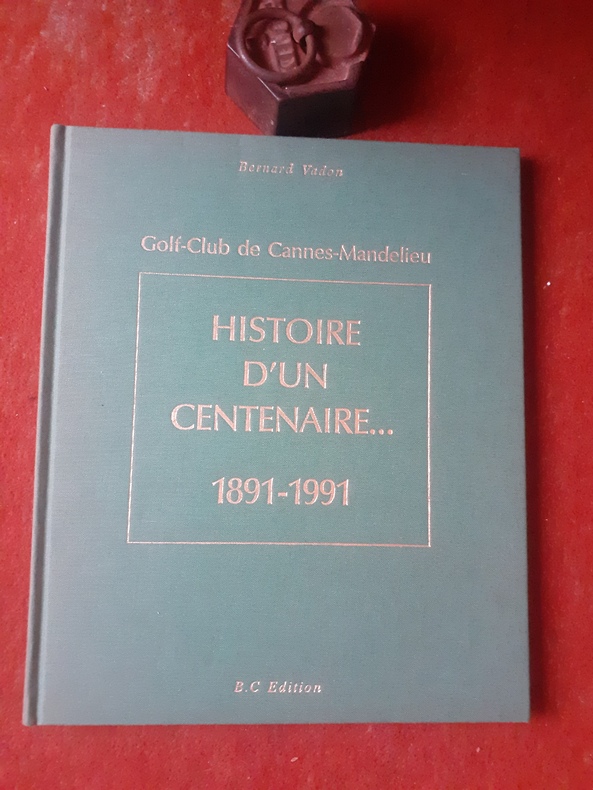
ref. QWA-19822Golf Magazine BC Editions, 1991, in-4 rel. toile verte (24,5 x 29,5), 95 p., nombreuses illustrations en n. et en coul., bon état.
VI, 238 pp. 8vo. Modern boards using the original printed upper cover. First edition. - The autobiography of Usamah ibn Murshid ibn Munqidh (1095-1188), who introduced this genre of writing to Arabic literature (cf. GAL I, 319). Born in Shaizar in northern Syria, where his family ruled a small Emirate, he was banished by his uncle and for a time entered the services of Atabeg Sihabaddin ibn Buri, where he got to know members of the Knights Templar. After spending several years in seclusion as a hunter in Egypt, he returned to Damaskus in 1154, joining the campaign against the European crusaders. The editor H. Derenbourg was the first to discover the sole surviving manuscript of the "Kitab al-I'tibar" (in the Escorial in Madrid) and produced this first translation, afterwards the first Arabic edition (1886) and a biography of Usamah (1889). - A few repaired paper defects; well-preserved altogether. OCLC 7045652.
ref. DADAX0754635333New unknown
Small 4to (21 x 15 cm). (16), 410, (6) pp. With woodcut arms of the Dominican order (with the IHS and cross covering the centre) on title-page, and a variant version on the last page, and 3 woodcuts in text (2 saints and the Cross). Further with 24 decorated woodcut initials in two series, including 11 repeats. Contemporary gold-tooled mottled calf, each board with the coat of arms of the French Seguier family and with the monogram PSMF (Pierre Seguier and his wife Madeleine Fabry) repeated 6 times on the spine, rebacked (on recessed cords) with original gold-tooled backstrip laid-down, a later spine label (between the 1st and 2nd monogram), the year of publication 1611 at the foot of the spine, later endpapers. First and only edition, in Spanish, of an early work on Ethiopia by the Spanish Dominican monk Luis de Urreta (ca. 1570-1636), who wrote two volumes glorifying his own order's accomplishments in Ethiopia while diminishing those of the Jesuits (his Dominican coat of arms incorporates the IHS with cross, often used by the Jesuits). In the present work, the second of the two, he deals specifically with the Dominican presence in Ethiopia and the history of the Ethiopian saints. Like the first work, the "Historia ecclesiastica" published in 1610, it is a late example of a stream of geographical fantasies where Ethiopia was presented as the wondrous utopian kingdom of Prester John, and Urreta makes the case for an ancient Dominican presence in the country, arguing that they should thus be given precedence over the Jesuits as Catholic missionaries in that country. On pp. 88-90 it gives the information from a report to Pope Gregory XIII (1502-85) on two Dominican monks (Blackfriars) from the Alleluya monastery, who entered Mecca around 1580 and had contact with a Faqih and a Marabout. Everyone who travelled from Africa to Mecca supposedly had to travel by way of the Alleluya monastery as the rest of the region was considered uninhabitable (p. 61). - From the library of Pierre Seguier, Lord Chancellor of France from 1635 to 1672, best known for his appearance in The three musketeers, with his arms and monogram stamped in gold on the binding. And with an owner's inscription of the 17th-century French scholar Etienne Baluze ("Stephanus Baluzius Tutelensis") on title-page. With a faint water stain in the lower margin of four leaves in the introduction, a tiny corner torn from the title-page and two tiny tears in the margins of the main text, otherwise in very good condition. Binding heavily restored, but with the gold-tooled coat of arms still very clear. Olivier, 271(4). Finger & Piccolino, The shocking history of electric fishes, p. 117; Palau 345993; Salva 3417; cf. Gay, Bibl. de l'Afrique et l'Arabe 2690.
8vo. XI, (1), 211, (1) pp. With a hand-coloured wood-engraved frontispiece and 4 large folding lithographed pedigree tables. Original burnt red cloth binding with giltstamped title to spine and upper cover. First edition. - Upton was one of the early experts on the bloodlines of British thoroughbreds. His book describes both the influence of the Arabian horse on the development of the English thoroughbred as well as many interesting aspects of the Arabian horse. Shortly after the publication of this work - intended to "point out errors that have been committed in the breeding of our horse" (p. iii) - he travelled in Arabia to obtain purebred horses and so improve the quality of British cavalry remounts. Upton served with the 9th Lancers. - Binding somewhat bumped and rubbed with traces of moisture to covers. Lightly browned throughout, paper brittle with occasional edge or corner flaws, frontispiece and title-page rather foxed. Rare. Boyd/P. 130. Huth 273. OCLC 12795478.
Watercolour over traces of pencil. 708 x 490 mm. Signed and dated by the artist. Matted.
1974Watercolour heightened with white. 681 x 520 mm. Signed and dated by the artist. Matted.
Watercolour over pencil, matted. Signed and dated by the artist lower left. 460 x 363 mm. An impressive watercolour of the famous Arabian mare, dedicated by the artist "to Rachel".
1987Ballpoint, heightened with white. 378 x 278 mm. A sheet of annotated preliminary sketches for Upton's watercolour portrait of the three Arab mares Gold Roseifa, Russallka, and Roxiralot. - Matted.
1987Watercolour over pencil. 780 x 525 mm. Signed and dated by the artist. Matted.
1987Ballpoint, heightened with white. 373 x 276 mm. Matted. A sheet of annotated preliminary sketches (one on recto, two on verso) for Upton's watercolour portrait of the three Arab mares Gold Roseifa, Russallka, and Roxiralot.
1996201p. Hardcover Very good condition good
Folio (212 x 324 mm). Persian manuscript on faintly ruled paper. 1 blank leaf, 336 pp. (168 ff.), 1 blank leaf. Text is complete, but last leaf is missing. 1 illuminated headpiece and 49 illustrations in ink and bright watercolour wash. Text in black, ruled in black, with important words and phrases picked out in purple. 19th century leather ruled and stamped in blind. Lavishly illuminated Persian manuscript depicting the romance which came to define the love story in Western literature. Composed by Abu al-Qasim Hasan Unsuri (ca. 961-1039), the original Persian was in fact lost, and preserved in a Turkish translation. Unsuri's version was itself based on what was already an ancient love story in his own time, the Ancient Greek novel "Metiochus and Parthenope", which also survives only in fragments. Though certainly derived from the Greek, like many Persian romances with Greek origins, "the nature of the relationship is not [...] the simple one of the earlier (Greek) material influencing the later (Persian) material, as the Greek novels contain a number of motifs and topoi which are identified within the narratives themselves as Persian in origin. The relationship between the love narratives of the two cultures appear, therefore, to have been one of mutual reciprocity over a considerable stretch of time" (Davis). - Some fragments of the original Persian do survive: Sa'id Nafisi collected 141 verses of "Wameq o 'Adra" that were used as evidence in Persian dictionaries, and 372 more verses were discovered by Mohammad Šafi' in the binding of an old manuscript in 1950 (Blois, 201). Unsuri's version was translated in the 16th century into Turkish by Shaikh Mahmud Lame'i, though in comparison with the earlier fragments, this is considered a loose translation of the original. However, it provides the source of most subsequent translations and most of what we know of "Vamiq va 'Azra", as a romance which underpins the genre. In literature both medieval and modern, the narratives of the original persist: lovers separated by a kidnapping, a virgin who must use a range of tricks to elude unworthy attempts on her chastity, an interrupted wedding, and a seemingly final separation with the (supposed) death of one of the lovers. In this way, "Vamiq va 'Azra" echoes down the literary ages. - Covers somewhat worn but professionally repaired; still tightly bound. Light soiling, otherwise a beautifully illustrated and uncommon manuscript. Richard Davis, "Greece IX. Greek and Persian Romances", in: Encyclopaedia Iranica XI, 339-342. Francois de Blois, Persian Literature: A Bio-Bibliographical Survey. Vol. V: Poetry of the Pre-Mongol Period (London: Royal Asiatic Society, 2004), pp. 201-204.
1900ref. 664unknown: unknown 1900. 9 1/2 x 8 inches 8 x 8 inches 8 x 8 inches. Very good condition. This is a set of three very rare etchings of golf. The first is a layout of the first tee and closing hole at St. Andrews Old Course. The second is of a golfer finishing his swing with. golfers in the background. The third is a golfer loonig at a difficult shoe if not impossible. These are very old and quite rare. They have been in my possession for 40 years and are new to the market. At one time I had the name of the artist but have misplaced my fact sheet. See pics. unknown unknown
ref. Q13R-01365Triumph Books. Used - Good. Good condition. Good dust jacket. A copy that has been read but remains intact. May contain markings such as bookplates stamps limited notes and highlighting or a few light stains. Triumph Books unknown
1989ref. 0096-22-41United States Golf Association and The Royal and Ancient Golf Club of St. Andrews 1989. 463p wraps beautiful copy FINE United States Golf Association and The Royal and Ancient Golf Club of St. Andrews paperback
2000ref. Q-1572434031Triumph Books 2000-09-01. Hardcover. New. In shrink wrap. Looks like an interesting title! Triumph Books hardcover
1995ref. Q-1572430478Triumph Books 1995-12-01. Paperback. New. In shrink wrap. Looks like an interesting title! Triumph Books paperback
1999ref. Q-1572433159Triumph Books 1999-03-01. Hardcover. New. In shrink wrap. Looks like an interesting title! Triumph Books hardcover
1993ref. Q-1880141213Triumph Books 1993-02-01. Paperback. New. New. In shrink wrap. Looks like an interesting title! Triumph Books paperback