4.588 resultados
ref. ria9781509546893_inpHardback. New. New Book; Fast Shipping from UK; Not signed; Not First Edition; N/A hardcover
1989No marks or inscriptions. No creasing to covers or to spine. A very clean very tight copy with bright unmarked boards and no bumping to corners. 124pp. The story of the Club from the day in October 1889 when a few men acquired 'golfing rights' over some farmland near Alderley Edge. Initially the land was shared with cattle ansd sheep.
1966V, (1), 51, (1), l. bl. f. With portrait frontispiece (HRH King Faisal) and 13 folding maps in pocket. Original printed green cloth binding. Rare Saudi government publication on iron ore deposits (mainly Goethite and Hematite) in Western Arabia. As stated in the foreword, "Bulletin 2 is the first geological report on an occurrence of a single metallic mineral to be published by the Ministry of Petroleum and Mineral Resources". Wadi Fatima, east of Jiddah on the Arabian Red Sea coast, is a microcosm of the geology of the Jiddah area. Rocks ranging in age from 800-million-year-old metamorphic rocks to Tertiary lava flows are exposed, and illustrate the geological richness of western Saudi Arabia. "The Wadi Fatima ore deposits promise to become one of the main sources of iron for the developing steel industry of the Kingdom". Binding rubbed with some discoloration to spine, otherwise fine. OCLC 4053546.
8vo. (2), 54, (6) pp. With engraved title vignette, folding engr. map of Persia and northern Arabia, and 2 double-page-sized engraved plates. Papered spine. First Dutch translation of "The travailes of John Mildenhall" and "Observations of Master John Cartwright" (from "Purchas his Pilgrimes", London, 1625, vol. 1, bk. 3, pp. 114-116, and vol. 2, pp. 1422-1437). The merchant adventurer John Mildenhall, "probably the first Englishman to travel overland to India" (Howgego I, 719), spent six months in Constantinople before, in July 1600, departing for Aleppo, proceeding to Bir, Urfa, Diabekr, Sultanieh, Qazvin, and ultimately Lahore. He returned to England in 1605/06. The English preacher John Cartwright accompanied him from Aleppo to Kashan in Persia, then proceeded to Esfahan alone "and travelled widely in the Middle East. The account of his journeys is one of the most valuable of the period" (Howgego I, 197). Tiele 5. Muller (Books, maps, plates on America) 1890f. Alden 707/2. J. C. Brown cat. III, 88. OCLC 746499809, 69110890.
1990ref. LFA-126741433Un ouvrage de 180 pages, format 155 x 240 mm, illustré, broché couverture couleurs, publié en 1990, bon état
1992ref. LFA-126720063Un ouvrage de 274 pages, format 165 x 245 mm, illustré, relié cartonnage sous jaquette couleurs, publié en 1992, bon état
ref. 1845136799.Ghardcover. Good. Access codes and supplements are not guaranteed with used items. May be an ex-library book. hardcover
Folio (230 x 338 mm). 2 parts in 1 volume. (8), 272 ff. (6), 277, (1 blank), (12) ff. With 39 woodcut illustrations in text. Near-contemporary full vellum on four raised bands with giltstamped red spine label. Second illustrated edition, the first with the commentary of Costaeus, of the collected works of the Arabic physician Mesue the Younger (also known as Masawaih al-Mardini) in Latin, with commentaries by Mondino de Liuzzi, Christoph de Honestis, Jacobus Sylvius, Giovanni mardi and Johannes Costaeus. - The work includes the "Canones universalis", dealing with treatment regimens; the second part, "De simplicibus", about the properties of various pharmaceutical drugs; and the Grabadin, "the most popular compendium of drugs in medieval Europe, and [...] used everywhere in their preparation" (Garrison). "The esteem in which these works were held is shown by the fact that a Latin translation of both was one of the first medical works to be printed (Venice, 1471)" (ibid.). - Binding stained; rubbed and chipped at extremeties. Interior shows occasional brownstaining. Modern flyleaves browned and brittle. Provenance: bookplates of the American botanist Edward Sandford Burgess (1855-1928) and of the Horticultural Society of New York, identifiying this volume as part of the bequest of the American attorney and plant collector Kenneth Kent MacKenzie (1877-1934). Durling 3131. Adams Y 10. BM-STC Italian 739. Edit 16, CNCE 27626.
560 x 430 mm. Folding poster with several black-and-white photographic illustrations. First edition. Scarce Aramco poster on the benefits of the Trans-Arabian Pipeline (Tapline) established in 1950. Celebrating seven years in the business, it presents the busy workforce behind the Tapline as well as the jobs it created, proving "that nationals of many countries and varying backgrounds can be welded into a harmonious, efficient work force". Among the images are the terminal at Sidon, pumping units, new townsites that emerged around Tapline pump stations, and medial care for Tapline employees. - Occasional light browning along folding lines. - All early issues of the eductional Aramco posters as reprinted in 1969 are rare.
8vo. X, 187, (1) pp. With frontispiece, 31 plates, 7 maps (3 in lower cover pocket), and 8 panoramas, mostly folding. Contemporary quarter calf over green cloth covers with giltstamped red spine labels. First edition. - The British-Indian Army's official account of the 1919-20 Waziristan campaign, marked "Confidential" on the title-page. The operations followed unrest that arose in the aftermath of the Third Anglo-Afghan War; they were conducted in the mountainous region of Waziristan (now in Pakistan) by British and Indian forces against the fiercely independent Waziri and Mahsud tribesmen that inhabited it. Since the 1870s, the British government agencies were assiduous in compiling internally published histories of their military frontier operations, with the intention of providing a "valuable guide" to such British commanders and policymakers as "might have future dealings with these turbulent neighbours" (as the Punjab Government phrased it in 1866). - Serial No. 1235 stamped to title-page. Occasional light marginal staining. A few edge flaws consistent with army use, repaired by a contemporary owner. In all a well-preserved, complete copy. OCLC 11497145. Catalogue No. C.W. 4 - Case No. 8987 N.S.
ref. ING9780309368520National Academies Press. New. Special order direct from the distributor National Academies Press unknown
2015ref. x-0309368529Natl Academy Pr 2015. Paperback. New. 1st edition. 75 pages. 10.75x8.25x0.25 inches. Natl Academy Pr paperback
ref. 0309368529.Gpaperback. Good. Access codes and supplements are not guaranteed with used items. May be an ex-library book. paperback
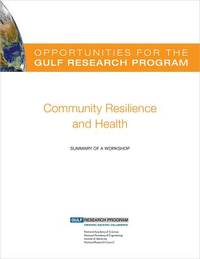
ref. A9780309368520Paperback / softback. New. There are many connections between human communities and their surrounding environments that influence community resilience and health in the Gulf of Mexico. The impacts of the Deepwater Horizon oil spill on Gulf communities and ecosystems - coupled with the region's preexisting health challenges and environmental stressors - illustrate the need to better understand these connections. In the future natural and man-made disasters climate change impacts and other environmental stressors will present complex challenges to the physical mental and social well-being of communities in the Gulf. Understanding the interrelationships among health ecological and economic impacts of disasters and other environmental stressors will be crucial to addressing these challenges. Opportunities for the Gulf Research Program: Community Resilience and Health summarizes a Gulf Research Program workshop held on September 22-23 2014 in New Orleans Louisiana. The workshop examined opportunities to improve the health well-being and resilience of communities in the Gulf region through discussions with about 50 participants with diverse expertise and experience. These discussions identified perceived needs challenges and opportunities that align with the Gulf Research Program's mission and goals - particularly its goal to improve understanding of the connections between human health and the environment to support the development of health and resilient Gulf communities. This workshop is expected to lead to the development of additional Program activities and opportunities for the research community. paperback
Folio. (188), (34), CCCCCXXXVI [= CCCCCXXXVIII; 538] pp. Title-page in red and black and separate title-page to index, both with woodcut border. Elaborately decorated calf, with image of the crucifixion on both panels. Blinrd-tooled spine. First and only Paris edition of "Historiae naturalis", with the annotations by Hermolaus Barbarus (1454-94), an Italian Renaissance scholar. His discussions of Pliny's "Naturalis Historia" was first published as "Castigationes Plinianae" in 1492, in which he made over 5000 corrections to the original text. Due to this work and other classical works he translated or edited he was considered a leader authority on Latin and Greek work on antiquity. The present copy was published by Jean Petit, in his days a leading bookseller in Paris, whose name and device are shown on the title-page with decorative woodcut border. The title-page to the index, here bound before the text, has the initials of the printer Nicolaus Sauetier. - The original text was by Gaius Plinius Secundus (AD 23-79), better known as Pliny the Elder. He was a Roman author, naturalist, and natural philosopher, as well as naval and army commander of the early Roman Empire, and personal friend of the emperor Vespasian. - The "Naturalis Historia" is one of the largest single works to have survived from the Roman empire to the modern day and purports to cover the entire field of ancient knowledge, based on the best authorities available to Pliny. He claims to be the only Roman ever to have undertaken such a work. It comprised 37 books in 10 volumes and covered over 20,000 facts on topics including the fields of botany, zoology, astronomy, geology and mineralogy as well as the exploitation of those resources. It remains a standard work for the Roman period and the advances in technology and understanding of natural phenomena at the time. Some technical advances he discusses are the only sources for those inventions, such as hushing in mining technology or the use of water mills for crushing or grinding corn. Much of what he wrote about has been confirmed by archaeology. ''We know from Pliny that there were important pearl fisheries in the Gulf [...] Pliny identifies Tylos (Bahrain) as a place famous for its pearls [... He] attests that pearls were the most highly rated valuable in Roman society, and that those from the Gulf were specially praised [...] The pearl related finds at the site of El-Dur indicate the site was integrated into the maritime trade routes linking the Roman Empire, the Persian Empire, India and South Arabia'' (Carter). Book 6 holds a chapter that gives the first detailed account of the regions around the Gulf, including what are now Qatar, the Emirates and Oman. - Not only is it virtually the only work which describes the work of artists of the time, and has it become an important reference work for the history of art, due to the wide range of topics, the referencing system and index it became a model for later encyclopaedias. - Panels shaved, affecting the decoration, spine cracked on the hinges. With manuscript ownership on title-page of the index. A good copy. Bird 1910. USTC (2 copies). Not in Adams, BMC French, Durling, Hunt, Wellcome.
4to (145 x 198 mm). (34) ff. Half calf over marbled overs (ca. 1900) with gold-tooled red label to gilt spine. All edges sprinkled red. Almost unobtainably rare first edition of this digest of medical prescriptions, taken from the works of the highly-regarded Arabic physician Mesue the Younger (also known as Masawaih al-Mardini), including "a kind of general manual for apothecaries and perfumers" (Duveen). All recipes are in Italian, while the main title and the headings are in Latin. Bibliographers are not agreed on the book's place or date of publication: GW locates it merely in Italy, ca. 1495, whereas Copinger believes it was printed in Venice, by an unidentified printer, in or around 1500. The British Museum Short-Title Catalogue suggests Sigismund Mayr in Naples as the printer and 1510 as possible year of publication, while the British Library's catalogue now appears to prefer Venice and 1505 as tentative place and year. Klebs notes that the collection constitutes a "rifacimento" of the Italian edition of Mesue's "Opera medicinalia", published in Venice on 12 December 1493. - Contemporary ink ownership to title-page. A restored tear in the final leaf (not affecting the text), some brown specks on the title-page and an insignificant waterstain along the lower edge of the final gathering, but altogether in excellent condition. Rebound in a pretty half-calf binding around the turn of the century. Only two copies in libraries internationally (British Library and Univ. of Wisconsin, formerly the Duveen copy). That in the British Library is incomplete, lacking the final leaf (falsely described by Copinger as having a final blank leaf, which is in fact the endpaper). Copinger 4011. GW M23031. Klebs 228 (note). Proctor 7427. ISTC im00521400. USTC 842290. BM-STC Italian 739. Duveen 651. Edit 16, CNCE 50479.
ref. 201310881Paris, France loisirs, 1992 ; in-8, 274 pp., cartonnage de l'éditeur. Les français dans la guerre du golfe - très bon état cartonnage d'éditeur avec jaquette.
Engraved map, outline coloured. 580 x 260 mm. An antique map showing the East African coastline, extending from the mouth of the Red Sea to the Island of Zanzibar. The work was originally included in Karl Müller's "Geographi Graeci minores", along with many other maps of the region. - The map is highly detailed, showing many settlements, mountains, wadis, and more. The map is composed of four insets, with the largest focusing on the Somali coast. Most interestingly, Müller models one inset after a Greco-Roman periplus describing the western Indian Ocean. On this inset, Müller notes the travel times between adjacent ports, ostensibly following the notes in the periplus. - Fold toning.
Large 8vo. 3 volumes. XVII, (5), 368, (4) pp. XIV, (4), 512, (2) pp. XX, 506, (4) pp. With 2 portraits as frontispieces in vols. 1 and 2. 16 pages with illustrations and 2 maps at the end of vols. 2 and 3. Red cloth with title information in gold on front cover and spine of all 3 vols. All 3 vols. have a dust jacket. Outstanding research on the oral traditions of the Bedouins in central Arabia, divided into 3 volumes containing information on the poetry and narratives of various Bedouin tribes and an analysis and translation of various poems and stories. Kurpershoek has recorded, transcribed and translated all poetry and narratives he discusses in this work. - Since its first publication in 1994-99, this trilogy has been expanded with two additional volumes: vol. 4, published in 2002, deals with Saudi tribal history, while vol. 5 (2005) looks back on almost 20 years of research on and involvement with Arabian oral culture. - The Dutch scholar, author and diplomat P. M. Kurpershoek specialises in Arab studies. Kurpershoek studied Arabic language and culture at the Universities of Leiden and Cairo; since 1974 he has worked for the Dutch ministry of foreign affairs, the UN and NATO. As a professor of languages and cultures of the Islamic Middle East at the University of Leiden, he has performed research on the Bedouins of Saudi Arabia. From 2002 until 2013 he served successively as Dutch ambassador to Pakistan, Turkey, and Poland. Subsequently, from August 2013 until December 2014 he served as envoy to Syria. - Spines of the dust jackets of vols. 1 and 2 are slightly discoloured, otherwise in very good condition.
4to. 20, (4) pp. Sewn. First edition. - Rare work on the Spanish expedition against Muslim Oran. After a survey of the history and geography of Oran (in modern Algeria), the author describes the preparations for the expedition to recapture the city, enumerates the Spanish leaders, and gives details of the Spanish naval and military attacks on sites in and around Oran in June and July 1732. The captain-general of the expedition was José Carrillo de Albornoz, first Duke of Montemar, who had fought in the War of the Spanish Succession and the War of the Quadruple Alliance; at this time he was viceroy of Sicily. Facing p. 20 is the plan of battle for the Spanish forces. The map on the verso shows the harbour at Oran, the town, and the half-dozen fortresses surrounding it, as well as the position of the Spanish navy during the battle. The final leaf has the key to the map on its recto, with the verso blank. Freire de Monterroyo Mascarenhas explains in the dedication that he compiled this account from many shorter accounts, because the public was eager to learn about the reconquest. Oran, which was in Spanish hands since 1509, had been captured by the Turks in 1708, while Spain was preoccupied with the War of the Spanish Succession. Spain held the city from 1732 until 1792, when it suffered a massively destructive earthquake and King Charles IV handed the city back to the Ottoman Empire. - Light waterstaining; a few leaves detached.
4to. 20, (3) pp., final blank page. With a woodcut illustration. - (Bound with) II: The same. Oran conquistado, e defendido, relaçam historica [...] Parte II. Ibid., 1733. 16 pp. Later full vellum. First editions. Both separately published parts of this rare work on the Spanish expedition against Muslim Oran. After a survey of the history and geography of Oran (in modern Algeria), the author describes the preparations for the expedition to recapture the city, enumerates the Spanish leaders, and gives details of the Spanish naval and military attacks on sites in and around Oran in June and July 1732. The captain-general of the expedition was José Carrillo de Albornoz, first Duke of Montemar, who had fought in the War of the Spanish Succession and the War of the Quadruple Alliance; at this time he was viceroy of Sicily. Facing p. 20 is the plan of battle for the Spanish forces. The woodcut on the verso shows the harbour at Oran, the town, and the half-dozen fortresses surrounding it, as well as the position of the Spanish navy during the battle. The final leaf has the key to the map on its recto, with the verso blank. Freire de Monterroyo Mascarenhas explains in the dedication that he compiled this account from many shorter ones, because the public was eager to learn about the reconquest. Oran, which was in Spanish hands since 1509, had been captured by the Turks in 1708, while Spain was preoccupied with the War of the Spanish Succession. Spain then held the city from 1732 until 1792, when it suffered a massively destructive earthquake and King Charles IV handed the city back to the Ottoman Empire. - First part uncut. Second part slightly wormed near the gutter. Occasional light brownstaining. The two parts are very rarely encountered together. Inocêncio IV, 348. Barbosa Machado II, 856. BGUC Misc. 3, 80.
Large 4to (210 x 250 mm). (4), VII, (1), 64 pp. Original half calf over marbled boards and giltstamped spine and title lable. Only printing of this oration on the great contributions made by Dutch scholars to the study of oriental languages, delivered by the Amsterdam professor Willmet (1750-1835) on 26 November 1804. A student of Everard Scheidius, Willmet also produced a valuable Arabic dictionary in 1784 (cf. Smitskamp, PO 317). - Old library shelfmarks to upper cover and front pastedown. A little browned and brownstained near the end, otherwise well preserved; a good, wide-margined copy. OCLC 64504237.
4to. 2 parts in 1 vol. (48), 94 (but: 96), (6) pp. (2), 256 (but: 156) pp. Title page printed in red and black. With 2 folding engr. plates and some 20 text engravings, all showing script specimens. - (Bound after) II: Morin, Stephan. Exercitationes de lingua primaeva ejusque appendicibus. Utrecht, Willem Broedelet, 1694. (14), 448, (8) pp. With engr. title page and 4 folding engr. plates. Contemp. Dutch blindstamped vellum with oriental-style, lozenge-shaped cover ornaments. First edition. - The Lord’s Prayer in more than 150 languages, including many European and Asian languages, but also Arabic (in two styles), Persian (in two styles), Syriac, Ottoman Turkish, etc., many of which are rendered both in Latin transliteration and in their original scripts, engraved in the text or as folding plates. The second part contains nine remarkable treatises on typefaces and languages, including the first publication ever of "De variis linguis" by the great German philosopher and polymath G. W. Leibniz. The English courtier John Chamberlayne (1666-1723) is said to have known sixteen languages; among his many writings is an immensely popular, amusing tract on coffee, tea, and hot chocolate which he published at the age of 19 (cf. DNB). - II: First edition. The plates show coins and medals from Palestine and Samaria. - One corner bumped. Insignificant browning; a good, clean copy. I: Ebert 3978. DNB IV, 9. Brunet I, 1761. Graesse II, 112. Ravier 317 (pt. 2 only). - II: Ebert 14415. Fürst II, 390. Lipsius 268.
Folio. (4). 67, (1 blank) pp. With a woodcut coat of arms of the province of Friesland on the title-page, 1 woodcut headpiece, 1 woodcut tailpiece (plus 2 repeats) and 4 woodcut decorated initials (2 series). Set in roman and italic types with a few words of Hebrew. Modern boards, covered with grey paper, red and blue sprinkled edges. First and only edition of an inaugural lecture by Samuel Hendrik Manger (1735-1791), appointed ordinary professor of oriental languages and of Hebrew antiquities at the University of Franeker in 1760. Partly under the influence of the orientalist Albert Schultens, Manger valued Arabic studies for the insights they gave into Old Testament scholarship. In his present inaugural lecture, he discusses the controversial expedition to Palestine that several scholars were planning to make in that year. It shows his interest in archaeological research carried out in expeditions instigated by the German scholar Johann David Michaëlis. Manger believed they would inaugurate a new era in Biblical scholarship. - In very good condition and with very large margins, with only some minor marginal foxing in the title-page and an occasional unobtrusive small stain. STCN (3 copies); for the author: Biografisch lexicon voor de geschiedenis van het Nederlands protestantisme I, pp. 155-156; NNBW IX, col. 644.
4to. 13 (paginated "9" in error), (3) pp. Woodcut printer's device to title page, large woodcut initials. Contemporary orange paper wrappers with floral designs stamped in black and white. Very scarce work about Cattarina Santorovichia, a Turkish girl from the Ottoman sandjak of Clissa (Klis) north of Spalato (Split) in Dalmatia, who crossed into Venetian territory and converted to Christianity. Mihale Satorovic, as she was born, was from a respected and well-connected Turkish family, the daughter of Ahmed Aga, an officer in the local garrison of Clissa, and the affair provoked a major international incident. "Although Venice had been at peace with the Ottoman Empire for almost half a century, the Spalato border was a sensitive area where tensions occasionally flared" (Dursteler, 63). When the girl disappeared in late December 1621, her parents immediately feared that she had been kidnapped and taken to the Venetian side - a relatively frequent phenomenon on the border that occurred for a variety of reasons. Although it was soon established that the girl had not been forcibly abducted, but rather had fled her home of her own free will so as to become a Christian, Muslim sensitivities were ignited. On 23 January 1622 Mihale was baptized "Cattarina" in Spalato, and the attendant ceremonies only intensified the anger on the Ottoman side: indeed, "immediately following Mihale's flight, eight Venetian subjects from the neighboring town of Trau were taken hostage in retaliation" (67), and the threat of military violence caused the Venetians to deploy six armed ships to Spalato. "The flight of Mihale Satorovic was an extremely serious affair that dragged out over five years, and eventually engaged the Ottoman and Venetian military forces, as well as the highest officials in the region and in the respective imperial capitals" (68). - The present oration that recounts part of the girl's history is an important source about the affair. While the occasion is here termed "nozze", it is clearly not a wedding (not even one "con la chiesa"), but apparently closer to a confirmation rite celebrated for the recently converted girl. The author was the parish priest at S. Eufemia in Giudecca, Venice, and dedicates his work to Giovanni Cornaro, Procurator of S. Marco. - Remains of an old label on the title-page. An excellent copy. Extremely rare; ICCU lists a single copy in Italy (Biblioteca nazionale Marciana, Venezia). ICCU VEAE\128667. Cf. Eric Dursteler, Renegade Women (Baltimore, 2011), pp. 62ff.