91 résultats
réf. 9466E1 page double sided 8” x 13”. Signed by the author - boxer Archie Moore on the verso dated June 6 1967 with the receipt stamp from the athletic commission dated June 121967 and with the approval and signature of the commission’s executive officer. Archie Moore fought in over 225 bouts won 140 of by them by knockout and went on to work with children against crime and drugs. Fine with two neat punch holes at the top. unknown
1955réf. 53801New York: Simon and Schuster 1955. 8vo. 8 375 1 pp. Double-page title numerous photo illustrations. Quarter-beige cloth over gray boards blue & red lettering front cover & spine minor edgewear rubbing slight bumping to couple corners w/ d.j. minor chipping head of spine couple minor tears couple closed tears minor creasing still VG/VG- copy inscribed by Rocky Graziano on ffep. First edition inscribed of this memoir detailing the violent life of the famed World Middleweight boxer which served as the basis for the 1956 Oscar-winning MGM film starring Paul Newman Pier Angeli Everett Sloane and directed by Robert Wise. An interesting side-note is that this was also one of the first screen appearances of a young Steve McQueen. Simon and Schuster, hardcover
1867réf. 47391Dublin: P. Brereton Printer 1867. Very Good. Dublin: P. Peter Brereton Printer ca. 1867. First Edition. Pictorial broadside 28.25x11cm; woodcut illustration followed by a ballad. Mild rubbing and toning to edges; Very Good and sound. John Morrissey 1831-1878 known as Old Smoke was an Irish-American politician bare-knuckle boxing champion and criminal. While this fight at Tierra del Fuego is not historically verified clearly Morrissey was the model for the hero. Born in County Tipperary Ireland his family emigrated to the U.S. when Morrissey was still a child. Among the exploits that would make him a folk hero in Ireland were his winning of the heavyweight boxing championship fighting and possibly murdering Bill the Butcher and testifying against Boss Tweed and winning a State Senate seat on an anti-Tammany platform. A version of this ballad is included in Sandburg's The American Songbag. Brereton printed a number of these Irish Street Ballads which were cheaply and carelessly printed as they are riddled with errors. "A closer investigation reveals the blemishes of composition—inverted letters multiple type-faces broken sorts uneven leading etc. Clearly neither the printer nor reader cared much for these minor details. The broadsheets were printed quickly and inexpensively" Kuhn. A lovely survival of Irish street literature highlighting the connection between the country's print trade and its robust oral tradition. Andrew Kuhn "Reading Room Log: Brereton Broadsides." From the John J. Burns Library Blog accessed online. P. Brereton Printer unknown
1954réf. 4197Kilmainham Ireland: Phoenix Boxing Club 1954. Poster. Near Fine. The Phoenix Boxing Club is an historic Dublin club that was established in the 1920s and still remains active today. A promotional poster printed in black ink onto robust paper measuring 30 x 20 inch wide. The poster advertises an impressive line up of bouts to be held in the National Stadium featuring Irish Northern County and Irish International champions on the fight card. Poster w. fold marks some soil and creases minor edge wear w. pin holes at upper right corner and two stray ink marks. An amazing survivor considering the posters intended use. A nice piece of scarce and ephemeral Irish Boxing memorabilia. Printed by "Ardiff" in Kilmainham Dublin Ireland. Phoenix Boxing Club unknown
1920réf. 106644Two BroadsidesThe New Colored Menace: World's Greatest Heavyweight Al Walker. 44x31 cm 17¼x12". c.1929. Ripple & Curran Manage the Greatest Boxing Stable in the West - Directing Fighters with a Future Who Fight. With a list of 7 boxers each with a short biography. c.1920s. General light wear with some old folds pinholes normal aging minor closed tears at edges etc. the Walker broadside may have some manuscript additions; both pieces very good. The Walker broadside is significant in that Black heavyweights were essentially eliminated from fighting for the heavyweight championship. After Jack Johnson white America wanted no part of a black heavyweight until Joe Louis came on the scene in the 1930s. It is doubtful Walker's record would have made a top ten fighter but he did fight George Godfrey. The second broadside features a list of western prizefighters including Cowboy Billy Owens a Native American heavyweight.
1920réf. 604042"Jack Dempsey" in dark blue fountain pen ink on full length pose dressed in boxing outfit in a fighting stance wearing boxing gloves. Note his muscular arms. Photograph is by Woodbury L.A. with their rubberstamp on the back and is on heavy stock; 7 1/2" x 9 1/2"; very good fresh tack holes in corners; ca. 1920. Signed and inscribed: "To My Friend Frank with best wishes Jack Dempsey". unknown
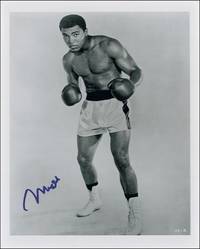
1978réf. 131531978. Ali Muhammad signed photograph documents the public image of the African American heavyweight champion whose athletic career intersected with civil rights politics antiwar dissent religious identity and twentieth-century mass media. Ali became the first fighter to win the world heavyweight championship on three separate occasions a boxing milestone confirmed by his 1978 victory over Leon Spinks and his career remains central to research on Black celebrity sports activism masculinity and political speech in the Vietnam era. Glossy photographic print undated signed in blue felt tip by Muhammad Ali. The photograph measures 8 x 10 inches and shows Ali in a pugilistic pose during his prime presenting the composed combative ring persona that shaped his public recognition beyond boxing. The quickly executed blue felt-tip signature adds autograph value while leaving the image's central focus on Ali's physical bearing as heavyweight champion and public figure. Glossy surface with no stated defects signature visible in blue felt tip near fine. Signed images of Ali in a boxing stance offer compact documentary value for collections focused on African American sports history twentieth-century protest culture celebrity and the visual construction of athletic authority. unknown
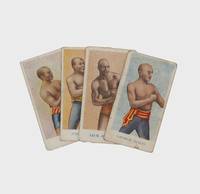
1909réf. 3787731909. Together 4 cards: Jack Johnson Joe Walcott Joe Gans and George Dixon. Approx. 1-1/2x2-3/4 inches each. Corners rounded two printed slightly offcenter other wear. Together 4 cards: Jack Johnson Joe Walcott Joe Gans and George Dixon. Approx. 1-1/2x2-3/4 inches each. unknown
1918réf. List3130Muskogee Oklahoma 1918. Real photo postcard measuring 3 ¼ x 5 ½ inches. A real photo postcard depicting Japanese-American boxer Young Togo inscribed verso: “To K. Iwana Muskogee Oklahoma / From Young Togo fighter and jiu jitsu wrestler Muskogee Okla”. Young Togo was a lightweight and sometimes featherweight or bantamweight boxer from Fort Smith Arkansas who debuted around 1907. He seemed to have been a popular fighter based on contemporaneous newspaper articles. Following a draw with Togo “Battling” Nelson described him as “the toughest piece of Japanese flesh that ever stepped into a prize ring” and stated that “he was game to the core. He fought clean and took his beating like a gamester” then noting that Young Togo had been “full of malaria” at the time.1 In the same article sports journalist Otto Floto described Togo as “one of the very toughest boys of his weight” who “seems to be invincible.” Togo may be Koriyama Kokichi the head coach of YūjirÅ Watanabe’s Nippon KentÅ Club founded in 1921 in Tokyo; Boxing: A Quick Guide 1923 a book written by the pair in Japanese identifies Kokichi as “Young Togo”. 1 “What Nelson Thinks Of Fort Smith Fans By Battling Nelson” Southwest American March 1 1912 5. unknown
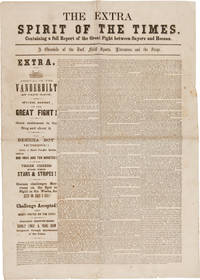
1860réf. 66827New York. 1860. Two Contemporary Accounts of the First "World Title" Match in Boxing A pair of special issue American newspapers offering "first-hand" reports on the famous Sayers-Heenan bareknuckle boxing match generally considered the sport's first international title match. As evidenced by these two papers contemporary reports of the fight vary wildly on the details but the outline appears to be as follows. John C. Heenan of California nicknamed the "Benicia Boy" travelled to England in early 1860 in order to enter the ring with the reigning champion of English pugilism Tom Sayers. The international nature of the contest attracted intense interest from both sides of the Atlantic despite the illegal nature of prize fighting. The fight took place on the morning of April 17 in front of a crowd of thousands at an "undisclosed location" in Farnborough Hampshire. The match was protracted and violent lasting over two hours and with both fighters sustaining serious injuries. The ultimate result is a point of debate but the most accepted version is that local police eventually managed to force their way into the ring and break up the unsanctioned event resulting in a draw. Together here are extra issues of two of the most prominent sports periodicals of the day the Spirit of the Times and the New York Clipper. Between them they present three different accounts of the day one in the Spirit and two different accounts in the Clipper. All three give a similar outline of the lead-up to the bout though differing in certain details. In effusive fashion they describe the machinations that went into organizing the illegal fight determining its location getting thousands of spectators "tickets to 'nowhere'" the forming of the ring the esteemed personages present and of course the betting odds. The round-by-round descriptions of the fight however differ in nearly every detail and betray a certain degree of wholesale fabrication. The Spirit of the Times is the most unapologetically pro-American claiming a complete victory for Heenan after a mere twenty-seven rounds. Their portrayal of the third round provides a succinct example of the colorful language used in these papers clearly meant to entertain the reader as much or more than to share truthful events: "3. Tom came up rather flushed and the gravy distilling from his damaged brow he dodged and tried his double but did not get home he tried a second time but was stopped cleverly and Heenan returned on the right ogle. This led to very heavy counters each on the larboard goggle Tom feinted and popped his left on the smeller. They got hold swung round broke away and Heenan then popped his left again on the right eye severe exchanges followed at close quarters and both were in the end down." The special issue of the Clipper tells a different story giving play-by-play details of forty-three rounds of bareknuckle boxing with round three ending in a knockdown by Heenan. At the end of the fight they claim that Sayer surrendered and was escorted out of the ring and declare "British 'Fair Play and May the Best Man Win' a Grand Humbug." The following page prints an account from The Bell which puts the fight at thirty-seven rounds ending with the police entering the ring. The rest of the issue is occupied by numerous other articles about the history and practice of boxing including the most recent "Rules of the Prize Ring" the history of "The Championship of England" from 1719 the "Duties of Seconds and Bottle Holders" and a full-page timeline of "Remarkable Occurrences in the Prize Ring" including a brief section on "Female Pugilists." A pair of rare antebellum sports reporting newspapers recording a legendary moment in the history of boxing. Old folds light foxing and staining minor edge wear. Some splitting to gutter of the Clipper which is uncut along the top edge. Both very good overall. For a detailed discussion of the Sayers-Heenan fight and its place in American culture see Elliott J. Gorn The Manly Art Ithaca NY 1986 pp.148-59. unknown
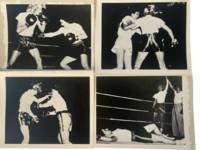
1910réf. 201861910. Women's participation in boxing long preceded formal recognition of the sport for female athletes developing through informal exhibitions training clubs and novelty bouts that challenged prevailing gender norms. Although women were largely excluded from organized boxing competitions during the nineteenth and early twentieth centuries scattered photographic evidence demonstrates that women continued to box recreationally and publicly despite social restrictions. This archive of photographs dating from the early twentieth century through the mid twentieth century documents women participating in boxing across a range of informal settings illustrating the gradual emergence of female athletic culture in a sport historically defined as masculine. Archive of sixteen black and white photographs including six silver gelatin prints and one real photo postcard measuring approximately 2.5 x 3.5 inches to 3.5 x 5.25 inches dating from the 1910s through the 1950s. The earliest image a real photo postcard dated August 1914 depicts two women wearing corsets and long dresses while sparring with boxing gloves before a mixed group of spectators. The postcard bears a pencil inscription on the verso reading "August 1914 For fun women boxers Francis Edith." Another early photograph shows two women posing with gloved fists raised before a snowy background with the inscription "Grace Miss Vandehei boxing This is Grace's roommate. A fine girl she's here now." Later photographs from the 1920s depict staged boxing encounters between a man and a woman with the female boxer dressed in athletic trousers and high heeled shoes reflecting the novelty and spectacle often associated with early female boxing exhibitions. One image shows the pair squared off with raised fists while another captures the moment of a punch landing against the man's chest. Another photograph shows two women sparring on a ship deck while surrounded by onlookers one boxer wearing a dress and curlers beneath her head covering while raising her gloved fists before a mixed audience of men and women. Boxing has historically generated controversy due to its physical intensity and female participation in the sport remained marginal for decades. Women occasionally boxed publicly as early as the eighteenth century yet organized opportunities remained rare. Women's boxing appeared briefly as a demonstration sport at the 1904 Olympic Games in St. Louis and training clubs such as Andrew Newton's Women's Boxing Club in London emerged during the 1920s. Nevertheless women's boxing did not become an official Olympic sport until the 2012 Olympic Games. The photographs in this archive illustrate the persistence of women athletes who trained and competed informally despite these restrictions offering visual evidence of women's athletic experimentation and resilience during a period of shifting gender expectations in sport. Sixteen photographs including silver gelatin prints and a real photo postcard measuring approximately 2.5 x 3.5 inches to 3.5 x 5.25 inches. Photographs clear and well preserved with light handling wear. Overall condition very good. unknown
réf. 1n6792.aVerschiedene Verlage. Mostly hardcover books. Meist gebundene Bücher. ca. 1930-2010. Mostly very good only slight damages. Wenige Gebrauchtsspuren/meist sehr gute Exemplare. - Text English/wegen des hohen Gewichts betragen die Versandkosten innerhalb Deutschlands 30.00 Eur =6 Pakete -Enthalten unter anderem: Heavyweight championschip 1719-1949/Rocky Marciano. Biography of a first son/Papa Jack/Mike Tyson. Money Myth and Betrayal/A firstful of Sugar/The archie Moore Story/Fat city. Roman Rowohlt/Loser and Still Champion Muhammad Ali/ I am Duran. The autobiography/Great moments in Sport: Heavyweight Boxing/Boxing#s Best. Short Storeis/Ready to Rumble/Leave the fighting to McGuigan/Unforgivable Blackness/Len Harvey. Prince of Boxers/Henry Cooper/Primo. The story of "Man Mountain" Carnera/Jack Johnson and his Times/Nobody asked me/Ginderella Man/Budd Schulberg. Sparing with Hemingway/Serenity. A boxing memoir/The Great Prize Fight/Debatable Decisions/More Ringside Seats/The Noble art/The Fight Game/Best Boxing Stories/The Black lights/A pictorial History Boxing/Ring battles of the century/The sweet science/Men behind the Gloves/The Jack Dempsey. Story/Battling for a title/Life's a Knock-out/The Heavyweights/Blood Season. Tyson and the world of boxing/Sugar Ray Leonard/Pound for Round/Jack Johnson in the ring and out/Sugar Ray/The Ring Boxing The 20th century/The saga of the FistThe Life and times of Jack JohnsonCock-a-doodle-do/Leaves fro my unwritten diary/Giants of the Ring/What do you know about boxing/Strange Encounters/Ringside Seat/The Ignoble art/40 boxers describe my greatest fight/The Heavyweight Champions John Durant/Men of Stee4l/Hands of Stone/Tyson/Arthur Mercante/Down for the Count and so on hardcover
1800réf. 28935AB1800. Four Volumes complete set. Paris Chez H.J.Jansen L'An 8me 1800. Octavo 21.5 cm x 14 cm. Collation: Volume I: 8 459 1 11 pages with Eleven 11 copper-engravings of which are: 5 Maps / Plans and 4 Engravings: The folded view of Fingals Cave "Grotte de Fingal dans l'Ile de Staffa" - 20.5 cm x 31.5 cm / "Folded Plate of the Giants Causeway "Vue occidentale de la Chaussee des Geans et des Caps voisins" 20.5 cm x 39 cm / Fantastic large Map/Plan of Gibraltar by Jean-Denis Barbié du Bocage with a Birds-Eye-View of the Ville de Gibraltar 20.5 cm x 65.5 cm also showing the Ville Irlandaise on Gibraltar / Scenic View of Gibraltar "Vue de Gibraltar prise du cote de l'Espagne" 20.5 cm x 33 cm / Large Fold-Out-Map of England by Jean-Denis Barbié du Bocage with an Inset-View of Stonehenge 47 cm x 51 cm / Large Fold-Out-Map of Scotland by Jean-Denis Barbié du Bocage including the Western Isles and Shetland with a stunning Inset-View of the irish pilgrimage-mountain Croagh Patrick Craig-Phadrick in Westport Ireland 37 cm x 50 cm/ Large Fold-Out-Map of Ireland with an Inset-View of the Lakes of Killarney 39 cm x 44.5 cm / Volume II: 532 1 12 pages with Large Fold-Out-Map of India "Possessions Anglaises" by Jean-Denis Barbié du Bocage - the large India-Map showing areas as far as Tibet Siam Sumatra and the Andaman Islands Ceylon Burma 48 cm x 43 cm / Volume III: 502 48 2 pages with two portraits: Guillaume Pitt William Pitt & Charles Jacques Fox each 20.5 cm x 12.5 cm/ Volume IV: 486 22 2 pages with the very famous Fold-out-Illustration of Pugilists / Boxers at Odiham in Hampshire "Combats de Boxers a Odiham" showing a boxing-match between Humphrey and Mendoza 32 cm x 20.5 cm. Hardcover / Original very decorative original half leather bindings with gilt lettering and ornament on spine. Volume One professionally rebacked by an english master bookbinder. All four Volumes in protective Collector's Mylar. Excellent condition with only minor signs of external wear. From the library of François-Xavier de Valenzi with his bookplate / exlibris to the pastedowns of each Volume. Maps in this de Luxe Edition are all considerably larger than in the normal-paper-edition and all the maps and illustrations are in superb condition. An underestimated collectable. Excellent early work on statistics of commercial revenue during the British Ruling of the North American Colonies Europe Revenue and dealings with Gibraltar Scotland and Ireland and Economic Statistics from India. The work is comprehensive and valuable due to its very detailed statistical data on Monetary Revenue and Goods generated from the British Colonies and even more so because of the large content of amazing maps and engravings. With a rare illustration of Ireland's Croagh Patrick and one of the earliest illustrations of Pugilists / Boxing Fights in England. The publication talks in depth about local customs Scottish Highlanders and their Whisky / Data of Cape Breton in Canada etc. Exemple de diagrammes statistiques inclus dans cette publication: 1. État de la paie de L'Armee par Jour Cavalerie Garde A Cheval et Dragons 2. État de la paie de L'Armee par Jour Infanterie Garde A Pied. et Infanterie 3. État des Variations de la Dette Publique a la Revolution de 1688 / Diminution pendant la paix / Diminution sous George Ier / L'Échiquier / La Compagnie des Indes / La Banque / 4. Agriculture: Produit Net de 32 Millions d'Acres Turneps / Pois / Orge / Trefle etc. 5. État de la Dette Publique au Premier Fevrier 1799 - Presente aux Communes par M. William Pitt en juillet suivant 6. Tableau de la Dette et des Fonds D'Amortissement au Premier Fevrier 1799 7. Revenu Ordinaire et Ressources Extraordinaires pour 1798 Angleterre / Ecosse / Irlande 8. État des Importations et Exportations du Port de Londres en 1797 Tonnage of Goods shipped to and from Greenland USA Sweden Russia Colonies in North America etc. etc. 9. "Revenues et Depenses de la Compagnie dans L'Inde" 10. "Etat Sommaire des Prisonniers de Londres" With a very large Fold-out-diagram showing the revenue from goods like Timber Real Estate Lottery Billets etc. between England Scotland Ireland etc. etc. etc. Charles-Alexandre-Balthazar-François-de-Paule baron de Baert-Duholant est un homme politique français né le 9 décembre 1751 à Saint-Omer dans l'ancienne province de l'Artois dans le royaume de France et mort le 23 mars 1825 à Paris. Charles-Alexandre-Balthazar-François-de-Paule baron de Baert-Duholant naît à Saint-Omer dans l'ancienne province de l'Artois dans le royaume de France sous le règne du roi Louis XV. Il se livre dans sa jeunesse au goût qu'il avait pour les voyages visita l'Angleterre en 1787 et 1788 puis l'Espagne et rentre à Saint-Omer au commencement de la Révolution française. Élu député du département du Pas-de-Calais à l'Assemblée législative le 31 août 1791 il vote constamment avec la minorité modérée ; dans la séance du 21 octobre 1791 il parle en faveur de la liberté des cultes. Il est un des sept députés qui le 20 avril 1792 votent contre la déclaration de guerre à l'Autriche ; le 20 juin lors de l'invasion des Tuileries il reste auprès de Louis XVI pour le protéger. Découragé par les événements du 10 août il part pour l'Amérique revint à Saint-Omer après le 18 brumaire et épouse Mlle de Montboissier la fille de Charles-Philippe-Simon de Montboissier-Beaufort-Canillac et petite-fille de Chrétien Guillaume de Lamoignon de Malesherbes. Leurs fille épouse le comte Nicolas Michel Le Peletier de Saint-Fargeau des Forts. Élu député par le collège de département du Loiret le 22 août 1815 il fait partie de la minorité dans la Chambre introuvable et renonce à la vie politique après cette législature. Baert-Duholant a publié plusieurs ouvrages fruits des notes réunies dans ses voyages ; le plus important est le Tableau de la Grande-Bretagne de l'Irlande et des possessions anglaises dans les quatre parties du monde 4 vol. in-8° avec cartes figures Paris 1800. Wikipedia hardcover
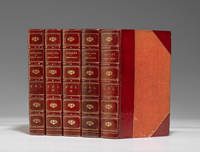
1823réf. 1252451823. EGAN Pierce. Boxiana; or Sketches of Ancient and Modern Pugilism. London: Sherwood Jones and Company 1823-29. Five volumes. Octavo 20th-century three-quarter red morocco gilt raised bands marbled endpapers all edges gilt. $3000.Early edition of this boxing classic with 50 engraved plates including an engraved vignette title page in Volume I 45 portraits and four folding plates of boxing matches handsomely bound by Bayntun.Egan was probably one of boxing's most enthusiastic and ardent disciples. Egan devotes a major part of Boxiana to a history of the boxing careers of about over a hundred boxers often including a round to round account of the famous fights of a particular boxer such as Jim Belcher Tom Cribb Dan Mendoza Tom Molyneaux 'Gentleman' John Jackson and many others. First published in 1812 Boxiana proved so popular that Egan expanded the work to an eventual four volumes; the fourth volume was written by another author after Egan briefly lost the rights to the series but after securing the rights to the title he published a further two volumes as part of a New Series. With Volume II only of the New Series. Without the portrait of Alexander Reed in the last volume but with an additional plate depicting ""A Sparring Match at the Fives Court"" in Volume III. Owner signature.Plates occasionally trimmed a bit close a few leaves with marginal paper repairs in the last volume. Very handsomely bound. hardcover
1820réf. 220416London: S. Fores Piccadilly 1820. 6 vols. Folio 16 x 10-1/4 inches sight. Frame: 23-1/2 x 18-1/2 inches. Framed and glazed some wear to frames. Prints slightly faded. 6 vols. Folio 16 x 10-1/4 inches sight. Frame: 23-1/2 x 18-1/2 inches. S. Fores, Piccadilly unknown
1941réf. 82212Norwalk Conn.:: Boxing Writer's Association; Nat Fleischer; The O'Brien Suburban Press 1941. 1941 Edition. publisher's blue gilt-lettered cloth. The cloth of the spine extending onto a portion of the front panel is discolored from water damage. The binding structure and contents are unaffected. 8vo. This book belonged to a boxing trainer named "Ray" Arcel and contains more than fifty signatures and inscription including champions Joe Louis Ray Robinson Jim Braddock Tony Canzoneri and Gus Lesnevich. Other signatures are those of ring announcers and writers restauranteur Toots Shor; boxing commissioner John J. Phelan; cartoonist Ham Fisher with a pencil drawing of Joe Palooka; Joe DiMaggio; and J. Edgar Hoover. Boxing Writer's Association; Nat Fleischer; The O'Brien Suburban Press], hardcover