156 resultados
1967ref. 2011160868xbvkPrag, Artia, 1967. 59 (2) Seiten, mit wenigen Abbildungen; (1) 60 teils farbige Kunstdrucktafeln. - Farbig illustrierter fester Original-Leineneinband mit Deckel- und Rückentitel; kl.-4to.(ca. 21,5 x 20 cm).
2006ref. 42290ABMünchen [u.a.], Piper, 2006. 8°, 158 S. mit s/w-Abb., Lesebändchen, illustr. original Pappband (Hardcover), ungekürzte Sonderausgabe sehr schönes, sauberes Exemplar.
1976ref. 16453ABWiesbaden, Falken-Verlag Erich Sicker, 1976. 29 cm, 88 Seiten, mit zahlreichen Farbfotos, illustrierter Pappband. Einband mit leichten Gebrauchsspuren, Fussecken und unteres Kapital leicht gestaucht, gut erhalten.
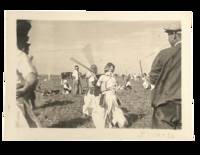
1920ref. 227341920. Unknown photographer Japanese American kendo tournament photo archive circa early 1930s documents public Japanese American martial arts practice during the interwar period when Issei and Nisei communities used cultural education sport and youth activities to sustain Japanese identity within a hostile racial climate. The strongest images show children or young adolescents in kendo armor competing outdoors before spectators preserving a rare visual record of diasporic martial arts instruction before wartime incarceration disrupted Japanese American institutions. Kendo in North America was closely tied to Japanese immigrant communities before World War II and the North American branch of the Dai Nippon Butoku Kai was approved in 1935 with an explicit goal of fostering kendo among Nisei youth placing these photographs within a broader history of cultural transmission discipline and intergenerational identity formation. Nine original silver gelatin photographs mounted on two black album leaves ranging from approximately 2½ x 3 inches to 5 x 7 inches. Four central photographs depict a large outdoor kendo match on a grassy field with child-age participants wearing full bogu armor and holding shinai bamboo swords in competitive formation. Spectators including men in Western suits and brimmed hats sit or stand along the sidelines while automobiles and period dress place the event firmly within interwar American public life. The remaining five photographs show white Americans in leisure scenes automobiles and a naval ship at dock clarifying that the kendo images were preserved within a broader travel album context rather than a single Japanese American family or dojo archive. The kendo images carry particular research value because they document Japanese cultural practice in the United States before World War II when Japanese immigrants and their American-born children negotiated public visibility under exclusion law racial restriction and assimilationist pressure. A later historical study of kendo in the United States notes that wartime conditions led to the suppression of kendo and destruction of equipment and records which heightens the evidentiary value of prewar photographs showing armored youth practice in public. Light wear and rippling from adhesive photographs clear and intact very good overall. Compact but significant Japanese American sports and cultural archive preserving interwar youth kendo community spectatorship and the public performance of diasporic identity through traditional martial art. unknown books
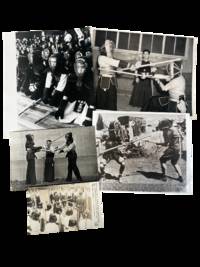
1930ref. 228001930. Kendo photo archive group of five press photographs dating from the 1930s to the 1950s documenting the practice of Japanese swordsmanship in both Japan and the United States during a period of war displacement and postwar recovery. The material captures training demonstration and competition settings providing visual evidence of how kendo was practiced across institutional and community environments. These images record both continuity and adaptation showing martial training in prewar Japan wartime or immediate postwar contexts and among Japanese American practitioners maintaining cultural traditions under changing social conditions. Five original silver gelatin photographs ranging in size from approximately 5 x 7 inches to 8 x 10 inches each with typed caption slips agency stamps and editorial markings on the verso. The images include scenes of armored kendo practitioners engaged in sparring with shinai captured mid-strike and counterstrike within dojo interiors and outdoor settings. One photograph shows rows of trainees assembled beneath banners indicating organized competition or instruction. Another depicts two fighters in a wooden-floored dojo observed by an instructor in formal attire emphasizing structured training environments. A U.S.-based image presents a group of practitioners in full armor conducting drills against a brick wall identified in captioning as Japanese American kendo activity. An outdoor scene shows two fighters engaged on uneven ground suggesting demonstration or informal practice. A postcard-format image with Japanese text shows a group of female students participating in kendo training indicating inclusion of women in organized instruction. Across the archive visual elements include protective armor bÅgu bamboo swords and regimented group formations. Produced across decades marked by militarization wartime disruption and postwar reconstruction these photographs document the persistence of kendo as a cultural and physical discipline. The archive illustrates how martial practices were maintained within Japan and transmitted within diaspora communities including Japanese Americans during periods of restriction and reestablishment. The material supports research into Japanese cultural history martial arts practice and transnational identity formation in the twentieth century. Minor edge wear and corner creasing with editorial markings on versos; overall very good condition. A concise visual record of kendo practice across shifting historical contexts. unknown books
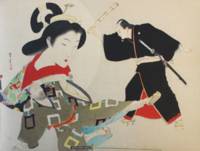
1880ref. 184811880. Japanese woodblock print 19th century depicts samurai martial practice within a domestic or staged setting providing visual evidence of sword training traditions that informed later codifications of kendo the discipline derived from earlier samurai combat techniques. The composition places a woman in formal kimono in the foreground while a samurai figure engages in training with a bamboo implement in the background his katana remaining sheathed. This pairing of civilian and martial figures situates the image within the social world of late Edo period Japan when samurai identity persisted as both a lived class structure and a cultural ideal despite the gradual decline of feudal governance prior to the Meiji Restoration. Hand colored woodblock print on thick tea paper measuring approximately 11.5 x 9 inches accompanied by a secondary tea paper sheet of similar size containing more than ten vertical columns of kanji text. The image presents detailed coloration and line work with emphasis on textile pattern posture and gesture. The samurai figure is shown in active motion with a bamboo weapon consistent with training practices while the foreground figure's kimono is rendered with attention to layered fabric and ornament. The accompanying text sheet suggests publication or descriptive context tied to the image. Produced during a period when woodblock printing functioned as a primary medium for circulating visual culture in Japan the work aligns with broader traditions of ukiyo e and related print forms that documented social roles performance and martial identity. The depiction of training rather than battlefield combat underscores the transition of sword practice into structured discipline and codified movement anticipating later formalization of kendo as both martial practice and cultural tradition. Light wear consistent with age; colors remain strong and impressions clear. Overall very good condition. unknown books
ref. 96781Unide - sd - In-4 couverture cartonnée illustrée - 76 pages - nombreuses reproductions photographiques
1908ref. E1846Tokyo, s.e., 1908 ; 172 x 249 mm, 10 pp., broché. Tiré-à-part, en langue anglaise. the Botanical Magazine (Reprinted from) Tokyo, Vol. XXII. No. 252. Bon état.
1908ref. E1835Tokyo, Published by the University, 1908 ; 191 x 265 mm, 78 pp. + 3 pl. dépliantes hors-texte, couverture et cahiers agrafés. Tiré à part, en langue allemande (titre en japonais). the Journal of the College of Science, Imperial University of Tokyo. Vol. XXIII, article 15. État moyen.
1922ref. E1843Tokyo, Published by National Research Council of Japan, 1922 ; 192 x 261 mm, 54 pp. + 2 pl. hors-texte, couverture et cahiers agrafés. Tiré à part, en langue allemande. Japanese Journal of Botany (Abdruck aus) Vol. I, No. 1. Bon état.
1918ref. E1840Tokyo, s.e., 1918 ; 173 x 250 mm, 24 pp., couverture et cahier agrafés. Tiré à part, en langue allemande. the Botanical Magazine (Abdruck aus) Tokyo, Vol. XXXII, No. 373 - 374, 1918. Bon état.
1906ref. E1838Tokyo, s.e., 1906 ; 172 x 250 mm, 14 pp., broché. Tiré à part, en langue allemande. the Botanical Magazine (Abdruck aus) Tokyo, Vol. XX, P. 57-69, 1906. État moyen.
1918ref. E1841Tokyo, s.e., 1918 ; 172 x 253 mm, 2 pp., couverture et feuille collées. Tiré à part, en langue allemande. the Botanical Magazine (Abdruck aus) Tokyo, Vol. XXXII, No. 374, 1918. Bon état.
1904ref. E1834Tokyo, Published by the University, 1904 ; 191 x 262 mm, 14-8-2 pp. + 1 pl. hors-texte, broché. Tiré à part, en langue allemande (titre en japonais). the Journal of the College of Science, Imperial University of Tokyo. Vol. XIX, article 18 et article 19. État moyen.
1916ref. E1836Tokyo, Published by the University, 1916 ; 193 x 260 mm, 74 pp., couverture et cahiers agrafés. Tiré à part, en langue allemande (titre en japonais). the Journal of the College of Science, Imperial University of Tokyo. Vol. XXXIX, article 3. Bon état.
2010ref. R200126587A compte d'auteur. 2010. In-4. Broché. Bon état, Couv. convenable, Dos satisfaisant, Intérieur frais. 15 pages reliées en spirale + 60 + non paginé environ 70 pages : Programme du stage Kendo ADSL Orgeres + en supplément un manuel de l'équipement du Kendoka et un manuel sur le Kendo (lecture à l'italienne, texte en deux colonnes) - nombreuses illustrations en noir et blanc dans et hors texte.. . . . Classification Dewey : 796.1-Sports divers
ref. QWA-19176Chiron, 1973, in-8 br. (13,5 x 21), 92 p., préface d'H. Zander, traduit par Francine Braun et Denys Ferrando-Durfort, 135 illustrations, très bon état.
2015brossura
2017brossura
2018brossura
2001ill., br. Acuto nell'alternare il racconto della propria esperienza con i dettagli tecnici, la storia del Kendo e dei suoi maestri con la descrizione minuziosa dei vari esercizi o kata, Darrell Craig dimostra come le arti marziali siano un illimitato viaggio affascinante senza destinazione finale, una vera e propria filosofia di vita. Non è sufficiente, infatti, studiare solamente la tecnica se non si è penetrata la dimensione essenziale del Kendo che implica una precisa filosofia e un'etica di comportamento. Ecco perché questo libro inizia con il racconto in prima persona del percorso compiuto dall'autore e con i colloqui avuti dallo stesso con il samurai Chiba Sensei, trentasettesima generazione dell'Hokushin Ryu, un uomo che rappresenta 750 anni di storia. I capitoli dedicati alla pratica dell'arte della spada forniscono indicazioni dettagliate e soprattutto progressive, come del resto un vero maestro deve fare con i propri allievi. I disegni che illustrano passo dopo passo l'allenamento, a partire dalla vestizione fino al saluto finale, sono chiarissimi e pensati appositamente per gli allievi occidentali.
1994ill. Il primo libro che descrive ed analizza la tradizionale arte giapponese della spada, le sue caratteristiche essenziali e le sue tecniche fondamentali. Il kendo era in origine l'arte del maneggiare la spada nel Giappone feudale. In seguito al suo sviluppo e all'impegno di un gruppo di importanti maestri, si è perfezionato sino a raggiungere l'attuale dimensione sportiva. La teoria, la tecnica, la disciplina di combattimento ed il metodo di allenamento sviluppati dalle varie scuole si sono tramandati sino ai nostri giorni e sono stati fusi in una pratica educativa che contiene ancora tutte le caratteristiche del passato.
198822 cm, ril. edit. ill, tit. al piatto e dorso; pp. 125, numerose ill. in nero e col
1980Book shows light shelf wear only to covers. Binding is solid and square, text/interior is clean and free of marking of any kind. 300 pages with a few b&w photos, chapters include: Toward the foundtion of the higher schools, Between nation and campus: the making of the higher school gentleman, Seclusion and self-government, The culture of ceremony, Public tyranny, The higher school catharsis, From Meiji to Taisho: broadening perspectives and enduring traditions.