KendoBiblio.com
156 résultats
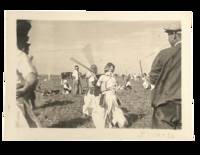
1920réf. 227341920. Unknown photographer Japanese American kendo tournament photo archive circa early 1930s documents public Japanese American martial arts practice during the interwar period when Issei and Nisei communities used cultural education sport and youth activities to sustain Japanese identity within a hostile racial climate. The strongest images show children or young adolescents in kendo armor competing outdoors before spectators preserving a rare visual record of diasporic martial arts instruction before wartime incarceration disrupted Japanese American institutions. Kendo in North America was closely tied to Japanese immigrant communities before World War II and the North American branch of the Dai Nippon Butoku Kai was approved in 1935 with an explicit goal of fostering kendo among Nisei youth placing these photographs within a broader history of cultural transmission discipline and intergenerational identity formation. Nine original silver gelatin photographs mounted on two black album leaves ranging from approximately 2½ x 3 inches to 5 x 7 inches. Four central photographs depict a large outdoor kendo match on a grassy field with child-age participants wearing full bogu armor and holding shinai bamboo swords in competitive formation. Spectators including men in Western suits and brimmed hats sit or stand along the sidelines while automobiles and period dress place the event firmly within interwar American public life. The remaining five photographs show white Americans in leisure scenes automobiles and a naval ship at dock clarifying that the kendo images were preserved within a broader travel album context rather than a single Japanese American family or dojo archive. The kendo images carry particular research value because they document Japanese cultural practice in the United States before World War II when Japanese immigrants and their American-born children negotiated public visibility under exclusion law racial restriction and assimilationist pressure. A later historical study of kendo in the United States notes that wartime conditions led to the suppression of kendo and destruction of equipment and records which heightens the evidentiary value of prewar photographs showing armored youth practice in public. Light wear and rippling from adhesive photographs clear and intact very good overall. Compact but significant Japanese American sports and cultural archive preserving interwar youth kendo community spectatorship and the public performance of diasporic identity through traditional martial art. unknown
1920réf. 227341920. Unknown photographer Japanese American kendo tournament photo archive circa early 1930s documents public Japanese American martial arts practice during the interwar period when Issei and Nisei communities used cultural education sport and youth activities to sustain Japanese identity within a hostile racial climate. The strongest images show children or young adolescents in kendo armor competing outdoors before spectators preserving a rare visual record of diasporic martial arts instruction before wartime incarceration disrupted Japanese American institutions. Kendo in North America was closely tied to Japanese immigrant communities before World War II and the North American branch of the Dai Nippon Butoku Kai was approved in 1935 with an explicit goal of fostering kendo among Nisei youth placing these photographs within a broader history of cultural transmission discipline and intergenerational identity formation. Nine original silver gelatin photographs mounted on two black album leaves ranging from approximately 2½ x 3 inches to 5 x 7 inches. Four central photographs depict a large outdoor kendo match on a grassy field with child-age participants wearing full bogu armor and holding shinai bamboo swords in competitive formation. Spectators including men in Western suits and brimmed hats sit or stand along the sidelines while automobiles and period dress place the event firmly within interwar American public life. The remaining five photographs show white Americans in leisure scenes automobiles and a naval ship at dock clarifying that the kendo images were preserved within a broader travel album context rather than a single Japanese American family or dojo archive. The kendo images carry particular research value because they document Japanese cultural practice in the United States before World War II when Japanese immigrants and their American-born children negotiated public visibility under exclusion law racial restriction and assimilationist pressure. A later historical study of kendo in the United States notes that wartime conditions led to the suppression of kendo and destruction of equipment and records which heightens the evidentiary value of prewar photographs showing armored youth practice in public. Light wear and rippling from adhesive photographs clear and intact very good overall. Compact but significant Japanese American sports and cultural archive preserving interwar youth kendo community spectatorship and the public performance of diasporic identity through traditional martial art. unknown books
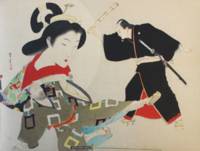
1880réf. 184811880. Japanese woodblock print 19th century depicts samurai martial practice within a domestic or staged setting providing visual evidence of sword training traditions that informed later codifications of kendo the discipline derived from earlier samurai combat techniques. The composition places a woman in formal kimono in the foreground while a samurai figure engages in training with a bamboo implement in the background his katana remaining sheathed. This pairing of civilian and martial figures situates the image within the social world of late Edo period Japan when samurai identity persisted as both a lived class structure and a cultural ideal despite the gradual decline of feudal governance prior to the Meiji Restoration. Hand colored woodblock print on thick tea paper measuring approximately 11.5 x 9 inches accompanied by a secondary tea paper sheet of similar size containing more than ten vertical columns of kanji text. The image presents detailed coloration and line work with emphasis on textile pattern posture and gesture. The samurai figure is shown in active motion with a bamboo weapon consistent with training practices while the foreground figure's kimono is rendered with attention to layered fabric and ornament. The accompanying text sheet suggests publication or descriptive context tied to the image. Produced during a period when woodblock printing functioned as a primary medium for circulating visual culture in Japan the work aligns with broader traditions of ukiyo e and related print forms that documented social roles performance and martial identity. The depiction of training rather than battlefield combat underscores the transition of sword practice into structured discipline and codified movement anticipating later formalization of kendo as both martial practice and cultural tradition. Light wear consistent with age; colors remain strong and impressions clear. Overall very good condition. unknown
1880réf. 184811880. Japanese woodblock print 19th century depicts samurai martial practice within a domestic or staged setting providing visual evidence of sword training traditions that informed later codifications of kendo the discipline derived from earlier samurai combat techniques. The composition places a woman in formal kimono in the foreground while a samurai figure engages in training with a bamboo implement in the background his katana remaining sheathed. This pairing of civilian and martial figures situates the image within the social world of late Edo period Japan when samurai identity persisted as both a lived class structure and a cultural ideal despite the gradual decline of feudal governance prior to the Meiji Restoration. Hand colored woodblock print on thick tea paper measuring approximately 11.5 x 9 inches accompanied by a secondary tea paper sheet of similar size containing more than ten vertical columns of kanji text. The image presents detailed coloration and line work with emphasis on textile pattern posture and gesture. The samurai figure is shown in active motion with a bamboo weapon consistent with training practices while the foreground figure's kimono is rendered with attention to layered fabric and ornament. The accompanying text sheet suggests publication or descriptive context tied to the image. Produced during a period when woodblock printing functioned as a primary medium for circulating visual culture in Japan the work aligns with broader traditions of ukiyo e and related print forms that documented social roles performance and martial identity. The depiction of training rather than battlefield combat underscores the transition of sword practice into structured discipline and codified movement anticipating later formalization of kendo as both martial practice and cultural tradition. Light wear consistent with age; colors remain strong and impressions clear. Overall very good condition. unknown books
1974réf. 2111902156200437Takara bun-do shuppan 1974. Soft Cover. Fine. Number of pages: 302 pages Size: A5 size Takara bun-do shuppan paperback
1991réf. 2080502106402385Shimadzushobo 1991. Soft Cover. Fine. Number of pages: 578p Shimadzushobo paperback
1991réf. 2081502111700949Not Available 1991. Soft Cover. Fine. The book is in fine condition. Not Available paperback
1943réf. 2091502135303264Sanseido 1943. Soft Cover. Fine. Volume: 1 Sanseido paperback
1991réf. 2092902139000483Shimadzushobo 1991. Soft Cover. Fine. Number of books: 1 Shimadzushobo paperback
1943réf. 2092902141504443Sanseido 1943. Soft Cover. Fine. Size: A5 size Sanseido paperback
1991réf. 2111902152900688Shimadzushobo 1991. Soft Cover. Fine. The book is in fine condition. Shimadzushobo paperback
1943réf. 2111902153302589Sanseido 1943. Soft Cover. Fine. Number of books: 1 Sanseido paperback
1943réf. 2081402109802025Toyama bo 1943. Soft Cover. Fine. Volume: 1 Toyama bo paperback
1943réf. 2090602128800102Toyama bo 1943. Soft Cover. Fine. Number of books: 1 book Toyama bo paperback
1943réf. 2092902141100110Toyama bo 1943. Soft Cover. Fine. Volume: 1 Toyama bo paperback
1943réf. 2080402107100180Toyama bo 1943. Soft Cover. Fine. The book is in fine condition. Toyama bo paperback
1967réf. 2011160868xbvkPrag, Artia, 1967. 59 (2) Seiten, mit wenigen Abbildungen; (1) 60 teils farbige Kunstdrucktafeln. - Farbig illustrierter fester Original-Leineneinband mit Deckel- und Rückentitel; kl.-4to.(ca. 21,5 x 20 cm).
1903réf. 2092902137306653Hakubunkan 1903. Soft Cover. Fine. The book is in fine condition. Hakubunkan paperback
1976réf. 16453ABWiesbaden, Falken-Verlag Erich Sicker, 1976. 29 cm, 88 Seiten, mit zahlreichen Farbfotos, illustrierter Pappband. Einband mit leichten Gebrauchsspuren, Fussecken und unteres Kapital leicht gestaucht, gut erhalten.
réf. 2091502133900404Not Available N.A. Soft Cover. Fine. Volume: 1 Not Available paperback
réf. QWA-19176Chiron, 1973, in-8 br. (13,5 x 21), 92 p., préface d'H. Zander, traduit par Francine Braun et Denys Ferrando-Durfort, 135 illustrations, très bon état.
1994réf. 106516All Japan Kendo Federation 1994-01-01. Paperback. Like New. Looks unread with just a touch of shelf wear E22 Please email for photos. All Japan Kendo Federation paperback
1994réf. 1065151994-01-01. Paperback. Like New. Looks unread with just a touch of shelf wear E22 Please email for photos. paperback
198822 cm, ril. edit. ill, tit. al piatto e dorso; pp. 125, numerose ill. in nero e col
1994ill. Il primo libro che descrive ed analizza la tradizionale arte giapponese della spada, le sue caratteristiche essenziali e le sue tecniche fondamentali. Il kendo era in origine l'arte del maneggiare la spada nel Giappone feudale. In seguito al suo sviluppo e all'impegno di un gruppo di importanti maestri, si è perfezionato sino a raggiungere l'attuale dimensione sportiva. La teoria, la tecnica, la disciplina di combattimento ed il metodo di allenamento sviluppati dalle varie scuole si sono tramandati sino ai nostri giorni e sono stati fusi in una pratica educativa che contiene ancora tutte le caratteristiche del passato.