24 718 résultats
1928réf. RAUTNEW00lh1928. Very Good. Automobile Club of America. New England 1928. Good Roads Everywhere. 16 panels. . NY: NP 1928. Illustrated. 31 x 46 in. Pamphlet. Book condition: Very good. Small chips in edges. 16 panel guide map of National and State Highways across New England in the 1920s. unknown books
1926réf. RAUTUSH00drpNational Highways Association 1926. Good. Automobile Club of America. U.S. Highways 1926. Baltimore: National Highways Association 1926. Illustrated. 36x51 inches. Folded map. Book condition: Good with tears in folds. Some penciling in margins with stamping. National Highways Association unknown books
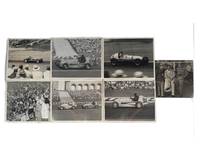
1940réf. 215481940. Archive of original photographs documenting midget auto racing at the Los Angeles Memorial Coliseum during the postwar expansion of American motorsports culture in the 1940s and 1950s. The material captures competitive race action spectator culture and driver camaraderie at one of Southern California's most recognizable sports venues during a formative period in American automobile racing. The photographs provide visual evidence of the growing popularity of midget racing in the decades following World War II when compact open-wheel race cars became central attractions at urban speedways and stadium tracks across the United States. The archive also preserves details of racing technology protective gear crowd demographics and public spectacle associated with mid-century American motorsports entertainment. Collection consists of seven vintage black-and-white silver gelatin photographs measuring approximately 10 x 8 inches. The images depict open-wheel midget race cars with exposed suspensions streamlined bodies and oversized racing numerals characteristic of late 1940s designs associated with manufacturers such as Kurtis Kraft. Several photographs capture high-speed racing sequences with drivers leaning into turns gripping steering wheels tightly as cars accelerate around the Coliseum track. Cars numbered "81" and "60" appear repeatedly throughout the archive in both individual and competitive scenes. One photograph prominently features a driver wearing a dark leather racing helmet and protective goggles typical of the period. Additional race images show vehicles crossing near the checkered start-finish line while spectators densely fill the Coliseum grandstands in period attire including brimmed hats jackets and collared shirts. One particularly striking image frames speeding race cars against the Los Angeles Memorial Coliseum's monumental archways in the background. Beyond race action the archive includes candid social scenes associated with the event including a photograph of a driver addressing a crowd from an elevated platform while spectators gather below and another image showing three men in racing attire and plaid shirts standing beside a race car in a relaxed pit-side setting. The archive documents the culture of early postwar American motorsports at a time when Southern California emerged as a major center for automobile racing innovation promotion and spectatorship. Midget racing attracted large urban audiences during the mid-twentieth century and served as an important developmental arena for drivers mechanics and racing technologies that later shaped broader American auto racing culture. Particularly notable are the photographs balancing high-speed competition with informal social interactions preserving both the spectacle of racing and the community surrounding the sport. Minor handling wear scattered creasing and light edge wear; photographs otherwise remain in very good condition overall. A strong visual archive of mid-century American midget racing and postwar Los Angeles sports culture. unknown books
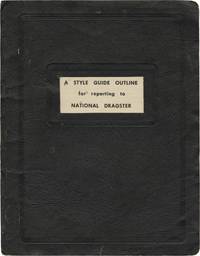
1960réf. 152883Los Angeles: National Hot Rod Association 1960. Original style guide for freelance reporters and photographers covering competition drag racing created by the National Hot Rod Association NHRA circa 1960s. The NHRA was founded by Wally Parks editor of Hot Rod magazine in 1951 in order to promote "safety sportsmanship and fellowship" among racer and more broadly to convince the general public and especially police that there was a difference between reckless street racers and hot rod drivers. In 1960 the association began publishing "National Dragster" a biweekly news magazine featuring racing stats and interviews which continues to be published today. Housed in black wrappers with a die-cut title window in the British style. Mimeograph duplication rectos only. Ten leaves not numbered. Wrapper Very Good plus leaves Very Good plus lightly age-toned bound internally with three silver brads. National Hot Rod Association unknown books
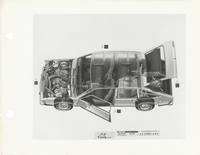
1962réf. 164713Detroit: General Motors 1962. First Edition. First Edition. ST 21. Illustrated profusely with black-and-white diagrams and photographs. The 1963 Chevrolet Corvette was the first model of a second generation of Corvettes known as the C2. The release represented a major design change from previous models incorporating a new body and chassis and also presented the Corvette as a coupe for the first time. Very Good plus in perfect-bound wrappers lightly toned at the wrapper edges. General Motors unknown books
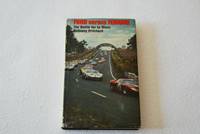
1968réf. 169361968. Pritchard Anthony. Ford versus Ferrari: The Battle for Le Mans 1968 a contemporary account of the fierce competition between Ford Motor Company and Ferrari for supremacy in international endurance racing during the 1960s. Published just two years after Ford's historic victory at the 1966 24 Hours of Le Mans the book chronicles the American manufacturer's efforts to defeat Ferrari whose cars had dominated the race with six consecutive victories from 1960 through 1965. Central to the narrative are American automotive designer Carroll Shelby and British racing driver Ken Miles whose development and testing of the Ford GT40 helped transform Ford's racing program into a formidable competitor. Pritchard's account appeared while the rivalry was still unfolding preserving a contemporary history of one of the most consequential contests in international sports car racing. Pritchard Anthony. Ford versus Ferrari: The Battle for Le Mans. London: Pelham Books 1968. First edition. Hardcover octavo bound in original cloth with the original illustrated dust jacket. Illustrated throughout with numerous photographs of the actual races vehicles and personalities involved in the Ford-Ferrari competition. Pritchard examines the engineering racing strategies and personalities behind Ford's challenge to Ferrari including Shelby's leadership and Miles's contributions to the development of the GT40. The narrative centers on the 1966 Le Mans race where Ford achieved a historic first second and third-place finish ending Ferrari's dominance of the event. The same events were later dramatized in James Mangold's 2019 film Ford v Ferrari starring Matt Damon as Shelby and Christian Bale as Miles although the film is not established as a direct adaptation of Pritchard's book. Published in 1968 Pritchard's account predates decades of retrospective histories and cinematic treatments of the Ford GT40 program providing a near-contemporary narrative of the engineering and competitive decisions behind Ford's victory. Its photographic illustrations preserve additional details of the cars drivers and racing events beyond those depicted in the 2019 film. Original cloth binding and illustrated dust jacket in very good condition. Overall very good condition. First edition of an early illustrated history of the Ford-Ferrari rivalry published during the final years of Ford's four-year winning streak at Le Mans from 1966 through 1969. unknown books
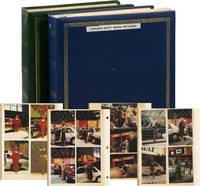
réf. 167954N.p.: N.p. 1990. Archive of approximately 570 vernacular color photographs of the Chicago Auto Show housed in two generic photograph albums with plastic overlays covering every year from 1979 through 1990 lacking 1981. The first photograph album a blue 3-ring binder of 58 leaves with a "Chicago Auto Show Pictures" label on the front board contains approximately 320 photographs housed on the rectos and versos of the leaves and has ink annotations on the verso of the front board noting the years 1979 1980 1982 1983 1984 and "David Hasslehoff" a guest at the 1983 Chicago Auto Show. The vast majority of photographs in this album are 5 x 3.5 inch photographs with approximately 40 3.5 x 3.5 inch photographs. The second photograph album a green 3-ring binder of approximately 53 leaves with a "Chicago Auto Show Pictures" label on the front board contains approximately 250 photographs housed on the rectos and versos of the leaves and has ink annotations on the verso of the front board noting the years 1985 1986 1987 1988 1989 1990 and "William Perry The Refrigerator" a guest at the 1986 Chicago Auto Show. The vast majority of photographs in this album are 5 x 3.5 inches with eleven 4.25 x 3.5 inch photographs. A sizable photographic archive documenting eleven years of a devoted fan's annual trips to the Chicago Auto Show throughout the 1980s. The majority of the photographs depict the displayed vehicles with their attending female models and performers as well as the lavish booths and fashions of the 1980s. A documentation of a transitional decade for the US automobile as the behemoths of the late 1970s evolved into the more compact and fuel-efficient Japanese-influenced models emergent by 1990. The Chicago Auto Show was begun in 1901 by bicycle show promoter Samuel Miles and quickly rose to prominence often regarded as the "National Auto Show" by the early 1930s. World War II curtailed the production of motor vehicles for consumers and as a result the Chicago Auto Show was not held between 1941 and 1949. In 1961 the Chicago Auto Show was moved from the International Amphitheatre to its current location at McCormick Place. It is currently the largest auto show in the United States. Photograph Albums 11.5 x 11 inches. Albums and photographs all Near Fine. N.p. unknown books
réf. 158941Detroit MI: General Motors 1980. Substantial archive of over 750 General Motors GM design assembly and advertising photographs 23 contact sheets of vehicles and parts photographs and 100 print advertising proofs and mockups from the Chevrolet Motor Division of General Motors dating from 1973 through 1980. Nearly all the materials in the archive are overlaid with Campbell Ewald Advertising Agency watermarks or bear GM Photographic stamps on the bottom margins or versos. Materials also frequently note catalog numbers and dates in manuscript pencil and ink. Detailed inventory and additional images available upon request. Please contact us directly. A vast and insightful archive of distinctly 1970s GM automotive design and marketing. The photographic prints in the archive include approximately 550 photographs and design renderings of vehicles parts and accessories as well as emblems and logos with material relating to the Bel Air Camaro Caprice Chevelle Chevette Citation Impala Malibu Monte Carlo Monza Nova and Vega models. Of particular note are 100 proofs and mockups for print advertisements for various Chevrolet vehicles markedly reflecting the era's fuel crisis and imposing international compact car market. Photographs largely 11 x 8.5 inches with some photographs 10 x 8 inches. Advertising proofs and mockups are all on standard letter-size paper. Near Fine overall with some light edgewear and light creasing at the corners. General Motors unknown books
1966réf. 155116N.p.: N.p. 1966. Archive of photographs newspaper clippings and various ephemera belonging to a Kenny Aumont Brown 1943-2016 of Burlington North Carolina largely relating to automobiles and automobile accidents 1963-1966. The archive assembled by Brown when in his early twenties documents his preoccupation with automobiles automobile accidents and racing at a time when Brown was first employed as a tow truck driver for Cobb Motor Company and later as part of a rescue unit as seen in one of the newspaper clippings. In his later years Brown would serve as an Alamance County Deputy Sheriff for 34 years. A copious and insightful vernacular documentation of the relationship of southern culture and automobiles in the early to mid 1960s. The archive contains 37 standard size black and white photographs one 8 x 10 inch black and white photograph four color photographs 25 newspaper clippings two newspaper issues and twelve various documents all housed in a photo album. The archive contains annotations throughout in white marker on the black leaves of the photo album and frequently in pen or pencil on the margins of articles and photographs. The photographs in the archive include shots of Cobb Motor Company vehicles and shop including a circa 1930s photograph of a 1930s Cobb vehicle laid in various crashed vehicles with annotations including location and fatalities wrecked NASCAR vehicles one page including the annotations of "Petty Plymouth's 1962" and "Car witch sic almost killed Lee Perry" three of local drag races and several of friends and family vehicles including Brown's own cherished 1949 Plymouth which he identifies as "My Own True Love KAB." Many of the photographs include developer dates stamped into the margin which range from 1958 1960 1962 and 1965. The newspaper clippings in the archive date from 1963 to 1966 with the majority about local automobile accidents but also feature articles on NASCAR accidents and fatalities Joe Weatherly illegal racing a transportation shop fire a murder suicide and an Alamance plane crash which killed three which is included in two clippings as well as a full issue of the Daily Times News. As well as the photographs and newspaper clippings the archive includes various personal effects which include Brown's driver's license two car registrations belonging to his mother Cathera Garner Brown a 1962 Dion and Sam Cook concert ticket and a letter from the North Carolina Department of Motor Vehicles warning Brown his license is in danger of suspension from speeding violations with an adjacent "Nasty Letter" annotation. Also included are much older family artifacts including a 1914 postcard receipt from Burlington Coffin Company a 1917 postcard receipt from Piedmont Railway and Electric and a 1919 receipt from Souther Bell Telephone and Telegraph Company all belonging to a presumed grandfather W.L. Burke of Burlington. On the first leaf of the album is Brown's name dated "Dec. 1963" and his initials in bold Gothic calligraphy in white. On the verso of the first leaf is a Sunday May 19 1963 newspaper clipping of an accident featuring a strikingly disturbing photograph of a man hanging from a telephone pole upon which his body was thrown his car burning below him with the adjacent annotation "Will They Ever Learn." The photograph in the clipping is of note as it was the image appropriated by Andy Warhol for his 1963 painting "Green Car Crash Green Burning Car I" one of the most celebrated paintings of his early "Death and Disaster" series. Photo album with string binding 12.5 x 8.75 inches. Very Good plus. Photographs Newspaper clippings and ephemera Very Good overall with a few clippings laid in and ten of the photographs loose from the original tape mounting many with faint soil tape shadows and light creasing. N.p. unknown books
1938réf. 155078N.p.: N.p. 1938. Archive of 63 vintage vernacular and professional photographs along with a number of newspaper and program clippings all relating to midget auto racing in Southern California circa 1937-1938. All materials housed in a string-bound scrapbook with captions in manuscript ink adjacent to most photographs. Of particular note in the archive are five photographs of African American "outlaw" racer Rajo Jack the first driver to integrate into the all-white sport-nearly two decades before Jackie Robinson broke the "color barrier" in Major League baseball in 1947. Born Dewey Gatson in 1905 Jack would never have been able to compete on a national level in the American Automobile Association AAA due to his race so he instead competed in the American Racing Association ARA the largest racing body to allow him to compete-making him an "outlaw" racer in the eyes of the AAA and largely restricting him to West Coast racing. A continual target of discrimination Jack would frequently claim to be of Native American or Portuguese heritage in order to race although he was largely welcomed by his fellow drivers out of respect for his talent. These supporters would frequently band together to insist on Jack receiving equal service at segregated restaurants and motels. Jack won races up and down the West Coast in stock cars midgets big cars and motorcycles and in 2003 was inducted into the West Coast Stock Car Hall of Fame and the National Sprint Car Hall of Fame in 2007. Archive also includes content relating to drivers Fred Frame and the Robson brothers as well as the Oakland Speedway and the Southern Ascot Speedway. Other noted drivers in the collection include Travis 'Spider' Webb Tex Petersen including one photograph signed by Petersen Einer 'Swede' Lindskog Harry Lester Morris 'Slim' Mathis Hal Robson and Harry Secrest. An impressive and extensive archive of photographs of the South California midget auto racing scene of the 1930s with a rare substantial grouping of photographs of Rajo Jack at the height of his career. Scrapbook measuring 12.25 x 13.5 inches. Very Good with most leaves brittle and separated from binding. Photographs generally 5 x 3.25 inches with one as small as 1.25 x 1.5 inches and several as large as 5 x 3.25 inches. Very Good plus to Near Fine. N.p. unknown books
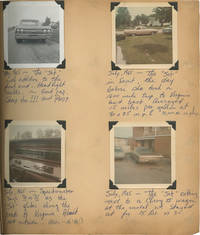
1967réf. 154897Peru Indiana: N.p. 1967. Vintage stringbound vernacular photograph album documenting the vehicular obsessions of one Greg Wildrick of Peru Indiana who would ultimately kill four people in a motor vehicle accident and later die himself in the same manner while speeding. Approximately 150 black-and-white photographs and 50 color photographs with manuscript ink annotations captioning most of the images. Manuscript ink annotations on the front board provide the album's title: "#1 / Our new cars etc. / Family Too." Additional annotations on the inside rear board note: "The bullshit contained in this so called albumn sic belongs to Greg E. Wildrick / 4 Holiday Drive / Peru Indiana is where I live if you don't know me. Call 472-2550 / If you don't call me forget it!!! / Book Finished March 5 1967 at 4:45 A.M." The photographs in the album span roughly 1955 to 1966 compiled by Greg at the age of 19. In addition to many images of the family's muscle cars and trucks the album also contains quite a few shots of bicycles go-karts quarter midgets and speedboats often with family members posing happily nearby. Several images also capture vehicles in use. Patently obsessed with cars and speed from a young age Wildrick would go on to work as a used car salesman in nearby Kokomo Indiana throughout the 1960s and 1970s. Wildrick's fanaticism also evidently extended to his leisure hours as the Kokomo Tribune notes Wildrick's involvement in multiple speeding violations during the same period. One of the album's more striking photographs taken on December 19 1965 is a blurry color Polaroid of the speedometer of a 1966 Oldsmobile 442 going 110 miles per hour down US Highway 31. This same stretch of 31 would see Wildrick gravely injured and four others dead in a grisly two-car accident five years later in January of 1971. Sadly this would not be Wildrick's last serious accident as a similar collision on US Highway 35 would precipitate his own demise in 1986 at the age of 39. A fascinating and thorough album capturing a young man's coming-of-age in a car-centric family and more broadly allowing a personal glimpse into the golden age of the automobile in postwar America. 12.75 x 12.25 inches. Photographs ranging from Near Fine to Very Good plus with approximately 18 photographs lightly scuffed cracked toned and edgeworn. Album Very Good plus with light edgewear and scuffing on the boards. N.p. unknown books
1952réf. 155462N.p.: N.p. 1952. Vintage string bound photograph album belonging to William Arthur Slaughter an ambulance driver in Southern California circa 1951 and 1952. Included with the album are a pay stub dated June 1948 and noting Slaughter's previous employment by Southern Pacific Company as a railway lineman two driver's identification cards dated 1951 and 1952 a promotional matchbook bearing the name and number of Schaefer Ambulance Service in California and approximately 24 newspaper clippings covering accidents in Los Angeles several showing photographs of Slaughter. Stamp of photographer Lew Nichols on the versos of nearly all of the photographs. The album contains 36 black-and-white photographs with six additional loose photographs also included with the collection. Manuscript ink annotations by Slaughter provide captions for many of the photographs identifying subjects and locations and noting details about the various incidents captured in the album. One particularly striking caption for a photograph of a woman being carried out on a stretcher reads: "Honeymoon Cottage / Her Husband Died during the night / she was found next morning unconsius / Suficated Gas Heater / in coma for 30 days then Died / Maried only Two weeks" sic. As the above caption implies the incidents captured in the album span from asphyxiation to heart attacks although the majority of photographs document automobile accidents-almost certainly one of the main causes of death in California in the 1950s. The album also includes several photographs of Slaughter and the other ambulance drivers "off duty" as well as one photograph of a new Cadillac apparently used as an ambulance. A grisly and fascinating collection of accident photography capturing the dark side of the golden age of the automobile in postwar America. Album 12 x 9 inches. Photographs range from 10 x 8 inches to 5 x 4 inches. Photographs Very Good plus album Very Good with front board detached from the binding. N.p. unknown books
1968réf. 149422N.p.: N.p. 1968. Archive of 48 vintage photographs of car accidents scenes in the Columbia County New York area from the years 1961-1965 1966 and 1968. With the stamp of Lee's Studio in Chatham NY on the verso of the majority of photographs along with occasional manuscript annotations. Most photographs housed in sleeves with annotations detailing dates locations and occasionally noting whether or not the accident was fatal. Also included are several accident reports prepared by Lee Studios for internal use and correspondence between Lee and law firms representing people involved in the accidents requesting copies of photographs. The 1960s saw large increases in the number of vehicle fatalities as car ownership greatly increased over the previous decades and out of the six years documented in the archive 1966 and 1968 are both among the ten deadliest in US history. Photographs variously sized with most being 10 x 8 inches. Generally Near Fine. Housed in a contemporary photo album and two folders. N.p. unknown books
1974réf. 149416N.p.: N.p. 1974. Archive of 20 vintage black-and-white photographs along with one color photo of Central Valley CA stock car racer Don Darling 1972-1974. Five photographs loose the remainder tipped onto black card stock leaves with masking tape. Occasional manuscript ink annotations to the tape identifying the years as well as dirt tracks in Roseville and Maryville CA. Included are images of Darling and others drivers in action crashed or wrecked cars many of which appear to be a decade or more older than the photographs and posed shots of Darling or others with vehicles including a signed portrait. Also including is a handwritten note listing the point totals for racers on Aug. 18 1974 showing Darling solidly in sixth place out of a field of 16. Black-and-white photographs 10 x 8 inches color photograph 5 x 3.5 inches. About Very Good. N.p. unknown books
1956réf. 151379Indianapolis: O'Dell and Shields Studios 1956. Two vintage photo albums documenting Dean Van Lines Indy car team before during and after the Indianapolis 500 in 1955 and 1956 with legendary driver Jimmy Bryan at the helm. Several photographs stamped on the verso by the O'Dell and Shields Studios of Indianapolis longtime contract photographers for the Indianapolis Motor Speedway. Dean a California moving company magnate and noted championship car owner began his association with Bryan in 1954 when the driver would score his first significant win the AAA National Championship. The pair would win an astonishing 17 national championship races over the course of the next four years. The 1955 album contains 12 photographs capturing the moments before the 500 with several views of the team performing last-minute modifications to the Kuzma-Offenhauser better known as the Dean Van Lines #2 Special custom-built by Eddie Kuzma for the 1955 race. Also included in the album are several action shots of the race itself along with a single photograph of Bryan posing behind the wheel of Dean's #7 Champ car. The second album containing 20 photographs documents the Dean Van Lines team at the 500 the following year with Bryan again behind the wheel. A blown tire around lap 100 would spin the Special into the south infield effectively ending the team's shot at winning the race a moment evocatively captured in the album. Dean and Bryan would take the roadster pictured in both albums to the short-lived Race of Two Worlds in Italy in 1957 an event featuring Indy drivers racing against European Formula One drivers. Bryan would go on to win the 500 in 1958 for George Salih only a few years before Bryan's death at 34 in a crash on the Langhorne Speedway in 1960. A fascinating collection of photographs providing an unusually intimate look behind the scenes at two pivotal figures in US motorsport history. Albums 11.25 x 8.5 inches photographs 8 x 11 inches. Albums and contents generally Very Good plus. O'Dell and Shields Studios unknown books
1925réf. 28216aDenver: Welch-Haffner Printing Co. n.d. ca. 1925. Octavo color-illustrated self-wrappers stapled 12 pp. Color photos b&w photos. Very Good.` Welch-Haffner Printing Co., n.d. [ca. 1925.] unknown books
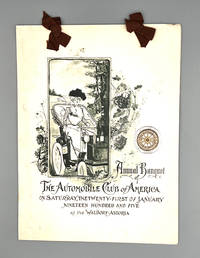
1905réf. 5172New York: The Automobile Club of America 1905. Cards. Illustrated embossed heavy cards. Very good. 24 x 18 cm. A rare historic menu. On January 32 1905 the Automobile Club of America held a major a annual dinner and banquet at the Waldorf-Astoria hotel in New York City. Banquets of this caliber were private ticketed events exclusively for club members and high-profile political guests. Only a few hundred custom menu cards would have been printed. The 1905 dinner was a landmark event where early auto pioneers and U.S. senators debated the creation of the national highway system. Congressman Walter P. Brownlow Tennessee and Senator Asbury C. Latimer South Carolina both attended - they co-authored the landmark Brownlow-Latimer Bill which proposed a national Bureau of Public Highways and a $24 million federal fund to help states build paved roads. In 1905 automobiles were still seen as expensive toys for the wealthy and many rural citizens opposed paying taxes to build paved roads for "city folks' machines". By speaking at the ACA banquet alongside wealthy industrialists Brownlow and Latimer were building a powerful coalition between early car clubs and agricultural advocates. Though Congress initially rejected their Brownlow-Latimer Bill during that session their efforts laid the direct legislative groundwork for the Federal-Aid Highway Act which eventually transformed American transportation. Menu includes gumbo filet terrapin duck champagne wine liqueurs and whiskey. Covers lightly soiled. Interior clean. The Automobile Club of America books
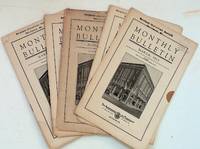
1923réf. 28588The Automobile Club of Maryland 1923. Paperback. Very Good. Paperback. Includes February 1923 March 1923 April 1923 August 1923 and March 1924. An interesting view into automotive history in Maryland. Issues include updates on new traffic laws taxes safety traffic complaints such as hogging the road club meetings road trips list of officers and staff list of service stations and short stories related to cars. Ex-library from the Maryland Historical Society with their stamp to the front of each issue. Side-stapled paper wrappers with black titles and photographic illustration to each cover. Some covers are present but either loose or detached. Some pages are chipped browned and stained; however text remains bright and legible. Issues are 8 pages each. MD/090215. The Automobile Club of Maryland paperback books
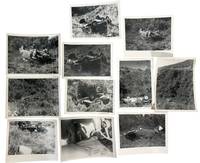
réf. 23903Automobile accident photo archive circa 1940s to 1950s documenting a severe rollover in which a passenger car left the roadway and came to rest inverted on a steep brush covered hillside. Eleven successive views record the wreck from the road above at intermediate distance and at close range preserving the vehicle's position damage and surrounding terrain. The sequence gives unusually sustained coverage to a single rural crash scene rather than treating the wreck as an isolated snapshot. Photo archive of 11 likely silver gelatin photographs circa 1940s to 1950s. The photographs show the overturned automobile from multiple sides its undercarriage and wheels exposed with several wider views establishing the considerable distance between the roadway and the point where the car stopped. Closer photographs record crushed body panels and the collapsed passenger compartment; one interior view shows a human arm amid the damaged cabin while another image includes a man standing beside the wreck. By the late 1940s photography had become an established part of formal traffic accident investigation: FBI police training material in 1947 specifically addressed photographic evidence in accident work and 1950 guidance included photographing and measuring the scene among standard investigative procedures. FBI: Law Enforcement Bulletin The repeated changes of distance and viewpoint here closely parallel that documentary concern with position damage and scene context. Light edge wear minor curling and occasional handling marks. Overall in good condition. A concentrated photographic record of a serious midcentury automobile rollover from landscape view to damaged interior. unknown books
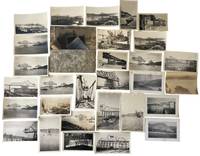
1927réf. 233011927. Carquinez Bridge construction photo archive documenting the industrial development of the 1927 cantilever crossing at the Carquinez Strait a transportation project driven by California's rapid automobile growth and the mounting inadequacy of the Vallejo ferry connection between the Bay Area and Sacramento. By the early 1920s California vehicle registrations had risen sharply ferry traffic across the strait had become a bottleneck and the new span created the first direct highway link between San Francisco and Sacramento when it opened in May 1927. Positioned between the first major wave of California highway investment in the 1910s and the later Freeway Era the archive records bridge construction as an industrial process showing how steel members cranes temporary decking marine equipment and high-angle labor were organized into a permanent transportation crossing. With two main spans of 1100' each the Carquinez Bridge at the time of its completion was the fourth largest cantilever truss bridge in the world and the second largest in the United States Photo archive of 31 silver gelatin photographs plus 12 photographic negatives ranging from roughly 3 x 5 to 3.5 x 6 inches Carquinez Strait California circa 1927. Most of the prints focus on the bridge construction process. The 1927 Carquinez Bridge was the first major auto bridge in the San Francisco Bay Area designed to resist seismic forces with piers extending 135 feet below water and notes its role as the first direct highway link between Sacramento and San Francisco. Exterior views show the cantilever arms extending out over open water from tall steel towers with large truss sections still incomplete the suspended span not yet joined and the full geometry of the crossing legible at successive phases of erection. Several photographs are taken from elevated ground above shoreline houses and industrial buildings locating the bridge within a worked waterfront rather than an isolated engineering view. Others are made from water level where the steel rises directly from the strait and barges work boats and temporary supports register the marine logistics required to build in the channel. One close construction view looks straight down a temporary work deck lined with rails or timbers toward cranes and hoisting apparatus embedded inside the growing steel frame. Another shows a group of workers seated and standing on a riveted member before placement making the relationship between labor and material explicit without shifting the archive away from its central subject the structure under assembly. Additional prints show falsework approach grading industrial shoreline staging and spectator vantage points from which the nearly completed trusses were watched from land. Versos carry Velox paper marks oval WEBBS processing stamps dated March 14 1927 on several prints and manuscript or stamped inventory numbers. The 12 negatives are secondary material and include unrelated vernacular subjects by the same photographer among them floodwater truss bridges a rifle-range scene and a few domestic snapshots. The archive belongs to the period when California road building and bridge construction accelerated to meet automobile traffic that older ferry systems could no longer absorb. In these photographs infrastructure is not presented as a finished monument but as an active building process with the visual emphasis placed on staged steel erection temporary supports shoreline preparation marine access and workers operating within narrow elevated material-heavy conditions. Light curling minor creasing and scattered discoloration on few with verso stamps or notations; overall good condition. Archive of photographs showing a necessary piece of California transportation infrastructure being built with the labor system and material processes documented. unknown books
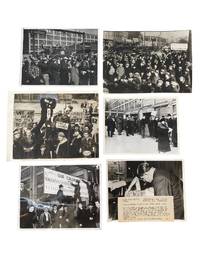
1937réf. 234461937. Labor Organization Chrysler strike press photo archive documenting the 1937 sit down strikes and picketing campaigns at Dodge Main and other Chrysler facilities in Detroit and Highland Park Michigan during the decisive phase of industrial unionization in the American automobile industry. The archive records workers occupying plants mass picket mobilizations outside factory gates anti injunction demonstrations and violence connected to the struggle between Chrysler management the United Automobile Workers and competing independent unions. These events unfolded only weeks after the February 1937 settlement of the Flint sit down strike against General Motors which established the UAW as a major industrial union and accelerated organizing efforts across Detroit's auto plants. Chrysler initially resisted recognition obtaining court injunctions ordering workers to evacuate occupied factories while thousands of laborers remained inside the plants or formed flying squadrons to block strikebreakers from entering. The scenes here capture the atmosphere of confrontation in Depression era industrial labor conflict at a time when mass production workers forced some of the largest corporations in the United States to negotiate with organized labor. Photo archive of 6 silver gelatin press photographs from 6 x 8 inches to 8 x 10 inches Detroit and Highland Park Michigan 1937. Affixed captions on versos with filing stamps dated March and August 1937. Crowds of striking workers gather outside Dodge Division and Chrysler factory gates beneath signs reading "Dodge Division of Chrysler Corporation Employment Office" and "We Are Here To Stay Dept. 82." Several men hold placards reading "82 is Sittin Too" "Spirit of 1937" and "Fence Jumper" while an effigy labeled "Injunction" hangs over the crowd in open defiance of a court order directing workers to vacate occupied plants. A large calendar board records the passing days of the sit down occupation beginning March 8 1937. Another scene shows relatives and supporters communicating with occupying workers through numbered department cards hung along the perimeter fence after union organizers established an improvised locating system for men inside the plant. One caption identifies "flying squadrons" directing picket activity outside Chrysler headquarters. The latest photograph records Frank A. Dillon identified as president of an independent Chrysler union receiving questioning from Detective Sergeant Harry Scher after an alleged beating connected to union violence that led Chrysler officials to temporarily close a plant pending investigation. The Chrysler strike formed part of the larger wave of industrial labor upheaval that reshaped American manufacturing during the New Deal. Passage of the Wagner Act in 1935 legally protected collective bargaining but enforcement depended on workers physically preventing corporations from continuing production with replacement labor. Sit down strikes became one of the most controversial tactics of the era because occupying workers halted machinery while denying employers access to their own factories. The archive preserves not only the mechanics of strike organization but also the public theater of industrial conflict in Depression era Detroit: marching pickets improvised communication systems anti injunction symbolism and massive worker assemblies outside factory gates. Moderate surface wear occasional creasing editorial markings and toning to versos with captions firmly affixed; images remain sharp and highly legible. Overall very good condition. unknown books
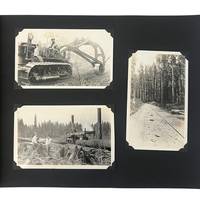
1930réf. 234241930. California photo Album documenting 1930's roadside commerce's Oil and logging industries and desert sightseeing across Southern California and Death Valley circa 1930s. Include logging photographs made when steam power still ran the woods before the gasoline tractor and chainsaw displaced the steam donkey engine and the logging railroad. The photographs were made just as the paved highway and the auto court were turning the California desert and mountains into a tourist destination reachable by family car. John Marshall High School in Los Angeles shown new and unweathered in the album opened its doors on January 26 1931 fixing the album's date to that year or shortly after. Photo Album of 116 silver gelatin photographs mostly snapshot format ranging approx 3 x 5 to 5 x 7 inches California Sierra Nevada and Death Valley circa 1931 to 1935. The logging images show a tracked crawler tractor fitted with a tall steel arch for skidding logs a steam donkey engine venting steam beside a yarding spar rigged with cables decked logs stacked on railcars marked with painted numbers a single rail line running through uncut timber and a man in suspenders and field hat standing beside a standing tree with a felling axe and undercut wedge driven into the trunk. The Southern California group includes wooden oil derricks stepped up a steep eroded canyon wall three women in cloche hats and drop-waist dresses standing arm in arm on a pile of oil-field casing pipe a touring sedan with passengers parked among the derricks a typed caption reading "No 4. Artist's Drive. Death Valley" above eroded badland hills the neon-topped "El Don Motel" sign advertising kitchenettes and refrigeration the "Beechwood Motor Apartments" and "Aut-O-Tel" auto court a palm-lined commercial street with a Citizens Bank and parked Model A automobiles the Collegiate Gothic John Marshall High School captioned in pencil the grounds of the Hotel del Coronado covered wagons drawn up in a mountain meadow a backyard scene of an older couple outside a board cabin and harbor views with a small fishing boat numbered "A 619." Photographs are mounted with black corner tabs on black album leaves several captioned in pencil or by typed slip. Southern California in the early 1930s was the most prolific oil-producing region in the world with derricks crowding canyons and city lots from Signal Hill to the Newhall fields and the album captures ordinary visitors treating an active oil field as a sightseeing stop. The same years saw the auto court and motel emerge along the new highways and the El Don and Aut-O-Tel signs document that roadside lodging industry in its first decade. The logging photographs record steam-era timber work the crawler tractor and steam donkey caught at the moment mechanized gasoline equipment was about to replace them. Overall in very good condition with some fading to individual prints. The album places steam-era timber work and first-decade California auto travel side by side recorded firsthand during the years of the development of roadside infrastructure. unknown books
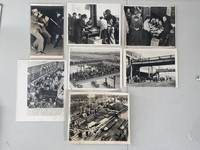
1941réf. 234341941. Labor Organizing Ford River Rouge plant labor photo archive documenting the struggle over union recognition strike enforcement and industrial bargaining at Ford Motor Company between 1941 and 1953. River Rouge was Ford's massive Dearborn complex where raw materials blast furnaces rail lines ships assembly shops and tens of thousands of workers were concentrated at one site. Ford resisted the United Auto Workers longer than General Motors and Chrysler and the 1941 strike forced the company into an NLRB-supervised vote that led to UAW representation at Rouge. The later 1949 strike over speed-up conditions demonstrates the continued role of the union in protecting workers from unreasonable production paces giving bargaining authority and strengthening worker control inside the plant. Photo archive of 7 Large silver gelatin press photographs measuring between 7 x 8 and 8 x 10 inches Dearborn and Detroit Michigan 1941-1953. Workers stream across elevated pedestrian bridges into the Rouge gates crowd plant entrances receive ballots under the supervision of officials and a Michigan State Police officer and stand in picket lines outside Ford buildings. A Black worker charges toward a picket while a state policeman advances with club raised with the Acme caption identifying the incident as "Vengeance at River Rouge" on April 4 1941. Other captions identify Sunday dinner served to pickets on April 6 1941; thousands returning to work after settlement of the UAW-CIO strike on April 14 1941; workers voting in the NLRB election on May 21 1941; pickets entertained from a truck during the May 1949 walkout; and Ford's River Rouge plant in 1953 described by the Ford News Department as employing more than 60000 and able to turn raw materials into a finished car in 28 hours. The archive records both the scale of River Rouge and the mechanics of labor conflict: police interference union voting picketing crowds and shop workers moving between strike and production. It connects the 1941 recognition fight to the postwar UAW's continuing battles over working conditions at one of the most closely watched industrial sites in the United States. Creasing handling wear surface marks and caption wear; images remain intact and legible. Overall in good condition. unknown books
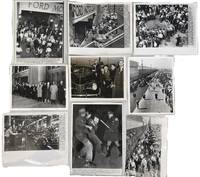
1941réf. 234311941. Labor Organizing Ford River Rouge plant press photographs documenting labor conflict picketing and union organization at the largest industrial complex in the United States from the early UAW recognition battles of 1941 through the major Ford walkouts of 1949 and 1967. The River Rouge plant in Dearborn employed tens of thousands of workers and was the center of Ford's anti-union resistance during the rise of the Congress of Industrial Organizations CIO. Ford Motor Company remained the last major Detroit automaker to recognize the United Auto Workers after General Motors and Chrysler signed contracts following the 1936-1937 sit-down strikes. Several scenes here connect directly to the April 1941 strike that finally forced Ford to negotiate with the UAW after years of union busting and company sanctioned violence against organizers. Later scenes document the 1949 strike involving roughly 65000 workers and the 1967 Rouge walkout documenting three decades of union activity in the American auto labor history. Photo archive of 9 black-and-white press photographs silver gelatin prints ranging from 7 x 9" to 8 x 11" Dearborn and Detroit Michigan 1941-1967. Photographs show UAW members at Rouge plant gates carrying placards reading "Ford Is On Strike" while reporters and cameramen surround circular picket formations outside the factory entrances. One scene records women from the Women's Auxiliary of UAW Local 600 marching in orderly formation with American flags during an April 1941 demonstration outside the Rouge complex. Another captures a state policeman advancing with baton raised as two men recoil during violence near a plant gate; the attached caption identifies one figure as an unidentified Black man striking a UAW picket captain. Additional scenes show workers waiting in line for pay envelopes during the strike men gathered outside plant entrances under heavy guard and a largely idle assembly floor where a lone foreman sits beside silent production lines after tens of thousands of workers walked out. Typed press captions affixed to versos on image margins including references to the May 1949 strike and September 1967 Rouge picketing. The Ford strikes were some of the most consequential labor battles in twentieth-century American industry. Ford's Service Department under Harry Bennett built an extensive anti-union apparatus that used labor spies intimidation and physical violence against organizers culminating in nationally publicized confrontations such as the 1937 "Battle of the Overpass." The April 1941 strike represented the decisive collapse of Ford's resistance to industrial unionism and secured UAW recognition at the Rouge plant fundamentally changing labor relations in the American automobile industry. These scenes preserve not only the mechanics of organized strike action but also the scale of industrial labor mobilization in midcentury Detroit where mass demonstrations were central in the struggle between organized labor and corporate management. Light creasing scattered surface wear and minor handling marks consistent with newsroom use; captions and editorial markings largely intact and legible. Overall good to very good condition. unknown books
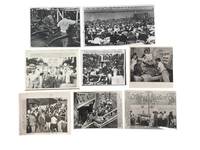
1961réf. 234081961. Labor Organizing United Auto Workers strike and labor photographs documenting national contract disputes factory shutdowns collective bargaining and picket line action across the American auto industry during the 1960s and 1970s. The group records major UAW conflicts involving General Motors Ford and Chrysler including the 1961 General Motors bargaining deadline the 1967 Ford strike in Los Angeles and the 1973 Chrysler contract dispute led by Leonard Woodcock and Douglas Fraser. These conflicts grew from fights over wages speedup compulsory overtime pensions medical coverage retirement eligibility and plant safety inside the nation's largest manufacturing sector. By the early 1970s the UAW represented more than one million workers and could halt production across dozens of plants through coordinated bargaining local picketing convention mobilization and public demonstrations. Photo archive of 8 Large silver gelatin press photographs one large panorama measuring approximately 8 x 14 inches and the remaining ranging from 8 x 8.5 to 8 x 10 inches primarily Detroit and Los Angeles 1961-1973. Workers paint strike placards inside a Local 15 UAW-CIO shop space with slogans including "Improve Working Conditions" "Free Paid Medical and Insurance" and "Stop Speed Up." Leonard Woodcock and Douglas Fraser march beside white-collar Chrysler employees carrying a sign reading "30 and Out No Age Limit." Ford workers gather beneath the "Ford Motor Co." sign at the Los Angeles assembly plant while signs reading "UAW on Strike for Justice" and "UAW Local 148" rise above the crowd. At Ford's Rouge plant hundreds of UAW members picket outside the entrance after a contract settlement while the attached caption notes that the plant employed roughly 33000 workers and that pickets remained after the "lonely guard" opened the gate. Factory interiors show chassis assembly lines rear axle installation and suspension components while a crowded convention hall displays banners reading "Get America Back to Work" and "Improve Working Conditions." The group demonstrates the UAW operations in the labor strife of the 60s and 70s: national officers negotiated with automakers local members prepared signs and walked gates convention delegates debated priorities and production workers controlled the pace of automobile output by withholding labor. Kennedy publicly intervened during the 1961 GM dispute to prevent a shutdown of the auto industry while the 1973 Chrysler negotiations centered on retirement working conditions and contract protections during a decade of inflation and labor unrest. Creasing edge wear scattered minor losses and occasional handling wear; captions editorial markings stamps and verso annotations retained throughout; images overall intact and clear. Overall in good condition. unknown books