Mexico Photography; Tourism and LeisureBiblio.com

6676 resultados
1950ref. 231941950. Mid-century Mexico photo archive of markets colonial architecture rural households and regional custom recording Mexico everyday labor Indigenous craft traditional dress and iconic national scenery. The photos primarily show on the ground local customs basket vendors seated behind stacks of woven wares pottery sellers in street market display women posed before hanging textiles and earthen vessels and a rural family gathered outside an adobe or jacal dwelling. These photos document monumental Mexico City life smaller scenes of household economy and village life cathedral plazas bullfighting spectacle Indigenous and mestizo craft traditions and rural environments. Photo archive of 20 real photo and photographic postcards varying postcard format sizes Mexico mid twentieth century. Visible captions identify scenes including "Vendedores de canastos. Mex." "Lacandon y textiles mayas C.D. de Las Casas Chis. Mex." "A Mexican Family / Mexican Casa / Adobe Huts" "El Zocalo Mexico D.F." "La Quebrada Acapulco Gro." "Patio de la fonda en San Blas Nay." and "En Xochimilco Mexico." The archive includes broad scenic and civic views of cathedral architecture plazas volcanic landscape lake and garden settings cliffside resort construction at Acapulco and waterfront or canal-side leisure scenes. Other cards focus closely on cultural and economic life: men in broad-brimmed hats selling baskets in market space pottery laid out for sale in the street women cooking outdoors in a scene labeled for the Mexican army a bullfighter in the arena a fruit or pottery market display a palm-thatched dwelling marked "A Mexican Home" and portraits tied to Chiapas and the Lacandon region. The archive belongs to a period when postcards were a primary vehicle for circulating Mexico as both modern nation and regional mosaic with tourism ethnographic curiosity and nationalist image-making all folded into the same marketable format. Light surface and edge wear; overall very good condition. The combination of major landmark views with market household and Indigenous-associated scenes gives the archive a grounded record of how mid century Mexico was pictured through work craft and regional custom. unknown
1950ref. 231941950. Mid-century Mexico photo archive of markets colonial architecture rural households and regional custom recording Mexico everyday labor Indigenous craft traditional dress and iconic national scenery. The photos primarily show on the ground local customs basket vendors seated behind stacks of woven wares pottery sellers in street market display women posed before hanging textiles and earthen vessels and a rural family gathered outside an adobe or jacal dwelling. These photos document monumental Mexico City life smaller scenes of household economy and village life cathedral plazas bullfighting spectacle Indigenous and mestizo craft traditions and rural environments. Photo archive of 20 real photo and photographic postcards varying postcard format sizes Mexico mid twentieth century. Visible captions identify scenes including "Vendedores de canastos. Mex." "Lacandon y textiles mayas C.D. de Las Casas Chis. Mex." "A Mexican Family / Mexican Casa / Adobe Huts" "El Zocalo Mexico D.F." "La Quebrada Acapulco Gro." "Patio de la fonda en San Blas Nay." and "En Xochimilco Mexico." The archive includes broad scenic and civic views of cathedral architecture plazas volcanic landscape lake and garden settings cliffside resort construction at Acapulco and waterfront or canal-side leisure scenes. Other cards focus closely on cultural and economic life: men in broad-brimmed hats selling baskets in market space pottery laid out for sale in the street women cooking outdoors in a scene labeled for the Mexican army a bullfighter in the arena a fruit or pottery market display a palm-thatched dwelling marked "A Mexican Home" and portraits tied to Chiapas and the Lacandon region. The archive belongs to a period when postcards were a primary vehicle for circulating Mexico as both modern nation and regional mosaic with tourism ethnographic curiosity and nationalist image-making all folded into the same marketable format. Light surface and edge wear; overall very good condition. The combination of major landmark views with market household and Indigenous-associated scenes gives the archive a grounded record of how mid century Mexico was pictured through work craft and regional custom. unknown books
2004ref. 2542191007062Notions - In Network 2004-04-01. Paperback. Very Good. Nice looking book has minor edge wear. Notions - In Network paperback
1987ref. 4400Couverture souple 1ère Édition Editions de Montfort 1987 Paris 37,5x29 cm
ref. 7426Bordeaux et Lille, 1911. Grand in 8 broché, manque au dos, LXVII-128pp. avec XXXVII planches, certaines dépliantes, certaines en couleurs.
ref. 7880Bordeaux et Lille, 1911. Grand in 8 broché, manque au dos, LXVII-128pp. avec XXXVII planches, certaines dépliantes, certaines en couleurs.
ref. 6696"P., Rotschild, 1891. In 8 demi-chagrin, dos à nerfs orné, XIX-errata-132 pp; et 25 planches montée sur onglet."
1936ref. 232721936. Camp Mabry and Texas personal photo album documenting prewar military camps domestic and civic life in Austin and San Antonio Arkansas political rally activity and Mexico in 1936 and 1937 with direct evidence of how an American soldier moved between troop grounds private homes city streets and cross border travel before the Second World War. Handwritten captions place the sequence at Bull Creek Road Breckenridge Park Dr. Davis's home in San Antonio the University of Texas Camp Mabry Pulaski political sites Mexico City and the pyramids and ruins visited on the Mexico trip. The Camp Mabry section shows troop buildings motor transport horses trench mortar practice parade formations and guard changes within the daily structure of a Texas military post in the late Depression period. Photo archive of 308 silver gelatin photographs and 1 photographic negative most measuring approximately 4 x 3 inches with several larger snapshot prints laid into the album Texas Arkansas and Mexico 1936 to 1937. Contemporary white ink captions identify places dates and subjects throughout including "Bull Creek Road / December 1936" "Bordeaux Home Thanksgiving November 1936" "Breckenridge Park S.A. 1937" "Dr. Davis's Home in San Antonio May 1937" "Ark. Stage During Political Rally" "Pulaski Office 1936 Aug" "State Capitol" "Congress Ave." "Law Bldg. Univ. Tex" "Motor Transport Units" "Troop Bldg." "Saddle Room" "Trench Mortar" "Troop Horses" "Parade" "Changing the Guards" "Mexico City" "El Gran Catedral" "Indian Ruins" "Big Pyramid" and "Early Ruins." The Texas photographs include women posed beside late 1930s automobiles garden and yard portraits at the Bordeaux home rocky riverbank scenes at Bull Creek and Marble Falls couples' snapshots and views around Austin and San Antonio. The Arkansas pages show storefronts hotel facades backstage and basement interiors campaign imagery around the Arkansas Theater and Pulaski office and men identified in caption as Ray Coley and Frank MacMahon. Camp Mabry appears in sustained sequence through barracks views transport lines artillery vehicles horse trough scenes calisthenics fields band and baseball activity parade grounds and numerous named soldiers and officers including Bill Brooks Capt. Sutton Capt. Müller Col. Boyd Maj. Newgarden Bill Connors Brown Luther Stone Jimmy Sadler and Jeff Kersey. The Mexico section extends from mountain roads and city streets to cathedral architecture and archaeological tourism including stepped pyramids broad stairways summit views and crowd scenes at the ruins. The album documents Texas in 1936 and 1937 Texas prewar military organization and the Mexico photographs placing the compiler within a broader 1930s culture of automobile tourism and hemispheric travel. Light edge wear to the album corner and mount wear scattered fading and silvering to some prints and handling wear to several laid in photographs; overall good condition. Photos from Camp Mabry act as dated records of daily troop routine at one of Texas's principal military posts that soon assumed a wartime home-front role as headquarters of the Texas Defense Guard. The dated photographs show Camp Mabry in the years immediately preceding World War II and the Arkansas and Mexico sections reveal how this interwar period allowed for movement leisure and social life in a way which would soon be restricted by the second world war. unknown
1936ref. 232721936. Camp Mabry and Texas personal photo album documenting prewar military camps domestic and civic life in Austin and San Antonio Arkansas political rally activity and Mexico in 1936 and 1937 with direct evidence of how an American soldier moved between troop grounds private homes city streets and cross border travel before the Second World War. Handwritten captions place the sequence at Bull Creek Road Breckenridge Park Dr. Davis's home in San Antonio the University of Texas Camp Mabry Pulaski political sites Mexico City and the pyramids and ruins visited on the Mexico trip. The Camp Mabry section shows troop buildings motor transport horses trench mortar practice parade formations and guard changes within the daily structure of a Texas military post in the late Depression period. Photo archive of 308 silver gelatin photographs and 1 photographic negative most measuring approximately 4 x 3 inches with several larger snapshot prints laid into the album Texas Arkansas and Mexico 1936 to 1937. Contemporary white ink captions identify places dates and subjects throughout including "Bull Creek Road / December 1936" "Bordeaux Home Thanksgiving November 1936" "Breckenridge Park S.A. 1937" "Dr. Davis's Home in San Antonio May 1937" "Ark. Stage During Political Rally" "Pulaski Office 1936 Aug" "State Capitol" "Congress Ave." "Law Bldg. Univ. Tex" "Motor Transport Units" "Troop Bldg." "Saddle Room" "Trench Mortar" "Troop Horses" "Parade" "Changing the Guards" "Mexico City" "El Gran Catedral" "Indian Ruins" "Big Pyramid" and "Early Ruins." The Texas photographs include women posed beside late 1930s automobiles garden and yard portraits at the Bordeaux home rocky riverbank scenes at Bull Creek and Marble Falls couples' snapshots and views around Austin and San Antonio. The Arkansas pages show storefronts hotel facades backstage and basement interiors campaign imagery around the Arkansas Theater and Pulaski office and men identified in caption as Ray Coley and Frank MacMahon. Camp Mabry appears in sustained sequence through barracks views transport lines artillery vehicles horse trough scenes calisthenics fields band and baseball activity parade grounds and numerous named soldiers and officers including Bill Brooks Capt. Sutton Capt. Müller Col. Boyd Maj. Newgarden Bill Connors Brown Luther Stone Jimmy Sadler and Jeff Kersey. The Mexico section extends from mountain roads and city streets to cathedral architecture and archaeological tourism including stepped pyramids broad stairways summit views and crowd scenes at the ruins. The album documents Texas in 1936 and 1937 Texas prewar military organization and the Mexico photographs placing the compiler within a broader 1930s culture of automobile tourism and hemispheric travel. Light edge wear to the album corner and mount wear scattered fading and silvering to some prints and handling wear to several laid in photographs; overall good condition. Photos from Camp Mabry act as dated records of daily troop routine at one of Texas's principal military posts that soon assumed a wartime home-front role as headquarters of the Texas Defense Guard. The dated photographs show Camp Mabry in the years immediately preceding World War II and the Arkansas and Mexico sections reveal how this interwar period allowed for movement leisure and social life in a way which would soon be restricted by the second world war. unknown books
1996ref. 236891996. Very large 1990s Los Angeles street culture photo negative archive with over 1000 images circa 1996 to 1999 recording the social scene of Hollywood Boulevard through street fashion performance tourism nightlife events and informal local portraits. The negatives show people on Hollywood Boulevard and nearby venues: break dancers performing on the Walk of Fame teenagers in streetwear musicians fashion shows costumed entertainers police officers tourists posing with Hollywood signs families nightclub patrons merchants and local personalities known to the photographer by name or occupation. A vibrant contemporary collection of Los Angeles street culture in the late 1990s. Archive of approximately 1038 color and black and white photographic negatives Los Angeles circa 1996 to 1999. Photographer unknown. Individual negatives measure approximately 1 x 1.5 inches and are retained in strips of three to six exposures in archival sleeves bound in a red faux leather binder embossed "The Melaleuca Portfolio". The Los Angeles material centers on Hollywood Boulevard and the Walk of Fame including dancers performing for sidewalk crowds portraits outside the Chinese Theatre Halloween costumes nightclub and fashion events police motorcycles and patrol cars street vendors visitors displaying Hollywood souvenirs and people posing beside limousines convertibles advertising vehicles storefronts and entertainment landmarks. Handwritten captions include "Basketball Players" "Girls on Marilyn" "Tanya - Star Trek Writer" "99/Boulevard" "Dr. Jones" "Carlos Cassio - Drug Bust @ Hotel" "Roesha" "Policewoman on Bicycle" "Fashion Show" "Blvd. Oct. Nov - 96 Halloween" and "Cable Guy Premiere" while several sheets document repeated portrait sittings public performances group gatherings and street encounters over multiple frames. About 30 images from Las Vegas show performers in masks and costumes interiors that appear to be hotels or casinos and portraits from the same period. Hollywood Boulevard in the late 1990s attracted residents street performers tourists promoters aspiring entertainers and nightlife patrons from all walks of life to the famous aisle of movie theatres and the Walk of Fame. These negatives record that environment at the street level with special attention to street wear and performers musicians and local characters. Negatives remain housed in sleeves and retain generally strong image density; occasional blank frames handling marks and isolated surface wear. Overall very good condition. A dense record of LA fashion performance tourism nightlife and informal portraits on Hollywood Boulevard at the close of the twentieth century. unknown
1996ref. 236891996. Very large 1990s Los Angeles street culture photo negative archive with over 1000 images circa 1996 to 1999 recording the social scene of Hollywood Boulevard through street fashion performance tourism nightlife events and informal local portraits. The negatives show people on Hollywood Boulevard and nearby venues: break dancers performing on the Walk of Fame teenagers in streetwear musicians fashion shows costumed entertainers police officers tourists posing with Hollywood signs families nightclub patrons merchants and local personalities known to the photographer by name or occupation. A vibrant contemporary collection of Los Angeles street culture in the late 1990s. Archive of approximately 1038 color and black and white photographic negatives Los Angeles circa 1996 to 1999. Photographer unknown. Individual negatives measure approximately 1 x 1.5 inches and are retained in strips of three to six exposures in archival sleeves bound in a red faux leather binder embossed "The Melaleuca Portfolio". The Los Angeles material centers on Hollywood Boulevard and the Walk of Fame including dancers performing for sidewalk crowds portraits outside the Chinese Theatre Halloween costumes nightclub and fashion events police motorcycles and patrol cars street vendors visitors displaying Hollywood souvenirs and people posing beside limousines convertibles advertising vehicles storefronts and entertainment landmarks. Handwritten captions include "Basketball Players" "Girls on Marilyn" "Tanya - Star Trek Writer" "99/Boulevard" "Dr. Jones" "Carlos Cassio - Drug Bust @ Hotel" "Roesha" "Policewoman on Bicycle" "Fashion Show" "Blvd. Oct. Nov - 96 Halloween" and "Cable Guy Premiere" while several sheets document repeated portrait sittings public performances group gatherings and street encounters over multiple frames. About 30 images from Las Vegas show performers in masks and costumes interiors that appear to be hotels or casinos and portraits from the same period. Hollywood Boulevard in the late 1990s attracted residents street performers tourists promoters aspiring entertainers and nightlife patrons from all walks of life to the famous aisle of movie theatres and the Walk of Fame. These negatives record that environment at the street level with special attention to street wear and performers musicians and local characters. Negatives remain housed in sleeves and retain generally strong image density; occasional blank frames handling marks and isolated surface wear. Overall very good condition. A dense record of LA fashion performance tourism nightlife and informal portraits on Hollywood Boulevard at the close of the twentieth century. unknown books
2013ref. 1-1464715785Leisure Arts 2013. Paperback. New. 48 pages. 11.00x8.50x0.25 inches. Leisure Arts paperback
1914ref. 231551914. Caribbean photograph album likely compiled by a person connected to the Panama Canal Zone and the Caribbean documenting how steamship mobility port circulation and U.S. imperial presence linked Jamaica Venezuela Trinidad Barbados Cuba Puerto Rico the Bahamas Florida and Panama in the years after the canal opened. The felt cover lettered "PANAMA" and bearing the Seal of the Canal Zone places the album within the new travel geography created by U.S. control of the Canal Zone and the canal's 1914 opening when Panama became a central hinge between Atlantic and Pacific movement and a major point of contact between North American travelers and Caribbean port cities. Photos show passengers on steamers and docks markets and streets forts and government buildings and repeated encounters between white visitors and Afro Caribbean and mixed-heritage residents across multiple colonial and semi-colonial settings. Panama Canal Zone travel photograph album. Caribbean and circum-Caribbean locations including Kingston Jamaica; La Guaira and Caracas Venezuela; Trinidad; Key West and Palm Beach Florida; Havana Cuba; Barbados; Panama City Balboa and Colón Panama; Nassau Bahamas; and San Juan Puerto Rico. Likely circa mid 1910s to early 1920s. Oblong felt-covered album measuring 6.5" x 11" with "PANAMA" stitched in large letters on the front cover and photographs pasted to grey leaves. Contains more than 160 black-and-white photographs most approximately 2.5 x 4.5 inches many with handwritten captions identifying locations activities and occasional names. The sequence opens in Kingston with captions including "Kingston JA" and "on the steamer" then moves through island and mainland stops; "Port of Spain Trinidad" "Market at Barbados" "Rapid Transit Barbados" "Havana Cuba" "San Juan Porto Rico" "Morro Castle" "Balboa" and "Colon R.P." Repeated figures especially a young college-aged woman and an older woman appear throughout. Notable images include a group of locals in shallow water at Barbados sifting for tossed coins from rowboats; a large crowd scene in San Juan gathered for what appears to be a public speech or civic event; battlements cannon and stone defenses in Havana; vernacular dwellings and children in impoverished conditions in Balboa; posed visitor photographs in what is labeled a "bull ring"; and numerous street dockside market and architectural views that juxtapose local populations with hotels public buildings ruins and newer urban construction. The album's historical force comes from the way it captures the social landscape of Caribbean travel under early twentieth-century U.S. power. After 1914 the Canal Zone intensified Panama's role within a wider American maritime sphere while Caribbean travel increasingly moved through port infrastructures shaped by empire commerce military strategy and tourism; this album records that world at eye level with photographs of docks steamers fortifications government sites public squares and local street life rather than limiting themselves to family snapshots alone. At the same time the images preserve the unequal human encounters built into that system especially where visitors photograph Black children boatmen market crowds and working neighborhoods as part of the travel experience. Felt cover worn and soiled with losses at edges and stitching strain; leaves brittle with chipping and tears; photographs generally present and legible with silvering fading corner wear and occasional losses or lifting. Overall fair to good condition. A substantial early twentieth-century visual record of Canal Zone connected Caribbean travel with dense captioning and wide geographic reach from Jamaica and Barbados to Havana San Juan and Panama. unknown
1914ref. 231551914. Caribbean photograph album likely compiled by a person connected to the Panama Canal Zone and the Caribbean documenting how steamship mobility port circulation and U.S. imperial presence linked Jamaica Venezuela Trinidad Barbados Cuba Puerto Rico the Bahamas Florida and Panama in the years after the canal opened. The felt cover lettered "PANAMA" and bearing the Seal of the Canal Zone places the album within the new travel geography created by U.S. control of the Canal Zone and the canal's 1914 opening when Panama became a central hinge between Atlantic and Pacific movement and a major point of contact between North American travelers and Caribbean port cities. Photos show passengers on steamers and docks markets and streets forts and government buildings and repeated encounters between white visitors and Afro Caribbean and mixed-heritage residents across multiple colonial and semi-colonial settings. Panama Canal Zone travel photograph album. Caribbean and circum-Caribbean locations including Kingston Jamaica; La Guaira and Caracas Venezuela; Trinidad; Key West and Palm Beach Florida; Havana Cuba; Barbados; Panama City Balboa and Colón Panama; Nassau Bahamas; and San Juan Puerto Rico. Likely circa mid 1910s to early 1920s. Oblong felt-covered album measuring 6.5" x 11" with "PANAMA" stitched in large letters on the front cover and photographs pasted to grey leaves. Contains more than 160 black-and-white photographs most approximately 2.5 x 4.5 inches many with handwritten captions identifying locations activities and occasional names. The sequence opens in Kingston with captions including "Kingston JA" and "on the steamer" then moves through island and mainland stops; "Port of Spain Trinidad" "Market at Barbados" "Rapid Transit Barbados" "Havana Cuba" "San Juan Porto Rico" "Morro Castle" "Balboa" and "Colon R.P." Repeated figures especially a young college-aged woman and an older woman appear throughout. Notable images include a group of locals in shallow water at Barbados sifting for tossed coins from rowboats; a large crowd scene in San Juan gathered for what appears to be a public speech or civic event; battlements cannon and stone defenses in Havana; vernacular dwellings and children in impoverished conditions in Balboa; posed visitor photographs in what is labeled a "bull ring"; and numerous street dockside market and architectural views that juxtapose local populations with hotels public buildings ruins and newer urban construction. The album's historical force comes from the way it captures the social landscape of Caribbean travel under early twentieth-century U.S. power. After 1914 the Canal Zone intensified Panama's role within a wider American maritime sphere while Caribbean travel increasingly moved through port infrastructures shaped by empire commerce military strategy and tourism; this album records that world at eye level with photographs of docks steamers fortifications government sites public squares and local street life rather than limiting themselves to family snapshots alone. At the same time the images preserve the unequal human encounters built into that system especially where visitors photograph Black children boatmen market crowds and working neighborhoods as part of the travel experience. Felt cover worn and soiled with losses at edges and stitching strain; leaves brittle with chipping and tears; photographs generally present and legible with silvering fading corner wear and occasional losses or lifting. Overall fair to good condition. A substantial early twentieth-century visual record of Canal Zone connected Caribbean travel with dense captioning and wide geographic reach from Jamaica and Barbados to Havana San Juan and Panama. unknown books
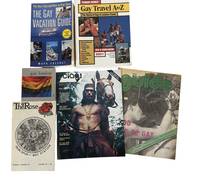
1978ref. 211511978. Gay travel guides published between 1978 and 2002 document the development of LGBTQ social spaces and travel networks during the late twentieth century. Printed guides of this kind served as practical tools for gay and lesbian travelers seeking safe environments and community venues in cities and tourist destinations. At a time when many establishments serving LGBTQ patrons were not openly advertised in mainstream publications specialized travel guides compiled addresses telephone numbers and descriptions of bars restaurants hotels gyms clubs and other gathering places. Today these publications provide valuable documentation of LGBTQ cultural geography preserving records of venues and community spaces that often operated informally and have since disappeared. Archive contains six travel guides and magazines published between 1978 and 2002 documenting LGBTQ travel destinations and social venues in North America and Europe. The publications include directories of establishments travel advice and descriptions of cities known for active LGBTQ communities. Many listings include addresses telephone numbers and brief descriptions of businesses catering to gay and lesbian travelers. 1 Ciao! The World of Gay Travel. New York: QQ Publications 1978. 54 pages. Early international gay travel magazine featuring destinations including Canada Malaysia El Salvador and Morocco with numerous listings for cafes bars restaurants and other venues. 2 The Rose. Vol. 1 No. 15. 1980. 43 pages. Travel and lifestyle guide focused on Southern California with listings for gay and gay friendly bars restaurants clubs gyms and entertainment venues. 3 The Guide to Gay New England. Boston: The Haymarket 1987. 70 pages. Travel guide covering New England destinations including cities such as Providence and Manchester as well as established resort communities including Provincetown. 4 Gay London: A Guide. London: Ellipsis 1999. Guide to LGBTQ nightlife and community spaces in London including bars clubs bookstores and cafes. 5 Ferrari Guides: Gay Travel A to Z. Phoenix: Ferrari International Publications 2001. 160 pages. Directory style guide listing United States destinations with entries for bars tour operators bathhouses and related venues. 6 Chesnut Mark. The Gay Vacation Guide: The Best Trips and How to Plan Them Revised and Updated. New York: Kensington Books 2002. 212 pages. Travel planning guide featuring information on resorts cruises tours and seasonal destinations popular among LGBTQ travelers. Together these publications illustrate the growth of LGBTQ tourism and the increasing visibility of queer social networks during the late twentieth century. Travel directories such as these helped connect travelers with welcoming venues and contributed to the development of identifiable LGBTQ neighborhoods and resort destinations. The guides also preserve historical records of establishments that have since closed making them useful sources for studying the geography of LGBTQ culture and nightlife. Volumes remain clean and well preserved with light handling wear. Very good condition overall and a representative group of late twentieth century LGBTQ travel publications. unknown
1978ref. 211511978. Gay travel guides published between 1978 and 2002 document the development of LGBTQ social spaces and travel networks during the late twentieth century. Printed guides of this kind served as practical tools for gay and lesbian travelers seeking safe environments and community venues in cities and tourist destinations. At a time when many establishments serving LGBTQ patrons were not openly advertised in mainstream publications specialized travel guides compiled addresses telephone numbers and descriptions of bars restaurants hotels gyms clubs and other gathering places. Today these publications provide valuable documentation of LGBTQ cultural geography preserving records of venues and community spaces that often operated informally and have since disappeared. Archive contains six travel guides and magazines published between 1978 and 2002 documenting LGBTQ travel destinations and social venues in North America and Europe. The publications include directories of establishments travel advice and descriptions of cities known for active LGBTQ communities. Many listings include addresses telephone numbers and brief descriptions of businesses catering to gay and lesbian travelers. 1 Ciao! The World of Gay Travel. New York: QQ Publications 1978. 54 pages. Early international gay travel magazine featuring destinations including Canada Malaysia El Salvador and Morocco with numerous listings for cafes bars restaurants and other venues. 2 The Rose. Vol. 1 No. 15. 1980. 43 pages. Travel and lifestyle guide focused on Southern California with listings for gay and gay friendly bars restaurants clubs gyms and entertainment venues. 3 The Guide to Gay New England. Boston: The Haymarket 1987. 70 pages. Travel guide covering New England destinations including cities such as Providence and Manchester as well as established resort communities including Provincetown. 4 Gay London: A Guide. London: Ellipsis 1999. Guide to LGBTQ nightlife and community spaces in London including bars clubs bookstores and cafes. 5 Ferrari Guides: Gay Travel A to Z. Phoenix: Ferrari International Publications 2001. 160 pages. Directory style guide listing United States destinations with entries for bars tour operators bathhouses and related venues. 6 Chesnut Mark. The Gay Vacation Guide: The Best Trips and How to Plan Them Revised and Updated. New York: Kensington Books 2002. 212 pages. Travel planning guide featuring information on resorts cruises tours and seasonal destinations popular among LGBTQ travelers. Together these publications illustrate the growth of LGBTQ tourism and the increasing visibility of queer social networks during the late twentieth century. Travel directories such as these helped connect travelers with welcoming venues and contributed to the development of identifiable LGBTQ neighborhoods and resort destinations. The guides also preserve historical records of establishments that have since closed making them useful sources for studying the geography of LGBTQ culture and nightlife. Volumes remain clean and well preserved with light handling wear. Very good condition overall and a representative group of late twentieth century LGBTQ travel publications. unknown books
ref. 19494Paris, Maradan, 1803-1806. 4 vol. in-12, VIII-VIII-247-[1] pp. 1 pl. + [4]-306 pp. 1 pl. + XIV-349 pp. 1 pl. + XX-336 pp. 1 pl., bradel de de mi-toile brune, dos long orné du titre doré (quelques rousseurs et taches, pâle mouillure à la gravure et au titre du 2e vol.)
ref. 23678Genève, Oscar Buess, [1917]. In-4 oblong, 65 pp. 48 pl., broché, cartonnage à dos de toile de aubergine (cartonnage défraîchi, dos décollé, quelques rousseurs et taches).
ref. 17255Paris, chez tous les libraires, 1860. In-12, 188 pp., 1 pl., maroquin rouge, dos à nerfs, titre doré au dos, tête dorée, couverture conservée (quelques petites déchirures, couverture défraîchie, rousseurs, pâles mouillures, restaurations du papier).
1888ref. 109730Paris, C. Marpon et E. Flammarion 1888 Ensemble de 2 volumes. In-4 26 x 16,5 cm. Reliures demi-maroquin rouille à coins, dos à 5 nerfs, titres et dates dorés au dos, têtes dorées, couvertures conservées. Vol. I : Les Femmes de sport. Préface par Henri Houssaye et Lettre de Catulle Mendès, [3] ff., IX pp., [1] ff., VI pp., [1] ff., 187 pp., [2] ff., 22 gravures et vignettes in-texte. édition originale. Tirage à 500 exemplaires numérotés, celui-ci, un des 464 sur papier de Hollande justifié “Au Bon de Vaux” - Vol. II : Les Hommes de sport. Préface par Alexandre Dumas. [4] ff., XXI pp., [1] ff., 336 pp., 18 portraits hors-texte gravés sur Chine, vignettes dans le texte. édition originale. Tirage à 500 exemplaires numérotés, celui-ci, un des 463 sur papier de Hollande. Très bel ensemble. Reliures légèrement frottées, intérieur et planches d’une grande fraîcheur.
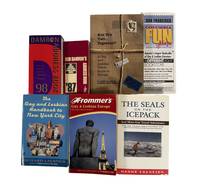
1987ref. 209821987. Damron Bob Lindsy Van Gelder Pamela Robin Brandt Hanns Ebensten and others archive of seven travel publications and related materials dating from 1987 to 2003 documents the development of queer travel infrastructure and the circulation of information necessary for LGBTQ individuals to navigate public space safely in the late twentieth century. Produced during and after the AIDS crisis these guides provided listings of bars hotels medical resources and social organizations at a time when visibility and safety varied widely by region. The publications extend a tradition of minority travel guides comparable in function to The Negro Motorist Green Book offering practical tools for identifying supportive environments and avoiding hostile ones. Early editions of the Damron guides compiled through firsthand travel by Bob Damron established a model for cataloging queer friendly spaces across North America and beyond while later publications expanded coverage to Europe and incorporated broader cultural and political resources. Archive of seven items comprising five travel guides one fold out map and one volume of travel writing published between 1987 and 2003. Items include: 1 Damron Bob. Damron Address Book. San Francisco 1987. Approximately 3 x 6 inches. Contains over 6000 listings across the United States Canada and Mexico with extensive coverage of U.S. locations. 2 Van Gelder Lindsy and Pamela Robin Brandt. Are You Two.Together A Gay and Lesbian Travel Guide to Europe. 1991. Approximately 345 pages. Covers accommodations dining and travel sites across multiple European countries. Signed by both authors. 3 The Gay and Lesbian Handbook to New York City. 1994. Approximately 277 pages. Includes listings for cultural venues social organizations and medical resources including AIDS related services. 4 Columbia Fun Maps: Mapping the Gay and Lesbian World. San Francisco 1995. Fold out map with directory of businesses and resources in San Francisco. 5 Damron Bob. Damron Address Book. 1998. Expanded edition with hundreds of pages of listings across North America the Caribbean and Europe. 6 Ebensten Hanns. The Seals on the Icepack and More Gay Travel Adventures. 1999. Signed and inscribed. Travel narratives documenting experiences in multiple global locations. 7 Frommer's Gay and Lesbian Europe. 2003. Comprehensive guide to travel across the United Kingdom and continental Europe. These materials document how LGBTQ travelers relied on print networks to construct routes of movement community and safety prior to the widespread availability of digital resources. The guides reveal the geographic distribution of queer spaces the integration of medical and social support listings during the AIDS crisis and the expansion of international travel opportunities in the late twentieth century. Ebensten's travel writing provides a narrative counterpart to directory based guides offering firsthand accounts that complement the logistical frameworks of the other publications. Together the archive provides evidence of how queer communities mapped social belonging across cities and nations contributing to the study of LGBTQ history tourism and spatial politics. Light handling wear across volumes with typical age toning; overall clean and stable. Overall very good condition. unknown
1987ref. 209821987. Damron Bob Lindsy Van Gelder Pamela Robin Brandt Hanns Ebensten and others archive of seven travel publications and related materials dating from 1987 to 2003 documents the development of queer travel infrastructure and the circulation of information necessary for LGBTQ individuals to navigate public space safely in the late twentieth century. Produced during and after the AIDS crisis these guides provided listings of bars hotels medical resources and social organizations at a time when visibility and safety varied widely by region. The publications extend a tradition of minority travel guides comparable in function to The Negro Motorist Green Book offering practical tools for identifying supportive environments and avoiding hostile ones. Early editions of the Damron guides compiled through firsthand travel by Bob Damron established a model for cataloging queer friendly spaces across North America and beyond while later publications expanded coverage to Europe and incorporated broader cultural and political resources. Archive of seven items comprising five travel guides one fold out map and one volume of travel writing published between 1987 and 2003. Items include: 1 Damron Bob. Damron Address Book. San Francisco 1987. Approximately 3 x 6 inches. Contains over 6000 listings across the United States Canada and Mexico with extensive coverage of U.S. locations. 2 Van Gelder Lindsy and Pamela Robin Brandt. Are You Two.Together A Gay and Lesbian Travel Guide to Europe. 1991. Approximately 345 pages. Covers accommodations dining and travel sites across multiple European countries. Signed by both authors. 3 The Gay and Lesbian Handbook to New York City. 1994. Approximately 277 pages. Includes listings for cultural venues social organizations and medical resources including AIDS related services. 4 Columbia Fun Maps: Mapping the Gay and Lesbian World. San Francisco 1995. Fold out map with directory of businesses and resources in San Francisco. 5 Damron Bob. Damron Address Book. 1998. Expanded edition with hundreds of pages of listings across North America the Caribbean and Europe. 6 Ebensten Hanns. The Seals on the Icepack and More Gay Travel Adventures. 1999. Signed and inscribed. Travel narratives documenting experiences in multiple global locations. 7 Frommer's Gay and Lesbian Europe. 2003. Comprehensive guide to travel across the United Kingdom and continental Europe. These materials document how LGBTQ travelers relied on print networks to construct routes of movement community and safety prior to the widespread availability of digital resources. The guides reveal the geographic distribution of queer spaces the integration of medical and social support listings during the AIDS crisis and the expansion of international travel opportunities in the late twentieth century. Ebensten's travel writing provides a narrative counterpart to directory based guides offering firsthand accounts that complement the logistical frameworks of the other publications. Together the archive provides evidence of how queer communities mapped social belonging across cities and nations contributing to the study of LGBTQ history tourism and spatial politics. Light handling wear across volumes with typical age toning; overall clean and stable. Overall very good condition. unknown books
1830ref. 2859Paris, Veuve TURGIS, sans date (circa 1830). Dimensions : 64 x 47 cm. Gravure collée sur carton. Rarissime grand jeu de l’oie napoléonien, gravé sur papier vergé et contrecollé sur carton pour former un plateau dépliant, qui retrace les événements de la vie du consul, puis de l'empereur Napoléon Ier, notamment les célèbres batailles. Il est composé de 63 cases qui mènent les joueurs jusqu’à la Colonne Vendôme, érigée entre 1806 et 1810 pour commémorer la bataille d'Austerlitz. Case 1 : « Allocution de Napoléon » - Case 63 : « Ah qu’on est fière (sic) d’être français quand on regarde la Colonne ». Les cases du jeu où se trouvent habituellement les oies sont occupées par des aigles impériaux accompagnés de la devise « La Gloire fut toujours son guide. ». Henri René D'ALLEMAGNE, Le Noble Jeu de l'Oie en France, de 1640 à 1950, p. 215.
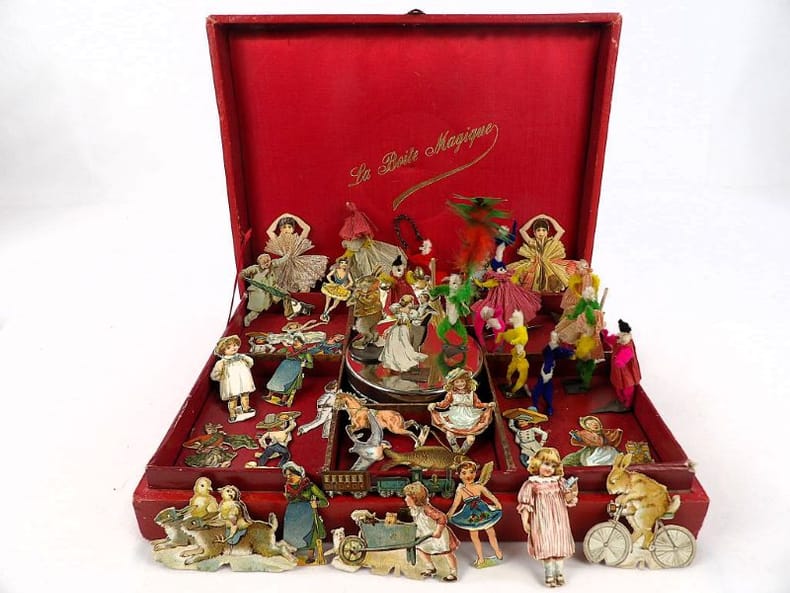
1906ref. 2854Paris, K-B (Kratz-Boussac), circa 1906. 26,5 x 20 x 5 cm. Boîte recouverte de papier rouge. Titre doré sur le couvercle. La Boîte Magique est un jouet magnétique créé à l'origine par Abraham Martin, ingénieur mécanicien, qui déposa son brevet en France le 21 décembre 1894 avant de céder ses droits à Henri Kratz-Boussac en janvier 1906. Ce dernier, fondateur de la célèbre "Société des inventions brevetées" et de la marque Euréka, commercialisa alors le jouet sous sa propre marque. Malgré son nom évocateur, le principe est purement magnétique : à l'intérieur d'un boîtier en métal chromé, un mécanisme entraîne en rotation un ou plusieurs volants à axe aimanté, lequel — actionné par une crémaillère — communique son mouvement à des figurines [en chromos, en papier crépon et cure pipe, en simple fil de fer torsadé, ou encore en tôle lithographiée (train et poisson)] posées sur des patins métalliques glissant sur la surface lisse de la boîte, s'animant ainsi en va-et-vient ou en rotation. Cette version de la boîte magique de Kratz-Boussac, avec ses sept compartiments, correspond vraisemblablement à la version de luxe, bien plus généreuse en figurines et accessoires que les modèles courants à deux compartiments décrits dans les catalogues de l'époque.
ref. 22069Paris, Marcel Plée, 1927-1932. 15 vol. in-4, demi-maroquin à coins bleu, dos à nerfs orné de caissons dorés, tranches mouchetées (rares et minuscules épidermures).