6.676 resultados
2013ref. SBBIH-WZTENYWWMO5JGALLIM LOISIRS 2013. paperback. Good. Our good condition books are generally good for reading but not for gifting or collecting. They could have imperfections such as creasing fanning inscriptions margin notes yellowing staining on edge or cover or pages bumps scuffs etc etc sometimes multiple of these. It's a wide category that encompasses anything that isn't almost-new down to anything that is slightly better than poor. We would NOT recommend gifting Good books - these should be considered reading copies. Our books are dispatched from a Yorkshire former cotton mill. We list via barcode/ISBN so please note that the images are stock images and may not be the exact copy you receive furthermore the details about edition and year might not be accurate as many publishers reuse the same ISBN for multiple editions and as we simply scan a barcode or enter an ISBN we do not check the validity of the edition data when listing. If you're looking for an exact edition please don't order at least not without checking with us first although we don't always have time to check. We aim to dispatch prompty the service used will depend on order value and book size. We can ship to most countries see our shipping policies. Payment is via Abe only. GALLIM LOISIRS paperback
2014ref. SBBIH-J53TXI32RHJ7Leisure Arts 2014. paperback. Good. Our good condition books are generally good for reading but not for gifting or collecting. They could have imperfections such as creasing fanning inscriptions margin notes yellowing staining on edge or cover or pages bumps scuffs etc etc sometimes multiple of these. It's a wide category that encompasses anything that isn't almost-new down to anything that is slightly better than poor. We would NOT recommend gifting Good books - these should be considered reading copies. Our books are dispatched from a Yorkshire former cotton mill. We list via barcode/ISBN so please note that the images are stock images and may not be the exact copy you receive furthermore the details about edition and year might not be accurate as many publishers reuse the same ISBN for multiple editions and as we simply scan a barcode or enter an ISBN we do not check the validity of the edition data when listing. If you're looking for an exact edition please don't order at least not without checking with us first although we don't always have time to check. We aim to dispatch prompty the service used will depend on order value and book size. We can ship to most countries see our shipping policies. Payment is via Abe only. Leisure Arts paperback

1772ref. 1840Couverture rigide 1ère Édition J.-L. de Boubers - Emmanuel Flon 1772 Bruxelles 19,5x11,5 cm
1900ref. 223161900. Early twentieth century Mexico documented in photographs and real photo postcards depicting rural life Indigenous labor archaeological sites and urban landscapes during the decades surrounding the Mexican Revolution. The images record scenes of everyday activity alongside monumental remains of ancient Mesoamerican civilizations illustrating the cultural landscape of Mexico during a period when tourism archaeology and national identity formation increasingly emphasized the country's Indigenous heritage. Photographs of markets domestic work agricultural labor and village life provide visual evidence of social conditions and cultural practices within rural communities during the early twentieth century. Archive of thirty nine black and white real photo postcards and photographs dating from approximately the 1900s through the 1920s. Many images contain captions printed in the negative in English or Spanish identifying locations and subjects. Several photographs depict well known archaeological sites including views of the Pyramid of the Sun at Teotihuacan and detailed images of the carved serpent heads of the Temple of Quetzalcoatl. Other photographs document rural environments and community life including images labeled "Xochimilco Mex." showing canal traffic and canoe riders navigating the waterways near Mexico City. One real photo postcard captioned "Haciendo tortillas" depicts Indigenous women preparing tortillas over open fires surrounded by cooking vessels and firewood. Additional photographs show thatched roof dwellings agricultural labor including men harvesting agave plants and scenes of local marketplaces. A group portrait depicting Mexican soldiers alongside women and children suggests the presence of military or political activity during the revolutionary era. The photographs reflect a period when Mexico's archaeological monuments and Indigenous communities were increasingly photographed by travelers ethnographers and publishers producing visual material for both domestic and international audiences. After the Mexican Revolution of 1910-1920 intellectual and political movements promoting indigenismo emphasized Indigenous heritage as a central component of Mexican national culture while archaeological research at sites such as Teotihuacan gained international attention. Real photo postcards circulated widely during this period and served both as souvenirs and as documentary images of landscapes monuments and local communities. Photographs and postcards generally measure approximately 3 x 5 inches and remain preserved as loose prints. Minor edge wear and surface toning visible with occasional curling at the corners; most images retain strong contrast and clarity. Overall very good condition. The archive provides a varied photographic record of Mexican cultural life Indigenous communities and archaeological sites in the early twentieth century. unknown
1900ref. 223161900. Early twentieth century Mexico documented in photographs and real photo postcards depicting rural life Indigenous labor archaeological sites and urban landscapes during the decades surrounding the Mexican Revolution. The images record scenes of everyday activity alongside monumental remains of ancient Mesoamerican civilizations illustrating the cultural landscape of Mexico during a period when tourism archaeology and national identity formation increasingly emphasized the country's Indigenous heritage. Photographs of markets domestic work agricultural labor and village life provide visual evidence of social conditions and cultural practices within rural communities during the early twentieth century. Archive of thirty nine black and white real photo postcards and photographs dating from approximately the 1900s through the 1920s. Many images contain captions printed in the negative in English or Spanish identifying locations and subjects. Several photographs depict well known archaeological sites including views of the Pyramid of the Sun at Teotihuacan and detailed images of the carved serpent heads of the Temple of Quetzalcoatl. Other photographs document rural environments and community life including images labeled "Xochimilco Mex." showing canal traffic and canoe riders navigating the waterways near Mexico City. One real photo postcard captioned "Haciendo tortillas" depicts Indigenous women preparing tortillas over open fires surrounded by cooking vessels and firewood. Additional photographs show thatched roof dwellings agricultural labor including men harvesting agave plants and scenes of local marketplaces. A group portrait depicting Mexican soldiers alongside women and children suggests the presence of military or political activity during the revolutionary era. The photographs reflect a period when Mexico's archaeological monuments and Indigenous communities were increasingly photographed by travelers ethnographers and publishers producing visual material for both domestic and international audiences. After the Mexican Revolution of 1910-1920 intellectual and political movements promoting indigenismo emphasized Indigenous heritage as a central component of Mexican national culture while archaeological research at sites such as Teotihuacan gained international attention. Real photo postcards circulated widely during this period and served both as souvenirs and as documentary images of landscapes monuments and local communities. Photographs and postcards generally measure approximately 3 x 5 inches and remain preserved as loose prints. Minor edge wear and surface toning visible with occasional curling at the corners; most images retain strong contrast and clarity. Overall very good condition. The archive provides a varied photographic record of Mexican cultural life Indigenous communities and archaeological sites in the early twentieth century. unknown books
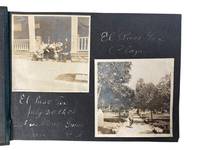
1905ref. 231541905. Texas HistoryBorderlands U.S.-Mexico borderlands photograph album 1905-1906 centered on El Paso and Juárez with additional views in New Mexico Arizona California Oregon and Alaska. The album documents an early twentieth-century traveler's movement through the southern border of the U.S. when El Paso and Ciudad Juárez were being promoted through rail travel tourism and cross-border entertainment and when American visitors regularly treated Mexican religious sites plazas bullrings and street life as part of a border excursion circuit. Its strongest historical value lies in the concentration of images tied to the Texas-Mexico border including Juárez bullfight and cockfight scenes street and church views and domestic group portraits in El Paso alongside a labeled photograph of a Santo Domingo Pueblo corn dance likely Kewa Pueblo north of Albuquerque showing non-Native travelers recording Indigenous life in the Southwest. Photograph album containing 81 original photographs most measuring approximately 2 x 3 to 4 x 5 inches mounted on thick black paper leaves in a cloth-bound album. Contemporary manuscript captions identify numerous locations and subjects including "El Paso Tex" "Juarez Mex" "Bull Fight" "Cock Fight" "Near Albuquerque 1906" "1906 New Mexico" "New Mexico 1905" "Juarez Mex Church over 350 years old" and "Corn Dance. Santo Domingo." Visible subjects include family and social group portraits posed on porches and in front of residences; women in white dresses and men in coats hats and ties; a tree-lined park path in El Paso; religious architecture and church interiors in Juárez; a fountain identified as Robinson Park in Albuquerque; river and landscape views labeled Rio Grande; a saguaro cactus study; a donkey; a seated elderly woman in a doorway; and multiple arena photographs showing matadors horses attendants spectators and ring action in Juárez. Several photographs bear later ink inscriptions including one later image of five men captioned "Alaska" en recto and with names on verso including "Mayor Goldstein" a prominent Jewish businessman and six time Juneau Mayor Isadore Goldstein. The album records border travel encompassing scenes of domestic life in El Paso tourism in Juárez and excursions into New Mexico and the wider West. The Juárez images are especially strong preserving direct vernacular views of public spectacle in the bullring and cockfight pit as well as church architecture and urban settings seen from the perspective of a visiting American observer. Photographs mounted throughout; some images faded or silvered with scattered surface wear corner wear occasional discoloration and a few later annotations or tape remnants visible. Overall very good condition. unknown
1905ref. 231541905. Texas HistoryBorderlands U.S.-Mexico borderlands photograph album 1905-1906 centered on El Paso and Juárez with additional views in New Mexico Arizona California Oregon and Alaska. The album documents an early twentieth-century traveler's movement through the southern border of the U.S. when El Paso and Ciudad Juárez were being promoted through rail travel tourism and cross-border entertainment and when American visitors regularly treated Mexican religious sites plazas bullrings and street life as part of a border excursion circuit. Its strongest historical value lies in the concentration of images tied to the Texas-Mexico border including Juárez bullfight and cockfight scenes street and church views and domestic group portraits in El Paso alongside a labeled photograph of a Santo Domingo Pueblo corn dance likely Kewa Pueblo north of Albuquerque showing non-Native travelers recording Indigenous life in the Southwest. Photograph album containing 81 original photographs most measuring approximately 2 x 3 to 4 x 5 inches mounted on thick black paper leaves in a cloth-bound album. Contemporary manuscript captions identify numerous locations and subjects including "El Paso Tex" "Juarez Mex" "Bull Fight" "Cock Fight" "Near Albuquerque 1906" "1906 New Mexico" "New Mexico 1905" "Juarez Mex Church over 350 years old" and "Corn Dance. Santo Domingo." Visible subjects include family and social group portraits posed on porches and in front of residences; women in white dresses and men in coats hats and ties; a tree-lined park path in El Paso; religious architecture and church interiors in Juárez; a fountain identified as Robinson Park in Albuquerque; river and landscape views labeled Rio Grande; a saguaro cactus study; a donkey; a seated elderly woman in a doorway; and multiple arena photographs showing matadors horses attendants spectators and ring action in Juárez. Several photographs bear later ink inscriptions including one later image of five men captioned "Alaska" en recto and with names on verso including "Mayor Goldstein" a prominent Jewish businessman and six time Juneau Mayor Isadore Goldstein. The album records border travel encompassing scenes of domestic life in El Paso tourism in Juárez and excursions into New Mexico and the wider West. The Juárez images are especially strong preserving direct vernacular views of public spectacle in the bullring and cockfight pit as well as church architecture and urban settings seen from the perspective of a visiting American observer. Photographs mounted throughout; some images faded or silvered with scattered surface wear corner wear occasional discoloration and a few later annotations or tape remnants visible. Overall very good condition. unknown books
ref. 5678Deux volumes in 4 demi-reliures (reliures craquelées, quelques manques de papier sur les plats), 379-380 pp. (petite mouillure à la fin du premier volume), très illustrées en noir et en couleurs. Il s'agit de la première mouture du Livre d'Allemagne sur les Jeux.
ref. 5854"P. Hachette et Cie, sans date. In folio relié, demi maroquin rouge postérieur, dos lisse, 316 pp., très nombreuses illustrations in et hors texte en noir et en couleurs, ancien tampon d'une amicale laïque masqué par de petits morceaux de papier ; très bel exemplaire."
ref. 8721"P., Panckoucke,; Liège, Plomteux; 1784-1792. Trois volumes in 4° + un atlas petit in folio veau marbré de l’ép. (petites différences dans les reliures) dos à nerfs orné de fleurons dorés, tr. rouges (quelques épidermures). 2 ff. on ch-CXIV pp. (discours préliminaire)-721 pp. et errata-787pp. 184 pp. + [IV-316 pp. et 16 planches], dictionnaire des jeux-Atlas de 43 planches. "
ref. 9804"P., Claude Prudhomme, 1709. Deux volumes in 12 veau époque, tête rouge (mors fendu, coiffes et coins usés. Tome I: 10 ff. non ch.-486 pp., 1 feuillet blanc; 64 figures sur bois dans le texte (petite tâche sur le titre); Tome II: 4 ff. non ch.; 518 pp.; 1 feuillet blanc; 52 figures sur bois dans le texte."
Affiche Normandie, 1935, retirage de l'affiche du voyage inaugural du paquebot du 29 mai 1935, illustrée par CASSANDRE, imprimerie Mouron, édition Distil 1998, entoilée. 160 x 100 cm. TRES BON ETAT !!! in fine condition !!!
1930ref. 3358Couverture rigide 1ère Édition Edizioni Mondadori 1930 Milano 35x25 cm
1878ref. 2598Paris, P. F. & CIE Éditeurs, Imprimerie H. Laas, sans date (circa 1878). Dimensions - Boîte : 40,5 x 29 x 4 cm ; Planches : 38 x 26,5 cm. Exceptionnel jeu de patience, d'une très grande rareté, sur le thème de l'Exposition Universelle de 1878. Il se compose de trois planches chromolithographiées et se trouve dans sa boîte d'origine, elle-même illustrée d'une magnifique chromolithographie. Sont représentés les pavillons de la ville de Paris, des Eaux et Forêts, de l'Amérique Centrale, de la Belgique, de la Suisse, de l'Autriche, de l'Algérie, des États-Unis d'Amérique, de la Russie, de la Tunisie, de la Perse, de la Suède et de la Norvège, du Luxembourg, du Maroc et de l'Annam, de la Grèce, de la Chine, des Indes Anglaises, du Portugal, du Danemark, de l'Italie, de l'Angleterre, de l'Espagne, mais aussi le Trocadéro, ses Colonnades, la Gare de Chemin de Fer, le Champ de Mars et son Palais.Etiquette du célèbre magasin "Au paradis des enfants" encollée à l'intérieur du couvercle. L'Exposition universelle de 1878 est la troisième Exposition universelle de Paris ; elle a lieu du 1er mai au 31 octobre 1878 sur le Champ-de-Mars, et couvre ainsi 75 ha. Elle célèbre l'industrie, le travail et le progrès. La gare du Champ de Mars est refaite, et on construit le Trocadéro pour l'occasion. Le Palais de l'Exposition, dit aussi Palais de fer, occupe presque tout le Champ-de-Mars. Il renferme les envois de toutes les nations. Comparable à une longue serre en damier, il occupe une surface de 420 000 m². La Rue des nations, avec ses façades typiques de chacun des pays exposants, occupe tout un côté de l'édifice. Le centre du bâtiment est consacré aux beaux-arts et au stand de la ville de Paris. Une "Galerie du Travail" expose les richesses du savoir-faire humain et une section d'anthropologie permet d'observer des crânes d'assassins. C'est durant cette exposition que l'on peut visiter la tête de la statue de la Liberté ou l'aquarium de la colline de Chaillot, emprunter le ballon captif d'Henri Giffard, admirer le pavillon japonais qui impressionne beaucoup ou encore le modèle en plâtre au 1/3 du lion de Belfort présenté par Bartholdi et récompensé.
ref. 22689Londres, MacMillan and Co., 1887. In-12, 96 pp., toile rouge à la bradel de l'éditeur, titre doré au premier plat, dos long (dos gauchi et terni, petits frottements, diagramme et jetons manquants).
1909ref. 2588Imprimeur : Georges Dreyfus, 1909. Plateau : 32 x 26 cm ; diamètre des jetons 3 cm. (sans boîte). Ce très rare jeu sur le thème de l'aviation en bel état d'origine se compose d'un plateau, de 2 dés, d'1 cornet tricolore et de 12 jetons en ivoire représentant 12 pionniers français et américains de l'aviation : Louis Blériot (1872-1936) ; Alberto Santos-Dumont (1873-1932) ; Hubert Latham (1883-1912) ; Léon Delagrange (1872-1910) ; Louis Paulhan (1883-1963) ; Étienne Bunau-Varilla (1890-1961) ; Glenn Hammond Curtiss (1878-1930) ; Paul Tissandier (1881-1945) ; Charles de Lambert (1865-1944) ; Henri Farman (1874-1958) ; Wilbur Wright (1867-1912) ; Roger Sommer (1877-1965). Le plateau est divisé en 34 cases, avec un départ et une arrivée à Reims. Les autres cases représentent divers monuments et villes du monde : Paris et son Arc de Triomphe, Londres, Rome, Lima, le Pôle nord, Tokyo, Washington, Nancy, la Tour de Pise, Bruxelles, New-York, Rio de Janeiro, une Prison du Maroc, Bordeaux, Berlin, le Siam, le Mont Saint-Michel, la Tour Eiffel, Alger, Madrid, Venise, les Pyramides, Mexico, Montevideo, Shanghai, les Cataractes du Niagara, Moscou, Marseille, Nantes, Constantinople, Buenos-Aires et Lyon. L'ensemble entouré de 14 drapeaux de 14 pays. Le jeu commémore le premier meeting international d'aviation de Reims ou "Grande semaine d'aviation de la Champagne", qui fut organisé par le Marquis Melchior de Polignac du 22 au 29 août 1909. Après les éliminatoires du 22 au 28 août, mettant aux prises 36 appareils dans des épreuves de vitesse sur des distances de 10 et 30 km, trois pilotes restent en lice le dernier jour pour les finales : l'Américain G. H. Curtiss et les français H. Latham et L. Blériot. Curtiss remporte la course de vitesse devant Blériot (75 km/h). Latham remporte le prix des passagers (course de 10 km avec deux passagers) et le prix de l'altitude (155 mètres). Blériot remporte la course du tour de piste (10 km). Le 28 août, Glenn Curtiss remporte la coupe Gordon-Bennett avec son Curtiss-Herring n°1 « Reims Racer », avec un chrono de quinze minutes et cinquante secondes.
1850ref. 2658Paris, H. Duru, sans date (circa 1850). 40,5 x 27 x 6,5 cm. Boîte entièrement restaurée, ornée d'une lithographie en couleurs d'origine signée G.D. Boîte ornée d'une lithographie en couleurs d'origine signée G.D. Rarissime puzzle complet de ses 3 planches divisées en 12 cases numérotées, chacune ornée d'une vignette en couleurs et comportant une question grammaticale avec la réponse.Les lithographie du couvercle et des planches ont été imprimées par Henri Jannin.Ce jeu est d'une rareté absolue puisque seule la lithographie du couvercle est référencée au Musée national de l'Éducation.
ref. Z1-C-054-01573NEDO. Used - Good. Worn cover. Ships from UK in 48 hours or less usually same day. Your purchase helps support Sri Lankan Children's Charity 'The Rainbow Centre'. Ex-library so some stamps and wear but in good overall condition. May contain underlining and/or highlighting. 100% money back guarantee. We are a world class secondhand bookstore based in Hertfordshire United Kingdom and specialize in high quality textbooks across an enormous variety of subjects. We aim to provide a vast range of textbooks rare and collectible books at a great price. Our donations to The Rainbow Centre have helped provide an education and a safe haven to hundreds of children who live in appalling conditions. We provide a 100% money back guarantee and are dedicated to providing our customers with the highest standards of service in the bookselling industry. NEDO unknown
1987ref. 74406Musee; Et Al. New. Paperback. FREE UPGRADE to Courier/Priority Shipping Upon Request - IN STOCK AND IMMEDIATELY AVAILABLE FOR SHIPMENT - Flawless copy brand new pristine never opened -- Text in French. 102 pp. With 71 ills. 30 x 21 cm. -- with a bonus offer--; French Edition . 1987. 2905613033 . Musee; Et Al paperback
ref. 4785"P., Chez Lamy, 1782. In 8 de (2) ff., 363 pp., + 22 planches hors texte ; demi basane cerise, dos à faux nerfs orné avec les initiales dorées H.C. en queue (reliure postérieure, fin XIXème siècle)."
1946ref. 31670Imp. Roger Amiard 1946 Grand in-8 broché, couv. imp, 350 pp. Manus. imp. avec dessins de l’auteur, en grande partie non coupé. Couverture défraîchie, mors fendillés, manques au dos, hum. en tête en seconde partie de l’ouvrage.
ref. 7775"Tête de collection ; relié en un volume in 8 demi-chagrin rouge à coins, dos à nerfs (reliure moderne) nombreuses illustrations. "
ref. 12210Bruxelles: Sélection, 1921. In-4, 45-(3) pp., broché (couverture restaurée). 4to, 45-(3) p., softcover (restored cover).
ref. 17297Paris, Au bureau du Journal pour rire, s.d. [1854] In-4, 24 pl., maroquin rouge de l'époque, caissons, filets et arabesques dorés en encadrement sur les plats, des fleurons mosaïqués de peau fauve, verte et brune dans les angles et au milieu des caissons, frise de palmettes à froid et filets dorés cantonnés de fleurons dorés en encadrement autour du fleuron doré central, dos lisse orné de filets dorés et de fleurons dorés et mosaïqués de peau fauve et verte (restaurations du papier, rousseurs, quelques petits frottements et épidermures).