1 136 résultats
1833réf. 12630Paris, au bureau du journal, 1833 à. 5 volumes in-8 de 384 pages chacun, demi-basane bleue, dos lisses ornés de filets, roulettes, fleurons, titre et tomaison dorés. Le volume 5 est d'un format très légèrement supérieur, le décor des dos diffère légèrement aux 2 derniers volumes.
réf. DADAX0668059052New unknown
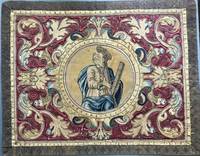
réf. 22057Italy Sixteenth century. Good with some modest surface abrasion and minor loss to a part of the applied stitched strapwork decoration; some light fading of original color in the thread of the portrait. Embroidered panel measuring appx. 454 x 570 mm. Apparels such as this were produced throughout Italy. The work would have been undertaken by a number of people to do the background portrait and decorative elements. A variety of thread was used. The piece is quite heavy indicating the use of metallic wire wrapped around silk thread. The border frame outermost perimeter is entirely metal wire thread. Color dyed silk thread is used in the portrait in order to effect "depth" and realism and to accomplish the figure's modelling. It is assumed that the subject is St. Anthony of Egypt given the cross that accompanies the figure. The strapwork foliate ornamentation is first seen in Islamic manuscripts and artwork; taken up in Italy where it was used in an array of decorative arts eventually to spread throughout Europe. unknown books
réf. DADAX185585273XNew unknown
1821réf. 2759Paris, Audot, libraire-éditeur, 1821-1822. 19 Volumes. In-18 - 14 x 9 cm. Reliure uniforme d'époque en demi-basane fauve, dos lisse orné de filets dorés, pièces de titre et de tomaison en basane noire, couvertures conservées, tranches mouchetées. Amusante et intéressante collection qui se compose de 9 titres répartis en 19 volumes : Histoire de France par Mme Sophie de Maraise (2 tomes, les deux ornés d'un frontispice) ; Cours de Littérature ancienne extrait de La Harpe (2 tomes) ; Cabinet d'Histoire naturelle par M. Boitard (2 tomes, une planche dépliante in fine du second volume) ; La Botanique des Dames par Boitard (3 tomes de texte et 1 atlas de 104 planches gravées) ; Manuel de la Maîtresse de Maison par Mme Pariset (1 tome orné d'un frontispice) ; Beaux-Arts - Du Beau dans les Arts d'Imitation par M. Kératry (3 tomes, tous ornés d'un frontispice) ; Principes de Logique par M. Coeuret de Saint-Georges (1 tome) ; La Maison de Campagne par Mme Aglaé Adanson (3 tomes, en plus du frontispice qui orne le tome I, 3 planches hors texte se trouvent dans le deuxième volume) et Lettres sur la Toilette des Dames par Elise Voïart (1 tome orné d'un frontispice). Exemplaire imprimé pour la bibliothèque de Madame Lebrun de Viviers. Rarissime ensemble dont nous n'avons trouvé aucune trace sous la forme de collection dans les institutions et bibliothèques à travers le monde. Il pourrait donc s’agir d’une commande particulière auprès de l’éditeur.
réf. DADAX0684143771New unknown
réf. 2581A stunning and large framed embroidery dated 1900 bearing the inscription "Vesta/MS/1900" and paper label on verso "M.E.F.S." 63 cm x 21.5 cm. The composition depicts the virgin goddess of hearth home and family Vesta in long flowing gown holding the 'sacred fire' that burned at her hearth and temples. An exquisite piece wonderfully preserved. Very scarce. unknown books
réf. 2581A stunning and large framed embroidery dated 1900 bearing the inscription "Vesta/MS/1900" and paper label on verso "M.E.F.S." 63 cm x 21.5 cm. The composition depicts the virgin goddess of hearth home and family Vesta in long flowing gown holding the 'sacred fire' that burned at her hearth and temples. An exquisite piece wonderfully preserved. Very scarce. unknown
1970réf. 48081970 1 Gouache, (1970), 53.5 x 37 cm, encadrée.
réf. 4471Normandy 19th century. Embroidered ceremonial stole measuring 184 x 48.5 cm approx. 72.5 x 19 inches liner of thick doubled cotton or linen fabric covered in red felt the front elaborately embroidered with applied passementerie in gold and colored threads including roses vines and wheat sheafs within a wide embossed gold band the stole edged with abundant fringe further decorated with metallic thread; in upper half a large relief-embroidered gold cloth disk representing the sun with wavy rays and a tassel border surmounted and flanked by pairs of attached tassels; in the lower half a large appliqué of a richly embroidered figure of a bishop with pilgrim's staff his face and hands painted his vestments embellished with colored threads sequins purls and lace below him the embroidered number 2 and the place name "Ste. Marthe." Condition: worn dusty the felt with holes possibly wormed especially at top. Known as a chaperon de chariton or de charité this elaborately embroidered 6-foot long "stole" would have been a regular feature of village life in Normandy being worn in processions of the local confraternity. This one was produced in Saint-Marthe a village in the Eure. Sometimes called simply "charités" charitable confraternities were still active during the 19th century after being temporarily suppressed by Revolutionary secularism and at least until recently could still be found in some Normandy villages especially in the Eure Chaline p. 96. Their principal charge dating back to centuries of plague was the burial of the dead. Each confraternity placed itself under the tutelage of a saint or several saints and the Virgin. Consisting of 12 members called "charitons" they were led by the village curé; while basically egalitarian each member had a different duty banner-carrier bell-ringer treasurer etc. The chaperon was the most important of several elements of their special costumes the others being an equally heavy dalmatic a soutanelle or black robe and the barette the ecclesiastical beretta; these were worn in church and in processions. Red chaperons were for regular processions and black ones for funerals. Originally carried only by the ancien maitre the recently retired master of the confraternity a role that was relayed every two years the chaperon came to be worn by all members of the confraternity. One can only imagine what martyrdom hot days brought. In compensation for their sufferings confraternity brothers expected to be wined and dined after funerals earning a certain reputation; hence the French saying "boire comme un chariton." This lavishly embroidered and decorated chaperon was probably made by local women. In photos of modern processions somewhat lighter-looking and simpler chaperons are worn by the charitons. The Musée des Beaux-Arts of Bernay has a chaperon from the same village Inv. 985.6.1. Cf. N. J. Chaline "Pratique et vie religieuse en Haute-Normandie aux XIXe et XXe siècles" Cahier des Annales de Normandie 1976 no. 8 Mentalités religieuses dans la France de l'ouest aux XIXe et XXe siècles: études d'histoire sérielle pp. 35-116. unknown books
réf. 4471Normandy 19th century. Embroidered ceremonial stole measuring 184 x 48.5 cm approx. 72.5 x 19 inches liner of thick doubled cotton or linen fabric covered in red felt the front elaborately embroidered with applied passementerie in gold and colored threads including roses vines and wheat sheafs within a wide embossed gold band the stole edged with abundant fringe further decorated with metallic thread; in upper half a large relief-embroidered gold cloth disk representing the sun with wavy rays and a tassel border surmounted and flanked by pairs of attached tassels; in the lower half a large appliqué of a richly embroidered figure of a bishop with pilgrim's staff his face and hands painted his vestments embellished with colored threads sequins purls and lace below him the embroidered number 2 and the place name "Ste. Marthe." Condition: worn dusty the felt with holes possibly wormed especially at top. Known as a chaperon de chariton or de charité this elaborately embroidered 6-foot long "stole" would have been a regular feature of village life in Normandy being worn in processions of the local confraternity. This one was produced in Saint-Marthe a village in the Eure. Sometimes called simply "charités" charitable confraternities were still active during the 19th century after being temporarily suppressed by Revolutionary secularism and at least until recently could still be found in some Normandy villages especially in the Eure Chaline p. 96. Their principal charge dating back to centuries of plague was the burial of the dead. Each confraternity placed itself under the tutelage of a saint or several saints and the Virgin. Consisting of 12 members called "charitons" they were led by the village curé; while basically egalitarian each member had a different duty banner-carrier bell-ringer treasurer etc. The chaperon was the most important of several elements of their special costumes the others being an equally heavy dalmatic a soutanelle or black robe and the barette the ecclesiastical beretta; these were worn in church and in processions. Red chaperons were for regular processions and black ones for funerals. Originally carried only by the ancien maitre the recently retired master of the confraternity a role that was relayed every two years the chaperon came to be worn by all members of the confraternity. One can only imagine what martyrdom hot days brought. In compensation for their sufferings confraternity brothers expected to be wined and dined after funerals earning a certain reputation; hence the French saying "boire comme un chariton." This lavishly embroidered and decorated chaperon was probably made by local women. In photos of modern processions somewhat lighter-looking and simpler chaperons are worn by the charitons. The Musée des Beaux-Arts of Bernay has a chaperon from the same village Inv. 985.6.1. Cf. N. J. Chaline "Pratique et vie religieuse en Haute-Normandie aux XIXe et XXe siècles" Cahier des Annales de Normandie 1976 no. 8 Mentalités religieuses dans la France de l'ouest aux XIXe et XXe siècles: études d'histoire sérielle pp. 35-116. unknown