Livre Rare Book
[BRODERIE]Livre Rare Book
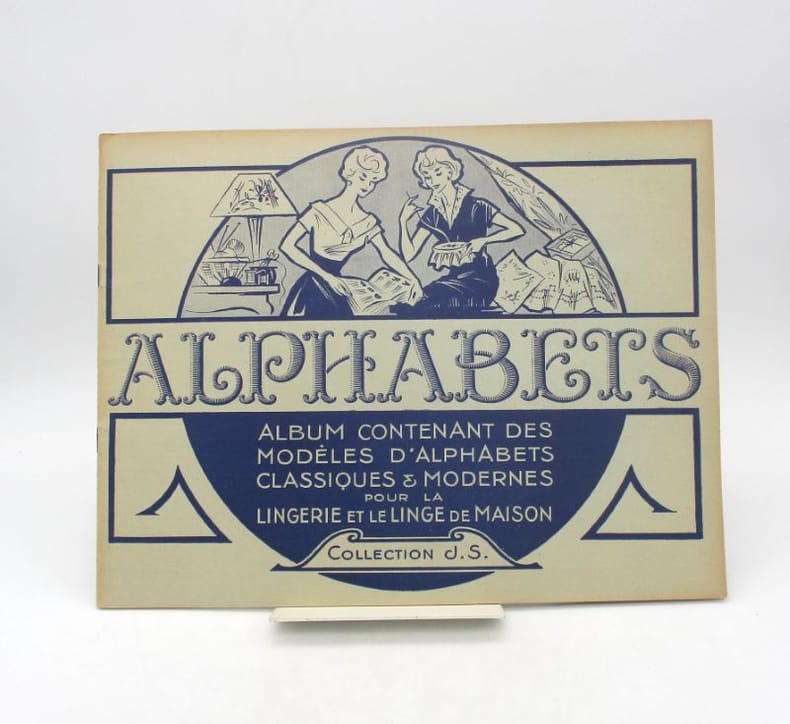
Alphabets
réf. 20428Paris, Mme J. Sonrel, 1961.In-folio oblong, 32 pp., broché, couverture originale illustrée (petite déchirure marginale à plusieurs ff.)
L'Ancienne Librairie · Paris, France80,00 €
1 219 résultats
réf. 100508Bibliothèque D.M.C. Dillmont Editions Th. de Dillmont, Bibliothèque D.M.C., 1954, 60 planches + VII p. de texte, broché oblong, environ 22x31cm, plats salis et froissés, une déchirure sans manque en bordure de la page de titre et la première de l'introduction, sinon intérieur propre.
réf. 20428Paris, Mme J. Sonrel, 1961.In-folio oblong, 32 pp., broché, couverture originale illustrée (petite déchirure marginale à plusieurs ff.)
1880réf. 253121880 Paris, sans date, vers 1880 ; plaquette in-12°, couverture beige illustrée et imprimée en noir ; 7 pages de modèles imprimées en bleu d'un seul tenant.
1880réf. 84241880 Paris, sans date, vers 1880 ; plaquette in-12°, couverture beige illustrée et imprimée en noir ; 7 pages de modèles imprimées en bleu d'un seul tenant.
réf. 5777lettres,chiffres,monogrammes et ornements à points comptés. In 12 à l’italienne,cartonnage d’éditeur titre et décor en ouvrage sur le premier plat titre en long, au dos.Titre,92 planches en couleurs en 46 pages,9 calques de planches,42 pages de catalogue.Edition Thérèse Dillmont Mulhouse France, sans date. Légèrement manié
réf. 6264lettres,chiffres,monogrammes et ornements à points comptés suivis d’une série de modèles avec calques pour broderie de blanc,in 12 cartonné d’éditeur titre au dos et sur le premier plat,encadré d’une frise,titre suivi de 92 planches et de 10 calques.Catalogue en fin de volume Th. Dillmont éditeur
réf. ALEG00015Editions A. Ponchon, collection "Bleuet". In-4 (25 x 31,7 cm), 200 alphabets et chiffres pour draps, taies, nappes, serviettes, lingerie.
1956réf. va144Sonrel Mme J. Collection JS Dos agrafé 1956 In-12 (24 x 15 cm), format à l'italienne, dos agrafé, 12 pages ; très bon état. Livraison a domicile (La Poste) ou en Mondial Relay sur simple demande.
1999réf. 8717Flammarion 1999 In-4 Relié toile éditeur sous jaquette, 157 pp. Nombreuses illustrations en couleurs.
réf. 19080Paris, Albin Michel/Régine Deforges, 1987. 25 x 31, 47 pp., nombreuses illustrations en couleurs, cartonnage d'édition illustré, bon état (couverture avant légèrement : 1 coin plié).
1937réf. 26611937 revue (magazine) in-quarto (Grand Aigle), couverture illustrée (cover illustrated) très légèrement défraîchie (lightly faded), illustrations : nombreux modèles en grandeur d'exécution (patterns in the size of making), 64 pages, 1937 à Paris Edition du Petit Echo de la Mode,
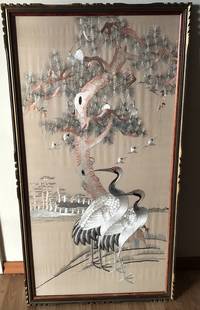
réf. 57185Not Dated. An attractive embroidered scene using variously coloured and metallic thread. Fine condition. The image measures 19 x 37.5 inches in a frame measuring 21.5 x 40 inches. Large and beautifully executed a striking image. This is an oversize item and normal postage rates do not apply. Large framed artworks are sometimes available for pickup only. Not Dated. unknown
réf. 57184c.1900. An attractive embroidered scene using gold and metallic thread. Japanese probably from the Meiji period. Very beautifully executed. Fine condition. The image measures 13 x 19 inches in a frame measuring 20 x 27 inches. Small chips from frame edges. This is an oversize item and normal postage rates do not apply. Large framed artworks are sometimes available for pickup only. c.1900. unknown
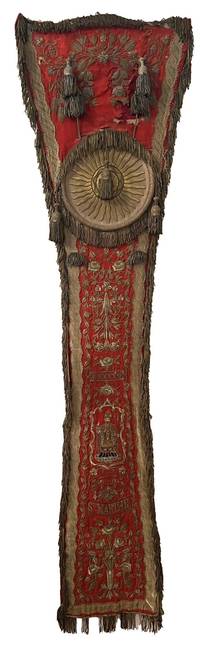
réf. 4471Normandy 19th century. Embroidered ceremonial stole measuring 184 x 48.5 cm approx. 72.5 x 19 inches liner of thick doubled cotton or linen fabric covered in red felt the front elaborately embroidered with applied passementerie in gold and colored threads including roses vines and wheat sheafs within a wide embossed gold band the stole edged with abundant fringe further decorated with metallic thread; in upper half a large relief-embroidered gold cloth disk representing the sun with wavy rays and a tassel border surmounted and flanked by pairs of attached tassels; in the lower half a large appliqué of a richly embroidered figure of a bishop with pilgrim's staff his face and hands painted his vestments embellished with colored threads sequins purls and lace below him the embroidered number 2 and the place name "Ste. Marthe." Condition: worn dusty the felt with holes possibly wormed especially at top. Known as a chaperon de chariton or de charité this elaborately embroidered 6-foot long "stole" would have been a regular feature of village life in Normandy being worn in processions of the local confraternity. This one was produced in Saint-Marthe a village in the Eure. Sometimes called simply "charités" charitable confraternities were still active during the 19th century after being temporarily suppressed by Revolutionary secularism and at least until recently could still be found in some Normandy villages especially in the Eure Chaline p. 96. Their principal charge dating back to centuries of plague was the burial of the dead. Each confraternity placed itself under the tutelage of a saint or several saints and the Virgin. Consisting of 12 members called "charitons" they were led by the village curé; while basically egalitarian each member had a different duty banner-carrier bell-ringer treasurer etc. The chaperon was the most important of several elements of their special costumes the others being an equally heavy dalmatic a soutanelle or black robe and the barette the ecclesiastical beretta; these were worn in church and in processions. Red chaperons were for regular processions and black ones for funerals. Originally carried only by the ancien maitre the recently retired master of the confraternity a role that was relayed every two years the chaperon came to be worn by all members of the confraternity. One can only imagine what martyrdom hot days brought. In compensation for their sufferings confraternity brothers expected to be wined and dined after funerals earning a certain reputation; hence the French saying "boire comme un chariton." This lavishly embroidered and decorated chaperon was probably made by local women. In photos of modern processions somewhat lighter-looking and simpler chaperons are worn by the charitons. The Musée des Beaux-Arts of Bernay has a chaperon from the same village Inv. 985.6.1. Cf. N. J. Chaline "Pratique et vie religieuse en Haute-Normandie aux XIXe et XXe siècles" Cahier des Annales de Normandie 1976 no. 8 Mentalités religieuses dans la France de l'ouest aux XIXe et XXe siècles: études d'histoire sérielle pp. 35-116. unknown
réf. 4471Normandy 19th century. Embroidered ceremonial stole measuring 184 x 48.5 cm approx. 72.5 x 19 inches liner of thick doubled cotton or linen fabric covered in red felt the front elaborately embroidered with applied passementerie in gold and colored threads including roses vines and wheat sheafs within a wide embossed gold band the stole edged with abundant fringe further decorated with metallic thread; in upper half a large relief-embroidered gold cloth disk representing the sun with wavy rays and a tassel border surmounted and flanked by pairs of attached tassels; in the lower half a large appliqué of a richly embroidered figure of a bishop with pilgrim's staff his face and hands painted his vestments embellished with colored threads sequins purls and lace below him the embroidered number 2 and the place name "Ste. Marthe." Condition: worn dusty the felt with holes possibly wormed especially at top. Known as a chaperon de chariton or de charité this elaborately embroidered 6-foot long "stole" would have been a regular feature of village life in Normandy being worn in processions of the local confraternity. This one was produced in Saint-Marthe a village in the Eure. Sometimes called simply "charités" charitable confraternities were still active during the 19th century after being temporarily suppressed by Revolutionary secularism and at least until recently could still be found in some Normandy villages especially in the Eure Chaline p. 96. Their principal charge dating back to centuries of plague was the burial of the dead. Each confraternity placed itself under the tutelage of a saint or several saints and the Virgin. Consisting of 12 members called "charitons" they were led by the village curé; while basically egalitarian each member had a different duty banner-carrier bell-ringer treasurer etc. The chaperon was the most important of several elements of their special costumes the others being an equally heavy dalmatic a soutanelle or black robe and the barette the ecclesiastical beretta; these were worn in church and in processions. Red chaperons were for regular processions and black ones for funerals. Originally carried only by the ancien maitre the recently retired master of the confraternity a role that was relayed every two years the chaperon came to be worn by all members of the confraternity. One can only imagine what martyrdom hot days brought. In compensation for their sufferings confraternity brothers expected to be wined and dined after funerals earning a certain reputation; hence the French saying "boire comme un chariton." This lavishly embroidered and decorated chaperon was probably made by local women. In photos of modern processions somewhat lighter-looking and simpler chaperons are worn by the charitons. The Musée des Beaux-Arts of Bernay has a chaperon from the same village Inv. 985.6.1. Cf. N. J. Chaline "Pratique et vie religieuse en Haute-Normandie aux XIXe et XXe siècles" Cahier des Annales de Normandie 1976 no. 8 Mentalités religieuses dans la France de l'ouest aux XIXe et XXe siècles: études d'histoire sérielle pp. 35-116. unknown books
Very Good English Paperback. Pbo. 4to. (29 x 21 cm). In Turkish. 18 p. texts; [22] p. b/w plates. Turkish handicrafts series V. Anatolian women clothes. Anadolu kadin kiliklari. (El sanatlari V).
Very Good English Paperback. Pbo. 4to. (29 x 21 cm). In Turkish. 11 p. texts; [16] p. b/w plates. Turkish handicrafts series I. Anatolian socks. Anadolu çoraplari. (El sanatlari I).
1980Budapest, 1980. In-8 relié toile avec jaquette, 67 pages suivies de 79 pages d'illustrations (en noir et blanc)
réf. H-7-494847374756Very Good. unknown
1964réf. 59551964 revue (magazine) grand in-octavo, dos et couverture marrons imprimés (spiner and cover printed), tranches lisses (edges smooth), quelques illustrations (some illustrations), 272 pages, 1964 à Laval Imprimerie de la Mayenne,
1920réf. 225421920 1 Draeger, (1920), in-4, porte-buvard de voyage dans un cartonnage à décor persan enfermant un poème.
1977Features: Sculpture Busts - the face of the individual; Portrait Miniatures; Collecting Banknotes for their art; English Embroidery; The Vienna Secession and the Contemporary Artistic Movements; Antique Beds; Glass Candlesticks; Precious Objects Mounted in Silver; Theatrical Mezzotints after Zoffany; Longcase Clocks from the Country; Victorian Majolica; Antique Collecting in America; Under l0 pounds in Streatham and Croydon. Somewhat above-average external wear. Magazine
réf. 856Draeger 1 Présentement comme au Temps Jadis Tenues de Gala et Livrées. Paris, Draeger, 1952, in-4, broché, couverture rempliée titrée gaufrée, titre doré, 52 pages.
1948Ex library book with usual marks and stamps. No creasing to covers or to spine. Pages in fine condition. Boards well rubbed, dusty and with tape marks. 48pp. Well illustrated study of applique with stitches, samplers, designs, furnishings, toys and more. The outside of the book doesn't look great but the contents are in excellent condition.
1997Armand Colin DMC 1997, In-4 cartonnage de l'éditeur illustré, 96 pages + 9 patrons. Parfait état.