9033 risultati
rif. DADAX0571068995New unknown
rif. 06392England: 1830. A Handsome Early Nineteenth-Century Poetry Anthology Manuscript Elegantly Written and Illustrated with Charming Wash Drawings MANUSCRIPT POETRY ANTHOLOGY. Manuscript anthology of English poetry. England early-to mid-19th century. Square octavo 7 3/4 x 6 3/8 inches; 197 x 162 mm. 115 manuscript pages followed by four manuscript pages of index and one blank leaf. Written throughout in a clear and elegant brown-ink cursive hand. Several pages embellished with attractive pen-and-wash drawings including pastoral landscapes and small ornamental vignettes one depicting a rustic cottage beside a stream with church spire beyond another a pair of doves rendered in delicate gray wash. Handsomely bound in full contemporary maroon straight-grain morocco covers decoratively paneled in gilt and blind with elaborate floral corner borders spine in compartments richly ruled and ornamented in gilt board edges and turn-ins gilt red endpapers all edges gilt. A particularly appealing early nineteenth-century manuscript poetry anthology carefully compiled by an accomplished hand and attractively embellished with original drawings. The manuscript contains copies of poems and extracts by many of the most celebrated poets of the English canon including Robert Burns Lord Byron William Cowper Oliver Goldsmith John Milton Alexander Pope Sir Walter Scott William Shakespeare James Thomson and William Wordsworth together with additional popular verses circulating in print culture during the late eighteenth and early nineteenth centuries. The selection reflects the literary taste of the Romantic age drawing heavily on poets whose works were widely read and admired in the decades around 1800. Many poems were clearly copied from contemporary printed editions and literary magazines a common practice among educated readers of the period who assembled their own "commonplace books" or poetic albums as records of personal reading and reflection. Such manuscripts served both as repositories of admired literature and as exercises in penmanship literary appreciation and polite accomplishment. The present manuscript belongs firmly within this tradition. The writing is careful and highly legible suggesting a compiler who took pride in both calligraphy and arrangement. Several poems are introduced with small decorative drawings charmingly executed in sepia wash and placed above the text in the manner of vignette illustrations. These include a pastoral landscape scene accompanying lines beginning "O that this lovely vale were mine!" and a small study of doves above a transcription of lines attributed to Wordsworth beginning "Stay passenger and though within / Nor gold nor glittering gems are seen.". The drawings though modest in scale give the volume the atmosphere of a personal gift book or keepsake rather than a purely utilitarian notebook. A neatly prepared manuscript index at the end of the volume lists the poems and authors demonstrating that the compiler intended the book to function as a permanent anthology rather than a casual collection of copied verses. The combination of literary selection calligraphic care and decorative illustration suggests a manuscript created either as a cultivated personal project or as a presentation volume within the domestic literary culture of the early nineteenth century. Manuscript poetry anthologies of this kind were especially popular in Britain during the late Georgian and early Victorian periods when poetry formed an essential part of polite education and social life. Before the widespread availability of inexpensive printed anthologies readers frequently created their own compilations of favorite poems. These volumes often preserve fascinating evidence of the reading habits and aesthetic preferences of their compilers and when illustrated-as in the present example-they provide a particularly vivid glimpse into the culture of literary appreciation in the Romantic era. A handsome and engaging survival: a finely bound and attractively illustrated nineteenth-century manuscript anthology celebrating the great poets of the English language. England: , 1830 unknown
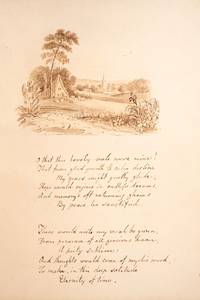
rif. 06392England: 1830. A Handsome Early Nineteenth-Century Poetry Anthology Manuscript Elegantly Written and Illustrated with Charming Wash Drawings MANUSCRIPT POETRY ANTHOLOGY. Manuscript anthology of English poetry. England early-to mid-19th century. Square octavo 7 3/4 x 6 3/8 inches; 197 x 162 mm. 115 manuscript pages followed by four manuscript pages of index and one blank leaf. Written throughout in a clear and elegant brown-ink cursive hand. Several pages embellished with attractive pen-and-wash drawings including pastoral landscapes and small ornamental vignettes one depicting a rustic cottage beside a stream with church spire beyond another a pair of doves rendered in delicate gray wash. Handsomely bound in full contemporary maroon straight-grain morocco covers decoratively paneled in gilt and blind with elaborate floral corner borders spine in compartments richly ruled and ornamented in gilt board edges and turn-ins gilt red endpapers all edges gilt. A particularly appealing early nineteenth-century manuscript poetry anthology carefully compiled by an accomplished hand and attractively embellished with original drawings. The manuscript contains copies of poems and extracts by many of the most celebrated poets of the English canon including Robert Burns Lord Byron William Cowper Oliver Goldsmith John Milton Alexander Pope Sir Walter Scott William Shakespeare James Thomson and William Wordsworth together with additional popular verses circulating in print culture during the late eighteenth and early nineteenth centuries. The selection reflects the literary taste of the Romantic age drawing heavily on poets whose works were widely read and admired in the decades around 1800. Many poems were clearly copied from contemporary printed editions and literary magazines a common practice among educated readers of the period who assembled their own "commonplace books" or poetic albums as records of personal reading and reflection. Such manuscripts served both as repositories of admired literature and as exercises in penmanship literary appreciation and polite accomplishment. The present manuscript belongs firmly within this tradition. The writing is careful and highly legible suggesting a compiler who took pride in both calligraphy and arrangement. Several poems are introduced with small decorative drawings charmingly executed in sepia wash and placed above the text in the manner of vignette illustrations. These include a pastoral landscape scene accompanying lines beginning "O that this lovely vale were mine!" and a small study of doves above a transcription of lines attributed to Wordsworth beginning "Stay passenger and though within / Nor gold nor glittering gems are seen.". The drawings though modest in scale give the volume the atmosphere of a personal gift book or keepsake rather than a purely utilitarian notebook. A neatly prepared manuscript index at the end of the volume lists the poems and authors demonstrating that the compiler intended the book to function as a permanent anthology rather than a casual collection of copied verses. The combination of literary selection calligraphic care and decorative illustration suggests a manuscript created either as a cultivated personal project or as a presentation volume within the domestic literary culture of the early nineteenth century. Manuscript poetry anthologies of this kind were especially popular in Britain during the late Georgian and early Victorian periods when poetry formed an essential part of polite education and social life. Before the widespread availability of inexpensive printed anthologies readers frequently created their own compilations of favorite poems. These volumes often preserve fascinating evidence of the reading habits and aesthetic preferences of their compilers and when illustrated-as in the present example-they provide a particularly vivid glimpse into the culture of literary appreciation in the Romantic era. A handsome and engaging survival: a finely bound and attractively illustrated nineteenth-century manuscript anthology celebrating the great poets of the English language. England: , 1830 unknown books
1917rif. 0345-16Innsbruck, Brenner-Verlag [1917]. gr.-8°. 43 S., 2 Bll. OHPgmt.
1555rif. 30476ABBasel, Henripetri, 1555. Folio. 48 n.n. Bl., 1499 (recte 1503) S., 1 S. Druckermarke. Schweinslederband der Zeit über Holzdeckeln mit handschriftlichem Rückentitel und Rollstempelverzierung. [2 Warenabbildungen]
1555rif. 30476ABBasel, Henripetri, 1555. Folio. 48 n.n. Bl., 1499 (recte 1503) S., 1 S. Druckermarke. Schweinslederband der Zeit über Holzdeckeln mit handschriftlichem Rückentitel und Rollstempelverzierung.
18272 vol. in-8, pp. 744 (num. continua), legatura coeva in mezza pelle verde e carta marmorizzata ai piatti, fregi e titolo in oro su tassello al dorso. Edizione originale, rara a trovarsi completa dei due volumi, in quanto uscirono a qualche mese di distanza l'uno dall'altro. La scelta antologica, curata da Leopardi con acume e sensibilità storico-linguistica, è preceduta dallo scritto originale dell'A. "Ai lettori", che occupa le pp. 3-6. Prima edizione, non comune. Esemplare assai bello e puro. . Manca a Mazzatinti-Menghini e Cappelletti. Fondo Leopardiano Comune di Milano, n. 93. .
1935rif. 66440Wien, Verlag der Johannes-Presse, 1935. 8°. 223 S., OHLdr. m. goldgepr. Deckelvignette, Rückenverg. u. goldgepr. Rückentitel in OPp.-Schuber m. goldgepr. Deckelvignette.