L' ARIOSTEBiblio.com

1332 risultati
1839rif. 77042Paris: Knab 1839. Fine. Knab Paris 1839 12.50 x 21.80 cm 3 volumes reliés New translation by A. Mazuy. The 3 volumes are illustrated with a portrait of Ariosto as frontispiece and 85 wood-engraved figures printed on China paper and mounted on strong paper. They are numbered from 1 to 85. The 3 volumes properly contain the placement sheets for the engravings at the end and the errata. This beautiful illustration a romantic vision of the chivalrous Middle Ages is the work of Meissonnier Baron Français Girardet. Contemporary full glazed calf binding in violet. Smooth spine decorated with Rocaille tools in long and mirror patterns. Gilt title. Boards stamped in blind with a large ornamental plate in Renaissance style. Gilt framing fillets. Interior frieze. Lemon-yellow endpapers. Tissue guards present. Some occasional scattered foxing on an otherwise clean set the tissue guards often browned or foxed. Signs of rubbing. Cracks on one lower joint at foot. Spine uniformly blue-green. Very handsome copy rare in this condition. The work is completed with several studies by the translator notes on chivalric romances oriental traditions chronicles songs of the trouvères and troubadours. An index of proper names in Orlando Furioso. Knab hardcover
1756rif. 50805Arezzo, Michele Belotti, 1756. Large 4to. 2 contemp. full vellum with handwritten titles on spine. Marbled edges. VII,435421,(3) pp. and 2 engraved portraits (Ariosto and Barbolani). printed on good paper, clean and fine. Italian and Latin text in 2 columns.
1756rif. 50805Arezzo Michele Belotti 1756. Large 4to. 2 contemp. full vellum with handwritten titles on spine. Marbled edges. VII435;4213 pp. and 2 engraved portraits Ariosto and Barbolani. printed on good paper clean and fine. Italian and Latin text in 2 columns. A fine copy of the first translation of Orlando Furioso into Latin. - Brunet I 440. hardcover
rif. 108859Venetia Felice Valgrisi 1887. Kl.4° Titelholzschnitt 8 Bl. 654 S. 16 Bl Tavola zahlreiche Vignetten und 51 blattgrossen Holzstich-Illustrationen von Dosso Dossi am Anfang jedes Gesanges. Perg. d. Zeit handschriftl Rückentitel Deckel etwas fleckig Titelbl. aufgezogen Buchblock etwas fleckig min. wasserärndig 13 Bl. der Tavola mit grösseren hinterlegen ersetzten Fehlstellen Textverlust. Einige Illustrationen etwas stumpf. abgezogen einige Marginalien von alter Hand.Cover slightly stained; title page reattached; text block slightly stained with minimal water damage; 13 leaves of the Tavola with larger gaps filled in loss of text. Some illustrations slightly faded; some marginal notes in an old hand. Die erste Valgrisi-Ausgabe des „Furioso“ stammt aus dem Jahr 1556; ab 1565 erscheinen die 5 posthumen Gesänge begleitet von den Zusammenfassungen von Luigi Grotta d’Adria. - Ludovico Ariosto deutsch Ariost; 8. September 1474 in Reggio nell’Emilia; † 6. Juli 1533 in Ferrara war ein italienischer Humanist Militär Höfling und Autor. Sein Hauptwerk das Versepos Orlando furioso „Der rasende Roland“ gilt als einer der wichtigsten Texte der italienischen Literatur und wurde in ganz Europa rezipiert.Text Ital. 010 Venetia, Felice Valgrisi, 1887 unknown
1809Cinque volumi in folio (cm. 41), pp. (4) viii, 299 (1); 317 (1); (4) 315 (1); (2) 353 (1); (2) 396. Bel ritratto dell'Ariosto inciso in rame all'antiporta del primo volume. Solida legatura (1900 ca.?) in mezza pergamena con punte, dorsi a nervi con titoli in oro su tasselli. Esemplare particolarmente fresco e marginoso (in barbe), in ottimo stato di conservazione. Pregiata edizione impressa in soli 250 esemplari numerati e ad personam (il presente il n. 203). Cfr. Graesse e Brunet I, 438 ("tres belle edition"); Agnelli-Ravegnani: "Bellissima e pregiata edizione in-folio pubblicata da G. Rosini...".
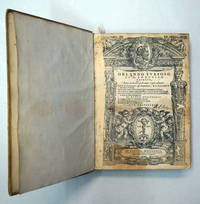
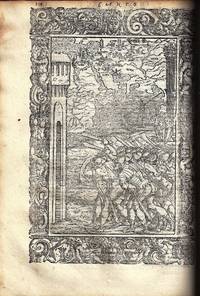
1572rif. 2012300015Venetia Appresso Vincenzo Valgrisi 1572. Hardcover. Good. The Romance of Roland: Early Italian edition Quarto. Early boards rebacked with renewed leather spine. Spine gilt ruled and lettered. Good binding. 16 654 32 p. Text in double columns. Title within architectural border surmounted by portrait bust of author and with Valgrisi's woodcut device. Full-page woodcut illustrations with ornamental sidepieces at beginning of each canto; head-pieces; historiated initials; printed marginalia. Scattered staining throughout browning. Chip missing from margin of rearmost leaf. Lacking final blank leaf. Mortimer Italian Books 29 citing 1562 ed. Adams A1673 citing 1571 ed. Venetia Appresso Vincenzo Valgrisi hardcover
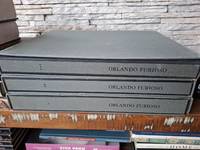
1967rif. 1081A monumental edition of Ludovico Ariosto's Orlando Furioso published by Electa Editrice of Milan in 1967 featuring an introduction by Riccardo Bacchelli and 158 striking lithographic illustrations by Fabrizio Clerici. Comprising three large-format folio volumes: the first contains the text while the other two serve as portfolios housing the 158 loose color lithographic plates printed by the renowned Stamperia Fantoni in Venice. Housed in the publisher's original cardboard slipcase. Limited edition of 350 copies; this is copy no. 39 one of 150 hors-commerce copies. In perfect condition. Electa Milano hardcover
rif. 2272In Venetia: Appresso Pietro Farri 1619. Hardcover. Good. Quarto. No pagination. 340pp. a8 A8-SS8 TT4. Engraved title-page. Cinque canti has separate title-page. Seventeenth-century vellum worn. Agnelli-Ravegnani I p.186. 0 In Venetia: Appresso Pietro Farri, 1619. hardcover
1603rif. 004548Venice: F. Valgrisi and N. Moretti 1603. Early Printing. Hardcover. Some of the impressions are weak but most are quite presentable. Trimmed at the top close to the text and plate lines affecting one line of text in the dedication; other margins quite adequate. Vellum soiled. Very Good or better. Large octavo 7" x 10" bound in early full vellum 16 654 32 pages. The complete and corrected ORLANDO FURIOSO with Ruscelli's dedication to the Duke of Ferrara dated 1556 and an account of the life of Ariosto by Battista Pigna. Illustrated with an engraved title page 51 full-page woodcuts ornamental headpieces and initial letters. The woodcuts within decorative borders are after the designs of Dossa Dossi the Ferrarese painter and are printed from the blocks of the first Valgrisi quarto editon of 1556. First published in 1516 this classic Italian romantic epic influenced many later works including Spenser's THE FAERIE QUEENE and Shakespeare's MUCH ADO ABOUT NOTHING. The action takes place against the background of the war between Charlemagne and his Christian paladins and the Saracen army which is attempting to invade Europe. However Ariosto has little concern for historical or geographical accuracy and the poem wanders at will from Japan to the Hebrides as well as including many fantastical and magical elements such as a trip to the moon and an array of fantastical creatures including a gigantic sea monster called the orc and the hippogriff. The poem grew in popularity as well in size after Ariosto's death increasing from 40 to 46 cantos in 1532 and finally to the finished form of 51 cantos. F. Valgrisi and N. Moretti hardcover books
rif. 2121709Venice: Gabriele Giolito de' Ferrari. 1551. 12mo. Early 19th-century English half calf roll-tooled in blind spine with raised bands tooled in blind and lettered directly in gilt; ff. 43 1; woodcut printer's device to recto of first and final leaf woodcut initials and ornaments; extremities a little worn hinges cracked but hold firm head of spine chipped; a few small stains but otherwise a very good crisp copy; armorial bookplate of Samuel R. Block to front pastedown his ownership signature in ink to title page.First edition the final and definitive ""Ferrara"" version of Ariosto's first comedy in verse and his ""most problematic work for the stage"" Portner.Ludovico Ariosto 1474-1533 best known today for his epic poem Orlando furioso was also the author of five comedies. Following the successful staging of his comedy I Suppositi in the Vatican during the 1519 Carnival he was commissioned by Pope Leo X to write a new play. Il Negromante The Necromancer was sent to Rome on 16 January 1520 however its planned Roman premiere never took place; the pope instead chose to stage Niccolo Machiavelli's La Mandragola. The most likely reason for the play's cancellation was its veiled yet pointed critique of Leo X and the Vatican particularly regarding the sale of indulgences and clerical corruption. While Ariosto's wit was tolerated in other settings a performance of Il Negromante in the heart of the papal court - just three years after Martin Luther's Ninety-five Theses - may have been considered too unsettling.In the play the charlatan Mastro Iachelino the so-called ""Necromancer"" is summoned to cure the supposed impotence of Clintio through his claimed magic arts. Clintio a newlywed is in fact secretly married to another woman Lavinia. Seeking to escape the marriage imposed on him by his foster father Massimo he later turns to Iachelino himself hoping to maintain the illusion of impotence. Meanwhile another young man Camillo also seeks the Necromancer's help hoping to win the favour of Emilia the bride involved in the unconsummated marriage with Clintio.Two versions of the comedy exist: one ""for Rome"" and one ""for Ferrara"". The first sent to the papal court in 1520 was published posthumously in Venice in 1535. The second revised for the Ferrarese court around 1528 was also published posthumously in this edition printed by Gabriele Giolito de' Ferrari in 1551 and dedicated by the editor Lodovico Dolce c. 1508-1568 to Giovan Vincenzo Vigliona. Dolce based his edition on the original manuscript which he had acquired from Ariosto's heirs.Adams A-1655; Edit16 CNCE 2665; Agnelli-Ravegnani Annali delle Edizioni Ariostee II p. 123 ""of considerable rarity like all Giolito editions and of undeniable importance regarding the text of Il Negromante inasmuch as it provides us with a version of the comedy not merely corrected but entirely rewritten by the poet"" trans. See Portner ""A Non-Performance of Il Negromante"" Italica 59/4 Renaissance Winter 1982 pp. 316-329. hardcover
1775rif. ST17632bParis: Brunet 1775-83. 225 x 142 mm. 8 7/8 x 5 5/8". With blank leaf M6 in volume III half title in volume IV. Four volumes. A new translation by M. d'Ussieux. Appealing contemporary marbled calf gilt covers with triple gilt fillet border flat spines gilt in compartments with central patera sunburst lancet tools at corners and sides one black and one red morocco label red paste paper endpapers all edges gilt. With engraved portrait in volume I and 92 ENGRAVED PLATES with original tissue guards 46 from the Baskerville suite see below and 46 by Cochin. Cohen-De Ricci 98; Ray "French" p. 113. Bindings with half a dozen small patches of lost patina due to insect activity leather on spines a little dried and crackled occasional mild browning other trivial imperfections but an extremely pleasing copy especially internally with a clean remarkably fresh text wide margins and excellent impressions of the engravings. Our French edition of Ariosto's great sprawling romantic epic combines illustrations from two famed editions with engravings by top artists of the period. Each of the 46 cantos of "Mad Orlando" has two plates depicting the events described one from the Baskerville edition of 1773 printed in Italian for Molini and one from the quarto edition of the present French translation published just before our octavo printing. These 46 pairs of images are not only aesthetically pleasing as engravings but they allow for fascinating studies in interpretation because the pairs are consistently--and sometimes very distinctly--different one from the other. Jean-Michel Moreau known as Moreau le Jeune 1741-1814 provided illustrations for Diderot's encyclopedia and engraved works for François Boucher in addition to illustrating the works of Rousseau and Voltaire. According to the Getty Museum "publishers sought him out for his powers of observation and ability to capture nuances of gesture pose and light." Ray says that the best work by Moreau "showed him to be the equal of the established rococo masters Boucher Eisen and Gravelot" and that in his heyday "he carried all before him." Ray was enchanted by the Moreau engravings seen here noting "Moreau was at the top of his form as might have been expected when the most elegant of illustrators encountered the most elegant of poets." Charles Nicholas Cochin 1715-90 was one of the foremost French illustrators and one of the most influential persons in the French art world of the 18th century. He began producing engravings in his teens was elected to the Academy at 26 and was a member of the court for 40 years doing portraits of almost every celebrity of the period. As the person who provided the finished plates from the 276 original compositions by Oudry for the famous large folio edition of La Fontaine's "Fables" 1755-59 Cochin played an instrumental role in producing what Ray says is "one of the most ambitious and successful of all illustrated books." At 50000 lines long and 26 years in the making and refining "Orlando Furioso" by Ariosto 1474-1533 is one of the most singular and extravagant of narratives ever conceived. The story takes place against the background of the war between Charlemagne and the Saracens when Orlando Roland one of Charlemagne's finest knights neglects his duty out of love for the pagan princess Angelica. After she falls in love with a Saracen and elopes Orlando goes mad and is only restored to sanity when another knight flies to the moon in Ezekiel's chariot and obtains a magic potion to break the spell. There are many more complications. First published in 1516 "Orlando" was translated into English French as here Spanish and German becoming one of the most influential works of literature writers indebted to Ariosto include Tasso Cervantes Spenser Shakespeare Milton Byron and Shelley. Brunet unknown books
rif. ORD-17385Paris. Brunet. 1775 - 1783. 4 volumes in-8 (146 x 226 mm) plein veau porphyre à dos lisse finement orné, pièces de titre et de tomaison maroquin rouge, filet et double roulettes d'encadrement des plats, roulette intérieure et sur les coupes, tranches dorées, gardes jaspées. Complet des 46 figures hors texte avec encadrement, dessinées par Cochin, gravées par Delaunay, Lingée et Ponce et des 46 figures de la suite de Baskerville. Toutes estampes avant la lettre. Cochin indique que les planches des chants V et XII ont été redessinées avec grand soin par Moreau le Jeune. Papier très lgt bruni avec de rares piqûres éparses, cachet discret d'un précédent possesseur sur les pages de titre, petites étiquettes de bibliothèque privée et coupure de catalogue sur le 1er contreplat. Très bon état des belles reliures et des gravures.
rif. 46635Paris.Brunet.1775.4 vols.in-8 reliés.Traduction de M.d'Ussieux.Portrait. 93 gravures.2ème édition parue la mème année que l'originale. Belles reliures en veau marbré.Encadrement des plats avec filets,dents de rat,motifs dorés.Dos richement décorés avec pièce de titre et de tomaison.Tranches marbrées.Quelques rousseurs et brunissures.
rif. 997573Chez Brunet - Chez Laporte Paris 1775 - 1783 4 volumes in-8 ( 230 X 155 mm ) de 321 391 407 et 410 pages, veau fauve marbré, dos ornés d'un superbe décor doré "aux petits fers", pièces de titre de maroquin rouge et de tomaison de maroquin vert et rouge, belles dentelles dorées d'encadrement sur les plats, coupes et coiffes filetées d'or, tranches dorées ( Reliures vers 1810 ). Célèbre et belle édition ornée d'un portrait et de 92 figures gravés sur acier en épreuve avant la lettre, à savoir: le portrait-frontispice et les 46 figures de la suite dite Baskerville, dessinés par Cipriani, Cochin, Eisen, Greuze, Monnet et Moreau, et la suite des 46 compositions dessinées par Cochin et gravées par De Launay, Lingée et Ponce. Bel exemplaire dans des reliures très décoratives.
1802in-4, pp. 268, leg. in m. pelle, tassello granata al dorso. Completo di un ritratto inciso in antiporta e di 5 tavole f.t. raffiguranti: il monumento traslato, la casa, il calamaio, la sedia e la grafia di Lodovico Ariosto. In fine vignetta di medaglia commemorativa. Incisioni di Giuliano Zuliani su disegni di Aloys Passega Ferrar. e Jo. Carri Ferrar. Prima ed unica edizione, tirata in pochi esemplari, su carta forte. Si tratta della descrizione della festa organizzata dalla città di Ferrara, seguita da una lunga serie di testi poetici encomiastici, di letterati in prevalenza ferraresi, in italiano, latino, greco ed ebraico, di vari autori, quali: C. Arici, G. Baruffaldi, B. Benincasa, S. Bettinelli, L. Cicognara, L. Lamberti, L. Minzoni, G. Signorelli e altri. Ottimo esemplare, freschissimo, a pieni margini.. .
1565In Venetia, Apresso Vincenzo Valgrissi 1568. In-4 relié demi-basane à petits coins de l'époque, dos lisse, pièce de titre de maroquin rouge, fleurons dorés. Titre frontispice gravé sur bois à la marque de Vincent Valgrissi, 7 feuillets non chiffrés, 654 pages, 16 feuillets de table, 1 feuillet blanc. 51 planches à pleines pages gravées sur bois à chaque chant (46 pour Orlando Furioso et 5 pour Il Cinque Canti), lettrines et vignettes. Texte sur 2 colonnes. Impression en italique. Con le Annotationi, gli Avertimenti, & le Dichiarationi di Jeronimo Ruscelli. La Vita dell'Autore descritta dal Signor Giovan Battista Pigna. Gli Scontri de' luoghi mutati dall'Autore dopo la prima impressione. La dichiaratione di tutte le Istorie, & Fauole toccate nel presente libro, fatte da M. Nicolò Eugenico. Di nuouo aggiuntoui. Li Cinque Canti, del medesimo Autore. Et una Tavola de' principii di tutte le Stanze. Con altre cose utili, & necessarie. Mouillure pale en fin des derniers feuillets de table, quelques feuillets restaurés sinon Bel exemplaire.
1542In-8°; molto raro; cc. 36, al frontespizio grande ritratto di ariosto di prfofilo inciso su legno. .Legatura in piena pelle moderna. Una leggera gora di umidità. Agnelli-Ravegnani (II, p. 87) “rarissima”.
1643In-12°; pp. (8), 317, (5), un legno al frontespizio, finalini tipografici nel testo. Legatura moderna in mezza pelle con titolo in oro al dorso. Edizione originale. XVI canti in ottava rima, che in tono burlesco si prendono piacevolmente gioco delle avventure dei paladini, cantati nei grandi poemi romanzeschi del tempo. I personaggi del titolo sono infatti personaggi dell’Ariosto. Michelangelo BUONARROTI il Giovane nipote del grande Michelangelo, con Piero de' Bardi aveva iniziato scherzosamente una prima stesura dell'Avinavoliottoneberlinghieri (componevano a canti alterni, ma il B. non terminò il suo terzo canto) (DBI voce Michelangelo il Giovane). A woodcut on title. Original edition of these parodies of knightly poetry: the characters are from the Ariosto poem. Melzi, Romanzi e poemi cavallereschi, 709.
1536In-8°; cc. XXXII, , al frontespizio grande ritratto di ariosto di prfofilo inciso su legno, ALL’ULTIMA PAGINA marca tipografica incisa su legno. Legatura in piena pergamena. un foro di tarlo all’ultima carta.
1967rif. 045947Milan: Electa 1967. First Edition. Softcover. Near Fine Condition. Fabrizio Clerici. 3 volumes in slightly worn slipcases 1 text volume and 2 plate volumes. In English Heroical Verse by John Harington 1560-1612. 158 finely executed illustrations many double page - a few tiny creases and marks generally fine internally chemises with very slight wear modest wear to slipcases. A very fine edition of Orlando Furioso with a remarkable array of illustrations by Clerici; one of 150 copies. The racy beginnings of Harington's translation of Orlando Furioso got him banished from Queen Elizabeth's court until he finished his translation which it was assumed he would be unable to do but he completed it in 1591 and returned. Size: Folio. Illustrator: Fabrizio Clerici. Quantity Available: 1. Shipped Weight: Over 3 kilos. Category: Literature & Literary; Poetry. Inventory No: 045947. Electa paperback
1787rif. 18758Paris, Chez Plassan, Libraire, 1787. 10 volumes in-16, demi-veau glacé rouge, dos lisses ornés de motifs et encadrements dorés.
1879rif. 55489Paris: Librairie Hachette 1879. Grande in-folio cm. 49 pp. 4 viii 658. Frontespizio in rosso e nero moltissime incisioni nel testo e su tavole fuori testo. Solida legatura coeva in mezza pelle dorso a nervi con titoli in oro. Piatti e sguardie marmorizzate taglio di testa dorato. Qualche spellatura superficiale al dorso ma complessivamente esemplare genuino e ben conservato. Si tratta della rara tiratura di testa in 40 esemplari numerati su carta Whitman ns. esemplare n. 1. Librairie Hachette unknown
1879Grande in-folio (cm. 49), pp. (4) viii, 658. Frontespizio in rosso e nero, moltissime incisioni nel testo e su tavole fuori testo. Solida legatura coeva in mezza pelle, dorso a nervi con titoli in oro. Piatti e sguardie marmorizzate, taglio di testa dorato. Qualche spellatura superficiale al dorso, ma complessivamente esemplare genuino e ben conservato. Si tratta della rara tiratura di testa in 40 esemplari numerati su carta Whitman (ns. esemplare n. 1).
1603rif. 004548Venice: F. Valgrisi and N. Moretti 1603. Early Printing. Hardcover. Some of the impressions are weak but most are quite presentable. Trimmed at the top close to the text and plate lines affecting one line of text in the dedication; other margins quite adequate. Vellum soiled. Very Good or better. Large octavo 7" x 10" bound in early full vellum 16 654 32 pages. The complete and corrected ORLANDO FURIOSO with Ruscelli's dedication to the Duke of Ferrara dated 1556 and an account of the life of Ariosto by Battista Pigna. Illustrated with an engraved title page 51 full-page woodcuts ornamental headpieces and initial letters. The woodcuts within decorative borders are after the designs of Dossa Dossi the Ferrarese painter and are printed from the blocks of the first Valgrisi quarto editon of 1556. First published in 1516 this classic Italian romantic epic influenced many later works including Spenser's THE FAERIE QUEENE and Shakespeare's MUCH ADO ABOUT NOTHING. The action takes place against the background of the war between Charlemagne and his Christian paladins and the Saracen army which is attempting to invade Europe. However Ariosto has little concern for historical or geographical accuracy and the poem wanders at will from Japan to the Hebrides as well as including many fantastical and magical elements such as a trip to the moon and an array of fantastical creatures including a gigantic sea monster called the orc and the hippogriff. The poem grew in popularity as well in size after Ariosto's death increasing from 40 to 46 cantos in 1532 and finally to the finished form of 51 cantos. F. Valgrisi and N. Moretti hardcover
1535In-8°; seconda edizione, pp. (64), al frontespizio grande ritratto di ariosto di prfofilo inciso su legno. Legatura in piena pelle moderna. all’ultima pagina nota manoscritta e leggero timbro a inchiostro. AGNELLI-RAVEGNANI II,110