882 risultati
1775rif. 600AG1775. Paris 1775 gez. 1775 Kupferstich Voltaire im Bett liegend von Personen umgeben von Neé und Masquelier nach Non. Bildgrösse: 145 x 18 cm. Blattgrösse: 195 x 23 cm. Leicht fleckig. unknown
1756rif. 00290050Paris 1756. Hardcover. Good. Original gilt half leather.; Edges and corners cover worn; top spine damaged; name/place stamp on endpaper. Paris hardcover
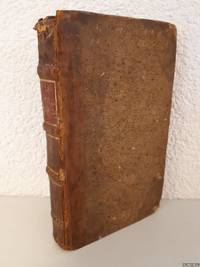
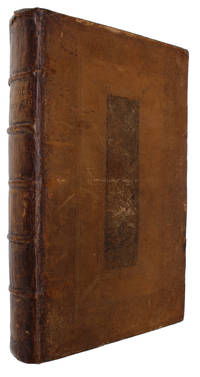
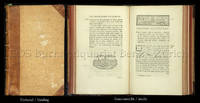
1733rif. 60085London C. Davis and A. Lyon 1733. 8vo. Lovely contemporary full Cambridge-style binding with five raised bands to spine and blindstamped ornamental borders to boards. . Double gilt line-borders to boards. All edges of boards with gilt borders. Gilt title to spine. Hinges neatly and professionally re-inforced. Internally very nice clean and fresh. A lovely crisp and large copy with good margins printed on heavy fine paper. 16 -including preface contents advertisements 253 1 18 -Index pp. The important actual first edition of this highly celebrated key work of the Enlightenment in which the anecdote of how Newton discovered gravity the story about Newton and the falling apple appeared for the first time together with the description of the difference between the physical world view of the English and the French the "plenum" and the "vacuum". This seminal work in which Voltaire famously depicts British philosophy science society and culture in comparison to French can be viewed as the Enlightenment equivalent to Tocqueville's "Democracy in America". This series of essays which is based on Voltaire's experiences when living in England was actually written by Voltaire mostly in English which he mastered to perfection. It has often been presumed that the first edition of the work was that published in French in 1734 but actually the present English edition constitutes the actual first appearance of the work as well as the version that is closest to Voltaire's intention as the French language version is the re-written one and the English version the original. Curiously almost all modern English versions are translations into English of the French edition instead of the original English version making this edition of the utmost importance.After the original English edition of 1733 two French editions soon followed the first in 1734. Unlike the British the French resented the book and already in 1734 the French Parliament issued an order for the author's arrest and condemned the work causing the impact of it in France to be delayed. The book was burned for being "dangerous to religion and civil order". At the same time the work became a bestseller in Britain and as much as 14 editions of the work were published in the eighteenth century. "Inspired by Voltaire's two-year stay in England 1726-8 this is one of the key works of the Enlightenment. Exactly contemporary with Gulliver's Travels and The Beggar's Opera Voltaire's controversial pronouncements on politics philosophy religion and literature have placed the Letters among the great Augustan satires. Voltaire wrote most of the book in English in which he was fluent and witty and it fast became a bestseller in Britain. He re-wrote it in French as the Lettres philosophiques and current editions in English translate his French." Nicholas Cronk Introduction to the Oxford's Classics edition from 1999.The great French philosopher Voltaire was greatly impressed by the philosophical and scientific achievements of the English especially those of Newton Locke and Bacon. As a disseminator of scientific knowledge Voltaire came to play a great rôle in the popularization of Newtonian science and its discoveries the present work being a prime example. Although the work was condemned by the French authorities it still came to play a great rôle in the spreading of Newtonian ideas in France. The present work generally came to play a dominant rôle in Enlightenment accounts of the history of science and philosophy. The work focuses on British science and thought and uses the accounts of these to emphasize what is lacking in French society and French thought. The work is generally very critical towards the French "ancient régime" and when Voltaire here discusses the emergence of empiricism it is viewed as an English tradition that stands in opposition to the French rationalist tradition with Descartes as the prime example. This view is taken over by the following Enlightenment historians of science and philosophy e.g. d'Alembert see for instance his "Preliminary Discourse" of 1751. Some of the most influential passages of the work are probably those on Bacon who Voltaire sees as the founder of modern experimental science Newton and Descartes. Letters XIV on Descartes and Newton XV on attraction and XVI on Newton's Optics from 1704 are among the most influential essays of the work. In XVI Voltaire reflects upon Newton's "Optics" and the way that he rejected Descartes' theory and set out his own account of the properties of light. In XV he presents the first account of Newton and the falling apple: "As he was walking one Day in his Garden and saw some Fruits fall from a Tree he fell into profound Meditation on that Gravity the Cause of which had so long been sought but in vain by all the Philosophers whilst the Vulgar think there is nothing mysterious in it. He said to himself that from what height soever in our Hemisphere those Bodies might descend their Fall wou'd certainly be in the Progression discover'd by Galileo; and the Spaces they run thro' would be as the Square of the Times. Why may not this Power which causes heavy Bodies to descend and is the fame without any sensible Diminution at the remotest Distance from the Center of the Earth or on the Summits of the highest Mountains; Why said Sir Isaac may not this Power extend as high as the Moon." pp. 127-28.But perhaps the most famous passage in the volume is the opening of Letter XIV: "A Frenchman who arrives in London will find Philosophy like every Thing else very much chang'd there. He had left the World a "plenum" and he now finds it a "vacuum". At Paris the Universe is seen compos'd of Vortices of subtile Matter; but nothing like it is seen in London. In France 'tis the Pressure of the Moon that causes the Tides; but in England 'tis the Sea that gravitates towards the Moon; so that when you think that the Moon should make it Flood with us those Gentlemen fancy it should be Ebb which very unluckily cannot be prov'd." pp. 109-10. hardcover
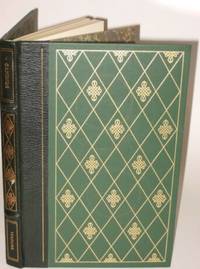
rif. 16958Voltaire. Candide. Franklin Library. Pennsylvania: Franklin Library 1979. Hardcover. A Limited Edition. Original binding. Bound in one quarter premium full leather. Covers Accented in Gilt motifs. Printed on archival paper with gilded edges with silk ribbon page marker and decorated endsheets. Translation of Tobias Smollet This version also includes many with illustrations of Antoni Clave. Candide is a satire first published in 1759 by Voltaire a philosopher of the Age of Enlightenment. A beautiful book in pristine condition. Candide is living a sheltered life with his mentor Professor Pangloss who's mantra is "all is for the best" in the "best of all possible worlds" but as the fantastical and fast-moving plot continues Candide slowly and painfully is disillusioned as he witnesses and experiences great hardships. Voltaire concludes Candide with a practical precept "we must cultivate our garden" in lieu of the "all is for the best" in the "best of all possible worlds". Candide has enjoyed both great success and great scandal. Immediately after its secretive publication the book was widely banned to the public because it contained religious blasphemy political sedition and intellectual hostility hidden under a thin veil of naïveté. Today Candide is recognized as Voltaire's magnum opus and is often listed as part of the Western canon. unknown
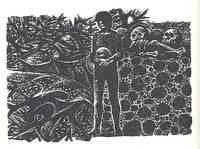
1977rif. 020413Lincoln: Penmaen Press 1977. First Edition. Hardcover. Light marking to cloth along spine. Near Fine in a Near Fine slipcase. Lynd Ward. Quarto in cloth-backed boards. Of 200 numbered copies of this special edition this copy not numbered but marked "O.S." out-of-series. Illustrated with six wood engravings by Lynd Ward. SIGNED by artist Lynd Ward Anthony Hecht the translator and Arthur Wilson who wrote the introduction. Hand-printed by Michael McCurdy and Evelyn Clarke with Ward's engravings struck from the blocks. There were also 100 deluxe copies and 200 trade copies. Prospectus laid in. Penmaen Press hardcover
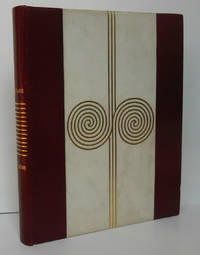
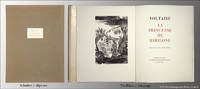
rif. 115135ABParis: Blaizot; 1927. 225 x 27 cm. 6 Bll. 176 S. 3 Bll. Halbfranzband in Maroquin. Pergamentüberzug mit goldener Spiralmusterprägung. Meistereinband von und gestempelt mit "René & Michel Kieffer". Sehr guter Zustand. Kurzroman von Voltaire in dem ein Nordamerikaner an der Küste der Bretagne landet und durch eine Verwechslung bei einem Prior und dessen Schwester aufgenommen wird. Durch seine Ehrlichkeit weil er "ganz naiv stets sagt was er denkt und tut was er will" nennt man ihn den Harmlosen; und da ihm die Kunst der Heuchelei fremd ist stehen ihm viele Enttäuschungen in der Adelsgesellschaft des franz. 18. Jhdts bevor. Voltaire erreicht es so die europäische Kultur in ihrem Zusammenstoß mit der unverbildeten Person des Harmlosen lächerlich und fragwürdig zu machen. siehe auch KLL. Eines von 350 num. Exemplaren auf Vélin-de-Rives-Bütten. Die Zeichungen und der Buchschmuck in diesem Band von Bernard Naudin 1876-1946 zählen zu seinen schönsten Arbeiten. 1927 unknown
1919rif. 6269BB1919. 2 Bände. Berlin Gustav Kiepenheuer 1919. Mit Illustrationen von Moreau Le Jeune nach alten Vorlagen. Orig.-Pergamentbande mit reicher Rücken- und Deckelvergoldung sowie Kopfgoldschnitt. Eines von 150 nummerierten Exemplaren. - Papier gebräunt und wenig stockfleckig. Einband berieben und fleckig. Die Deckel verzogen. unknown
1942rif. 5878BB1942. Zürich Les belles feuilles 1942. 4°. 2 Bl. 115 4 S. 2 Bl. Mit 1 Frontispiz mehreren Textillustr. u. der Suite in 12 losen Tafeln nach Holzschnitten von Imre Reiner. Lose Bogen in illustr. brosch. Orig.-Umschlag sowie Suite in Bütten-Mappe zus. in Halbpergament-Chemise u. Orig.-Pappschuber dieser leicht berieben u. lichtrandig. SIK II 856 für Reiner. - Unnumeriertes nicht signiertes Ex. von 170 GA 232 mit kompletter Suite in dieser Form normalerweise numeriert u. signiert des ersten Druckes der "Belles Feuilles" auf Rives-Bütten. Imre Reiner 1900-1987 geb. in Ungarn war in den 20er Jahren als Graphiker in London Paris New York und ab 1931 in Ruvigliana bei Lugano als Maler Typograph Graphiker u. Illustrator tätig. unknown
1765rif. 4481CB1765. 2 in 1 Band. Genève Cramer 1765. 8°. 292 283 S. Mit 1 gest. Tafel 1 Textholzschn. und einigen Holzschnittvignetten. Lederband der Zeit. Erschien ebenfalls anonym erstmals ebenda 1759-1763 in 2 Bänden. - Nur wenig stockfleckig. Einband berieben und bestossen. unknown
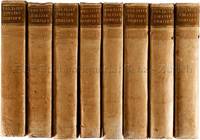
1772rif. 30301AB1772. 8 Bände. Lausanne François Grasset 1772. 8°. Pappbände der Zeit mit verg. Rückensch. Papier vereinzelt stockfleckig. Einbände berieben und bestossen Rücken verblichen. unknown
1771rif. 56745No place No printer 1771. Contemp. hcalf. Spine gilt. Gilt lettering. A paperlabel pasted on upper part of spine. Stamp on both title-pages. VIII478 pp. A few scattered brownspots. Collection complette des Oeuvres de Mr. de Voltaire. Tome 12. Separately printed unknown
1843rif. 33932AB1843. Leipzig Brockhaus = Ausgewählte Bibliothek der Classiker des Auslandes Band 17 1843 8° XLVIII 206 S. mit Zeilenzählern Glanzvorsatzseiten Text: Fraktur Leineneinband der Zeit mit goldener Rückenbeschriftung der Rücken etwas aufgehellt alter Besitzervermerk auf Vorsatzseite zu Beginn und am Schluß etwas altersbraunfleckig sonst ein schönes sauberes Exemplar. Abholung im Ladengeschäft in Frankfurt am Main Nordend ggü. Musterschule möglich. Das spart die Portokosten. Pickup at the store in Frankfurt am Main Nordend close to Musterschule is possible. It saves the shipping costs. unknown
1815rif. 964F61Paris: Pierre Didot 1815 . Leather. Very Good. 5.5" by 3.5". None. Early 19th century editions of two historical works by Voltaire discussing the Russian Empire Peter the Great Louis XIV and Louis XV. In the original French.Two works are present here: 'Histoire de l"Empire de Russie sous Pierre le Grand' complete in two volumes and 'Siecles de Louis XIV et de Louis XV' complete in five volumes.These are early 19th century editions of mid-18th century works from Voltaire the French Enlightenment writer philosopher satirist and historian. 'Histoire de l"Empire de Russie sous Pierre le Grand' recounts the reign of Peter the Great and the transformation of Russia from an unremarkable state into a European power.'Le Siècle de Louis XIV' is Voltaire"s ambitious attempt to chronicle not only the political events of Louis XIV"s reign but also its cultural and intellectual flourishing.The posthumously published 'Le Siècle de Louis XV' deals with the complexities and contradictions of Louis XV"s rule including military setbacks and political corruption.From the Edition Stereotype of Voltaire's works published by Didot.Inscriptions to half title heads. In full calf bindings with gilt detailing to back strip. Lacking two volume number labels and a small portion of one title label. A touch of rubbing to joints otherwise externally lovely. Head and tail of Russia vol I front joint starting with board firmly held. Inscriptions to half title heads. Internally firmly bound. Pages bright with the odd instance of spotting most concentrated to first and last few leaves. Very Good Pierre Didot hardcover
1785rif. 862N27Paris: De l'Impremerie de la Societe Litteraire Typographique 1785. Leather. Fair. 8" by 5". None. Forty three leather bound volumes from the Complete Works of Voltaire. 43 volumes from the complete works of Voltaire. Published in French. The present collection of the French philosopher's works includes volumes 2-10 12 14-17 20-23 25 27 32-35 37 45 51 60 63-69 70-77 and 89. With four plates to volumes two three and six. With three plates to volume four. With seven plates to volumes five and nine. With nine plates to volume eight. With ten plates to volume nine. With five plates to volume ten. The present collection opens with the theatrical works of Voltaire which is followed by his poetry including his epic poem the Henriade. In his Essay on the Universal History Manners and Spirit of Nations Voltaire discusses the history of Europe before Charlemagne until the age of Louis XIV. This is followed by his History of the Russian Empire Under Peter the Great his writings on politics and legislation some miscellaneous literary criticism and his commentary on the dramatic works of Pierre Corneille. The latter volumes are comprised of Voltaire's letter exchanges. Voltaire was a French Enlightenment writer philosopher and historian famed for his wit his criticism of Christianity and slavery and advocation of the separation of the church and state. The versatile and prolific writer produced works in many literary forms including plays novels essays but also scientific expositions. In a full contemporary calf binding. Externally sound. The rear board of volume 64 id disbound but present. The remaining volumes are lightly rubbed to the boards with some cracking to the leather along the spine. Volume 27 is missing some calf to the front extremity. Generally lightly rubbed to the head and tail of the spine although some volumes including 14 27 32-34 and the majority of the volumes in the 70s are missing a slither of calf to the head or tail of the spine or both. The front joints of volumes 10 16 20 33 and 45 are rather tender. Although the hinges are better to the latter volumes they are starting but firm to the majority of the earlier volumes.The front hinges are particularly tender to volumes 9 15 16 20 45 60 and 89 and the rear hinges are loose in volumes 10 and15. Internally firmly bound. Pages are generally bright and clean with some patches of light foxing. Fair De l'Impremerie de la Societe Litteraire Typographique hardcover
rif. 6101088611Wilder Publications Limited . Papeback. New. pp. 536 Wilder Publications, Limited unknown
rif. 6103281937Wilder Publications Limited . Papeback. New. pp. 668 Wilder Publications, Limited unknown
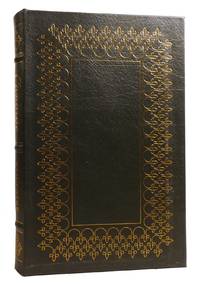
1977rif. 216580Norwalk Connecticut: Easton Press 1977. First Edition; First Printing. Hardcover. Near Fine Leather Bound. Printed on archival paper with gilded bottom and side edges. The endsheets are of moire fabric with a silk ribbon page marker. Smyth sewing and concealed muslin joints to ensure the highest quality binding. This book is in full leather with hubbed spines.; The 100 Greatest Books Ever Written Collector's Edition. Easton Press hardcover
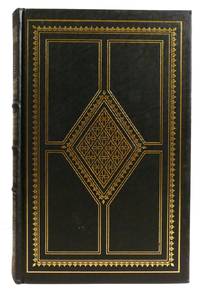
1979rif. 333152New York: Franklin Library 1979. First Edition; First Printing. Hardcover. Illustrated by Antoni Clave. Very Good Leather Bound. Printed on archival paper with gilded edges. The endsheets are of moire fabric with a silk ribbon page marker. Smyth sewing and concealed muslin joints to ensure the highest quality binding. This book is in full leather with hubbed spines. Foxing on top text block edge. Franklin Library hardcover
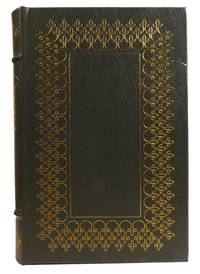
1977rif. 335713Norwalk Connecticut: Easton Press 1977. First Edition; First Printing. Hardcover. Illustrated by Sylvain Sauvage. Very Good Leather Bound. Accented in 22kt gold. Printed on archival paper with gilded edges. The endsheets are of moire fabric with a silk ribbon page marker. Smyth sewing and concealed muslin joints. This book is in full leather with hubbed spines. Owner personalization pressed into half title page.; The 100 Greatest Books Ever Written Collector's Edition. Easton Press hardcover
1977rif. 331919Norwalk Connecticut: Easton Press 1977. First Edition; First Printing. Hardcover. Near Fine Leather Bound. Printed on archival paper with gilded edges. The endsheets are of moire fabric with a silk ribbon page marker. Smyth sewing and concealed muslin joints to ensure the highest quality binding. This book is in full leather with hubbed spines.; 100 Greatest Books Ever Written Collector's Edition. Easton Press hardcover
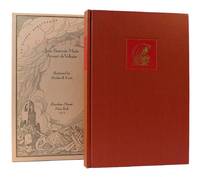
1950rif. 311507New York: Heritage Press 1950. First Edition Thus; First Printing. Hardcover. Very Good in a Very Good slipcase. Shelfwear on slipcase corners and bottom edge. Heritage Press hardcover
1981rif. 312788New York: Franklin Library / Oxford University Press 1981. First Edition; First Printing. Hardcover. Illustrated by Antoni Clave. Near Fine Bound in one quarter premium full leather. Accented in 22kt gold. Printed on archival paper with gilded edges. Decorated endsheets and with a silk ribbon page marker. Smyth sewing and concealed muslin joints.; First Franklin Library Edition. Franklin Library / Oxford University Press hardcover
1975rif. 307365New York: Random House 1975. Facsimile; First Printing. Hardcover. Very Good in a Near Fine slipcase. Very light shelfwear on panel corners and spine crown and heel. Random House hardcover
1786rif. 41246AB1786. Basel De l'imprimerie de Jean-Jacques Tourneisen 1786. 20.9cm x 12.6cm. 552 pages. Original Hardcover. Good condition only with considerable rubbing to the binding. Preowner's name plate on pastedown. Bookplate of Richard Oliver Presented to the Albemarle Club. Oeuvres Completes de Voltaire. Tome Trente-Huitieme. Includes also the description of : "Austerités" / Astrologie / Athéisme / Atomes / Avarice / Auguste Octave / Avocats / Babel / Roger Bacon / Baiser / Banqeroute / Barac et Debora / Bataillon / Bayle / Blaspheme / Bornes de L'esprit Human / Brachmanes Brames / Cartesianisme / Celtes / Chaine des Etres Crées Charité / Charlatan / De La Chine - Section I. etc. hardcover
1880rif. 260409Paris: Chez J. Lemonyer Libraire 1880. Frontispieces and 20 headpieces. 2 vols. 8vo. Bound in three quarters green morocco spines faded uniformally to brown printed wrappers bound in by Flammarion. Fine. Frontispieces and 20 headpieces. 2 vols. 8vo. Chez J. Lemonyer, Libraire unknown