881 resultados
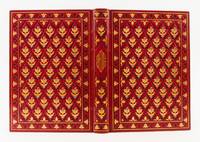
1893ref. ST17884Paris: Imprimé pour Les Amis de Livres par Chamerot et Renouard 1893. No. 55 OF 115 COPIES printed for M. Van der Vrecken de Bormans. 275 x 190 mm. 10 3/4 x 7 1/2". 4 p.l. 159 3. DAZZLING CONTEMPORARY SCARLET MOROCCO VERY ORNATELY DECORATED IN GILT SILVER AND BLACK AS WELL AS INLAID BY MARIUS MICHEL stamp-signed on front doublure covers elaborately embellished with a floral frame enclosing a large central panel filled with diapered compartments formed by gently curving black leaves each compartment containing a floral sprig tooled in silver and gold flat spine with similarly decorated ogival compartments and gilt titling OLIVE BROWN MOROCCO DOUBLURES filled with rows of inlaid red carnations with dark green pedicels leather hinges jacquard silk endleaves in pink blue and green pattern marbled flyleaves all edges gilt. Original white textured paper wrappers bound in. In a slightly worn brown morocco-trimmed marbled paper slipcase. With eight pleasing color engravings by Rops 4 Robaudi 2 and Garnier 2 depicting scenes from the story accompanied by 29 proofs in red yellow cyan and black & white as called for in the colophon. A Large Paper Copy. Front flyleaf with INK INSCRIPTION SIGNED BY MARIUS MICHEL and dated Mai 1920 noting that he had bound this copy for M. Van der Vrecken de Bormans in 1896 for a very substantial price of 600 francs. Carteret IV 407; Vicaire I 47. Three blank front flyleaves with narrow faint brown horizontal blemish across most of the page apparently a tape shadow; in all other ways A BEAUTIFUL COPY clean fresh and bright internally IN A PRISTINE BINDING. This ravishing object is a bibliophile's treasure: an illustrated luxury edition in Large Paper format of Voltaire's philosophical novel offered in a binding from a pre-eminent Parisian atelier. The impressive binding stands out not only because of its remarkable condition but also because of the variety and unerring execution of its decorative elements--from the vigorous use of black gold and silver on the cover and spine to the particularly animated inlaid morocco doublures. Considered the best binder of his generation as well as the founder of modern French bookbinding Henri Marius Michel 1846-1925 began his career in the workshop established by his father Jean in Paris in 1849 where they produced distinguished bindings in the prevailing historical styles for two decades. After the father's death in 1890 the firm came to even greater prominence when Henri began producing bindings in a completely new and original style that did nothing less than change the course of modern bookbinding in France. According to Duncan & De Bartha Henri believed passionately "that bookbinding needed a new vocabulary of ornamentation in order to express the mood and spirit of contemporary authors." The "vocabulary of ornamentation" he developed was based on nature the revolutionary "La Flore Ornamentale" style that he unveiled at the 1878 International Exposition. His favored floral forms dominate the present binding both as inlays and as silver and gold tooling. Our binding was commissioned by Paul Van der Vrecken Baron de Bormans an attaché at the Belgian Embassy in Paris and a bibliophile who belonged to "La société du livre contemporain" as well as the "Cercle Parisien du livre." The 600 francs the binding cost would have bought a very great deal in France at the end of the 19th century. Another copy of this work with the same special features and also bound in inlaid morocco by Marius Michel sold at Sotheby's in 1995 for the hammer price equivalent of $31200. Imprimé pour Les Amis de Livres par Chamerot et Renouard unknown books
1947ref. 313881947. Chamonix chez Jean Landru 1947. Un vol. au format pt in-4 265 x 207 mm de 193 pp. en feuilles sous couverture illustre rabats remplis et tui-chemise de plein cartonnage gris-perle dos lisse titre frapp l'oser lie-de-vin. Soigneuse ralisation. Un des exemplaires du tirage numrot sur vlin de Rives. Il s'agrmente - ici en premier tirage - de spirituelles compositions en couleurs de Roger Mauge. ''Dans ce siÂcle du voyage et de la philosophie Zadig entreprend son apprentissage dans un univers partag entre le bien et le mal. Trahi par Smire et Azora dÂŽÂu par l'amour Zadig trouve refuge dans la nature qui est l'image de Dieu. Remarqu par le roi d'gypte Moabdar il retourne dans le tourbillon du monde et devient Premier ministre. Sduit par la reine Astart et menac par la jalousie du roi il fuit bientt Babylone. C'est l'occasion pour lui d'un retour sur soi et d'une rflexion sur les caprices de la fatalit. Au hasard des aventures qu'il croise sur son chemin en compagnie de l'ermite Zadig devient l'incarnation de la Providence dont les voies restent par ailleurs impntrables. L'ange Jesrad lui rvlera une partie des mystÂres de la Destine. Si l'homme est sans cesse tiraill entre libert et dterminisme il semble bien devoir les concilier. Et c'est l sans doute la seule vrit qui nous soit accessible.'' Lgers dfauts affectant les coupes de l'tui. Du reste trÂs belle condition. b42961 unknown
ref. 882141LondonLondon: John Brindley 1749 3/4 Tan Calf. Good. 16mo - over 5¾" - 6¾" tall. Engraved frontis.238pp. rebacked with new tan morocco spine raised bands and gold lettering over original marble boards. Contents slightly age toned binding rubbed and soiled corners bumped but a very nice copy. Probably the First English Edition. LondonLondon: John Brindley, 1749 hardcover
1738ref. 103384Amsterdam, Jacques Desbordes, 1738, in-8, [2]-399-[1] pp. 9 pl, , Édition originale, à l'adresse de Jacques Desbordes. Elle est illustrée d'un portrait de Voltaire, d'un portrait allégorique de Newton, 6 planches gravées, un tableau dépliant et de nombreuses vignettes dans le texte ainsi que de jolis bandeaux et culs-de-lampe. Dans ses Élémens, dédicacés à la Marquise du Châtelet, qui partage avec Voltaire la gloire d'avoir introduit, en France, les idées scientifiques et philosophiques de Newton et à qui l'on doit la première édition française des Principia, Voltaire présente Newton comme le découvreur du vrai système du monde et le destructeur des erreurs du cartésianisme. Il s'engage personnellement pour la propagation de newtonisme, dont il fit la découverte pendant son exil en Angleterre entre 1725-1728 : pour Voltaire, l'empirisme de Newton, sa méthode expérimentale et son refus de tout dogme symbolise la victoire des Lumières sur la métaphysique chrétienne (Voir Norman). Manques et épidermures, pâles mouillures, quelques rousseurs et taches. Norman 2165 ; DSB XIV, pages 82-85; Babson, 120. Couverture rigide
ref. LCS-186414L’un des exemplaires imprimés sur grand papier fin. De l’imprimerie de la Société Littéraire typographique 1784-1789. 70 volumes. Grand in-8, maroquin vert, encadrement doré sur les plats, roulette intérieure et coupes finement ornées, dos lisses ornés de motifs dorés (certains légèrement passés), pièces de titre et de tomaison de maroquin rouge, tranches dorées. Quelques rousseurs inhérentes au papier. Reliure de l’époque. 245 x 150 mm.
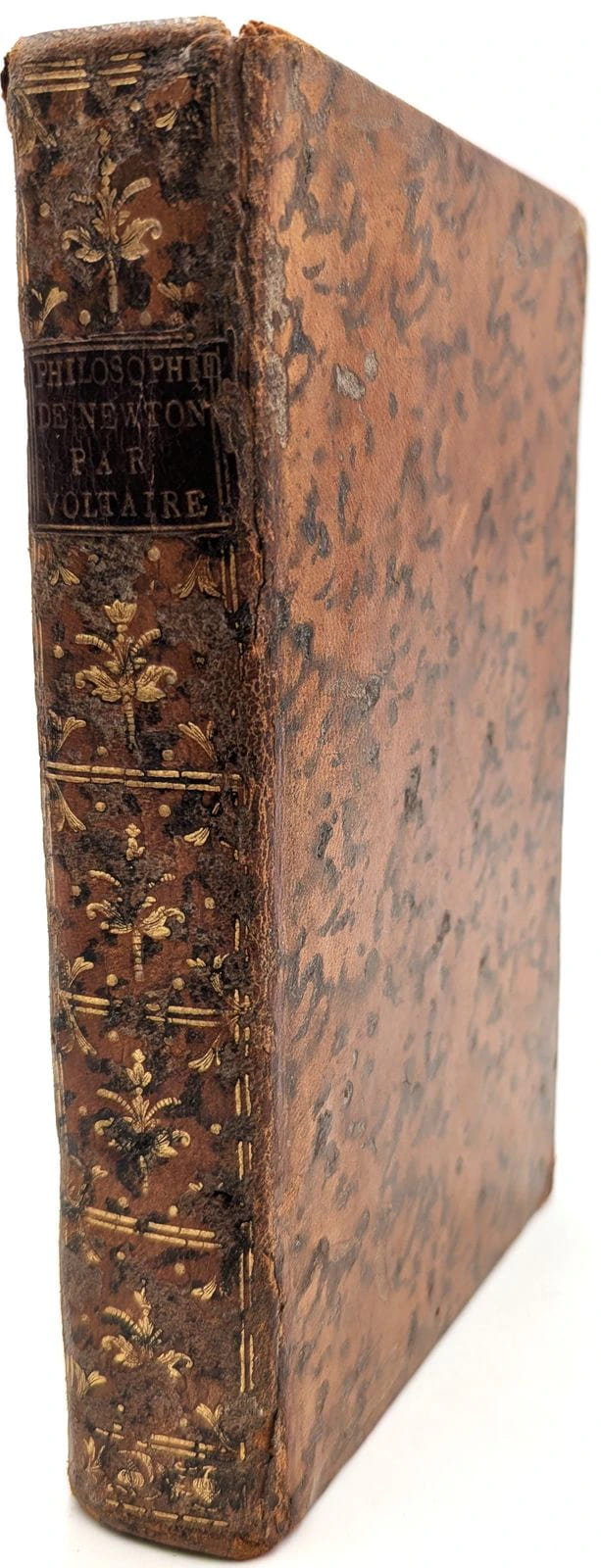
ref. elala3798London Paris: Prault 1738. Second Edition the first to contain the 26th chapter on fluxions. ìOwing to Descartesí great influence and Newtonís dispute with Leibniz the spread of Newtonís thought on the Continent took about fifty years. One of his greatest champions was Voltaire whose …lÈmens De La Philosophie De Neuton 1738 was widely read.î Printing and the Mind of Man It was during his exile in England from 1726 to 1729 that Voltaire became acquainted with Newtonís scientific methods and achievements. His Letters Concerning the English Nation first published in 1733 contained four letters on Newton including the first account of the famous story about the falling apple which inspired Newtonís law of gravitation. His celebrated popularization of Newtonian principles the …lÈmens served to establish the pre-eminence of empirical philosophy in eighteenth century France. The work is dedicated to Voltaireís mistress the Marquise de Ch‚telet whom he assisted in a French translation of Newtonís Principia. Bengesco 1570. Cioranescu 64736. Gray 156. cfBabson 120. See Printing and the Mind of Man 161. 8vo. pp. 1 p.l. xvi 4 328 12. lacking half-title errata & portrait of Voltaire. title in red & black with engraved vignette by Duflos. engraved frontis. portrait of Newton by P.Dupin possibly inserted. folding engraved table 6 engraved plates & numerous engravings in the text. contemporary mottled calf rebacked corners & edges renewed occasional browning London [Paris: Prault], 1738 unknown