198 résultats
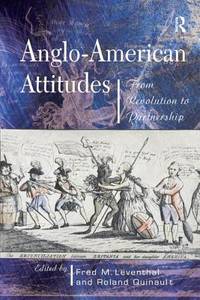
2000réf. x-0754600300Ashgate Pub Ltd 2000. Hardcover. New. 313 pages. 9.25x6.25x1.00 inches. Ashgate Pub Ltd hardcover
2012réf. x-1409420469Ashgate Pub Co 2012. Hardcover. New. new edition edition. 368 pages. 9.53x6.50x1.22 inches. Ashgate Pub Co hardcover
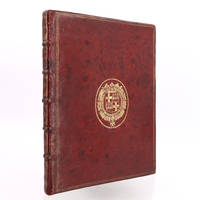
1824réf. 006561Paris: Crapelet Imprimeur-Libraire 1824. Book. Near Fine. Leather and Marbled Boards. First Thus. 8vo - over 7¾" - 9¾" tall. In handsome red leather and marbled boards end pages marbled top edges gilt gilt titles and decorations 4 raised band Near Fine slight rubbing to leather at tips slight foxing and toning scattered throughout. Philippe Quinault 1635-1688 was a French dramatist best known for his 14 opera librettos which he wrote for Lully. Crapelet, Imprimeur-Libraire Hardcover
1824réf. 006561Paris: Crapelet Imprimeur-Libraire 1824. Book. Near Fine. Leather and Marbled Boards. First Thus. 8vo - over 7¾" - 9¾" tall. In handsome red leather and marbled boards end pages marbled top edges gilt gilt titles and decorations 4 raised band Near Fine slight rubbing to leather at tips slight foxing and toning scattered throughout. Philippe Quinault 1635-1688 was a French dramatist best known for his 14 opera librettos which he wrote for Lully. Crapelet, Imprimeur-Libraire Hardcover books
réf. DADAX0940359014New unknown
réf. 18033Amsterdam, Antoine Schelte, 1697. 2 vol. petit in-12, vélin ivoire Bradel à rabats, titre en noir au dos. Reliure du XIXe s. Bon exemplaire. 2 titres-frontispice h.-t. gravés à l'eau-forte, 16 frontispices h.-t. gravés à l'eau-forte en tête de chaque pièce et 1 frontispice gravé à l'eau-forte au verso du titre de Stratonice, (6) ff. (front. compris), (4) ff., 65 pp., (4) ff., 66 pp., (4) ff., 65 pp., (4) ff., 66 pp., (4) ff., 66 pp., (4) ff., 66 pp., (5) ff., 87 pp., (4) ff., 77 pp.; (2) ff. (front. compr.), (5) ff., 74 pp., (1) f. blanc, (4) ff., 78 pp., (4) ff., 70 pp., (3) ff., 80 pp., (4) ff., 65 pp., (4) ff., 62 pp., (2) ff. blancs, (4) ff., 61 pp., (4) ff., 65 pp. Les frontispices sont intervertis ainsi que les pp. 43 à 61 d'Astrate et de Pausanias au tome II.
1824réf. 46402783Paris, Crapelet, 1824 ; 2 volumes grand in-8, plein maroquin violet, large encadrement de filets dorés et guirlandes à froid, grande arabesque à froid au centre des plats, dos orné d’un décor romantique doré et à froid, tranches dorées, dentelles intérieurieures dorées. (Dauphin) 2 ff., portrait, 50 pp., 1 f., 446 pp., 1 f. - 2 ff., 460 pp.Portrait de Quinault gravé par Bonvoisin.Belle édition typographique du théâtre de Quinault : Astrate, La mère coquette, Alcestee, Thésée, Atys, Isis, Prosperine, Persée, Phaeton, Amadis, Roland, Le Temple de la Paix, Armide, Sceaux. La plupart de ces oeuvres ont été mises en musique par Lulli.Le premier tome, outre la vie de Quinault par Crapelet et un examen de ses oeuvres par Laharpe, contient diverses pièces relatives à l’établissement de l’Académie Royale de Musique, les lettres patentes du roi pour l’établissement de l’Académie de Danse de Paris, la création d’Académies d’opéra ou représentations en musique, en langue française, sur le pied de celles d’Italie, en faveur de Perrin, la permission en faveur de Lulli, le privilège pour l’impression des oeuvres de Lulli.UN DES 42 EXEMPLAIRES NUMÉROTÉS SUR GRAND RAISIN VÉLIN, seuls grands papiers. Vicaire VI, 902. Il est somptueusement relié à l’époque par l’excellent relieur lyonnais Dauphin. Qq. rousseurs.
réf. Bloomsbury-9781441104281Continuum. Hardback. New. 304 pages Continuum hardcover
réf. Bloomsbury-9781441104281Continuum. Hardback. New. 304 pages Continuum hardcover
1824réf. 002122Paris Crapelet 1824
1715réf. 35600685Amsterdam, David Mortier, 1715 ; 2 volumes in-12, veau fauve, colombe dor. frappée au centre des plats, dos ornés avec colombes dor. au bas, tr. rouge. (Reliure de l'époque) Seconde édition collective elzevirienne. La première, de 1663 ne contenait que 12 pièces (Willems 1724). Celle-ci contient en tout 16 pièces, soit la totalité de l'œuvre théâtrale. Ces deux tomes sont constitués de la manière suivante :1) Frontispice, titre en rouge et noir avec vignette, 4 ff. de préface ; La mort de Cyrus. Suivant la copie imprimée à Paris. 1708. 3 ff., 65 pp., - Le mariage de Cambise. Id. 1708. 3 ff., 66 pp. - Le feint Alcibiade. Id., 1682. 3 ff., 65 pp. - Les Coups de l’Amour et de la Fortune. Id., 1708. 80 pp. en tout. - Amalasonte. Amsterdam, Schelte, 1697. 3 ff., 66 pp. - Stratonice. Suivant la Copie impr. à Paris, 1708. 3 ff., 66 pp. - La Comédie sans Comédie. Id. ; 1662. 3 ff., 82 pp. - Le Fantosme amoureux. Amsterdam, Schelte, 1697. 3 ff., 77 pp.2) Frontispice, 1 f. titre en rouge et noir ; La Généreuse ingratitude. Amsterdam, Schelte, 1697. 4 ff., 74 pp. - L’Amant indiscret. Id., 1697. 3 ff., 78 pp. - Les Rivales. Id., 1697. 1 f., 70 pp. - Agrippa Roy d’Albe. Id., 1697. 3 ff., 65 pp. - Bellerophon. Suivant la Copie impr. à Paris. 1688. 3 ff., 61 pp., - La mère coquette. Id., 1666. 2 ff., 80 pp. - Astrate Roy de Tyr. Id., 1665. 3 ff., 65 pp. - Pausanias. Amsterdam, Schelte, 1697. 3 ff., 61 pp.Outre les frontispices généraux pour chaque tome, ce recueil contient des frontispices particuliers pour chaque pièce, soit 16 gravures.Bel exemplaire relié au début du XVIIIe siècle avec un emblème (colombe dressée) que nous n’avons pu identifier.
1777réf. 121877P., Deslauriers, s.d. (1777), in-folio (323 x 250 mm), (1) f. de titre, 279 pp, reliure plein veau raciné, dos à 5 larges faux-nerfs soulignés de doubles filets dorés, titre doré dans un encadrement floral au 1er plat, tranches mouchetées (rel.de l'époque), coiffes arasées, pt accrocs au 2e plat, pt mque à un coin, plats lég. frottés, coins émoussés, trace de mouillure ancienne en coin, infime travail de vers en marge sup. des 10 derniers feuillets, marges des 4 premiers feuillets restaurées, 4 pages manquantes (p. 217-220) remplacées par une copie manuscrite très bien exécutée à l'époque, bon exemplaire, entièrement gravé sur cuivre, imprimé sur papier fort
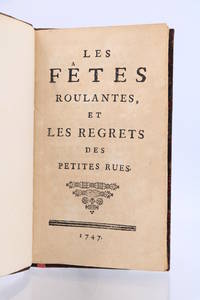
1747réf. 91802n. l.: s. n. 1747. Fine. s. n. n. l. 1747 10 x 16.8 cm Relié First edition of this work published by the Société du Bout-du-Banc the celebrated literary salon presided over by Mademoiselle Jeanne-Françoise Quinault and the Comte de Caylus. This intimate circle originally comprising eight members would gather on Mondays at dinner to exchange ideas and to write; at the close of each meal every distinguished guest was required to set down a few lines whether in the coarse poissard style or in a more refined vein on paper. It was in this context that Les Fêtes roulantes ou les regrets des petites rues came into being in the wake of the celebrations held in Paris in honour of the Dauphin's second marriage to Marie-Josèphe de Saxe. Pastiche binding in plum half-shagreen spine with five raised bands framed by gilt dotted fillets and six compartments decorated with gilt fillets and fleurons marbled paper boards gilt top edge pastedowns and endpapers in shell-pattern marbled paper. Some minor rubbing to the paper of the lower board corners slightly bumped. ""In his youth the Comte de Caylus had paid considerable tribute to the literature of fairy tales which the translations from Arabic and Persian by Galland and Pétis de la Croix had brought into fashion; one does not find him again in these artificial creations to which he returned when he was nearly seventy. But in the intervening years his character as a writer emerged and declared itself in accordance with his manners and tastes and in how propitious a milieu! The Société du bout du banc that academy of Gallic ribaldry presided over by Mademoiselle Quinault; those suppers at which an inkwell served as centrepiece and which La Chaussée d'Armenonville Voisenon Moncrif the Grand Prior of Vendôme Duclos Salley and Crébillon fils enlivened with their bawdy and bantering wit. All men of letters with little taste for philosophy all content to let the world go its own way and finding it perfectly satisfactory as it was all of that sacred flock of Epicurus somewhat transformed by Circe in which each member is satisfied or very nearly with what their presiding lady declared sufficient for Duclos the least fastidious among them. The popular literature of the eighteenth century that is to say literature which took the common people as the subject of its observations and tableaux was born within this company of mirth and folly and the Comte de Caylus was its natural father and its foster father; it took its first lively flights in those ""Écosseuses"" 1739 those ""Étrennes de la Saint-Jean"" 1742 those ""Mémoires de l'Académie des colporteurs"" those ""Avantures des bals des Bois"" those ""Fêtes roulantes"" 1748 a veritable magic lantern of Parisian popular life ."" Avertissement ""Mémoires et réflexions du comte de Caylus"" 1874 s. n. hardcover
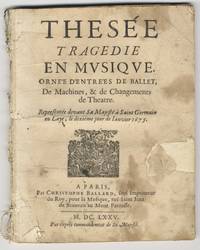
1675réf. 39713Paris: Christophe Ballard seul Inprimeur du Roy pour la Musique ruë Saint Jean de Beauvais au Mont Parnasse . Par exprés commandement de Sa Majesté 1675. Quarto. Disbound. 1f. recto title verso blank 1f. "Acteurs du Prologue" 3ff. "Prologue" 1f. "Acteurs de la Tragedie" 70 pp. With woodcut device to title including Apollo with lyre figures in Greco-Roman dress with harp and lute and a pegasus; woodcut headpieces to each act; decorative woodcut initials and tailpieces throughout. Full named cast lists for the "Acteurs du Prologue" and the "Acteurs de la Tragedie." Somewhat worn browned foxed soiled and stained a bit heavier to title; some worming especially to lower inner margins; stub of front free endpaper and blank preliminary leaf preceding title; first signature detached; loss to blank outer margin of title repaired with contemporary paper; blank outer margin of all leaves of "Prologue" repaired with contemporary paper; numerous additional leaves with contemporary paper reinforcements to inner margins; other minor defects. Lacking first leaf of Prologue pp. 65-66 and pp. 71-76. First Edition first issue all other issues with a date of first performance as 11 January 1675. This issue not in Sonneck Librettos. Schmidt LLC3-1. Thesée a tragédie en musique in a prologue and five acts to a libretto by Quinault after Ovid's Metamorphoses was first performed at St Germain-en-Laye on 11 January 1675. "The orchestra and chorus are used with brilliant effect in several divertissements but especially in the evocation of battle throughout Act 1. Medea's role like that of Lully's final lovesick sorceress Armide is replete with expressive monologue airs: 'Doux repos' 'Dépit mortel' 'Sortez Ombres' and 'Ah! faut-il me venger'. Thésée was part of the standard repertory at the Paris Opéra from 1675 until 1767; in addition it was selected to represent Lully when in 1779 the Opéra presented an historical survey of French operatic styles. Lully's score was substantially modernized by editors for productions from 1754 onwards." Lois Rosow in Grove Music Online. Christophe Ballard, seul Inprimeur du Roy, pour la Musique, ruë Saint Jean de Beauvais au Mont Parnasse ... Par exprés command unknown
1675réf. 39713Paris: Christophe Ballard seul Inprimeur du Roy pour la Musique ruë Saint Jean de Beauvais au Mont Parnasse . Par exprés commandement de Sa Majesté 1675. Quarto. Disbound. 1f. recto title verso blank 1f. "Acteurs du Prologue" 3ff. "Prologue" 1f. "Acteurs de la Tragedie" 70 pp. With woodcut device to title including Apollo with lyre figures in Greco-Roman dress with harp and lute and a pegasus; woodcut headpieces to each act; decorative woodcut initials and tailpieces throughout. Full named cast lists for the "Acteurs du Prologue" and the "Acteurs de la Tragedie." Somewhat worn browned foxed soiled and stained a bit heavier to title; some worming especially to lower inner margins; stub of front free endpaper and blank preliminary leaf preceding title; first signature detached; loss to blank outer margin of title repaired with contemporary paper; blank outer margin of all leaves of "Prologue" repaired with contemporary paper; numerous additional leaves with contemporary paper reinforcements to inner margins; other minor defects. Lacking first leaf of Prologue pp. 65-66 and pp. 71-76. First Edition first issue all other issues with a date of first performance as 11 January 1675. This issue not in Sonneck Librettos. Schmidt LLC3-1. Thesée a tragédie en musique in a prologue and five acts to a libretto by Quinault after Ovid's Metamorphoses was first performed at St Germain-en-Laye on 11 January 1675. "The orchestra and chorus are used with brilliant effect in several divertissements but especially in the evocation of battle throughout Act 1. Medea's role like that of Lully's final lovesick sorceress Armide is replete with expressive monologue airs: 'Doux repos' 'Dépit mortel' 'Sortez Ombres' and 'Ah! faut-il me venger'. Thésée was part of the standard repertory at the Paris Opéra from 1675 until 1767; in addition it was selected to represent Lully when in 1779 the Opéra presented an historical survey of French operatic styles. Lully's score was substantially modernized by editors for productions from 1754 onwards." Lois Rosow in Grove Music Online. Christophe Ballard, seul Inprimeur du Roy, pour la Musique, ruë Saint Jean de Beauvais au Mont Parnasse ... Par exprés command unknown books
1697réf. 85501697 A Amsterdam chez Antoine Schelte, 1697. Deux volumes : 7 x 13.5 cm. Nouvelle édition augmentée & enrichie de figures en taille douce. I/ 2 ff. bl., 1 f. titre grav., 5 pp. [Préface], 65 pp. [La Mort de Cyrus], 4 pp. [Epistre] 66 pp. [Le Mariage de Cambise], 4 pp. [Epistre], 65 pp. [Le Feint Alcibiade], 80 pp. [Les Coups de l'Amour & de la Fortune], 4 pp. [Epistre], 66 pp. [Amalasonte], 4 pp. [Epistre], 66 pp. [Stratonice], 4 pp. [Epistre], 82 pp. [La Comédie sans Comédie], 4 pp. [Epistre], 72 pp. [Le Fantosme Amoureux], 1 f. bl. II/ 1 f. bl., 1 f. titre grav., 6 pp. [Ode], 74 pp. [La Généreuse Ingratitude], 4 pp. [Epistre], 78 pp. [L'Amant Indiscret], 70 pp. [Les Rivales], 3 pp. [Epistre], 65 pp. [Agrippa Roy d'Albe, ou le Faux Tiberinus], 4 pp. [Epistre], 61 pp. [Bellerophon], 2 pp. [A Madame de la Duchesse de Monthaussier], 80 pp. [La Mère Coquette], 3 pp. [A la Reyne], 65 pp. [Astrate, Roy de Ty], 3 pp. [A Monseigneur], 61 pp. [Pausanias]. Elégantes reliures en cuir de Russie bleu, plats à filets dorés, dos à quatre nerfs, capitales et tomaisons dorés, roulettes décorées, gardes jaspées. Ex-libris: André Gutzwiller. Chaque pièce est illustrée d'un titre gravé (non-signé) en représentant le sujet. Rousseurs sur la page de titre du second volume sinon en très bon état.
réf. 6957Paris, Aux dépens de l'Académie & de Lormel, 1778. In-8 carré (174 x 232 mm), 60 pp. Maroquin brun aux armes, encadrement de filets et fleurs de lys, dos à nerfs orné, roulette sur les coupes, doublure et garde de tabis bleu ciel, tranches dorées (reliure de l'époque).
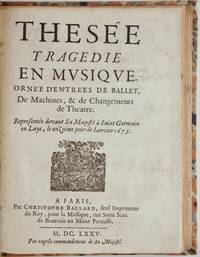
1675réf. 39689Paris: Christophe Ballard seul Imprimeur du Roy pour la Musique ruë Saint Jean de Beauvais au Mont Parnasse . Par exprés commandement de Sa Majesté 1675. Small quarto. Modern marbled boards with paper title label to upper and spine. 1f. recto title verso blank 1f. "Acteurs du Prologue" 4ff. "Prologue" 1f. "Acteurs de la Tragedie" 76 pp. With woodcut device to title including Apollo with lyre figures in Greco-Roman dress with harp and lute and a pegasus; exceptionally fine woodcut headpiece to Prologue and additional headpieces to each act; decorative woodcut initials and tailpieces throughout. Full named cast lists for the "Acteurs du Prologue" and the "Acteurs de la Tragedie." Small holes to blank inner margins from previous sewing; slightly worn; very occasional minor foxing soiling and stains; minor loss to blank upper outer corner of pp. 31/32. First Edition fourth issue. Sonneck Librettos p. 1069. Schmidt LLC3-2.3. Thesée a tragédie en musique in a prologue and five acts to a libretto by Quinault after Ovid's Metamorphoses was first performed at St Germain-en-Laye on 11 January 1675. "The orchestra and chorus are used with brilliant effect in several divertissements but especially in the evocation of battle throughout Act 1. Medea's role like that of Lully's final lovesick sorceress Armide is replete with expressive monologue airs: 'Doux repos' 'Dépit mortel' 'Sortez Ombres' and 'Ah! faut-il me venger'. Thésée was part of the standard repertory at the Paris Opéra from 1675 until 1767; in addition it was selected to represent Lully when in 1779 the Opéra presented an historical survey of French operatic styles. Lully's score was substantially modernized by editors for productions from 1754 onwards." Lois Rosow in Grove Music Online. Christophe Ballard, seul Imprimeur du Roy, pour la Musique, ruë Saint Jean de Beauvais au Mont Parnasse ... Par exprés command unknown
1675réf. 39689Paris: Christophe Ballard seul Imprimeur du Roy pour la Musique ruë Saint Jean de Beauvais au Mont Parnasse . Par exprés commandement de Sa Majesté 1675. Small quarto. Modern marbled boards with paper title label to upper and spine. 1f. recto title verso blank 1f. "Acteurs du Prologue" 4ff. "Prologue" 1f. "Acteurs de la Tragedie" 76 pp. With woodcut device to title including Apollo with lyre figures in Greco-Roman dress with harp and lute and a pegasus; exceptionally fine woodcut headpiece to Prologue and additional headpieces to each act; decorative woodcut initials and tailpieces throughout. Full named cast lists for the "Acteurs du Prologue" and the "Acteurs de la Tragedie." Small holes to blank inner margins from previous sewing; slightly worn; very occasional minor foxing soiling and stains; minor loss to blank upper outer corner of pp. 31/32. First Edition fourth issue. Sonneck Librettos p. 1069. Schmidt LLC3-2.3. Thesée a tragédie en musique in a prologue and five acts to a libretto by Quinault after Ovid's Metamorphoses was first performed at St Germain-en-Laye on 11 January 1675. "The orchestra and chorus are used with brilliant effect in several divertissements but especially in the evocation of battle throughout Act 1. Medea's role like that of Lully's final lovesick sorceress Armide is replete with expressive monologue airs: 'Doux repos' 'Dépit mortel' 'Sortez Ombres' and 'Ah! faut-il me venger'. Thésée was part of the standard repertory at the Paris Opéra from 1675 until 1767; in addition it was selected to represent Lully when in 1779 the Opéra presented an historical survey of French operatic styles. Lully's score was substantially modernized by editors for productions from 1754 onwards." Lois Rosow in Grove Music Online. Christophe Ballard, seul Imprimeur du Roy, pour la Musique, ruë Saint Jean de Beauvais au Mont Parnasse ... Par exprés command unknown books
1725réf. 93531725 A Paris, de limprimerie de Jean-Baptiste-Christophe Ballard, seul imprimeur du Roy pour la musique, & noteur de la Chapelle de Sa Majesté. 1725. Avec privilège du Roy. Un volume grand in-2° (275 x 386 mm) de 4 pages typographiées +204 pages gravées; grande vignette sur bois gravé au titre et six superbes bandeaux sur cuivre dessinés par C. Gillet et gravés par G. Scotin, en tête du prologue et des cinq actes. Reliure de lépoque en plein veau moucheté, dos à nerfs orné, pièce de titre en maroquin rouge, tranches rouges. Coiffes restaurées, déchirure marginale sans manque de texte en page 203/204. En très bon état.
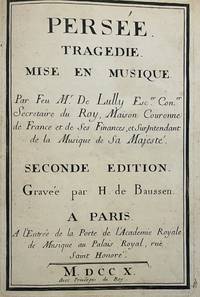
1710réf. 2811Paris: A l’Entrée de la Porte de l'Academie Royale de Musique …: Henry de Baussen 1710. The first illustrated and the first edition engraved full score of Lully’s Persée. Engraved music. Folio. In somewhat later green half maroquin. Spine and front panel gilt. Supra ex-libris: M.me Adolp. de Lanneau - Partitions. With six engravings by Scotin and Deplaces after Duplessis. Binding rubbed at the extremities. Water stain to the lower edge of the first and last leaves. Sporadic foxing pages toned due to aging. Otherwise in fine condition. The first illustrated and the first edition engraved full score of Lully’s Persée. Engraved music. Folio. In somewhat later green half maroquin. Spine and front panel gilt. Supra ex-libris: M.me Adolp. de Lanneau - Partitions. With six engravings by Scotin and Deplaces after Duplessis. 4 229 1 p. The first illustrated and the first edition engraved full score of Lully’s Persée. Full score of Lully’s tragédie en musique with Philippe Quinault libretto. The opera premiered on 7 April 1682. This is the Persée’s first engraved edition adorned with six engravings illustrating scenes from the opera the first for the prologue and one for each of the five acts. Provenance: Madame Adolphe de Lanneau wife of A. de Lanneau 1796–1881 a French school director and politician to whom George Onslow dedicated his Violin Sonata No. 6 Opus 31. RISM L 2993. A l’Entrée de la Porte de l'Academie Royale de Musique […]: [Henry de Baussen] unknown
1686réf. 92213Christophe Ballard | Paris 1686 | 19.3 x 24.9 cm | Relié
1686réf. 92213Paris: Christophe Ballard 1686. Fine. Outstanding armorial binding of Louvois minister to Louis XIV Christophe Ballard Paris 1686 19.3 x 24.9 cm Relié First edition of the opera libretto. Full red morocco binding spine with five raised bands and panels stamped with fleurs-de-lys boards framed three times in gilt stamped at center with the arms of the Marquis de Louvois and de Courtenvaux gilt roll-tooling to the edges marbled paper endpapers and pastedowns contemporary binding. A few scuffs to the lower cover binding with light spotting. Illustrated with a superb frontispiece by Berin Berain who also designed the opera's sets etched by Jean Dolivar depicting the destruction of Armide's palace by the demons at the close of the work. A superb copy of Lully's penultimate operatic tragedy sumptuously bound with the arms of his contemporary and ""colleague"" within the French court: the celebrated Marquis de Louvois who played an essential role in the circumstances surrounding the work's creation. This masterful late work of the Florentine composer would prove his last collaboration with his longtime librettist the poet Philippe Quinault: ""The opera Armide is Lulli's masterpiece and Armide's monologue is the masterpiece of this opera"" Diderot Au petit prophète de Boesmischbroda au Grand Prophète Monet 1753 This first edition of Armide composed by Lully who reigned supreme over the pleasures of the court found its place in the library of a figure equally central to this golden era of XVIIth-century France: Louvois holder of the kingdom's political and administrative power whose responsibilities notably included supervision of Lully's Académie Royale de Musique. As Thierry Sarmant recalls ""The early years of Louvois's superintendency corresponded to the last great creative years of Lully: he produced Amadis in 1684 Roland and the Idylle sur la Paix in 1685 and Armide in 1686. The subjects inspired romance rather than fable as in the earlier decades of the reign are thought to have been chosen by Louis XIV."" Les Demeures du Soleil Louis XIV Louvois et la surintendance des bâtiments du Roi. A letter from Louvois reveals that he personally presented the opera to the king: I have reported to the king on the subject of the prologue of the opera Armide which His Majesty has approved and so you may proceed with this project which I am returning to you. Letter to Philippe Quinault of the Académie française Versailles 7 January 1686 A1 761 fol. 104. He had undertaken the same presentation the previous year for the opera Roland: ""It will be noted that this approval was given about a month before the premiere of each work Roland and Armide both inspired by Tasso's La Gerusalemme liberata which suggests that the prologues were written after the five acts. One may also conclude that Quinault and Lully worked quickly to finish the words the libretto was printed before the first performances and the music of these prologues or that their work was already well advanced and that they were nearly certain their project would not be rejected."" Buford Norman. Armide came about against a backdrop of court intrigue and above all amid a scandal of morals that struck the Surintendant de la Musique and concerned Louvois directly. One of Lully's young pages presented as his lover had been arrested a year earlier by men placed under Louvois's authority. This notorious Brunet affair was nonetheless covered up by the minister himself since his own cousin was involved and shared the great Lully's preferences. Louis XIV distanced himself from his composer despite having personally chosen the subject of Armide. When the opera premiered on 15 February 1686 on the stage of the Académie Royale de Musique at the Palais-Royal the monarch was not present. The Grand Dauphin attended the performance conducted by Colasse with sets by Bérain who also designed the frontispiece of this libretto. Whether Louvois was among the audience remains Christophe Ballard hardcover