Philippe De Lombaerde; Fredrik SoderbaumBiblio.com

42.291 risultati
2013rif. Atlantic-9781446257180Sage Publications 2013. Hardcover. New. Sage Publications hardcover
1991rif. 93137Difference. New. 1991. Paperback. 2729106901 . FREE UPGRADE to Courier/Priority Shipping Upon Request - IN STOCK AND IMMEDIATELY AVAILABLE FOR SHIPMENT - Flawless copy brand new pristine never opened --VOLUME 1 OF A TWO 2 VOLUME SET. Text in French. Volume 1: 120 pages. Catalogue Raisonne Catalog Raisonné Complete Works La Vie et L'uvre Oeuvre Raisonnee -- with a bonus offer . Difference paperback
1991rif. 93136Difference. New. 1991. Paperback. 272910691X . FREE UPGRADE to Courier/Priority Shipping Upon Request - IN STOCK AND IMMEDIATELY AVAILABLE FOR SHIPMENT - Flawless copy brand new pristine never opened --VOLUME 2 OF A TWO 2 VOLUME SET. Text in French. Volume 2: 175 pages. Catalogue Raisonne Catalog Raisonné Complete Works La Vie et L'uvre Oeuvre Raisonnee -- with a bonus offer . Difference paperback
1998rif. 20-11739The Metropolitan Museum of Art 1998-01-01. Paperback. New. In shrink wrap. The Metropolitan Museum of Art paperback
rif. 207617Paris, Firmin Didot Frères, 1854-1860 19 vol. in-8, important index (tout le T. XIX), demi-chagrin maroquiné bleu nuit, dos lisse, filets dorés (Babin).
rif. 209065Paris, Firmin Didot Frères, 1854-1860 19 vol. in-8, env. 470 pp. par vol., important index (tout le T. XIX), demi-vélin crème, dos lisses ornés, filets dorés, pièces de titre et de tomaison (rel. de l'époque). Qqs rousseurs. Bon exemplaire.
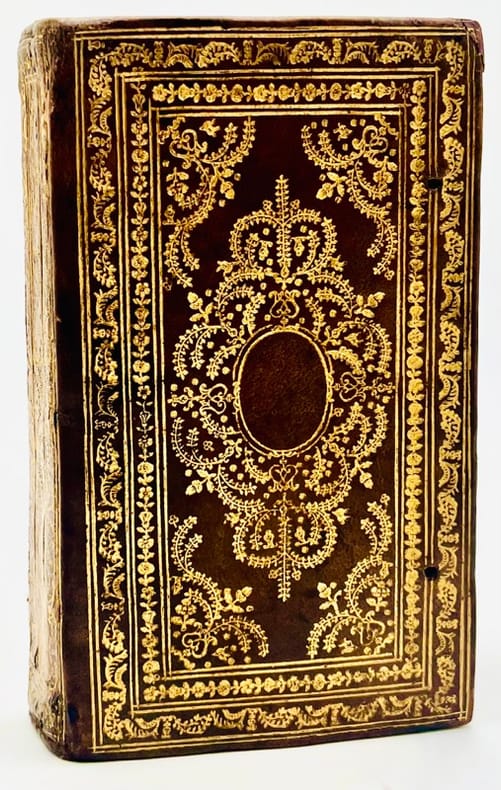
1603rif. 43271(Paris), Abel L'Angelier, sans date, (1603-1604). 2 parties en 1 vol. in-12 réglé de (2) ff. dont titre-frontispice, 187 ff. (saut de pagination 1-132/233-287) (8) ff. de table, (1) f. bl., 23 ff. dont titre, (1) f. bl., 17 ff., (1) f. de table, maroquin fauve entièrement décoré à petits fers, dos lisse orné de caissons en long décor de feuillages et rinceaux dorés, double frise d'encadrement et décor de feuillages et rinceaux dorés sur les plats, grand fleuron central avec ovale en réserve, tranches dorées, traces de lacets (reliure de l'époque).
1918rif. 22783Paris, Librairie de Victor Lecoffre, J. Gabalda, éditeur, 1918 ; in-12, veau vert pâle cuir repoussé, premier plat à grand décor symboliste dans des tons de vieux rose, ocre pâle et bistre en forme de losange art-nouveau, au pied duquel ont poussé quatre épis de blé, une banderole qui ondule, portant la devise "Fructibus eorum cognoscetis eos" ("Vous les reconnaîtrez à leurs fruits"), phrase célèbre tirée de l'Evangile selon Saint-Matthieu 7.20. (reliure signée de Jeanne Dangon) ; 238 pp. et [1] f. de table.
1844rif. 87756Paris, 1844-1892, in-8, 24 plaquettes, couvertures conservées, Demi-chagrin rouge de l'époque, dos à nerfs et fleuronné, monogramme G.M. en pied du dos [Galien Mingaud], Joli recueil d'opuscules divers publiés par le pharmacien et naturaliste du Gard Philippe Mingaud (1819-1904), réunis et reliés vers 1893-1894, à l'intention de son fils Galien-Philippe Mingaud (1854-1912). L'ouvrage ouvre sur l'ex-dono manuscrit du père, signé à Paris et daté du 20 mai 1893 : "Ce volume est réservé à mon fils Galien. Souvenir affectueux de son père". Plusieurs portraits photographiques de l'auteur en médaillon apparaissent dans le recueil : au début de l'ouvrage, un cliché au format carte de visite [58 x 98 mm] représente Mingaud à l'âge de 75 ans ; sur un autre cliché, plus petit [20 x 30 mm], qui apparait à plusieurs reprises, il a à peu près le même âge ; un troisième cliché [55 x 65 mm] le représente cette fois-ci plus jeune, âgé de 46 ans. Quelques pièces portent le cachet de l'auteur (Mingaud. Conférencier scientifique. Paris) et certaines sont enrichies de notes manuscrites. Philippe Mingaud, pharmacien de première classe de l'École supérieure de Montpellier, fonda en 1844 une pharmacie normale et un cabinet d'histoire naturelle à Saint-Jean-du-Gard, dans les Cévennes. Dans les alentours, il fit la découverte d'importantes mines métallifères de gisements minéraux. Il s'installa à Paris en 1858 et fit don de sa collection au musée de Nîmes. Son fils, Galien-Philippe, s'occupa de minéralogie à ses côtés. Les pièces du présent recueil comprennent les travaux de Mingaud parus entre 1844 et les années 1880, ainsi que des recensions sur ses travaux. Elles ont été reliées dans l'ordre suivant : ? Travaux de Mingaud entre 1844 et 1865 : Grand établissement pour la fabrication des eaux minérales artificielles de Mingaud fils, chimiste à Saint Jean-du-Gard. Alais, Veirun, (s.d.) 8 pp. Synthèses chimiques et pharmaceutiques, présentées et publiquement soutenues devant l'École spéciale de Montpellier le 27 et 28 août 1844. Montpellier, Boehm. 16 pp. Examen d'un minerai qui présente tous les caractères de l'allophane (silicides). Paris, imprimerie de W. Remquet, 1859. 11 pp. Plaquette enrichie du petit portrait photographique de l'auteur [20 x 30 mm] contrecollé sur la couverture et d'un papillon comportant une note manuscrite signée de l'auteur, collé sur la dernière page : "Nota. Je suis très heureux d'avoir pu accomplir le voeu que j'avais exprimé en 1844. Mingaud, âge de 84 ans. Nîmes le 7 juillet 1903". Mémoire sur la fondation d'une pharmacie normale. Paris, Martinet, 1859. 29 pp. Plaquette enrichie du petit portrait photographique. De l'erinus alpinus. Érine pourprée des Alpes de la famille des Personnées de Jussieu. Histoire topographique de son habitat constaté. Paris, Gaittet, 1861. 19 pp. Herbier du bassin de Saint-Jean-du-Gard, précédé de quelques réflexions sur la vie de l'auteur. Paris, Dubuisson, 1863. 22 pp. Plaquette enrichie du petit portrait photographique. Explorations géologiques faites avec Marcel de Serres. Coup d'oeil rapide sur les terrains qui constituent le sol du bassin de Saint-Jean-du-Gard et des principaux gisements métallifères qu'on y rencontre. Paris, Dubuisson, 1863. 36 pp. Plaquette enrichie du petit portrait photographique. De l'erinus alpinus. Érine pourprée des Alpes de la famille des Personnées de J. Histoire topographique de son habitat constaté. Paris, Dubuisson, 1863. 12 pp. Seconde édition. Papillon manuscrit (p. 9). De l'arbousier. De la propagation de sa culture et des produits économiques qui en résultent considérés au point de vue de l'alimentation en général. Paris, Dubuisson, 1863. Front, 24 pp. Plaquette enrichie du petit portrait photographique. De l'arbousier. De la propagation de sa culture et des produits économiques qui en résultent considérés au point de vue de Couverture rigide
1598rif. 10688A La Rochelle, Par Hierosme Haultin, 1598. 1 vol. in-8 de 91-(2)-956 pp., vélin souple à rabats (reliure de l'époque).
1581rif. 42253S.l. [Genève], chez Jean Durant, 1581. In-8 de 248 pp. (A-P8 Q4), veau gris, dos orné à nerfs, triple filet doré sur les plats, tranches rouges (Galette).
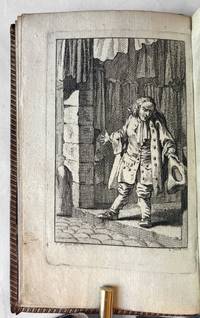
1746rif. 4391The Hague i.e. Paris: s.n. 1746. 8vo 168 x 101 mm. 2 parts separately titled and paginated: 3-vi-xxiv 182 pages 1 blank leaf; 2 leaves 128 pages. Engraved frontispiece by Fessard after Cochin fils apparently included in the pagination typographic title ornaments head- and tailpieces. An attractive copy stain to fols. A2-3 in second part 2 or 3 minor marginal tears some spotting. Contemporary red morocco triple gilt fillet on sides smooth spine sparingly gold-tooled and lettered board edges gilt gilt edges scuffing to lower board edges and extremities of spine corners a bit bumped. Provenance: early purchase note on lower flyleaf; John Wodehouse 3rd Earl of Kimberley 1883-1941 bookplate; Leonard Forrer 1869-1953 his bookshop ticket of L. S. Forrer Ltd. Numismatic Booksellers London; Charles Van der Elst 1904-1982 bookplate. Only Edition of an extended literary joke by the brilliant antiquarian engraver art patron and connoisseur the Comte de Caylus. He exercised his stylistic muscles in this peculiar collection of two dozen literary pieces revolving around the word manteau: in part 1 racy anecdotes short stories fairy tales and a chivalric tale written in pseudo-archaic French; and in part 2 tongue-in-cheek erudite essays in several styles — the religious history the antiquarian disquisition the etymological or bibliographical analysis — all laced with fictional and a few real references including imaginary medieval manuscripts. A glance at the entry for manteau in the online Trésor de la Langue Française gives an idea of the semantic opportunities offered by this word whose appearances in many idiomatic expressions are exhaustively exploited by Caylus. In part 1 appear the manteau de fourrure fur coat the manteau de lit a short bed-jacket into which a jealous husband is metamorphosed by his fairy mother-in-law to teach him a lesson the long and short coat the chimney mantel same word in French and a portrait of a remarkable old man presented as the fictional originator of the term “sous le manteau” clandestine or clandestinely. In part 2 which its title notes with a wink “one doesn’t need to read” the author delves into the Roman pallium a cloak the coats of saints and clerics those both heraldic and actual of Dukes and Peers and the order of the Blancs-Manteaux. Completing the picture are a florilegium of dictionary extracts and a satirical etymological comparison of the French manteau with other languages containing sentences like: “As for the letter L which is found at the end of words like Mantel and Mantello one can very well understand it to be a diminutive of the Arabic word Allah meaning God” p. 103. The self-imposition of arbitrary constraints onto one’s writing while an ancient practice viz. poetic meter have been associated more recently with a French literary movement from the 1960s known as Oulipo short for Ouvroir de littérature potentielle ”workship of potential literature” which included the great French authors Raymond Queneau and Georges Perec whose wry humor and doggedness in pursuing the conceit to the end Caylus foreshadowed. Cochin’s frontispiece shows a rather shifty-looking merchant in the doorway of his shop filled with coats. OCLC locates 4 copies in North American libraries. Cohen-De Ricci 210; Gay-Lemonnyer 3:23; Barbier III: 34 a 1775 edition not seen elsewhere. s.n. unknown
1746rif. 4391The Hague i.e. Paris: s.n. 1746. 8vo 168 x 101 mm. 2 parts separately titled and paginated: 3-vi-xxiv 182 pages 1 blank leaf; 2 leaves 128 pages. Engraved frontispiece by Fessard after Cochin fils apparently included in the pagination typographic title ornaments head- and tailpieces. An attractive copy stain to fols. A2-3 in second part 2 or 3 minor marginal tears some spotting. Contemporary red morocco triple gilt fillet on sides smooth spine sparingly gold-tooled and lettered board edges gilt gilt edges scuffing to lower board edges and extremities of spine corners a bit bumped. Provenance: early purchase note on lower flyleaf; John Wodehouse 3rd Earl of Kimberley 1883-1941 bookplate; Leonard Forrer 1869-1953 his bookshop ticket of L. S. Forrer Ltd. Numismatic Booksellers London; Charles Van der Elst 1904-1982 bookplate. Only Edition of an extended literary joke by the brilliant antiquarian engraver art patron and connoisseur the Comte de Caylus. He exercised his stylistic muscles in this peculiar collection of two dozen literary pieces revolving around the word manteau: in part 1 racy anecdotes short stories fairy tales and a chivalric tale written in pseudo-archaic French; and in part 2 tongue-in-cheek erudite essays in several styles — the religious history the antiquarian disquisition the etymological or bibliographical analysis — all laced with fictional and a few real references including imaginary medieval manuscripts. A glance at the entry for manteau in the online Trésor de la Langue Française gives an idea of the semantic opportunities offered by this word whose appearances in many idiomatic expressions are exhaustively exploited by Caylus. In part 1 appear the manteau de fourrure fur coat the manteau de lit a short bed-jacket into which a jealous husband is metamorphosed by his fairy mother-in-law to teach him a lesson the long and short coat the chimney mantel same word in French and a portrait of a remarkable old man presented as the fictional originator of the term “sous le manteau” clandestine or clandestinely. In part 2 which its title notes with a wink “one doesn’t need to read” the author delves into the Roman pallium a cloak the coats of saints and clerics those both heraldic and actual of Dukes and Peers and the order of the Blancs-Manteaux. Completing the picture are a florilegium of dictionary extracts and a satirical etymological comparison of the French manteau with other languages containing sentences like: “As for the letter L which is found at the end of words like Mantel and Mantello one can very well understand it to be a diminutive of the Arabic word Allah meaning God” p. 103. The self-imposition of arbitrary constraints onto one’s writing while an ancient practice viz. poetic meter have been associated more recently with a French literary movement from the 1960s known as Oulipo short for Ouvroir de littérature potentielle ”workship of potential literature” which included the great French authors Raymond Queneau and Georges Perec whose wry humor and doggedness in pursuing the conceit to the end Caylus foreshadowed. Cochin’s frontispiece shows a rather shifty-looking merchant in the doorway of his shop filled with coats. OCLC locates 4 copies in North American libraries. Cohen-De Ricci 210; Gay-Lemonnyer 3:23; Barbier III: 34 a 1775 edition not seen elsewhere. s.n. unknown books
rif. 164616 p.l. 398 pp.; 27 pp. Two parts in one vol. 8vo cont. calf extremities a little rubbed contrasting leather lettering piece on spine. Rouen: A. Maurry for L. Billaine 1678. Third edition 1st ed.: 1664 “of the earliest extant bibliography of bibliographies. It is basically an alphabetical list arranged by authors’ first names followed by eight intricate subject indices among them one of publishers’ and booksellers’ catalogues. Appended is a very useful numismatic bibliography. The work enjoyed three later editions during the seventeenth century and provided the basis for Teissier. Labbé 1607-67 one of the most learned polymaths of his time was a Jesuit professor of philosophy in Paris.”–Grolier Club Bibliography 62–1st ed. The work attributed to John Selden on the title-page is actually by Alessandro Sardi 1520-88 and first appeared in 1579. There is also included a substantial bibliography on weights and measures. Haebler in his Handbuch states that this is the second book on incunabula and the first in which the word is used in connection with printing. A fine copy with some minor foxing. ⧠Taylor Book Catalogues pp. 176 208 & 219-20. unknown
rif. 164616 p.l. 398 pp.; 27 pp. Two parts in one vol. 8vo cont. calf extremities a little rubbed contrasting leather lettering piece on spine. Rouen: A. Maurry for L. Billaine 1678. Third edition 1st ed.: 1664 “of the earliest extant bibliography of bibliographies. It is basically an alphabetical list arranged by authors’ first names followed by eight intricate subject indices among them one of publishers’ and booksellers’ catalogues. Appended is a very useful numismatic bibliography. The work enjoyed three later editions during the seventeenth century and provided the basis for Teissier. Labbé 1607-67 one of the most learned polymaths of his time was a Jesuit professor of philosophy in Paris.”–Grolier Club Bibliography 62–1st ed. The work attributed to John Selden on the title-page is actually by Alessandro Sardi 1520-88 and first appeared in 1579. There is also included a substantial bibliography on weights and measures. Haebler in his Handbuch states that this is the second book on incunabula and the first in which the word is used in connection with printing. A fine copy with some minor foxing. ⧠Taylor Book Catalogues pp. 176 208 & 219-20. unknown books
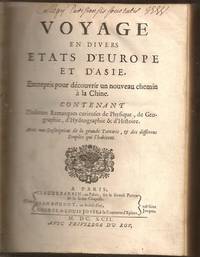
1692rif. E0527titlepictorial platexviifolding map406xxiv pages with engraved initials and vignettes and three additional plates and index. Royal octavo 9 3/4" x 7 1/2" bound in full leather with five raised bands and lettering in gilt and decorative vignettes. First edition. Philippe Avril was a Jesuit explorer of the Far East and professor of philosophy and mathematics at Paris when he was dispatched to the Jesuit missions of China. He was summoned by the Jesuit missions and sent as a Jesuit to the missions in China. Following the instructions of Ferdinand Verbiest another Jesuit then at Peking suggested that he attempted an overland journey which he ended up traveling for six years through Kurdistan Armenia Astrakhan Persia and other countries of eastern Asia arriving at Moscow. He now traveled to Grodno in Poland where he renewed an acquaintance with Count de Syri who had formerly befriended him at Astrakham. The count at the suggestion of Avril applied ot the French government for the appointment of ambassador from the King of France to the Emperor of China. He succeed in obtaining the appointment and it was arranged that Avril should accompany him. They set out to Moscow together. An accident detained Avril and the count arrived at Moscow days before his companion. On the arrival of Avril he received the intelligence that the Russian authorities and compelled the count to proceed and was refused permission to over take him. Avril proceeded to Warsaw and through the assistance of Prince Jablonowksi to reach Constantinople by way of Moldavia. Here he was seized with spitting of blood and he found himself compelled to relinquish his mission and returned to France. He landed at Toulon in 1690 and published an account of his travels. Avril's journal and writings provide a significant amount of useful material for modern historians and demographers. Condition: Corners bumped and rubbed lacking 3E4 blank leaf between the end of the main text and start of the Table de Metiers occasional toning ink inscription to title spine ends and raised spine rubbed some spotting to leather else a good to very good copy. Claude Barbin, Jean Boudot, George & Louis Josse hardcover
1692rif. E0527titlepictorial platexviifolding map406xxiv pages with engraved initials and vignettes and three additional plates and index. Royal octavo 9 3/4" x 7 1/2" bound in full leather with five raised bands and lettering in gilt and decorative vignettes. First edition. Philippe Avril was a Jesuit explorer of the Far East and professor of philosophy and mathematics at Paris when he was dispatched to the Jesuit missions of China. He was summoned by the Jesuit missions and sent as a Jesuit to the missions in China. Following the instructions of Ferdinand Verbiest another Jesuit then at Peking suggested that he attempted an overland journey which he ended up traveling for six years through Kurdistan Armenia Astrakhan Persia and other countries of eastern Asia arriving at Moscow. He now traveled to Grodno in Poland where he renewed an acquaintance with Count de Syri who had formerly befriended him at Astrakham. The count at the suggestion of Avril applied ot the French government for the appointment of ambassador from the King of France to the Emperor of China. He succeed in obtaining the appointment and it was arranged that Avril should accompany him. They set out to Moscow together. An accident detained Avril and the count arrived at Moscow days before his companion. On the arrival of Avril he received the intelligence that the Russian authorities and compelled the count to proceed and was refused permission to over take him. Avril proceeded to Warsaw and through the assistance of Prince Jablonowksi to reach Constantinople by way of Moldavia. Here he was seized with spitting of blood and he found himself compelled to relinquish his mission and returned to France. He landed at Toulon in 1690 and published an account of his travels. Avril's journal and writings provide a significant amount of useful material for modern historians and demographers. Condition: Corners bumped and rubbed lacking 3E4 blank leaf between the end of the main text and start of the Table de Metiers occasional toning ink inscription to title spine ends and raised spine rubbed some spotting to leather else a good to very good copy. Claude Barbin, Jean Boudot, George & Louis Josse hardcover books
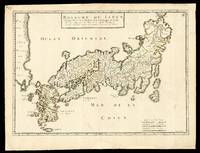
1658rif. 15988Paris: Chez Pierre Mariette rue S.t Iacques a l'Esperance 1658. 457 by 572mm. 18 by 22.5 inches. Hand-coloured engraved map. The second state of the plate published separately and extensively corrected with the addition of: the four cardinal points added midway along the graticule scale around the map; 'ou Saycock a io 10 Roy.mes' and'ou Tokoesi a 4. R.'; and additional titles for the 'kingdoms' throughout the map. Hubbard points out that this is "an enormous number of corrections for the engraver Somer to make" although many other errors remain. Briet 1601-1668 came from the same town Abbeville as Nicolas Sanson I and examples of this map have been found in composite atlases largely made up of maps by Sanson. Sanson and Mariette who published this map also had a business relationship that eventually ended badly. The engraver Jan van Somer worked for Sanson in Paris. A Jesuit from 1619 Briet was also a teacher of humanities and rhetoric. He wrote literature as well as history and historical geography. He published his 'Paralella Geographica' in 1648 and 1649 with 144 maps of Europe. He had intended further volumes of maps of the other continents but only managed a manuscript for the Asia volume which was never published. Many of the maps from the original work were republished in his 'Theatre Geographique de L'Europe' and 'Theatrum Geographicum Europae Veteris' in 1653. Hubbard 31.2. Chez Pierre Mariette, rue S.t Iacques a l'Esperance, unknown
1921rif. 2416Bruxelles 1921. Original illustrated paper. In fine condition. Original illustrated paper. 4 p. First edition of this score edition of which is 500 copies. Poem by Philippe Soupault and music by E.L.T. Feel. The cover was designed by Man Ray. unknown
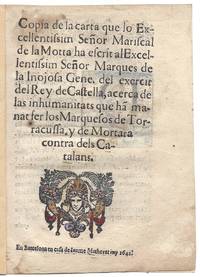
1642rif. 2051En Barcelona: en casa de Iaume Methevat Jaime Matevad 1642. First edition. With a woodcut device on title page and a large woodcut initial both colored by a later hand and typographic head and tailpieces. In later marbled paper. Light brown stains throughout paper tanned otherwise in fine condition. First edition. With a woodcut device on title page and a large woodcut initial both colored by a later hand and typographic head and tailpieces. In later marbled paper. 4 p. Extremely rare document related to the early episodes of the Catalan Revolt. Written by Philippe de La Mothe-Houdancourt 1605–1657 French soldier and Marshal of France who was serving as the French Viceroy of Catalonia during the Reaper’s War or Catalan Revolt 1640–1659 to the parallel Spanish Viceroy of Catalan Juan Ramirez de Arellano y Manrique de Lara 1606-1643 the Marquis of Hinojosa to complain about the inhumanities that the Catalans suffer. Scarce IB locates only 3 copies in libraries Biblioteca de Catalunya Barcelona; Biblioteca Nacional de Portugal Lisbon; Biblioteca-Museo Víctor Balaguer; Villanueva y Geltrú / Vilanova i la Geltrú. IB B68429; Palau 61205 . en casa de Iaume Methevat [Jaime Matevad] unknown
1978rif. 91955n. l.: s. n. 1978. Fine. s. n. n. l. 1978 18.7 x 19.8 cm En feuilles sous chemise et étui First edition one of 30 numbered copies printed on handmade pure rag paper.Illustrated with original colour engravings by Ania Staritsky who also designed the original layout of the work with the collaboration of Claude Nardin.A rare and very fine copy complete with its chemise and brown cloth slipcase.Pencil signatures of Philippe Jones and Ania Staritsky at the colophon.Inscribed by Philippe Jones to Claude Nardin at the colophon.Our copy is enriched with a five-line autograph manuscript text by Philippe Jones as well as an original collage by Ania Staritsky signed by her. s. n. hardcover
1769rif. 10715Paris: P. Vente 1769. Contemporary gilt-ruled polished tan calf rubbed flat spine gilt à la grotesque with a gilt-lettered morocco label red edges blue silk marker. A talented sculptor and frame-maker Cayeux 1688-1769 collected for six decades: “his cabinet was renowned for its examples of ‘our talented modern artists’” like Boucher van Loo and Cochin Bailey. Many lots have eighty or more drawings or prints. One copy in the U.S. In good condition contemporary title inscription On behalf of your most humble servant Cayeux tr. — penned by the deceased collector’s son Louis-Philippe d. 1776. ¶Bailey Patriotic Taste: Collecting Modern Art in Pre-Revolutionary Paris 21-22; Advielle Notice sur Philippe Cayeux passim; Lugt Répertoire des catalogues des ventes 1793. P. Vente unknown
rif. 51-7411Paris: Librairie de la Collection des dix A. Romagnol directeur Paris 1910. Large 4to 23 x 31 x 6 cm. Original wraps and marbled board chemise and slipcase.One of 120 copies with 3 suites of the etchings and a portfolio of 8 etchings not used in the book = 128 plates.Édition illustrée de 48 eaux-fortes par Lobel-Riche dont 21 hors-texte dont un portrait frontispice de l'auteur 20 en-têtes et 7 culs-de-lampe.Tirage à 300 exemplaires. Un des 120 exemplaires sur japon ou vélin celui-ci n° 108 sur japon avec une triple suite des illustrations.Bel exemplaire enrichi d'une suite de 8 planches non mises dans le commerce en triple état.Petites rousseurs au dos et fentes en pied. .OCLC Number / Unique Identifier: 1377723012; Luc Monod Manuel de l'amateur no. 946; Gordon Ray The Art of the French Illustrated Book no. 318. Paris: Librairie de la Collection des dix, A. Romagnol, directeur, Paris, 1910 paperback
rif. 51-6051Paris: HENRI CHARPENTIER IMPRIMEUR-EDITEUR M. DCCC. LXI. 1861. Folio. 33 x 49cm. 3 vols. Original publisher's gilt half blonde shagreen binding restored. Gilt coat of arms of Paris on covers. 100 tinted lithograph plates and a plan of Paris.Very good.OCLC Number / Unique Identifier: 4401208.illustré de 100 planches lithographiées dont 1 plan de Paris par MM. Philippe Benoist Bachelier Félix Benoist Chapuy Eug. Cicéri. et de nombreuses vignettes par Félix Benoist et Catenacci. Reliure de l'éditeur demi-chagrin dos et plats ornés des armes de la ville de Paris tranche sup. dorée Quelques rares claires rousseurs bon exemplaire.PAR MM. PHILIPPE BENOIST POUR LE PLUS GRAND NOMBRE ET AVEC L'AIDE DE LA PHOTOGRAPHIE; JULES ARNOUT BACHELIER A. BAYOT FÉLIX BENOIST CHAPUY EUGÈNE CICERI HUBERT CLERGET JULES DAVID FICHOT JULES GAILDRAU GUÉRARD J. JACOTTET GUSTAVE JANET HIPPOLYTE LALAISSE AUG. MATHIEU SABATIER ETC. .VIGNETTES DE FELIX BENOIST ET CATENACCI EXÉCUTÉES SUR BOIS PAR LES PREMIERS GRAVEURS. HEAVY VOLUMES. Paris: HENRI CHARPENTIER, IMPRIMEUR-EDITEUR, M. DCCC. LXI. 1861 unknown
1685rif. 743Lyon: Jean Girin & Barthélemy Rivière 1685. First edition. A landmark in the cultural and scientific history of coffee tea and chocolate — the three “new beverages” of early modern Europe. Written by Philippe Sylvestre Dufour 1622–1687 a Lyon apothecary physician and merchant this 1685 first edition is among the earliest treatises devoted to the preparation medicinal properties and social virtues of these drinks. Dufour discusses the origin of coffee in the Ottoman Empire tea in China and cacao in the Americas blending pharmacological observation with moral reflection on their consumption. The work marks an important moment in the spread of global trade and early modern dietary theory illustrating how exotic imports became staples of European life and medicine. Illustrated with three full-page engravings and an engraved frontispiece including a striking depiction of an Ottoman coffee drinker a Chinese tea ceremony and a native American holding a chocolate vessel. These plates helped define the visual iconography of coffee and chocolate in the 17th century. Dufour’s Traitez became the foundational French-language reference on these drinks influencing subsequent European authors. This copy shows early marginal notes and the presence of all plates noted for the true first edition confirming its completeness and authenticity. Condition & Binding: Contemporary full mottled calf spine gilt in compartments with floral ornaments and gilt title “TRAITÉ DU CAFÉ.” Light rubbing and edge wear; some cracking along joints but binding remains solid and entirely original. Mild staining and toning to a few leaves; scattered foxing consistent with age. Engravings crisp and well-inked showing excellent impression quality. Early manuscript notes on title and endpaper likely from an 18th-century hand. Overall- good. Jean Girin & Barthélemy Rivière unknown